
Add SSH environment support (#4358)
## Thinking Path
> - Paperclip orchestrates AI agents for zero-human companies
> - The environments subsystem already models execution environments,
but before this branch there was no end-to-end SSH-backed runtime path
for agents to actually run work against a remote box
> - That meant agents could be configured around environment concepts
without a reliable way to execute adapter sessions remotely, sync
workspace state, and preserve run context across supported adapters
> - We also need environment selection to participate in normal
Paperclip control-plane behavior: agent defaults, project/issue
selection, route validation, and environment probing
> - Because this capability is still experimental, the UI surface should
be easy to hide and easy to remove later without undoing the underlying
implementation
> - This pull request adds SSH environment execution support across the
runtime, adapters, routes, schema, and tests, then puts the visible
environment-management UI behind an experimental flag
> - The benefit is that we can validate real SSH-backed agent execution
now while keeping the user-facing controls safely gated until the
feature is ready to come out of experimentation
## What Changed
- Added SSH-backed execution target support in the shared adapter
runtime, including remote workspace preparation, skill/runtime asset
sync, remote session handling, and workspace restore behavior after
runs.
- Added SSH execution coverage for supported local adapters, plus remote
execution tests across Claude, Codex, Cursor, Gemini, OpenCode, and Pi.
- Added environment selection and environment-management backend support
needed for SSH execution, including route/service work, validation,
probing, and agent default environment persistence.
- Added CLI support for SSH environment lab verification and updated
related docs/tests.
- Added the `enableEnvironments` experimental flag and gated the
environment UI behind it on company settings, agent configuration, and
project configuration surfaces.
## Verification
- `pnpm exec vitest run
packages/adapters/claude-local/src/server/execute.remote.test.ts
packages/adapters/cursor-local/src/server/execute.remote.test.ts
packages/adapters/gemini-local/src/server/execute.remote.test.ts
packages/adapters/opencode-local/src/server/execute.remote.test.ts
packages/adapters/pi-local/src/server/execute.remote.test.ts`
- `pnpm exec vitest run server/src/__tests__/environment-routes.test.ts`
- `pnpm exec vitest run
server/src/__tests__/instance-settings-routes.test.ts`
- `pnpm exec vitest run ui/src/lib/new-agent-hire-payload.test.ts
ui/src/lib/new-agent-runtime-config.test.ts`
- `pnpm -r typecheck`
- `pnpm build`
- Manual verification on a branch-local dev server:
- enabled the experimental flag
- created an SSH environment
- created a Linux Claude agent using that environment
- confirmed a run executed on the Linux box and synced workspace changes
back
## Risks
- Medium: this touches runtime execution flow across multiple adapters,
so regressions would likely show up in remote session setup, workspace
sync, or environment selection precedence.
- The UI flag reduces exposure, but the underlying runtime and route
changes are still substantial and rely on migration correctness.
- The change set is broad across adapters, control-plane services,
migrations, and UI gating, so review should pay close attention to
environment-selection precedence and remote workspace lifecycle
behavior.
## Model Used
- OpenAI Codex via Paperclip's local Codex adapter, GPT-5-class coding
model with tool use and code execution in the local repo workspace. The
local adapter does not surface a more specific public model version
string in this branch workflow.
## Checklist
- [x] I have included a thinking path that traces from project context
to this change
- [x] I have specified the model used (with version and capability
details)
- [x] I have checked ROADMAP.md and confirmed this PR does not duplicate
planned core work
- [x] I have run tests locally and they pass
- [x] I have added or updated tests where applicable
- [ ] If this change affects the UI, I have included before/after
screenshots
- [x] I have updated relevant documentation to reflect my changes
- [x] I have considered and documented any risks above
- [x] I will address all Greptile and reviewer comments before
requesting merge
2026-04-23 19:15:22 -07:00
|
|
|
import { z } from "zod";
|
Add sandbox environment support (#4415)
## Thinking Path
> - Paperclip orchestrates AI agents for zero-human companies.
> - The environment/runtime layer decides where agent work executes and
how the control plane reaches those runtimes.
> - Today Paperclip can run locally and over SSH, but sandboxed
execution needs a first-class environment model instead of one-off
adapter behavior.
> - We also want sandbox providers to be pluggable so the core does not
hardcode every provider implementation.
> - This branch adds the Sandbox environment path, the provider
contract, and a deterministic fake provider plugin.
> - That required synchronized changes across shared contracts, plugin
SDK surfaces, server runtime orchestration, and the UI
environment/workspace flows.
> - The result is that sandbox execution becomes a core control-plane
capability while keeping provider implementations extensible and
testable.
## What Changed
- Added sandbox runtime support to the environment execution path,
including runtime URL discovery, sandbox execution targeting,
orchestration, and heartbeat integration.
- Added plugin-provider support for sandbox environments so providers
can be supplied via plugins instead of hardcoded server logic.
- Added the fake sandbox provider plugin with deterministic behavior
suitable for local and automated testing.
- Updated shared types, validators, plugin protocol definitions, and SDK
helpers to carry sandbox provider and workspace-runtime contracts across
package boundaries.
- Updated server routes and services so companies can create sandbox
environments, select them for work, and execute work through the sandbox
runtime path.
- Updated the UI environment and workspace surfaces to expose sandbox
environment configuration and selection.
- Added test coverage for sandbox runtime behavior, provider seams,
environment route guards, orchestration, and the fake provider plugin.
## Verification
- Ran locally before the final fixture-only scrub:
- `pnpm -r typecheck`
- `pnpm test:run`
- `pnpm build`
- Ran locally after the final scrub amend:
- `pnpm vitest run server/src/__tests__/runtime-api.test.ts`
- Reviewer spot checks:
- create a sandbox environment backed by the fake provider plugin
- run work through that environment
- confirm sandbox provider execution does not inherit host secrets
implicitly
## Risks
- This touches shared contracts, plugin SDK plumbing, server runtime
orchestration, and UI environment/workspace flows, so regressions would
likely show up as cross-layer mismatches rather than isolated type
errors.
- Runtime URL discovery and sandbox callback selection are sensitive to
host/bind configuration; if that logic is wrong, sandbox-backed
callbacks may fail even when execution succeeds.
- The fake provider plugin is intentionally deterministic and
test-oriented; future providers may expose capability gaps that this
branch does not yet cover.
## Model Used
- OpenAI Codex coding agent on a GPT-5-class backend in the
Paperclip/Codex harness. Exact backend model ID is not exposed
in-session. Tool-assisted workflow with shell execution, file editing,
git history inspection, and local test execution.
## Checklist
- [x] I have included a thinking path that traces from project context
to this change
- [x] I have specified the model used (with version and capability
details)
- [x] I have checked ROADMAP.md and confirmed this PR does not duplicate
planned core work
- [x] I have run tests locally and they pass
- [x] I have added or updated tests where applicable
- [ ] If this change affects the UI, I have included before/after
screenshots
- [x] I have updated relevant documentation to reflect my changes
- [x] I have considered and documented any risks above
- [x] I will address all Greptile and reviewer comments before
requesting merge
2026-04-24 12:15:53 -07:00
|
|
|
import { randomUUID } from "node:crypto";
|
Add SSH environment support (#4358)
## Thinking Path
> - Paperclip orchestrates AI agents for zero-human companies
> - The environments subsystem already models execution environments,
but before this branch there was no end-to-end SSH-backed runtime path
for agents to actually run work against a remote box
> - That meant agents could be configured around environment concepts
without a reliable way to execute adapter sessions remotely, sync
workspace state, and preserve run context across supported adapters
> - We also need environment selection to participate in normal
Paperclip control-plane behavior: agent defaults, project/issue
selection, route validation, and environment probing
> - Because this capability is still experimental, the UI surface should
be easy to hide and easy to remove later without undoing the underlying
implementation
> - This pull request adds SSH environment execution support across the
runtime, adapters, routes, schema, and tests, then puts the visible
environment-management UI behind an experimental flag
> - The benefit is that we can validate real SSH-backed agent execution
now while keeping the user-facing controls safely gated until the
feature is ready to come out of experimentation
## What Changed
- Added SSH-backed execution target support in the shared adapter
runtime, including remote workspace preparation, skill/runtime asset
sync, remote session handling, and workspace restore behavior after
runs.
- Added SSH execution coverage for supported local adapters, plus remote
execution tests across Claude, Codex, Cursor, Gemini, OpenCode, and Pi.
- Added environment selection and environment-management backend support
needed for SSH execution, including route/service work, validation,
probing, and agent default environment persistence.
- Added CLI support for SSH environment lab verification and updated
related docs/tests.
- Added the `enableEnvironments` experimental flag and gated the
environment UI behind it on company settings, agent configuration, and
project configuration surfaces.
## Verification
- `pnpm exec vitest run
packages/adapters/claude-local/src/server/execute.remote.test.ts
packages/adapters/cursor-local/src/server/execute.remote.test.ts
packages/adapters/gemini-local/src/server/execute.remote.test.ts
packages/adapters/opencode-local/src/server/execute.remote.test.ts
packages/adapters/pi-local/src/server/execute.remote.test.ts`
- `pnpm exec vitest run server/src/__tests__/environment-routes.test.ts`
- `pnpm exec vitest run
server/src/__tests__/instance-settings-routes.test.ts`
- `pnpm exec vitest run ui/src/lib/new-agent-hire-payload.test.ts
ui/src/lib/new-agent-runtime-config.test.ts`
- `pnpm -r typecheck`
- `pnpm build`
- Manual verification on a branch-local dev server:
- enabled the experimental flag
- created an SSH environment
- created a Linux Claude agent using that environment
- confirmed a run executed on the Linux box and synced workspace changes
back
## Risks
- Medium: this touches runtime execution flow across multiple adapters,
so regressions would likely show up in remote session setup, workspace
sync, or environment selection precedence.
- The UI flag reduces exposure, but the underlying runtime and route
changes are still substantial and rely on migration correctness.
- The change set is broad across adapters, control-plane services,
migrations, and UI gating, so review should pay close attention to
environment-selection precedence and remote workspace lifecycle
behavior.
## Model Used
- OpenAI Codex via Paperclip's local Codex adapter, GPT-5-class coding
model with tool use and code execution in the local repo workspace. The
local adapter does not surface a more specific public model version
string in this branch workflow.
## Checklist
- [x] I have included a thinking path that traces from project context
to this change
- [x] I have specified the model used (with version and capability
details)
- [x] I have checked ROADMAP.md and confirmed this PR does not duplicate
planned core work
- [x] I have run tests locally and they pass
- [x] I have added or updated tests where applicable
- [ ] If this change affects the UI, I have included before/after
screenshots
- [x] I have updated relevant documentation to reflect my changes
- [x] I have considered and documented any risks above
- [x] I will address all Greptile and reviewer comments before
requesting merge
2026-04-23 19:15:22 -07:00
|
|
|
import type { Db } from "@paperclipai/db";
|
|
|
|
|
import type {
|
|
|
|
|
Environment,
|
|
|
|
|
EnvironmentDriver,
|
Add sandbox environment support (#4415)
## Thinking Path
> - Paperclip orchestrates AI agents for zero-human companies.
> - The environment/runtime layer decides where agent work executes and
how the control plane reaches those runtimes.
> - Today Paperclip can run locally and over SSH, but sandboxed
execution needs a first-class environment model instead of one-off
adapter behavior.
> - We also want sandbox providers to be pluggable so the core does not
hardcode every provider implementation.
> - This branch adds the Sandbox environment path, the provider
contract, and a deterministic fake provider plugin.
> - That required synchronized changes across shared contracts, plugin
SDK surfaces, server runtime orchestration, and the UI
environment/workspace flows.
> - The result is that sandbox execution becomes a core control-plane
capability while keeping provider implementations extensible and
testable.
## What Changed
- Added sandbox runtime support to the environment execution path,
including runtime URL discovery, sandbox execution targeting,
orchestration, and heartbeat integration.
- Added plugin-provider support for sandbox environments so providers
can be supplied via plugins instead of hardcoded server logic.
- Added the fake sandbox provider plugin with deterministic behavior
suitable for local and automated testing.
- Updated shared types, validators, plugin protocol definitions, and SDK
helpers to carry sandbox provider and workspace-runtime contracts across
package boundaries.
- Updated server routes and services so companies can create sandbox
environments, select them for work, and execute work through the sandbox
runtime path.
- Updated the UI environment and workspace surfaces to expose sandbox
environment configuration and selection.
- Added test coverage for sandbox runtime behavior, provider seams,
environment route guards, orchestration, and the fake provider plugin.
## Verification
- Ran locally before the final fixture-only scrub:
- `pnpm -r typecheck`
- `pnpm test:run`
- `pnpm build`
- Ran locally after the final scrub amend:
- `pnpm vitest run server/src/__tests__/runtime-api.test.ts`
- Reviewer spot checks:
- create a sandbox environment backed by the fake provider plugin
- run work through that environment
- confirm sandbox provider execution does not inherit host secrets
implicitly
## Risks
- This touches shared contracts, plugin SDK plumbing, server runtime
orchestration, and UI environment/workspace flows, so regressions would
likely show up as cross-layer mismatches rather than isolated type
errors.
- Runtime URL discovery and sandbox callback selection are sensitive to
host/bind configuration; if that logic is wrong, sandbox-backed
callbacks may fail even when execution succeeds.
- The fake provider plugin is intentionally deterministic and
test-oriented; future providers may expose capability gaps that this
branch does not yet cover.
## Model Used
- OpenAI Codex coding agent on a GPT-5-class backend in the
Paperclip/Codex harness. Exact backend model ID is not exposed
in-session. Tool-assisted workflow with shell execution, file editing,
git history inspection, and local test execution.
## Checklist
- [x] I have included a thinking path that traces from project context
to this change
- [x] I have specified the model used (with version and capability
details)
- [x] I have checked ROADMAP.md and confirmed this PR does not duplicate
planned core work
- [x] I have run tests locally and they pass
- [x] I have added or updated tests where applicable
- [ ] If this change affects the UI, I have included before/after
screenshots
- [x] I have updated relevant documentation to reflect my changes
- [x] I have considered and documented any risks above
- [x] I will address all Greptile and reviewer comments before
requesting merge
2026-04-24 12:15:53 -07:00
|
|
|
FakeSandboxEnvironmentConfig,
|
Add SSH environment support (#4358)
## Thinking Path
> - Paperclip orchestrates AI agents for zero-human companies
> - The environments subsystem already models execution environments,
but before this branch there was no end-to-end SSH-backed runtime path
for agents to actually run work against a remote box
> - That meant agents could be configured around environment concepts
without a reliable way to execute adapter sessions remotely, sync
workspace state, and preserve run context across supported adapters
> - We also need environment selection to participate in normal
Paperclip control-plane behavior: agent defaults, project/issue
selection, route validation, and environment probing
> - Because this capability is still experimental, the UI surface should
be easy to hide and easy to remove later without undoing the underlying
implementation
> - This pull request adds SSH environment execution support across the
runtime, adapters, routes, schema, and tests, then puts the visible
environment-management UI behind an experimental flag
> - The benefit is that we can validate real SSH-backed agent execution
now while keeping the user-facing controls safely gated until the
feature is ready to come out of experimentation
## What Changed
- Added SSH-backed execution target support in the shared adapter
runtime, including remote workspace preparation, skill/runtime asset
sync, remote session handling, and workspace restore behavior after
runs.
- Added SSH execution coverage for supported local adapters, plus remote
execution tests across Claude, Codex, Cursor, Gemini, OpenCode, and Pi.
- Added environment selection and environment-management backend support
needed for SSH execution, including route/service work, validation,
probing, and agent default environment persistence.
- Added CLI support for SSH environment lab verification and updated
related docs/tests.
- Added the `enableEnvironments` experimental flag and gated the
environment UI behind it on company settings, agent configuration, and
project configuration surfaces.
## Verification
- `pnpm exec vitest run
packages/adapters/claude-local/src/server/execute.remote.test.ts
packages/adapters/cursor-local/src/server/execute.remote.test.ts
packages/adapters/gemini-local/src/server/execute.remote.test.ts
packages/adapters/opencode-local/src/server/execute.remote.test.ts
packages/adapters/pi-local/src/server/execute.remote.test.ts`
- `pnpm exec vitest run server/src/__tests__/environment-routes.test.ts`
- `pnpm exec vitest run
server/src/__tests__/instance-settings-routes.test.ts`
- `pnpm exec vitest run ui/src/lib/new-agent-hire-payload.test.ts
ui/src/lib/new-agent-runtime-config.test.ts`
- `pnpm -r typecheck`
- `pnpm build`
- Manual verification on a branch-local dev server:
- enabled the experimental flag
- created an SSH environment
- created a Linux Claude agent using that environment
- confirmed a run executed on the Linux box and synced workspace changes
back
## Risks
- Medium: this touches runtime execution flow across multiple adapters,
so regressions would likely show up in remote session setup, workspace
sync, or environment selection precedence.
- The UI flag reduces exposure, but the underlying runtime and route
changes are still substantial and rely on migration correctness.
- The change set is broad across adapters, control-plane services,
migrations, and UI gating, so review should pay close attention to
environment-selection precedence and remote workspace lifecycle
behavior.
## Model Used
- OpenAI Codex via Paperclip's local Codex adapter, GPT-5-class coding
model with tool use and code execution in the local repo workspace. The
local adapter does not surface a more specific public model version
string in this branch workflow.
## Checklist
- [x] I have included a thinking path that traces from project context
to this change
- [x] I have specified the model used (with version and capability
details)
- [x] I have checked ROADMAP.md and confirmed this PR does not duplicate
planned core work
- [x] I have run tests locally and they pass
- [x] I have added or updated tests where applicable
- [ ] If this change affects the UI, I have included before/after
screenshots
- [x] I have updated relevant documentation to reflect my changes
- [x] I have considered and documented any risks above
- [x] I will address all Greptile and reviewer comments before
requesting merge
2026-04-23 19:15:22 -07:00
|
|
|
LocalEnvironmentConfig,
|
Add sandbox environment support (#4415)
## Thinking Path
> - Paperclip orchestrates AI agents for zero-human companies.
> - The environment/runtime layer decides where agent work executes and
how the control plane reaches those runtimes.
> - Today Paperclip can run locally and over SSH, but sandboxed
execution needs a first-class environment model instead of one-off
adapter behavior.
> - We also want sandbox providers to be pluggable so the core does not
hardcode every provider implementation.
> - This branch adds the Sandbox environment path, the provider
contract, and a deterministic fake provider plugin.
> - That required synchronized changes across shared contracts, plugin
SDK surfaces, server runtime orchestration, and the UI
environment/workspace flows.
> - The result is that sandbox execution becomes a core control-plane
capability while keeping provider implementations extensible and
testable.
## What Changed
- Added sandbox runtime support to the environment execution path,
including runtime URL discovery, sandbox execution targeting,
orchestration, and heartbeat integration.
- Added plugin-provider support for sandbox environments so providers
can be supplied via plugins instead of hardcoded server logic.
- Added the fake sandbox provider plugin with deterministic behavior
suitable for local and automated testing.
- Updated shared types, validators, plugin protocol definitions, and SDK
helpers to carry sandbox provider and workspace-runtime contracts across
package boundaries.
- Updated server routes and services so companies can create sandbox
environments, select them for work, and execute work through the sandbox
runtime path.
- Updated the UI environment and workspace surfaces to expose sandbox
environment configuration and selection.
- Added test coverage for sandbox runtime behavior, provider seams,
environment route guards, orchestration, and the fake provider plugin.
## Verification
- Ran locally before the final fixture-only scrub:
- `pnpm -r typecheck`
- `pnpm test:run`
- `pnpm build`
- Ran locally after the final scrub amend:
- `pnpm vitest run server/src/__tests__/runtime-api.test.ts`
- Reviewer spot checks:
- create a sandbox environment backed by the fake provider plugin
- run work through that environment
- confirm sandbox provider execution does not inherit host secrets
implicitly
## Risks
- This touches shared contracts, plugin SDK plumbing, server runtime
orchestration, and UI environment/workspace flows, so regressions would
likely show up as cross-layer mismatches rather than isolated type
errors.
- Runtime URL discovery and sandbox callback selection are sensitive to
host/bind configuration; if that logic is wrong, sandbox-backed
callbacks may fail even when execution succeeds.
- The fake provider plugin is intentionally deterministic and
test-oriented; future providers may expose capability gaps that this
branch does not yet cover.
## Model Used
- OpenAI Codex coding agent on a GPT-5-class backend in the
Paperclip/Codex harness. Exact backend model ID is not exposed
in-session. Tool-assisted workflow with shell execution, file editing,
git history inspection, and local test execution.
## Checklist
- [x] I have included a thinking path that traces from project context
to this change
- [x] I have specified the model used (with version and capability
details)
- [x] I have checked ROADMAP.md and confirmed this PR does not duplicate
planned core work
- [x] I have run tests locally and they pass
- [x] I have added or updated tests where applicable
- [ ] If this change affects the UI, I have included before/after
screenshots
- [x] I have updated relevant documentation to reflect my changes
- [x] I have considered and documented any risks above
- [x] I will address all Greptile and reviewer comments before
requesting merge
2026-04-24 12:15:53 -07:00
|
|
|
PluginEnvironmentConfig,
|
Generalize sandbox provider core for plugin-only providers (#4449)
## Thinking Path
> - Paperclip is a control plane, so optional execution providers should
sit at the plugin edge instead of hardcoding provider-specific behavior
into core shared/server/ui layers.
> - Sandbox environments are already first-class, and the fake provider
proves the built-in path; the remaining gap was that real providers
still leaked provider-specific config and runtime assumptions into core.
> - That coupling showed up in config normalization, secret persistence,
capabilities reporting, lease reconstruction, and the board UI form
fields.
> - As long as core knew about those provider-shaped details, shipping a
provider as a pure third-party plugin meant every new provider would
still require host changes.
> - This pull request generalizes the sandbox provider seam around
schema-driven plugin metadata and generic secret-ref handling.
> - The runtime and UI now consume provider metadata generically, so
core only special-cases the built-in fake provider while third-party
providers can live entirely in plugins.
## What Changed
- Added generic sandbox-provider capability metadata so plugin-backed
providers can expose `configSchema` through shared environment support
and the environments capabilities API.
- Reworked sandbox config normalization/persistence/runtime resolution
to handle schema-declared secret-ref fields generically, storing them as
Paperclip secrets and resolving them for probe/execute/release flows.
- Generalized plugin sandbox runtime handling so provider validation,
reusable-lease matching, lease reconstruction, and plugin worker calls
all operate on provider-agnostic config instead of provider-shaped
branches.
- Replaced hardcoded sandbox provider form fields in Company Settings
with schema-driven rendering and blocked agent environment selection
from the built-in fake provider.
- Added regression coverage for the generic seam across shared support
helpers plus environment config, probe, routes, runtime, and
sandbox-provider runtime tests.
## Verification
- `pnpm vitest --run packages/shared/src/environment-support.test.ts
server/src/__tests__/environment-config.test.ts
server/src/__tests__/environment-probe.test.ts
server/src/__tests__/environment-routes.test.ts
server/src/__tests__/environment-runtime.test.ts
server/src/__tests__/sandbox-provider-runtime.test.ts`
- `pnpm -r typecheck`
## Risks
- Plugin sandbox providers now depend more heavily on accurate
`configSchema` declarations; incorrect schemas can misclassify
secret-bearing fields or omit required config.
- Reusable lease matching is now metadata-driven for plugin-backed
providers, so providers that fail to persist stable metadata may
reprovision instead of resuming an existing lease.
- The UI form is now fully schema-driven for plugin-backed sandbox
providers; provider manifests without good defaults or descriptions may
produce a rougher operator experience.
## Model Used
- OpenAI Codex via `codex_local`
- Model ID: `gpt-5.4`
- Reasoning effort: `high`
- Context window observed in runtime session metadata: `258400` tokens
- Capabilities used: terminal tool execution, git, and local code/test
inspection
## Checklist
- [x] I have included a thinking path that traces from project context
to this change
- [x] I have specified the model used (with version and capability
details)
- [x] I have checked ROADMAP.md and confirmed this PR does not duplicate
planned core work
- [x] I have run tests locally and they pass
- [x] I have added or updated tests where applicable
- [ ] If this change affects the UI, I have included before/after
screenshots
- [x] I have updated relevant documentation to reflect my changes
- [x] I have considered and documented any risks above
- [x] I will address all Greptile and reviewer comments before
requesting merge
2026-04-24 18:03:41 -07:00
|
|
|
PluginSandboxEnvironmentConfig,
|
Add sandbox environment support (#4415)
## Thinking Path
> - Paperclip orchestrates AI agents for zero-human companies.
> - The environment/runtime layer decides where agent work executes and
how the control plane reaches those runtimes.
> - Today Paperclip can run locally and over SSH, but sandboxed
execution needs a first-class environment model instead of one-off
adapter behavior.
> - We also want sandbox providers to be pluggable so the core does not
hardcode every provider implementation.
> - This branch adds the Sandbox environment path, the provider
contract, and a deterministic fake provider plugin.
> - That required synchronized changes across shared contracts, plugin
SDK surfaces, server runtime orchestration, and the UI
environment/workspace flows.
> - The result is that sandbox execution becomes a core control-plane
capability while keeping provider implementations extensible and
testable.
## What Changed
- Added sandbox runtime support to the environment execution path,
including runtime URL discovery, sandbox execution targeting,
orchestration, and heartbeat integration.
- Added plugin-provider support for sandbox environments so providers
can be supplied via plugins instead of hardcoded server logic.
- Added the fake sandbox provider plugin with deterministic behavior
suitable for local and automated testing.
- Updated shared types, validators, plugin protocol definitions, and SDK
helpers to carry sandbox provider and workspace-runtime contracts across
package boundaries.
- Updated server routes and services so companies can create sandbox
environments, select them for work, and execute work through the sandbox
runtime path.
- Updated the UI environment and workspace surfaces to expose sandbox
environment configuration and selection.
- Added test coverage for sandbox runtime behavior, provider seams,
environment route guards, orchestration, and the fake provider plugin.
## Verification
- Ran locally before the final fixture-only scrub:
- `pnpm -r typecheck`
- `pnpm test:run`
- `pnpm build`
- Ran locally after the final scrub amend:
- `pnpm vitest run server/src/__tests__/runtime-api.test.ts`
- Reviewer spot checks:
- create a sandbox environment backed by the fake provider plugin
- run work through that environment
- confirm sandbox provider execution does not inherit host secrets
implicitly
## Risks
- This touches shared contracts, plugin SDK plumbing, server runtime
orchestration, and UI environment/workspace flows, so regressions would
likely show up as cross-layer mismatches rather than isolated type
errors.
- Runtime URL discovery and sandbox callback selection are sensitive to
host/bind configuration; if that logic is wrong, sandbox-backed
callbacks may fail even when execution succeeds.
- The fake provider plugin is intentionally deterministic and
test-oriented; future providers may expose capability gaps that this
branch does not yet cover.
## Model Used
- OpenAI Codex coding agent on a GPT-5-class backend in the
Paperclip/Codex harness. Exact backend model ID is not exposed
in-session. Tool-assisted workflow with shell execution, file editing,
git history inspection, and local test execution.
## Checklist
- [x] I have included a thinking path that traces from project context
to this change
- [x] I have specified the model used (with version and capability
details)
- [x] I have checked ROADMAP.md and confirmed this PR does not duplicate
planned core work
- [x] I have run tests locally and they pass
- [x] I have added or updated tests where applicable
- [ ] If this change affects the UI, I have included before/after
screenshots
- [x] I have updated relevant documentation to reflect my changes
- [x] I have considered and documented any risks above
- [x] I will address all Greptile and reviewer comments before
requesting merge
2026-04-24 12:15:53 -07:00
|
|
|
SandboxEnvironmentConfig,
|
Add secrets provider vaults and remote import (#5429)
## Thinking Path
> - Paperclip orchestrates AI-agent companies and needs secrets handling
to work across local development, hosted operators, and governed agent
execution.
> - The affected subsystem is the company-scoped secrets control plane:
database schema, server services/routes, CLI workflows, and the Secrets
settings UI.
> - The gap was that secrets were local-only and operators could not
manage provider vaults or import existing remote references without
exposing plaintext.
> - This branch adds provider vault configuration plus an AWS Secrets
Manager remote-import path while preserving company boundaries, binding
context, and audit trails.
> - I kept the PR to a single branch PR, removed unrelated
lockfile/package drift, rebased the full branch onto the current
`public-gh/master`, and addressed fresh Greptile findings.
> - The benefit is a reviewable implementation of provider-backed
secrets with focused tests covering provider selection, import
conflicts, deleted secret reuse, rotation guards, and AWS signing
behavior.
## What Changed
- Added provider vault support for company secrets, including provider
config storage, default vault handling, health checks, binding usage,
access events, and remote import preview/commit.
- Added an AWS Secrets Manager provider using SigV4 request signing,
bounded request timeouts, namespace guardrails, cached runtime
credential resolution, and external-reference linking without plaintext
reads.
- Added Secrets UI surfaces for vault management and remote import, plus
CLI/API documentation for setup and operations.
- Stabilized routine webhook secret binding paths and SSH
environment-driver fixture bindings discovered during verification.
- Addressed Greptile and CI findings: no lockfile/package drift,
monotonic migration metadata, disabled-vault default races, soft-deleted
secret hiding/recreate behavior, remove behavior with disabled vaults,
soft-deleted external-reference re-import, non-active rotation guards,
managed-secret soft deletion through PATCH, and per-call AWS SDK
credential client churn.
- Rebased this branch onto `public-gh/master` at `0e1a5828` and
force-pushed with lease to keep this as the single PR for the branch.
## Verification
- `git fetch public-gh master`
- `git rebase public-gh/master`
- `git diff --name-only public-gh/master...HEAD | grep
'^pnpm-lock\.yaml$' || true` confirmed `pnpm-lock.yaml` is not in the PR
diff.
- Confirmed migration ordering: master ends at `0081_optimal_dormammu`;
this PR adds `0082_dry_vision` and
`0083_company_secret_provider_configs`.
- Inspected migrations for repeat safety: new tables/indexes use `IF NOT
EXISTS`; foreign keys are guarded by `DO $$ ... IF NOT EXISTS`; column
additions use `ADD COLUMN IF NOT EXISTS`.
- `pnpm -r typecheck` passed before the Greptile follow-up commits.
- `pnpm test:run` ran the full stable Vitest path before the Greptile
follow-up commits; it completed with 3 timing-related failures under
parallel load: `codex-local-execute.test.ts`,
`cursor-local-execute.test.ts`, and `environment-service.test.ts`.
- `pnpm --filter @paperclipai/server exec vitest run
src/__tests__/codex-local-execute.test.ts
src/__tests__/cursor-local-execute.test.ts
src/__tests__/environment-service.test.ts` passed on targeted rerun
(`24/24`).
- `pnpm build` passed before the Greptile follow-up commits. Vite
reported existing chunk-size/dynamic-import warnings.
- After Greptile follow-up commits: `pnpm --filter @paperclipai/server
exec vitest run src/__tests__/secrets-service.test.ts` passed (`26/26`).
- After Greptile follow-up commits: `pnpm --filter @paperclipai/server
exec vitest run src/__tests__/aws-secrets-manager-provider.test.ts
src/__tests__/secrets-service.test.ts` passed (`39/39`).
- After Greptile follow-up commits: `pnpm --filter @paperclipai/server
typecheck` passed.
- Captured Storybook screenshots from `ui/storybook-static` for visual
review.
- Latest PR checks on `5ca3a5cf`: `policy`, serialized server suites
1/4-4/4, `Canary Dry Run`, `e2e`, `security/snyk`, and `Greptile Review`
pass; aggregate `verify` is still registering the completed child
checks.
- Greptile review loop continued through the latest requested pass; all
Greptile review threads are resolved and the latest `Greptile Review`
check on `5ca3a5cf` passed with 0 comments added.
## Screenshots
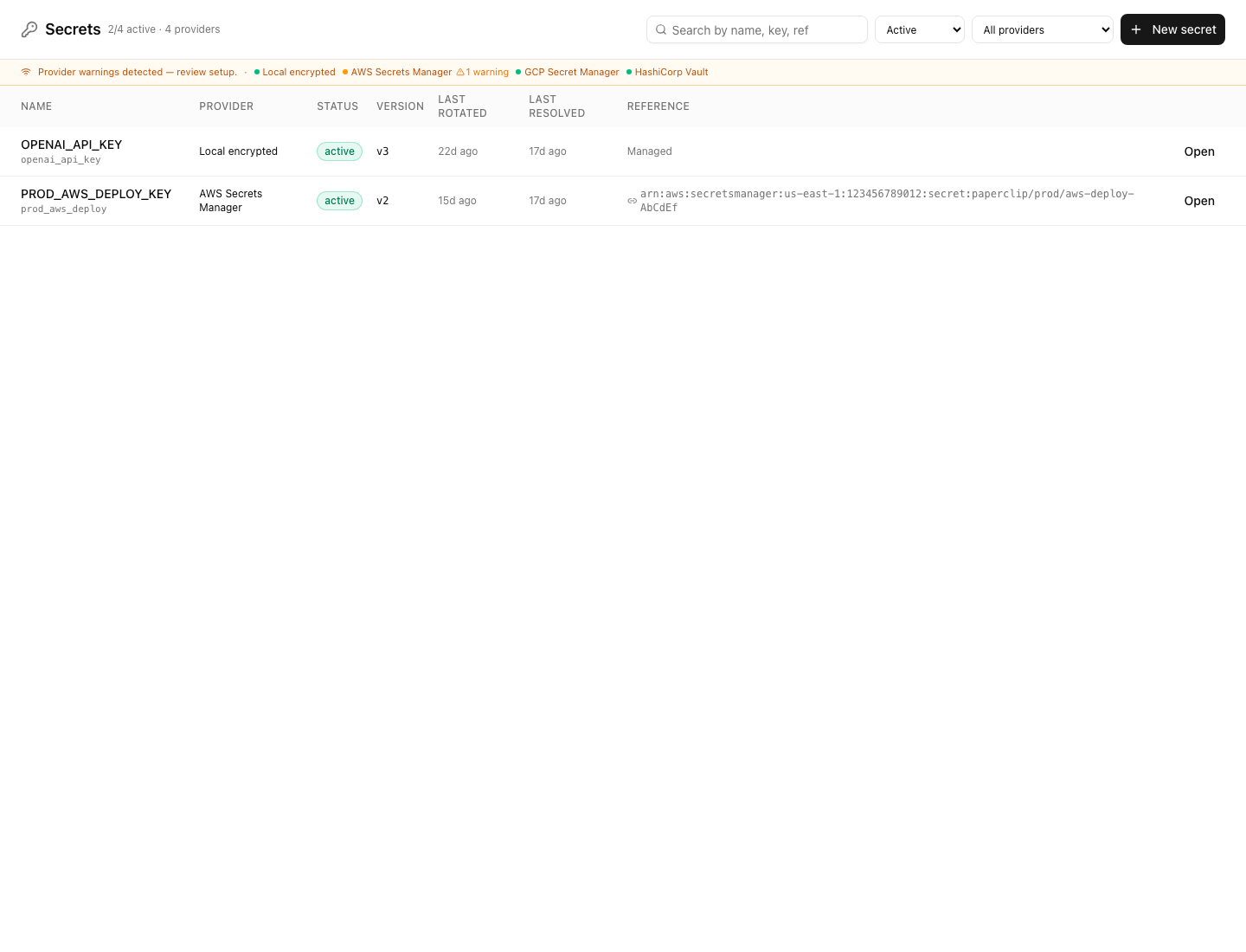
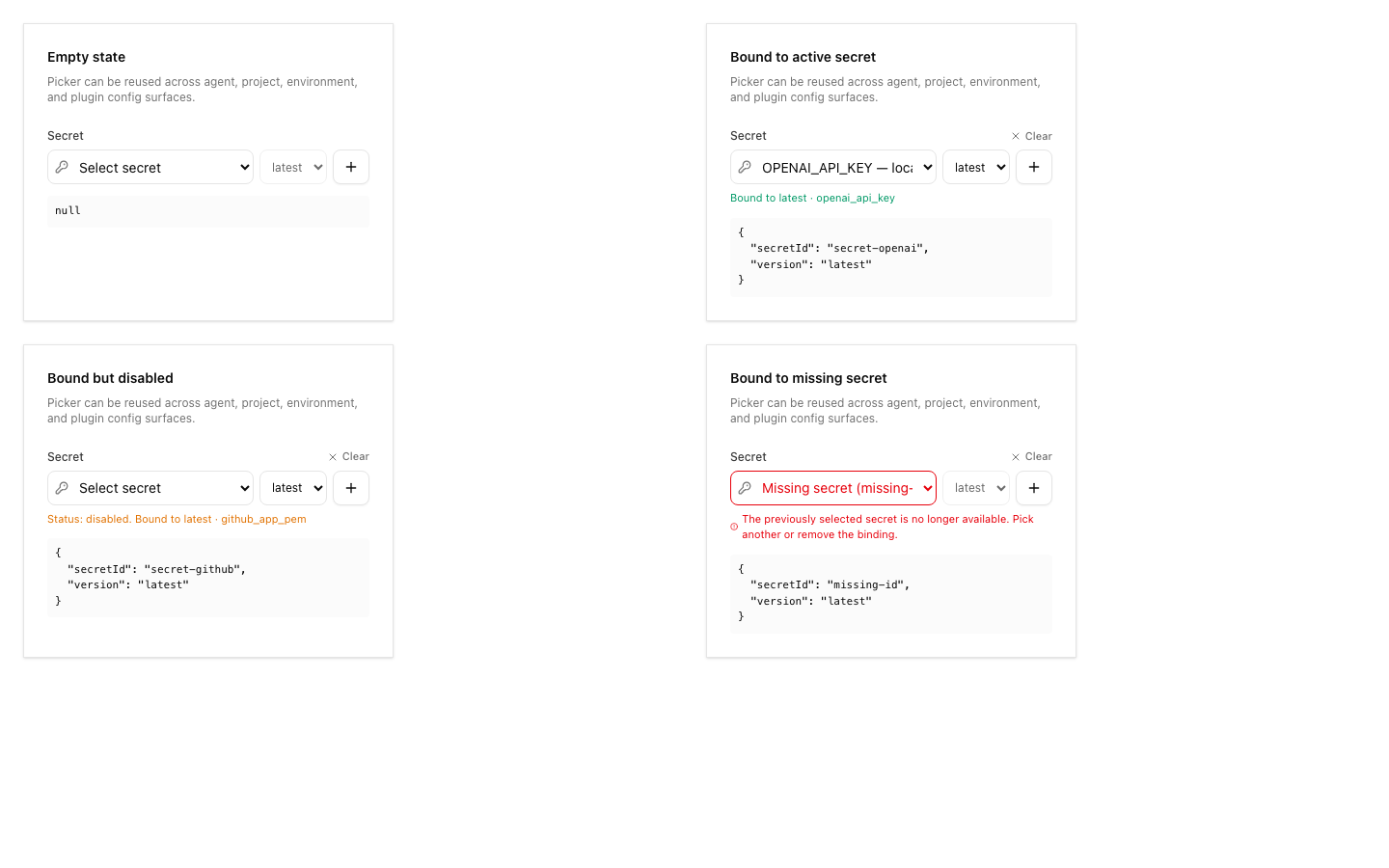
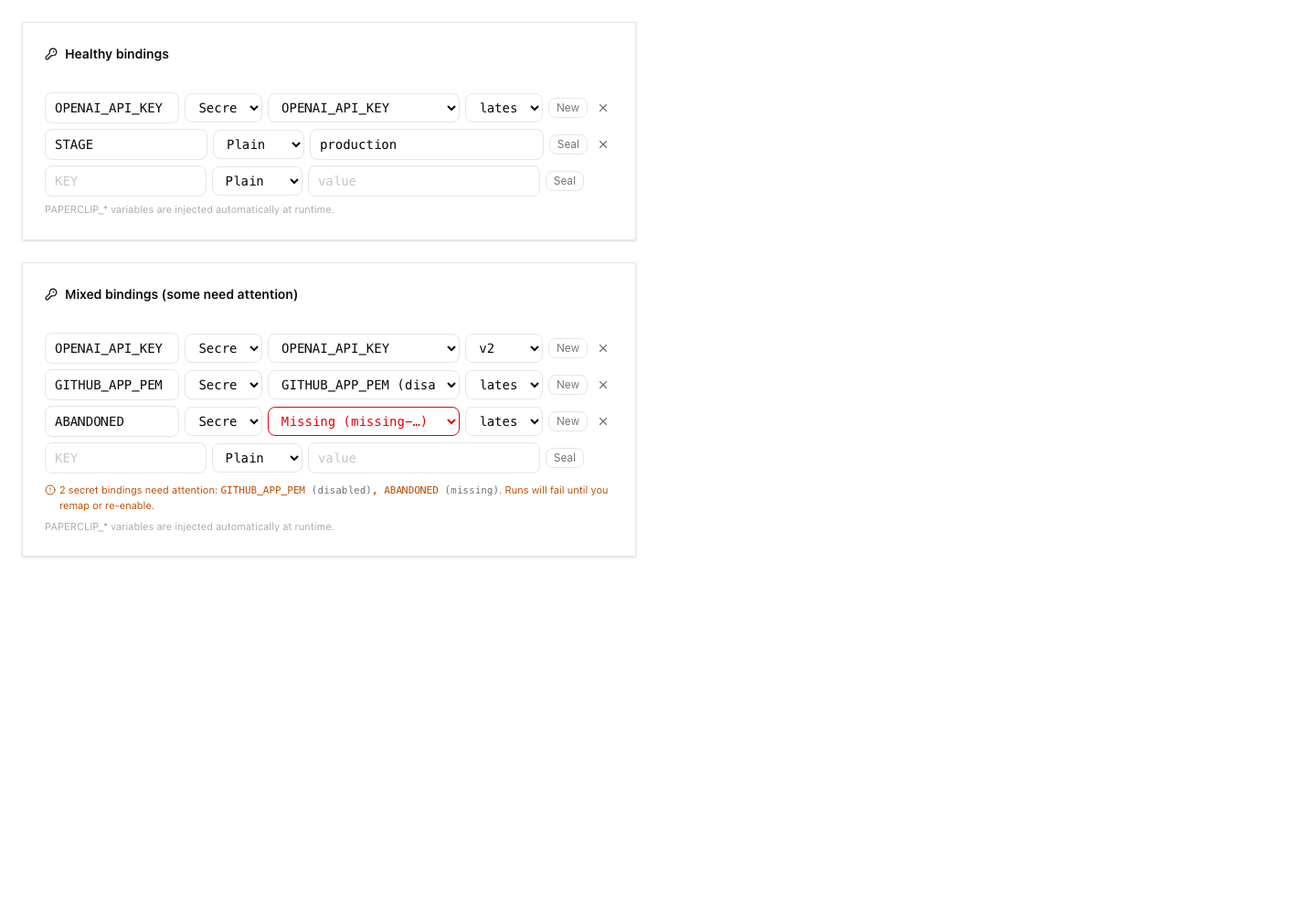
Before: the provider-vault and remote-import surfaces did not exist on
`master`; these are after-state screenshots from the Storybook fixtures.
## Risks
- Migration risk: this adds new secret provider tables and extends
existing secret rows. The migrations were checked for monotonic ordering
and idempotent guards, but reviewers should still inspect upgrade
behavior carefully.
- Provider risk: AWS support uses direct SigV4 requests. Automated tests
cover signing, request timeouts, vault-config selection, namespace
guardrails, pending-version archival, sanitized provider errors, and
service-level cleanup paths. A real-vault AWS smoke test remains
deployment validation for an operator with AWS credentials rather than
an unverified merge blocker in this local branch.
- UI risk: the Secrets page and import dialog are large new surfaces;
screenshots are included above for reviewer inspection.
- Verification risk: the full local stable test command hit
parallel-load timing failures, although the exact failed files passed
when rerun directly.
- Operational risk: remote import intentionally avoids plaintext reads;
operators must understand that imported external references resolve at
runtime and may fail if AWS permissions change.
> For core feature work, check [`ROADMAP.md`](ROADMAP.md) first and
discuss it in `#dev` before opening the PR. Feature PRs that overlap
with planned core work may need to be redirected — check the roadmap
first. See `CONTRIBUTING.md`.
## Model Used
- OpenAI Codex, GPT-5 coding agent with local shell/tool use in the
Paperclip worktree. Exact context-window size was not exposed by the
runtime.
## Checklist
- [x] I have included a thinking path that traces from project context
to this change
- [x] I have specified the model used (with version and capability
details)
- [x] I have checked ROADMAP.md and confirmed this PR does not duplicate
planned core work
- [ ] I have run tests locally and they pass
- [x] I have added or updated tests where applicable
- [x] If this change affects the UI, I have included before/after
screenshots
- [x] I have updated relevant documentation to reflect my changes
- [x] I have considered and documented any risks above
- [x] I will address all Greptile and reviewer comments before
requesting merge
---------
Co-authored-by: Paperclip <noreply@paperclip.ing>
Co-authored-by: Claude Sonnet 4.6 <noreply@anthropic.com>
2026-05-09 18:22:17 -05:00
|
|
|
SecretProvider,
|
|
|
|
|
SecretVersionSelector,
|
Add SSH environment support (#4358)
## Thinking Path
> - Paperclip orchestrates AI agents for zero-human companies
> - The environments subsystem already models execution environments,
but before this branch there was no end-to-end SSH-backed runtime path
for agents to actually run work against a remote box
> - That meant agents could be configured around environment concepts
without a reliable way to execute adapter sessions remotely, sync
workspace state, and preserve run context across supported adapters
> - We also need environment selection to participate in normal
Paperclip control-plane behavior: agent defaults, project/issue
selection, route validation, and environment probing
> - Because this capability is still experimental, the UI surface should
be easy to hide and easy to remove later without undoing the underlying
implementation
> - This pull request adds SSH environment execution support across the
runtime, adapters, routes, schema, and tests, then puts the visible
environment-management UI behind an experimental flag
> - The benefit is that we can validate real SSH-backed agent execution
now while keeping the user-facing controls safely gated until the
feature is ready to come out of experimentation
## What Changed
- Added SSH-backed execution target support in the shared adapter
runtime, including remote workspace preparation, skill/runtime asset
sync, remote session handling, and workspace restore behavior after
runs.
- Added SSH execution coverage for supported local adapters, plus remote
execution tests across Claude, Codex, Cursor, Gemini, OpenCode, and Pi.
- Added environment selection and environment-management backend support
needed for SSH execution, including route/service work, validation,
probing, and agent default environment persistence.
- Added CLI support for SSH environment lab verification and updated
related docs/tests.
- Added the `enableEnvironments` experimental flag and gated the
environment UI behind it on company settings, agent configuration, and
project configuration surfaces.
## Verification
- `pnpm exec vitest run
packages/adapters/claude-local/src/server/execute.remote.test.ts
packages/adapters/cursor-local/src/server/execute.remote.test.ts
packages/adapters/gemini-local/src/server/execute.remote.test.ts
packages/adapters/opencode-local/src/server/execute.remote.test.ts
packages/adapters/pi-local/src/server/execute.remote.test.ts`
- `pnpm exec vitest run server/src/__tests__/environment-routes.test.ts`
- `pnpm exec vitest run
server/src/__tests__/instance-settings-routes.test.ts`
- `pnpm exec vitest run ui/src/lib/new-agent-hire-payload.test.ts
ui/src/lib/new-agent-runtime-config.test.ts`
- `pnpm -r typecheck`
- `pnpm build`
- Manual verification on a branch-local dev server:
- enabled the experimental flag
- created an SSH environment
- created a Linux Claude agent using that environment
- confirmed a run executed on the Linux box and synced workspace changes
back
## Risks
- Medium: this touches runtime execution flow across multiple adapters,
so regressions would likely show up in remote session setup, workspace
sync, or environment selection precedence.
- The UI flag reduces exposure, but the underlying runtime and route
changes are still substantial and rely on migration correctness.
- The change set is broad across adapters, control-plane services,
migrations, and UI gating, so review should pay close attention to
environment-selection precedence and remote workspace lifecycle
behavior.
## Model Used
- OpenAI Codex via Paperclip's local Codex adapter, GPT-5-class coding
model with tool use and code execution in the local repo workspace. The
local adapter does not surface a more specific public model version
string in this branch workflow.
## Checklist
- [x] I have included a thinking path that traces from project context
to this change
- [x] I have specified the model used (with version and capability
details)
- [x] I have checked ROADMAP.md and confirmed this PR does not duplicate
planned core work
- [x] I have run tests locally and they pass
- [x] I have added or updated tests where applicable
- [ ] If this change affects the UI, I have included before/after
screenshots
- [x] I have updated relevant documentation to reflect my changes
- [x] I have considered and documented any risks above
- [x] I will address all Greptile and reviewer comments before
requesting merge
2026-04-23 19:15:22 -07:00
|
|
|
SshEnvironmentConfig,
|
|
|
|
|
} from "@paperclipai/shared";
|
|
|
|
|
import { unprocessable } from "../errors.js";
|
|
|
|
|
import { parseObject } from "../adapters/utils.js";
|
|
|
|
|
import { secretService } from "./secrets.js";
|
Generalize sandbox provider core for plugin-only providers (#4449)
## Thinking Path
> - Paperclip is a control plane, so optional execution providers should
sit at the plugin edge instead of hardcoding provider-specific behavior
into core shared/server/ui layers.
> - Sandbox environments are already first-class, and the fake provider
proves the built-in path; the remaining gap was that real providers
still leaked provider-specific config and runtime assumptions into core.
> - That coupling showed up in config normalization, secret persistence,
capabilities reporting, lease reconstruction, and the board UI form
fields.
> - As long as core knew about those provider-shaped details, shipping a
provider as a pure third-party plugin meant every new provider would
still require host changes.
> - This pull request generalizes the sandbox provider seam around
schema-driven plugin metadata and generic secret-ref handling.
> - The runtime and UI now consume provider metadata generically, so
core only special-cases the built-in fake provider while third-party
providers can live entirely in plugins.
## What Changed
- Added generic sandbox-provider capability metadata so plugin-backed
providers can expose `configSchema` through shared environment support
and the environments capabilities API.
- Reworked sandbox config normalization/persistence/runtime resolution
to handle schema-declared secret-ref fields generically, storing them as
Paperclip secrets and resolving them for probe/execute/release flows.
- Generalized plugin sandbox runtime handling so provider validation,
reusable-lease matching, lease reconstruction, and plugin worker calls
all operate on provider-agnostic config instead of provider-shaped
branches.
- Replaced hardcoded sandbox provider form fields in Company Settings
with schema-driven rendering and blocked agent environment selection
from the built-in fake provider.
- Added regression coverage for the generic seam across shared support
helpers plus environment config, probe, routes, runtime, and
sandbox-provider runtime tests.
## Verification
- `pnpm vitest --run packages/shared/src/environment-support.test.ts
server/src/__tests__/environment-config.test.ts
server/src/__tests__/environment-probe.test.ts
server/src/__tests__/environment-routes.test.ts
server/src/__tests__/environment-runtime.test.ts
server/src/__tests__/sandbox-provider-runtime.test.ts`
- `pnpm -r typecheck`
## Risks
- Plugin sandbox providers now depend more heavily on accurate
`configSchema` declarations; incorrect schemas can misclassify
secret-bearing fields or omit required config.
- Reusable lease matching is now metadata-driven for plugin-backed
providers, so providers that fail to persist stable metadata may
reprovision instead of resuming an existing lease.
- The UI form is now fully schema-driven for plugin-backed sandbox
providers; provider manifests without good defaults or descriptions may
produce a rougher operator experience.
## Model Used
- OpenAI Codex via `codex_local`
- Model ID: `gpt-5.4`
- Reasoning effort: `high`
- Context window observed in runtime session metadata: `258400` tokens
- Capabilities used: terminal tool execution, git, and local code/test
inspection
## Checklist
- [x] I have included a thinking path that traces from project context
to this change
- [x] I have specified the model used (with version and capability
details)
- [x] I have checked ROADMAP.md and confirmed this PR does not duplicate
planned core work
- [x] I have run tests locally and they pass
- [x] I have added or updated tests where applicable
- [ ] If this change affects the UI, I have included before/after
screenshots
- [x] I have updated relevant documentation to reflect my changes
- [x] I have considered and documented any risks above
- [x] I will address all Greptile and reviewer comments before
requesting merge
2026-04-24 18:03:41 -07:00
|
|
|
import {
|
|
|
|
|
resolvePluginSandboxProviderDriverByKey,
|
|
|
|
|
validatePluginEnvironmentDriverConfig,
|
|
|
|
|
validatePluginSandboxProviderConfig,
|
|
|
|
|
} from "./plugin-environment-driver.js";
|
Add sandbox environment support (#4415)
## Thinking Path
> - Paperclip orchestrates AI agents for zero-human companies.
> - The environment/runtime layer decides where agent work executes and
how the control plane reaches those runtimes.
> - Today Paperclip can run locally and over SSH, but sandboxed
execution needs a first-class environment model instead of one-off
adapter behavior.
> - We also want sandbox providers to be pluggable so the core does not
hardcode every provider implementation.
> - This branch adds the Sandbox environment path, the provider
contract, and a deterministic fake provider plugin.
> - That required synchronized changes across shared contracts, plugin
SDK surfaces, server runtime orchestration, and the UI
environment/workspace flows.
> - The result is that sandbox execution becomes a core control-plane
capability while keeping provider implementations extensible and
testable.
## What Changed
- Added sandbox runtime support to the environment execution path,
including runtime URL discovery, sandbox execution targeting,
orchestration, and heartbeat integration.
- Added plugin-provider support for sandbox environments so providers
can be supplied via plugins instead of hardcoded server logic.
- Added the fake sandbox provider plugin with deterministic behavior
suitable for local and automated testing.
- Updated shared types, validators, plugin protocol definitions, and SDK
helpers to carry sandbox provider and workspace-runtime contracts across
package boundaries.
- Updated server routes and services so companies can create sandbox
environments, select them for work, and execute work through the sandbox
runtime path.
- Updated the UI environment and workspace surfaces to expose sandbox
environment configuration and selection.
- Added test coverage for sandbox runtime behavior, provider seams,
environment route guards, orchestration, and the fake provider plugin.
## Verification
- Ran locally before the final fixture-only scrub:
- `pnpm -r typecheck`
- `pnpm test:run`
- `pnpm build`
- Ran locally after the final scrub amend:
- `pnpm vitest run server/src/__tests__/runtime-api.test.ts`
- Reviewer spot checks:
- create a sandbox environment backed by the fake provider plugin
- run work through that environment
- confirm sandbox provider execution does not inherit host secrets
implicitly
## Risks
- This touches shared contracts, plugin SDK plumbing, server runtime
orchestration, and UI environment/workspace flows, so regressions would
likely show up as cross-layer mismatches rather than isolated type
errors.
- Runtime URL discovery and sandbox callback selection are sensitive to
host/bind configuration; if that logic is wrong, sandbox-backed
callbacks may fail even when execution succeeds.
- The fake provider plugin is intentionally deterministic and
test-oriented; future providers may expose capability gaps that this
branch does not yet cover.
## Model Used
- OpenAI Codex coding agent on a GPT-5-class backend in the
Paperclip/Codex harness. Exact backend model ID is not exposed
in-session. Tool-assisted workflow with shell execution, file editing,
git history inspection, and local test execution.
## Checklist
- [x] I have included a thinking path that traces from project context
to this change
- [x] I have specified the model used (with version and capability
details)
- [x] I have checked ROADMAP.md and confirmed this PR does not duplicate
planned core work
- [x] I have run tests locally and they pass
- [x] I have added or updated tests where applicable
- [ ] If this change affects the UI, I have included before/after
screenshots
- [x] I have updated relevant documentation to reflect my changes
- [x] I have considered and documented any risks above
- [x] I will address all Greptile and reviewer comments before
requesting merge
2026-04-24 12:15:53 -07:00
|
|
|
import type { PluginWorkerManager } from "./plugin-worker-manager.js";
|
Generalize sandbox provider core for plugin-only providers (#4449)
## Thinking Path
> - Paperclip is a control plane, so optional execution providers should
sit at the plugin edge instead of hardcoding provider-specific behavior
into core shared/server/ui layers.
> - Sandbox environments are already first-class, and the fake provider
proves the built-in path; the remaining gap was that real providers
still leaked provider-specific config and runtime assumptions into core.
> - That coupling showed up in config normalization, secret persistence,
capabilities reporting, lease reconstruction, and the board UI form
fields.
> - As long as core knew about those provider-shaped details, shipping a
provider as a pure third-party plugin meant every new provider would
still require host changes.
> - This pull request generalizes the sandbox provider seam around
schema-driven plugin metadata and generic secret-ref handling.
> - The runtime and UI now consume provider metadata generically, so
core only special-cases the built-in fake provider while third-party
providers can live entirely in plugins.
## What Changed
- Added generic sandbox-provider capability metadata so plugin-backed
providers can expose `configSchema` through shared environment support
and the environments capabilities API.
- Reworked sandbox config normalization/persistence/runtime resolution
to handle schema-declared secret-ref fields generically, storing them as
Paperclip secrets and resolving them for probe/execute/release flows.
- Generalized plugin sandbox runtime handling so provider validation,
reusable-lease matching, lease reconstruction, and plugin worker calls
all operate on provider-agnostic config instead of provider-shaped
branches.
- Replaced hardcoded sandbox provider form fields in Company Settings
with schema-driven rendering and blocked agent environment selection
from the built-in fake provider.
- Added regression coverage for the generic seam across shared support
helpers plus environment config, probe, routes, runtime, and
sandbox-provider runtime tests.
## Verification
- `pnpm vitest --run packages/shared/src/environment-support.test.ts
server/src/__tests__/environment-config.test.ts
server/src/__tests__/environment-probe.test.ts
server/src/__tests__/environment-routes.test.ts
server/src/__tests__/environment-runtime.test.ts
server/src/__tests__/sandbox-provider-runtime.test.ts`
- `pnpm -r typecheck`
## Risks
- Plugin sandbox providers now depend more heavily on accurate
`configSchema` declarations; incorrect schemas can misclassify
secret-bearing fields or omit required config.
- Reusable lease matching is now metadata-driven for plugin-backed
providers, so providers that fail to persist stable metadata may
reprovision instead of resuming an existing lease.
- The UI form is now fully schema-driven for plugin-backed sandbox
providers; provider manifests without good defaults or descriptions may
produce a rougher operator experience.
## Model Used
- OpenAI Codex via `codex_local`
- Model ID: `gpt-5.4`
- Reasoning effort: `high`
- Context window observed in runtime session metadata: `258400` tokens
- Capabilities used: terminal tool execution, git, and local code/test
inspection
## Checklist
- [x] I have included a thinking path that traces from project context
to this change
- [x] I have specified the model used (with version and capability
details)
- [x] I have checked ROADMAP.md and confirmed this PR does not duplicate
planned core work
- [x] I have run tests locally and they pass
- [x] I have added or updated tests where applicable
- [ ] If this change affects the UI, I have included before/after
screenshots
- [x] I have updated relevant documentation to reflect my changes
- [x] I have considered and documented any risks above
- [x] I will address all Greptile and reviewer comments before
requesting merge
2026-04-24 18:03:41 -07:00
|
|
|
import {
|
|
|
|
|
collectSecretRefPaths,
|
|
|
|
|
isUuidSecretRef,
|
|
|
|
|
readConfigValueAtPath,
|
|
|
|
|
writeConfigValueAtPath,
|
|
|
|
|
} from "./json-schema-secret-refs.js";
|
Add SSH environment support (#4358)
## Thinking Path
> - Paperclip orchestrates AI agents for zero-human companies
> - The environments subsystem already models execution environments,
but before this branch there was no end-to-end SSH-backed runtime path
for agents to actually run work against a remote box
> - That meant agents could be configured around environment concepts
without a reliable way to execute adapter sessions remotely, sync
workspace state, and preserve run context across supported adapters
> - We also need environment selection to participate in normal
Paperclip control-plane behavior: agent defaults, project/issue
selection, route validation, and environment probing
> - Because this capability is still experimental, the UI surface should
be easy to hide and easy to remove later without undoing the underlying
implementation
> - This pull request adds SSH environment execution support across the
runtime, adapters, routes, schema, and tests, then puts the visible
environment-management UI behind an experimental flag
> - The benefit is that we can validate real SSH-backed agent execution
now while keeping the user-facing controls safely gated until the
feature is ready to come out of experimentation
## What Changed
- Added SSH-backed execution target support in the shared adapter
runtime, including remote workspace preparation, skill/runtime asset
sync, remote session handling, and workspace restore behavior after
runs.
- Added SSH execution coverage for supported local adapters, plus remote
execution tests across Claude, Codex, Cursor, Gemini, OpenCode, and Pi.
- Added environment selection and environment-management backend support
needed for SSH execution, including route/service work, validation,
probing, and agent default environment persistence.
- Added CLI support for SSH environment lab verification and updated
related docs/tests.
- Added the `enableEnvironments` experimental flag and gated the
environment UI behind it on company settings, agent configuration, and
project configuration surfaces.
## Verification
- `pnpm exec vitest run
packages/adapters/claude-local/src/server/execute.remote.test.ts
packages/adapters/cursor-local/src/server/execute.remote.test.ts
packages/adapters/gemini-local/src/server/execute.remote.test.ts
packages/adapters/opencode-local/src/server/execute.remote.test.ts
packages/adapters/pi-local/src/server/execute.remote.test.ts`
- `pnpm exec vitest run server/src/__tests__/environment-routes.test.ts`
- `pnpm exec vitest run
server/src/__tests__/instance-settings-routes.test.ts`
- `pnpm exec vitest run ui/src/lib/new-agent-hire-payload.test.ts
ui/src/lib/new-agent-runtime-config.test.ts`
- `pnpm -r typecheck`
- `pnpm build`
- Manual verification on a branch-local dev server:
- enabled the experimental flag
- created an SSH environment
- created a Linux Claude agent using that environment
- confirmed a run executed on the Linux box and synced workspace changes
back
## Risks
- Medium: this touches runtime execution flow across multiple adapters,
so regressions would likely show up in remote session setup, workspace
sync, or environment selection precedence.
- The UI flag reduces exposure, but the underlying runtime and route
changes are still substantial and rely on migration correctness.
- The change set is broad across adapters, control-plane services,
migrations, and UI gating, so review should pay close attention to
environment-selection precedence and remote workspace lifecycle
behavior.
## Model Used
- OpenAI Codex via Paperclip's local Codex adapter, GPT-5-class coding
model with tool use and code execution in the local repo workspace. The
local adapter does not surface a more specific public model version
string in this branch workflow.
## Checklist
- [x] I have included a thinking path that traces from project context
to this change
- [x] I have specified the model used (with version and capability
details)
- [x] I have checked ROADMAP.md and confirmed this PR does not duplicate
planned core work
- [x] I have run tests locally and they pass
- [x] I have added or updated tests where applicable
- [ ] If this change affects the UI, I have included before/after
screenshots
- [x] I have updated relevant documentation to reflect my changes
- [x] I have considered and documented any risks above
- [x] I will address all Greptile and reviewer comments before
requesting merge
2026-04-23 19:15:22 -07:00
|
|
|
|
|
|
|
|
const secretRefSchema = z.object({
|
|
|
|
|
type: z.literal("secret_ref"),
|
|
|
|
|
secretId: z.string().uuid(),
|
|
|
|
|
version: z.union([z.literal("latest"), z.number().int().positive()]).optional().default("latest"),
|
|
|
|
|
}).strict();
|
|
|
|
|
|
|
|
|
|
const sshEnvironmentConfigSchema = z.object({
|
|
|
|
|
host: z.string({ required_error: "SSH environments require a host." }).trim().min(1, "SSH environments require a host."),
|
|
|
|
|
port: z.coerce.number().int().min(1).max(65535).default(22),
|
|
|
|
|
username: z.string({ required_error: "SSH environments require a username." }).trim().min(1, "SSH environments require a username."),
|
|
|
|
|
remoteWorkspacePath: z
|
|
|
|
|
.string({ required_error: "SSH environments require a remote workspace path." })
|
|
|
|
|
.trim()
|
|
|
|
|
.min(1, "SSH environments require a remote workspace path.")
|
|
|
|
|
.refine((value) => value.startsWith("/"), "SSH remote workspace path must be absolute."),
|
|
|
|
|
privateKey: z.null().optional().default(null),
|
|
|
|
|
privateKeySecretRef: secretRefSchema.optional().nullable().default(null),
|
|
|
|
|
knownHosts: z
|
|
|
|
|
.string()
|
|
|
|
|
.trim()
|
|
|
|
|
.optional()
|
|
|
|
|
.nullable()
|
|
|
|
|
.transform((value) => (value && value.length > 0 ? value : null)),
|
|
|
|
|
strictHostKeyChecking: z.boolean().optional().default(true),
|
|
|
|
|
}).strict();
|
|
|
|
|
|
Generalize sandbox provider core for plugin-only providers (#4449)
## Thinking Path
> - Paperclip is a control plane, so optional execution providers should
sit at the plugin edge instead of hardcoding provider-specific behavior
into core shared/server/ui layers.
> - Sandbox environments are already first-class, and the fake provider
proves the built-in path; the remaining gap was that real providers
still leaked provider-specific config and runtime assumptions into core.
> - That coupling showed up in config normalization, secret persistence,
capabilities reporting, lease reconstruction, and the board UI form
fields.
> - As long as core knew about those provider-shaped details, shipping a
provider as a pure third-party plugin meant every new provider would
still require host changes.
> - This pull request generalizes the sandbox provider seam around
schema-driven plugin metadata and generic secret-ref handling.
> - The runtime and UI now consume provider metadata generically, so
core only special-cases the built-in fake provider while third-party
providers can live entirely in plugins.
## What Changed
- Added generic sandbox-provider capability metadata so plugin-backed
providers can expose `configSchema` through shared environment support
and the environments capabilities API.
- Reworked sandbox config normalization/persistence/runtime resolution
to handle schema-declared secret-ref fields generically, storing them as
Paperclip secrets and resolving them for probe/execute/release flows.
- Generalized plugin sandbox runtime handling so provider validation,
reusable-lease matching, lease reconstruction, and plugin worker calls
all operate on provider-agnostic config instead of provider-shaped
branches.
- Replaced hardcoded sandbox provider form fields in Company Settings
with schema-driven rendering and blocked agent environment selection
from the built-in fake provider.
- Added regression coverage for the generic seam across shared support
helpers plus environment config, probe, routes, runtime, and
sandbox-provider runtime tests.
## Verification
- `pnpm vitest --run packages/shared/src/environment-support.test.ts
server/src/__tests__/environment-config.test.ts
server/src/__tests__/environment-probe.test.ts
server/src/__tests__/environment-routes.test.ts
server/src/__tests__/environment-runtime.test.ts
server/src/__tests__/sandbox-provider-runtime.test.ts`
- `pnpm -r typecheck`
## Risks
- Plugin sandbox providers now depend more heavily on accurate
`configSchema` declarations; incorrect schemas can misclassify
secret-bearing fields or omit required config.
- Reusable lease matching is now metadata-driven for plugin-backed
providers, so providers that fail to persist stable metadata may
reprovision instead of resuming an existing lease.
- The UI form is now fully schema-driven for plugin-backed sandbox
providers; provider manifests without good defaults or descriptions may
produce a rougher operator experience.
## Model Used
- OpenAI Codex via `codex_local`
- Model ID: `gpt-5.4`
- Reasoning effort: `high`
- Context window observed in runtime session metadata: `258400` tokens
- Capabilities used: terminal tool execution, git, and local code/test
inspection
## Checklist
- [x] I have included a thinking path that traces from project context
to this change
- [x] I have specified the model used (with version and capability
details)
- [x] I have checked ROADMAP.md and confirmed this PR does not duplicate
planned core work
- [x] I have run tests locally and they pass
- [x] I have added or updated tests where applicable
- [ ] If this change affects the UI, I have included before/after
screenshots
- [x] I have updated relevant documentation to reflect my changes
- [x] I have considered and documented any risks above
- [x] I will address all Greptile and reviewer comments before
requesting merge
2026-04-24 18:03:41 -07:00
|
|
|
const sshEnvironmentConfigProbeSchema = sshEnvironmentConfigSchema.extend({
|
|
|
|
|
privateKey: z
|
|
|
|
|
.string()
|
|
|
|
|
.trim()
|
|
|
|
|
.optional()
|
|
|
|
|
.nullable()
|
|
|
|
|
.transform((value) => (value && value.length > 0 ? value : null)),
|
|
|
|
|
}).strict();
|
|
|
|
|
|
|
|
|
|
const sshEnvironmentConfigPersistenceSchema = sshEnvironmentConfigProbeSchema;
|
|
|
|
|
|
Add sandbox environment support (#4415)
## Thinking Path
> - Paperclip orchestrates AI agents for zero-human companies.
> - The environment/runtime layer decides where agent work executes and
how the control plane reaches those runtimes.
> - Today Paperclip can run locally and over SSH, but sandboxed
execution needs a first-class environment model instead of one-off
adapter behavior.
> - We also want sandbox providers to be pluggable so the core does not
hardcode every provider implementation.
> - This branch adds the Sandbox environment path, the provider
contract, and a deterministic fake provider plugin.
> - That required synchronized changes across shared contracts, plugin
SDK surfaces, server runtime orchestration, and the UI
environment/workspace flows.
> - The result is that sandbox execution becomes a core control-plane
capability while keeping provider implementations extensible and
testable.
## What Changed
- Added sandbox runtime support to the environment execution path,
including runtime URL discovery, sandbox execution targeting,
orchestration, and heartbeat integration.
- Added plugin-provider support for sandbox environments so providers
can be supplied via plugins instead of hardcoded server logic.
- Added the fake sandbox provider plugin with deterministic behavior
suitable for local and automated testing.
- Updated shared types, validators, plugin protocol definitions, and SDK
helpers to carry sandbox provider and workspace-runtime contracts across
package boundaries.
- Updated server routes and services so companies can create sandbox
environments, select them for work, and execute work through the sandbox
runtime path.
- Updated the UI environment and workspace surfaces to expose sandbox
environment configuration and selection.
- Added test coverage for sandbox runtime behavior, provider seams,
environment route guards, orchestration, and the fake provider plugin.
## Verification
- Ran locally before the final fixture-only scrub:
- `pnpm -r typecheck`
- `pnpm test:run`
- `pnpm build`
- Ran locally after the final scrub amend:
- `pnpm vitest run server/src/__tests__/runtime-api.test.ts`
- Reviewer spot checks:
- create a sandbox environment backed by the fake provider plugin
- run work through that environment
- confirm sandbox provider execution does not inherit host secrets
implicitly
## Risks
- This touches shared contracts, plugin SDK plumbing, server runtime
orchestration, and UI environment/workspace flows, so regressions would
likely show up as cross-layer mismatches rather than isolated type
errors.
- Runtime URL discovery and sandbox callback selection are sensitive to
host/bind configuration; if that logic is wrong, sandbox-backed
callbacks may fail even when execution succeeds.
- The fake provider plugin is intentionally deterministic and
test-oriented; future providers may expose capability gaps that this
branch does not yet cover.
## Model Used
- OpenAI Codex coding agent on a GPT-5-class backend in the
Paperclip/Codex harness. Exact backend model ID is not exposed
in-session. Tool-assisted workflow with shell execution, file editing,
git history inspection, and local test execution.
## Checklist
- [x] I have included a thinking path that traces from project context
to this change
- [x] I have specified the model used (with version and capability
details)
- [x] I have checked ROADMAP.md and confirmed this PR does not duplicate
planned core work
- [x] I have run tests locally and they pass
- [x] I have added or updated tests where applicable
- [ ] If this change affects the UI, I have included before/after
screenshots
- [x] I have updated relevant documentation to reflect my changes
- [x] I have considered and documented any risks above
- [x] I will address all Greptile and reviewer comments before
requesting merge
2026-04-24 12:15:53 -07:00
|
|
|
const fakeSandboxEnvironmentConfigSchema = z.object({
|
|
|
|
|
provider: z.literal("fake").default("fake"),
|
|
|
|
|
image: z
|
Add SSH environment support (#4358)
## Thinking Path
> - Paperclip orchestrates AI agents for zero-human companies
> - The environments subsystem already models execution environments,
but before this branch there was no end-to-end SSH-backed runtime path
for agents to actually run work against a remote box
> - That meant agents could be configured around environment concepts
without a reliable way to execute adapter sessions remotely, sync
workspace state, and preserve run context across supported adapters
> - We also need environment selection to participate in normal
Paperclip control-plane behavior: agent defaults, project/issue
selection, route validation, and environment probing
> - Because this capability is still experimental, the UI surface should
be easy to hide and easy to remove later without undoing the underlying
implementation
> - This pull request adds SSH environment execution support across the
runtime, adapters, routes, schema, and tests, then puts the visible
environment-management UI behind an experimental flag
> - The benefit is that we can validate real SSH-backed agent execution
now while keeping the user-facing controls safely gated until the
feature is ready to come out of experimentation
## What Changed
- Added SSH-backed execution target support in the shared adapter
runtime, including remote workspace preparation, skill/runtime asset
sync, remote session handling, and workspace restore behavior after
runs.
- Added SSH execution coverage for supported local adapters, plus remote
execution tests across Claude, Codex, Cursor, Gemini, OpenCode, and Pi.
- Added environment selection and environment-management backend support
needed for SSH execution, including route/service work, validation,
probing, and agent default environment persistence.
- Added CLI support for SSH environment lab verification and updated
related docs/tests.
- Added the `enableEnvironments` experimental flag and gated the
environment UI behind it on company settings, agent configuration, and
project configuration surfaces.
## Verification
- `pnpm exec vitest run
packages/adapters/claude-local/src/server/execute.remote.test.ts
packages/adapters/cursor-local/src/server/execute.remote.test.ts
packages/adapters/gemini-local/src/server/execute.remote.test.ts
packages/adapters/opencode-local/src/server/execute.remote.test.ts
packages/adapters/pi-local/src/server/execute.remote.test.ts`
- `pnpm exec vitest run server/src/__tests__/environment-routes.test.ts`
- `pnpm exec vitest run
server/src/__tests__/instance-settings-routes.test.ts`
- `pnpm exec vitest run ui/src/lib/new-agent-hire-payload.test.ts
ui/src/lib/new-agent-runtime-config.test.ts`
- `pnpm -r typecheck`
- `pnpm build`
- Manual verification on a branch-local dev server:
- enabled the experimental flag
- created an SSH environment
- created a Linux Claude agent using that environment
- confirmed a run executed on the Linux box and synced workspace changes
back
## Risks
- Medium: this touches runtime execution flow across multiple adapters,
so regressions would likely show up in remote session setup, workspace
sync, or environment selection precedence.
- The UI flag reduces exposure, but the underlying runtime and route
changes are still substantial and rely on migration correctness.
- The change set is broad across adapters, control-plane services,
migrations, and UI gating, so review should pay close attention to
environment-selection precedence and remote workspace lifecycle
behavior.
## Model Used
- OpenAI Codex via Paperclip's local Codex adapter, GPT-5-class coding
model with tool use and code execution in the local repo workspace. The
local adapter does not surface a more specific public model version
string in this branch workflow.
## Checklist
- [x] I have included a thinking path that traces from project context
to this change
- [x] I have specified the model used (with version and capability
details)
- [x] I have checked ROADMAP.md and confirmed this PR does not duplicate
planned core work
- [x] I have run tests locally and they pass
- [x] I have added or updated tests where applicable
- [ ] If this change affects the UI, I have included before/after
screenshots
- [x] I have updated relevant documentation to reflect my changes
- [x] I have considered and documented any risks above
- [x] I will address all Greptile and reviewer comments before
requesting merge
2026-04-23 19:15:22 -07:00
|
|
|
.string()
|
|
|
|
|
.trim()
|
Add sandbox environment support (#4415)
## Thinking Path
> - Paperclip orchestrates AI agents for zero-human companies.
> - The environment/runtime layer decides where agent work executes and
how the control plane reaches those runtimes.
> - Today Paperclip can run locally and over SSH, but sandboxed
execution needs a first-class environment model instead of one-off
adapter behavior.
> - We also want sandbox providers to be pluggable so the core does not
hardcode every provider implementation.
> - This branch adds the Sandbox environment path, the provider
contract, and a deterministic fake provider plugin.
> - That required synchronized changes across shared contracts, plugin
SDK surfaces, server runtime orchestration, and the UI
environment/workspace flows.
> - The result is that sandbox execution becomes a core control-plane
capability while keeping provider implementations extensible and
testable.
## What Changed
- Added sandbox runtime support to the environment execution path,
including runtime URL discovery, sandbox execution targeting,
orchestration, and heartbeat integration.
- Added plugin-provider support for sandbox environments so providers
can be supplied via plugins instead of hardcoded server logic.
- Added the fake sandbox provider plugin with deterministic behavior
suitable for local and automated testing.
- Updated shared types, validators, plugin protocol definitions, and SDK
helpers to carry sandbox provider and workspace-runtime contracts across
package boundaries.
- Updated server routes and services so companies can create sandbox
environments, select them for work, and execute work through the sandbox
runtime path.
- Updated the UI environment and workspace surfaces to expose sandbox
environment configuration and selection.
- Added test coverage for sandbox runtime behavior, provider seams,
environment route guards, orchestration, and the fake provider plugin.
## Verification
- Ran locally before the final fixture-only scrub:
- `pnpm -r typecheck`
- `pnpm test:run`
- `pnpm build`
- Ran locally after the final scrub amend:
- `pnpm vitest run server/src/__tests__/runtime-api.test.ts`
- Reviewer spot checks:
- create a sandbox environment backed by the fake provider plugin
- run work through that environment
- confirm sandbox provider execution does not inherit host secrets
implicitly
## Risks
- This touches shared contracts, plugin SDK plumbing, server runtime
orchestration, and UI environment/workspace flows, so regressions would
likely show up as cross-layer mismatches rather than isolated type
errors.
- Runtime URL discovery and sandbox callback selection are sensitive to
host/bind configuration; if that logic is wrong, sandbox-backed
callbacks may fail even when execution succeeds.
- The fake provider plugin is intentionally deterministic and
test-oriented; future providers may expose capability gaps that this
branch does not yet cover.
## Model Used
- OpenAI Codex coding agent on a GPT-5-class backend in the
Paperclip/Codex harness. Exact backend model ID is not exposed
in-session. Tool-assisted workflow with shell execution, file editing,
git history inspection, and local test execution.
## Checklist
- [x] I have included a thinking path that traces from project context
to this change
- [x] I have specified the model used (with version and capability
details)
- [x] I have checked ROADMAP.md and confirmed this PR does not duplicate
planned core work
- [x] I have run tests locally and they pass
- [x] I have added or updated tests where applicable
- [ ] If this change affects the UI, I have included before/after
screenshots
- [x] I have updated relevant documentation to reflect my changes
- [x] I have considered and documented any risks above
- [x] I will address all Greptile and reviewer comments before
requesting merge
2026-04-24 12:15:53 -07:00
|
|
|
.min(1, "Fake sandbox environments require an image.")
|
|
|
|
|
.default("ubuntu:24.04"),
|
|
|
|
|
reuseLease: z.boolean().optional().default(false),
|
Add SSH environment support (#4358)
## Thinking Path
> - Paperclip orchestrates AI agents for zero-human companies
> - The environments subsystem already models execution environments,
but before this branch there was no end-to-end SSH-backed runtime path
for agents to actually run work against a remote box
> - That meant agents could be configured around environment concepts
without a reliable way to execute adapter sessions remotely, sync
workspace state, and preserve run context across supported adapters
> - We also need environment selection to participate in normal
Paperclip control-plane behavior: agent defaults, project/issue
selection, route validation, and environment probing
> - Because this capability is still experimental, the UI surface should
be easy to hide and easy to remove later without undoing the underlying
implementation
> - This pull request adds SSH environment execution support across the
runtime, adapters, routes, schema, and tests, then puts the visible
environment-management UI behind an experimental flag
> - The benefit is that we can validate real SSH-backed agent execution
now while keeping the user-facing controls safely gated until the
feature is ready to come out of experimentation
## What Changed
- Added SSH-backed execution target support in the shared adapter
runtime, including remote workspace preparation, skill/runtime asset
sync, remote session handling, and workspace restore behavior after
runs.
- Added SSH execution coverage for supported local adapters, plus remote
execution tests across Claude, Codex, Cursor, Gemini, OpenCode, and Pi.
- Added environment selection and environment-management backend support
needed for SSH execution, including route/service work, validation,
probing, and agent default environment persistence.
- Added CLI support for SSH environment lab verification and updated
related docs/tests.
- Added the `enableEnvironments` experimental flag and gated the
environment UI behind it on company settings, agent configuration, and
project configuration surfaces.
## Verification
- `pnpm exec vitest run
packages/adapters/claude-local/src/server/execute.remote.test.ts
packages/adapters/cursor-local/src/server/execute.remote.test.ts
packages/adapters/gemini-local/src/server/execute.remote.test.ts
packages/adapters/opencode-local/src/server/execute.remote.test.ts
packages/adapters/pi-local/src/server/execute.remote.test.ts`
- `pnpm exec vitest run server/src/__tests__/environment-routes.test.ts`
- `pnpm exec vitest run
server/src/__tests__/instance-settings-routes.test.ts`
- `pnpm exec vitest run ui/src/lib/new-agent-hire-payload.test.ts
ui/src/lib/new-agent-runtime-config.test.ts`
- `pnpm -r typecheck`
- `pnpm build`
- Manual verification on a branch-local dev server:
- enabled the experimental flag
- created an SSH environment
- created a Linux Claude agent using that environment
- confirmed a run executed on the Linux box and synced workspace changes
back
## Risks
- Medium: this touches runtime execution flow across multiple adapters,
so regressions would likely show up in remote session setup, workspace
sync, or environment selection precedence.
- The UI flag reduces exposure, but the underlying runtime and route
changes are still substantial and rely on migration correctness.
- The change set is broad across adapters, control-plane services,
migrations, and UI gating, so review should pay close attention to
environment-selection precedence and remote workspace lifecycle
behavior.
## Model Used
- OpenAI Codex via Paperclip's local Codex adapter, GPT-5-class coding
model with tool use and code execution in the local repo workspace. The
local adapter does not surface a more specific public model version
string in this branch workflow.
## Checklist
- [x] I have included a thinking path that traces from project context
to this change
- [x] I have specified the model used (with version and capability
details)
- [x] I have checked ROADMAP.md and confirmed this PR does not duplicate
planned core work
- [x] I have run tests locally and they pass
- [x] I have added or updated tests where applicable
- [ ] If this change affects the UI, I have included before/after
screenshots
- [x] I have updated relevant documentation to reflect my changes
- [x] I have considered and documented any risks above
- [x] I will address all Greptile and reviewer comments before
requesting merge
2026-04-23 19:15:22 -07:00
|
|
|
}).strict();
|
|
|
|
|
|
Add sandbox environment support (#4415)
## Thinking Path
> - Paperclip orchestrates AI agents for zero-human companies.
> - The environment/runtime layer decides where agent work executes and
how the control plane reaches those runtimes.
> - Today Paperclip can run locally and over SSH, but sandboxed
execution needs a first-class environment model instead of one-off
adapter behavior.
> - We also want sandbox providers to be pluggable so the core does not
hardcode every provider implementation.
> - This branch adds the Sandbox environment path, the provider
contract, and a deterministic fake provider plugin.
> - That required synchronized changes across shared contracts, plugin
SDK surfaces, server runtime orchestration, and the UI
environment/workspace flows.
> - The result is that sandbox execution becomes a core control-plane
capability while keeping provider implementations extensible and
testable.
## What Changed
- Added sandbox runtime support to the environment execution path,
including runtime URL discovery, sandbox execution targeting,
orchestration, and heartbeat integration.
- Added plugin-provider support for sandbox environments so providers
can be supplied via plugins instead of hardcoded server logic.
- Added the fake sandbox provider plugin with deterministic behavior
suitable for local and automated testing.
- Updated shared types, validators, plugin protocol definitions, and SDK
helpers to carry sandbox provider and workspace-runtime contracts across
package boundaries.
- Updated server routes and services so companies can create sandbox
environments, select them for work, and execute work through the sandbox
runtime path.
- Updated the UI environment and workspace surfaces to expose sandbox
environment configuration and selection.
- Added test coverage for sandbox runtime behavior, provider seams,
environment route guards, orchestration, and the fake provider plugin.
## Verification
- Ran locally before the final fixture-only scrub:
- `pnpm -r typecheck`
- `pnpm test:run`
- `pnpm build`
- Ran locally after the final scrub amend:
- `pnpm vitest run server/src/__tests__/runtime-api.test.ts`
- Reviewer spot checks:
- create a sandbox environment backed by the fake provider plugin
- run work through that environment
- confirm sandbox provider execution does not inherit host secrets
implicitly
## Risks
- This touches shared contracts, plugin SDK plumbing, server runtime
orchestration, and UI environment/workspace flows, so regressions would
likely show up as cross-layer mismatches rather than isolated type
errors.
- Runtime URL discovery and sandbox callback selection are sensitive to
host/bind configuration; if that logic is wrong, sandbox-backed
callbacks may fail even when execution succeeds.
- The fake provider plugin is intentionally deterministic and
test-oriented; future providers may expose capability gaps that this
branch does not yet cover.
## Model Used
- OpenAI Codex coding agent on a GPT-5-class backend in the
Paperclip/Codex harness. Exact backend model ID is not exposed
in-session. Tool-assisted workflow with shell execution, file editing,
git history inspection, and local test execution.
## Checklist
- [x] I have included a thinking path that traces from project context
to this change
- [x] I have specified the model used (with version and capability
details)
- [x] I have checked ROADMAP.md and confirmed this PR does not duplicate
planned core work
- [x] I have run tests locally and they pass
- [x] I have added or updated tests where applicable
- [ ] If this change affects the UI, I have included before/after
screenshots
- [x] I have updated relevant documentation to reflect my changes
- [x] I have considered and documented any risks above
- [x] I will address all Greptile and reviewer comments before
requesting merge
2026-04-24 12:15:53 -07:00
|
|
|
const pluginSandboxProviderKeySchema = z.string()
|
|
|
|
|
.trim()
|
|
|
|
|
.min(1, "Sandbox provider is required.")
|
|
|
|
|
.regex(
|
|
|
|
|
/^[a-z0-9][a-z0-9._-]*$/,
|
|
|
|
|
"Sandbox provider key must start with a lowercase alphanumeric and contain only lowercase letters, digits, dots, hyphens, or underscores",
|
Generalize sandbox provider core for plugin-only providers (#4449)
## Thinking Path
> - Paperclip is a control plane, so optional execution providers should
sit at the plugin edge instead of hardcoding provider-specific behavior
into core shared/server/ui layers.
> - Sandbox environments are already first-class, and the fake provider
proves the built-in path; the remaining gap was that real providers
still leaked provider-specific config and runtime assumptions into core.
> - That coupling showed up in config normalization, secret persistence,
capabilities reporting, lease reconstruction, and the board UI form
fields.
> - As long as core knew about those provider-shaped details, shipping a
provider as a pure third-party plugin meant every new provider would
still require host changes.
> - This pull request generalizes the sandbox provider seam around
schema-driven plugin metadata and generic secret-ref handling.
> - The runtime and UI now consume provider metadata generically, so
core only special-cases the built-in fake provider while third-party
providers can live entirely in plugins.
## What Changed
- Added generic sandbox-provider capability metadata so plugin-backed
providers can expose `configSchema` through shared environment support
and the environments capabilities API.
- Reworked sandbox config normalization/persistence/runtime resolution
to handle schema-declared secret-ref fields generically, storing them as
Paperclip secrets and resolving them for probe/execute/release flows.
- Generalized plugin sandbox runtime handling so provider validation,
reusable-lease matching, lease reconstruction, and plugin worker calls
all operate on provider-agnostic config instead of provider-shaped
branches.
- Replaced hardcoded sandbox provider form fields in Company Settings
with schema-driven rendering and blocked agent environment selection
from the built-in fake provider.
- Added regression coverage for the generic seam across shared support
helpers plus environment config, probe, routes, runtime, and
sandbox-provider runtime tests.
## Verification
- `pnpm vitest --run packages/shared/src/environment-support.test.ts
server/src/__tests__/environment-config.test.ts
server/src/__tests__/environment-probe.test.ts
server/src/__tests__/environment-routes.test.ts
server/src/__tests__/environment-runtime.test.ts
server/src/__tests__/sandbox-provider-runtime.test.ts`
- `pnpm -r typecheck`
## Risks
- Plugin sandbox providers now depend more heavily on accurate
`configSchema` declarations; incorrect schemas can misclassify
secret-bearing fields or omit required config.
- Reusable lease matching is now metadata-driven for plugin-backed
providers, so providers that fail to persist stable metadata may
reprovision instead of resuming an existing lease.
- The UI form is now fully schema-driven for plugin-backed sandbox
providers; provider manifests without good defaults or descriptions may
produce a rougher operator experience.
## Model Used
- OpenAI Codex via `codex_local`
- Model ID: `gpt-5.4`
- Reasoning effort: `high`
- Context window observed in runtime session metadata: `258400` tokens
- Capabilities used: terminal tool execution, git, and local code/test
inspection
## Checklist
- [x] I have included a thinking path that traces from project context
to this change
- [x] I have specified the model used (with version and capability
details)
- [x] I have checked ROADMAP.md and confirmed this PR does not duplicate
planned core work
- [x] I have run tests locally and they pass
- [x] I have added or updated tests where applicable
- [ ] If this change affects the UI, I have included before/after
screenshots
- [x] I have updated relevant documentation to reflect my changes
- [x] I have considered and documented any risks above
- [x] I will address all Greptile and reviewer comments before
requesting merge
2026-04-24 18:03:41 -07:00
|
|
|
);
|
Add sandbox environment support (#4415)
## Thinking Path
> - Paperclip orchestrates AI agents for zero-human companies.
> - The environment/runtime layer decides where agent work executes and
how the control plane reaches those runtimes.
> - Today Paperclip can run locally and over SSH, but sandboxed
execution needs a first-class environment model instead of one-off
adapter behavior.
> - We also want sandbox providers to be pluggable so the core does not
hardcode every provider implementation.
> - This branch adds the Sandbox environment path, the provider
contract, and a deterministic fake provider plugin.
> - That required synchronized changes across shared contracts, plugin
SDK surfaces, server runtime orchestration, and the UI
environment/workspace flows.
> - The result is that sandbox execution becomes a core control-plane
capability while keeping provider implementations extensible and
testable.
## What Changed
- Added sandbox runtime support to the environment execution path,
including runtime URL discovery, sandbox execution targeting,
orchestration, and heartbeat integration.
- Added plugin-provider support for sandbox environments so providers
can be supplied via plugins instead of hardcoded server logic.
- Added the fake sandbox provider plugin with deterministic behavior
suitable for local and automated testing.
- Updated shared types, validators, plugin protocol definitions, and SDK
helpers to carry sandbox provider and workspace-runtime contracts across
package boundaries.
- Updated server routes and services so companies can create sandbox
environments, select them for work, and execute work through the sandbox
runtime path.
- Updated the UI environment and workspace surfaces to expose sandbox
environment configuration and selection.
- Added test coverage for sandbox runtime behavior, provider seams,
environment route guards, orchestration, and the fake provider plugin.
## Verification
- Ran locally before the final fixture-only scrub:
- `pnpm -r typecheck`
- `pnpm test:run`
- `pnpm build`
- Ran locally after the final scrub amend:
- `pnpm vitest run server/src/__tests__/runtime-api.test.ts`
- Reviewer spot checks:
- create a sandbox environment backed by the fake provider plugin
- run work through that environment
- confirm sandbox provider execution does not inherit host secrets
implicitly
## Risks
- This touches shared contracts, plugin SDK plumbing, server runtime
orchestration, and UI environment/workspace flows, so regressions would
likely show up as cross-layer mismatches rather than isolated type
errors.
- Runtime URL discovery and sandbox callback selection are sensitive to
host/bind configuration; if that logic is wrong, sandbox-backed
callbacks may fail even when execution succeeds.
- The fake provider plugin is intentionally deterministic and
test-oriented; future providers may expose capability gaps that this
branch does not yet cover.
## Model Used
- OpenAI Codex coding agent on a GPT-5-class backend in the
Paperclip/Codex harness. Exact backend model ID is not exposed
in-session. Tool-assisted workflow with shell execution, file editing,
git history inspection, and local test execution.
## Checklist
- [x] I have included a thinking path that traces from project context
to this change
- [x] I have specified the model used (with version and capability
details)
- [x] I have checked ROADMAP.md and confirmed this PR does not duplicate
planned core work
- [x] I have run tests locally and they pass
- [x] I have added or updated tests where applicable
- [ ] If this change affects the UI, I have included before/after
screenshots
- [x] I have updated relevant documentation to reflect my changes
- [x] I have considered and documented any risks above
- [x] I will address all Greptile and reviewer comments before
requesting merge
2026-04-24 12:15:53 -07:00
|
|
|
|
|
|
|
|
const pluginSandboxEnvironmentConfigSchema = z.object({
|
|
|
|
|
provider: pluginSandboxProviderKeySchema,
|
|
|
|
|
timeoutMs: z.coerce.number().int().min(1).max(86_400_000).optional(),
|
|
|
|
|
reuseLease: z.boolean().optional().default(false),
|
|
|
|
|
}).catchall(z.unknown());
|
|
|
|
|
|
|
|
|
|
const pluginEnvironmentConfigSchema = z.object({
|
|
|
|
|
pluginKey: z.string().min(1),
|
|
|
|
|
driverKey: z.string().min(1).regex(
|
|
|
|
|
/^[a-z0-9][a-z0-9._-]*$/,
|
|
|
|
|
"Environment driver key must start with a lowercase alphanumeric and contain only lowercase letters, digits, dots, hyphens, or underscores",
|
|
|
|
|
),
|
|
|
|
|
driverConfig: z.record(z.unknown()).optional().default({}),
|
|
|
|
|
}).strict();
|
Add SSH environment support (#4358)
## Thinking Path
> - Paperclip orchestrates AI agents for zero-human companies
> - The environments subsystem already models execution environments,
but before this branch there was no end-to-end SSH-backed runtime path
for agents to actually run work against a remote box
> - That meant agents could be configured around environment concepts
without a reliable way to execute adapter sessions remotely, sync
workspace state, and preserve run context across supported adapters
> - We also need environment selection to participate in normal
Paperclip control-plane behavior: agent defaults, project/issue
selection, route validation, and environment probing
> - Because this capability is still experimental, the UI surface should
be easy to hide and easy to remove later without undoing the underlying
implementation
> - This pull request adds SSH environment execution support across the
runtime, adapters, routes, schema, and tests, then puts the visible
environment-management UI behind an experimental flag
> - The benefit is that we can validate real SSH-backed agent execution
now while keeping the user-facing controls safely gated until the
feature is ready to come out of experimentation
## What Changed
- Added SSH-backed execution target support in the shared adapter
runtime, including remote workspace preparation, skill/runtime asset
sync, remote session handling, and workspace restore behavior after
runs.
- Added SSH execution coverage for supported local adapters, plus remote
execution tests across Claude, Codex, Cursor, Gemini, OpenCode, and Pi.
- Added environment selection and environment-management backend support
needed for SSH execution, including route/service work, validation,
probing, and agent default environment persistence.
- Added CLI support for SSH environment lab verification and updated
related docs/tests.
- Added the `enableEnvironments` experimental flag and gated the
environment UI behind it on company settings, agent configuration, and
project configuration surfaces.
## Verification
- `pnpm exec vitest run
packages/adapters/claude-local/src/server/execute.remote.test.ts
packages/adapters/cursor-local/src/server/execute.remote.test.ts
packages/adapters/gemini-local/src/server/execute.remote.test.ts
packages/adapters/opencode-local/src/server/execute.remote.test.ts
packages/adapters/pi-local/src/server/execute.remote.test.ts`
- `pnpm exec vitest run server/src/__tests__/environment-routes.test.ts`
- `pnpm exec vitest run
server/src/__tests__/instance-settings-routes.test.ts`
- `pnpm exec vitest run ui/src/lib/new-agent-hire-payload.test.ts
ui/src/lib/new-agent-runtime-config.test.ts`
- `pnpm -r typecheck`
- `pnpm build`
- Manual verification on a branch-local dev server:
- enabled the experimental flag
- created an SSH environment
- created a Linux Claude agent using that environment
- confirmed a run executed on the Linux box and synced workspace changes
back
## Risks
- Medium: this touches runtime execution flow across multiple adapters,
so regressions would likely show up in remote session setup, workspace
sync, or environment selection precedence.
- The UI flag reduces exposure, but the underlying runtime and route
changes are still substantial and rely on migration correctness.
- The change set is broad across adapters, control-plane services,
migrations, and UI gating, so review should pay close attention to
environment-selection precedence and remote workspace lifecycle
behavior.
## Model Used
- OpenAI Codex via Paperclip's local Codex adapter, GPT-5-class coding
model with tool use and code execution in the local repo workspace. The
local adapter does not surface a more specific public model version
string in this branch workflow.
## Checklist
- [x] I have included a thinking path that traces from project context
to this change
- [x] I have specified the model used (with version and capability
details)
- [x] I have checked ROADMAP.md and confirmed this PR does not duplicate
planned core work
- [x] I have run tests locally and they pass
- [x] I have added or updated tests where applicable
- [ ] If this change affects the UI, I have included before/after
screenshots
- [x] I have updated relevant documentation to reflect my changes
- [x] I have considered and documented any risks above
- [x] I will address all Greptile and reviewer comments before
requesting merge
2026-04-23 19:15:22 -07:00
|
|
|
|
|
|
|
|
export type ParsedEnvironmentConfig =
|
|
|
|
|
| { driver: "local"; config: LocalEnvironmentConfig }
|
Add sandbox environment support (#4415)
## Thinking Path
> - Paperclip orchestrates AI agents for zero-human companies.
> - The environment/runtime layer decides where agent work executes and
how the control plane reaches those runtimes.
> - Today Paperclip can run locally and over SSH, but sandboxed
execution needs a first-class environment model instead of one-off
adapter behavior.
> - We also want sandbox providers to be pluggable so the core does not
hardcode every provider implementation.
> - This branch adds the Sandbox environment path, the provider
contract, and a deterministic fake provider plugin.
> - That required synchronized changes across shared contracts, plugin
SDK surfaces, server runtime orchestration, and the UI
environment/workspace flows.
> - The result is that sandbox execution becomes a core control-plane
capability while keeping provider implementations extensible and
testable.
## What Changed
- Added sandbox runtime support to the environment execution path,
including runtime URL discovery, sandbox execution targeting,
orchestration, and heartbeat integration.
- Added plugin-provider support for sandbox environments so providers
can be supplied via plugins instead of hardcoded server logic.
- Added the fake sandbox provider plugin with deterministic behavior
suitable for local and automated testing.
- Updated shared types, validators, plugin protocol definitions, and SDK
helpers to carry sandbox provider and workspace-runtime contracts across
package boundaries.
- Updated server routes and services so companies can create sandbox
environments, select them for work, and execute work through the sandbox
runtime path.
- Updated the UI environment and workspace surfaces to expose sandbox
environment configuration and selection.
- Added test coverage for sandbox runtime behavior, provider seams,
environment route guards, orchestration, and the fake provider plugin.
## Verification
- Ran locally before the final fixture-only scrub:
- `pnpm -r typecheck`
- `pnpm test:run`
- `pnpm build`
- Ran locally after the final scrub amend:
- `pnpm vitest run server/src/__tests__/runtime-api.test.ts`
- Reviewer spot checks:
- create a sandbox environment backed by the fake provider plugin
- run work through that environment
- confirm sandbox provider execution does not inherit host secrets
implicitly
## Risks
- This touches shared contracts, plugin SDK plumbing, server runtime
orchestration, and UI environment/workspace flows, so regressions would
likely show up as cross-layer mismatches rather than isolated type
errors.
- Runtime URL discovery and sandbox callback selection are sensitive to
host/bind configuration; if that logic is wrong, sandbox-backed
callbacks may fail even when execution succeeds.
- The fake provider plugin is intentionally deterministic and
test-oriented; future providers may expose capability gaps that this
branch does not yet cover.
## Model Used
- OpenAI Codex coding agent on a GPT-5-class backend in the
Paperclip/Codex harness. Exact backend model ID is not exposed
in-session. Tool-assisted workflow with shell execution, file editing,
git history inspection, and local test execution.
## Checklist
- [x] I have included a thinking path that traces from project context
to this change
- [x] I have specified the model used (with version and capability
details)
- [x] I have checked ROADMAP.md and confirmed this PR does not duplicate
planned core work
- [x] I have run tests locally and they pass
- [x] I have added or updated tests where applicable
- [ ] If this change affects the UI, I have included before/after
screenshots
- [x] I have updated relevant documentation to reflect my changes
- [x] I have considered and documented any risks above
- [x] I will address all Greptile and reviewer comments before
requesting merge
2026-04-24 12:15:53 -07:00
|
|
|
| { driver: "ssh"; config: SshEnvironmentConfig }
|
|
|
|
|
| { driver: "sandbox"; config: SandboxEnvironmentConfig }
|
|
|
|
|
| { driver: "plugin"; config: PluginEnvironmentConfig };
|
Add SSH environment support (#4358)
## Thinking Path
> - Paperclip orchestrates AI agents for zero-human companies
> - The environments subsystem already models execution environments,
but before this branch there was no end-to-end SSH-backed runtime path
for agents to actually run work against a remote box
> - That meant agents could be configured around environment concepts
without a reliable way to execute adapter sessions remotely, sync
workspace state, and preserve run context across supported adapters
> - We also need environment selection to participate in normal
Paperclip control-plane behavior: agent defaults, project/issue
selection, route validation, and environment probing
> - Because this capability is still experimental, the UI surface should
be easy to hide and easy to remove later without undoing the underlying
implementation
> - This pull request adds SSH environment execution support across the
runtime, adapters, routes, schema, and tests, then puts the visible
environment-management UI behind an experimental flag
> - The benefit is that we can validate real SSH-backed agent execution
now while keeping the user-facing controls safely gated until the
feature is ready to come out of experimentation
## What Changed
- Added SSH-backed execution target support in the shared adapter
runtime, including remote workspace preparation, skill/runtime asset
sync, remote session handling, and workspace restore behavior after
runs.
- Added SSH execution coverage for supported local adapters, plus remote
execution tests across Claude, Codex, Cursor, Gemini, OpenCode, and Pi.
- Added environment selection and environment-management backend support
needed for SSH execution, including route/service work, validation,
probing, and agent default environment persistence.
- Added CLI support for SSH environment lab verification and updated
related docs/tests.
- Added the `enableEnvironments` experimental flag and gated the
environment UI behind it on company settings, agent configuration, and
project configuration surfaces.
## Verification
- `pnpm exec vitest run
packages/adapters/claude-local/src/server/execute.remote.test.ts
packages/adapters/cursor-local/src/server/execute.remote.test.ts
packages/adapters/gemini-local/src/server/execute.remote.test.ts
packages/adapters/opencode-local/src/server/execute.remote.test.ts
packages/adapters/pi-local/src/server/execute.remote.test.ts`
- `pnpm exec vitest run server/src/__tests__/environment-routes.test.ts`
- `pnpm exec vitest run
server/src/__tests__/instance-settings-routes.test.ts`
- `pnpm exec vitest run ui/src/lib/new-agent-hire-payload.test.ts
ui/src/lib/new-agent-runtime-config.test.ts`
- `pnpm -r typecheck`
- `pnpm build`
- Manual verification on a branch-local dev server:
- enabled the experimental flag
- created an SSH environment
- created a Linux Claude agent using that environment
- confirmed a run executed on the Linux box and synced workspace changes
back
## Risks
- Medium: this touches runtime execution flow across multiple adapters,
so regressions would likely show up in remote session setup, workspace
sync, or environment selection precedence.
- The UI flag reduces exposure, but the underlying runtime and route
changes are still substantial and rely on migration correctness.
- The change set is broad across adapters, control-plane services,
migrations, and UI gating, so review should pay close attention to
environment-selection precedence and remote workspace lifecycle
behavior.
## Model Used
- OpenAI Codex via Paperclip's local Codex adapter, GPT-5-class coding
model with tool use and code execution in the local repo workspace. The
local adapter does not surface a more specific public model version
string in this branch workflow.
## Checklist
- [x] I have included a thinking path that traces from project context
to this change
- [x] I have specified the model used (with version and capability
details)
- [x] I have checked ROADMAP.md and confirmed this PR does not duplicate
planned core work
- [x] I have run tests locally and they pass
- [x] I have added or updated tests where applicable
- [ ] If this change affects the UI, I have included before/after
screenshots
- [x] I have updated relevant documentation to reflect my changes
- [x] I have considered and documented any risks above
- [x] I will address all Greptile and reviewer comments before
requesting merge
2026-04-23 19:15:22 -07:00
|
|
|
|
|
|
|
|
function toErrorMessage(error: z.ZodError) {
|
|
|
|
|
const first = error.issues[0];
|
|
|
|
|
if (!first) return "Invalid environment config.";
|
|
|
|
|
return first.message;
|
|
|
|
|
}
|
|
|
|
|
|
Add sandbox environment support (#4415)
## Thinking Path
> - Paperclip orchestrates AI agents for zero-human companies.
> - The environment/runtime layer decides where agent work executes and
how the control plane reaches those runtimes.
> - Today Paperclip can run locally and over SSH, but sandboxed
execution needs a first-class environment model instead of one-off
adapter behavior.
> - We also want sandbox providers to be pluggable so the core does not
hardcode every provider implementation.
> - This branch adds the Sandbox environment path, the provider
contract, and a deterministic fake provider plugin.
> - That required synchronized changes across shared contracts, plugin
SDK surfaces, server runtime orchestration, and the UI
environment/workspace flows.
> - The result is that sandbox execution becomes a core control-plane
capability while keeping provider implementations extensible and
testable.
## What Changed
- Added sandbox runtime support to the environment execution path,
including runtime URL discovery, sandbox execution targeting,
orchestration, and heartbeat integration.
- Added plugin-provider support for sandbox environments so providers
can be supplied via plugins instead of hardcoded server logic.
- Added the fake sandbox provider plugin with deterministic behavior
suitable for local and automated testing.
- Updated shared types, validators, plugin protocol definitions, and SDK
helpers to carry sandbox provider and workspace-runtime contracts across
package boundaries.
- Updated server routes and services so companies can create sandbox
environments, select them for work, and execute work through the sandbox
runtime path.
- Updated the UI environment and workspace surfaces to expose sandbox
environment configuration and selection.
- Added test coverage for sandbox runtime behavior, provider seams,
environment route guards, orchestration, and the fake provider plugin.
## Verification
- Ran locally before the final fixture-only scrub:
- `pnpm -r typecheck`
- `pnpm test:run`
- `pnpm build`
- Ran locally after the final scrub amend:
- `pnpm vitest run server/src/__tests__/runtime-api.test.ts`
- Reviewer spot checks:
- create a sandbox environment backed by the fake provider plugin
- run work through that environment
- confirm sandbox provider execution does not inherit host secrets
implicitly
## Risks
- This touches shared contracts, plugin SDK plumbing, server runtime
orchestration, and UI environment/workspace flows, so regressions would
likely show up as cross-layer mismatches rather than isolated type
errors.
- Runtime URL discovery and sandbox callback selection are sensitive to
host/bind configuration; if that logic is wrong, sandbox-backed
callbacks may fail even when execution succeeds.
- The fake provider plugin is intentionally deterministic and
test-oriented; future providers may expose capability gaps that this
branch does not yet cover.
## Model Used
- OpenAI Codex coding agent on a GPT-5-class backend in the
Paperclip/Codex harness. Exact backend model ID is not exposed
in-session. Tool-assisted workflow with shell execution, file editing,
git history inspection, and local test execution.
## Checklist
- [x] I have included a thinking path that traces from project context
to this change
- [x] I have specified the model used (with version and capability
details)
- [x] I have checked ROADMAP.md and confirmed this PR does not duplicate
planned core work
- [x] I have run tests locally and they pass
- [x] I have added or updated tests where applicable
- [ ] If this change affects the UI, I have included before/after
screenshots
- [x] I have updated relevant documentation to reflect my changes
- [x] I have considered and documented any risks above
- [x] I will address all Greptile and reviewer comments before
requesting merge
2026-04-24 12:15:53 -07:00
|
|
|
function getSandboxProvider(raw: Record<string, unknown>) {
|
|
|
|
|
return typeof raw.provider === "string" && raw.provider.trim().length > 0 ? raw.provider.trim() : "fake";
|
|
|
|
|
}
|
|
|
|
|
|
|
|
|
|
function parseSandboxEnvironmentConfig(
|
|
|
|
|
input: Record<string, unknown> | null | undefined,
|
|
|
|
|
) {
|
|
|
|
|
const raw = parseObject(input);
|
|
|
|
|
const provider = getSandboxProvider(raw);
|
|
|
|
|
|
|
|
|
|
if (provider === "fake") {
|
|
|
|
|
const parsed = fakeSandboxEnvironmentConfigSchema.safeParse(raw);
|
|
|
|
|
return parsed.success
|
|
|
|
|
? ({ success: true as const, data: parsed.data satisfies FakeSandboxEnvironmentConfig })
|
|
|
|
|
: ({ success: false as const, error: parsed.error });
|
|
|
|
|
}
|
|
|
|
|
|
|
|
|
|
const parsed = pluginSandboxEnvironmentConfigSchema.safeParse(raw);
|
|
|
|
|
return parsed.success
|
|
|
|
|
? ({ success: true as const, data: parsed.data satisfies PluginSandboxEnvironmentConfig })
|
|
|
|
|
: ({ success: false as const, error: parsed.error });
|
|
|
|
|
}
|
|
|
|
|
|
Generalize sandbox provider core for plugin-only providers (#4449)
## Thinking Path
> - Paperclip is a control plane, so optional execution providers should
sit at the plugin edge instead of hardcoding provider-specific behavior
into core shared/server/ui layers.
> - Sandbox environments are already first-class, and the fake provider
proves the built-in path; the remaining gap was that real providers
still leaked provider-specific config and runtime assumptions into core.
> - That coupling showed up in config normalization, secret persistence,
capabilities reporting, lease reconstruction, and the board UI form
fields.
> - As long as core knew about those provider-shaped details, shipping a
provider as a pure third-party plugin meant every new provider would
still require host changes.
> - This pull request generalizes the sandbox provider seam around
schema-driven plugin metadata and generic secret-ref handling.
> - The runtime and UI now consume provider metadata generically, so
core only special-cases the built-in fake provider while third-party
providers can live entirely in plugins.
## What Changed
- Added generic sandbox-provider capability metadata so plugin-backed
providers can expose `configSchema` through shared environment support
and the environments capabilities API.
- Reworked sandbox config normalization/persistence/runtime resolution
to handle schema-declared secret-ref fields generically, storing them as
Paperclip secrets and resolving them for probe/execute/release flows.
- Generalized plugin sandbox runtime handling so provider validation,
reusable-lease matching, lease reconstruction, and plugin worker calls
all operate on provider-agnostic config instead of provider-shaped
branches.
- Replaced hardcoded sandbox provider form fields in Company Settings
with schema-driven rendering and blocked agent environment selection
from the built-in fake provider.
- Added regression coverage for the generic seam across shared support
helpers plus environment config, probe, routes, runtime, and
sandbox-provider runtime tests.
## Verification
- `pnpm vitest --run packages/shared/src/environment-support.test.ts
server/src/__tests__/environment-config.test.ts
server/src/__tests__/environment-probe.test.ts
server/src/__tests__/environment-routes.test.ts
server/src/__tests__/environment-runtime.test.ts
server/src/__tests__/sandbox-provider-runtime.test.ts`
- `pnpm -r typecheck`
## Risks
- Plugin sandbox providers now depend more heavily on accurate
`configSchema` declarations; incorrect schemas can misclassify
secret-bearing fields or omit required config.
- Reusable lease matching is now metadata-driven for plugin-backed
providers, so providers that fail to persist stable metadata may
reprovision instead of resuming an existing lease.
- The UI form is now fully schema-driven for plugin-backed sandbox
providers; provider manifests without good defaults or descriptions may
produce a rougher operator experience.
## Model Used
- OpenAI Codex via `codex_local`
- Model ID: `gpt-5.4`
- Reasoning effort: `high`
- Context window observed in runtime session metadata: `258400` tokens
- Capabilities used: terminal tool execution, git, and local code/test
inspection
## Checklist
- [x] I have included a thinking path that traces from project context
to this change
- [x] I have specified the model used (with version and capability
details)
- [x] I have checked ROADMAP.md and confirmed this PR does not duplicate
planned core work
- [x] I have run tests locally and they pass
- [x] I have added or updated tests where applicable
- [ ] If this change affects the UI, I have included before/after
screenshots
- [x] I have updated relevant documentation to reflect my changes
- [x] I have considered and documented any risks above
- [x] I will address all Greptile and reviewer comments before
requesting merge
2026-04-24 18:03:41 -07:00
|
|
|
async function getSandboxProviderConfigSchema(
|
|
|
|
|
db: Db,
|
|
|
|
|
provider: string,
|
|
|
|
|
): Promise<Record<string, unknown> | null> {
|
|
|
|
|
const resolved = await resolvePluginSandboxProviderDriverByKey({
|
|
|
|
|
db,
|
|
|
|
|
driverKey: provider,
|
|
|
|
|
});
|
|
|
|
|
const schema = resolved?.driver.configSchema;
|
|
|
|
|
return schema && typeof schema === "object" && !Array.isArray(schema)
|
|
|
|
|
? schema as Record<string, unknown>
|
|
|
|
|
: null;
|
|
|
|
|
}
|
Add sandbox environment support (#4415)
## Thinking Path
> - Paperclip orchestrates AI agents for zero-human companies.
> - The environment/runtime layer decides where agent work executes and
how the control plane reaches those runtimes.
> - Today Paperclip can run locally and over SSH, but sandboxed
execution needs a first-class environment model instead of one-off
adapter behavior.
> - We also want sandbox providers to be pluggable so the core does not
hardcode every provider implementation.
> - This branch adds the Sandbox environment path, the provider
contract, and a deterministic fake provider plugin.
> - That required synchronized changes across shared contracts, plugin
SDK surfaces, server runtime orchestration, and the UI
environment/workspace flows.
> - The result is that sandbox execution becomes a core control-plane
capability while keeping provider implementations extensible and
testable.
## What Changed
- Added sandbox runtime support to the environment execution path,
including runtime URL discovery, sandbox execution targeting,
orchestration, and heartbeat integration.
- Added plugin-provider support for sandbox environments so providers
can be supplied via plugins instead of hardcoded server logic.
- Added the fake sandbox provider plugin with deterministic behavior
suitable for local and automated testing.
- Updated shared types, validators, plugin protocol definitions, and SDK
helpers to carry sandbox provider and workspace-runtime contracts across
package boundaries.
- Updated server routes and services so companies can create sandbox
environments, select them for work, and execute work through the sandbox
runtime path.
- Updated the UI environment and workspace surfaces to expose sandbox
environment configuration and selection.
- Added test coverage for sandbox runtime behavior, provider seams,
environment route guards, orchestration, and the fake provider plugin.
## Verification
- Ran locally before the final fixture-only scrub:
- `pnpm -r typecheck`
- `pnpm test:run`
- `pnpm build`
- Ran locally after the final scrub amend:
- `pnpm vitest run server/src/__tests__/runtime-api.test.ts`
- Reviewer spot checks:
- create a sandbox environment backed by the fake provider plugin
- run work through that environment
- confirm sandbox provider execution does not inherit host secrets
implicitly
## Risks
- This touches shared contracts, plugin SDK plumbing, server runtime
orchestration, and UI environment/workspace flows, so regressions would
likely show up as cross-layer mismatches rather than isolated type
errors.
- Runtime URL discovery and sandbox callback selection are sensitive to
host/bind configuration; if that logic is wrong, sandbox-backed
callbacks may fail even when execution succeeds.
- The fake provider plugin is intentionally deterministic and
test-oriented; future providers may expose capability gaps that this
branch does not yet cover.
## Model Used
- OpenAI Codex coding agent on a GPT-5-class backend in the
Paperclip/Codex harness. Exact backend model ID is not exposed
in-session. Tool-assisted workflow with shell execution, file editing,
git history inspection, and local test execution.
## Checklist
- [x] I have included a thinking path that traces from project context
to this change
- [x] I have specified the model used (with version and capability
details)
- [x] I have checked ROADMAP.md and confirmed this PR does not duplicate
planned core work
- [x] I have run tests locally and they pass
- [x] I have added or updated tests where applicable
- [ ] If this change affects the UI, I have included before/after
screenshots
- [x] I have updated relevant documentation to reflect my changes
- [x] I have considered and documented any risks above
- [x] I will address all Greptile and reviewer comments before
requesting merge
2026-04-24 12:15:53 -07:00
|
|
|
|
Add SSH environment support (#4358)
## Thinking Path
> - Paperclip orchestrates AI agents for zero-human companies
> - The environments subsystem already models execution environments,
but before this branch there was no end-to-end SSH-backed runtime path
for agents to actually run work against a remote box
> - That meant agents could be configured around environment concepts
without a reliable way to execute adapter sessions remotely, sync
workspace state, and preserve run context across supported adapters
> - We also need environment selection to participate in normal
Paperclip control-plane behavior: agent defaults, project/issue
selection, route validation, and environment probing
> - Because this capability is still experimental, the UI surface should
be easy to hide and easy to remove later without undoing the underlying
implementation
> - This pull request adds SSH environment execution support across the
runtime, adapters, routes, schema, and tests, then puts the visible
environment-management UI behind an experimental flag
> - The benefit is that we can validate real SSH-backed agent execution
now while keeping the user-facing controls safely gated until the
feature is ready to come out of experimentation
## What Changed
- Added SSH-backed execution target support in the shared adapter
runtime, including remote workspace preparation, skill/runtime asset
sync, remote session handling, and workspace restore behavior after
runs.
- Added SSH execution coverage for supported local adapters, plus remote
execution tests across Claude, Codex, Cursor, Gemini, OpenCode, and Pi.
- Added environment selection and environment-management backend support
needed for SSH execution, including route/service work, validation,
probing, and agent default environment persistence.
- Added CLI support for SSH environment lab verification and updated
related docs/tests.
- Added the `enableEnvironments` experimental flag and gated the
environment UI behind it on company settings, agent configuration, and
project configuration surfaces.
## Verification
- `pnpm exec vitest run
packages/adapters/claude-local/src/server/execute.remote.test.ts
packages/adapters/cursor-local/src/server/execute.remote.test.ts
packages/adapters/gemini-local/src/server/execute.remote.test.ts
packages/adapters/opencode-local/src/server/execute.remote.test.ts
packages/adapters/pi-local/src/server/execute.remote.test.ts`
- `pnpm exec vitest run server/src/__tests__/environment-routes.test.ts`
- `pnpm exec vitest run
server/src/__tests__/instance-settings-routes.test.ts`
- `pnpm exec vitest run ui/src/lib/new-agent-hire-payload.test.ts
ui/src/lib/new-agent-runtime-config.test.ts`
- `pnpm -r typecheck`
- `pnpm build`
- Manual verification on a branch-local dev server:
- enabled the experimental flag
- created an SSH environment
- created a Linux Claude agent using that environment
- confirmed a run executed on the Linux box and synced workspace changes
back
## Risks
- Medium: this touches runtime execution flow across multiple adapters,
so regressions would likely show up in remote session setup, workspace
sync, or environment selection precedence.
- The UI flag reduces exposure, but the underlying runtime and route
changes are still substantial and rely on migration correctness.
- The change set is broad across adapters, control-plane services,
migrations, and UI gating, so review should pay close attention to
environment-selection precedence and remote workspace lifecycle
behavior.
## Model Used
- OpenAI Codex via Paperclip's local Codex adapter, GPT-5-class coding
model with tool use and code execution in the local repo workspace. The
local adapter does not surface a more specific public model version
string in this branch workflow.
## Checklist
- [x] I have included a thinking path that traces from project context
to this change
- [x] I have specified the model used (with version and capability
details)
- [x] I have checked ROADMAP.md and confirmed this PR does not duplicate
planned core work
- [x] I have run tests locally and they pass
- [x] I have added or updated tests where applicable
- [ ] If this change affects the UI, I have included before/after
screenshots
- [x] I have updated relevant documentation to reflect my changes
- [x] I have considered and documented any risks above
- [x] I will address all Greptile and reviewer comments before
requesting merge
2026-04-23 19:15:22 -07:00
|
|
|
function secretName(input: {
|
|
|
|
|
environmentName: string;
|
|
|
|
|
driver: EnvironmentDriver;
|
|
|
|
|
field: string;
|
|
|
|
|
}) {
|
|
|
|
|
const slug = input.environmentName
|
|
|
|
|
.toLowerCase()
|
|
|
|
|
.replace(/[^a-z0-9]+/g, "-")
|
|
|
|
|
.replace(/^-+|-+$/g, "")
|
|
|
|
|
.slice(0, 48) || "environment";
|
|
|
|
|
return `environment-${input.driver}-${slug}-${input.field}-${randomUUID().slice(0, 8)}`;
|
|
|
|
|
}
|
|
|
|
|
|
|
|
|
|
async function createEnvironmentSecret(input: {
|
|
|
|
|
db: Db;
|
|
|
|
|
companyId: string;
|
|
|
|
|
environmentName: string;
|
|
|
|
|
driver: EnvironmentDriver;
|
|
|
|
|
field: string;
|
Add secrets provider vaults and remote import (#5429)
## Thinking Path
> - Paperclip orchestrates AI-agent companies and needs secrets handling
to work across local development, hosted operators, and governed agent
execution.
> - The affected subsystem is the company-scoped secrets control plane:
database schema, server services/routes, CLI workflows, and the Secrets
settings UI.
> - The gap was that secrets were local-only and operators could not
manage provider vaults or import existing remote references without
exposing plaintext.
> - This branch adds provider vault configuration plus an AWS Secrets
Manager remote-import path while preserving company boundaries, binding
context, and audit trails.
> - I kept the PR to a single branch PR, removed unrelated
lockfile/package drift, rebased the full branch onto the current
`public-gh/master`, and addressed fresh Greptile findings.
> - The benefit is a reviewable implementation of provider-backed
secrets with focused tests covering provider selection, import
conflicts, deleted secret reuse, rotation guards, and AWS signing
behavior.
## What Changed
- Added provider vault support for company secrets, including provider
config storage, default vault handling, health checks, binding usage,
access events, and remote import preview/commit.
- Added an AWS Secrets Manager provider using SigV4 request signing,
bounded request timeouts, namespace guardrails, cached runtime
credential resolution, and external-reference linking without plaintext
reads.
- Added Secrets UI surfaces for vault management and remote import, plus
CLI/API documentation for setup and operations.
- Stabilized routine webhook secret binding paths and SSH
environment-driver fixture bindings discovered during verification.
- Addressed Greptile and CI findings: no lockfile/package drift,
monotonic migration metadata, disabled-vault default races, soft-deleted
secret hiding/recreate behavior, remove behavior with disabled vaults,
soft-deleted external-reference re-import, non-active rotation guards,
managed-secret soft deletion through PATCH, and per-call AWS SDK
credential client churn.
- Rebased this branch onto `public-gh/master` at `0e1a5828` and
force-pushed with lease to keep this as the single PR for the branch.
## Verification
- `git fetch public-gh master`
- `git rebase public-gh/master`
- `git diff --name-only public-gh/master...HEAD | grep
'^pnpm-lock\.yaml$' || true` confirmed `pnpm-lock.yaml` is not in the PR
diff.
- Confirmed migration ordering: master ends at `0081_optimal_dormammu`;
this PR adds `0082_dry_vision` and
`0083_company_secret_provider_configs`.
- Inspected migrations for repeat safety: new tables/indexes use `IF NOT
EXISTS`; foreign keys are guarded by `DO $$ ... IF NOT EXISTS`; column
additions use `ADD COLUMN IF NOT EXISTS`.
- `pnpm -r typecheck` passed before the Greptile follow-up commits.
- `pnpm test:run` ran the full stable Vitest path before the Greptile
follow-up commits; it completed with 3 timing-related failures under
parallel load: `codex-local-execute.test.ts`,
`cursor-local-execute.test.ts`, and `environment-service.test.ts`.
- `pnpm --filter @paperclipai/server exec vitest run
src/__tests__/codex-local-execute.test.ts
src/__tests__/cursor-local-execute.test.ts
src/__tests__/environment-service.test.ts` passed on targeted rerun
(`24/24`).
- `pnpm build` passed before the Greptile follow-up commits. Vite
reported existing chunk-size/dynamic-import warnings.
- After Greptile follow-up commits: `pnpm --filter @paperclipai/server
exec vitest run src/__tests__/secrets-service.test.ts` passed (`26/26`).
- After Greptile follow-up commits: `pnpm --filter @paperclipai/server
exec vitest run src/__tests__/aws-secrets-manager-provider.test.ts
src/__tests__/secrets-service.test.ts` passed (`39/39`).
- After Greptile follow-up commits: `pnpm --filter @paperclipai/server
typecheck` passed.
- Captured Storybook screenshots from `ui/storybook-static` for visual
review.
- Latest PR checks on `5ca3a5cf`: `policy`, serialized server suites
1/4-4/4, `Canary Dry Run`, `e2e`, `security/snyk`, and `Greptile Review`
pass; aggregate `verify` is still registering the completed child
checks.
- Greptile review loop continued through the latest requested pass; all
Greptile review threads are resolved and the latest `Greptile Review`
check on `5ca3a5cf` passed with 0 comments added.
## Screenshots
Before: the provider-vault and remote-import surfaces did not exist on
`master`; these are after-state screenshots from the Storybook fixtures.



## Risks
- Migration risk: this adds new secret provider tables and extends
existing secret rows. The migrations were checked for monotonic ordering
and idempotent guards, but reviewers should still inspect upgrade
behavior carefully.
- Provider risk: AWS support uses direct SigV4 requests. Automated tests
cover signing, request timeouts, vault-config selection, namespace
guardrails, pending-version archival, sanitized provider errors, and
service-level cleanup paths. A real-vault AWS smoke test remains
deployment validation for an operator with AWS credentials rather than
an unverified merge blocker in this local branch.
- UI risk: the Secrets page and import dialog are large new surfaces;
screenshots are included above for reviewer inspection.
- Verification risk: the full local stable test command hit
parallel-load timing failures, although the exact failed files passed
when rerun directly.
- Operational risk: remote import intentionally avoids plaintext reads;
operators must understand that imported external references resolve at
runtime and may fail if AWS permissions change.
> For core feature work, check [`ROADMAP.md`](ROADMAP.md) first and
discuss it in `#dev` before opening the PR. Feature PRs that overlap
with planned core work may need to be redirected — check the roadmap
first. See `CONTRIBUTING.md`.
## Model Used
- OpenAI Codex, GPT-5 coding agent with local shell/tool use in the
Paperclip worktree. Exact context-window size was not exposed by the
runtime.
## Checklist
- [x] I have included a thinking path that traces from project context
to this change
- [x] I have specified the model used (with version and capability
details)
- [x] I have checked ROADMAP.md and confirmed this PR does not duplicate
planned core work
- [ ] I have run tests locally and they pass
- [x] I have added or updated tests where applicable
- [x] If this change affects the UI, I have included before/after
screenshots
- [x] I have updated relevant documentation to reflect my changes
- [x] I have considered and documented any risks above
- [x] I will address all Greptile and reviewer comments before
requesting merge
---------
Co-authored-by: Paperclip <noreply@paperclip.ing>
Co-authored-by: Claude Sonnet 4.6 <noreply@anthropic.com>
2026-05-09 18:22:17 -05:00
|
|
|
provider: SecretProvider;
|
Add SSH environment support (#4358)
## Thinking Path
> - Paperclip orchestrates AI agents for zero-human companies
> - The environments subsystem already models execution environments,
but before this branch there was no end-to-end SSH-backed runtime path
for agents to actually run work against a remote box
> - That meant agents could be configured around environment concepts
without a reliable way to execute adapter sessions remotely, sync
workspace state, and preserve run context across supported adapters
> - We also need environment selection to participate in normal
Paperclip control-plane behavior: agent defaults, project/issue
selection, route validation, and environment probing
> - Because this capability is still experimental, the UI surface should
be easy to hide and easy to remove later without undoing the underlying
implementation
> - This pull request adds SSH environment execution support across the
runtime, adapters, routes, schema, and tests, then puts the visible
environment-management UI behind an experimental flag
> - The benefit is that we can validate real SSH-backed agent execution
now while keeping the user-facing controls safely gated until the
feature is ready to come out of experimentation
## What Changed
- Added SSH-backed execution target support in the shared adapter
runtime, including remote workspace preparation, skill/runtime asset
sync, remote session handling, and workspace restore behavior after
runs.
- Added SSH execution coverage for supported local adapters, plus remote
execution tests across Claude, Codex, Cursor, Gemini, OpenCode, and Pi.
- Added environment selection and environment-management backend support
needed for SSH execution, including route/service work, validation,
probing, and agent default environment persistence.
- Added CLI support for SSH environment lab verification and updated
related docs/tests.
- Added the `enableEnvironments` experimental flag and gated the
environment UI behind it on company settings, agent configuration, and
project configuration surfaces.
## Verification
- `pnpm exec vitest run
packages/adapters/claude-local/src/server/execute.remote.test.ts
packages/adapters/cursor-local/src/server/execute.remote.test.ts
packages/adapters/gemini-local/src/server/execute.remote.test.ts
packages/adapters/opencode-local/src/server/execute.remote.test.ts
packages/adapters/pi-local/src/server/execute.remote.test.ts`
- `pnpm exec vitest run server/src/__tests__/environment-routes.test.ts`
- `pnpm exec vitest run
server/src/__tests__/instance-settings-routes.test.ts`
- `pnpm exec vitest run ui/src/lib/new-agent-hire-payload.test.ts
ui/src/lib/new-agent-runtime-config.test.ts`
- `pnpm -r typecheck`
- `pnpm build`
- Manual verification on a branch-local dev server:
- enabled the experimental flag
- created an SSH environment
- created a Linux Claude agent using that environment
- confirmed a run executed on the Linux box and synced workspace changes
back
## Risks
- Medium: this touches runtime execution flow across multiple adapters,
so regressions would likely show up in remote session setup, workspace
sync, or environment selection precedence.
- The UI flag reduces exposure, but the underlying runtime and route
changes are still substantial and rely on migration correctness.
- The change set is broad across adapters, control-plane services,
migrations, and UI gating, so review should pay close attention to
environment-selection precedence and remote workspace lifecycle
behavior.
## Model Used
- OpenAI Codex via Paperclip's local Codex adapter, GPT-5-class coding
model with tool use and code execution in the local repo workspace. The
local adapter does not surface a more specific public model version
string in this branch workflow.
## Checklist
- [x] I have included a thinking path that traces from project context
to this change
- [x] I have specified the model used (with version and capability
details)
- [x] I have checked ROADMAP.md and confirmed this PR does not duplicate
planned core work
- [x] I have run tests locally and they pass
- [x] I have added or updated tests where applicable
- [ ] If this change affects the UI, I have included before/after
screenshots
- [x] I have updated relevant documentation to reflect my changes
- [x] I have considered and documented any risks above
- [x] I will address all Greptile and reviewer comments before
requesting merge
2026-04-23 19:15:22 -07:00
|
|
|
value: string;
|
|
|
|
|
actor?: { userId?: string | null; agentId?: string | null };
|
|
|
|
|
}) {
|
|
|
|
|
const created = await secretService(input.db).create(
|
|
|
|
|
input.companyId,
|
|
|
|
|
{
|
|
|
|
|
name: secretName(input),
|
Add secrets provider vaults and remote import (#5429)
## Thinking Path
> - Paperclip orchestrates AI-agent companies and needs secrets handling
to work across local development, hosted operators, and governed agent
execution.
> - The affected subsystem is the company-scoped secrets control plane:
database schema, server services/routes, CLI workflows, and the Secrets
settings UI.
> - The gap was that secrets were local-only and operators could not
manage provider vaults or import existing remote references without
exposing plaintext.
> - This branch adds provider vault configuration plus an AWS Secrets
Manager remote-import path while preserving company boundaries, binding
context, and audit trails.
> - I kept the PR to a single branch PR, removed unrelated
lockfile/package drift, rebased the full branch onto the current
`public-gh/master`, and addressed fresh Greptile findings.
> - The benefit is a reviewable implementation of provider-backed
secrets with focused tests covering provider selection, import
conflicts, deleted secret reuse, rotation guards, and AWS signing
behavior.
## What Changed
- Added provider vault support for company secrets, including provider
config storage, default vault handling, health checks, binding usage,
access events, and remote import preview/commit.
- Added an AWS Secrets Manager provider using SigV4 request signing,
bounded request timeouts, namespace guardrails, cached runtime
credential resolution, and external-reference linking without plaintext
reads.
- Added Secrets UI surfaces for vault management and remote import, plus
CLI/API documentation for setup and operations.
- Stabilized routine webhook secret binding paths and SSH
environment-driver fixture bindings discovered during verification.
- Addressed Greptile and CI findings: no lockfile/package drift,
monotonic migration metadata, disabled-vault default races, soft-deleted
secret hiding/recreate behavior, remove behavior with disabled vaults,
soft-deleted external-reference re-import, non-active rotation guards,
managed-secret soft deletion through PATCH, and per-call AWS SDK
credential client churn.
- Rebased this branch onto `public-gh/master` at `0e1a5828` and
force-pushed with lease to keep this as the single PR for the branch.
## Verification
- `git fetch public-gh master`
- `git rebase public-gh/master`
- `git diff --name-only public-gh/master...HEAD | grep
'^pnpm-lock\.yaml$' || true` confirmed `pnpm-lock.yaml` is not in the PR
diff.
- Confirmed migration ordering: master ends at `0081_optimal_dormammu`;
this PR adds `0082_dry_vision` and
`0083_company_secret_provider_configs`.
- Inspected migrations for repeat safety: new tables/indexes use `IF NOT
EXISTS`; foreign keys are guarded by `DO $$ ... IF NOT EXISTS`; column
additions use `ADD COLUMN IF NOT EXISTS`.
- `pnpm -r typecheck` passed before the Greptile follow-up commits.
- `pnpm test:run` ran the full stable Vitest path before the Greptile
follow-up commits; it completed with 3 timing-related failures under
parallel load: `codex-local-execute.test.ts`,
`cursor-local-execute.test.ts`, and `environment-service.test.ts`.
- `pnpm --filter @paperclipai/server exec vitest run
src/__tests__/codex-local-execute.test.ts
src/__tests__/cursor-local-execute.test.ts
src/__tests__/environment-service.test.ts` passed on targeted rerun
(`24/24`).
- `pnpm build` passed before the Greptile follow-up commits. Vite
reported existing chunk-size/dynamic-import warnings.
- After Greptile follow-up commits: `pnpm --filter @paperclipai/server
exec vitest run src/__tests__/secrets-service.test.ts` passed (`26/26`).
- After Greptile follow-up commits: `pnpm --filter @paperclipai/server
exec vitest run src/__tests__/aws-secrets-manager-provider.test.ts
src/__tests__/secrets-service.test.ts` passed (`39/39`).
- After Greptile follow-up commits: `pnpm --filter @paperclipai/server
typecheck` passed.
- Captured Storybook screenshots from `ui/storybook-static` for visual
review.
- Latest PR checks on `5ca3a5cf`: `policy`, serialized server suites
1/4-4/4, `Canary Dry Run`, `e2e`, `security/snyk`, and `Greptile Review`
pass; aggregate `verify` is still registering the completed child
checks.
- Greptile review loop continued through the latest requested pass; all
Greptile review threads are resolved and the latest `Greptile Review`
check on `5ca3a5cf` passed with 0 comments added.
## Screenshots
Before: the provider-vault and remote-import surfaces did not exist on
`master`; these are after-state screenshots from the Storybook fixtures.



## Risks
- Migration risk: this adds new secret provider tables and extends
existing secret rows. The migrations were checked for monotonic ordering
and idempotent guards, but reviewers should still inspect upgrade
behavior carefully.
- Provider risk: AWS support uses direct SigV4 requests. Automated tests
cover signing, request timeouts, vault-config selection, namespace
guardrails, pending-version archival, sanitized provider errors, and
service-level cleanup paths. A real-vault AWS smoke test remains
deployment validation for an operator with AWS credentials rather than
an unverified merge blocker in this local branch.
- UI risk: the Secrets page and import dialog are large new surfaces;
screenshots are included above for reviewer inspection.
- Verification risk: the full local stable test command hit
parallel-load timing failures, although the exact failed files passed
when rerun directly.
- Operational risk: remote import intentionally avoids plaintext reads;
operators must understand that imported external references resolve at
runtime and may fail if AWS permissions change.
> For core feature work, check [`ROADMAP.md`](ROADMAP.md) first and
discuss it in `#dev` before opening the PR. Feature PRs that overlap
with planned core work may need to be redirected — check the roadmap
first. See `CONTRIBUTING.md`.
## Model Used
- OpenAI Codex, GPT-5 coding agent with local shell/tool use in the
Paperclip worktree. Exact context-window size was not exposed by the
runtime.
## Checklist
- [x] I have included a thinking path that traces from project context
to this change
- [x] I have specified the model used (with version and capability
details)
- [x] I have checked ROADMAP.md and confirmed this PR does not duplicate
planned core work
- [ ] I have run tests locally and they pass
- [x] I have added or updated tests where applicable
- [x] If this change affects the UI, I have included before/after
screenshots
- [x] I have updated relevant documentation to reflect my changes
- [x] I have considered and documented any risks above
- [x] I will address all Greptile and reviewer comments before
requesting merge
---------
Co-authored-by: Paperclip <noreply@paperclip.ing>
Co-authored-by: Claude Sonnet 4.6 <noreply@anthropic.com>
2026-05-09 18:22:17 -05:00
|
|
|
provider: input.provider,
|
Add SSH environment support (#4358)
## Thinking Path
> - Paperclip orchestrates AI agents for zero-human companies
> - The environments subsystem already models execution environments,
but before this branch there was no end-to-end SSH-backed runtime path
for agents to actually run work against a remote box
> - That meant agents could be configured around environment concepts
without a reliable way to execute adapter sessions remotely, sync
workspace state, and preserve run context across supported adapters
> - We also need environment selection to participate in normal
Paperclip control-plane behavior: agent defaults, project/issue
selection, route validation, and environment probing
> - Because this capability is still experimental, the UI surface should
be easy to hide and easy to remove later without undoing the underlying
implementation
> - This pull request adds SSH environment execution support across the
runtime, adapters, routes, schema, and tests, then puts the visible
environment-management UI behind an experimental flag
> - The benefit is that we can validate real SSH-backed agent execution
now while keeping the user-facing controls safely gated until the
feature is ready to come out of experimentation
## What Changed
- Added SSH-backed execution target support in the shared adapter
runtime, including remote workspace preparation, skill/runtime asset
sync, remote session handling, and workspace restore behavior after
runs.
- Added SSH execution coverage for supported local adapters, plus remote
execution tests across Claude, Codex, Cursor, Gemini, OpenCode, and Pi.
- Added environment selection and environment-management backend support
needed for SSH execution, including route/service work, validation,
probing, and agent default environment persistence.
- Added CLI support for SSH environment lab verification and updated
related docs/tests.
- Added the `enableEnvironments` experimental flag and gated the
environment UI behind it on company settings, agent configuration, and
project configuration surfaces.
## Verification
- `pnpm exec vitest run
packages/adapters/claude-local/src/server/execute.remote.test.ts
packages/adapters/cursor-local/src/server/execute.remote.test.ts
packages/adapters/gemini-local/src/server/execute.remote.test.ts
packages/adapters/opencode-local/src/server/execute.remote.test.ts
packages/adapters/pi-local/src/server/execute.remote.test.ts`
- `pnpm exec vitest run server/src/__tests__/environment-routes.test.ts`
- `pnpm exec vitest run
server/src/__tests__/instance-settings-routes.test.ts`
- `pnpm exec vitest run ui/src/lib/new-agent-hire-payload.test.ts
ui/src/lib/new-agent-runtime-config.test.ts`
- `pnpm -r typecheck`
- `pnpm build`
- Manual verification on a branch-local dev server:
- enabled the experimental flag
- created an SSH environment
- created a Linux Claude agent using that environment
- confirmed a run executed on the Linux box and synced workspace changes
back
## Risks
- Medium: this touches runtime execution flow across multiple adapters,
so regressions would likely show up in remote session setup, workspace
sync, or environment selection precedence.
- The UI flag reduces exposure, but the underlying runtime and route
changes are still substantial and rely on migration correctness.
- The change set is broad across adapters, control-plane services,
migrations, and UI gating, so review should pay close attention to
environment-selection precedence and remote workspace lifecycle
behavior.
## Model Used
- OpenAI Codex via Paperclip's local Codex adapter, GPT-5-class coding
model with tool use and code execution in the local repo workspace. The
local adapter does not surface a more specific public model version
string in this branch workflow.
## Checklist
- [x] I have included a thinking path that traces from project context
to this change
- [x] I have specified the model used (with version and capability
details)
- [x] I have checked ROADMAP.md and confirmed this PR does not duplicate
planned core work
- [x] I have run tests locally and they pass
- [x] I have added or updated tests where applicable
- [ ] If this change affects the UI, I have included before/after
screenshots
- [x] I have updated relevant documentation to reflect my changes
- [x] I have considered and documented any risks above
- [x] I will address all Greptile and reviewer comments before
requesting merge
2026-04-23 19:15:22 -07:00
|
|
|
value: input.value,
|
|
|
|
|
description: `Secret for ${input.environmentName} ${input.field}.`,
|
|
|
|
|
},
|
|
|
|
|
input.actor,
|
|
|
|
|
);
|
|
|
|
|
return {
|
|
|
|
|
type: "secret_ref" as const,
|
|
|
|
|
secretId: created.id,
|
|
|
|
|
version: "latest" as const,
|
|
|
|
|
};
|
|
|
|
|
}
|
|
|
|
|
|
Generalize sandbox provider core for plugin-only providers (#4449)
## Thinking Path
> - Paperclip is a control plane, so optional execution providers should
sit at the plugin edge instead of hardcoding provider-specific behavior
into core shared/server/ui layers.
> - Sandbox environments are already first-class, and the fake provider
proves the built-in path; the remaining gap was that real providers
still leaked provider-specific config and runtime assumptions into core.
> - That coupling showed up in config normalization, secret persistence,
capabilities reporting, lease reconstruction, and the board UI form
fields.
> - As long as core knew about those provider-shaped details, shipping a
provider as a pure third-party plugin meant every new provider would
still require host changes.
> - This pull request generalizes the sandbox provider seam around
schema-driven plugin metadata and generic secret-ref handling.
> - The runtime and UI now consume provider metadata generically, so
core only special-cases the built-in fake provider while third-party
providers can live entirely in plugins.
## What Changed
- Added generic sandbox-provider capability metadata so plugin-backed
providers can expose `configSchema` through shared environment support
and the environments capabilities API.
- Reworked sandbox config normalization/persistence/runtime resolution
to handle schema-declared secret-ref fields generically, storing them as
Paperclip secrets and resolving them for probe/execute/release flows.
- Generalized plugin sandbox runtime handling so provider validation,
reusable-lease matching, lease reconstruction, and plugin worker calls
all operate on provider-agnostic config instead of provider-shaped
branches.
- Replaced hardcoded sandbox provider form fields in Company Settings
with schema-driven rendering and blocked agent environment selection
from the built-in fake provider.
- Added regression coverage for the generic seam across shared support
helpers plus environment config, probe, routes, runtime, and
sandbox-provider runtime tests.
## Verification
- `pnpm vitest --run packages/shared/src/environment-support.test.ts
server/src/__tests__/environment-config.test.ts
server/src/__tests__/environment-probe.test.ts
server/src/__tests__/environment-routes.test.ts
server/src/__tests__/environment-runtime.test.ts
server/src/__tests__/sandbox-provider-runtime.test.ts`
- `pnpm -r typecheck`
## Risks
- Plugin sandbox providers now depend more heavily on accurate
`configSchema` declarations; incorrect schemas can misclassify
secret-bearing fields or omit required config.
- Reusable lease matching is now metadata-driven for plugin-backed
providers, so providers that fail to persist stable metadata may
reprovision instead of resuming an existing lease.
- The UI form is now fully schema-driven for plugin-backed sandbox
providers; provider manifests without good defaults or descriptions may
produce a rougher operator experience.
## Model Used
- OpenAI Codex via `codex_local`
- Model ID: `gpt-5.4`
- Reasoning effort: `high`
- Context window observed in runtime session metadata: `258400` tokens
- Capabilities used: terminal tool execution, git, and local code/test
inspection
## Checklist
- [x] I have included a thinking path that traces from project context
to this change
- [x] I have specified the model used (with version and capability
details)
- [x] I have checked ROADMAP.md and confirmed this PR does not duplicate
planned core work
- [x] I have run tests locally and they pass
- [x] I have added or updated tests where applicable
- [ ] If this change affects the UI, I have included before/after
screenshots
- [x] I have updated relevant documentation to reflect my changes
- [x] I have considered and documented any risks above
- [x] I will address all Greptile and reviewer comments before
requesting merge
2026-04-24 18:03:41 -07:00
|
|
|
async function persistConfigSecretRefs(input: {
|
|
|
|
|
db: Db;
|
|
|
|
|
companyId: string;
|
|
|
|
|
environmentName: string;
|
|
|
|
|
driver: EnvironmentDriver;
|
Add secrets provider vaults and remote import (#5429)
## Thinking Path
> - Paperclip orchestrates AI-agent companies and needs secrets handling
to work across local development, hosted operators, and governed agent
execution.
> - The affected subsystem is the company-scoped secrets control plane:
database schema, server services/routes, CLI workflows, and the Secrets
settings UI.
> - The gap was that secrets were local-only and operators could not
manage provider vaults or import existing remote references without
exposing plaintext.
> - This branch adds provider vault configuration plus an AWS Secrets
Manager remote-import path while preserving company boundaries, binding
context, and audit trails.
> - I kept the PR to a single branch PR, removed unrelated
lockfile/package drift, rebased the full branch onto the current
`public-gh/master`, and addressed fresh Greptile findings.
> - The benefit is a reviewable implementation of provider-backed
secrets with focused tests covering provider selection, import
conflicts, deleted secret reuse, rotation guards, and AWS signing
behavior.
## What Changed
- Added provider vault support for company secrets, including provider
config storage, default vault handling, health checks, binding usage,
access events, and remote import preview/commit.
- Added an AWS Secrets Manager provider using SigV4 request signing,
bounded request timeouts, namespace guardrails, cached runtime
credential resolution, and external-reference linking without plaintext
reads.
- Added Secrets UI surfaces for vault management and remote import, plus
CLI/API documentation for setup and operations.
- Stabilized routine webhook secret binding paths and SSH
environment-driver fixture bindings discovered during verification.
- Addressed Greptile and CI findings: no lockfile/package drift,
monotonic migration metadata, disabled-vault default races, soft-deleted
secret hiding/recreate behavior, remove behavior with disabled vaults,
soft-deleted external-reference re-import, non-active rotation guards,
managed-secret soft deletion through PATCH, and per-call AWS SDK
credential client churn.
- Rebased this branch onto `public-gh/master` at `0e1a5828` and
force-pushed with lease to keep this as the single PR for the branch.
## Verification
- `git fetch public-gh master`
- `git rebase public-gh/master`
- `git diff --name-only public-gh/master...HEAD | grep
'^pnpm-lock\.yaml$' || true` confirmed `pnpm-lock.yaml` is not in the PR
diff.
- Confirmed migration ordering: master ends at `0081_optimal_dormammu`;
this PR adds `0082_dry_vision` and
`0083_company_secret_provider_configs`.
- Inspected migrations for repeat safety: new tables/indexes use `IF NOT
EXISTS`; foreign keys are guarded by `DO $$ ... IF NOT EXISTS`; column
additions use `ADD COLUMN IF NOT EXISTS`.
- `pnpm -r typecheck` passed before the Greptile follow-up commits.
- `pnpm test:run` ran the full stable Vitest path before the Greptile
follow-up commits; it completed with 3 timing-related failures under
parallel load: `codex-local-execute.test.ts`,
`cursor-local-execute.test.ts`, and `environment-service.test.ts`.
- `pnpm --filter @paperclipai/server exec vitest run
src/__tests__/codex-local-execute.test.ts
src/__tests__/cursor-local-execute.test.ts
src/__tests__/environment-service.test.ts` passed on targeted rerun
(`24/24`).
- `pnpm build` passed before the Greptile follow-up commits. Vite
reported existing chunk-size/dynamic-import warnings.
- After Greptile follow-up commits: `pnpm --filter @paperclipai/server
exec vitest run src/__tests__/secrets-service.test.ts` passed (`26/26`).
- After Greptile follow-up commits: `pnpm --filter @paperclipai/server
exec vitest run src/__tests__/aws-secrets-manager-provider.test.ts
src/__tests__/secrets-service.test.ts` passed (`39/39`).
- After Greptile follow-up commits: `pnpm --filter @paperclipai/server
typecheck` passed.
- Captured Storybook screenshots from `ui/storybook-static` for visual
review.
- Latest PR checks on `5ca3a5cf`: `policy`, serialized server suites
1/4-4/4, `Canary Dry Run`, `e2e`, `security/snyk`, and `Greptile Review`
pass; aggregate `verify` is still registering the completed child
checks.
- Greptile review loop continued through the latest requested pass; all
Greptile review threads are resolved and the latest `Greptile Review`
check on `5ca3a5cf` passed with 0 comments added.
## Screenshots
Before: the provider-vault and remote-import surfaces did not exist on
`master`; these are after-state screenshots from the Storybook fixtures.



## Risks
- Migration risk: this adds new secret provider tables and extends
existing secret rows. The migrations were checked for monotonic ordering
and idempotent guards, but reviewers should still inspect upgrade
behavior carefully.
- Provider risk: AWS support uses direct SigV4 requests. Automated tests
cover signing, request timeouts, vault-config selection, namespace
guardrails, pending-version archival, sanitized provider errors, and
service-level cleanup paths. A real-vault AWS smoke test remains
deployment validation for an operator with AWS credentials rather than
an unverified merge blocker in this local branch.
- UI risk: the Secrets page and import dialog are large new surfaces;
screenshots are included above for reviewer inspection.
- Verification risk: the full local stable test command hit
parallel-load timing failures, although the exact failed files passed
when rerun directly.
- Operational risk: remote import intentionally avoids plaintext reads;
operators must understand that imported external references resolve at
runtime and may fail if AWS permissions change.
> For core feature work, check [`ROADMAP.md`](ROADMAP.md) first and
discuss it in `#dev` before opening the PR. Feature PRs that overlap
with planned core work may need to be redirected — check the roadmap
first. See `CONTRIBUTING.md`.
## Model Used
- OpenAI Codex, GPT-5 coding agent with local shell/tool use in the
Paperclip worktree. Exact context-window size was not exposed by the
runtime.
## Checklist
- [x] I have included a thinking path that traces from project context
to this change
- [x] I have specified the model used (with version and capability
details)
- [x] I have checked ROADMAP.md and confirmed this PR does not duplicate
planned core work
- [ ] I have run tests locally and they pass
- [x] I have added or updated tests where applicable
- [x] If this change affects the UI, I have included before/after
screenshots
- [x] I have updated relevant documentation to reflect my changes
- [x] I have considered and documented any risks above
- [x] I will address all Greptile and reviewer comments before
requesting merge
---------
Co-authored-by: Paperclip <noreply@paperclip.ing>
Co-authored-by: Claude Sonnet 4.6 <noreply@anthropic.com>
2026-05-09 18:22:17 -05:00
|
|
|
secretProvider: SecretProvider;
|
Generalize sandbox provider core for plugin-only providers (#4449)
## Thinking Path
> - Paperclip is a control plane, so optional execution providers should
sit at the plugin edge instead of hardcoding provider-specific behavior
into core shared/server/ui layers.
> - Sandbox environments are already first-class, and the fake provider
proves the built-in path; the remaining gap was that real providers
still leaked provider-specific config and runtime assumptions into core.
> - That coupling showed up in config normalization, secret persistence,
capabilities reporting, lease reconstruction, and the board UI form
fields.
> - As long as core knew about those provider-shaped details, shipping a
provider as a pure third-party plugin meant every new provider would
still require host changes.
> - This pull request generalizes the sandbox provider seam around
schema-driven plugin metadata and generic secret-ref handling.
> - The runtime and UI now consume provider metadata generically, so
core only special-cases the built-in fake provider while third-party
providers can live entirely in plugins.
## What Changed
- Added generic sandbox-provider capability metadata so plugin-backed
providers can expose `configSchema` through shared environment support
and the environments capabilities API.
- Reworked sandbox config normalization/persistence/runtime resolution
to handle schema-declared secret-ref fields generically, storing them as
Paperclip secrets and resolving them for probe/execute/release flows.
- Generalized plugin sandbox runtime handling so provider validation,
reusable-lease matching, lease reconstruction, and plugin worker calls
all operate on provider-agnostic config instead of provider-shaped
branches.
- Replaced hardcoded sandbox provider form fields in Company Settings
with schema-driven rendering and blocked agent environment selection
from the built-in fake provider.
- Added regression coverage for the generic seam across shared support
helpers plus environment config, probe, routes, runtime, and
sandbox-provider runtime tests.
## Verification
- `pnpm vitest --run packages/shared/src/environment-support.test.ts
server/src/__tests__/environment-config.test.ts
server/src/__tests__/environment-probe.test.ts
server/src/__tests__/environment-routes.test.ts
server/src/__tests__/environment-runtime.test.ts
server/src/__tests__/sandbox-provider-runtime.test.ts`
- `pnpm -r typecheck`
## Risks
- Plugin sandbox providers now depend more heavily on accurate
`configSchema` declarations; incorrect schemas can misclassify
secret-bearing fields or omit required config.
- Reusable lease matching is now metadata-driven for plugin-backed
providers, so providers that fail to persist stable metadata may
reprovision instead of resuming an existing lease.
- The UI form is now fully schema-driven for plugin-backed sandbox
providers; provider manifests without good defaults or descriptions may
produce a rougher operator experience.
## Model Used
- OpenAI Codex via `codex_local`
- Model ID: `gpt-5.4`
- Reasoning effort: `high`
- Context window observed in runtime session metadata: `258400` tokens
- Capabilities used: terminal tool execution, git, and local code/test
inspection
## Checklist
- [x] I have included a thinking path that traces from project context
to this change
- [x] I have specified the model used (with version and capability
details)
- [x] I have checked ROADMAP.md and confirmed this PR does not duplicate
planned core work
- [x] I have run tests locally and they pass
- [x] I have added or updated tests where applicable
- [ ] If this change affects the UI, I have included before/after
screenshots
- [x] I have updated relevant documentation to reflect my changes
- [x] I have considered and documented any risks above
- [x] I will address all Greptile and reviewer comments before
requesting merge
2026-04-24 18:03:41 -07:00
|
|
|
config: Record<string, unknown>;
|
|
|
|
|
schema: Record<string, unknown> | null;
|
|
|
|
|
actor?: { userId?: string | null; agentId?: string | null };
|
|
|
|
|
}): Promise<Record<string, unknown>> {
|
|
|
|
|
let nextConfig = { ...input.config };
|
|
|
|
|
for (const path of collectSecretRefPaths(input.schema)) {
|
|
|
|
|
const rawValue = readConfigValueAtPath(nextConfig, path);
|
|
|
|
|
if (typeof rawValue !== "string") continue;
|
|
|
|
|
const trimmed = rawValue.trim();
|
|
|
|
|
if (trimmed.length === 0) {
|
|
|
|
|
nextConfig = writeConfigValueAtPath(nextConfig, path, undefined);
|
|
|
|
|
continue;
|
|
|
|
|
}
|
|
|
|
|
if (isUuidSecretRef(trimmed)) {
|
|
|
|
|
nextConfig = writeConfigValueAtPath(nextConfig, path, trimmed);
|
|
|
|
|
continue;
|
|
|
|
|
}
|
|
|
|
|
const created = await createEnvironmentSecret({
|
|
|
|
|
db: input.db,
|
|
|
|
|
companyId: input.companyId,
|
|
|
|
|
environmentName: input.environmentName,
|
|
|
|
|
driver: input.driver,
|
|
|
|
|
field: path.replace(/[^a-z0-9]+/gi, "-").toLowerCase(),
|
Add secrets provider vaults and remote import (#5429)
## Thinking Path
> - Paperclip orchestrates AI-agent companies and needs secrets handling
to work across local development, hosted operators, and governed agent
execution.
> - The affected subsystem is the company-scoped secrets control plane:
database schema, server services/routes, CLI workflows, and the Secrets
settings UI.
> - The gap was that secrets were local-only and operators could not
manage provider vaults or import existing remote references without
exposing plaintext.
> - This branch adds provider vault configuration plus an AWS Secrets
Manager remote-import path while preserving company boundaries, binding
context, and audit trails.
> - I kept the PR to a single branch PR, removed unrelated
lockfile/package drift, rebased the full branch onto the current
`public-gh/master`, and addressed fresh Greptile findings.
> - The benefit is a reviewable implementation of provider-backed
secrets with focused tests covering provider selection, import
conflicts, deleted secret reuse, rotation guards, and AWS signing
behavior.
## What Changed
- Added provider vault support for company secrets, including provider
config storage, default vault handling, health checks, binding usage,
access events, and remote import preview/commit.
- Added an AWS Secrets Manager provider using SigV4 request signing,
bounded request timeouts, namespace guardrails, cached runtime
credential resolution, and external-reference linking without plaintext
reads.
- Added Secrets UI surfaces for vault management and remote import, plus
CLI/API documentation for setup and operations.
- Stabilized routine webhook secret binding paths and SSH
environment-driver fixture bindings discovered during verification.
- Addressed Greptile and CI findings: no lockfile/package drift,
monotonic migration metadata, disabled-vault default races, soft-deleted
secret hiding/recreate behavior, remove behavior with disabled vaults,
soft-deleted external-reference re-import, non-active rotation guards,
managed-secret soft deletion through PATCH, and per-call AWS SDK
credential client churn.
- Rebased this branch onto `public-gh/master` at `0e1a5828` and
force-pushed with lease to keep this as the single PR for the branch.
## Verification
- `git fetch public-gh master`
- `git rebase public-gh/master`
- `git diff --name-only public-gh/master...HEAD | grep
'^pnpm-lock\.yaml$' || true` confirmed `pnpm-lock.yaml` is not in the PR
diff.
- Confirmed migration ordering: master ends at `0081_optimal_dormammu`;
this PR adds `0082_dry_vision` and
`0083_company_secret_provider_configs`.
- Inspected migrations for repeat safety: new tables/indexes use `IF NOT
EXISTS`; foreign keys are guarded by `DO $$ ... IF NOT EXISTS`; column
additions use `ADD COLUMN IF NOT EXISTS`.
- `pnpm -r typecheck` passed before the Greptile follow-up commits.
- `pnpm test:run` ran the full stable Vitest path before the Greptile
follow-up commits; it completed with 3 timing-related failures under
parallel load: `codex-local-execute.test.ts`,
`cursor-local-execute.test.ts`, and `environment-service.test.ts`.
- `pnpm --filter @paperclipai/server exec vitest run
src/__tests__/codex-local-execute.test.ts
src/__tests__/cursor-local-execute.test.ts
src/__tests__/environment-service.test.ts` passed on targeted rerun
(`24/24`).
- `pnpm build` passed before the Greptile follow-up commits. Vite
reported existing chunk-size/dynamic-import warnings.
- After Greptile follow-up commits: `pnpm --filter @paperclipai/server
exec vitest run src/__tests__/secrets-service.test.ts` passed (`26/26`).
- After Greptile follow-up commits: `pnpm --filter @paperclipai/server
exec vitest run src/__tests__/aws-secrets-manager-provider.test.ts
src/__tests__/secrets-service.test.ts` passed (`39/39`).
- After Greptile follow-up commits: `pnpm --filter @paperclipai/server
typecheck` passed.
- Captured Storybook screenshots from `ui/storybook-static` for visual
review.
- Latest PR checks on `5ca3a5cf`: `policy`, serialized server suites
1/4-4/4, `Canary Dry Run`, `e2e`, `security/snyk`, and `Greptile Review`
pass; aggregate `verify` is still registering the completed child
checks.
- Greptile review loop continued through the latest requested pass; all
Greptile review threads are resolved and the latest `Greptile Review`
check on `5ca3a5cf` passed with 0 comments added.
## Screenshots
Before: the provider-vault and remote-import surfaces did not exist on
`master`; these are after-state screenshots from the Storybook fixtures.



## Risks
- Migration risk: this adds new secret provider tables and extends
existing secret rows. The migrations were checked for monotonic ordering
and idempotent guards, but reviewers should still inspect upgrade
behavior carefully.
- Provider risk: AWS support uses direct SigV4 requests. Automated tests
cover signing, request timeouts, vault-config selection, namespace
guardrails, pending-version archival, sanitized provider errors, and
service-level cleanup paths. A real-vault AWS smoke test remains
deployment validation for an operator with AWS credentials rather than
an unverified merge blocker in this local branch.
- UI risk: the Secrets page and import dialog are large new surfaces;
screenshots are included above for reviewer inspection.
- Verification risk: the full local stable test command hit
parallel-load timing failures, although the exact failed files passed
when rerun directly.
- Operational risk: remote import intentionally avoids plaintext reads;
operators must understand that imported external references resolve at
runtime and may fail if AWS permissions change.
> For core feature work, check [`ROADMAP.md`](ROADMAP.md) first and
discuss it in `#dev` before opening the PR. Feature PRs that overlap
with planned core work may need to be redirected — check the roadmap
first. See `CONTRIBUTING.md`.
## Model Used
- OpenAI Codex, GPT-5 coding agent with local shell/tool use in the
Paperclip worktree. Exact context-window size was not exposed by the
runtime.
## Checklist
- [x] I have included a thinking path that traces from project context
to this change
- [x] I have specified the model used (with version and capability
details)
- [x] I have checked ROADMAP.md and confirmed this PR does not duplicate
planned core work
- [ ] I have run tests locally and they pass
- [x] I have added or updated tests where applicable
- [x] If this change affects the UI, I have included before/after
screenshots
- [x] I have updated relevant documentation to reflect my changes
- [x] I have considered and documented any risks above
- [x] I will address all Greptile and reviewer comments before
requesting merge
---------
Co-authored-by: Paperclip <noreply@paperclip.ing>
Co-authored-by: Claude Sonnet 4.6 <noreply@anthropic.com>
2026-05-09 18:22:17 -05:00
|
|
|
provider: input.secretProvider,
|
Generalize sandbox provider core for plugin-only providers (#4449)
## Thinking Path
> - Paperclip is a control plane, so optional execution providers should
sit at the plugin edge instead of hardcoding provider-specific behavior
into core shared/server/ui layers.
> - Sandbox environments are already first-class, and the fake provider
proves the built-in path; the remaining gap was that real providers
still leaked provider-specific config and runtime assumptions into core.
> - That coupling showed up in config normalization, secret persistence,
capabilities reporting, lease reconstruction, and the board UI form
fields.
> - As long as core knew about those provider-shaped details, shipping a
provider as a pure third-party plugin meant every new provider would
still require host changes.
> - This pull request generalizes the sandbox provider seam around
schema-driven plugin metadata and generic secret-ref handling.
> - The runtime and UI now consume provider metadata generically, so
core only special-cases the built-in fake provider while third-party
providers can live entirely in plugins.
## What Changed
- Added generic sandbox-provider capability metadata so plugin-backed
providers can expose `configSchema` through shared environment support
and the environments capabilities API.
- Reworked sandbox config normalization/persistence/runtime resolution
to handle schema-declared secret-ref fields generically, storing them as
Paperclip secrets and resolving them for probe/execute/release flows.
- Generalized plugin sandbox runtime handling so provider validation,
reusable-lease matching, lease reconstruction, and plugin worker calls
all operate on provider-agnostic config instead of provider-shaped
branches.
- Replaced hardcoded sandbox provider form fields in Company Settings
with schema-driven rendering and blocked agent environment selection
from the built-in fake provider.
- Added regression coverage for the generic seam across shared support
helpers plus environment config, probe, routes, runtime, and
sandbox-provider runtime tests.
## Verification
- `pnpm vitest --run packages/shared/src/environment-support.test.ts
server/src/__tests__/environment-config.test.ts
server/src/__tests__/environment-probe.test.ts
server/src/__tests__/environment-routes.test.ts
server/src/__tests__/environment-runtime.test.ts
server/src/__tests__/sandbox-provider-runtime.test.ts`
- `pnpm -r typecheck`
## Risks
- Plugin sandbox providers now depend more heavily on accurate
`configSchema` declarations; incorrect schemas can misclassify
secret-bearing fields or omit required config.
- Reusable lease matching is now metadata-driven for plugin-backed
providers, so providers that fail to persist stable metadata may
reprovision instead of resuming an existing lease.
- The UI form is now fully schema-driven for plugin-backed sandbox
providers; provider manifests without good defaults or descriptions may
produce a rougher operator experience.
## Model Used
- OpenAI Codex via `codex_local`
- Model ID: `gpt-5.4`
- Reasoning effort: `high`
- Context window observed in runtime session metadata: `258400` tokens
- Capabilities used: terminal tool execution, git, and local code/test
inspection
## Checklist
- [x] I have included a thinking path that traces from project context
to this change
- [x] I have specified the model used (with version and capability
details)
- [x] I have checked ROADMAP.md and confirmed this PR does not duplicate
planned core work
- [x] I have run tests locally and they pass
- [x] I have added or updated tests where applicable
- [ ] If this change affects the UI, I have included before/after
screenshots
- [x] I have updated relevant documentation to reflect my changes
- [x] I have considered and documented any risks above
- [x] I will address all Greptile and reviewer comments before
requesting merge
2026-04-24 18:03:41 -07:00
|
|
|
value: trimmed,
|
|
|
|
|
actor: input.actor,
|
|
|
|
|
});
|
|
|
|
|
nextConfig = writeConfigValueAtPath(nextConfig, path, created.secretId);
|
|
|
|
|
}
|
|
|
|
|
return nextConfig;
|
|
|
|
|
}
|
|
|
|
|
|
|
|
|
|
async function resolveConfigSecretRefsForRuntime(input: {
|
|
|
|
|
db: Db;
|
|
|
|
|
companyId: string;
|
|
|
|
|
config: Record<string, unknown>;
|
|
|
|
|
schema: Record<string, unknown> | null;
|
Add secrets provider vaults and remote import (#5429)
## Thinking Path
> - Paperclip orchestrates AI-agent companies and needs secrets handling
to work across local development, hosted operators, and governed agent
execution.
> - The affected subsystem is the company-scoped secrets control plane:
database schema, server services/routes, CLI workflows, and the Secrets
settings UI.
> - The gap was that secrets were local-only and operators could not
manage provider vaults or import existing remote references without
exposing plaintext.
> - This branch adds provider vault configuration plus an AWS Secrets
Manager remote-import path while preserving company boundaries, binding
context, and audit trails.
> - I kept the PR to a single branch PR, removed unrelated
lockfile/package drift, rebased the full branch onto the current
`public-gh/master`, and addressed fresh Greptile findings.
> - The benefit is a reviewable implementation of provider-backed
secrets with focused tests covering provider selection, import
conflicts, deleted secret reuse, rotation guards, and AWS signing
behavior.
## What Changed
- Added provider vault support for company secrets, including provider
config storage, default vault handling, health checks, binding usage,
access events, and remote import preview/commit.
- Added an AWS Secrets Manager provider using SigV4 request signing,
bounded request timeouts, namespace guardrails, cached runtime
credential resolution, and external-reference linking without plaintext
reads.
- Added Secrets UI surfaces for vault management and remote import, plus
CLI/API documentation for setup and operations.
- Stabilized routine webhook secret binding paths and SSH
environment-driver fixture bindings discovered during verification.
- Addressed Greptile and CI findings: no lockfile/package drift,
monotonic migration metadata, disabled-vault default races, soft-deleted
secret hiding/recreate behavior, remove behavior with disabled vaults,
soft-deleted external-reference re-import, non-active rotation guards,
managed-secret soft deletion through PATCH, and per-call AWS SDK
credential client churn.
- Rebased this branch onto `public-gh/master` at `0e1a5828` and
force-pushed with lease to keep this as the single PR for the branch.
## Verification
- `git fetch public-gh master`
- `git rebase public-gh/master`
- `git diff --name-only public-gh/master...HEAD | grep
'^pnpm-lock\.yaml$' || true` confirmed `pnpm-lock.yaml` is not in the PR
diff.
- Confirmed migration ordering: master ends at `0081_optimal_dormammu`;
this PR adds `0082_dry_vision` and
`0083_company_secret_provider_configs`.
- Inspected migrations for repeat safety: new tables/indexes use `IF NOT
EXISTS`; foreign keys are guarded by `DO $$ ... IF NOT EXISTS`; column
additions use `ADD COLUMN IF NOT EXISTS`.
- `pnpm -r typecheck` passed before the Greptile follow-up commits.
- `pnpm test:run` ran the full stable Vitest path before the Greptile
follow-up commits; it completed with 3 timing-related failures under
parallel load: `codex-local-execute.test.ts`,
`cursor-local-execute.test.ts`, and `environment-service.test.ts`.
- `pnpm --filter @paperclipai/server exec vitest run
src/__tests__/codex-local-execute.test.ts
src/__tests__/cursor-local-execute.test.ts
src/__tests__/environment-service.test.ts` passed on targeted rerun
(`24/24`).
- `pnpm build` passed before the Greptile follow-up commits. Vite
reported existing chunk-size/dynamic-import warnings.
- After Greptile follow-up commits: `pnpm --filter @paperclipai/server
exec vitest run src/__tests__/secrets-service.test.ts` passed (`26/26`).
- After Greptile follow-up commits: `pnpm --filter @paperclipai/server
exec vitest run src/__tests__/aws-secrets-manager-provider.test.ts
src/__tests__/secrets-service.test.ts` passed (`39/39`).
- After Greptile follow-up commits: `pnpm --filter @paperclipai/server
typecheck` passed.
- Captured Storybook screenshots from `ui/storybook-static` for visual
review.
- Latest PR checks on `5ca3a5cf`: `policy`, serialized server suites
1/4-4/4, `Canary Dry Run`, `e2e`, `security/snyk`, and `Greptile Review`
pass; aggregate `verify` is still registering the completed child
checks.
- Greptile review loop continued through the latest requested pass; all
Greptile review threads are resolved and the latest `Greptile Review`
check on `5ca3a5cf` passed with 0 comments added.
## Screenshots
Before: the provider-vault and remote-import surfaces did not exist on
`master`; these are after-state screenshots from the Storybook fixtures.



## Risks
- Migration risk: this adds new secret provider tables and extends
existing secret rows. The migrations were checked for monotonic ordering
and idempotent guards, but reviewers should still inspect upgrade
behavior carefully.
- Provider risk: AWS support uses direct SigV4 requests. Automated tests
cover signing, request timeouts, vault-config selection, namespace
guardrails, pending-version archival, sanitized provider errors, and
service-level cleanup paths. A real-vault AWS smoke test remains
deployment validation for an operator with AWS credentials rather than
an unverified merge blocker in this local branch.
- UI risk: the Secrets page and import dialog are large new surfaces;
screenshots are included above for reviewer inspection.
- Verification risk: the full local stable test command hit
parallel-load timing failures, although the exact failed files passed
when rerun directly.
- Operational risk: remote import intentionally avoids plaintext reads;
operators must understand that imported external references resolve at
runtime and may fail if AWS permissions change.
> For core feature work, check [`ROADMAP.md`](ROADMAP.md) first and
discuss it in `#dev` before opening the PR. Feature PRs that overlap
with planned core work may need to be redirected — check the roadmap
first. See `CONTRIBUTING.md`.
## Model Used
- OpenAI Codex, GPT-5 coding agent with local shell/tool use in the
Paperclip worktree. Exact context-window size was not exposed by the
runtime.
## Checklist
- [x] I have included a thinking path that traces from project context
to this change
- [x] I have specified the model used (with version and capability
details)
- [x] I have checked ROADMAP.md and confirmed this PR does not duplicate
planned core work
- [ ] I have run tests locally and they pass
- [x] I have added or updated tests where applicable
- [x] If this change affects the UI, I have included before/after
screenshots
- [x] I have updated relevant documentation to reflect my changes
- [x] I have considered and documented any risks above
- [x] I will address all Greptile and reviewer comments before
requesting merge
---------
Co-authored-by: Paperclip <noreply@paperclip.ing>
Co-authored-by: Claude Sonnet 4.6 <noreply@anthropic.com>
2026-05-09 18:22:17 -05:00
|
|
|
context: {
|
|
|
|
|
consumerId: string;
|
|
|
|
|
issueId?: string | null;
|
|
|
|
|
heartbeatRunId?: string | null;
|
|
|
|
|
};
|
Generalize sandbox provider core for plugin-only providers (#4449)
## Thinking Path
> - Paperclip is a control plane, so optional execution providers should
sit at the plugin edge instead of hardcoding provider-specific behavior
into core shared/server/ui layers.
> - Sandbox environments are already first-class, and the fake provider
proves the built-in path; the remaining gap was that real providers
still leaked provider-specific config and runtime assumptions into core.
> - That coupling showed up in config normalization, secret persistence,
capabilities reporting, lease reconstruction, and the board UI form
fields.
> - As long as core knew about those provider-shaped details, shipping a
provider as a pure third-party plugin meant every new provider would
still require host changes.
> - This pull request generalizes the sandbox provider seam around
schema-driven plugin metadata and generic secret-ref handling.
> - The runtime and UI now consume provider metadata generically, so
core only special-cases the built-in fake provider while third-party
providers can live entirely in plugins.
## What Changed
- Added generic sandbox-provider capability metadata so plugin-backed
providers can expose `configSchema` through shared environment support
and the environments capabilities API.
- Reworked sandbox config normalization/persistence/runtime resolution
to handle schema-declared secret-ref fields generically, storing them as
Paperclip secrets and resolving them for probe/execute/release flows.
- Generalized plugin sandbox runtime handling so provider validation,
reusable-lease matching, lease reconstruction, and plugin worker calls
all operate on provider-agnostic config instead of provider-shaped
branches.
- Replaced hardcoded sandbox provider form fields in Company Settings
with schema-driven rendering and blocked agent environment selection
from the built-in fake provider.
- Added regression coverage for the generic seam across shared support
helpers plus environment config, probe, routes, runtime, and
sandbox-provider runtime tests.
## Verification
- `pnpm vitest --run packages/shared/src/environment-support.test.ts
server/src/__tests__/environment-config.test.ts
server/src/__tests__/environment-probe.test.ts
server/src/__tests__/environment-routes.test.ts
server/src/__tests__/environment-runtime.test.ts
server/src/__tests__/sandbox-provider-runtime.test.ts`
- `pnpm -r typecheck`
## Risks
- Plugin sandbox providers now depend more heavily on accurate
`configSchema` declarations; incorrect schemas can misclassify
secret-bearing fields or omit required config.
- Reusable lease matching is now metadata-driven for plugin-backed
providers, so providers that fail to persist stable metadata may
reprovision instead of resuming an existing lease.
- The UI form is now fully schema-driven for plugin-backed sandbox
providers; provider manifests without good defaults or descriptions may
produce a rougher operator experience.
## Model Used
- OpenAI Codex via `codex_local`
- Model ID: `gpt-5.4`
- Reasoning effort: `high`
- Context window observed in runtime session metadata: `258400` tokens
- Capabilities used: terminal tool execution, git, and local code/test
inspection
## Checklist
- [x] I have included a thinking path that traces from project context
to this change
- [x] I have specified the model used (with version and capability
details)
- [x] I have checked ROADMAP.md and confirmed this PR does not duplicate
planned core work
- [x] I have run tests locally and they pass
- [x] I have added or updated tests where applicable
- [ ] If this change affects the UI, I have included before/after
screenshots
- [x] I have updated relevant documentation to reflect my changes
- [x] I have considered and documented any risks above
- [x] I will address all Greptile and reviewer comments before
requesting merge
2026-04-24 18:03:41 -07:00
|
|
|
}): Promise<Record<string, unknown>> {
|
|
|
|
|
const secrets = secretService(input.db);
|
|
|
|
|
let nextConfig = { ...input.config };
|
|
|
|
|
for (const path of collectSecretRefPaths(input.schema)) {
|
|
|
|
|
const current = readConfigValueAtPath(nextConfig, path);
|
|
|
|
|
if (typeof current !== "string") continue;
|
|
|
|
|
const trimmed = current.trim();
|
|
|
|
|
if (!isUuidSecretRef(trimmed)) continue;
|
Add secrets provider vaults and remote import (#5429)
## Thinking Path
> - Paperclip orchestrates AI-agent companies and needs secrets handling
to work across local development, hosted operators, and governed agent
execution.
> - The affected subsystem is the company-scoped secrets control plane:
database schema, server services/routes, CLI workflows, and the Secrets
settings UI.
> - The gap was that secrets were local-only and operators could not
manage provider vaults or import existing remote references without
exposing plaintext.
> - This branch adds provider vault configuration plus an AWS Secrets
Manager remote-import path while preserving company boundaries, binding
context, and audit trails.
> - I kept the PR to a single branch PR, removed unrelated
lockfile/package drift, rebased the full branch onto the current
`public-gh/master`, and addressed fresh Greptile findings.
> - The benefit is a reviewable implementation of provider-backed
secrets with focused tests covering provider selection, import
conflicts, deleted secret reuse, rotation guards, and AWS signing
behavior.
## What Changed
- Added provider vault support for company secrets, including provider
config storage, default vault handling, health checks, binding usage,
access events, and remote import preview/commit.
- Added an AWS Secrets Manager provider using SigV4 request signing,
bounded request timeouts, namespace guardrails, cached runtime
credential resolution, and external-reference linking without plaintext
reads.
- Added Secrets UI surfaces for vault management and remote import, plus
CLI/API documentation for setup and operations.
- Stabilized routine webhook secret binding paths and SSH
environment-driver fixture bindings discovered during verification.
- Addressed Greptile and CI findings: no lockfile/package drift,
monotonic migration metadata, disabled-vault default races, soft-deleted
secret hiding/recreate behavior, remove behavior with disabled vaults,
soft-deleted external-reference re-import, non-active rotation guards,
managed-secret soft deletion through PATCH, and per-call AWS SDK
credential client churn.
- Rebased this branch onto `public-gh/master` at `0e1a5828` and
force-pushed with lease to keep this as the single PR for the branch.
## Verification
- `git fetch public-gh master`
- `git rebase public-gh/master`
- `git diff --name-only public-gh/master...HEAD | grep
'^pnpm-lock\.yaml$' || true` confirmed `pnpm-lock.yaml` is not in the PR
diff.
- Confirmed migration ordering: master ends at `0081_optimal_dormammu`;
this PR adds `0082_dry_vision` and
`0083_company_secret_provider_configs`.
- Inspected migrations for repeat safety: new tables/indexes use `IF NOT
EXISTS`; foreign keys are guarded by `DO $$ ... IF NOT EXISTS`; column
additions use `ADD COLUMN IF NOT EXISTS`.
- `pnpm -r typecheck` passed before the Greptile follow-up commits.
- `pnpm test:run` ran the full stable Vitest path before the Greptile
follow-up commits; it completed with 3 timing-related failures under
parallel load: `codex-local-execute.test.ts`,
`cursor-local-execute.test.ts`, and `environment-service.test.ts`.
- `pnpm --filter @paperclipai/server exec vitest run
src/__tests__/codex-local-execute.test.ts
src/__tests__/cursor-local-execute.test.ts
src/__tests__/environment-service.test.ts` passed on targeted rerun
(`24/24`).
- `pnpm build` passed before the Greptile follow-up commits. Vite
reported existing chunk-size/dynamic-import warnings.
- After Greptile follow-up commits: `pnpm --filter @paperclipai/server
exec vitest run src/__tests__/secrets-service.test.ts` passed (`26/26`).
- After Greptile follow-up commits: `pnpm --filter @paperclipai/server
exec vitest run src/__tests__/aws-secrets-manager-provider.test.ts
src/__tests__/secrets-service.test.ts` passed (`39/39`).
- After Greptile follow-up commits: `pnpm --filter @paperclipai/server
typecheck` passed.
- Captured Storybook screenshots from `ui/storybook-static` for visual
review.
- Latest PR checks on `5ca3a5cf`: `policy`, serialized server suites
1/4-4/4, `Canary Dry Run`, `e2e`, `security/snyk`, and `Greptile Review`
pass; aggregate `verify` is still registering the completed child
checks.
- Greptile review loop continued through the latest requested pass; all
Greptile review threads are resolved and the latest `Greptile Review`
check on `5ca3a5cf` passed with 0 comments added.
## Screenshots
Before: the provider-vault and remote-import surfaces did not exist on
`master`; these are after-state screenshots from the Storybook fixtures.



## Risks
- Migration risk: this adds new secret provider tables and extends
existing secret rows. The migrations were checked for monotonic ordering
and idempotent guards, but reviewers should still inspect upgrade
behavior carefully.
- Provider risk: AWS support uses direct SigV4 requests. Automated tests
cover signing, request timeouts, vault-config selection, namespace
guardrails, pending-version archival, sanitized provider errors, and
service-level cleanup paths. A real-vault AWS smoke test remains
deployment validation for an operator with AWS credentials rather than
an unverified merge blocker in this local branch.
- UI risk: the Secrets page and import dialog are large new surfaces;
screenshots are included above for reviewer inspection.
- Verification risk: the full local stable test command hit
parallel-load timing failures, although the exact failed files passed
when rerun directly.
- Operational risk: remote import intentionally avoids plaintext reads;
operators must understand that imported external references resolve at
runtime and may fail if AWS permissions change.
> For core feature work, check [`ROADMAP.md`](ROADMAP.md) first and
discuss it in `#dev` before opening the PR. Feature PRs that overlap
with planned core work may need to be redirected — check the roadmap
first. See `CONTRIBUTING.md`.
## Model Used
- OpenAI Codex, GPT-5 coding agent with local shell/tool use in the
Paperclip worktree. Exact context-window size was not exposed by the
runtime.
## Checklist
- [x] I have included a thinking path that traces from project context
to this change
- [x] I have specified the model used (with version and capability
details)
- [x] I have checked ROADMAP.md and confirmed this PR does not duplicate
planned core work
- [ ] I have run tests locally and they pass
- [x] I have added or updated tests where applicable
- [x] If this change affects the UI, I have included before/after
screenshots
- [x] I have updated relevant documentation to reflect my changes
- [x] I have considered and documented any risks above
- [x] I will address all Greptile and reviewer comments before
requesting merge
---------
Co-authored-by: Paperclip <noreply@paperclip.ing>
Co-authored-by: Claude Sonnet 4.6 <noreply@anthropic.com>
2026-05-09 18:22:17 -05:00
|
|
|
if (!input.context.consumerId) {
|
|
|
|
|
throw unprocessable("Runtime secret resolution requires an environment id");
|
|
|
|
|
}
|
Generalize sandbox provider core for plugin-only providers (#4449)
## Thinking Path
> - Paperclip is a control plane, so optional execution providers should
sit at the plugin edge instead of hardcoding provider-specific behavior
into core shared/server/ui layers.
> - Sandbox environments are already first-class, and the fake provider
proves the built-in path; the remaining gap was that real providers
still leaked provider-specific config and runtime assumptions into core.
> - That coupling showed up in config normalization, secret persistence,
capabilities reporting, lease reconstruction, and the board UI form
fields.
> - As long as core knew about those provider-shaped details, shipping a
provider as a pure third-party plugin meant every new provider would
still require host changes.
> - This pull request generalizes the sandbox provider seam around
schema-driven plugin metadata and generic secret-ref handling.
> - The runtime and UI now consume provider metadata generically, so
core only special-cases the built-in fake provider while third-party
providers can live entirely in plugins.
## What Changed
- Added generic sandbox-provider capability metadata so plugin-backed
providers can expose `configSchema` through shared environment support
and the environments capabilities API.
- Reworked sandbox config normalization/persistence/runtime resolution
to handle schema-declared secret-ref fields generically, storing them as
Paperclip secrets and resolving them for probe/execute/release flows.
- Generalized plugin sandbox runtime handling so provider validation,
reusable-lease matching, lease reconstruction, and plugin worker calls
all operate on provider-agnostic config instead of provider-shaped
branches.
- Replaced hardcoded sandbox provider form fields in Company Settings
with schema-driven rendering and blocked agent environment selection
from the built-in fake provider.
- Added regression coverage for the generic seam across shared support
helpers plus environment config, probe, routes, runtime, and
sandbox-provider runtime tests.
## Verification
- `pnpm vitest --run packages/shared/src/environment-support.test.ts
server/src/__tests__/environment-config.test.ts
server/src/__tests__/environment-probe.test.ts
server/src/__tests__/environment-routes.test.ts
server/src/__tests__/environment-runtime.test.ts
server/src/__tests__/sandbox-provider-runtime.test.ts`
- `pnpm -r typecheck`
## Risks
- Plugin sandbox providers now depend more heavily on accurate
`configSchema` declarations; incorrect schemas can misclassify
secret-bearing fields or omit required config.
- Reusable lease matching is now metadata-driven for plugin-backed
providers, so providers that fail to persist stable metadata may
reprovision instead of resuming an existing lease.
- The UI form is now fully schema-driven for plugin-backed sandbox
providers; provider manifests without good defaults or descriptions may
produce a rougher operator experience.
## Model Used
- OpenAI Codex via `codex_local`
- Model ID: `gpt-5.4`
- Reasoning effort: `high`
- Context window observed in runtime session metadata: `258400` tokens
- Capabilities used: terminal tool execution, git, and local code/test
inspection
## Checklist
- [x] I have included a thinking path that traces from project context
to this change
- [x] I have specified the model used (with version and capability
details)
- [x] I have checked ROADMAP.md and confirmed this PR does not duplicate
planned core work
- [x] I have run tests locally and they pass
- [x] I have added or updated tests where applicable
- [ ] If this change affects the UI, I have included before/after
screenshots
- [x] I have updated relevant documentation to reflect my changes
- [x] I have considered and documented any risks above
- [x] I will address all Greptile and reviewer comments before
requesting merge
2026-04-24 18:03:41 -07:00
|
|
|
nextConfig = writeConfigValueAtPath(
|
|
|
|
|
nextConfig,
|
|
|
|
|
path,
|
Add secrets provider vaults and remote import (#5429)
## Thinking Path
> - Paperclip orchestrates AI-agent companies and needs secrets handling
to work across local development, hosted operators, and governed agent
execution.
> - The affected subsystem is the company-scoped secrets control plane:
database schema, server services/routes, CLI workflows, and the Secrets
settings UI.
> - The gap was that secrets were local-only and operators could not
manage provider vaults or import existing remote references without
exposing plaintext.
> - This branch adds provider vault configuration plus an AWS Secrets
Manager remote-import path while preserving company boundaries, binding
context, and audit trails.
> - I kept the PR to a single branch PR, removed unrelated
lockfile/package drift, rebased the full branch onto the current
`public-gh/master`, and addressed fresh Greptile findings.
> - The benefit is a reviewable implementation of provider-backed
secrets with focused tests covering provider selection, import
conflicts, deleted secret reuse, rotation guards, and AWS signing
behavior.
## What Changed
- Added provider vault support for company secrets, including provider
config storage, default vault handling, health checks, binding usage,
access events, and remote import preview/commit.
- Added an AWS Secrets Manager provider using SigV4 request signing,
bounded request timeouts, namespace guardrails, cached runtime
credential resolution, and external-reference linking without plaintext
reads.
- Added Secrets UI surfaces for vault management and remote import, plus
CLI/API documentation for setup and operations.
- Stabilized routine webhook secret binding paths and SSH
environment-driver fixture bindings discovered during verification.
- Addressed Greptile and CI findings: no lockfile/package drift,
monotonic migration metadata, disabled-vault default races, soft-deleted
secret hiding/recreate behavior, remove behavior with disabled vaults,
soft-deleted external-reference re-import, non-active rotation guards,
managed-secret soft deletion through PATCH, and per-call AWS SDK
credential client churn.
- Rebased this branch onto `public-gh/master` at `0e1a5828` and
force-pushed with lease to keep this as the single PR for the branch.
## Verification
- `git fetch public-gh master`
- `git rebase public-gh/master`
- `git diff --name-only public-gh/master...HEAD | grep
'^pnpm-lock\.yaml$' || true` confirmed `pnpm-lock.yaml` is not in the PR
diff.
- Confirmed migration ordering: master ends at `0081_optimal_dormammu`;
this PR adds `0082_dry_vision` and
`0083_company_secret_provider_configs`.
- Inspected migrations for repeat safety: new tables/indexes use `IF NOT
EXISTS`; foreign keys are guarded by `DO $$ ... IF NOT EXISTS`; column
additions use `ADD COLUMN IF NOT EXISTS`.
- `pnpm -r typecheck` passed before the Greptile follow-up commits.
- `pnpm test:run` ran the full stable Vitest path before the Greptile
follow-up commits; it completed with 3 timing-related failures under
parallel load: `codex-local-execute.test.ts`,
`cursor-local-execute.test.ts`, and `environment-service.test.ts`.
- `pnpm --filter @paperclipai/server exec vitest run
src/__tests__/codex-local-execute.test.ts
src/__tests__/cursor-local-execute.test.ts
src/__tests__/environment-service.test.ts` passed on targeted rerun
(`24/24`).
- `pnpm build` passed before the Greptile follow-up commits. Vite
reported existing chunk-size/dynamic-import warnings.
- After Greptile follow-up commits: `pnpm --filter @paperclipai/server
exec vitest run src/__tests__/secrets-service.test.ts` passed (`26/26`).
- After Greptile follow-up commits: `pnpm --filter @paperclipai/server
exec vitest run src/__tests__/aws-secrets-manager-provider.test.ts
src/__tests__/secrets-service.test.ts` passed (`39/39`).
- After Greptile follow-up commits: `pnpm --filter @paperclipai/server
typecheck` passed.
- Captured Storybook screenshots from `ui/storybook-static` for visual
review.
- Latest PR checks on `5ca3a5cf`: `policy`, serialized server suites
1/4-4/4, `Canary Dry Run`, `e2e`, `security/snyk`, and `Greptile Review`
pass; aggregate `verify` is still registering the completed child
checks.
- Greptile review loop continued through the latest requested pass; all
Greptile review threads are resolved and the latest `Greptile Review`
check on `5ca3a5cf` passed with 0 comments added.
## Screenshots
Before: the provider-vault and remote-import surfaces did not exist on
`master`; these are after-state screenshots from the Storybook fixtures.



## Risks
- Migration risk: this adds new secret provider tables and extends
existing secret rows. The migrations were checked for monotonic ordering
and idempotent guards, but reviewers should still inspect upgrade
behavior carefully.
- Provider risk: AWS support uses direct SigV4 requests. Automated tests
cover signing, request timeouts, vault-config selection, namespace
guardrails, pending-version archival, sanitized provider errors, and
service-level cleanup paths. A real-vault AWS smoke test remains
deployment validation for an operator with AWS credentials rather than
an unverified merge blocker in this local branch.
- UI risk: the Secrets page and import dialog are large new surfaces;
screenshots are included above for reviewer inspection.
- Verification risk: the full local stable test command hit
parallel-load timing failures, although the exact failed files passed
when rerun directly.
- Operational risk: remote import intentionally avoids plaintext reads;
operators must understand that imported external references resolve at
runtime and may fail if AWS permissions change.
> For core feature work, check [`ROADMAP.md`](ROADMAP.md) first and
discuss it in `#dev` before opening the PR. Feature PRs that overlap
with planned core work may need to be redirected — check the roadmap
first. See `CONTRIBUTING.md`.
## Model Used
- OpenAI Codex, GPT-5 coding agent with local shell/tool use in the
Paperclip worktree. Exact context-window size was not exposed by the
runtime.
## Checklist
- [x] I have included a thinking path that traces from project context
to this change
- [x] I have specified the model used (with version and capability
details)
- [x] I have checked ROADMAP.md and confirmed this PR does not duplicate
planned core work
- [ ] I have run tests locally and they pass
- [x] I have added or updated tests where applicable
- [x] If this change affects the UI, I have included before/after
screenshots
- [x] I have updated relevant documentation to reflect my changes
- [x] I have considered and documented any risks above
- [x] I will address all Greptile and reviewer comments before
requesting merge
---------
Co-authored-by: Paperclip <noreply@paperclip.ing>
Co-authored-by: Claude Sonnet 4.6 <noreply@anthropic.com>
2026-05-09 18:22:17 -05:00
|
|
|
await secrets.resolveSecretValue(input.companyId, trimmed, "latest", {
|
|
|
|
|
consumerType: "environment",
|
|
|
|
|
consumerId: input.context.consumerId,
|
|
|
|
|
actorType: "system",
|
|
|
|
|
actorId: null,
|
|
|
|
|
issueId: input.context.issueId ?? null,
|
|
|
|
|
heartbeatRunId: input.context.heartbeatRunId ?? null,
|
|
|
|
|
configPath: path,
|
|
|
|
|
}),
|
Generalize sandbox provider core for plugin-only providers (#4449)
## Thinking Path
> - Paperclip is a control plane, so optional execution providers should
sit at the plugin edge instead of hardcoding provider-specific behavior
into core shared/server/ui layers.
> - Sandbox environments are already first-class, and the fake provider
proves the built-in path; the remaining gap was that real providers
still leaked provider-specific config and runtime assumptions into core.
> - That coupling showed up in config normalization, secret persistence,
capabilities reporting, lease reconstruction, and the board UI form
fields.
> - As long as core knew about those provider-shaped details, shipping a
provider as a pure third-party plugin meant every new provider would
still require host changes.
> - This pull request generalizes the sandbox provider seam around
schema-driven plugin metadata and generic secret-ref handling.
> - The runtime and UI now consume provider metadata generically, so
core only special-cases the built-in fake provider while third-party
providers can live entirely in plugins.
## What Changed
- Added generic sandbox-provider capability metadata so plugin-backed
providers can expose `configSchema` through shared environment support
and the environments capabilities API.
- Reworked sandbox config normalization/persistence/runtime resolution
to handle schema-declared secret-ref fields generically, storing them as
Paperclip secrets and resolving them for probe/execute/release flows.
- Generalized plugin sandbox runtime handling so provider validation,
reusable-lease matching, lease reconstruction, and plugin worker calls
all operate on provider-agnostic config instead of provider-shaped
branches.
- Replaced hardcoded sandbox provider form fields in Company Settings
with schema-driven rendering and blocked agent environment selection
from the built-in fake provider.
- Added regression coverage for the generic seam across shared support
helpers plus environment config, probe, routes, runtime, and
sandbox-provider runtime tests.
## Verification
- `pnpm vitest --run packages/shared/src/environment-support.test.ts
server/src/__tests__/environment-config.test.ts
server/src/__tests__/environment-probe.test.ts
server/src/__tests__/environment-routes.test.ts
server/src/__tests__/environment-runtime.test.ts
server/src/__tests__/sandbox-provider-runtime.test.ts`
- `pnpm -r typecheck`
## Risks
- Plugin sandbox providers now depend more heavily on accurate
`configSchema` declarations; incorrect schemas can misclassify
secret-bearing fields or omit required config.
- Reusable lease matching is now metadata-driven for plugin-backed
providers, so providers that fail to persist stable metadata may
reprovision instead of resuming an existing lease.
- The UI form is now fully schema-driven for plugin-backed sandbox
providers; provider manifests without good defaults or descriptions may
produce a rougher operator experience.
## Model Used
- OpenAI Codex via `codex_local`
- Model ID: `gpt-5.4`
- Reasoning effort: `high`
- Context window observed in runtime session metadata: `258400` tokens
- Capabilities used: terminal tool execution, git, and local code/test
inspection
## Checklist
- [x] I have included a thinking path that traces from project context
to this change
- [x] I have specified the model used (with version and capability
details)
- [x] I have checked ROADMAP.md and confirmed this PR does not duplicate
planned core work
- [x] I have run tests locally and they pass
- [x] I have added or updated tests where applicable
- [ ] If this change affects the UI, I have included before/after
screenshots
- [x] I have updated relevant documentation to reflect my changes
- [x] I have considered and documented any risks above
- [x] I will address all Greptile and reviewer comments before
requesting merge
2026-04-24 18:03:41 -07:00
|
|
|
);
|
|
|
|
|
}
|
|
|
|
|
return nextConfig;
|
|
|
|
|
}
|
|
|
|
|
|
Add secrets provider vaults and remote import (#5429)
## Thinking Path
> - Paperclip orchestrates AI-agent companies and needs secrets handling
to work across local development, hosted operators, and governed agent
execution.
> - The affected subsystem is the company-scoped secrets control plane:
database schema, server services/routes, CLI workflows, and the Secrets
settings UI.
> - The gap was that secrets were local-only and operators could not
manage provider vaults or import existing remote references without
exposing plaintext.
> - This branch adds provider vault configuration plus an AWS Secrets
Manager remote-import path while preserving company boundaries, binding
context, and audit trails.
> - I kept the PR to a single branch PR, removed unrelated
lockfile/package drift, rebased the full branch onto the current
`public-gh/master`, and addressed fresh Greptile findings.
> - The benefit is a reviewable implementation of provider-backed
secrets with focused tests covering provider selection, import
conflicts, deleted secret reuse, rotation guards, and AWS signing
behavior.
## What Changed
- Added provider vault support for company secrets, including provider
config storage, default vault handling, health checks, binding usage,
access events, and remote import preview/commit.
- Added an AWS Secrets Manager provider using SigV4 request signing,
bounded request timeouts, namespace guardrails, cached runtime
credential resolution, and external-reference linking without plaintext
reads.
- Added Secrets UI surfaces for vault management and remote import, plus
CLI/API documentation for setup and operations.
- Stabilized routine webhook secret binding paths and SSH
environment-driver fixture bindings discovered during verification.
- Addressed Greptile and CI findings: no lockfile/package drift,
monotonic migration metadata, disabled-vault default races, soft-deleted
secret hiding/recreate behavior, remove behavior with disabled vaults,
soft-deleted external-reference re-import, non-active rotation guards,
managed-secret soft deletion through PATCH, and per-call AWS SDK
credential client churn.
- Rebased this branch onto `public-gh/master` at `0e1a5828` and
force-pushed with lease to keep this as the single PR for the branch.
## Verification
- `git fetch public-gh master`
- `git rebase public-gh/master`
- `git diff --name-only public-gh/master...HEAD | grep
'^pnpm-lock\.yaml$' || true` confirmed `pnpm-lock.yaml` is not in the PR
diff.
- Confirmed migration ordering: master ends at `0081_optimal_dormammu`;
this PR adds `0082_dry_vision` and
`0083_company_secret_provider_configs`.
- Inspected migrations for repeat safety: new tables/indexes use `IF NOT
EXISTS`; foreign keys are guarded by `DO $$ ... IF NOT EXISTS`; column
additions use `ADD COLUMN IF NOT EXISTS`.
- `pnpm -r typecheck` passed before the Greptile follow-up commits.
- `pnpm test:run` ran the full stable Vitest path before the Greptile
follow-up commits; it completed with 3 timing-related failures under
parallel load: `codex-local-execute.test.ts`,
`cursor-local-execute.test.ts`, and `environment-service.test.ts`.
- `pnpm --filter @paperclipai/server exec vitest run
src/__tests__/codex-local-execute.test.ts
src/__tests__/cursor-local-execute.test.ts
src/__tests__/environment-service.test.ts` passed on targeted rerun
(`24/24`).
- `pnpm build` passed before the Greptile follow-up commits. Vite
reported existing chunk-size/dynamic-import warnings.
- After Greptile follow-up commits: `pnpm --filter @paperclipai/server
exec vitest run src/__tests__/secrets-service.test.ts` passed (`26/26`).
- After Greptile follow-up commits: `pnpm --filter @paperclipai/server
exec vitest run src/__tests__/aws-secrets-manager-provider.test.ts
src/__tests__/secrets-service.test.ts` passed (`39/39`).
- After Greptile follow-up commits: `pnpm --filter @paperclipai/server
typecheck` passed.
- Captured Storybook screenshots from `ui/storybook-static` for visual
review.
- Latest PR checks on `5ca3a5cf`: `policy`, serialized server suites
1/4-4/4, `Canary Dry Run`, `e2e`, `security/snyk`, and `Greptile Review`
pass; aggregate `verify` is still registering the completed child
checks.
- Greptile review loop continued through the latest requested pass; all
Greptile review threads are resolved and the latest `Greptile Review`
check on `5ca3a5cf` passed with 0 comments added.
## Screenshots
Before: the provider-vault and remote-import surfaces did not exist on
`master`; these are after-state screenshots from the Storybook fixtures.



## Risks
- Migration risk: this adds new secret provider tables and extends
existing secret rows. The migrations were checked for monotonic ordering
and idempotent guards, but reviewers should still inspect upgrade
behavior carefully.
- Provider risk: AWS support uses direct SigV4 requests. Automated tests
cover signing, request timeouts, vault-config selection, namespace
guardrails, pending-version archival, sanitized provider errors, and
service-level cleanup paths. A real-vault AWS smoke test remains
deployment validation for an operator with AWS credentials rather than
an unverified merge blocker in this local branch.
- UI risk: the Secrets page and import dialog are large new surfaces;
screenshots are included above for reviewer inspection.
- Verification risk: the full local stable test command hit
parallel-load timing failures, although the exact failed files passed
when rerun directly.
- Operational risk: remote import intentionally avoids plaintext reads;
operators must understand that imported external references resolve at
runtime and may fail if AWS permissions change.
> For core feature work, check [`ROADMAP.md`](ROADMAP.md) first and
discuss it in `#dev` before opening the PR. Feature PRs that overlap
with planned core work may need to be redirected — check the roadmap
first. See `CONTRIBUTING.md`.
## Model Used
- OpenAI Codex, GPT-5 coding agent with local shell/tool use in the
Paperclip worktree. Exact context-window size was not exposed by the
runtime.
## Checklist
- [x] I have included a thinking path that traces from project context
to this change
- [x] I have specified the model used (with version and capability
details)
- [x] I have checked ROADMAP.md and confirmed this PR does not duplicate
planned core work
- [ ] I have run tests locally and they pass
- [x] I have added or updated tests where applicable
- [x] If this change affects the UI, I have included before/after
screenshots
- [x] I have updated relevant documentation to reflect my changes
- [x] I have considered and documented any risks above
- [x] I will address all Greptile and reviewer comments before
requesting merge
---------
Co-authored-by: Paperclip <noreply@paperclip.ing>
Co-authored-by: Claude Sonnet 4.6 <noreply@anthropic.com>
2026-05-09 18:22:17 -05:00
|
|
|
export async function collectEnvironmentSecretRefs(input: {
|
|
|
|
|
db: Db;
|
|
|
|
|
environment: Pick<Environment, "id" | "driver" | "config">;
|
|
|
|
|
}): Promise<Array<{ secretId: string; configPath: string; versionSelector?: SecretVersionSelector }>> {
|
|
|
|
|
const parsed = parseEnvironmentDriverConfig(input.environment);
|
|
|
|
|
if (parsed.driver === "ssh" && parsed.config.privateKeySecretRef) {
|
|
|
|
|
return [{
|
|
|
|
|
secretId: parsed.config.privateKeySecretRef.secretId,
|
|
|
|
|
configPath: "privateKeySecretRef",
|
|
|
|
|
versionSelector: parsed.config.privateKeySecretRef.version ?? "latest",
|
|
|
|
|
}];
|
|
|
|
|
}
|
|
|
|
|
if (parsed.driver === "sandbox" && parsed.config.provider !== "fake") {
|
|
|
|
|
const schema = await getSandboxProviderConfigSchema(input.db, parsed.config.provider);
|
|
|
|
|
const refs: Array<{ secretId: string; configPath: string; versionSelector?: SecretVersionSelector }> = [];
|
|
|
|
|
for (const path of collectSecretRefPaths(schema)) {
|
|
|
|
|
const current = readConfigValueAtPath(parsed.config as Record<string, unknown>, path);
|
|
|
|
|
if (typeof current === "string" && isUuidSecretRef(current.trim())) {
|
|
|
|
|
refs.push({ secretId: current.trim(), configPath: path, versionSelector: "latest" });
|
|
|
|
|
}
|
|
|
|
|
}
|
|
|
|
|
return refs;
|
|
|
|
|
}
|
|
|
|
|
return [];
|
|
|
|
|
}
|
|
|
|
|
|
Generalize sandbox provider core for plugin-only providers (#4449)
## Thinking Path
> - Paperclip is a control plane, so optional execution providers should
sit at the plugin edge instead of hardcoding provider-specific behavior
into core shared/server/ui layers.
> - Sandbox environments are already first-class, and the fake provider
proves the built-in path; the remaining gap was that real providers
still leaked provider-specific config and runtime assumptions into core.
> - That coupling showed up in config normalization, secret persistence,
capabilities reporting, lease reconstruction, and the board UI form
fields.
> - As long as core knew about those provider-shaped details, shipping a
provider as a pure third-party plugin meant every new provider would
still require host changes.
> - This pull request generalizes the sandbox provider seam around
schema-driven plugin metadata and generic secret-ref handling.
> - The runtime and UI now consume provider metadata generically, so
core only special-cases the built-in fake provider while third-party
providers can live entirely in plugins.
## What Changed
- Added generic sandbox-provider capability metadata so plugin-backed
providers can expose `configSchema` through shared environment support
and the environments capabilities API.
- Reworked sandbox config normalization/persistence/runtime resolution
to handle schema-declared secret-ref fields generically, storing them as
Paperclip secrets and resolving them for probe/execute/release flows.
- Generalized plugin sandbox runtime handling so provider validation,
reusable-lease matching, lease reconstruction, and plugin worker calls
all operate on provider-agnostic config instead of provider-shaped
branches.
- Replaced hardcoded sandbox provider form fields in Company Settings
with schema-driven rendering and blocked agent environment selection
from the built-in fake provider.
- Added regression coverage for the generic seam across shared support
helpers plus environment config, probe, routes, runtime, and
sandbox-provider runtime tests.
## Verification
- `pnpm vitest --run packages/shared/src/environment-support.test.ts
server/src/__tests__/environment-config.test.ts
server/src/__tests__/environment-probe.test.ts
server/src/__tests__/environment-routes.test.ts
server/src/__tests__/environment-runtime.test.ts
server/src/__tests__/sandbox-provider-runtime.test.ts`
- `pnpm -r typecheck`
## Risks
- Plugin sandbox providers now depend more heavily on accurate
`configSchema` declarations; incorrect schemas can misclassify
secret-bearing fields or omit required config.
- Reusable lease matching is now metadata-driven for plugin-backed
providers, so providers that fail to persist stable metadata may
reprovision instead of resuming an existing lease.
- The UI form is now fully schema-driven for plugin-backed sandbox
providers; provider manifests without good defaults or descriptions may
produce a rougher operator experience.
## Model Used
- OpenAI Codex via `codex_local`
- Model ID: `gpt-5.4`
- Reasoning effort: `high`
- Context window observed in runtime session metadata: `258400` tokens
- Capabilities used: terminal tool execution, git, and local code/test
inspection
## Checklist
- [x] I have included a thinking path that traces from project context
to this change
- [x] I have specified the model used (with version and capability
details)
- [x] I have checked ROADMAP.md and confirmed this PR does not duplicate
planned core work
- [x] I have run tests locally and they pass
- [x] I have added or updated tests where applicable
- [ ] If this change affects the UI, I have included before/after
screenshots
- [x] I have updated relevant documentation to reflect my changes
- [x] I have considered and documented any risks above
- [x] I will address all Greptile and reviewer comments before
requesting merge
2026-04-24 18:03:41 -07:00
|
|
|
export function stripSandboxProviderEnvelope(config: SandboxEnvironmentConfig): Record<string, unknown> {
|
|
|
|
|
const { provider: _provider, ...driverConfig } = config as Record<string, unknown>;
|
|
|
|
|
return driverConfig;
|
|
|
|
|
}
|
|
|
|
|
|
Add SSH environment support (#4358)
## Thinking Path
> - Paperclip orchestrates AI agents for zero-human companies
> - The environments subsystem already models execution environments,
but before this branch there was no end-to-end SSH-backed runtime path
for agents to actually run work against a remote box
> - That meant agents could be configured around environment concepts
without a reliable way to execute adapter sessions remotely, sync
workspace state, and preserve run context across supported adapters
> - We also need environment selection to participate in normal
Paperclip control-plane behavior: agent defaults, project/issue
selection, route validation, and environment probing
> - Because this capability is still experimental, the UI surface should
be easy to hide and easy to remove later without undoing the underlying
implementation
> - This pull request adds SSH environment execution support across the
runtime, adapters, routes, schema, and tests, then puts the visible
environment-management UI behind an experimental flag
> - The benefit is that we can validate real SSH-backed agent execution
now while keeping the user-facing controls safely gated until the
feature is ready to come out of experimentation
## What Changed
- Added SSH-backed execution target support in the shared adapter
runtime, including remote workspace preparation, skill/runtime asset
sync, remote session handling, and workspace restore behavior after
runs.
- Added SSH execution coverage for supported local adapters, plus remote
execution tests across Claude, Codex, Cursor, Gemini, OpenCode, and Pi.
- Added environment selection and environment-management backend support
needed for SSH execution, including route/service work, validation,
probing, and agent default environment persistence.
- Added CLI support for SSH environment lab verification and updated
related docs/tests.
- Added the `enableEnvironments` experimental flag and gated the
environment UI behind it on company settings, agent configuration, and
project configuration surfaces.
## Verification
- `pnpm exec vitest run
packages/adapters/claude-local/src/server/execute.remote.test.ts
packages/adapters/cursor-local/src/server/execute.remote.test.ts
packages/adapters/gemini-local/src/server/execute.remote.test.ts
packages/adapters/opencode-local/src/server/execute.remote.test.ts
packages/adapters/pi-local/src/server/execute.remote.test.ts`
- `pnpm exec vitest run server/src/__tests__/environment-routes.test.ts`
- `pnpm exec vitest run
server/src/__tests__/instance-settings-routes.test.ts`
- `pnpm exec vitest run ui/src/lib/new-agent-hire-payload.test.ts
ui/src/lib/new-agent-runtime-config.test.ts`
- `pnpm -r typecheck`
- `pnpm build`
- Manual verification on a branch-local dev server:
- enabled the experimental flag
- created an SSH environment
- created a Linux Claude agent using that environment
- confirmed a run executed on the Linux box and synced workspace changes
back
## Risks
- Medium: this touches runtime execution flow across multiple adapters,
so regressions would likely show up in remote session setup, workspace
sync, or environment selection precedence.
- The UI flag reduces exposure, but the underlying runtime and route
changes are still substantial and rely on migration correctness.
- The change set is broad across adapters, control-plane services,
migrations, and UI gating, so review should pay close attention to
environment-selection precedence and remote workspace lifecycle
behavior.
## Model Used
- OpenAI Codex via Paperclip's local Codex adapter, GPT-5-class coding
model with tool use and code execution in the local repo workspace. The
local adapter does not surface a more specific public model version
string in this branch workflow.
## Checklist
- [x] I have included a thinking path that traces from project context
to this change
- [x] I have specified the model used (with version and capability
details)
- [x] I have checked ROADMAP.md and confirmed this PR does not duplicate
planned core work
- [x] I have run tests locally and they pass
- [x] I have added or updated tests where applicable
- [ ] If this change affects the UI, I have included before/after
screenshots
- [x] I have updated relevant documentation to reflect my changes
- [x] I have considered and documented any risks above
- [x] I will address all Greptile and reviewer comments before
requesting merge
2026-04-23 19:15:22 -07:00
|
|
|
export function normalizeEnvironmentConfig(input: {
|
|
|
|
|
driver: EnvironmentDriver;
|
|
|
|
|
config: Record<string, unknown> | null | undefined;
|
|
|
|
|
}): Record<string, unknown> {
|
|
|
|
|
if (input.driver === "local") {
|
|
|
|
|
return { ...parseObject(input.config) };
|
|
|
|
|
}
|
|
|
|
|
|
|
|
|
|
if (input.driver === "ssh") {
|
|
|
|
|
const parsed = sshEnvironmentConfigSchema.safeParse(parseObject(input.config));
|
|
|
|
|
if (!parsed.success) {
|
|
|
|
|
throw unprocessable(toErrorMessage(parsed.error), {
|
|
|
|
|
issues: parsed.error.issues,
|
|
|
|
|
});
|
|
|
|
|
}
|
|
|
|
|
return parsed.data satisfies SshEnvironmentConfig;
|
|
|
|
|
}
|
|
|
|
|
|
Add sandbox environment support (#4415)
## Thinking Path
> - Paperclip orchestrates AI agents for zero-human companies.
> - The environment/runtime layer decides where agent work executes and
how the control plane reaches those runtimes.
> - Today Paperclip can run locally and over SSH, but sandboxed
execution needs a first-class environment model instead of one-off
adapter behavior.
> - We also want sandbox providers to be pluggable so the core does not
hardcode every provider implementation.
> - This branch adds the Sandbox environment path, the provider
contract, and a deterministic fake provider plugin.
> - That required synchronized changes across shared contracts, plugin
SDK surfaces, server runtime orchestration, and the UI
environment/workspace flows.
> - The result is that sandbox execution becomes a core control-plane
capability while keeping provider implementations extensible and
testable.
## What Changed
- Added sandbox runtime support to the environment execution path,
including runtime URL discovery, sandbox execution targeting,
orchestration, and heartbeat integration.
- Added plugin-provider support for sandbox environments so providers
can be supplied via plugins instead of hardcoded server logic.
- Added the fake sandbox provider plugin with deterministic behavior
suitable for local and automated testing.
- Updated shared types, validators, plugin protocol definitions, and SDK
helpers to carry sandbox provider and workspace-runtime contracts across
package boundaries.
- Updated server routes and services so companies can create sandbox
environments, select them for work, and execute work through the sandbox
runtime path.
- Updated the UI environment and workspace surfaces to expose sandbox
environment configuration and selection.
- Added test coverage for sandbox runtime behavior, provider seams,
environment route guards, orchestration, and the fake provider plugin.
## Verification
- Ran locally before the final fixture-only scrub:
- `pnpm -r typecheck`
- `pnpm test:run`
- `pnpm build`
- Ran locally after the final scrub amend:
- `pnpm vitest run server/src/__tests__/runtime-api.test.ts`
- Reviewer spot checks:
- create a sandbox environment backed by the fake provider plugin
- run work through that environment
- confirm sandbox provider execution does not inherit host secrets
implicitly
## Risks
- This touches shared contracts, plugin SDK plumbing, server runtime
orchestration, and UI environment/workspace flows, so regressions would
likely show up as cross-layer mismatches rather than isolated type
errors.
- Runtime URL discovery and sandbox callback selection are sensitive to
host/bind configuration; if that logic is wrong, sandbox-backed
callbacks may fail even when execution succeeds.
- The fake provider plugin is intentionally deterministic and
test-oriented; future providers may expose capability gaps that this
branch does not yet cover.
## Model Used
- OpenAI Codex coding agent on a GPT-5-class backend in the
Paperclip/Codex harness. Exact backend model ID is not exposed
in-session. Tool-assisted workflow with shell execution, file editing,
git history inspection, and local test execution.
## Checklist
- [x] I have included a thinking path that traces from project context
to this change
- [x] I have specified the model used (with version and capability
details)
- [x] I have checked ROADMAP.md and confirmed this PR does not duplicate
planned core work
- [x] I have run tests locally and they pass
- [x] I have added or updated tests where applicable
- [ ] If this change affects the UI, I have included before/after
screenshots
- [x] I have updated relevant documentation to reflect my changes
- [x] I have considered and documented any risks above
- [x] I will address all Greptile and reviewer comments before
requesting merge
2026-04-24 12:15:53 -07:00
|
|
|
if (input.driver === "sandbox") {
|
Generalize sandbox provider core for plugin-only providers (#4449)
## Thinking Path
> - Paperclip is a control plane, so optional execution providers should
sit at the plugin edge instead of hardcoding provider-specific behavior
into core shared/server/ui layers.
> - Sandbox environments are already first-class, and the fake provider
proves the built-in path; the remaining gap was that real providers
still leaked provider-specific config and runtime assumptions into core.
> - That coupling showed up in config normalization, secret persistence,
capabilities reporting, lease reconstruction, and the board UI form
fields.
> - As long as core knew about those provider-shaped details, shipping a
provider as a pure third-party plugin meant every new provider would
still require host changes.
> - This pull request generalizes the sandbox provider seam around
schema-driven plugin metadata and generic secret-ref handling.
> - The runtime and UI now consume provider metadata generically, so
core only special-cases the built-in fake provider while third-party
providers can live entirely in plugins.
## What Changed
- Added generic sandbox-provider capability metadata so plugin-backed
providers can expose `configSchema` through shared environment support
and the environments capabilities API.
- Reworked sandbox config normalization/persistence/runtime resolution
to handle schema-declared secret-ref fields generically, storing them as
Paperclip secrets and resolving them for probe/execute/release flows.
- Generalized plugin sandbox runtime handling so provider validation,
reusable-lease matching, lease reconstruction, and plugin worker calls
all operate on provider-agnostic config instead of provider-shaped
branches.
- Replaced hardcoded sandbox provider form fields in Company Settings
with schema-driven rendering and blocked agent environment selection
from the built-in fake provider.
- Added regression coverage for the generic seam across shared support
helpers plus environment config, probe, routes, runtime, and
sandbox-provider runtime tests.
## Verification
- `pnpm vitest --run packages/shared/src/environment-support.test.ts
server/src/__tests__/environment-config.test.ts
server/src/__tests__/environment-probe.test.ts
server/src/__tests__/environment-routes.test.ts
server/src/__tests__/environment-runtime.test.ts
server/src/__tests__/sandbox-provider-runtime.test.ts`
- `pnpm -r typecheck`
## Risks
- Plugin sandbox providers now depend more heavily on accurate
`configSchema` declarations; incorrect schemas can misclassify
secret-bearing fields or omit required config.
- Reusable lease matching is now metadata-driven for plugin-backed
providers, so providers that fail to persist stable metadata may
reprovision instead of resuming an existing lease.
- The UI form is now fully schema-driven for plugin-backed sandbox
providers; provider manifests without good defaults or descriptions may
produce a rougher operator experience.
## Model Used
- OpenAI Codex via `codex_local`
- Model ID: `gpt-5.4`
- Reasoning effort: `high`
- Context window observed in runtime session metadata: `258400` tokens
- Capabilities used: terminal tool execution, git, and local code/test
inspection
## Checklist
- [x] I have included a thinking path that traces from project context
to this change
- [x] I have specified the model used (with version and capability
details)
- [x] I have checked ROADMAP.md and confirmed this PR does not duplicate
planned core work
- [x] I have run tests locally and they pass
- [x] I have added or updated tests where applicable
- [ ] If this change affects the UI, I have included before/after
screenshots
- [x] I have updated relevant documentation to reflect my changes
- [x] I have considered and documented any risks above
- [x] I will address all Greptile and reviewer comments before
requesting merge
2026-04-24 18:03:41 -07:00
|
|
|
const parsed = parseSandboxEnvironmentConfig(input.config);
|
Add sandbox environment support (#4415)
## Thinking Path
> - Paperclip orchestrates AI agents for zero-human companies.
> - The environment/runtime layer decides where agent work executes and
how the control plane reaches those runtimes.
> - Today Paperclip can run locally and over SSH, but sandboxed
execution needs a first-class environment model instead of one-off
adapter behavior.
> - We also want sandbox providers to be pluggable so the core does not
hardcode every provider implementation.
> - This branch adds the Sandbox environment path, the provider
contract, and a deterministic fake provider plugin.
> - That required synchronized changes across shared contracts, plugin
SDK surfaces, server runtime orchestration, and the UI
environment/workspace flows.
> - The result is that sandbox execution becomes a core control-plane
capability while keeping provider implementations extensible and
testable.
## What Changed
- Added sandbox runtime support to the environment execution path,
including runtime URL discovery, sandbox execution targeting,
orchestration, and heartbeat integration.
- Added plugin-provider support for sandbox environments so providers
can be supplied via plugins instead of hardcoded server logic.
- Added the fake sandbox provider plugin with deterministic behavior
suitable for local and automated testing.
- Updated shared types, validators, plugin protocol definitions, and SDK
helpers to carry sandbox provider and workspace-runtime contracts across
package boundaries.
- Updated server routes and services so companies can create sandbox
environments, select them for work, and execute work through the sandbox
runtime path.
- Updated the UI environment and workspace surfaces to expose sandbox
environment configuration and selection.
- Added test coverage for sandbox runtime behavior, provider seams,
environment route guards, orchestration, and the fake provider plugin.
## Verification
- Ran locally before the final fixture-only scrub:
- `pnpm -r typecheck`
- `pnpm test:run`
- `pnpm build`
- Ran locally after the final scrub amend:
- `pnpm vitest run server/src/__tests__/runtime-api.test.ts`
- Reviewer spot checks:
- create a sandbox environment backed by the fake provider plugin
- run work through that environment
- confirm sandbox provider execution does not inherit host secrets
implicitly
## Risks
- This touches shared contracts, plugin SDK plumbing, server runtime
orchestration, and UI environment/workspace flows, so regressions would
likely show up as cross-layer mismatches rather than isolated type
errors.
- Runtime URL discovery and sandbox callback selection are sensitive to
host/bind configuration; if that logic is wrong, sandbox-backed
callbacks may fail even when execution succeeds.
- The fake provider plugin is intentionally deterministic and
test-oriented; future providers may expose capability gaps that this
branch does not yet cover.
## Model Used
- OpenAI Codex coding agent on a GPT-5-class backend in the
Paperclip/Codex harness. Exact backend model ID is not exposed
in-session. Tool-assisted workflow with shell execution, file editing,
git history inspection, and local test execution.
## Checklist
- [x] I have included a thinking path that traces from project context
to this change
- [x] I have specified the model used (with version and capability
details)
- [x] I have checked ROADMAP.md and confirmed this PR does not duplicate
planned core work
- [x] I have run tests locally and they pass
- [x] I have added or updated tests where applicable
- [ ] If this change affects the UI, I have included before/after
screenshots
- [x] I have updated relevant documentation to reflect my changes
- [x] I have considered and documented any risks above
- [x] I will address all Greptile and reviewer comments before
requesting merge
2026-04-24 12:15:53 -07:00
|
|
|
if (!parsed.success) {
|
|
|
|
|
throw unprocessable(toErrorMessage(parsed.error), {
|
|
|
|
|
issues: parsed.error.issues,
|
|
|
|
|
});
|
|
|
|
|
}
|
|
|
|
|
return parsed.data;
|
|
|
|
|
}
|
|
|
|
|
|
|
|
|
|
if (input.driver === "plugin") {
|
|
|
|
|
const parsed = pluginEnvironmentConfigSchema.safeParse(parseObject(input.config));
|
|
|
|
|
if (!parsed.success) {
|
|
|
|
|
throw unprocessable(toErrorMessage(parsed.error), {
|
|
|
|
|
issues: parsed.error.issues,
|
|
|
|
|
});
|
|
|
|
|
}
|
|
|
|
|
return parsed.data satisfies PluginEnvironmentConfig;
|
|
|
|
|
}
|
|
|
|
|
|
Add SSH environment support (#4358)
## Thinking Path
> - Paperclip orchestrates AI agents for zero-human companies
> - The environments subsystem already models execution environments,
but before this branch there was no end-to-end SSH-backed runtime path
for agents to actually run work against a remote box
> - That meant agents could be configured around environment concepts
without a reliable way to execute adapter sessions remotely, sync
workspace state, and preserve run context across supported adapters
> - We also need environment selection to participate in normal
Paperclip control-plane behavior: agent defaults, project/issue
selection, route validation, and environment probing
> - Because this capability is still experimental, the UI surface should
be easy to hide and easy to remove later without undoing the underlying
implementation
> - This pull request adds SSH environment execution support across the
runtime, adapters, routes, schema, and tests, then puts the visible
environment-management UI behind an experimental flag
> - The benefit is that we can validate real SSH-backed agent execution
now while keeping the user-facing controls safely gated until the
feature is ready to come out of experimentation
## What Changed
- Added SSH-backed execution target support in the shared adapter
runtime, including remote workspace preparation, skill/runtime asset
sync, remote session handling, and workspace restore behavior after
runs.
- Added SSH execution coverage for supported local adapters, plus remote
execution tests across Claude, Codex, Cursor, Gemini, OpenCode, and Pi.
- Added environment selection and environment-management backend support
needed for SSH execution, including route/service work, validation,
probing, and agent default environment persistence.
- Added CLI support for SSH environment lab verification and updated
related docs/tests.
- Added the `enableEnvironments` experimental flag and gated the
environment UI behind it on company settings, agent configuration, and
project configuration surfaces.
## Verification
- `pnpm exec vitest run
packages/adapters/claude-local/src/server/execute.remote.test.ts
packages/adapters/cursor-local/src/server/execute.remote.test.ts
packages/adapters/gemini-local/src/server/execute.remote.test.ts
packages/adapters/opencode-local/src/server/execute.remote.test.ts
packages/adapters/pi-local/src/server/execute.remote.test.ts`
- `pnpm exec vitest run server/src/__tests__/environment-routes.test.ts`
- `pnpm exec vitest run
server/src/__tests__/instance-settings-routes.test.ts`
- `pnpm exec vitest run ui/src/lib/new-agent-hire-payload.test.ts
ui/src/lib/new-agent-runtime-config.test.ts`
- `pnpm -r typecheck`
- `pnpm build`
- Manual verification on a branch-local dev server:
- enabled the experimental flag
- created an SSH environment
- created a Linux Claude agent using that environment
- confirmed a run executed on the Linux box and synced workspace changes
back
## Risks
- Medium: this touches runtime execution flow across multiple adapters,
so regressions would likely show up in remote session setup, workspace
sync, or environment selection precedence.
- The UI flag reduces exposure, but the underlying runtime and route
changes are still substantial and rely on migration correctness.
- The change set is broad across adapters, control-plane services,
migrations, and UI gating, so review should pay close attention to
environment-selection precedence and remote workspace lifecycle
behavior.
## Model Used
- OpenAI Codex via Paperclip's local Codex adapter, GPT-5-class coding
model with tool use and code execution in the local repo workspace. The
local adapter does not surface a more specific public model version
string in this branch workflow.
## Checklist
- [x] I have included a thinking path that traces from project context
to this change
- [x] I have specified the model used (with version and capability
details)
- [x] I have checked ROADMAP.md and confirmed this PR does not duplicate
planned core work
- [x] I have run tests locally and they pass
- [x] I have added or updated tests where applicable
- [ ] If this change affects the UI, I have included before/after
screenshots
- [x] I have updated relevant documentation to reflect my changes
- [x] I have considered and documented any risks above
- [x] I will address all Greptile and reviewer comments before
requesting merge
2026-04-23 19:15:22 -07:00
|
|
|
throw unprocessable(`Unsupported environment driver "${input.driver}".`);
|
|
|
|
|
}
|
|
|
|
|
|
|
|
|
|
export function normalizeEnvironmentConfigForProbe(input: {
|
Generalize sandbox provider core for plugin-only providers (#4449)
## Thinking Path
> - Paperclip is a control plane, so optional execution providers should
sit at the plugin edge instead of hardcoding provider-specific behavior
into core shared/server/ui layers.
> - Sandbox environments are already first-class, and the fake provider
proves the built-in path; the remaining gap was that real providers
still leaked provider-specific config and runtime assumptions into core.
> - That coupling showed up in config normalization, secret persistence,
capabilities reporting, lease reconstruction, and the board UI form
fields.
> - As long as core knew about those provider-shaped details, shipping a
provider as a pure third-party plugin meant every new provider would
still require host changes.
> - This pull request generalizes the sandbox provider seam around
schema-driven plugin metadata and generic secret-ref handling.
> - The runtime and UI now consume provider metadata generically, so
core only special-cases the built-in fake provider while third-party
providers can live entirely in plugins.
## What Changed
- Added generic sandbox-provider capability metadata so plugin-backed
providers can expose `configSchema` through shared environment support
and the environments capabilities API.
- Reworked sandbox config normalization/persistence/runtime resolution
to handle schema-declared secret-ref fields generically, storing them as
Paperclip secrets and resolving them for probe/execute/release flows.
- Generalized plugin sandbox runtime handling so provider validation,
reusable-lease matching, lease reconstruction, and plugin worker calls
all operate on provider-agnostic config instead of provider-shaped
branches.
- Replaced hardcoded sandbox provider form fields in Company Settings
with schema-driven rendering and blocked agent environment selection
from the built-in fake provider.
- Added regression coverage for the generic seam across shared support
helpers plus environment config, probe, routes, runtime, and
sandbox-provider runtime tests.
## Verification
- `pnpm vitest --run packages/shared/src/environment-support.test.ts
server/src/__tests__/environment-config.test.ts
server/src/__tests__/environment-probe.test.ts
server/src/__tests__/environment-routes.test.ts
server/src/__tests__/environment-runtime.test.ts
server/src/__tests__/sandbox-provider-runtime.test.ts`
- `pnpm -r typecheck`
## Risks
- Plugin sandbox providers now depend more heavily on accurate
`configSchema` declarations; incorrect schemas can misclassify
secret-bearing fields or omit required config.
- Reusable lease matching is now metadata-driven for plugin-backed
providers, so providers that fail to persist stable metadata may
reprovision instead of resuming an existing lease.
- The UI form is now fully schema-driven for plugin-backed sandbox
providers; provider manifests without good defaults or descriptions may
produce a rougher operator experience.
## Model Used
- OpenAI Codex via `codex_local`
- Model ID: `gpt-5.4`
- Reasoning effort: `high`
- Context window observed in runtime session metadata: `258400` tokens
- Capabilities used: terminal tool execution, git, and local code/test
inspection
## Checklist
- [x] I have included a thinking path that traces from project context
to this change
- [x] I have specified the model used (with version and capability
details)
- [x] I have checked ROADMAP.md and confirmed this PR does not duplicate
planned core work
- [x] I have run tests locally and they pass
- [x] I have added or updated tests where applicable
- [ ] If this change affects the UI, I have included before/after
screenshots
- [x] I have updated relevant documentation to reflect my changes
- [x] I have considered and documented any risks above
- [x] I will address all Greptile and reviewer comments before
requesting merge
2026-04-24 18:03:41 -07:00
|
|
|
db: Db;
|
Add SSH environment support (#4358)
## Thinking Path
> - Paperclip orchestrates AI agents for zero-human companies
> - The environments subsystem already models execution environments,
but before this branch there was no end-to-end SSH-backed runtime path
for agents to actually run work against a remote box
> - That meant agents could be configured around environment concepts
without a reliable way to execute adapter sessions remotely, sync
workspace state, and preserve run context across supported adapters
> - We also need environment selection to participate in normal
Paperclip control-plane behavior: agent defaults, project/issue
selection, route validation, and environment probing
> - Because this capability is still experimental, the UI surface should
be easy to hide and easy to remove later without undoing the underlying
implementation
> - This pull request adds SSH environment execution support across the
runtime, adapters, routes, schema, and tests, then puts the visible
environment-management UI behind an experimental flag
> - The benefit is that we can validate real SSH-backed agent execution
now while keeping the user-facing controls safely gated until the
feature is ready to come out of experimentation
## What Changed
- Added SSH-backed execution target support in the shared adapter
runtime, including remote workspace preparation, skill/runtime asset
sync, remote session handling, and workspace restore behavior after
runs.
- Added SSH execution coverage for supported local adapters, plus remote
execution tests across Claude, Codex, Cursor, Gemini, OpenCode, and Pi.
- Added environment selection and environment-management backend support
needed for SSH execution, including route/service work, validation,
probing, and agent default environment persistence.
- Added CLI support for SSH environment lab verification and updated
related docs/tests.
- Added the `enableEnvironments` experimental flag and gated the
environment UI behind it on company settings, agent configuration, and
project configuration surfaces.
## Verification
- `pnpm exec vitest run
packages/adapters/claude-local/src/server/execute.remote.test.ts
packages/adapters/cursor-local/src/server/execute.remote.test.ts
packages/adapters/gemini-local/src/server/execute.remote.test.ts
packages/adapters/opencode-local/src/server/execute.remote.test.ts
packages/adapters/pi-local/src/server/execute.remote.test.ts`
- `pnpm exec vitest run server/src/__tests__/environment-routes.test.ts`
- `pnpm exec vitest run
server/src/__tests__/instance-settings-routes.test.ts`
- `pnpm exec vitest run ui/src/lib/new-agent-hire-payload.test.ts
ui/src/lib/new-agent-runtime-config.test.ts`
- `pnpm -r typecheck`
- `pnpm build`
- Manual verification on a branch-local dev server:
- enabled the experimental flag
- created an SSH environment
- created a Linux Claude agent using that environment
- confirmed a run executed on the Linux box and synced workspace changes
back
## Risks
- Medium: this touches runtime execution flow across multiple adapters,
so regressions would likely show up in remote session setup, workspace
sync, or environment selection precedence.
- The UI flag reduces exposure, but the underlying runtime and route
changes are still substantial and rely on migration correctness.
- The change set is broad across adapters, control-plane services,
migrations, and UI gating, so review should pay close attention to
environment-selection precedence and remote workspace lifecycle
behavior.
## Model Used
- OpenAI Codex via Paperclip's local Codex adapter, GPT-5-class coding
model with tool use and code execution in the local repo workspace. The
local adapter does not surface a more specific public model version
string in this branch workflow.
## Checklist
- [x] I have included a thinking path that traces from project context
to this change
- [x] I have specified the model used (with version and capability
details)
- [x] I have checked ROADMAP.md and confirmed this PR does not duplicate
planned core work
- [x] I have run tests locally and they pass
- [x] I have added or updated tests where applicable
- [ ] If this change affects the UI, I have included before/after
screenshots
- [x] I have updated relevant documentation to reflect my changes
- [x] I have considered and documented any risks above
- [x] I will address all Greptile and reviewer comments before
requesting merge
2026-04-23 19:15:22 -07:00
|
|
|
driver: EnvironmentDriver;
|
|
|
|
|
config: Record<string, unknown> | null | undefined;
|
Generalize sandbox provider core for plugin-only providers (#4449)
## Thinking Path
> - Paperclip is a control plane, so optional execution providers should
sit at the plugin edge instead of hardcoding provider-specific behavior
into core shared/server/ui layers.
> - Sandbox environments are already first-class, and the fake provider
proves the built-in path; the remaining gap was that real providers
still leaked provider-specific config and runtime assumptions into core.
> - That coupling showed up in config normalization, secret persistence,
capabilities reporting, lease reconstruction, and the board UI form
fields.
> - As long as core knew about those provider-shaped details, shipping a
provider as a pure third-party plugin meant every new provider would
still require host changes.
> - This pull request generalizes the sandbox provider seam around
schema-driven plugin metadata and generic secret-ref handling.
> - The runtime and UI now consume provider metadata generically, so
core only special-cases the built-in fake provider while third-party
providers can live entirely in plugins.
## What Changed
- Added generic sandbox-provider capability metadata so plugin-backed
providers can expose `configSchema` through shared environment support
and the environments capabilities API.
- Reworked sandbox config normalization/persistence/runtime resolution
to handle schema-declared secret-ref fields generically, storing them as
Paperclip secrets and resolving them for probe/execute/release flows.
- Generalized plugin sandbox runtime handling so provider validation,
reusable-lease matching, lease reconstruction, and plugin worker calls
all operate on provider-agnostic config instead of provider-shaped
branches.
- Replaced hardcoded sandbox provider form fields in Company Settings
with schema-driven rendering and blocked agent environment selection
from the built-in fake provider.
- Added regression coverage for the generic seam across shared support
helpers plus environment config, probe, routes, runtime, and
sandbox-provider runtime tests.
## Verification
- `pnpm vitest --run packages/shared/src/environment-support.test.ts
server/src/__tests__/environment-config.test.ts
server/src/__tests__/environment-probe.test.ts
server/src/__tests__/environment-routes.test.ts
server/src/__tests__/environment-runtime.test.ts
server/src/__tests__/sandbox-provider-runtime.test.ts`
- `pnpm -r typecheck`
## Risks
- Plugin sandbox providers now depend more heavily on accurate
`configSchema` declarations; incorrect schemas can misclassify
secret-bearing fields or omit required config.
- Reusable lease matching is now metadata-driven for plugin-backed
providers, so providers that fail to persist stable metadata may
reprovision instead of resuming an existing lease.
- The UI form is now fully schema-driven for plugin-backed sandbox
providers; provider manifests without good defaults or descriptions may
produce a rougher operator experience.
## Model Used
- OpenAI Codex via `codex_local`
- Model ID: `gpt-5.4`
- Reasoning effort: `high`
- Context window observed in runtime session metadata: `258400` tokens
- Capabilities used: terminal tool execution, git, and local code/test
inspection
## Checklist
- [x] I have included a thinking path that traces from project context
to this change
- [x] I have specified the model used (with version and capability
details)
- [x] I have checked ROADMAP.md and confirmed this PR does not duplicate
planned core work
- [x] I have run tests locally and they pass
- [x] I have added or updated tests where applicable
- [ ] If this change affects the UI, I have included before/after
screenshots
- [x] I have updated relevant documentation to reflect my changes
- [x] I have considered and documented any risks above
- [x] I will address all Greptile and reviewer comments before
requesting merge
2026-04-24 18:03:41 -07:00
|
|
|
pluginWorkerManager?: PluginWorkerManager;
|
|
|
|
|
}): Promise<Record<string, unknown>> | Record<string, unknown> {
|
Add SSH environment support (#4358)
## Thinking Path
> - Paperclip orchestrates AI agents for zero-human companies
> - The environments subsystem already models execution environments,
but before this branch there was no end-to-end SSH-backed runtime path
for agents to actually run work against a remote box
> - That meant agents could be configured around environment concepts
without a reliable way to execute adapter sessions remotely, sync
workspace state, and preserve run context across supported adapters
> - We also need environment selection to participate in normal
Paperclip control-plane behavior: agent defaults, project/issue
selection, route validation, and environment probing
> - Because this capability is still experimental, the UI surface should
be easy to hide and easy to remove later without undoing the underlying
implementation
> - This pull request adds SSH environment execution support across the
runtime, adapters, routes, schema, and tests, then puts the visible
environment-management UI behind an experimental flag
> - The benefit is that we can validate real SSH-backed agent execution
now while keeping the user-facing controls safely gated until the
feature is ready to come out of experimentation
## What Changed
- Added SSH-backed execution target support in the shared adapter
runtime, including remote workspace preparation, skill/runtime asset
sync, remote session handling, and workspace restore behavior after
runs.
- Added SSH execution coverage for supported local adapters, plus remote
execution tests across Claude, Codex, Cursor, Gemini, OpenCode, and Pi.
- Added environment selection and environment-management backend support
needed for SSH execution, including route/service work, validation,
probing, and agent default environment persistence.
- Added CLI support for SSH environment lab verification and updated
related docs/tests.
- Added the `enableEnvironments` experimental flag and gated the
environment UI behind it on company settings, agent configuration, and
project configuration surfaces.
## Verification
- `pnpm exec vitest run
packages/adapters/claude-local/src/server/execute.remote.test.ts
packages/adapters/cursor-local/src/server/execute.remote.test.ts
packages/adapters/gemini-local/src/server/execute.remote.test.ts
packages/adapters/opencode-local/src/server/execute.remote.test.ts
packages/adapters/pi-local/src/server/execute.remote.test.ts`
- `pnpm exec vitest run server/src/__tests__/environment-routes.test.ts`
- `pnpm exec vitest run
server/src/__tests__/instance-settings-routes.test.ts`
- `pnpm exec vitest run ui/src/lib/new-agent-hire-payload.test.ts
ui/src/lib/new-agent-runtime-config.test.ts`
- `pnpm -r typecheck`
- `pnpm build`
- Manual verification on a branch-local dev server:
- enabled the experimental flag
- created an SSH environment
- created a Linux Claude agent using that environment
- confirmed a run executed on the Linux box and synced workspace changes
back
## Risks
- Medium: this touches runtime execution flow across multiple adapters,
so regressions would likely show up in remote session setup, workspace
sync, or environment selection precedence.
- The UI flag reduces exposure, but the underlying runtime and route
changes are still substantial and rely on migration correctness.
- The change set is broad across adapters, control-plane services,
migrations, and UI gating, so review should pay close attention to
environment-selection precedence and remote workspace lifecycle
behavior.
## Model Used
- OpenAI Codex via Paperclip's local Codex adapter, GPT-5-class coding
model with tool use and code execution in the local repo workspace. The
local adapter does not surface a more specific public model version
string in this branch workflow.
## Checklist
- [x] I have included a thinking path that traces from project context
to this change
- [x] I have specified the model used (with version and capability
details)
- [x] I have checked ROADMAP.md and confirmed this PR does not duplicate
planned core work
- [x] I have run tests locally and they pass
- [x] I have added or updated tests where applicable
- [ ] If this change affects the UI, I have included before/after
screenshots
- [x] I have updated relevant documentation to reflect my changes
- [x] I have considered and documented any risks above
- [x] I will address all Greptile and reviewer comments before
requesting merge
2026-04-23 19:15:22 -07:00
|
|
|
if (input.driver === "ssh") {
|
|
|
|
|
const parsed = sshEnvironmentConfigProbeSchema.safeParse(parseObject(input.config));
|
|
|
|
|
if (!parsed.success) {
|
|
|
|
|
throw unprocessable(toErrorMessage(parsed.error), {
|
|
|
|
|
issues: parsed.error.issues,
|
|
|
|
|
});
|
|
|
|
|
}
|
|
|
|
|
return parsed.data satisfies SshEnvironmentConfig;
|
|
|
|
|
}
|
|
|
|
|
|
Add sandbox environment support (#4415)
## Thinking Path
> - Paperclip orchestrates AI agents for zero-human companies.
> - The environment/runtime layer decides where agent work executes and
how the control plane reaches those runtimes.
> - Today Paperclip can run locally and over SSH, but sandboxed
execution needs a first-class environment model instead of one-off
adapter behavior.
> - We also want sandbox providers to be pluggable so the core does not
hardcode every provider implementation.
> - This branch adds the Sandbox environment path, the provider
contract, and a deterministic fake provider plugin.
> - That required synchronized changes across shared contracts, plugin
SDK surfaces, server runtime orchestration, and the UI
environment/workspace flows.
> - The result is that sandbox execution becomes a core control-plane
capability while keeping provider implementations extensible and
testable.
## What Changed
- Added sandbox runtime support to the environment execution path,
including runtime URL discovery, sandbox execution targeting,
orchestration, and heartbeat integration.
- Added plugin-provider support for sandbox environments so providers
can be supplied via plugins instead of hardcoded server logic.
- Added the fake sandbox provider plugin with deterministic behavior
suitable for local and automated testing.
- Updated shared types, validators, plugin protocol definitions, and SDK
helpers to carry sandbox provider and workspace-runtime contracts across
package boundaries.
- Updated server routes and services so companies can create sandbox
environments, select them for work, and execute work through the sandbox
runtime path.
- Updated the UI environment and workspace surfaces to expose sandbox
environment configuration and selection.
- Added test coverage for sandbox runtime behavior, provider seams,
environment route guards, orchestration, and the fake provider plugin.
## Verification
- Ran locally before the final fixture-only scrub:
- `pnpm -r typecheck`
- `pnpm test:run`
- `pnpm build`
- Ran locally after the final scrub amend:
- `pnpm vitest run server/src/__tests__/runtime-api.test.ts`
- Reviewer spot checks:
- create a sandbox environment backed by the fake provider plugin
- run work through that environment
- confirm sandbox provider execution does not inherit host secrets
implicitly
## Risks
- This touches shared contracts, plugin SDK plumbing, server runtime
orchestration, and UI environment/workspace flows, so regressions would
likely show up as cross-layer mismatches rather than isolated type
errors.
- Runtime URL discovery and sandbox callback selection are sensitive to
host/bind configuration; if that logic is wrong, sandbox-backed
callbacks may fail even when execution succeeds.
- The fake provider plugin is intentionally deterministic and
test-oriented; future providers may expose capability gaps that this
branch does not yet cover.
## Model Used
- OpenAI Codex coding agent on a GPT-5-class backend in the
Paperclip/Codex harness. Exact backend model ID is not exposed
in-session. Tool-assisted workflow with shell execution, file editing,
git history inspection, and local test execution.
## Checklist
- [x] I have included a thinking path that traces from project context
to this change
- [x] I have specified the model used (with version and capability
details)
- [x] I have checked ROADMAP.md and confirmed this PR does not duplicate
planned core work
- [x] I have run tests locally and they pass
- [x] I have added or updated tests where applicable
- [ ] If this change affects the UI, I have included before/after
screenshots
- [x] I have updated relevant documentation to reflect my changes
- [x] I have considered and documented any risks above
- [x] I will address all Greptile and reviewer comments before
requesting merge
2026-04-24 12:15:53 -07:00
|
|
|
if (input.driver === "sandbox") {
|
Generalize sandbox provider core for plugin-only providers (#4449)
## Thinking Path
> - Paperclip is a control plane, so optional execution providers should
sit at the plugin edge instead of hardcoding provider-specific behavior
into core shared/server/ui layers.
> - Sandbox environments are already first-class, and the fake provider
proves the built-in path; the remaining gap was that real providers
still leaked provider-specific config and runtime assumptions into core.
> - That coupling showed up in config normalization, secret persistence,
capabilities reporting, lease reconstruction, and the board UI form
fields.
> - As long as core knew about those provider-shaped details, shipping a
provider as a pure third-party plugin meant every new provider would
still require host changes.
> - This pull request generalizes the sandbox provider seam around
schema-driven plugin metadata and generic secret-ref handling.
> - The runtime and UI now consume provider metadata generically, so
core only special-cases the built-in fake provider while third-party
providers can live entirely in plugins.
## What Changed
- Added generic sandbox-provider capability metadata so plugin-backed
providers can expose `configSchema` through shared environment support
and the environments capabilities API.
- Reworked sandbox config normalization/persistence/runtime resolution
to handle schema-declared secret-ref fields generically, storing them as
Paperclip secrets and resolving them for probe/execute/release flows.
- Generalized plugin sandbox runtime handling so provider validation,
reusable-lease matching, lease reconstruction, and plugin worker calls
all operate on provider-agnostic config instead of provider-shaped
branches.
- Replaced hardcoded sandbox provider form fields in Company Settings
with schema-driven rendering and blocked agent environment selection
from the built-in fake provider.
- Added regression coverage for the generic seam across shared support
helpers plus environment config, probe, routes, runtime, and
sandbox-provider runtime tests.
## Verification
- `pnpm vitest --run packages/shared/src/environment-support.test.ts
server/src/__tests__/environment-config.test.ts
server/src/__tests__/environment-probe.test.ts
server/src/__tests__/environment-routes.test.ts
server/src/__tests__/environment-runtime.test.ts
server/src/__tests__/sandbox-provider-runtime.test.ts`
- `pnpm -r typecheck`
## Risks
- Plugin sandbox providers now depend more heavily on accurate
`configSchema` declarations; incorrect schemas can misclassify
secret-bearing fields or omit required config.
- Reusable lease matching is now metadata-driven for plugin-backed
providers, so providers that fail to persist stable metadata may
reprovision instead of resuming an existing lease.
- The UI form is now fully schema-driven for plugin-backed sandbox
providers; provider manifests without good defaults or descriptions may
produce a rougher operator experience.
## Model Used
- OpenAI Codex via `codex_local`
- Model ID: `gpt-5.4`
- Reasoning effort: `high`
- Context window observed in runtime session metadata: `258400` tokens
- Capabilities used: terminal tool execution, git, and local code/test
inspection
## Checklist
- [x] I have included a thinking path that traces from project context
to this change
- [x] I have specified the model used (with version and capability
details)
- [x] I have checked ROADMAP.md and confirmed this PR does not duplicate
planned core work
- [x] I have run tests locally and they pass
- [x] I have added or updated tests where applicable
- [ ] If this change affects the UI, I have included before/after
screenshots
- [x] I have updated relevant documentation to reflect my changes
- [x] I have considered and documented any risks above
- [x] I will address all Greptile and reviewer comments before
requesting merge
2026-04-24 18:03:41 -07:00
|
|
|
const parsed = parseSandboxEnvironmentConfig(input.config);
|
Add sandbox environment support (#4415)
## Thinking Path
> - Paperclip orchestrates AI agents for zero-human companies.
> - The environment/runtime layer decides where agent work executes and
how the control plane reaches those runtimes.
> - Today Paperclip can run locally and over SSH, but sandboxed
execution needs a first-class environment model instead of one-off
adapter behavior.
> - We also want sandbox providers to be pluggable so the core does not
hardcode every provider implementation.
> - This branch adds the Sandbox environment path, the provider
contract, and a deterministic fake provider plugin.
> - That required synchronized changes across shared contracts, plugin
SDK surfaces, server runtime orchestration, and the UI
environment/workspace flows.
> - The result is that sandbox execution becomes a core control-plane
capability while keeping provider implementations extensible and
testable.
## What Changed
- Added sandbox runtime support to the environment execution path,
including runtime URL discovery, sandbox execution targeting,
orchestration, and heartbeat integration.
- Added plugin-provider support for sandbox environments so providers
can be supplied via plugins instead of hardcoded server logic.
- Added the fake sandbox provider plugin with deterministic behavior
suitable for local and automated testing.
- Updated shared types, validators, plugin protocol definitions, and SDK
helpers to carry sandbox provider and workspace-runtime contracts across
package boundaries.
- Updated server routes and services so companies can create sandbox
environments, select them for work, and execute work through the sandbox
runtime path.
- Updated the UI environment and workspace surfaces to expose sandbox
environment configuration and selection.
- Added test coverage for sandbox runtime behavior, provider seams,
environment route guards, orchestration, and the fake provider plugin.
## Verification
- Ran locally before the final fixture-only scrub:
- `pnpm -r typecheck`
- `pnpm test:run`
- `pnpm build`
- Ran locally after the final scrub amend:
- `pnpm vitest run server/src/__tests__/runtime-api.test.ts`
- Reviewer spot checks:
- create a sandbox environment backed by the fake provider plugin
- run work through that environment
- confirm sandbox provider execution does not inherit host secrets
implicitly
## Risks
- This touches shared contracts, plugin SDK plumbing, server runtime
orchestration, and UI environment/workspace flows, so regressions would
likely show up as cross-layer mismatches rather than isolated type
errors.
- Runtime URL discovery and sandbox callback selection are sensitive to
host/bind configuration; if that logic is wrong, sandbox-backed
callbacks may fail even when execution succeeds.
- The fake provider plugin is intentionally deterministic and
test-oriented; future providers may expose capability gaps that this
branch does not yet cover.
## Model Used
- OpenAI Codex coding agent on a GPT-5-class backend in the
Paperclip/Codex harness. Exact backend model ID is not exposed
in-session. Tool-assisted workflow with shell execution, file editing,
git history inspection, and local test execution.
## Checklist
- [x] I have included a thinking path that traces from project context
to this change
- [x] I have specified the model used (with version and capability
details)
- [x] I have checked ROADMAP.md and confirmed this PR does not duplicate
planned core work
- [x] I have run tests locally and they pass
- [x] I have added or updated tests where applicable
- [ ] If this change affects the UI, I have included before/after
screenshots
- [x] I have updated relevant documentation to reflect my changes
- [x] I have considered and documented any risks above
- [x] I will address all Greptile and reviewer comments before
requesting merge
2026-04-24 12:15:53 -07:00
|
|
|
if (!parsed.success) {
|
|
|
|
|
throw unprocessable(toErrorMessage(parsed.error), {
|
|
|
|
|
issues: parsed.error.issues,
|
|
|
|
|
});
|
|
|
|
|
}
|
Generalize sandbox provider core for plugin-only providers (#4449)
## Thinking Path
> - Paperclip is a control plane, so optional execution providers should
sit at the plugin edge instead of hardcoding provider-specific behavior
into core shared/server/ui layers.
> - Sandbox environments are already first-class, and the fake provider
proves the built-in path; the remaining gap was that real providers
still leaked provider-specific config and runtime assumptions into core.
> - That coupling showed up in config normalization, secret persistence,
capabilities reporting, lease reconstruction, and the board UI form
fields.
> - As long as core knew about those provider-shaped details, shipping a
provider as a pure third-party plugin meant every new provider would
still require host changes.
> - This pull request generalizes the sandbox provider seam around
schema-driven plugin metadata and generic secret-ref handling.
> - The runtime and UI now consume provider metadata generically, so
core only special-cases the built-in fake provider while third-party
providers can live entirely in plugins.
## What Changed
- Added generic sandbox-provider capability metadata so plugin-backed
providers can expose `configSchema` through shared environment support
and the environments capabilities API.
- Reworked sandbox config normalization/persistence/runtime resolution
to handle schema-declared secret-ref fields generically, storing them as
Paperclip secrets and resolving them for probe/execute/release flows.
- Generalized plugin sandbox runtime handling so provider validation,
reusable-lease matching, lease reconstruction, and plugin worker calls
all operate on provider-agnostic config instead of provider-shaped
branches.
- Replaced hardcoded sandbox provider form fields in Company Settings
with schema-driven rendering and blocked agent environment selection
from the built-in fake provider.
- Added regression coverage for the generic seam across shared support
helpers plus environment config, probe, routes, runtime, and
sandbox-provider runtime tests.
## Verification
- `pnpm vitest --run packages/shared/src/environment-support.test.ts
server/src/__tests__/environment-config.test.ts
server/src/__tests__/environment-probe.test.ts
server/src/__tests__/environment-routes.test.ts
server/src/__tests__/environment-runtime.test.ts
server/src/__tests__/sandbox-provider-runtime.test.ts`
- `pnpm -r typecheck`
## Risks
- Plugin sandbox providers now depend more heavily on accurate
`configSchema` declarations; incorrect schemas can misclassify
secret-bearing fields or omit required config.
- Reusable lease matching is now metadata-driven for plugin-backed
providers, so providers that fail to persist stable metadata may
reprovision instead of resuming an existing lease.
- The UI form is now fully schema-driven for plugin-backed sandbox
providers; provider manifests without good defaults or descriptions may
produce a rougher operator experience.
## Model Used
- OpenAI Codex via `codex_local`
- Model ID: `gpt-5.4`
- Reasoning effort: `high`
- Context window observed in runtime session metadata: `258400` tokens
- Capabilities used: terminal tool execution, git, and local code/test
inspection
## Checklist
- [x] I have included a thinking path that traces from project context
to this change
- [x] I have specified the model used (with version and capability
details)
- [x] I have checked ROADMAP.md and confirmed this PR does not duplicate
planned core work
- [x] I have run tests locally and they pass
- [x] I have added or updated tests where applicable
- [ ] If this change affects the UI, I have included before/after
screenshots
- [x] I have updated relevant documentation to reflect my changes
- [x] I have considered and documented any risks above
- [x] I will address all Greptile and reviewer comments before
requesting merge
2026-04-24 18:03:41 -07:00
|
|
|
if (parsed.data.provider === "fake") {
|
|
|
|
|
return parsed.data;
|
|
|
|
|
}
|
|
|
|
|
if (!input.pluginWorkerManager) {
|
|
|
|
|
throw unprocessable("Sandbox provider config validation requires a running plugin worker manager.");
|
|
|
|
|
}
|
|
|
|
|
return validatePluginSandboxProviderConfig({
|
|
|
|
|
db: input.db,
|
|
|
|
|
workerManager: input.pluginWorkerManager,
|
|
|
|
|
provider: parsed.data.provider,
|
|
|
|
|
config: stripSandboxProviderEnvelope(parsed.data),
|
|
|
|
|
}).then((validated) => ({
|
|
|
|
|
provider: parsed.data.provider,
|
|
|
|
|
...validated.normalizedConfig,
|
|
|
|
|
}));
|
Add sandbox environment support (#4415)
## Thinking Path
> - Paperclip orchestrates AI agents for zero-human companies.
> - The environment/runtime layer decides where agent work executes and
how the control plane reaches those runtimes.
> - Today Paperclip can run locally and over SSH, but sandboxed
execution needs a first-class environment model instead of one-off
adapter behavior.
> - We also want sandbox providers to be pluggable so the core does not
hardcode every provider implementation.
> - This branch adds the Sandbox environment path, the provider
contract, and a deterministic fake provider plugin.
> - That required synchronized changes across shared contracts, plugin
SDK surfaces, server runtime orchestration, and the UI
environment/workspace flows.
> - The result is that sandbox execution becomes a core control-plane
capability while keeping provider implementations extensible and
testable.
## What Changed
- Added sandbox runtime support to the environment execution path,
including runtime URL discovery, sandbox execution targeting,
orchestration, and heartbeat integration.
- Added plugin-provider support for sandbox environments so providers
can be supplied via plugins instead of hardcoded server logic.
- Added the fake sandbox provider plugin with deterministic behavior
suitable for local and automated testing.
- Updated shared types, validators, plugin protocol definitions, and SDK
helpers to carry sandbox provider and workspace-runtime contracts across
package boundaries.
- Updated server routes and services so companies can create sandbox
environments, select them for work, and execute work through the sandbox
runtime path.
- Updated the UI environment and workspace surfaces to expose sandbox
environment configuration and selection.
- Added test coverage for sandbox runtime behavior, provider seams,
environment route guards, orchestration, and the fake provider plugin.
## Verification
- Ran locally before the final fixture-only scrub:
- `pnpm -r typecheck`
- `pnpm test:run`
- `pnpm build`
- Ran locally after the final scrub amend:
- `pnpm vitest run server/src/__tests__/runtime-api.test.ts`
- Reviewer spot checks:
- create a sandbox environment backed by the fake provider plugin
- run work through that environment
- confirm sandbox provider execution does not inherit host secrets
implicitly
## Risks
- This touches shared contracts, plugin SDK plumbing, server runtime
orchestration, and UI environment/workspace flows, so regressions would
likely show up as cross-layer mismatches rather than isolated type
errors.
- Runtime URL discovery and sandbox callback selection are sensitive to
host/bind configuration; if that logic is wrong, sandbox-backed
callbacks may fail even when execution succeeds.
- The fake provider plugin is intentionally deterministic and
test-oriented; future providers may expose capability gaps that this
branch does not yet cover.
## Model Used
- OpenAI Codex coding agent on a GPT-5-class backend in the
Paperclip/Codex harness. Exact backend model ID is not exposed
in-session. Tool-assisted workflow with shell execution, file editing,
git history inspection, and local test execution.
## Checklist
- [x] I have included a thinking path that traces from project context
to this change
- [x] I have specified the model used (with version and capability
details)
- [x] I have checked ROADMAP.md and confirmed this PR does not duplicate
planned core work
- [x] I have run tests locally and they pass
- [x] I have added or updated tests where applicable
- [ ] If this change affects the UI, I have included before/after
screenshots
- [x] I have updated relevant documentation to reflect my changes
- [x] I have considered and documented any risks above
- [x] I will address all Greptile and reviewer comments before
requesting merge
2026-04-24 12:15:53 -07:00
|
|
|
}
|
|
|
|
|
|
Generalize sandbox provider core for plugin-only providers (#4449)
## Thinking Path
> - Paperclip is a control plane, so optional execution providers should
sit at the plugin edge instead of hardcoding provider-specific behavior
into core shared/server/ui layers.
> - Sandbox environments are already first-class, and the fake provider
proves the built-in path; the remaining gap was that real providers
still leaked provider-specific config and runtime assumptions into core.
> - That coupling showed up in config normalization, secret persistence,
capabilities reporting, lease reconstruction, and the board UI form
fields.
> - As long as core knew about those provider-shaped details, shipping a
provider as a pure third-party plugin meant every new provider would
still require host changes.
> - This pull request generalizes the sandbox provider seam around
schema-driven plugin metadata and generic secret-ref handling.
> - The runtime and UI now consume provider metadata generically, so
core only special-cases the built-in fake provider while third-party
providers can live entirely in plugins.
## What Changed
- Added generic sandbox-provider capability metadata so plugin-backed
providers can expose `configSchema` through shared environment support
and the environments capabilities API.
- Reworked sandbox config normalization/persistence/runtime resolution
to handle schema-declared secret-ref fields generically, storing them as
Paperclip secrets and resolving them for probe/execute/release flows.
- Generalized plugin sandbox runtime handling so provider validation,
reusable-lease matching, lease reconstruction, and plugin worker calls
all operate on provider-agnostic config instead of provider-shaped
branches.
- Replaced hardcoded sandbox provider form fields in Company Settings
with schema-driven rendering and blocked agent environment selection
from the built-in fake provider.
- Added regression coverage for the generic seam across shared support
helpers plus environment config, probe, routes, runtime, and
sandbox-provider runtime tests.
## Verification
- `pnpm vitest --run packages/shared/src/environment-support.test.ts
server/src/__tests__/environment-config.test.ts
server/src/__tests__/environment-probe.test.ts
server/src/__tests__/environment-routes.test.ts
server/src/__tests__/environment-runtime.test.ts
server/src/__tests__/sandbox-provider-runtime.test.ts`
- `pnpm -r typecheck`
## Risks
- Plugin sandbox providers now depend more heavily on accurate
`configSchema` declarations; incorrect schemas can misclassify
secret-bearing fields or omit required config.
- Reusable lease matching is now metadata-driven for plugin-backed
providers, so providers that fail to persist stable metadata may
reprovision instead of resuming an existing lease.
- The UI form is now fully schema-driven for plugin-backed sandbox
providers; provider manifests without good defaults or descriptions may
produce a rougher operator experience.
## Model Used
- OpenAI Codex via `codex_local`
- Model ID: `gpt-5.4`
- Reasoning effort: `high`
- Context window observed in runtime session metadata: `258400` tokens
- Capabilities used: terminal tool execution, git, and local code/test
inspection
## Checklist
- [x] I have included a thinking path that traces from project context
to this change
- [x] I have specified the model used (with version and capability
details)
- [x] I have checked ROADMAP.md and confirmed this PR does not duplicate
planned core work
- [x] I have run tests locally and they pass
- [x] I have added or updated tests where applicable
- [ ] If this change affects the UI, I have included before/after
screenshots
- [x] I have updated relevant documentation to reflect my changes
- [x] I have considered and documented any risks above
- [x] I will address all Greptile and reviewer comments before
requesting merge
2026-04-24 18:03:41 -07:00
|
|
|
return normalizeEnvironmentConfig({
|
|
|
|
|
driver: input.driver,
|
|
|
|
|
config: input.config,
|
|
|
|
|
});
|
Add SSH environment support (#4358)
## Thinking Path
> - Paperclip orchestrates AI agents for zero-human companies
> - The environments subsystem already models execution environments,
but before this branch there was no end-to-end SSH-backed runtime path
for agents to actually run work against a remote box
> - That meant agents could be configured around environment concepts
without a reliable way to execute adapter sessions remotely, sync
workspace state, and preserve run context across supported adapters
> - We also need environment selection to participate in normal
Paperclip control-plane behavior: agent defaults, project/issue
selection, route validation, and environment probing
> - Because this capability is still experimental, the UI surface should
be easy to hide and easy to remove later without undoing the underlying
implementation
> - This pull request adds SSH environment execution support across the
runtime, adapters, routes, schema, and tests, then puts the visible
environment-management UI behind an experimental flag
> - The benefit is that we can validate real SSH-backed agent execution
now while keeping the user-facing controls safely gated until the
feature is ready to come out of experimentation
## What Changed
- Added SSH-backed execution target support in the shared adapter
runtime, including remote workspace preparation, skill/runtime asset
sync, remote session handling, and workspace restore behavior after
runs.
- Added SSH execution coverage for supported local adapters, plus remote
execution tests across Claude, Codex, Cursor, Gemini, OpenCode, and Pi.
- Added environment selection and environment-management backend support
needed for SSH execution, including route/service work, validation,
probing, and agent default environment persistence.
- Added CLI support for SSH environment lab verification and updated
related docs/tests.
- Added the `enableEnvironments` experimental flag and gated the
environment UI behind it on company settings, agent configuration, and
project configuration surfaces.
## Verification
- `pnpm exec vitest run
packages/adapters/claude-local/src/server/execute.remote.test.ts
packages/adapters/cursor-local/src/server/execute.remote.test.ts
packages/adapters/gemini-local/src/server/execute.remote.test.ts
packages/adapters/opencode-local/src/server/execute.remote.test.ts
packages/adapters/pi-local/src/server/execute.remote.test.ts`
- `pnpm exec vitest run server/src/__tests__/environment-routes.test.ts`
- `pnpm exec vitest run
server/src/__tests__/instance-settings-routes.test.ts`
- `pnpm exec vitest run ui/src/lib/new-agent-hire-payload.test.ts
ui/src/lib/new-agent-runtime-config.test.ts`
- `pnpm -r typecheck`
- `pnpm build`
- Manual verification on a branch-local dev server:
- enabled the experimental flag
- created an SSH environment
- created a Linux Claude agent using that environment
- confirmed a run executed on the Linux box and synced workspace changes
back
## Risks
- Medium: this touches runtime execution flow across multiple adapters,
so regressions would likely show up in remote session setup, workspace
sync, or environment selection precedence.
- The UI flag reduces exposure, but the underlying runtime and route
changes are still substantial and rely on migration correctness.
- The change set is broad across adapters, control-plane services,
migrations, and UI gating, so review should pay close attention to
environment-selection precedence and remote workspace lifecycle
behavior.
## Model Used
- OpenAI Codex via Paperclip's local Codex adapter, GPT-5-class coding
model with tool use and code execution in the local repo workspace. The
local adapter does not surface a more specific public model version
string in this branch workflow.
## Checklist
- [x] I have included a thinking path that traces from project context
to this change
- [x] I have specified the model used (with version and capability
details)
- [x] I have checked ROADMAP.md and confirmed this PR does not duplicate
planned core work
- [x] I have run tests locally and they pass
- [x] I have added or updated tests where applicable
- [ ] If this change affects the UI, I have included before/after
screenshots
- [x] I have updated relevant documentation to reflect my changes
- [x] I have considered and documented any risks above
- [x] I will address all Greptile and reviewer comments before
requesting merge
2026-04-23 19:15:22 -07:00
|
|
|
}
|
|
|
|
|
|
|
|
|
|
export async function normalizeEnvironmentConfigForPersistence(input: {
|
|
|
|
|
db: Db;
|
|
|
|
|
companyId: string;
|
|
|
|
|
environmentName: string;
|
|
|
|
|
driver: EnvironmentDriver;
|
Add secrets provider vaults and remote import (#5429)
## Thinking Path
> - Paperclip orchestrates AI-agent companies and needs secrets handling
to work across local development, hosted operators, and governed agent
execution.
> - The affected subsystem is the company-scoped secrets control plane:
database schema, server services/routes, CLI workflows, and the Secrets
settings UI.
> - The gap was that secrets were local-only and operators could not
manage provider vaults or import existing remote references without
exposing plaintext.
> - This branch adds provider vault configuration plus an AWS Secrets
Manager remote-import path while preserving company boundaries, binding
context, and audit trails.
> - I kept the PR to a single branch PR, removed unrelated
lockfile/package drift, rebased the full branch onto the current
`public-gh/master`, and addressed fresh Greptile findings.
> - The benefit is a reviewable implementation of provider-backed
secrets with focused tests covering provider selection, import
conflicts, deleted secret reuse, rotation guards, and AWS signing
behavior.
## What Changed
- Added provider vault support for company secrets, including provider
config storage, default vault handling, health checks, binding usage,
access events, and remote import preview/commit.
- Added an AWS Secrets Manager provider using SigV4 request signing,
bounded request timeouts, namespace guardrails, cached runtime
credential resolution, and external-reference linking without plaintext
reads.
- Added Secrets UI surfaces for vault management and remote import, plus
CLI/API documentation for setup and operations.
- Stabilized routine webhook secret binding paths and SSH
environment-driver fixture bindings discovered during verification.
- Addressed Greptile and CI findings: no lockfile/package drift,
monotonic migration metadata, disabled-vault default races, soft-deleted
secret hiding/recreate behavior, remove behavior with disabled vaults,
soft-deleted external-reference re-import, non-active rotation guards,
managed-secret soft deletion through PATCH, and per-call AWS SDK
credential client churn.
- Rebased this branch onto `public-gh/master` at `0e1a5828` and
force-pushed with lease to keep this as the single PR for the branch.
## Verification
- `git fetch public-gh master`
- `git rebase public-gh/master`
- `git diff --name-only public-gh/master...HEAD | grep
'^pnpm-lock\.yaml$' || true` confirmed `pnpm-lock.yaml` is not in the PR
diff.
- Confirmed migration ordering: master ends at `0081_optimal_dormammu`;
this PR adds `0082_dry_vision` and
`0083_company_secret_provider_configs`.
- Inspected migrations for repeat safety: new tables/indexes use `IF NOT
EXISTS`; foreign keys are guarded by `DO $$ ... IF NOT EXISTS`; column
additions use `ADD COLUMN IF NOT EXISTS`.
- `pnpm -r typecheck` passed before the Greptile follow-up commits.
- `pnpm test:run` ran the full stable Vitest path before the Greptile
follow-up commits; it completed with 3 timing-related failures under
parallel load: `codex-local-execute.test.ts`,
`cursor-local-execute.test.ts`, and `environment-service.test.ts`.
- `pnpm --filter @paperclipai/server exec vitest run
src/__tests__/codex-local-execute.test.ts
src/__tests__/cursor-local-execute.test.ts
src/__tests__/environment-service.test.ts` passed on targeted rerun
(`24/24`).
- `pnpm build` passed before the Greptile follow-up commits. Vite
reported existing chunk-size/dynamic-import warnings.
- After Greptile follow-up commits: `pnpm --filter @paperclipai/server
exec vitest run src/__tests__/secrets-service.test.ts` passed (`26/26`).
- After Greptile follow-up commits: `pnpm --filter @paperclipai/server
exec vitest run src/__tests__/aws-secrets-manager-provider.test.ts
src/__tests__/secrets-service.test.ts` passed (`39/39`).
- After Greptile follow-up commits: `pnpm --filter @paperclipai/server
typecheck` passed.
- Captured Storybook screenshots from `ui/storybook-static` for visual
review.
- Latest PR checks on `5ca3a5cf`: `policy`, serialized server suites
1/4-4/4, `Canary Dry Run`, `e2e`, `security/snyk`, and `Greptile Review`
pass; aggregate `verify` is still registering the completed child
checks.
- Greptile review loop continued through the latest requested pass; all
Greptile review threads are resolved and the latest `Greptile Review`
check on `5ca3a5cf` passed with 0 comments added.
## Screenshots
Before: the provider-vault and remote-import surfaces did not exist on
`master`; these are after-state screenshots from the Storybook fixtures.



## Risks
- Migration risk: this adds new secret provider tables and extends
existing secret rows. The migrations were checked for monotonic ordering
and idempotent guards, but reviewers should still inspect upgrade
behavior carefully.
- Provider risk: AWS support uses direct SigV4 requests. Automated tests
cover signing, request timeouts, vault-config selection, namespace
guardrails, pending-version archival, sanitized provider errors, and
service-level cleanup paths. A real-vault AWS smoke test remains
deployment validation for an operator with AWS credentials rather than
an unverified merge blocker in this local branch.
- UI risk: the Secrets page and import dialog are large new surfaces;
screenshots are included above for reviewer inspection.
- Verification risk: the full local stable test command hit
parallel-load timing failures, although the exact failed files passed
when rerun directly.
- Operational risk: remote import intentionally avoids plaintext reads;
operators must understand that imported external references resolve at
runtime and may fail if AWS permissions change.
> For core feature work, check [`ROADMAP.md`](ROADMAP.md) first and
discuss it in `#dev` before opening the PR. Feature PRs that overlap
with planned core work may need to be redirected — check the roadmap
first. See `CONTRIBUTING.md`.
## Model Used
- OpenAI Codex, GPT-5 coding agent with local shell/tool use in the
Paperclip worktree. Exact context-window size was not exposed by the
runtime.
## Checklist
- [x] I have included a thinking path that traces from project context
to this change
- [x] I have specified the model used (with version and capability
details)
- [x] I have checked ROADMAP.md and confirmed this PR does not duplicate
planned core work
- [ ] I have run tests locally and they pass
- [x] I have added or updated tests where applicable
- [x] If this change affects the UI, I have included before/after
screenshots
- [x] I have updated relevant documentation to reflect my changes
- [x] I have considered and documented any risks above
- [x] I will address all Greptile and reviewer comments before
requesting merge
---------
Co-authored-by: Paperclip <noreply@paperclip.ing>
Co-authored-by: Claude Sonnet 4.6 <noreply@anthropic.com>
2026-05-09 18:22:17 -05:00
|
|
|
secretProvider: SecretProvider;
|
Add SSH environment support (#4358)
## Thinking Path
> - Paperclip orchestrates AI agents for zero-human companies
> - The environments subsystem already models execution environments,
but before this branch there was no end-to-end SSH-backed runtime path
for agents to actually run work against a remote box
> - That meant agents could be configured around environment concepts
without a reliable way to execute adapter sessions remotely, sync
workspace state, and preserve run context across supported adapters
> - We also need environment selection to participate in normal
Paperclip control-plane behavior: agent defaults, project/issue
selection, route validation, and environment probing
> - Because this capability is still experimental, the UI surface should
be easy to hide and easy to remove later without undoing the underlying
implementation
> - This pull request adds SSH environment execution support across the
runtime, adapters, routes, schema, and tests, then puts the visible
environment-management UI behind an experimental flag
> - The benefit is that we can validate real SSH-backed agent execution
now while keeping the user-facing controls safely gated until the
feature is ready to come out of experimentation
## What Changed
- Added SSH-backed execution target support in the shared adapter
runtime, including remote workspace preparation, skill/runtime asset
sync, remote session handling, and workspace restore behavior after
runs.
- Added SSH execution coverage for supported local adapters, plus remote
execution tests across Claude, Codex, Cursor, Gemini, OpenCode, and Pi.
- Added environment selection and environment-management backend support
needed for SSH execution, including route/service work, validation,
probing, and agent default environment persistence.
- Added CLI support for SSH environment lab verification and updated
related docs/tests.
- Added the `enableEnvironments` experimental flag and gated the
environment UI behind it on company settings, agent configuration, and
project configuration surfaces.
## Verification
- `pnpm exec vitest run
packages/adapters/claude-local/src/server/execute.remote.test.ts
packages/adapters/cursor-local/src/server/execute.remote.test.ts
packages/adapters/gemini-local/src/server/execute.remote.test.ts
packages/adapters/opencode-local/src/server/execute.remote.test.ts
packages/adapters/pi-local/src/server/execute.remote.test.ts`
- `pnpm exec vitest run server/src/__tests__/environment-routes.test.ts`
- `pnpm exec vitest run
server/src/__tests__/instance-settings-routes.test.ts`
- `pnpm exec vitest run ui/src/lib/new-agent-hire-payload.test.ts
ui/src/lib/new-agent-runtime-config.test.ts`
- `pnpm -r typecheck`
- `pnpm build`
- Manual verification on a branch-local dev server:
- enabled the experimental flag
- created an SSH environment
- created a Linux Claude agent using that environment
- confirmed a run executed on the Linux box and synced workspace changes
back
## Risks
- Medium: this touches runtime execution flow across multiple adapters,
so regressions would likely show up in remote session setup, workspace
sync, or environment selection precedence.
- The UI flag reduces exposure, but the underlying runtime and route
changes are still substantial and rely on migration correctness.
- The change set is broad across adapters, control-plane services,
migrations, and UI gating, so review should pay close attention to
environment-selection precedence and remote workspace lifecycle
behavior.
## Model Used
- OpenAI Codex via Paperclip's local Codex adapter, GPT-5-class coding
model with tool use and code execution in the local repo workspace. The
local adapter does not surface a more specific public model version
string in this branch workflow.
## Checklist
- [x] I have included a thinking path that traces from project context
to this change
- [x] I have specified the model used (with version and capability
details)
- [x] I have checked ROADMAP.md and confirmed this PR does not duplicate
planned core work
- [x] I have run tests locally and they pass
- [x] I have added or updated tests where applicable
- [ ] If this change affects the UI, I have included before/after
screenshots
- [x] I have updated relevant documentation to reflect my changes
- [x] I have considered and documented any risks above
- [x] I will address all Greptile and reviewer comments before
requesting merge
2026-04-23 19:15:22 -07:00
|
|
|
config: Record<string, unknown> | null | undefined;
|
|
|
|
|
actor?: { userId?: string | null; agentId?: string | null };
|
Add sandbox environment support (#4415)
## Thinking Path
> - Paperclip orchestrates AI agents for zero-human companies.
> - The environment/runtime layer decides where agent work executes and
how the control plane reaches those runtimes.
> - Today Paperclip can run locally and over SSH, but sandboxed
execution needs a first-class environment model instead of one-off
adapter behavior.
> - We also want sandbox providers to be pluggable so the core does not
hardcode every provider implementation.
> - This branch adds the Sandbox environment path, the provider
contract, and a deterministic fake provider plugin.
> - That required synchronized changes across shared contracts, plugin
SDK surfaces, server runtime orchestration, and the UI
environment/workspace flows.
> - The result is that sandbox execution becomes a core control-plane
capability while keeping provider implementations extensible and
testable.
## What Changed
- Added sandbox runtime support to the environment execution path,
including runtime URL discovery, sandbox execution targeting,
orchestration, and heartbeat integration.
- Added plugin-provider support for sandbox environments so providers
can be supplied via plugins instead of hardcoded server logic.
- Added the fake sandbox provider plugin with deterministic behavior
suitable for local and automated testing.
- Updated shared types, validators, plugin protocol definitions, and SDK
helpers to carry sandbox provider and workspace-runtime contracts across
package boundaries.
- Updated server routes and services so companies can create sandbox
environments, select them for work, and execute work through the sandbox
runtime path.
- Updated the UI environment and workspace surfaces to expose sandbox
environment configuration and selection.
- Added test coverage for sandbox runtime behavior, provider seams,
environment route guards, orchestration, and the fake provider plugin.
## Verification
- Ran locally before the final fixture-only scrub:
- `pnpm -r typecheck`
- `pnpm test:run`
- `pnpm build`
- Ran locally after the final scrub amend:
- `pnpm vitest run server/src/__tests__/runtime-api.test.ts`
- Reviewer spot checks:
- create a sandbox environment backed by the fake provider plugin
- run work through that environment
- confirm sandbox provider execution does not inherit host secrets
implicitly
## Risks
- This touches shared contracts, plugin SDK plumbing, server runtime
orchestration, and UI environment/workspace flows, so regressions would
likely show up as cross-layer mismatches rather than isolated type
errors.
- Runtime URL discovery and sandbox callback selection are sensitive to
host/bind configuration; if that logic is wrong, sandbox-backed
callbacks may fail even when execution succeeds.
- The fake provider plugin is intentionally deterministic and
test-oriented; future providers may expose capability gaps that this
branch does not yet cover.
## Model Used
- OpenAI Codex coding agent on a GPT-5-class backend in the
Paperclip/Codex harness. Exact backend model ID is not exposed
in-session. Tool-assisted workflow with shell execution, file editing,
git history inspection, and local test execution.
## Checklist
- [x] I have included a thinking path that traces from project context
to this change
- [x] I have specified the model used (with version and capability
details)
- [x] I have checked ROADMAP.md and confirmed this PR does not duplicate
planned core work
- [x] I have run tests locally and they pass
- [x] I have added or updated tests where applicable
- [ ] If this change affects the UI, I have included before/after
screenshots
- [x] I have updated relevant documentation to reflect my changes
- [x] I have considered and documented any risks above
- [x] I will address all Greptile and reviewer comments before
requesting merge
2026-04-24 12:15:53 -07:00
|
|
|
pluginWorkerManager?: PluginWorkerManager;
|
Add SSH environment support (#4358)
## Thinking Path
> - Paperclip orchestrates AI agents for zero-human companies
> - The environments subsystem already models execution environments,
but before this branch there was no end-to-end SSH-backed runtime path
for agents to actually run work against a remote box
> - That meant agents could be configured around environment concepts
without a reliable way to execute adapter sessions remotely, sync
workspace state, and preserve run context across supported adapters
> - We also need environment selection to participate in normal
Paperclip control-plane behavior: agent defaults, project/issue
selection, route validation, and environment probing
> - Because this capability is still experimental, the UI surface should
be easy to hide and easy to remove later without undoing the underlying
implementation
> - This pull request adds SSH environment execution support across the
runtime, adapters, routes, schema, and tests, then puts the visible
environment-management UI behind an experimental flag
> - The benefit is that we can validate real SSH-backed agent execution
now while keeping the user-facing controls safely gated until the
feature is ready to come out of experimentation
## What Changed
- Added SSH-backed execution target support in the shared adapter
runtime, including remote workspace preparation, skill/runtime asset
sync, remote session handling, and workspace restore behavior after
runs.
- Added SSH execution coverage for supported local adapters, plus remote
execution tests across Claude, Codex, Cursor, Gemini, OpenCode, and Pi.
- Added environment selection and environment-management backend support
needed for SSH execution, including route/service work, validation,
probing, and agent default environment persistence.
- Added CLI support for SSH environment lab verification and updated
related docs/tests.
- Added the `enableEnvironments` experimental flag and gated the
environment UI behind it on company settings, agent configuration, and
project configuration surfaces.
## Verification
- `pnpm exec vitest run
packages/adapters/claude-local/src/server/execute.remote.test.ts
packages/adapters/cursor-local/src/server/execute.remote.test.ts
packages/adapters/gemini-local/src/server/execute.remote.test.ts
packages/adapters/opencode-local/src/server/execute.remote.test.ts
packages/adapters/pi-local/src/server/execute.remote.test.ts`
- `pnpm exec vitest run server/src/__tests__/environment-routes.test.ts`
- `pnpm exec vitest run
server/src/__tests__/instance-settings-routes.test.ts`
- `pnpm exec vitest run ui/src/lib/new-agent-hire-payload.test.ts
ui/src/lib/new-agent-runtime-config.test.ts`
- `pnpm -r typecheck`
- `pnpm build`
- Manual verification on a branch-local dev server:
- enabled the experimental flag
- created an SSH environment
- created a Linux Claude agent using that environment
- confirmed a run executed on the Linux box and synced workspace changes
back
## Risks
- Medium: this touches runtime execution flow across multiple adapters,
so regressions would likely show up in remote session setup, workspace
sync, or environment selection precedence.
- The UI flag reduces exposure, but the underlying runtime and route
changes are still substantial and rely on migration correctness.
- The change set is broad across adapters, control-plane services,
migrations, and UI gating, so review should pay close attention to
environment-selection precedence and remote workspace lifecycle
behavior.
## Model Used
- OpenAI Codex via Paperclip's local Codex adapter, GPT-5-class coding
model with tool use and code execution in the local repo workspace. The
local adapter does not surface a more specific public model version
string in this branch workflow.
## Checklist
- [x] I have included a thinking path that traces from project context
to this change
- [x] I have specified the model used (with version and capability
details)
- [x] I have checked ROADMAP.md and confirmed this PR does not duplicate
planned core work
- [x] I have run tests locally and they pass
- [x] I have added or updated tests where applicable
- [ ] If this change affects the UI, I have included before/after
screenshots
- [x] I have updated relevant documentation to reflect my changes
- [x] I have considered and documented any risks above
- [x] I will address all Greptile and reviewer comments before
requesting merge
2026-04-23 19:15:22 -07:00
|
|
|
}): Promise<Record<string, unknown>> {
|
|
|
|
|
if (input.driver === "ssh") {
|
|
|
|
|
const parsed = sshEnvironmentConfigPersistenceSchema.safeParse(parseObject(input.config));
|
|
|
|
|
if (!parsed.success) {
|
|
|
|
|
throw unprocessable(toErrorMessage(parsed.error), {
|
|
|
|
|
issues: parsed.error.issues,
|
|
|
|
|
});
|
|
|
|
|
}
|
|
|
|
|
const secrets = secretService(input.db);
|
|
|
|
|
const { privateKey, ...stored } = parsed.data;
|
|
|
|
|
let nextPrivateKeySecretRef = stored.privateKeySecretRef;
|
|
|
|
|
if (privateKey) {
|
|
|
|
|
nextPrivateKeySecretRef = await createEnvironmentSecret({
|
|
|
|
|
db: input.db,
|
|
|
|
|
companyId: input.companyId,
|
|
|
|
|
environmentName: input.environmentName,
|
|
|
|
|
driver: input.driver,
|
|
|
|
|
field: "private-key",
|
Add secrets provider vaults and remote import (#5429)
## Thinking Path
> - Paperclip orchestrates AI-agent companies and needs secrets handling
to work across local development, hosted operators, and governed agent
execution.
> - The affected subsystem is the company-scoped secrets control plane:
database schema, server services/routes, CLI workflows, and the Secrets
settings UI.
> - The gap was that secrets were local-only and operators could not
manage provider vaults or import existing remote references without
exposing plaintext.
> - This branch adds provider vault configuration plus an AWS Secrets
Manager remote-import path while preserving company boundaries, binding
context, and audit trails.
> - I kept the PR to a single branch PR, removed unrelated
lockfile/package drift, rebased the full branch onto the current
`public-gh/master`, and addressed fresh Greptile findings.
> - The benefit is a reviewable implementation of provider-backed
secrets with focused tests covering provider selection, import
conflicts, deleted secret reuse, rotation guards, and AWS signing
behavior.
## What Changed
- Added provider vault support for company secrets, including provider
config storage, default vault handling, health checks, binding usage,
access events, and remote import preview/commit.
- Added an AWS Secrets Manager provider using SigV4 request signing,
bounded request timeouts, namespace guardrails, cached runtime
credential resolution, and external-reference linking without plaintext
reads.
- Added Secrets UI surfaces for vault management and remote import, plus
CLI/API documentation for setup and operations.
- Stabilized routine webhook secret binding paths and SSH
environment-driver fixture bindings discovered during verification.
- Addressed Greptile and CI findings: no lockfile/package drift,
monotonic migration metadata, disabled-vault default races, soft-deleted
secret hiding/recreate behavior, remove behavior with disabled vaults,
soft-deleted external-reference re-import, non-active rotation guards,
managed-secret soft deletion through PATCH, and per-call AWS SDK
credential client churn.
- Rebased this branch onto `public-gh/master` at `0e1a5828` and
force-pushed with lease to keep this as the single PR for the branch.
## Verification
- `git fetch public-gh master`
- `git rebase public-gh/master`
- `git diff --name-only public-gh/master...HEAD | grep
'^pnpm-lock\.yaml$' || true` confirmed `pnpm-lock.yaml` is not in the PR
diff.
- Confirmed migration ordering: master ends at `0081_optimal_dormammu`;
this PR adds `0082_dry_vision` and
`0083_company_secret_provider_configs`.
- Inspected migrations for repeat safety: new tables/indexes use `IF NOT
EXISTS`; foreign keys are guarded by `DO $$ ... IF NOT EXISTS`; column
additions use `ADD COLUMN IF NOT EXISTS`.
- `pnpm -r typecheck` passed before the Greptile follow-up commits.
- `pnpm test:run` ran the full stable Vitest path before the Greptile
follow-up commits; it completed with 3 timing-related failures under
parallel load: `codex-local-execute.test.ts`,
`cursor-local-execute.test.ts`, and `environment-service.test.ts`.
- `pnpm --filter @paperclipai/server exec vitest run
src/__tests__/codex-local-execute.test.ts
src/__tests__/cursor-local-execute.test.ts
src/__tests__/environment-service.test.ts` passed on targeted rerun
(`24/24`).
- `pnpm build` passed before the Greptile follow-up commits. Vite
reported existing chunk-size/dynamic-import warnings.
- After Greptile follow-up commits: `pnpm --filter @paperclipai/server
exec vitest run src/__tests__/secrets-service.test.ts` passed (`26/26`).
- After Greptile follow-up commits: `pnpm --filter @paperclipai/server
exec vitest run src/__tests__/aws-secrets-manager-provider.test.ts
src/__tests__/secrets-service.test.ts` passed (`39/39`).
- After Greptile follow-up commits: `pnpm --filter @paperclipai/server
typecheck` passed.
- Captured Storybook screenshots from `ui/storybook-static` for visual
review.
- Latest PR checks on `5ca3a5cf`: `policy`, serialized server suites
1/4-4/4, `Canary Dry Run`, `e2e`, `security/snyk`, and `Greptile Review`
pass; aggregate `verify` is still registering the completed child
checks.
- Greptile review loop continued through the latest requested pass; all
Greptile review threads are resolved and the latest `Greptile Review`
check on `5ca3a5cf` passed with 0 comments added.
## Screenshots
Before: the provider-vault and remote-import surfaces did not exist on
`master`; these are after-state screenshots from the Storybook fixtures.



## Risks
- Migration risk: this adds new secret provider tables and extends
existing secret rows. The migrations were checked for monotonic ordering
and idempotent guards, but reviewers should still inspect upgrade
behavior carefully.
- Provider risk: AWS support uses direct SigV4 requests. Automated tests
cover signing, request timeouts, vault-config selection, namespace
guardrails, pending-version archival, sanitized provider errors, and
service-level cleanup paths. A real-vault AWS smoke test remains
deployment validation for an operator with AWS credentials rather than
an unverified merge blocker in this local branch.
- UI risk: the Secrets page and import dialog are large new surfaces;
screenshots are included above for reviewer inspection.
- Verification risk: the full local stable test command hit
parallel-load timing failures, although the exact failed files passed
when rerun directly.
- Operational risk: remote import intentionally avoids plaintext reads;
operators must understand that imported external references resolve at
runtime and may fail if AWS permissions change.
> For core feature work, check [`ROADMAP.md`](ROADMAP.md) first and
discuss it in `#dev` before opening the PR. Feature PRs that overlap
with planned core work may need to be redirected — check the roadmap
first. See `CONTRIBUTING.md`.
## Model Used
- OpenAI Codex, GPT-5 coding agent with local shell/tool use in the
Paperclip worktree. Exact context-window size was not exposed by the
runtime.
## Checklist
- [x] I have included a thinking path that traces from project context
to this change
- [x] I have specified the model used (with version and capability
details)
- [x] I have checked ROADMAP.md and confirmed this PR does not duplicate
planned core work
- [ ] I have run tests locally and they pass
- [x] I have added or updated tests where applicable
- [x] If this change affects the UI, I have included before/after
screenshots
- [x] I have updated relevant documentation to reflect my changes
- [x] I have considered and documented any risks above
- [x] I will address all Greptile and reviewer comments before
requesting merge
---------
Co-authored-by: Paperclip <noreply@paperclip.ing>
Co-authored-by: Claude Sonnet 4.6 <noreply@anthropic.com>
2026-05-09 18:22:17 -05:00
|
|
|
provider: input.secretProvider,
|
Add SSH environment support (#4358)
## Thinking Path
> - Paperclip orchestrates AI agents for zero-human companies
> - The environments subsystem already models execution environments,
but before this branch there was no end-to-end SSH-backed runtime path
for agents to actually run work against a remote box
> - That meant agents could be configured around environment concepts
without a reliable way to execute adapter sessions remotely, sync
workspace state, and preserve run context across supported adapters
> - We also need environment selection to participate in normal
Paperclip control-plane behavior: agent defaults, project/issue
selection, route validation, and environment probing
> - Because this capability is still experimental, the UI surface should
be easy to hide and easy to remove later without undoing the underlying
implementation
> - This pull request adds SSH environment execution support across the
runtime, adapters, routes, schema, and tests, then puts the visible
environment-management UI behind an experimental flag
> - The benefit is that we can validate real SSH-backed agent execution
now while keeping the user-facing controls safely gated until the
feature is ready to come out of experimentation
## What Changed
- Added SSH-backed execution target support in the shared adapter
runtime, including remote workspace preparation, skill/runtime asset
sync, remote session handling, and workspace restore behavior after
runs.
- Added SSH execution coverage for supported local adapters, plus remote
execution tests across Claude, Codex, Cursor, Gemini, OpenCode, and Pi.
- Added environment selection and environment-management backend support
needed for SSH execution, including route/service work, validation,
probing, and agent default environment persistence.
- Added CLI support for SSH environment lab verification and updated
related docs/tests.
- Added the `enableEnvironments` experimental flag and gated the
environment UI behind it on company settings, agent configuration, and
project configuration surfaces.
## Verification
- `pnpm exec vitest run
packages/adapters/claude-local/src/server/execute.remote.test.ts
packages/adapters/cursor-local/src/server/execute.remote.test.ts
packages/adapters/gemini-local/src/server/execute.remote.test.ts
packages/adapters/opencode-local/src/server/execute.remote.test.ts
packages/adapters/pi-local/src/server/execute.remote.test.ts`
- `pnpm exec vitest run server/src/__tests__/environment-routes.test.ts`
- `pnpm exec vitest run
server/src/__tests__/instance-settings-routes.test.ts`
- `pnpm exec vitest run ui/src/lib/new-agent-hire-payload.test.ts
ui/src/lib/new-agent-runtime-config.test.ts`
- `pnpm -r typecheck`
- `pnpm build`
- Manual verification on a branch-local dev server:
- enabled the experimental flag
- created an SSH environment
- created a Linux Claude agent using that environment
- confirmed a run executed on the Linux box and synced workspace changes
back
## Risks
- Medium: this touches runtime execution flow across multiple adapters,
so regressions would likely show up in remote session setup, workspace
sync, or environment selection precedence.
- The UI flag reduces exposure, but the underlying runtime and route
changes are still substantial and rely on migration correctness.
- The change set is broad across adapters, control-plane services,
migrations, and UI gating, so review should pay close attention to
environment-selection precedence and remote workspace lifecycle
behavior.
## Model Used
- OpenAI Codex via Paperclip's local Codex adapter, GPT-5-class coding
model with tool use and code execution in the local repo workspace. The
local adapter does not surface a more specific public model version
string in this branch workflow.
## Checklist
- [x] I have included a thinking path that traces from project context
to this change
- [x] I have specified the model used (with version and capability
details)
- [x] I have checked ROADMAP.md and confirmed this PR does not duplicate
planned core work
- [x] I have run tests locally and they pass
- [x] I have added or updated tests where applicable
- [ ] If this change affects the UI, I have included before/after
screenshots
- [x] I have updated relevant documentation to reflect my changes
- [x] I have considered and documented any risks above
- [x] I will address all Greptile and reviewer comments before
requesting merge
2026-04-23 19:15:22 -07:00
|
|
|
value: privateKey,
|
|
|
|
|
actor: input.actor,
|
|
|
|
|
});
|
|
|
|
|
if (
|
|
|
|
|
stored.privateKeySecretRef &&
|
|
|
|
|
stored.privateKeySecretRef.secretId !== nextPrivateKeySecretRef.secretId
|
|
|
|
|
) {
|
|
|
|
|
await secrets.remove(stored.privateKeySecretRef.secretId);
|
|
|
|
|
}
|
|
|
|
|
}
|
|
|
|
|
return {
|
|
|
|
|
...stored,
|
|
|
|
|
privateKey: null,
|
|
|
|
|
privateKeySecretRef: nextPrivateKeySecretRef,
|
|
|
|
|
} satisfies SshEnvironmentConfig;
|
|
|
|
|
}
|
|
|
|
|
|
Add sandbox environment support (#4415)
## Thinking Path
> - Paperclip orchestrates AI agents for zero-human companies.
> - The environment/runtime layer decides where agent work executes and
how the control plane reaches those runtimes.
> - Today Paperclip can run locally and over SSH, but sandboxed
execution needs a first-class environment model instead of one-off
adapter behavior.
> - We also want sandbox providers to be pluggable so the core does not
hardcode every provider implementation.
> - This branch adds the Sandbox environment path, the provider
contract, and a deterministic fake provider plugin.
> - That required synchronized changes across shared contracts, plugin
SDK surfaces, server runtime orchestration, and the UI
environment/workspace flows.
> - The result is that sandbox execution becomes a core control-plane
capability while keeping provider implementations extensible and
testable.
## What Changed
- Added sandbox runtime support to the environment execution path,
including runtime URL discovery, sandbox execution targeting,
orchestration, and heartbeat integration.
- Added plugin-provider support for sandbox environments so providers
can be supplied via plugins instead of hardcoded server logic.
- Added the fake sandbox provider plugin with deterministic behavior
suitable for local and automated testing.
- Updated shared types, validators, plugin protocol definitions, and SDK
helpers to carry sandbox provider and workspace-runtime contracts across
package boundaries.
- Updated server routes and services so companies can create sandbox
environments, select them for work, and execute work through the sandbox
runtime path.
- Updated the UI environment and workspace surfaces to expose sandbox
environment configuration and selection.
- Added test coverage for sandbox runtime behavior, provider seams,
environment route guards, orchestration, and the fake provider plugin.
## Verification
- Ran locally before the final fixture-only scrub:
- `pnpm -r typecheck`
- `pnpm test:run`
- `pnpm build`
- Ran locally after the final scrub amend:
- `pnpm vitest run server/src/__tests__/runtime-api.test.ts`
- Reviewer spot checks:
- create a sandbox environment backed by the fake provider plugin
- run work through that environment
- confirm sandbox provider execution does not inherit host secrets
implicitly
## Risks
- This touches shared contracts, plugin SDK plumbing, server runtime
orchestration, and UI environment/workspace flows, so regressions would
likely show up as cross-layer mismatches rather than isolated type
errors.
- Runtime URL discovery and sandbox callback selection are sensitive to
host/bind configuration; if that logic is wrong, sandbox-backed
callbacks may fail even when execution succeeds.
- The fake provider plugin is intentionally deterministic and
test-oriented; future providers may expose capability gaps that this
branch does not yet cover.
## Model Used
- OpenAI Codex coding agent on a GPT-5-class backend in the
Paperclip/Codex harness. Exact backend model ID is not exposed
in-session. Tool-assisted workflow with shell execution, file editing,
git history inspection, and local test execution.
## Checklist
- [x] I have included a thinking path that traces from project context
to this change
- [x] I have specified the model used (with version and capability
details)
- [x] I have checked ROADMAP.md and confirmed this PR does not duplicate
planned core work
- [x] I have run tests locally and they pass
- [x] I have added or updated tests where applicable
- [ ] If this change affects the UI, I have included before/after
screenshots
- [x] I have updated relevant documentation to reflect my changes
- [x] I have considered and documented any risks above
- [x] I will address all Greptile and reviewer comments before
requesting merge
2026-04-24 12:15:53 -07:00
|
|
|
if (input.driver === "sandbox") {
|
Generalize sandbox provider core for plugin-only providers (#4449)
## Thinking Path
> - Paperclip is a control plane, so optional execution providers should
sit at the plugin edge instead of hardcoding provider-specific behavior
into core shared/server/ui layers.
> - Sandbox environments are already first-class, and the fake provider
proves the built-in path; the remaining gap was that real providers
still leaked provider-specific config and runtime assumptions into core.
> - That coupling showed up in config normalization, secret persistence,
capabilities reporting, lease reconstruction, and the board UI form
fields.
> - As long as core knew about those provider-shaped details, shipping a
provider as a pure third-party plugin meant every new provider would
still require host changes.
> - This pull request generalizes the sandbox provider seam around
schema-driven plugin metadata and generic secret-ref handling.
> - The runtime and UI now consume provider metadata generically, so
core only special-cases the built-in fake provider while third-party
providers can live entirely in plugins.
## What Changed
- Added generic sandbox-provider capability metadata so plugin-backed
providers can expose `configSchema` through shared environment support
and the environments capabilities API.
- Reworked sandbox config normalization/persistence/runtime resolution
to handle schema-declared secret-ref fields generically, storing them as
Paperclip secrets and resolving them for probe/execute/release flows.
- Generalized plugin sandbox runtime handling so provider validation,
reusable-lease matching, lease reconstruction, and plugin worker calls
all operate on provider-agnostic config instead of provider-shaped
branches.
- Replaced hardcoded sandbox provider form fields in Company Settings
with schema-driven rendering and blocked agent environment selection
from the built-in fake provider.
- Added regression coverage for the generic seam across shared support
helpers plus environment config, probe, routes, runtime, and
sandbox-provider runtime tests.
## Verification
- `pnpm vitest --run packages/shared/src/environment-support.test.ts
server/src/__tests__/environment-config.test.ts
server/src/__tests__/environment-probe.test.ts
server/src/__tests__/environment-routes.test.ts
server/src/__tests__/environment-runtime.test.ts
server/src/__tests__/sandbox-provider-runtime.test.ts`
- `pnpm -r typecheck`
## Risks
- Plugin sandbox providers now depend more heavily on accurate
`configSchema` declarations; incorrect schemas can misclassify
secret-bearing fields or omit required config.
- Reusable lease matching is now metadata-driven for plugin-backed
providers, so providers that fail to persist stable metadata may
reprovision instead of resuming an existing lease.
- The UI form is now fully schema-driven for plugin-backed sandbox
providers; provider manifests without good defaults or descriptions may
produce a rougher operator experience.
## Model Used
- OpenAI Codex via `codex_local`
- Model ID: `gpt-5.4`
- Reasoning effort: `high`
- Context window observed in runtime session metadata: `258400` tokens
- Capabilities used: terminal tool execution, git, and local code/test
inspection
## Checklist
- [x] I have included a thinking path that traces from project context
to this change
- [x] I have specified the model used (with version and capability
details)
- [x] I have checked ROADMAP.md and confirmed this PR does not duplicate
planned core work
- [x] I have run tests locally and they pass
- [x] I have added or updated tests where applicable
- [ ] If this change affects the UI, I have included before/after
screenshots
- [x] I have updated relevant documentation to reflect my changes
- [x] I have considered and documented any risks above
- [x] I will address all Greptile and reviewer comments before
requesting merge
2026-04-24 18:03:41 -07:00
|
|
|
const parsed = parseSandboxEnvironmentConfig(input.config);
|
Add sandbox environment support (#4415)
## Thinking Path
> - Paperclip orchestrates AI agents for zero-human companies.
> - The environment/runtime layer decides where agent work executes and
how the control plane reaches those runtimes.
> - Today Paperclip can run locally and over SSH, but sandboxed
execution needs a first-class environment model instead of one-off
adapter behavior.
> - We also want sandbox providers to be pluggable so the core does not
hardcode every provider implementation.
> - This branch adds the Sandbox environment path, the provider
contract, and a deterministic fake provider plugin.
> - That required synchronized changes across shared contracts, plugin
SDK surfaces, server runtime orchestration, and the UI
environment/workspace flows.
> - The result is that sandbox execution becomes a core control-plane
capability while keeping provider implementations extensible and
testable.
## What Changed
- Added sandbox runtime support to the environment execution path,
including runtime URL discovery, sandbox execution targeting,
orchestration, and heartbeat integration.
- Added plugin-provider support for sandbox environments so providers
can be supplied via plugins instead of hardcoded server logic.
- Added the fake sandbox provider plugin with deterministic behavior
suitable for local and automated testing.
- Updated shared types, validators, plugin protocol definitions, and SDK
helpers to carry sandbox provider and workspace-runtime contracts across
package boundaries.
- Updated server routes and services so companies can create sandbox
environments, select them for work, and execute work through the sandbox
runtime path.
- Updated the UI environment and workspace surfaces to expose sandbox
environment configuration and selection.
- Added test coverage for sandbox runtime behavior, provider seams,
environment route guards, orchestration, and the fake provider plugin.
## Verification
- Ran locally before the final fixture-only scrub:
- `pnpm -r typecheck`
- `pnpm test:run`
- `pnpm build`
- Ran locally after the final scrub amend:
- `pnpm vitest run server/src/__tests__/runtime-api.test.ts`
- Reviewer spot checks:
- create a sandbox environment backed by the fake provider plugin
- run work through that environment
- confirm sandbox provider execution does not inherit host secrets
implicitly
## Risks
- This touches shared contracts, plugin SDK plumbing, server runtime
orchestration, and UI environment/workspace flows, so regressions would
likely show up as cross-layer mismatches rather than isolated type
errors.
- Runtime URL discovery and sandbox callback selection are sensitive to
host/bind configuration; if that logic is wrong, sandbox-backed
callbacks may fail even when execution succeeds.
- The fake provider plugin is intentionally deterministic and
test-oriented; future providers may expose capability gaps that this
branch does not yet cover.
## Model Used
- OpenAI Codex coding agent on a GPT-5-class backend in the
Paperclip/Codex harness. Exact backend model ID is not exposed
in-session. Tool-assisted workflow with shell execution, file editing,
git history inspection, and local test execution.
## Checklist
- [x] I have included a thinking path that traces from project context
to this change
- [x] I have specified the model used (with version and capability
details)
- [x] I have checked ROADMAP.md and confirmed this PR does not duplicate
planned core work
- [x] I have run tests locally and they pass
- [x] I have added or updated tests where applicable
- [ ] If this change affects the UI, I have included before/after
screenshots
- [x] I have updated relevant documentation to reflect my changes
- [x] I have considered and documented any risks above
- [x] I will address all Greptile and reviewer comments before
requesting merge
2026-04-24 12:15:53 -07:00
|
|
|
if (!parsed.success) {
|
|
|
|
|
throw unprocessable(toErrorMessage(parsed.error), {
|
|
|
|
|
issues: parsed.error.issues,
|
|
|
|
|
});
|
|
|
|
|
}
|
Generalize sandbox provider core for plugin-only providers (#4449)
## Thinking Path
> - Paperclip is a control plane, so optional execution providers should
sit at the plugin edge instead of hardcoding provider-specific behavior
into core shared/server/ui layers.
> - Sandbox environments are already first-class, and the fake provider
proves the built-in path; the remaining gap was that real providers
still leaked provider-specific config and runtime assumptions into core.
> - That coupling showed up in config normalization, secret persistence,
capabilities reporting, lease reconstruction, and the board UI form
fields.
> - As long as core knew about those provider-shaped details, shipping a
provider as a pure third-party plugin meant every new provider would
still require host changes.
> - This pull request generalizes the sandbox provider seam around
schema-driven plugin metadata and generic secret-ref handling.
> - The runtime and UI now consume provider metadata generically, so
core only special-cases the built-in fake provider while third-party
providers can live entirely in plugins.
## What Changed
- Added generic sandbox-provider capability metadata so plugin-backed
providers can expose `configSchema` through shared environment support
and the environments capabilities API.
- Reworked sandbox config normalization/persistence/runtime resolution
to handle schema-declared secret-ref fields generically, storing them as
Paperclip secrets and resolving them for probe/execute/release flows.
- Generalized plugin sandbox runtime handling so provider validation,
reusable-lease matching, lease reconstruction, and plugin worker calls
all operate on provider-agnostic config instead of provider-shaped
branches.
- Replaced hardcoded sandbox provider form fields in Company Settings
with schema-driven rendering and blocked agent environment selection
from the built-in fake provider.
- Added regression coverage for the generic seam across shared support
helpers plus environment config, probe, routes, runtime, and
sandbox-provider runtime tests.
## Verification
- `pnpm vitest --run packages/shared/src/environment-support.test.ts
server/src/__tests__/environment-config.test.ts
server/src/__tests__/environment-probe.test.ts
server/src/__tests__/environment-routes.test.ts
server/src/__tests__/environment-runtime.test.ts
server/src/__tests__/sandbox-provider-runtime.test.ts`
- `pnpm -r typecheck`
## Risks
- Plugin sandbox providers now depend more heavily on accurate
`configSchema` declarations; incorrect schemas can misclassify
secret-bearing fields or omit required config.
- Reusable lease matching is now metadata-driven for plugin-backed
providers, so providers that fail to persist stable metadata may
reprovision instead of resuming an existing lease.
- The UI form is now fully schema-driven for plugin-backed sandbox
providers; provider manifests without good defaults or descriptions may
produce a rougher operator experience.
## Model Used
- OpenAI Codex via `codex_local`
- Model ID: `gpt-5.4`
- Reasoning effort: `high`
- Context window observed in runtime session metadata: `258400` tokens
- Capabilities used: terminal tool execution, git, and local code/test
inspection
## Checklist
- [x] I have included a thinking path that traces from project context
to this change
- [x] I have specified the model used (with version and capability
details)
- [x] I have checked ROADMAP.md and confirmed this PR does not duplicate
planned core work
- [x] I have run tests locally and they pass
- [x] I have added or updated tests where applicable
- [ ] If this change affects the UI, I have included before/after
screenshots
- [x] I have updated relevant documentation to reflect my changes
- [x] I have considered and documented any risks above
- [x] I will address all Greptile and reviewer comments before
requesting merge
2026-04-24 18:03:41 -07:00
|
|
|
if (parsed.data.provider === "fake") {
|
Add sandbox environment support (#4415)
## Thinking Path
> - Paperclip orchestrates AI agents for zero-human companies.
> - The environment/runtime layer decides where agent work executes and
how the control plane reaches those runtimes.
> - Today Paperclip can run locally and over SSH, but sandboxed
execution needs a first-class environment model instead of one-off
adapter behavior.
> - We also want sandbox providers to be pluggable so the core does not
hardcode every provider implementation.
> - This branch adds the Sandbox environment path, the provider
contract, and a deterministic fake provider plugin.
> - That required synchronized changes across shared contracts, plugin
SDK surfaces, server runtime orchestration, and the UI
environment/workspace flows.
> - The result is that sandbox execution becomes a core control-plane
capability while keeping provider implementations extensible and
testable.
## What Changed
- Added sandbox runtime support to the environment execution path,
including runtime URL discovery, sandbox execution targeting,
orchestration, and heartbeat integration.
- Added plugin-provider support for sandbox environments so providers
can be supplied via plugins instead of hardcoded server logic.
- Added the fake sandbox provider plugin with deterministic behavior
suitable for local and automated testing.
- Updated shared types, validators, plugin protocol definitions, and SDK
helpers to carry sandbox provider and workspace-runtime contracts across
package boundaries.
- Updated server routes and services so companies can create sandbox
environments, select them for work, and execute work through the sandbox
runtime path.
- Updated the UI environment and workspace surfaces to expose sandbox
environment configuration and selection.
- Added test coverage for sandbox runtime behavior, provider seams,
environment route guards, orchestration, and the fake provider plugin.
## Verification
- Ran locally before the final fixture-only scrub:
- `pnpm -r typecheck`
- `pnpm test:run`
- `pnpm build`
- Ran locally after the final scrub amend:
- `pnpm vitest run server/src/__tests__/runtime-api.test.ts`
- Reviewer spot checks:
- create a sandbox environment backed by the fake provider plugin
- run work through that environment
- confirm sandbox provider execution does not inherit host secrets
implicitly
## Risks
- This touches shared contracts, plugin SDK plumbing, server runtime
orchestration, and UI environment/workspace flows, so regressions would
likely show up as cross-layer mismatches rather than isolated type
errors.
- Runtime URL discovery and sandbox callback selection are sensitive to
host/bind configuration; if that logic is wrong, sandbox-backed
callbacks may fail even when execution succeeds.
- The fake provider plugin is intentionally deterministic and
test-oriented; future providers may expose capability gaps that this
branch does not yet cover.
## Model Used
- OpenAI Codex coding agent on a GPT-5-class backend in the
Paperclip/Codex harness. Exact backend model ID is not exposed
in-session. Tool-assisted workflow with shell execution, file editing,
git history inspection, and local test execution.
## Checklist
- [x] I have included a thinking path that traces from project context
to this change
- [x] I have specified the model used (with version and capability
details)
- [x] I have checked ROADMAP.md and confirmed this PR does not duplicate
planned core work
- [x] I have run tests locally and they pass
- [x] I have added or updated tests where applicable
- [ ] If this change affects the UI, I have included before/after
screenshots
- [x] I have updated relevant documentation to reflect my changes
- [x] I have considered and documented any risks above
- [x] I will address all Greptile and reviewer comments before
requesting merge
2026-04-24 12:15:53 -07:00
|
|
|
throw unprocessable(
|
|
|
|
|
"Built-in fake sandbox environments are reserved for internal probes and cannot be saved.",
|
|
|
|
|
);
|
|
|
|
|
}
|
Generalize sandbox provider core for plugin-only providers (#4449)
## Thinking Path
> - Paperclip is a control plane, so optional execution providers should
sit at the plugin edge instead of hardcoding provider-specific behavior
into core shared/server/ui layers.
> - Sandbox environments are already first-class, and the fake provider
proves the built-in path; the remaining gap was that real providers
still leaked provider-specific config and runtime assumptions into core.
> - That coupling showed up in config normalization, secret persistence,
capabilities reporting, lease reconstruction, and the board UI form
fields.
> - As long as core knew about those provider-shaped details, shipping a
provider as a pure third-party plugin meant every new provider would
still require host changes.
> - This pull request generalizes the sandbox provider seam around
schema-driven plugin metadata and generic secret-ref handling.
> - The runtime and UI now consume provider metadata generically, so
core only special-cases the built-in fake provider while third-party
providers can live entirely in plugins.
## What Changed
- Added generic sandbox-provider capability metadata so plugin-backed
providers can expose `configSchema` through shared environment support
and the environments capabilities API.
- Reworked sandbox config normalization/persistence/runtime resolution
to handle schema-declared secret-ref fields generically, storing them as
Paperclip secrets and resolving them for probe/execute/release flows.
- Generalized plugin sandbox runtime handling so provider validation,
reusable-lease matching, lease reconstruction, and plugin worker calls
all operate on provider-agnostic config instead of provider-shaped
branches.
- Replaced hardcoded sandbox provider form fields in Company Settings
with schema-driven rendering and blocked agent environment selection
from the built-in fake provider.
- Added regression coverage for the generic seam across shared support
helpers plus environment config, probe, routes, runtime, and
sandbox-provider runtime tests.
## Verification
- `pnpm vitest --run packages/shared/src/environment-support.test.ts
server/src/__tests__/environment-config.test.ts
server/src/__tests__/environment-probe.test.ts
server/src/__tests__/environment-routes.test.ts
server/src/__tests__/environment-runtime.test.ts
server/src/__tests__/sandbox-provider-runtime.test.ts`
- `pnpm -r typecheck`
## Risks
- Plugin sandbox providers now depend more heavily on accurate
`configSchema` declarations; incorrect schemas can misclassify
secret-bearing fields or omit required config.
- Reusable lease matching is now metadata-driven for plugin-backed
providers, so providers that fail to persist stable metadata may
reprovision instead of resuming an existing lease.
- The UI form is now fully schema-driven for plugin-backed sandbox
providers; provider manifests without good defaults or descriptions may
produce a rougher operator experience.
## Model Used
- OpenAI Codex via `codex_local`
- Model ID: `gpt-5.4`
- Reasoning effort: `high`
- Context window observed in runtime session metadata: `258400` tokens
- Capabilities used: terminal tool execution, git, and local code/test
inspection
## Checklist
- [x] I have included a thinking path that traces from project context
to this change
- [x] I have specified the model used (with version and capability
details)
- [x] I have checked ROADMAP.md and confirmed this PR does not duplicate
planned core work
- [x] I have run tests locally and they pass
- [x] I have added or updated tests where applicable
- [ ] If this change affects the UI, I have included before/after
screenshots
- [x] I have updated relevant documentation to reflect my changes
- [x] I have considered and documented any risks above
- [x] I will address all Greptile and reviewer comments before
requesting merge
2026-04-24 18:03:41 -07:00
|
|
|
if (!input.pluginWorkerManager) {
|
|
|
|
|
throw unprocessable("Sandbox provider config validation requires a running plugin worker manager.");
|
|
|
|
|
}
|
|
|
|
|
const validated = await validatePluginSandboxProviderConfig({
|
|
|
|
|
db: input.db,
|
|
|
|
|
workerManager: input.pluginWorkerManager,
|
|
|
|
|
provider: parsed.data.provider,
|
|
|
|
|
config: stripSandboxProviderEnvelope(parsed.data),
|
|
|
|
|
});
|
|
|
|
|
return await persistConfigSecretRefs({
|
|
|
|
|
db: input.db,
|
|
|
|
|
companyId: input.companyId,
|
|
|
|
|
environmentName: input.environmentName,
|
|
|
|
|
driver: input.driver,
|
Add secrets provider vaults and remote import (#5429)
## Thinking Path
> - Paperclip orchestrates AI-agent companies and needs secrets handling
to work across local development, hosted operators, and governed agent
execution.
> - The affected subsystem is the company-scoped secrets control plane:
database schema, server services/routes, CLI workflows, and the Secrets
settings UI.
> - The gap was that secrets were local-only and operators could not
manage provider vaults or import existing remote references without
exposing plaintext.
> - This branch adds provider vault configuration plus an AWS Secrets
Manager remote-import path while preserving company boundaries, binding
context, and audit trails.
> - I kept the PR to a single branch PR, removed unrelated
lockfile/package drift, rebased the full branch onto the current
`public-gh/master`, and addressed fresh Greptile findings.
> - The benefit is a reviewable implementation of provider-backed
secrets with focused tests covering provider selection, import
conflicts, deleted secret reuse, rotation guards, and AWS signing
behavior.
## What Changed
- Added provider vault support for company secrets, including provider
config storage, default vault handling, health checks, binding usage,
access events, and remote import preview/commit.
- Added an AWS Secrets Manager provider using SigV4 request signing,
bounded request timeouts, namespace guardrails, cached runtime
credential resolution, and external-reference linking without plaintext
reads.
- Added Secrets UI surfaces for vault management and remote import, plus
CLI/API documentation for setup and operations.
- Stabilized routine webhook secret binding paths and SSH
environment-driver fixture bindings discovered during verification.
- Addressed Greptile and CI findings: no lockfile/package drift,
monotonic migration metadata, disabled-vault default races, soft-deleted
secret hiding/recreate behavior, remove behavior with disabled vaults,
soft-deleted external-reference re-import, non-active rotation guards,
managed-secret soft deletion through PATCH, and per-call AWS SDK
credential client churn.
- Rebased this branch onto `public-gh/master` at `0e1a5828` and
force-pushed with lease to keep this as the single PR for the branch.
## Verification
- `git fetch public-gh master`
- `git rebase public-gh/master`
- `git diff --name-only public-gh/master...HEAD | grep
'^pnpm-lock\.yaml$' || true` confirmed `pnpm-lock.yaml` is not in the PR
diff.
- Confirmed migration ordering: master ends at `0081_optimal_dormammu`;
this PR adds `0082_dry_vision` and
`0083_company_secret_provider_configs`.
- Inspected migrations for repeat safety: new tables/indexes use `IF NOT
EXISTS`; foreign keys are guarded by `DO $$ ... IF NOT EXISTS`; column
additions use `ADD COLUMN IF NOT EXISTS`.
- `pnpm -r typecheck` passed before the Greptile follow-up commits.
- `pnpm test:run` ran the full stable Vitest path before the Greptile
follow-up commits; it completed with 3 timing-related failures under
parallel load: `codex-local-execute.test.ts`,
`cursor-local-execute.test.ts`, and `environment-service.test.ts`.
- `pnpm --filter @paperclipai/server exec vitest run
src/__tests__/codex-local-execute.test.ts
src/__tests__/cursor-local-execute.test.ts
src/__tests__/environment-service.test.ts` passed on targeted rerun
(`24/24`).
- `pnpm build` passed before the Greptile follow-up commits. Vite
reported existing chunk-size/dynamic-import warnings.
- After Greptile follow-up commits: `pnpm --filter @paperclipai/server
exec vitest run src/__tests__/secrets-service.test.ts` passed (`26/26`).
- After Greptile follow-up commits: `pnpm --filter @paperclipai/server
exec vitest run src/__tests__/aws-secrets-manager-provider.test.ts
src/__tests__/secrets-service.test.ts` passed (`39/39`).
- After Greptile follow-up commits: `pnpm --filter @paperclipai/server
typecheck` passed.
- Captured Storybook screenshots from `ui/storybook-static` for visual
review.
- Latest PR checks on `5ca3a5cf`: `policy`, serialized server suites
1/4-4/4, `Canary Dry Run`, `e2e`, `security/snyk`, and `Greptile Review`
pass; aggregate `verify` is still registering the completed child
checks.
- Greptile review loop continued through the latest requested pass; all
Greptile review threads are resolved and the latest `Greptile Review`
check on `5ca3a5cf` passed with 0 comments added.
## Screenshots
Before: the provider-vault and remote-import surfaces did not exist on
`master`; these are after-state screenshots from the Storybook fixtures.



## Risks
- Migration risk: this adds new secret provider tables and extends
existing secret rows. The migrations were checked for monotonic ordering
and idempotent guards, but reviewers should still inspect upgrade
behavior carefully.
- Provider risk: AWS support uses direct SigV4 requests. Automated tests
cover signing, request timeouts, vault-config selection, namespace
guardrails, pending-version archival, sanitized provider errors, and
service-level cleanup paths. A real-vault AWS smoke test remains
deployment validation for an operator with AWS credentials rather than
an unverified merge blocker in this local branch.
- UI risk: the Secrets page and import dialog are large new surfaces;
screenshots are included above for reviewer inspection.
- Verification risk: the full local stable test command hit
parallel-load timing failures, although the exact failed files passed
when rerun directly.
- Operational risk: remote import intentionally avoids plaintext reads;
operators must understand that imported external references resolve at
runtime and may fail if AWS permissions change.
> For core feature work, check [`ROADMAP.md`](ROADMAP.md) first and
discuss it in `#dev` before opening the PR. Feature PRs that overlap
with planned core work may need to be redirected — check the roadmap
first. See `CONTRIBUTING.md`.
## Model Used
- OpenAI Codex, GPT-5 coding agent with local shell/tool use in the
Paperclip worktree. Exact context-window size was not exposed by the
runtime.
## Checklist
- [x] I have included a thinking path that traces from project context
to this change
- [x] I have specified the model used (with version and capability
details)
- [x] I have checked ROADMAP.md and confirmed this PR does not duplicate
planned core work
- [ ] I have run tests locally and they pass
- [x] I have added or updated tests where applicable
- [x] If this change affects the UI, I have included before/after
screenshots
- [x] I have updated relevant documentation to reflect my changes
- [x] I have considered and documented any risks above
- [x] I will address all Greptile and reviewer comments before
requesting merge
---------
Co-authored-by: Paperclip <noreply@paperclip.ing>
Co-authored-by: Claude Sonnet 4.6 <noreply@anthropic.com>
2026-05-09 18:22:17 -05:00
|
|
|
secretProvider: input.secretProvider,
|
Generalize sandbox provider core for plugin-only providers (#4449)
## Thinking Path
> - Paperclip is a control plane, so optional execution providers should
sit at the plugin edge instead of hardcoding provider-specific behavior
into core shared/server/ui layers.
> - Sandbox environments are already first-class, and the fake provider
proves the built-in path; the remaining gap was that real providers
still leaked provider-specific config and runtime assumptions into core.
> - That coupling showed up in config normalization, secret persistence,
capabilities reporting, lease reconstruction, and the board UI form
fields.
> - As long as core knew about those provider-shaped details, shipping a
provider as a pure third-party plugin meant every new provider would
still require host changes.
> - This pull request generalizes the sandbox provider seam around
schema-driven plugin metadata and generic secret-ref handling.
> - The runtime and UI now consume provider metadata generically, so
core only special-cases the built-in fake provider while third-party
providers can live entirely in plugins.
## What Changed
- Added generic sandbox-provider capability metadata so plugin-backed
providers can expose `configSchema` through shared environment support
and the environments capabilities API.
- Reworked sandbox config normalization/persistence/runtime resolution
to handle schema-declared secret-ref fields generically, storing them as
Paperclip secrets and resolving them for probe/execute/release flows.
- Generalized plugin sandbox runtime handling so provider validation,
reusable-lease matching, lease reconstruction, and plugin worker calls
all operate on provider-agnostic config instead of provider-shaped
branches.
- Replaced hardcoded sandbox provider form fields in Company Settings
with schema-driven rendering and blocked agent environment selection
from the built-in fake provider.
- Added regression coverage for the generic seam across shared support
helpers plus environment config, probe, routes, runtime, and
sandbox-provider runtime tests.
## Verification
- `pnpm vitest --run packages/shared/src/environment-support.test.ts
server/src/__tests__/environment-config.test.ts
server/src/__tests__/environment-probe.test.ts
server/src/__tests__/environment-routes.test.ts
server/src/__tests__/environment-runtime.test.ts
server/src/__tests__/sandbox-provider-runtime.test.ts`
- `pnpm -r typecheck`
## Risks
- Plugin sandbox providers now depend more heavily on accurate
`configSchema` declarations; incorrect schemas can misclassify
secret-bearing fields or omit required config.
- Reusable lease matching is now metadata-driven for plugin-backed
providers, so providers that fail to persist stable metadata may
reprovision instead of resuming an existing lease.
- The UI form is now fully schema-driven for plugin-backed sandbox
providers; provider manifests without good defaults or descriptions may
produce a rougher operator experience.
## Model Used
- OpenAI Codex via `codex_local`
- Model ID: `gpt-5.4`
- Reasoning effort: `high`
- Context window observed in runtime session metadata: `258400` tokens
- Capabilities used: terminal tool execution, git, and local code/test
inspection
## Checklist
- [x] I have included a thinking path that traces from project context
to this change
- [x] I have specified the model used (with version and capability
details)
- [x] I have checked ROADMAP.md and confirmed this PR does not duplicate
planned core work
- [x] I have run tests locally and they pass
- [x] I have added or updated tests where applicable
- [ ] If this change affects the UI, I have included before/after
screenshots
- [x] I have updated relevant documentation to reflect my changes
- [x] I have considered and documented any risks above
- [x] I will address all Greptile and reviewer comments before
requesting merge
2026-04-24 18:03:41 -07:00
|
|
|
config: {
|
|
|
|
|
provider: parsed.data.provider,
|
|
|
|
|
...validated.normalizedConfig,
|
|
|
|
|
},
|
|
|
|
|
schema:
|
|
|
|
|
validated.driver.configSchema && typeof validated.driver.configSchema === "object" && !Array.isArray(validated.driver.configSchema)
|
|
|
|
|
? validated.driver.configSchema as Record<string, unknown>
|
|
|
|
|
: null,
|
|
|
|
|
actor: input.actor,
|
|
|
|
|
});
|
Add sandbox environment support (#4415)
## Thinking Path
> - Paperclip orchestrates AI agents for zero-human companies.
> - The environment/runtime layer decides where agent work executes and
how the control plane reaches those runtimes.
> - Today Paperclip can run locally and over SSH, but sandboxed
execution needs a first-class environment model instead of one-off
adapter behavior.
> - We also want sandbox providers to be pluggable so the core does not
hardcode every provider implementation.
> - This branch adds the Sandbox environment path, the provider
contract, and a deterministic fake provider plugin.
> - That required synchronized changes across shared contracts, plugin
SDK surfaces, server runtime orchestration, and the UI
environment/workspace flows.
> - The result is that sandbox execution becomes a core control-plane
capability while keeping provider implementations extensible and
testable.
## What Changed
- Added sandbox runtime support to the environment execution path,
including runtime URL discovery, sandbox execution targeting,
orchestration, and heartbeat integration.
- Added plugin-provider support for sandbox environments so providers
can be supplied via plugins instead of hardcoded server logic.
- Added the fake sandbox provider plugin with deterministic behavior
suitable for local and automated testing.
- Updated shared types, validators, plugin protocol definitions, and SDK
helpers to carry sandbox provider and workspace-runtime contracts across
package boundaries.
- Updated server routes and services so companies can create sandbox
environments, select them for work, and execute work through the sandbox
runtime path.
- Updated the UI environment and workspace surfaces to expose sandbox
environment configuration and selection.
- Added test coverage for sandbox runtime behavior, provider seams,
environment route guards, orchestration, and the fake provider plugin.
## Verification
- Ran locally before the final fixture-only scrub:
- `pnpm -r typecheck`
- `pnpm test:run`
- `pnpm build`
- Ran locally after the final scrub amend:
- `pnpm vitest run server/src/__tests__/runtime-api.test.ts`
- Reviewer spot checks:
- create a sandbox environment backed by the fake provider plugin
- run work through that environment
- confirm sandbox provider execution does not inherit host secrets
implicitly
## Risks
- This touches shared contracts, plugin SDK plumbing, server runtime
orchestration, and UI environment/workspace flows, so regressions would
likely show up as cross-layer mismatches rather than isolated type
errors.
- Runtime URL discovery and sandbox callback selection are sensitive to
host/bind configuration; if that logic is wrong, sandbox-backed
callbacks may fail even when execution succeeds.
- The fake provider plugin is intentionally deterministic and
test-oriented; future providers may expose capability gaps that this
branch does not yet cover.
## Model Used
- OpenAI Codex coding agent on a GPT-5-class backend in the
Paperclip/Codex harness. Exact backend model ID is not exposed
in-session. Tool-assisted workflow with shell execution, file editing,
git history inspection, and local test execution.
## Checklist
- [x] I have included a thinking path that traces from project context
to this change
- [x] I have specified the model used (with version and capability
details)
- [x] I have checked ROADMAP.md and confirmed this PR does not duplicate
planned core work
- [x] I have run tests locally and they pass
- [x] I have added or updated tests where applicable
- [ ] If this change affects the UI, I have included before/after
screenshots
- [x] I have updated relevant documentation to reflect my changes
- [x] I have considered and documented any risks above
- [x] I will address all Greptile and reviewer comments before
requesting merge
2026-04-24 12:15:53 -07:00
|
|
|
}
|
|
|
|
|
|
|
|
|
|
if (input.driver === "plugin") {
|
|
|
|
|
const parsed = pluginEnvironmentConfigSchema.safeParse(parseObject(input.config));
|
|
|
|
|
if (!parsed.success) {
|
|
|
|
|
throw unprocessable(toErrorMessage(parsed.error), {
|
|
|
|
|
issues: parsed.error.issues,
|
|
|
|
|
});
|
|
|
|
|
}
|
|
|
|
|
if (!input.pluginWorkerManager) {
|
|
|
|
|
throw unprocessable("Plugin environment config validation requires a running plugin worker manager.");
|
|
|
|
|
}
|
|
|
|
|
return { ...(await validatePluginEnvironmentDriverConfig({
|
|
|
|
|
db: input.db,
|
|
|
|
|
workerManager: input.pluginWorkerManager,
|
|
|
|
|
config: parsed.data,
|
|
|
|
|
})) };
|
|
|
|
|
}
|
|
|
|
|
|
Add SSH environment support (#4358)
## Thinking Path
> - Paperclip orchestrates AI agents for zero-human companies
> - The environments subsystem already models execution environments,
but before this branch there was no end-to-end SSH-backed runtime path
for agents to actually run work against a remote box
> - That meant agents could be configured around environment concepts
without a reliable way to execute adapter sessions remotely, sync
workspace state, and preserve run context across supported adapters
> - We also need environment selection to participate in normal
Paperclip control-plane behavior: agent defaults, project/issue
selection, route validation, and environment probing
> - Because this capability is still experimental, the UI surface should
be easy to hide and easy to remove later without undoing the underlying
implementation
> - This pull request adds SSH environment execution support across the
runtime, adapters, routes, schema, and tests, then puts the visible
environment-management UI behind an experimental flag
> - The benefit is that we can validate real SSH-backed agent execution
now while keeping the user-facing controls safely gated until the
feature is ready to come out of experimentation
## What Changed
- Added SSH-backed execution target support in the shared adapter
runtime, including remote workspace preparation, skill/runtime asset
sync, remote session handling, and workspace restore behavior after
runs.
- Added SSH execution coverage for supported local adapters, plus remote
execution tests across Claude, Codex, Cursor, Gemini, OpenCode, and Pi.
- Added environment selection and environment-management backend support
needed for SSH execution, including route/service work, validation,
probing, and agent default environment persistence.
- Added CLI support for SSH environment lab verification and updated
related docs/tests.
- Added the `enableEnvironments` experimental flag and gated the
environment UI behind it on company settings, agent configuration, and
project configuration surfaces.
## Verification
- `pnpm exec vitest run
packages/adapters/claude-local/src/server/execute.remote.test.ts
packages/adapters/cursor-local/src/server/execute.remote.test.ts
packages/adapters/gemini-local/src/server/execute.remote.test.ts
packages/adapters/opencode-local/src/server/execute.remote.test.ts
packages/adapters/pi-local/src/server/execute.remote.test.ts`
- `pnpm exec vitest run server/src/__tests__/environment-routes.test.ts`
- `pnpm exec vitest run
server/src/__tests__/instance-settings-routes.test.ts`
- `pnpm exec vitest run ui/src/lib/new-agent-hire-payload.test.ts
ui/src/lib/new-agent-runtime-config.test.ts`
- `pnpm -r typecheck`
- `pnpm build`
- Manual verification on a branch-local dev server:
- enabled the experimental flag
- created an SSH environment
- created a Linux Claude agent using that environment
- confirmed a run executed on the Linux box and synced workspace changes
back
## Risks
- Medium: this touches runtime execution flow across multiple adapters,
so regressions would likely show up in remote session setup, workspace
sync, or environment selection precedence.
- The UI flag reduces exposure, but the underlying runtime and route
changes are still substantial and rely on migration correctness.
- The change set is broad across adapters, control-plane services,
migrations, and UI gating, so review should pay close attention to
environment-selection precedence and remote workspace lifecycle
behavior.
## Model Used
- OpenAI Codex via Paperclip's local Codex adapter, GPT-5-class coding
model with tool use and code execution in the local repo workspace. The
local adapter does not surface a more specific public model version
string in this branch workflow.
## Checklist
- [x] I have included a thinking path that traces from project context
to this change
- [x] I have specified the model used (with version and capability
details)
- [x] I have checked ROADMAP.md and confirmed this PR does not duplicate
planned core work
- [x] I have run tests locally and they pass
- [x] I have added or updated tests where applicable
- [ ] If this change affects the UI, I have included before/after
screenshots
- [x] I have updated relevant documentation to reflect my changes
- [x] I have considered and documented any risks above
- [x] I will address all Greptile and reviewer comments before
requesting merge
2026-04-23 19:15:22 -07:00
|
|
|
return normalizeEnvironmentConfig({
|
|
|
|
|
driver: input.driver,
|
|
|
|
|
config: input.config,
|
|
|
|
|
});
|
|
|
|
|
}
|
|
|
|
|
|
|
|
|
|
export async function resolveEnvironmentDriverConfigForRuntime(
|
|
|
|
|
db: Db,
|
|
|
|
|
companyId: string,
|
Add secrets provider vaults and remote import (#5429)
## Thinking Path
> - Paperclip orchestrates AI-agent companies and needs secrets handling
to work across local development, hosted operators, and governed agent
execution.
> - The affected subsystem is the company-scoped secrets control plane:
database schema, server services/routes, CLI workflows, and the Secrets
settings UI.
> - The gap was that secrets were local-only and operators could not
manage provider vaults or import existing remote references without
exposing plaintext.
> - This branch adds provider vault configuration plus an AWS Secrets
Manager remote-import path while preserving company boundaries, binding
context, and audit trails.
> - I kept the PR to a single branch PR, removed unrelated
lockfile/package drift, rebased the full branch onto the current
`public-gh/master`, and addressed fresh Greptile findings.
> - The benefit is a reviewable implementation of provider-backed
secrets with focused tests covering provider selection, import
conflicts, deleted secret reuse, rotation guards, and AWS signing
behavior.
## What Changed
- Added provider vault support for company secrets, including provider
config storage, default vault handling, health checks, binding usage,
access events, and remote import preview/commit.
- Added an AWS Secrets Manager provider using SigV4 request signing,
bounded request timeouts, namespace guardrails, cached runtime
credential resolution, and external-reference linking without plaintext
reads.
- Added Secrets UI surfaces for vault management and remote import, plus
CLI/API documentation for setup and operations.
- Stabilized routine webhook secret binding paths and SSH
environment-driver fixture bindings discovered during verification.
- Addressed Greptile and CI findings: no lockfile/package drift,
monotonic migration metadata, disabled-vault default races, soft-deleted
secret hiding/recreate behavior, remove behavior with disabled vaults,
soft-deleted external-reference re-import, non-active rotation guards,
managed-secret soft deletion through PATCH, and per-call AWS SDK
credential client churn.
- Rebased this branch onto `public-gh/master` at `0e1a5828` and
force-pushed with lease to keep this as the single PR for the branch.
## Verification
- `git fetch public-gh master`
- `git rebase public-gh/master`
- `git diff --name-only public-gh/master...HEAD | grep
'^pnpm-lock\.yaml$' || true` confirmed `pnpm-lock.yaml` is not in the PR
diff.
- Confirmed migration ordering: master ends at `0081_optimal_dormammu`;
this PR adds `0082_dry_vision` and
`0083_company_secret_provider_configs`.
- Inspected migrations for repeat safety: new tables/indexes use `IF NOT
EXISTS`; foreign keys are guarded by `DO $$ ... IF NOT EXISTS`; column
additions use `ADD COLUMN IF NOT EXISTS`.
- `pnpm -r typecheck` passed before the Greptile follow-up commits.
- `pnpm test:run` ran the full stable Vitest path before the Greptile
follow-up commits; it completed with 3 timing-related failures under
parallel load: `codex-local-execute.test.ts`,
`cursor-local-execute.test.ts`, and `environment-service.test.ts`.
- `pnpm --filter @paperclipai/server exec vitest run
src/__tests__/codex-local-execute.test.ts
src/__tests__/cursor-local-execute.test.ts
src/__tests__/environment-service.test.ts` passed on targeted rerun
(`24/24`).
- `pnpm build` passed before the Greptile follow-up commits. Vite
reported existing chunk-size/dynamic-import warnings.
- After Greptile follow-up commits: `pnpm --filter @paperclipai/server
exec vitest run src/__tests__/secrets-service.test.ts` passed (`26/26`).
- After Greptile follow-up commits: `pnpm --filter @paperclipai/server
exec vitest run src/__tests__/aws-secrets-manager-provider.test.ts
src/__tests__/secrets-service.test.ts` passed (`39/39`).
- After Greptile follow-up commits: `pnpm --filter @paperclipai/server
typecheck` passed.
- Captured Storybook screenshots from `ui/storybook-static` for visual
review.
- Latest PR checks on `5ca3a5cf`: `policy`, serialized server suites
1/4-4/4, `Canary Dry Run`, `e2e`, `security/snyk`, and `Greptile Review`
pass; aggregate `verify` is still registering the completed child
checks.
- Greptile review loop continued through the latest requested pass; all
Greptile review threads are resolved and the latest `Greptile Review`
check on `5ca3a5cf` passed with 0 comments added.
## Screenshots
Before: the provider-vault and remote-import surfaces did not exist on
`master`; these are after-state screenshots from the Storybook fixtures.



## Risks
- Migration risk: this adds new secret provider tables and extends
existing secret rows. The migrations were checked for monotonic ordering
and idempotent guards, but reviewers should still inspect upgrade
behavior carefully.
- Provider risk: AWS support uses direct SigV4 requests. Automated tests
cover signing, request timeouts, vault-config selection, namespace
guardrails, pending-version archival, sanitized provider errors, and
service-level cleanup paths. A real-vault AWS smoke test remains
deployment validation for an operator with AWS credentials rather than
an unverified merge blocker in this local branch.
- UI risk: the Secrets page and import dialog are large new surfaces;
screenshots are included above for reviewer inspection.
- Verification risk: the full local stable test command hit
parallel-load timing failures, although the exact failed files passed
when rerun directly.
- Operational risk: remote import intentionally avoids plaintext reads;
operators must understand that imported external references resolve at
runtime and may fail if AWS permissions change.
> For core feature work, check [`ROADMAP.md`](ROADMAP.md) first and
discuss it in `#dev` before opening the PR. Feature PRs that overlap
with planned core work may need to be redirected — check the roadmap
first. See `CONTRIBUTING.md`.
## Model Used
- OpenAI Codex, GPT-5 coding agent with local shell/tool use in the
Paperclip worktree. Exact context-window size was not exposed by the
runtime.
## Checklist
- [x] I have included a thinking path that traces from project context
to this change
- [x] I have specified the model used (with version and capability
details)
- [x] I have checked ROADMAP.md and confirmed this PR does not duplicate
planned core work
- [ ] I have run tests locally and they pass
- [x] I have added or updated tests where applicable
- [x] If this change affects the UI, I have included before/after
screenshots
- [x] I have updated relevant documentation to reflect my changes
- [x] I have considered and documented any risks above
- [x] I will address all Greptile and reviewer comments before
requesting merge
---------
Co-authored-by: Paperclip <noreply@paperclip.ing>
Co-authored-by: Claude Sonnet 4.6 <noreply@anthropic.com>
2026-05-09 18:22:17 -05:00
|
|
|
environment: Pick<Environment, "driver" | "config"> & Partial<Pick<Environment, "id">>,
|
|
|
|
|
context?: { issueId?: string | null; heartbeatRunId?: string | null },
|
Add SSH environment support (#4358)
## Thinking Path
> - Paperclip orchestrates AI agents for zero-human companies
> - The environments subsystem already models execution environments,
but before this branch there was no end-to-end SSH-backed runtime path
for agents to actually run work against a remote box
> - That meant agents could be configured around environment concepts
without a reliable way to execute adapter sessions remotely, sync
workspace state, and preserve run context across supported adapters
> - We also need environment selection to participate in normal
Paperclip control-plane behavior: agent defaults, project/issue
selection, route validation, and environment probing
> - Because this capability is still experimental, the UI surface should
be easy to hide and easy to remove later without undoing the underlying
implementation
> - This pull request adds SSH environment execution support across the
runtime, adapters, routes, schema, and tests, then puts the visible
environment-management UI behind an experimental flag
> - The benefit is that we can validate real SSH-backed agent execution
now while keeping the user-facing controls safely gated until the
feature is ready to come out of experimentation
## What Changed
- Added SSH-backed execution target support in the shared adapter
runtime, including remote workspace preparation, skill/runtime asset
sync, remote session handling, and workspace restore behavior after
runs.
- Added SSH execution coverage for supported local adapters, plus remote
execution tests across Claude, Codex, Cursor, Gemini, OpenCode, and Pi.
- Added environment selection and environment-management backend support
needed for SSH execution, including route/service work, validation,
probing, and agent default environment persistence.
- Added CLI support for SSH environment lab verification and updated
related docs/tests.
- Added the `enableEnvironments` experimental flag and gated the
environment UI behind it on company settings, agent configuration, and
project configuration surfaces.
## Verification
- `pnpm exec vitest run
packages/adapters/claude-local/src/server/execute.remote.test.ts
packages/adapters/cursor-local/src/server/execute.remote.test.ts
packages/adapters/gemini-local/src/server/execute.remote.test.ts
packages/adapters/opencode-local/src/server/execute.remote.test.ts
packages/adapters/pi-local/src/server/execute.remote.test.ts`
- `pnpm exec vitest run server/src/__tests__/environment-routes.test.ts`
- `pnpm exec vitest run
server/src/__tests__/instance-settings-routes.test.ts`
- `pnpm exec vitest run ui/src/lib/new-agent-hire-payload.test.ts
ui/src/lib/new-agent-runtime-config.test.ts`
- `pnpm -r typecheck`
- `pnpm build`
- Manual verification on a branch-local dev server:
- enabled the experimental flag
- created an SSH environment
- created a Linux Claude agent using that environment
- confirmed a run executed on the Linux box and synced workspace changes
back
## Risks
- Medium: this touches runtime execution flow across multiple adapters,
so regressions would likely show up in remote session setup, workspace
sync, or environment selection precedence.
- The UI flag reduces exposure, but the underlying runtime and route
changes are still substantial and rely on migration correctness.
- The change set is broad across adapters, control-plane services,
migrations, and UI gating, so review should pay close attention to
environment-selection precedence and remote workspace lifecycle
behavior.
## Model Used
- OpenAI Codex via Paperclip's local Codex adapter, GPT-5-class coding
model with tool use and code execution in the local repo workspace. The
local adapter does not surface a more specific public model version
string in this branch workflow.
## Checklist
- [x] I have included a thinking path that traces from project context
to this change
- [x] I have specified the model used (with version and capability
details)
- [x] I have checked ROADMAP.md and confirmed this PR does not duplicate
planned core work
- [x] I have run tests locally and they pass
- [x] I have added or updated tests where applicable
- [ ] If this change affects the UI, I have included before/after
screenshots
- [x] I have updated relevant documentation to reflect my changes
- [x] I have considered and documented any risks above
- [x] I will address all Greptile and reviewer comments before
requesting merge
2026-04-23 19:15:22 -07:00
|
|
|
): Promise<ParsedEnvironmentConfig> {
|
|
|
|
|
const parsed = parseEnvironmentDriverConfig(environment);
|
Add sandbox environment support (#4415)
## Thinking Path
> - Paperclip orchestrates AI agents for zero-human companies.
> - The environment/runtime layer decides where agent work executes and
how the control plane reaches those runtimes.
> - Today Paperclip can run locally and over SSH, but sandboxed
execution needs a first-class environment model instead of one-off
adapter behavior.
> - We also want sandbox providers to be pluggable so the core does not
hardcode every provider implementation.
> - This branch adds the Sandbox environment path, the provider
contract, and a deterministic fake provider plugin.
> - That required synchronized changes across shared contracts, plugin
SDK surfaces, server runtime orchestration, and the UI
environment/workspace flows.
> - The result is that sandbox execution becomes a core control-plane
capability while keeping provider implementations extensible and
testable.
## What Changed
- Added sandbox runtime support to the environment execution path,
including runtime URL discovery, sandbox execution targeting,
orchestration, and heartbeat integration.
- Added plugin-provider support for sandbox environments so providers
can be supplied via plugins instead of hardcoded server logic.
- Added the fake sandbox provider plugin with deterministic behavior
suitable for local and automated testing.
- Updated shared types, validators, plugin protocol definitions, and SDK
helpers to carry sandbox provider and workspace-runtime contracts across
package boundaries.
- Updated server routes and services so companies can create sandbox
environments, select them for work, and execute work through the sandbox
runtime path.
- Updated the UI environment and workspace surfaces to expose sandbox
environment configuration and selection.
- Added test coverage for sandbox runtime behavior, provider seams,
environment route guards, orchestration, and the fake provider plugin.
## Verification
- Ran locally before the final fixture-only scrub:
- `pnpm -r typecheck`
- `pnpm test:run`
- `pnpm build`
- Ran locally after the final scrub amend:
- `pnpm vitest run server/src/__tests__/runtime-api.test.ts`
- Reviewer spot checks:
- create a sandbox environment backed by the fake provider plugin
- run work through that environment
- confirm sandbox provider execution does not inherit host secrets
implicitly
## Risks
- This touches shared contracts, plugin SDK plumbing, server runtime
orchestration, and UI environment/workspace flows, so regressions would
likely show up as cross-layer mismatches rather than isolated type
errors.
- Runtime URL discovery and sandbox callback selection are sensitive to
host/bind configuration; if that logic is wrong, sandbox-backed
callbacks may fail even when execution succeeds.
- The fake provider plugin is intentionally deterministic and
test-oriented; future providers may expose capability gaps that this
branch does not yet cover.
## Model Used
- OpenAI Codex coding agent on a GPT-5-class backend in the
Paperclip/Codex harness. Exact backend model ID is not exposed
in-session. Tool-assisted workflow with shell execution, file editing,
git history inspection, and local test execution.
## Checklist
- [x] I have included a thinking path that traces from project context
to this change
- [x] I have specified the model used (with version and capability
details)
- [x] I have checked ROADMAP.md and confirmed this PR does not duplicate
planned core work
- [x] I have run tests locally and they pass
- [x] I have added or updated tests where applicable
- [ ] If this change affects the UI, I have included before/after
screenshots
- [x] I have updated relevant documentation to reflect my changes
- [x] I have considered and documented any risks above
- [x] I will address all Greptile and reviewer comments before
requesting merge
2026-04-24 12:15:53 -07:00
|
|
|
const secrets = secretService(db);
|
Add secrets provider vaults and remote import (#5429)
## Thinking Path
> - Paperclip orchestrates AI-agent companies and needs secrets handling
to work across local development, hosted operators, and governed agent
execution.
> - The affected subsystem is the company-scoped secrets control plane:
database schema, server services/routes, CLI workflows, and the Secrets
settings UI.
> - The gap was that secrets were local-only and operators could not
manage provider vaults or import existing remote references without
exposing plaintext.
> - This branch adds provider vault configuration plus an AWS Secrets
Manager remote-import path while preserving company boundaries, binding
context, and audit trails.
> - I kept the PR to a single branch PR, removed unrelated
lockfile/package drift, rebased the full branch onto the current
`public-gh/master`, and addressed fresh Greptile findings.
> - The benefit is a reviewable implementation of provider-backed
secrets with focused tests covering provider selection, import
conflicts, deleted secret reuse, rotation guards, and AWS signing
behavior.
## What Changed
- Added provider vault support for company secrets, including provider
config storage, default vault handling, health checks, binding usage,
access events, and remote import preview/commit.
- Added an AWS Secrets Manager provider using SigV4 request signing,
bounded request timeouts, namespace guardrails, cached runtime
credential resolution, and external-reference linking without plaintext
reads.
- Added Secrets UI surfaces for vault management and remote import, plus
CLI/API documentation for setup and operations.
- Stabilized routine webhook secret binding paths and SSH
environment-driver fixture bindings discovered during verification.
- Addressed Greptile and CI findings: no lockfile/package drift,
monotonic migration metadata, disabled-vault default races, soft-deleted
secret hiding/recreate behavior, remove behavior with disabled vaults,
soft-deleted external-reference re-import, non-active rotation guards,
managed-secret soft deletion through PATCH, and per-call AWS SDK
credential client churn.
- Rebased this branch onto `public-gh/master` at `0e1a5828` and
force-pushed with lease to keep this as the single PR for the branch.
## Verification
- `git fetch public-gh master`
- `git rebase public-gh/master`
- `git diff --name-only public-gh/master...HEAD | grep
'^pnpm-lock\.yaml$' || true` confirmed `pnpm-lock.yaml` is not in the PR
diff.
- Confirmed migration ordering: master ends at `0081_optimal_dormammu`;
this PR adds `0082_dry_vision` and
`0083_company_secret_provider_configs`.
- Inspected migrations for repeat safety: new tables/indexes use `IF NOT
EXISTS`; foreign keys are guarded by `DO $$ ... IF NOT EXISTS`; column
additions use `ADD COLUMN IF NOT EXISTS`.
- `pnpm -r typecheck` passed before the Greptile follow-up commits.
- `pnpm test:run` ran the full stable Vitest path before the Greptile
follow-up commits; it completed with 3 timing-related failures under
parallel load: `codex-local-execute.test.ts`,
`cursor-local-execute.test.ts`, and `environment-service.test.ts`.
- `pnpm --filter @paperclipai/server exec vitest run
src/__tests__/codex-local-execute.test.ts
src/__tests__/cursor-local-execute.test.ts
src/__tests__/environment-service.test.ts` passed on targeted rerun
(`24/24`).
- `pnpm build` passed before the Greptile follow-up commits. Vite
reported existing chunk-size/dynamic-import warnings.
- After Greptile follow-up commits: `pnpm --filter @paperclipai/server
exec vitest run src/__tests__/secrets-service.test.ts` passed (`26/26`).
- After Greptile follow-up commits: `pnpm --filter @paperclipai/server
exec vitest run src/__tests__/aws-secrets-manager-provider.test.ts
src/__tests__/secrets-service.test.ts` passed (`39/39`).
- After Greptile follow-up commits: `pnpm --filter @paperclipai/server
typecheck` passed.
- Captured Storybook screenshots from `ui/storybook-static` for visual
review.
- Latest PR checks on `5ca3a5cf`: `policy`, serialized server suites
1/4-4/4, `Canary Dry Run`, `e2e`, `security/snyk`, and `Greptile Review`
pass; aggregate `verify` is still registering the completed child
checks.
- Greptile review loop continued through the latest requested pass; all
Greptile review threads are resolved and the latest `Greptile Review`
check on `5ca3a5cf` passed with 0 comments added.
## Screenshots
Before: the provider-vault and remote-import surfaces did not exist on
`master`; these are after-state screenshots from the Storybook fixtures.



## Risks
- Migration risk: this adds new secret provider tables and extends
existing secret rows. The migrations were checked for monotonic ordering
and idempotent guards, but reviewers should still inspect upgrade
behavior carefully.
- Provider risk: AWS support uses direct SigV4 requests. Automated tests
cover signing, request timeouts, vault-config selection, namespace
guardrails, pending-version archival, sanitized provider errors, and
service-level cleanup paths. A real-vault AWS smoke test remains
deployment validation for an operator with AWS credentials rather than
an unverified merge blocker in this local branch.
- UI risk: the Secrets page and import dialog are large new surfaces;
screenshots are included above for reviewer inspection.
- Verification risk: the full local stable test command hit
parallel-load timing failures, although the exact failed files passed
when rerun directly.
- Operational risk: remote import intentionally avoids plaintext reads;
operators must understand that imported external references resolve at
runtime and may fail if AWS permissions change.
> For core feature work, check [`ROADMAP.md`](ROADMAP.md) first and
discuss it in `#dev` before opening the PR. Feature PRs that overlap
with planned core work may need to be redirected — check the roadmap
first. See `CONTRIBUTING.md`.
## Model Used
- OpenAI Codex, GPT-5 coding agent with local shell/tool use in the
Paperclip worktree. Exact context-window size was not exposed by the
runtime.
## Checklist
- [x] I have included a thinking path that traces from project context
to this change
- [x] I have specified the model used (with version and capability
details)
- [x] I have checked ROADMAP.md and confirmed this PR does not duplicate
planned core work
- [ ] I have run tests locally and they pass
- [x] I have added or updated tests where applicable
- [x] If this change affects the UI, I have included before/after
screenshots
- [x] I have updated relevant documentation to reflect my changes
- [x] I have considered and documented any risks above
- [x] I will address all Greptile and reviewer comments before
requesting merge
---------
Co-authored-by: Paperclip <noreply@paperclip.ing>
Co-authored-by: Claude Sonnet 4.6 <noreply@anthropic.com>
2026-05-09 18:22:17 -05:00
|
|
|
const environmentId = environment.id;
|
|
|
|
|
if (parsed.driver === "ssh" && parsed.config.privateKeySecretRef && !environmentId) {
|
|
|
|
|
throw unprocessable("Runtime secret resolution requires an environment id");
|
|
|
|
|
}
|
Add sandbox environment support (#4415)
## Thinking Path
> - Paperclip orchestrates AI agents for zero-human companies.
> - The environment/runtime layer decides where agent work executes and
how the control plane reaches those runtimes.
> - Today Paperclip can run locally and over SSH, but sandboxed
execution needs a first-class environment model instead of one-off
adapter behavior.
> - We also want sandbox providers to be pluggable so the core does not
hardcode every provider implementation.
> - This branch adds the Sandbox environment path, the provider
contract, and a deterministic fake provider plugin.
> - That required synchronized changes across shared contracts, plugin
SDK surfaces, server runtime orchestration, and the UI
environment/workspace flows.
> - The result is that sandbox execution becomes a core control-plane
capability while keeping provider implementations extensible and
testable.
## What Changed
- Added sandbox runtime support to the environment execution path,
including runtime URL discovery, sandbox execution targeting,
orchestration, and heartbeat integration.
- Added plugin-provider support for sandbox environments so providers
can be supplied via plugins instead of hardcoded server logic.
- Added the fake sandbox provider plugin with deterministic behavior
suitable for local and automated testing.
- Updated shared types, validators, plugin protocol definitions, and SDK
helpers to carry sandbox provider and workspace-runtime contracts across
package boundaries.
- Updated server routes and services so companies can create sandbox
environments, select them for work, and execute work through the sandbox
runtime path.
- Updated the UI environment and workspace surfaces to expose sandbox
environment configuration and selection.
- Added test coverage for sandbox runtime behavior, provider seams,
environment route guards, orchestration, and the fake provider plugin.
## Verification
- Ran locally before the final fixture-only scrub:
- `pnpm -r typecheck`
- `pnpm test:run`
- `pnpm build`
- Ran locally after the final scrub amend:
- `pnpm vitest run server/src/__tests__/runtime-api.test.ts`
- Reviewer spot checks:
- create a sandbox environment backed by the fake provider plugin
- run work through that environment
- confirm sandbox provider execution does not inherit host secrets
implicitly
## Risks
- This touches shared contracts, plugin SDK plumbing, server runtime
orchestration, and UI environment/workspace flows, so regressions would
likely show up as cross-layer mismatches rather than isolated type
errors.
- Runtime URL discovery and sandbox callback selection are sensitive to
host/bind configuration; if that logic is wrong, sandbox-backed
callbacks may fail even when execution succeeds.
- The fake provider plugin is intentionally deterministic and
test-oriented; future providers may expose capability gaps that this
branch does not yet cover.
## Model Used
- OpenAI Codex coding agent on a GPT-5-class backend in the
Paperclip/Codex harness. Exact backend model ID is not exposed
in-session. Tool-assisted workflow with shell execution, file editing,
git history inspection, and local test execution.
## Checklist
- [x] I have included a thinking path that traces from project context
to this change
- [x] I have specified the model used (with version and capability
details)
- [x] I have checked ROADMAP.md and confirmed this PR does not duplicate
planned core work
- [x] I have run tests locally and they pass
- [x] I have added or updated tests where applicable
- [ ] If this change affects the UI, I have included before/after
screenshots
- [x] I have updated relevant documentation to reflect my changes
- [x] I have considered and documented any risks above
- [x] I will address all Greptile and reviewer comments before
requesting merge
2026-04-24 12:15:53 -07:00
|
|
|
|
Add SSH environment support (#4358)
## Thinking Path
> - Paperclip orchestrates AI agents for zero-human companies
> - The environments subsystem already models execution environments,
but before this branch there was no end-to-end SSH-backed runtime path
for agents to actually run work against a remote box
> - That meant agents could be configured around environment concepts
without a reliable way to execute adapter sessions remotely, sync
workspace state, and preserve run context across supported adapters
> - We also need environment selection to participate in normal
Paperclip control-plane behavior: agent defaults, project/issue
selection, route validation, and environment probing
> - Because this capability is still experimental, the UI surface should
be easy to hide and easy to remove later without undoing the underlying
implementation
> - This pull request adds SSH environment execution support across the
runtime, adapters, routes, schema, and tests, then puts the visible
environment-management UI behind an experimental flag
> - The benefit is that we can validate real SSH-backed agent execution
now while keeping the user-facing controls safely gated until the
feature is ready to come out of experimentation
## What Changed
- Added SSH-backed execution target support in the shared adapter
runtime, including remote workspace preparation, skill/runtime asset
sync, remote session handling, and workspace restore behavior after
runs.
- Added SSH execution coverage for supported local adapters, plus remote
execution tests across Claude, Codex, Cursor, Gemini, OpenCode, and Pi.
- Added environment selection and environment-management backend support
needed for SSH execution, including route/service work, validation,
probing, and agent default environment persistence.
- Added CLI support for SSH environment lab verification and updated
related docs/tests.
- Added the `enableEnvironments` experimental flag and gated the
environment UI behind it on company settings, agent configuration, and
project configuration surfaces.
## Verification
- `pnpm exec vitest run
packages/adapters/claude-local/src/server/execute.remote.test.ts
packages/adapters/cursor-local/src/server/execute.remote.test.ts
packages/adapters/gemini-local/src/server/execute.remote.test.ts
packages/adapters/opencode-local/src/server/execute.remote.test.ts
packages/adapters/pi-local/src/server/execute.remote.test.ts`
- `pnpm exec vitest run server/src/__tests__/environment-routes.test.ts`
- `pnpm exec vitest run
server/src/__tests__/instance-settings-routes.test.ts`
- `pnpm exec vitest run ui/src/lib/new-agent-hire-payload.test.ts
ui/src/lib/new-agent-runtime-config.test.ts`
- `pnpm -r typecheck`
- `pnpm build`
- Manual verification on a branch-local dev server:
- enabled the experimental flag
- created an SSH environment
- created a Linux Claude agent using that environment
- confirmed a run executed on the Linux box and synced workspace changes
back
## Risks
- Medium: this touches runtime execution flow across multiple adapters,
so regressions would likely show up in remote session setup, workspace
sync, or environment selection precedence.
- The UI flag reduces exposure, but the underlying runtime and route
changes are still substantial and rely on migration correctness.
- The change set is broad across adapters, control-plane services,
migrations, and UI gating, so review should pay close attention to
environment-selection precedence and remote workspace lifecycle
behavior.
## Model Used
- OpenAI Codex via Paperclip's local Codex adapter, GPT-5-class coding
model with tool use and code execution in the local repo workspace. The
local adapter does not surface a more specific public model version
string in this branch workflow.
## Checklist
- [x] I have included a thinking path that traces from project context
to this change
- [x] I have specified the model used (with version and capability
details)
- [x] I have checked ROADMAP.md and confirmed this PR does not duplicate
planned core work
- [x] I have run tests locally and they pass
- [x] I have added or updated tests where applicable
- [ ] If this change affects the UI, I have included before/after
screenshots
- [x] I have updated relevant documentation to reflect my changes
- [x] I have considered and documented any risks above
- [x] I will address all Greptile and reviewer comments before
requesting merge
2026-04-23 19:15:22 -07:00
|
|
|
if (parsed.driver === "ssh" && parsed.config.privateKeySecretRef) {
|
|
|
|
|
return {
|
|
|
|
|
driver: "ssh",
|
|
|
|
|
config: {
|
|
|
|
|
...parsed.config,
|
Add sandbox environment support (#4415)
## Thinking Path
> - Paperclip orchestrates AI agents for zero-human companies.
> - The environment/runtime layer decides where agent work executes and
how the control plane reaches those runtimes.
> - Today Paperclip can run locally and over SSH, but sandboxed
execution needs a first-class environment model instead of one-off
adapter behavior.
> - We also want sandbox providers to be pluggable so the core does not
hardcode every provider implementation.
> - This branch adds the Sandbox environment path, the provider
contract, and a deterministic fake provider plugin.
> - That required synchronized changes across shared contracts, plugin
SDK surfaces, server runtime orchestration, and the UI
environment/workspace flows.
> - The result is that sandbox execution becomes a core control-plane
capability while keeping provider implementations extensible and
testable.
## What Changed
- Added sandbox runtime support to the environment execution path,
including runtime URL discovery, sandbox execution targeting,
orchestration, and heartbeat integration.
- Added plugin-provider support for sandbox environments so providers
can be supplied via plugins instead of hardcoded server logic.
- Added the fake sandbox provider plugin with deterministic behavior
suitable for local and automated testing.
- Updated shared types, validators, plugin protocol definitions, and SDK
helpers to carry sandbox provider and workspace-runtime contracts across
package boundaries.
- Updated server routes and services so companies can create sandbox
environments, select them for work, and execute work through the sandbox
runtime path.
- Updated the UI environment and workspace surfaces to expose sandbox
environment configuration and selection.
- Added test coverage for sandbox runtime behavior, provider seams,
environment route guards, orchestration, and the fake provider plugin.
## Verification
- Ran locally before the final fixture-only scrub:
- `pnpm -r typecheck`
- `pnpm test:run`
- `pnpm build`
- Ran locally after the final scrub amend:
- `pnpm vitest run server/src/__tests__/runtime-api.test.ts`
- Reviewer spot checks:
- create a sandbox environment backed by the fake provider plugin
- run work through that environment
- confirm sandbox provider execution does not inherit host secrets
implicitly
## Risks
- This touches shared contracts, plugin SDK plumbing, server runtime
orchestration, and UI environment/workspace flows, so regressions would
likely show up as cross-layer mismatches rather than isolated type
errors.
- Runtime URL discovery and sandbox callback selection are sensitive to
host/bind configuration; if that logic is wrong, sandbox-backed
callbacks may fail even when execution succeeds.
- The fake provider plugin is intentionally deterministic and
test-oriented; future providers may expose capability gaps that this
branch does not yet cover.
## Model Used
- OpenAI Codex coding agent on a GPT-5-class backend in the
Paperclip/Codex harness. Exact backend model ID is not exposed
in-session. Tool-assisted workflow with shell execution, file editing,
git history inspection, and local test execution.
## Checklist
- [x] I have included a thinking path that traces from project context
to this change
- [x] I have specified the model used (with version and capability
details)
- [x] I have checked ROADMAP.md and confirmed this PR does not duplicate
planned core work
- [x] I have run tests locally and they pass
- [x] I have added or updated tests where applicable
- [ ] If this change affects the UI, I have included before/after
screenshots
- [x] I have updated relevant documentation to reflect my changes
- [x] I have considered and documented any risks above
- [x] I will address all Greptile and reviewer comments before
requesting merge
2026-04-24 12:15:53 -07:00
|
|
|
privateKey: await secrets.resolveSecretValue(
|
Add SSH environment support (#4358)
## Thinking Path
> - Paperclip orchestrates AI agents for zero-human companies
> - The environments subsystem already models execution environments,
but before this branch there was no end-to-end SSH-backed runtime path
for agents to actually run work against a remote box
> - That meant agents could be configured around environment concepts
without a reliable way to execute adapter sessions remotely, sync
workspace state, and preserve run context across supported adapters
> - We also need environment selection to participate in normal
Paperclip control-plane behavior: agent defaults, project/issue
selection, route validation, and environment probing
> - Because this capability is still experimental, the UI surface should
be easy to hide and easy to remove later without undoing the underlying
implementation
> - This pull request adds SSH environment execution support across the
runtime, adapters, routes, schema, and tests, then puts the visible
environment-management UI behind an experimental flag
> - The benefit is that we can validate real SSH-backed agent execution
now while keeping the user-facing controls safely gated until the
feature is ready to come out of experimentation
## What Changed
- Added SSH-backed execution target support in the shared adapter
runtime, including remote workspace preparation, skill/runtime asset
sync, remote session handling, and workspace restore behavior after
runs.
- Added SSH execution coverage for supported local adapters, plus remote
execution tests across Claude, Codex, Cursor, Gemini, OpenCode, and Pi.
- Added environment selection and environment-management backend support
needed for SSH execution, including route/service work, validation,
probing, and agent default environment persistence.
- Added CLI support for SSH environment lab verification and updated
related docs/tests.
- Added the `enableEnvironments` experimental flag and gated the
environment UI behind it on company settings, agent configuration, and
project configuration surfaces.
## Verification
- `pnpm exec vitest run
packages/adapters/claude-local/src/server/execute.remote.test.ts
packages/adapters/cursor-local/src/server/execute.remote.test.ts
packages/adapters/gemini-local/src/server/execute.remote.test.ts
packages/adapters/opencode-local/src/server/execute.remote.test.ts
packages/adapters/pi-local/src/server/execute.remote.test.ts`
- `pnpm exec vitest run server/src/__tests__/environment-routes.test.ts`
- `pnpm exec vitest run
server/src/__tests__/instance-settings-routes.test.ts`
- `pnpm exec vitest run ui/src/lib/new-agent-hire-payload.test.ts
ui/src/lib/new-agent-runtime-config.test.ts`
- `pnpm -r typecheck`
- `pnpm build`
- Manual verification on a branch-local dev server:
- enabled the experimental flag
- created an SSH environment
- created a Linux Claude agent using that environment
- confirmed a run executed on the Linux box and synced workspace changes
back
## Risks
- Medium: this touches runtime execution flow across multiple adapters,
so regressions would likely show up in remote session setup, workspace
sync, or environment selection precedence.
- The UI flag reduces exposure, but the underlying runtime and route
changes are still substantial and rely on migration correctness.
- The change set is broad across adapters, control-plane services,
migrations, and UI gating, so review should pay close attention to
environment-selection precedence and remote workspace lifecycle
behavior.
## Model Used
- OpenAI Codex via Paperclip's local Codex adapter, GPT-5-class coding
model with tool use and code execution in the local repo workspace. The
local adapter does not surface a more specific public model version
string in this branch workflow.
## Checklist
- [x] I have included a thinking path that traces from project context
to this change
- [x] I have specified the model used (with version and capability
details)
- [x] I have checked ROADMAP.md and confirmed this PR does not duplicate
planned core work
- [x] I have run tests locally and they pass
- [x] I have added or updated tests where applicable
- [ ] If this change affects the UI, I have included before/after
screenshots
- [x] I have updated relevant documentation to reflect my changes
- [x] I have considered and documented any risks above
- [x] I will address all Greptile and reviewer comments before
requesting merge
2026-04-23 19:15:22 -07:00
|
|
|
companyId,
|
|
|
|
|
parsed.config.privateKeySecretRef.secretId,
|
|
|
|
|
parsed.config.privateKeySecretRef.version ?? "latest",
|
Add secrets provider vaults and remote import (#5429)
## Thinking Path
> - Paperclip orchestrates AI-agent companies and needs secrets handling
to work across local development, hosted operators, and governed agent
execution.
> - The affected subsystem is the company-scoped secrets control plane:
database schema, server services/routes, CLI workflows, and the Secrets
settings UI.
> - The gap was that secrets were local-only and operators could not
manage provider vaults or import existing remote references without
exposing plaintext.
> - This branch adds provider vault configuration plus an AWS Secrets
Manager remote-import path while preserving company boundaries, binding
context, and audit trails.
> - I kept the PR to a single branch PR, removed unrelated
lockfile/package drift, rebased the full branch onto the current
`public-gh/master`, and addressed fresh Greptile findings.
> - The benefit is a reviewable implementation of provider-backed
secrets with focused tests covering provider selection, import
conflicts, deleted secret reuse, rotation guards, and AWS signing
behavior.
## What Changed
- Added provider vault support for company secrets, including provider
config storage, default vault handling, health checks, binding usage,
access events, and remote import preview/commit.
- Added an AWS Secrets Manager provider using SigV4 request signing,
bounded request timeouts, namespace guardrails, cached runtime
credential resolution, and external-reference linking without plaintext
reads.
- Added Secrets UI surfaces for vault management and remote import, plus
CLI/API documentation for setup and operations.
- Stabilized routine webhook secret binding paths and SSH
environment-driver fixture bindings discovered during verification.
- Addressed Greptile and CI findings: no lockfile/package drift,
monotonic migration metadata, disabled-vault default races, soft-deleted
secret hiding/recreate behavior, remove behavior with disabled vaults,
soft-deleted external-reference re-import, non-active rotation guards,
managed-secret soft deletion through PATCH, and per-call AWS SDK
credential client churn.
- Rebased this branch onto `public-gh/master` at `0e1a5828` and
force-pushed with lease to keep this as the single PR for the branch.
## Verification
- `git fetch public-gh master`
- `git rebase public-gh/master`
- `git diff --name-only public-gh/master...HEAD | grep
'^pnpm-lock\.yaml$' || true` confirmed `pnpm-lock.yaml` is not in the PR
diff.
- Confirmed migration ordering: master ends at `0081_optimal_dormammu`;
this PR adds `0082_dry_vision` and
`0083_company_secret_provider_configs`.
- Inspected migrations for repeat safety: new tables/indexes use `IF NOT
EXISTS`; foreign keys are guarded by `DO $$ ... IF NOT EXISTS`; column
additions use `ADD COLUMN IF NOT EXISTS`.
- `pnpm -r typecheck` passed before the Greptile follow-up commits.
- `pnpm test:run` ran the full stable Vitest path before the Greptile
follow-up commits; it completed with 3 timing-related failures under
parallel load: `codex-local-execute.test.ts`,
`cursor-local-execute.test.ts`, and `environment-service.test.ts`.
- `pnpm --filter @paperclipai/server exec vitest run
src/__tests__/codex-local-execute.test.ts
src/__tests__/cursor-local-execute.test.ts
src/__tests__/environment-service.test.ts` passed on targeted rerun
(`24/24`).
- `pnpm build` passed before the Greptile follow-up commits. Vite
reported existing chunk-size/dynamic-import warnings.
- After Greptile follow-up commits: `pnpm --filter @paperclipai/server
exec vitest run src/__tests__/secrets-service.test.ts` passed (`26/26`).
- After Greptile follow-up commits: `pnpm --filter @paperclipai/server
exec vitest run src/__tests__/aws-secrets-manager-provider.test.ts
src/__tests__/secrets-service.test.ts` passed (`39/39`).
- After Greptile follow-up commits: `pnpm --filter @paperclipai/server
typecheck` passed.
- Captured Storybook screenshots from `ui/storybook-static` for visual
review.
- Latest PR checks on `5ca3a5cf`: `policy`, serialized server suites
1/4-4/4, `Canary Dry Run`, `e2e`, `security/snyk`, and `Greptile Review`
pass; aggregate `verify` is still registering the completed child
checks.
- Greptile review loop continued through the latest requested pass; all
Greptile review threads are resolved and the latest `Greptile Review`
check on `5ca3a5cf` passed with 0 comments added.
## Screenshots
Before: the provider-vault and remote-import surfaces did not exist on
`master`; these are after-state screenshots from the Storybook fixtures.



## Risks
- Migration risk: this adds new secret provider tables and extends
existing secret rows. The migrations were checked for monotonic ordering
and idempotent guards, but reviewers should still inspect upgrade
behavior carefully.
- Provider risk: AWS support uses direct SigV4 requests. Automated tests
cover signing, request timeouts, vault-config selection, namespace
guardrails, pending-version archival, sanitized provider errors, and
service-level cleanup paths. A real-vault AWS smoke test remains
deployment validation for an operator with AWS credentials rather than
an unverified merge blocker in this local branch.
- UI risk: the Secrets page and import dialog are large new surfaces;
screenshots are included above for reviewer inspection.
- Verification risk: the full local stable test command hit
parallel-load timing failures, although the exact failed files passed
when rerun directly.
- Operational risk: remote import intentionally avoids plaintext reads;
operators must understand that imported external references resolve at
runtime and may fail if AWS permissions change.
> For core feature work, check [`ROADMAP.md`](ROADMAP.md) first and
discuss it in `#dev` before opening the PR. Feature PRs that overlap
with planned core work may need to be redirected — check the roadmap
first. See `CONTRIBUTING.md`.
## Model Used
- OpenAI Codex, GPT-5 coding agent with local shell/tool use in the
Paperclip worktree. Exact context-window size was not exposed by the
runtime.
## Checklist
- [x] I have included a thinking path that traces from project context
to this change
- [x] I have specified the model used (with version and capability
details)
- [x] I have checked ROADMAP.md and confirmed this PR does not duplicate
planned core work
- [ ] I have run tests locally and they pass
- [x] I have added or updated tests where applicable
- [x] If this change affects the UI, I have included before/after
screenshots
- [x] I have updated relevant documentation to reflect my changes
- [x] I have considered and documented any risks above
- [x] I will address all Greptile and reviewer comments before
requesting merge
---------
Co-authored-by: Paperclip <noreply@paperclip.ing>
Co-authored-by: Claude Sonnet 4.6 <noreply@anthropic.com>
2026-05-09 18:22:17 -05:00
|
|
|
{
|
|
|
|
|
consumerType: "environment",
|
|
|
|
|
consumerId: environmentId!,
|
|
|
|
|
actorType: "system",
|
|
|
|
|
actorId: null,
|
|
|
|
|
issueId: context?.issueId ?? null,
|
|
|
|
|
heartbeatRunId: context?.heartbeatRunId ?? null,
|
|
|
|
|
configPath: "privateKeySecretRef",
|
|
|
|
|
},
|
Add SSH environment support (#4358)
## Thinking Path
> - Paperclip orchestrates AI agents for zero-human companies
> - The environments subsystem already models execution environments,
but before this branch there was no end-to-end SSH-backed runtime path
for agents to actually run work against a remote box
> - That meant agents could be configured around environment concepts
without a reliable way to execute adapter sessions remotely, sync
workspace state, and preserve run context across supported adapters
> - We also need environment selection to participate in normal
Paperclip control-plane behavior: agent defaults, project/issue
selection, route validation, and environment probing
> - Because this capability is still experimental, the UI surface should
be easy to hide and easy to remove later without undoing the underlying
implementation
> - This pull request adds SSH environment execution support across the
runtime, adapters, routes, schema, and tests, then puts the visible
environment-management UI behind an experimental flag
> - The benefit is that we can validate real SSH-backed agent execution
now while keeping the user-facing controls safely gated until the
feature is ready to come out of experimentation
## What Changed
- Added SSH-backed execution target support in the shared adapter
runtime, including remote workspace preparation, skill/runtime asset
sync, remote session handling, and workspace restore behavior after
runs.
- Added SSH execution coverage for supported local adapters, plus remote
execution tests across Claude, Codex, Cursor, Gemini, OpenCode, and Pi.
- Added environment selection and environment-management backend support
needed for SSH execution, including route/service work, validation,
probing, and agent default environment persistence.
- Added CLI support for SSH environment lab verification and updated
related docs/tests.
- Added the `enableEnvironments` experimental flag and gated the
environment UI behind it on company settings, agent configuration, and
project configuration surfaces.
## Verification
- `pnpm exec vitest run
packages/adapters/claude-local/src/server/execute.remote.test.ts
packages/adapters/cursor-local/src/server/execute.remote.test.ts
packages/adapters/gemini-local/src/server/execute.remote.test.ts
packages/adapters/opencode-local/src/server/execute.remote.test.ts
packages/adapters/pi-local/src/server/execute.remote.test.ts`
- `pnpm exec vitest run server/src/__tests__/environment-routes.test.ts`
- `pnpm exec vitest run
server/src/__tests__/instance-settings-routes.test.ts`
- `pnpm exec vitest run ui/src/lib/new-agent-hire-payload.test.ts
ui/src/lib/new-agent-runtime-config.test.ts`
- `pnpm -r typecheck`
- `pnpm build`
- Manual verification on a branch-local dev server:
- enabled the experimental flag
- created an SSH environment
- created a Linux Claude agent using that environment
- confirmed a run executed on the Linux box and synced workspace changes
back
## Risks
- Medium: this touches runtime execution flow across multiple adapters,
so regressions would likely show up in remote session setup, workspace
sync, or environment selection precedence.
- The UI flag reduces exposure, but the underlying runtime and route
changes are still substantial and rely on migration correctness.
- The change set is broad across adapters, control-plane services,
migrations, and UI gating, so review should pay close attention to
environment-selection precedence and remote workspace lifecycle
behavior.
## Model Used
- OpenAI Codex via Paperclip's local Codex adapter, GPT-5-class coding
model with tool use and code execution in the local repo workspace. The
local adapter does not surface a more specific public model version
string in this branch workflow.
## Checklist
- [x] I have included a thinking path that traces from project context
to this change
- [x] I have specified the model used (with version and capability
details)
- [x] I have checked ROADMAP.md and confirmed this PR does not duplicate
planned core work
- [x] I have run tests locally and they pass
- [x] I have added or updated tests where applicable
- [ ] If this change affects the UI, I have included before/after
screenshots
- [x] I have updated relevant documentation to reflect my changes
- [x] I have considered and documented any risks above
- [x] I will address all Greptile and reviewer comments before
requesting merge
2026-04-23 19:15:22 -07:00
|
|
|
),
|
|
|
|
|
},
|
|
|
|
|
};
|
|
|
|
|
}
|
|
|
|
|
|
Generalize sandbox provider core for plugin-only providers (#4449)
## Thinking Path
> - Paperclip is a control plane, so optional execution providers should
sit at the plugin edge instead of hardcoding provider-specific behavior
into core shared/server/ui layers.
> - Sandbox environments are already first-class, and the fake provider
proves the built-in path; the remaining gap was that real providers
still leaked provider-specific config and runtime assumptions into core.
> - That coupling showed up in config normalization, secret persistence,
capabilities reporting, lease reconstruction, and the board UI form
fields.
> - As long as core knew about those provider-shaped details, shipping a
provider as a pure third-party plugin meant every new provider would
still require host changes.
> - This pull request generalizes the sandbox provider seam around
schema-driven plugin metadata and generic secret-ref handling.
> - The runtime and UI now consume provider metadata generically, so
core only special-cases the built-in fake provider while third-party
providers can live entirely in plugins.
## What Changed
- Added generic sandbox-provider capability metadata so plugin-backed
providers can expose `configSchema` through shared environment support
and the environments capabilities API.
- Reworked sandbox config normalization/persistence/runtime resolution
to handle schema-declared secret-ref fields generically, storing them as
Paperclip secrets and resolving them for probe/execute/release flows.
- Generalized plugin sandbox runtime handling so provider validation,
reusable-lease matching, lease reconstruction, and plugin worker calls
all operate on provider-agnostic config instead of provider-shaped
branches.
- Replaced hardcoded sandbox provider form fields in Company Settings
with schema-driven rendering and blocked agent environment selection
from the built-in fake provider.
- Added regression coverage for the generic seam across shared support
helpers plus environment config, probe, routes, runtime, and
sandbox-provider runtime tests.
## Verification
- `pnpm vitest --run packages/shared/src/environment-support.test.ts
server/src/__tests__/environment-config.test.ts
server/src/__tests__/environment-probe.test.ts
server/src/__tests__/environment-routes.test.ts
server/src/__tests__/environment-runtime.test.ts
server/src/__tests__/sandbox-provider-runtime.test.ts`
- `pnpm -r typecheck`
## Risks
- Plugin sandbox providers now depend more heavily on accurate
`configSchema` declarations; incorrect schemas can misclassify
secret-bearing fields or omit required config.
- Reusable lease matching is now metadata-driven for plugin-backed
providers, so providers that fail to persist stable metadata may
reprovision instead of resuming an existing lease.
- The UI form is now fully schema-driven for plugin-backed sandbox
providers; provider manifests without good defaults or descriptions may
produce a rougher operator experience.
## Model Used
- OpenAI Codex via `codex_local`
- Model ID: `gpt-5.4`
- Reasoning effort: `high`
- Context window observed in runtime session metadata: `258400` tokens
- Capabilities used: terminal tool execution, git, and local code/test
inspection
## Checklist
- [x] I have included a thinking path that traces from project context
to this change
- [x] I have specified the model used (with version and capability
details)
- [x] I have checked ROADMAP.md and confirmed this PR does not duplicate
planned core work
- [x] I have run tests locally and they pass
- [x] I have added or updated tests where applicable
- [ ] If this change affects the UI, I have included before/after
screenshots
- [x] I have updated relevant documentation to reflect my changes
- [x] I have considered and documented any risks above
- [x] I will address all Greptile and reviewer comments before
requesting merge
2026-04-24 18:03:41 -07:00
|
|
|
if (parsed.driver === "sandbox" && parsed.config.provider !== "fake") {
|
|
|
|
|
return {
|
|
|
|
|
driver: "sandbox",
|
|
|
|
|
config: await resolveConfigSecretRefsForRuntime({
|
|
|
|
|
db,
|
|
|
|
|
companyId,
|
|
|
|
|
config: parsed.config as Record<string, unknown>,
|
|
|
|
|
schema: await getSandboxProviderConfigSchema(db, parsed.config.provider),
|
Add secrets provider vaults and remote import (#5429)
## Thinking Path
> - Paperclip orchestrates AI-agent companies and needs secrets handling
to work across local development, hosted operators, and governed agent
execution.
> - The affected subsystem is the company-scoped secrets control plane:
database schema, server services/routes, CLI workflows, and the Secrets
settings UI.
> - The gap was that secrets were local-only and operators could not
manage provider vaults or import existing remote references without
exposing plaintext.
> - This branch adds provider vault configuration plus an AWS Secrets
Manager remote-import path while preserving company boundaries, binding
context, and audit trails.
> - I kept the PR to a single branch PR, removed unrelated
lockfile/package drift, rebased the full branch onto the current
`public-gh/master`, and addressed fresh Greptile findings.
> - The benefit is a reviewable implementation of provider-backed
secrets with focused tests covering provider selection, import
conflicts, deleted secret reuse, rotation guards, and AWS signing
behavior.
## What Changed
- Added provider vault support for company secrets, including provider
config storage, default vault handling, health checks, binding usage,
access events, and remote import preview/commit.
- Added an AWS Secrets Manager provider using SigV4 request signing,
bounded request timeouts, namespace guardrails, cached runtime
credential resolution, and external-reference linking without plaintext
reads.
- Added Secrets UI surfaces for vault management and remote import, plus
CLI/API documentation for setup and operations.
- Stabilized routine webhook secret binding paths and SSH
environment-driver fixture bindings discovered during verification.
- Addressed Greptile and CI findings: no lockfile/package drift,
monotonic migration metadata, disabled-vault default races, soft-deleted
secret hiding/recreate behavior, remove behavior with disabled vaults,
soft-deleted external-reference re-import, non-active rotation guards,
managed-secret soft deletion through PATCH, and per-call AWS SDK
credential client churn.
- Rebased this branch onto `public-gh/master` at `0e1a5828` and
force-pushed with lease to keep this as the single PR for the branch.
## Verification
- `git fetch public-gh master`
- `git rebase public-gh/master`
- `git diff --name-only public-gh/master...HEAD | grep
'^pnpm-lock\.yaml$' || true` confirmed `pnpm-lock.yaml` is not in the PR
diff.
- Confirmed migration ordering: master ends at `0081_optimal_dormammu`;
this PR adds `0082_dry_vision` and
`0083_company_secret_provider_configs`.
- Inspected migrations for repeat safety: new tables/indexes use `IF NOT
EXISTS`; foreign keys are guarded by `DO $$ ... IF NOT EXISTS`; column
additions use `ADD COLUMN IF NOT EXISTS`.
- `pnpm -r typecheck` passed before the Greptile follow-up commits.
- `pnpm test:run` ran the full stable Vitest path before the Greptile
follow-up commits; it completed with 3 timing-related failures under
parallel load: `codex-local-execute.test.ts`,
`cursor-local-execute.test.ts`, and `environment-service.test.ts`.
- `pnpm --filter @paperclipai/server exec vitest run
src/__tests__/codex-local-execute.test.ts
src/__tests__/cursor-local-execute.test.ts
src/__tests__/environment-service.test.ts` passed on targeted rerun
(`24/24`).
- `pnpm build` passed before the Greptile follow-up commits. Vite
reported existing chunk-size/dynamic-import warnings.
- After Greptile follow-up commits: `pnpm --filter @paperclipai/server
exec vitest run src/__tests__/secrets-service.test.ts` passed (`26/26`).
- After Greptile follow-up commits: `pnpm --filter @paperclipai/server
exec vitest run src/__tests__/aws-secrets-manager-provider.test.ts
src/__tests__/secrets-service.test.ts` passed (`39/39`).
- After Greptile follow-up commits: `pnpm --filter @paperclipai/server
typecheck` passed.
- Captured Storybook screenshots from `ui/storybook-static` for visual
review.
- Latest PR checks on `5ca3a5cf`: `policy`, serialized server suites
1/4-4/4, `Canary Dry Run`, `e2e`, `security/snyk`, and `Greptile Review`
pass; aggregate `verify` is still registering the completed child
checks.
- Greptile review loop continued through the latest requested pass; all
Greptile review threads are resolved and the latest `Greptile Review`
check on `5ca3a5cf` passed with 0 comments added.
## Screenshots
Before: the provider-vault and remote-import surfaces did not exist on
`master`; these are after-state screenshots from the Storybook fixtures.



## Risks
- Migration risk: this adds new secret provider tables and extends
existing secret rows. The migrations were checked for monotonic ordering
and idempotent guards, but reviewers should still inspect upgrade
behavior carefully.
- Provider risk: AWS support uses direct SigV4 requests. Automated tests
cover signing, request timeouts, vault-config selection, namespace
guardrails, pending-version archival, sanitized provider errors, and
service-level cleanup paths. A real-vault AWS smoke test remains
deployment validation for an operator with AWS credentials rather than
an unverified merge blocker in this local branch.
- UI risk: the Secrets page and import dialog are large new surfaces;
screenshots are included above for reviewer inspection.
- Verification risk: the full local stable test command hit
parallel-load timing failures, although the exact failed files passed
when rerun directly.
- Operational risk: remote import intentionally avoids plaintext reads;
operators must understand that imported external references resolve at
runtime and may fail if AWS permissions change.
> For core feature work, check [`ROADMAP.md`](ROADMAP.md) first and
discuss it in `#dev` before opening the PR. Feature PRs that overlap
with planned core work may need to be redirected — check the roadmap
first. See `CONTRIBUTING.md`.
## Model Used
- OpenAI Codex, GPT-5 coding agent with local shell/tool use in the
Paperclip worktree. Exact context-window size was not exposed by the
runtime.
## Checklist
- [x] I have included a thinking path that traces from project context
to this change
- [x] I have specified the model used (with version and capability
details)
- [x] I have checked ROADMAP.md and confirmed this PR does not duplicate
planned core work
- [ ] I have run tests locally and they pass
- [x] I have added or updated tests where applicable
- [x] If this change affects the UI, I have included before/after
screenshots
- [x] I have updated relevant documentation to reflect my changes
- [x] I have considered and documented any risks above
- [x] I will address all Greptile and reviewer comments before
requesting merge
---------
Co-authored-by: Paperclip <noreply@paperclip.ing>
Co-authored-by: Claude Sonnet 4.6 <noreply@anthropic.com>
2026-05-09 18:22:17 -05:00
|
|
|
context: {
|
|
|
|
|
consumerId: environmentId!,
|
|
|
|
|
issueId: context?.issueId ?? null,
|
|
|
|
|
heartbeatRunId: context?.heartbeatRunId ?? null,
|
|
|
|
|
},
|
Generalize sandbox provider core for plugin-only providers (#4449)
## Thinking Path
> - Paperclip is a control plane, so optional execution providers should
sit at the plugin edge instead of hardcoding provider-specific behavior
into core shared/server/ui layers.
> - Sandbox environments are already first-class, and the fake provider
proves the built-in path; the remaining gap was that real providers
still leaked provider-specific config and runtime assumptions into core.
> - That coupling showed up in config normalization, secret persistence,
capabilities reporting, lease reconstruction, and the board UI form
fields.
> - As long as core knew about those provider-shaped details, shipping a
provider as a pure third-party plugin meant every new provider would
still require host changes.
> - This pull request generalizes the sandbox provider seam around
schema-driven plugin metadata and generic secret-ref handling.
> - The runtime and UI now consume provider metadata generically, so
core only special-cases the built-in fake provider while third-party
providers can live entirely in plugins.
## What Changed
- Added generic sandbox-provider capability metadata so plugin-backed
providers can expose `configSchema` through shared environment support
and the environments capabilities API.
- Reworked sandbox config normalization/persistence/runtime resolution
to handle schema-declared secret-ref fields generically, storing them as
Paperclip secrets and resolving them for probe/execute/release flows.
- Generalized plugin sandbox runtime handling so provider validation,
reusable-lease matching, lease reconstruction, and plugin worker calls
all operate on provider-agnostic config instead of provider-shaped
branches.
- Replaced hardcoded sandbox provider form fields in Company Settings
with schema-driven rendering and blocked agent environment selection
from the built-in fake provider.
- Added regression coverage for the generic seam across shared support
helpers plus environment config, probe, routes, runtime, and
sandbox-provider runtime tests.
## Verification
- `pnpm vitest --run packages/shared/src/environment-support.test.ts
server/src/__tests__/environment-config.test.ts
server/src/__tests__/environment-probe.test.ts
server/src/__tests__/environment-routes.test.ts
server/src/__tests__/environment-runtime.test.ts
server/src/__tests__/sandbox-provider-runtime.test.ts`
- `pnpm -r typecheck`
## Risks
- Plugin sandbox providers now depend more heavily on accurate
`configSchema` declarations; incorrect schemas can misclassify
secret-bearing fields or omit required config.
- Reusable lease matching is now metadata-driven for plugin-backed
providers, so providers that fail to persist stable metadata may
reprovision instead of resuming an existing lease.
- The UI form is now fully schema-driven for plugin-backed sandbox
providers; provider manifests without good defaults or descriptions may
produce a rougher operator experience.
## Model Used
- OpenAI Codex via `codex_local`
- Model ID: `gpt-5.4`
- Reasoning effort: `high`
- Context window observed in runtime session metadata: `258400` tokens
- Capabilities used: terminal tool execution, git, and local code/test
inspection
## Checklist
- [x] I have included a thinking path that traces from project context
to this change
- [x] I have specified the model used (with version and capability
details)
- [x] I have checked ROADMAP.md and confirmed this PR does not duplicate
planned core work
- [x] I have run tests locally and they pass
- [x] I have added or updated tests where applicable
- [ ] If this change affects the UI, I have included before/after
screenshots
- [x] I have updated relevant documentation to reflect my changes
- [x] I have considered and documented any risks above
- [x] I will address all Greptile and reviewer comments before
requesting merge
2026-04-24 18:03:41 -07:00
|
|
|
}) as SandboxEnvironmentConfig,
|
|
|
|
|
};
|
|
|
|
|
}
|
|
|
|
|
|
Add SSH environment support (#4358)
## Thinking Path
> - Paperclip orchestrates AI agents for zero-human companies
> - The environments subsystem already models execution environments,
but before this branch there was no end-to-end SSH-backed runtime path
for agents to actually run work against a remote box
> - That meant agents could be configured around environment concepts
without a reliable way to execute adapter sessions remotely, sync
workspace state, and preserve run context across supported adapters
> - We also need environment selection to participate in normal
Paperclip control-plane behavior: agent defaults, project/issue
selection, route validation, and environment probing
> - Because this capability is still experimental, the UI surface should
be easy to hide and easy to remove later without undoing the underlying
implementation
> - This pull request adds SSH environment execution support across the
runtime, adapters, routes, schema, and tests, then puts the visible
environment-management UI behind an experimental flag
> - The benefit is that we can validate real SSH-backed agent execution
now while keeping the user-facing controls safely gated until the
feature is ready to come out of experimentation
## What Changed
- Added SSH-backed execution target support in the shared adapter
runtime, including remote workspace preparation, skill/runtime asset
sync, remote session handling, and workspace restore behavior after
runs.
- Added SSH execution coverage for supported local adapters, plus remote
execution tests across Claude, Codex, Cursor, Gemini, OpenCode, and Pi.
- Added environment selection and environment-management backend support
needed for SSH execution, including route/service work, validation,
probing, and agent default environment persistence.
- Added CLI support for SSH environment lab verification and updated
related docs/tests.
- Added the `enableEnvironments` experimental flag and gated the
environment UI behind it on company settings, agent configuration, and
project configuration surfaces.
## Verification
- `pnpm exec vitest run
packages/adapters/claude-local/src/server/execute.remote.test.ts
packages/adapters/cursor-local/src/server/execute.remote.test.ts
packages/adapters/gemini-local/src/server/execute.remote.test.ts
packages/adapters/opencode-local/src/server/execute.remote.test.ts
packages/adapters/pi-local/src/server/execute.remote.test.ts`
- `pnpm exec vitest run server/src/__tests__/environment-routes.test.ts`
- `pnpm exec vitest run
server/src/__tests__/instance-settings-routes.test.ts`
- `pnpm exec vitest run ui/src/lib/new-agent-hire-payload.test.ts
ui/src/lib/new-agent-runtime-config.test.ts`
- `pnpm -r typecheck`
- `pnpm build`
- Manual verification on a branch-local dev server:
- enabled the experimental flag
- created an SSH environment
- created a Linux Claude agent using that environment
- confirmed a run executed on the Linux box and synced workspace changes
back
## Risks
- Medium: this touches runtime execution flow across multiple adapters,
so regressions would likely show up in remote session setup, workspace
sync, or environment selection precedence.
- The UI flag reduces exposure, but the underlying runtime and route
changes are still substantial and rely on migration correctness.
- The change set is broad across adapters, control-plane services,
migrations, and UI gating, so review should pay close attention to
environment-selection precedence and remote workspace lifecycle
behavior.
## Model Used
- OpenAI Codex via Paperclip's local Codex adapter, GPT-5-class coding
model with tool use and code execution in the local repo workspace. The
local adapter does not surface a more specific public model version
string in this branch workflow.
## Checklist
- [x] I have included a thinking path that traces from project context
to this change
- [x] I have specified the model used (with version and capability
details)
- [x] I have checked ROADMAP.md and confirmed this PR does not duplicate
planned core work
- [x] I have run tests locally and they pass
- [x] I have added or updated tests where applicable
- [ ] If this change affects the UI, I have included before/after
screenshots
- [x] I have updated relevant documentation to reflect my changes
- [x] I have considered and documented any risks above
- [x] I will address all Greptile and reviewer comments before
requesting merge
2026-04-23 19:15:22 -07:00
|
|
|
return parsed;
|
|
|
|
|
}
|
|
|
|
|
|
|
|
|
|
export function readSshEnvironmentPrivateKeySecretId(
|
|
|
|
|
environment: Pick<Environment, "driver" | "config">,
|
|
|
|
|
): string | null {
|
|
|
|
|
if (environment.driver !== "ssh") return null;
|
|
|
|
|
const parsed = sshEnvironmentConfigSchema.safeParse(parseObject(environment.config));
|
|
|
|
|
if (!parsed.success) return null;
|
|
|
|
|
return parsed.data.privateKeySecretRef?.secretId ?? null;
|
|
|
|
|
}
|
|
|
|
|
|
|
|
|
|
export function parseEnvironmentDriverConfig(
|
|
|
|
|
environment: Pick<Environment, "driver" | "config">,
|
|
|
|
|
): ParsedEnvironmentConfig {
|
|
|
|
|
if (environment.driver === "local") {
|
|
|
|
|
return {
|
|
|
|
|
driver: "local",
|
|
|
|
|
config: { ...parseObject(environment.config) },
|
|
|
|
|
};
|
|
|
|
|
}
|
|
|
|
|
|
|
|
|
|
if (environment.driver === "ssh") {
|
|
|
|
|
const parsed = sshEnvironmentConfigSchema.parse(parseObject(environment.config));
|
|
|
|
|
return {
|
|
|
|
|
driver: "ssh",
|
|
|
|
|
config: parsed,
|
|
|
|
|
};
|
|
|
|
|
}
|
|
|
|
|
|
Add sandbox environment support (#4415)
## Thinking Path
> - Paperclip orchestrates AI agents for zero-human companies.
> - The environment/runtime layer decides where agent work executes and
how the control plane reaches those runtimes.
> - Today Paperclip can run locally and over SSH, but sandboxed
execution needs a first-class environment model instead of one-off
adapter behavior.
> - We also want sandbox providers to be pluggable so the core does not
hardcode every provider implementation.
> - This branch adds the Sandbox environment path, the provider
contract, and a deterministic fake provider plugin.
> - That required synchronized changes across shared contracts, plugin
SDK surfaces, server runtime orchestration, and the UI
environment/workspace flows.
> - The result is that sandbox execution becomes a core control-plane
capability while keeping provider implementations extensible and
testable.
## What Changed
- Added sandbox runtime support to the environment execution path,
including runtime URL discovery, sandbox execution targeting,
orchestration, and heartbeat integration.
- Added plugin-provider support for sandbox environments so providers
can be supplied via plugins instead of hardcoded server logic.
- Added the fake sandbox provider plugin with deterministic behavior
suitable for local and automated testing.
- Updated shared types, validators, plugin protocol definitions, and SDK
helpers to carry sandbox provider and workspace-runtime contracts across
package boundaries.
- Updated server routes and services so companies can create sandbox
environments, select them for work, and execute work through the sandbox
runtime path.
- Updated the UI environment and workspace surfaces to expose sandbox
environment configuration and selection.
- Added test coverage for sandbox runtime behavior, provider seams,
environment route guards, orchestration, and the fake provider plugin.
## Verification
- Ran locally before the final fixture-only scrub:
- `pnpm -r typecheck`
- `pnpm test:run`
- `pnpm build`
- Ran locally after the final scrub amend:
- `pnpm vitest run server/src/__tests__/runtime-api.test.ts`
- Reviewer spot checks:
- create a sandbox environment backed by the fake provider plugin
- run work through that environment
- confirm sandbox provider execution does not inherit host secrets
implicitly
## Risks
- This touches shared contracts, plugin SDK plumbing, server runtime
orchestration, and UI environment/workspace flows, so regressions would
likely show up as cross-layer mismatches rather than isolated type
errors.
- Runtime URL discovery and sandbox callback selection are sensitive to
host/bind configuration; if that logic is wrong, sandbox-backed
callbacks may fail even when execution succeeds.
- The fake provider plugin is intentionally deterministic and
test-oriented; future providers may expose capability gaps that this
branch does not yet cover.
## Model Used
- OpenAI Codex coding agent on a GPT-5-class backend in the
Paperclip/Codex harness. Exact backend model ID is not exposed
in-session. Tool-assisted workflow with shell execution, file editing,
git history inspection, and local test execution.
## Checklist
- [x] I have included a thinking path that traces from project context
to this change
- [x] I have specified the model used (with version and capability
details)
- [x] I have checked ROADMAP.md and confirmed this PR does not duplicate
planned core work
- [x] I have run tests locally and they pass
- [x] I have added or updated tests where applicable
- [ ] If this change affects the UI, I have included before/after
screenshots
- [x] I have updated relevant documentation to reflect my changes
- [x] I have considered and documented any risks above
- [x] I will address all Greptile and reviewer comments before
requesting merge
2026-04-24 12:15:53 -07:00
|
|
|
if (environment.driver === "sandbox") {
|
Generalize sandbox provider core for plugin-only providers (#4449)
## Thinking Path
> - Paperclip is a control plane, so optional execution providers should
sit at the plugin edge instead of hardcoding provider-specific behavior
into core shared/server/ui layers.
> - Sandbox environments are already first-class, and the fake provider
proves the built-in path; the remaining gap was that real providers
still leaked provider-specific config and runtime assumptions into core.
> - That coupling showed up in config normalization, secret persistence,
capabilities reporting, lease reconstruction, and the board UI form
fields.
> - As long as core knew about those provider-shaped details, shipping a
provider as a pure third-party plugin meant every new provider would
still require host changes.
> - This pull request generalizes the sandbox provider seam around
schema-driven plugin metadata and generic secret-ref handling.
> - The runtime and UI now consume provider metadata generically, so
core only special-cases the built-in fake provider while third-party
providers can live entirely in plugins.
## What Changed
- Added generic sandbox-provider capability metadata so plugin-backed
providers can expose `configSchema` through shared environment support
and the environments capabilities API.
- Reworked sandbox config normalization/persistence/runtime resolution
to handle schema-declared secret-ref fields generically, storing them as
Paperclip secrets and resolving them for probe/execute/release flows.
- Generalized plugin sandbox runtime handling so provider validation,
reusable-lease matching, lease reconstruction, and plugin worker calls
all operate on provider-agnostic config instead of provider-shaped
branches.
- Replaced hardcoded sandbox provider form fields in Company Settings
with schema-driven rendering and blocked agent environment selection
from the built-in fake provider.
- Added regression coverage for the generic seam across shared support
helpers plus environment config, probe, routes, runtime, and
sandbox-provider runtime tests.
## Verification
- `pnpm vitest --run packages/shared/src/environment-support.test.ts
server/src/__tests__/environment-config.test.ts
server/src/__tests__/environment-probe.test.ts
server/src/__tests__/environment-routes.test.ts
server/src/__tests__/environment-runtime.test.ts
server/src/__tests__/sandbox-provider-runtime.test.ts`
- `pnpm -r typecheck`
## Risks
- Plugin sandbox providers now depend more heavily on accurate
`configSchema` declarations; incorrect schemas can misclassify
secret-bearing fields or omit required config.
- Reusable lease matching is now metadata-driven for plugin-backed
providers, so providers that fail to persist stable metadata may
reprovision instead of resuming an existing lease.
- The UI form is now fully schema-driven for plugin-backed sandbox
providers; provider manifests without good defaults or descriptions may
produce a rougher operator experience.
## Model Used
- OpenAI Codex via `codex_local`
- Model ID: `gpt-5.4`
- Reasoning effort: `high`
- Context window observed in runtime session metadata: `258400` tokens
- Capabilities used: terminal tool execution, git, and local code/test
inspection
## Checklist
- [x] I have included a thinking path that traces from project context
to this change
- [x] I have specified the model used (with version and capability
details)
- [x] I have checked ROADMAP.md and confirmed this PR does not duplicate
planned core work
- [x] I have run tests locally and they pass
- [x] I have added or updated tests where applicable
- [ ] If this change affects the UI, I have included before/after
screenshots
- [x] I have updated relevant documentation to reflect my changes
- [x] I have considered and documented any risks above
- [x] I will address all Greptile and reviewer comments before
requesting merge
2026-04-24 18:03:41 -07:00
|
|
|
const parsed = parseSandboxEnvironmentConfig(environment.config);
|
Add sandbox environment support (#4415)
## Thinking Path
> - Paperclip orchestrates AI agents for zero-human companies.
> - The environment/runtime layer decides where agent work executes and
how the control plane reaches those runtimes.
> - Today Paperclip can run locally and over SSH, but sandboxed
execution needs a first-class environment model instead of one-off
adapter behavior.
> - We also want sandbox providers to be pluggable so the core does not
hardcode every provider implementation.
> - This branch adds the Sandbox environment path, the provider
contract, and a deterministic fake provider plugin.
> - That required synchronized changes across shared contracts, plugin
SDK surfaces, server runtime orchestration, and the UI
environment/workspace flows.
> - The result is that sandbox execution becomes a core control-plane
capability while keeping provider implementations extensible and
testable.
## What Changed
- Added sandbox runtime support to the environment execution path,
including runtime URL discovery, sandbox execution targeting,
orchestration, and heartbeat integration.
- Added plugin-provider support for sandbox environments so providers
can be supplied via plugins instead of hardcoded server logic.
- Added the fake sandbox provider plugin with deterministic behavior
suitable for local and automated testing.
- Updated shared types, validators, plugin protocol definitions, and SDK
helpers to carry sandbox provider and workspace-runtime contracts across
package boundaries.
- Updated server routes and services so companies can create sandbox
environments, select them for work, and execute work through the sandbox
runtime path.
- Updated the UI environment and workspace surfaces to expose sandbox
environment configuration and selection.
- Added test coverage for sandbox runtime behavior, provider seams,
environment route guards, orchestration, and the fake provider plugin.
## Verification
- Ran locally before the final fixture-only scrub:
- `pnpm -r typecheck`
- `pnpm test:run`
- `pnpm build`
- Ran locally after the final scrub amend:
- `pnpm vitest run server/src/__tests__/runtime-api.test.ts`
- Reviewer spot checks:
- create a sandbox environment backed by the fake provider plugin
- run work through that environment
- confirm sandbox provider execution does not inherit host secrets
implicitly
## Risks
- This touches shared contracts, plugin SDK plumbing, server runtime
orchestration, and UI environment/workspace flows, so regressions would
likely show up as cross-layer mismatches rather than isolated type
errors.
- Runtime URL discovery and sandbox callback selection are sensitive to
host/bind configuration; if that logic is wrong, sandbox-backed
callbacks may fail even when execution succeeds.
- The fake provider plugin is intentionally deterministic and
test-oriented; future providers may expose capability gaps that this
branch does not yet cover.
## Model Used
- OpenAI Codex coding agent on a GPT-5-class backend in the
Paperclip/Codex harness. Exact backend model ID is not exposed
in-session. Tool-assisted workflow with shell execution, file editing,
git history inspection, and local test execution.
## Checklist
- [x] I have included a thinking path that traces from project context
to this change
- [x] I have specified the model used (with version and capability
details)
- [x] I have checked ROADMAP.md and confirmed this PR does not duplicate
planned core work
- [x] I have run tests locally and they pass
- [x] I have added or updated tests where applicable
- [ ] If this change affects the UI, I have included before/after
screenshots
- [x] I have updated relevant documentation to reflect my changes
- [x] I have considered and documented any risks above
- [x] I will address all Greptile and reviewer comments before
requesting merge
2026-04-24 12:15:53 -07:00
|
|
|
if (!parsed.success) {
|
|
|
|
|
throw parsed.error;
|
|
|
|
|
}
|
|
|
|
|
return {
|
|
|
|
|
driver: "sandbox",
|
|
|
|
|
config: parsed.data,
|
|
|
|
|
};
|
|
|
|
|
}
|
|
|
|
|
|
|
|
|
|
if (environment.driver === "plugin") {
|
|
|
|
|
const parsed = pluginEnvironmentConfigSchema.parse(parseObject(environment.config));
|
|
|
|
|
return {
|
|
|
|
|
driver: "plugin",
|
|
|
|
|
config: parsed,
|
|
|
|
|
};
|
|
|
|
|
}
|
|
|
|
|
|
Add SSH environment support (#4358)
## Thinking Path
> - Paperclip orchestrates AI agents for zero-human companies
> - The environments subsystem already models execution environments,
but before this branch there was no end-to-end SSH-backed runtime path
for agents to actually run work against a remote box
> - That meant agents could be configured around environment concepts
without a reliable way to execute adapter sessions remotely, sync
workspace state, and preserve run context across supported adapters
> - We also need environment selection to participate in normal
Paperclip control-plane behavior: agent defaults, project/issue
selection, route validation, and environment probing
> - Because this capability is still experimental, the UI surface should
be easy to hide and easy to remove later without undoing the underlying
implementation
> - This pull request adds SSH environment execution support across the
runtime, adapters, routes, schema, and tests, then puts the visible
environment-management UI behind an experimental flag
> - The benefit is that we can validate real SSH-backed agent execution
now while keeping the user-facing controls safely gated until the
feature is ready to come out of experimentation
## What Changed
- Added SSH-backed execution target support in the shared adapter
runtime, including remote workspace preparation, skill/runtime asset
sync, remote session handling, and workspace restore behavior after
runs.
- Added SSH execution coverage for supported local adapters, plus remote
execution tests across Claude, Codex, Cursor, Gemini, OpenCode, and Pi.
- Added environment selection and environment-management backend support
needed for SSH execution, including route/service work, validation,
probing, and agent default environment persistence.
- Added CLI support for SSH environment lab verification and updated
related docs/tests.
- Added the `enableEnvironments` experimental flag and gated the
environment UI behind it on company settings, agent configuration, and
project configuration surfaces.
## Verification
- `pnpm exec vitest run
packages/adapters/claude-local/src/server/execute.remote.test.ts
packages/adapters/cursor-local/src/server/execute.remote.test.ts
packages/adapters/gemini-local/src/server/execute.remote.test.ts
packages/adapters/opencode-local/src/server/execute.remote.test.ts
packages/adapters/pi-local/src/server/execute.remote.test.ts`
- `pnpm exec vitest run server/src/__tests__/environment-routes.test.ts`
- `pnpm exec vitest run
server/src/__tests__/instance-settings-routes.test.ts`
- `pnpm exec vitest run ui/src/lib/new-agent-hire-payload.test.ts
ui/src/lib/new-agent-runtime-config.test.ts`
- `pnpm -r typecheck`
- `pnpm build`
- Manual verification on a branch-local dev server:
- enabled the experimental flag
- created an SSH environment
- created a Linux Claude agent using that environment
- confirmed a run executed on the Linux box and synced workspace changes
back
## Risks
- Medium: this touches runtime execution flow across multiple adapters,
so regressions would likely show up in remote session setup, workspace
sync, or environment selection precedence.
- The UI flag reduces exposure, but the underlying runtime and route
changes are still substantial and rely on migration correctness.
- The change set is broad across adapters, control-plane services,
migrations, and UI gating, so review should pay close attention to
environment-selection precedence and remote workspace lifecycle
behavior.
## Model Used
- OpenAI Codex via Paperclip's local Codex adapter, GPT-5-class coding
model with tool use and code execution in the local repo workspace. The
local adapter does not surface a more specific public model version
string in this branch workflow.
## Checklist
- [x] I have included a thinking path that traces from project context
to this change
- [x] I have specified the model used (with version and capability
details)
- [x] I have checked ROADMAP.md and confirmed this PR does not duplicate
planned core work
- [x] I have run tests locally and they pass
- [x] I have added or updated tests where applicable
- [ ] If this change affects the UI, I have included before/after
screenshots
- [x] I have updated relevant documentation to reflect my changes
- [x] I have considered and documented any risks above
- [x] I will address all Greptile and reviewer comments before
requesting merge
2026-04-23 19:15:22 -07:00
|
|
|
throw new Error(`Unsupported environment driver "${environment.driver}".`);
|
|
|
|
|
}
|