
Add SSH environment support (#4358)
## Thinking Path
> - Paperclip orchestrates AI agents for zero-human companies
> - The environments subsystem already models execution environments,
but before this branch there was no end-to-end SSH-backed runtime path
for agents to actually run work against a remote box
> - That meant agents could be configured around environment concepts
without a reliable way to execute adapter sessions remotely, sync
workspace state, and preserve run context across supported adapters
> - We also need environment selection to participate in normal
Paperclip control-plane behavior: agent defaults, project/issue
selection, route validation, and environment probing
> - Because this capability is still experimental, the UI surface should
be easy to hide and easy to remove later without undoing the underlying
implementation
> - This pull request adds SSH environment execution support across the
runtime, adapters, routes, schema, and tests, then puts the visible
environment-management UI behind an experimental flag
> - The benefit is that we can validate real SSH-backed agent execution
now while keeping the user-facing controls safely gated until the
feature is ready to come out of experimentation
## What Changed
- Added SSH-backed execution target support in the shared adapter
runtime, including remote workspace preparation, skill/runtime asset
sync, remote session handling, and workspace restore behavior after
runs.
- Added SSH execution coverage for supported local adapters, plus remote
execution tests across Claude, Codex, Cursor, Gemini, OpenCode, and Pi.
- Added environment selection and environment-management backend support
needed for SSH execution, including route/service work, validation,
probing, and agent default environment persistence.
- Added CLI support for SSH environment lab verification and updated
related docs/tests.
- Added the `enableEnvironments` experimental flag and gated the
environment UI behind it on company settings, agent configuration, and
project configuration surfaces.
## Verification
- `pnpm exec vitest run
packages/adapters/claude-local/src/server/execute.remote.test.ts
packages/adapters/cursor-local/src/server/execute.remote.test.ts
packages/adapters/gemini-local/src/server/execute.remote.test.ts
packages/adapters/opencode-local/src/server/execute.remote.test.ts
packages/adapters/pi-local/src/server/execute.remote.test.ts`
- `pnpm exec vitest run server/src/__tests__/environment-routes.test.ts`
- `pnpm exec vitest run
server/src/__tests__/instance-settings-routes.test.ts`
- `pnpm exec vitest run ui/src/lib/new-agent-hire-payload.test.ts
ui/src/lib/new-agent-runtime-config.test.ts`
- `pnpm -r typecheck`
- `pnpm build`
- Manual verification on a branch-local dev server:
- enabled the experimental flag
- created an SSH environment
- created a Linux Claude agent using that environment
- confirmed a run executed on the Linux box and synced workspace changes
back
## Risks
- Medium: this touches runtime execution flow across multiple adapters,
so regressions would likely show up in remote session setup, workspace
sync, or environment selection precedence.
- The UI flag reduces exposure, but the underlying runtime and route
changes are still substantial and rely on migration correctness.
- The change set is broad across adapters, control-plane services,
migrations, and UI gating, so review should pay close attention to
environment-selection precedence and remote workspace lifecycle
behavior.
## Model Used
- OpenAI Codex via Paperclip's local Codex adapter, GPT-5-class coding
model with tool use and code execution in the local repo workspace. The
local adapter does not surface a more specific public model version
string in this branch workflow.
## Checklist
- [x] I have included a thinking path that traces from project context
to this change
- [x] I have specified the model used (with version and capability
details)
- [x] I have checked ROADMAP.md and confirmed this PR does not duplicate
planned core work
- [x] I have run tests locally and they pass
- [x] I have added or updated tests where applicable
- [ ] If this change affects the UI, I have included before/after
screenshots
- [x] I have updated relevant documentation to reflect my changes
- [x] I have considered and documented any risks above
- [x] I will address all Greptile and reviewer comments before
requesting merge
2026-04-23 19:15:22 -07:00
|
|
|
import { afterEach, describe, expect, it, vi } from "vitest";
|
|
|
|
|
import * as ssh from "./ssh.js";
|
Sanitize remote execution envs at the boundary (#5325)
## Thinking Path
> - Paperclip orchestrates AI agents for zero-human companies
> - Adapters spawn CLIs against local, SSH, and sandbox targets,
threading a runtime env through `runAdapterExecutionTargetProcess` and
the SSH/sandbox runners
> - Host identity vars (HOME, TMPDIR, XDG_*, NVM_DIR, PATH) routinely
leak into the env we send to remote targets — sometimes via test probes,
sometimes via runtime config — and break sandboxed/SSH'd CLIs whose own
profiles set those values correctly
> - The sanitization logic existed but lived alongside other helpers in
`server-utils.ts` and was applied piecemeal at adapter callsites, so it
was easy to bypass
> - This pull request lifts the sanitization into a standalone
`remote-execution-env.ts`, applies it at the SSH and sandbox runtime
boundary so every remote spawn goes through it, and removes the
duplicated callsite-level filtering
> - The benefit is identity-bound host env stops leaking across
SSH/sandbox transports regardless of which adapter calls in
## What Changed
- `packages/adapter-utils/src/remote-execution-env.ts`: new module —
single source of truth for which env keys are identity-bound and how to
strip them when the value matches the host's value
- `packages/adapter-utils/src/server-utils.ts`: remove the inline
sanitization (now in `remote-execution-env.ts`)
- `packages/adapter-utils/src/execution-target.ts`: apply sanitization
at the sandbox runtime boundary
- `packages/adapter-utils/src/ssh.ts`: apply sanitization at the SSH
spawn boundary
- `packages/adapters/opencode-local/src/server/test.ts`: drop
now-redundant callsite filtering
- `packages/adapters/pi-local/src/server/test.ts`: drop now-redundant
callsite filtering
- New tests `execution-target.test.ts` and
`execution-target-sandbox.test.ts` cover the sanitizer flow at both
transports, including positive cases (host-shaped path stripped) and
explicit-override preservation
## Verification
- `pnpm vitest run --no-coverage --project @paperclipai/adapter-utils
--project @paperclipai/adapter-opencode-local --project
@paperclipai/adapter-pi-local`
- `pnpm typecheck` clean
## Risks
Low–medium. The sanitization is now applied at one layer (boundary)
instead of N (callsites), so behavior is more consistent. Any adapter
that previously relied on a leaked host var landing on the remote shell
would now see it stripped — but those reliances were what this change
exists to fix.
## Model Used
Claude Opus 4.7 (1M context)
## Checklist
- [x] I have included a thinking path that traces from project context
to this change
- [x] I have specified the model used (with version and capability
details)
- [x] I have checked ROADMAP.md and confirmed this PR does not duplicate
planned core work
- [x] I have run tests locally and they pass
- [x] I have added or updated tests where applicable — new tests at both
transports
- [x] If this change affects the UI, I have included before/after
screenshots — N/A (no UI)
- [x] I have updated relevant documentation to reflect my changes
- [x] I have considered and documented any risks above
- [x] I will address all Greptile and reviewer comments before
requesting merge
2026-05-05 19:30:14 -07:00
|
|
|
import * as serverUtils from "./server-utils.js";
|
Add SSH environment support (#4358)
## Thinking Path
> - Paperclip orchestrates AI agents for zero-human companies
> - The environments subsystem already models execution environments,
but before this branch there was no end-to-end SSH-backed runtime path
for agents to actually run work against a remote box
> - That meant agents could be configured around environment concepts
without a reliable way to execute adapter sessions remotely, sync
workspace state, and preserve run context across supported adapters
> - We also need environment selection to participate in normal
Paperclip control-plane behavior: agent defaults, project/issue
selection, route validation, and environment probing
> - Because this capability is still experimental, the UI surface should
be easy to hide and easy to remove later without undoing the underlying
implementation
> - This pull request adds SSH environment execution support across the
runtime, adapters, routes, schema, and tests, then puts the visible
environment-management UI behind an experimental flag
> - The benefit is that we can validate real SSH-backed agent execution
now while keeping the user-facing controls safely gated until the
feature is ready to come out of experimentation
## What Changed
- Added SSH-backed execution target support in the shared adapter
runtime, including remote workspace preparation, skill/runtime asset
sync, remote session handling, and workspace restore behavior after
runs.
- Added SSH execution coverage for supported local adapters, plus remote
execution tests across Claude, Codex, Cursor, Gemini, OpenCode, and Pi.
- Added environment selection and environment-management backend support
needed for SSH execution, including route/service work, validation,
probing, and agent default environment persistence.
- Added CLI support for SSH environment lab verification and updated
related docs/tests.
- Added the `enableEnvironments` experimental flag and gated the
environment UI behind it on company settings, agent configuration, and
project configuration surfaces.
## Verification
- `pnpm exec vitest run
packages/adapters/claude-local/src/server/execute.remote.test.ts
packages/adapters/cursor-local/src/server/execute.remote.test.ts
packages/adapters/gemini-local/src/server/execute.remote.test.ts
packages/adapters/opencode-local/src/server/execute.remote.test.ts
packages/adapters/pi-local/src/server/execute.remote.test.ts`
- `pnpm exec vitest run server/src/__tests__/environment-routes.test.ts`
- `pnpm exec vitest run
server/src/__tests__/instance-settings-routes.test.ts`
- `pnpm exec vitest run ui/src/lib/new-agent-hire-payload.test.ts
ui/src/lib/new-agent-runtime-config.test.ts`
- `pnpm -r typecheck`
- `pnpm build`
- Manual verification on a branch-local dev server:
- enabled the experimental flag
- created an SSH environment
- created a Linux Claude agent using that environment
- confirmed a run executed on the Linux box and synced workspace changes
back
## Risks
- Medium: this touches runtime execution flow across multiple adapters,
so regressions would likely show up in remote session setup, workspace
sync, or environment selection precedence.
- The UI flag reduces exposure, but the underlying runtime and route
changes are still substantial and rely on migration correctness.
- The change set is broad across adapters, control-plane services,
migrations, and UI gating, so review should pay close attention to
environment-selection precedence and remote workspace lifecycle
behavior.
## Model Used
- OpenAI Codex via Paperclip's local Codex adapter, GPT-5-class coding
model with tool use and code execution in the local repo workspace. The
local adapter does not surface a more specific public model version
string in this branch workflow.
## Checklist
- [x] I have included a thinking path that traces from project context
to this change
- [x] I have specified the model used (with version and capability
details)
- [x] I have checked ROADMAP.md and confirmed this PR does not duplicate
planned core work
- [x] I have run tests locally and they pass
- [x] I have added or updated tests where applicable
- [ ] If this change affects the UI, I have included before/after
screenshots
- [x] I have updated relevant documentation to reflect my changes
- [x] I have considered and documented any risks above
- [x] I will address all Greptile and reviewer comments before
requesting merge
2026-04-23 19:15:22 -07:00
|
|
|
import {
|
|
|
|
|
adapterExecutionTargetUsesManagedHome,
|
Let adapters declare runtime command spec for remote provisioning (#5141)
## Thinking Path
> - Paperclip orchestrates AI agents for zero-human companies, running
adapter
> commands like `claude`, `codex`, `pi` either locally or on remote
runtimes
> (SSH hosts, sandboxes, etc.)
> - On a fresh remote runtime — particularly an ephemeral sandbox — the
> adapter's CLI may not be installed yet. Today operators handle this
via
> external configuration (e.g. a project-level `provisionCommand` shell
> script) that has to know about every adapter the operator might want
to use
> - This means every adapter has its own well-known npm package, but
operators
> end up writing duplicate provision shell scripts that paste together
> `npm install -g @anthropic-ai/claude-code`, `npm install -g
@openai/codex`,
> etc. — knowledge the adapter itself already has
> - This PR moves that knowledge into the adapter modules: each adapter
declares
> how its runtime command should be detected and (if applicable)
installed
> via `getRuntimeCommandSpec(config)`. The execution path runs the
adapter's
> own install command on remote sandbox targets before launching, so a
fresh
> sandbox bootstraps itself instead of requiring a hand-written
provision script
> - The benefit is fewer footguns for operators provisioning remote
runtimes,
> and a clean place for new adapters to plug in their install recipe
## What Changed
- New types in `packages/adapter-utils/src/types.ts`:
- `AdapterRuntimeCommandSpec` describing `command`, optional
`detectCommand`, and optional `installCommand`
- Optional `getRuntimeCommandSpec(config)` on `ServerAdapterModule`
- Optional `runtimeCommandSpec` on `AdapterExecutionContext` so adapters
receive the resolved spec at execute time
- New helper `ensureAdapterExecutionTargetRuntimeCommandInstalled(...)`
in
`packages/adapter-utils/src/execution-target.ts` that runs the install
command
on remote targets when `transport === "sandbox"`. SSH and local targets
are
no-ops. Throws on timeout or non-zero exit so failures surface early.
- Each of `claude-local`, `codex-local`, `cursor-local`, `gemini-local`,
`opencode-local`, `pi-local`'s `execute.ts` now reads
`ctx.runtimeCommandSpec?.installCommand` and calls the helper before
launching
the adapter command.
- `server/src/adapters/registry.ts` declares `getRuntimeCommandSpec` for
each
adapter:
- claude/codex/gemini/opencode/pi-local: `npm install -g <package>`
recipe via
a shared `buildNpmRuntimeCommandSpec` helper, with a defensive guard
that
only auto-installs when the configured `command` matches the well-known
fallback (custom binaries are left alone).
- cursor-local: declares `command` only; no auto-install (no public npm
package), preserving the existing manual setup.
- `server/src/services/heartbeat.ts` resolves the spec via
`adapter.getRuntimeCommandSpec?.(runtimeConfig)` and passes it through
to
`AdapterExecutionContext`.
- Tests added in `execution-target.test.ts` (~75 lines), e2b
`plugin.test.ts` (~32 lines), and `environment-run-orchestrator.test.ts`
(~76 lines).
## Verification
- `pnpm --filter @paperclipai/adapter-utils test`
- `pnpm --filter @paperclipai/server test --
environment-run-orchestrator`
- `pnpm --filter @paperclipai/sandbox-providers-e2b test`
- Manual QA: run an adapter (claude/codex/etc.) against a fresh
sandbox-backed
environment that does NOT have the adapter CLI pre-installed. Confirm
the
install runs once at the start of the agent run and the adapter then
launches
successfully. Re-run on the same sandbox; confirm the install command is
idempotent and the second run starts faster.
- Confirm SSH and local execution paths are unaffected (gated by
`transport === "sandbox"`).
## Risks
- Behavioural shift on sandbox runs: a new install step now runs at the
start
of every sandbox agent run for adapters with `installCommand` set. The
install commands are idempotent (`if ! command -v X >/dev/null 2>&1;
then
npm install -g <pkg>; fi`), so this is fast on warm sandboxes. On a cold
sandbox, the first run takes longer.
- Operators who used the legacy project-level `provisionCommand` to
install
adapter CLIs can drop that part of their script; the adapter handles it
now.
Existing scripts continue to work — installs are idempotent.
- The cursor-local adapter has no auto-install (no public npm package).
Behaviour for cursor-local on sandboxes is unchanged.
- New optional surface on `ServerAdapterModule`. Plugins that don't
implement
`getRuntimeCommandSpec` retain previous behaviour (no auto-install).
## Model Used
- OpenAI GPT-5.4 (reasoning effort: high) via Codex CLI
- Provider: OpenAI
- Used to author the code changes in this PR
## Checklist
- [x] I have included a thinking path that traces from project context
to this change
- [x] I have specified the model used (with version and capability
details)
- [x] I have checked ROADMAP.md and confirmed this PR does not duplicate
planned core work
- [x] I have run tests locally and they pass
- [x] I have added or updated tests where applicable
- [ ] If this change affects the UI, I have included before/after
screenshots — N/A
- [ ] I have updated relevant documentation to reflect my changes — N/A
- [x] I have considered and documented any risks above
- [x] I will address all Greptile and reviewer comments before
requesting merge
2026-05-03 18:35:36 -07:00
|
|
|
ensureAdapterExecutionTargetRuntimeCommandInstalled,
|
Add dedicated environment settings page and test-in-environment (#4798)
## Thinking Path
> - Paperclip orchestrates AI agents for zero-human companies
> - Agents run inside environments (local, SSH, E2B sandbox)
> - Operators need to configure and manage these environments
> - But environment settings were buried inside the general company
settings page, making them hard to find
> - Additionally, when testing an agent from the configuration form, the
test always ran locally regardless of which environment was selected
> - This PR moves environments into a dedicated top-level company
settings section and wires the "Test Environment" button to run inside
the selected environment
> - The benefit is operators can find and manage environments more
easily, and the test button now validates the actual environment the
agent will use
## What Changed
- Added a dedicated `CompanyEnvironments` settings page with its own
route and sidebar entry
- Updated `CompanySettingsSidebar` and `CompanySettingsNav` to include
the new environments section
- Modified the agent test route (`POST /agents/:id/test`) to accept an
optional `environmentId` parameter
- Updated all adapter `test.ts` handlers to resolve and use the
specified execution target environment
- Added `resolveTestExecutionTarget` to `execution-target.ts` for remote
environment test resolution with cwd fallback
- Moved the "Test Environment" button and its feedback display into the
`NewAgent` page footer for better UX flow
## Verification
- `pnpm test` — all existing and new tests pass
- `pnpm typecheck` — clean
- Manual: navigate to Company Settings, confirm "Environments" appears
as a top-level section
- Manual: configure an agent with a non-local environment, click "Test
Environment", confirm the test runs inside that environment
## Risks
- Low risk. UI-only routing change for the settings page. The
test-in-environment change adds an optional parameter with a local
fallback, so existing behavior is preserved when no environment is
specified.
## Model Used
Codex GPT 5.4 high via Paperclip.
## Checklist
- [x] I have included a thinking path that traces from project context
to this change
- [x] I have specified the model used (with version and capability
details)
- [x] I have checked ROADMAP.md and confirmed this PR does not duplicate
planned core work
- [x] I have run tests locally and they pass
- [x] I have added or updated tests where applicable
- [x] If this change affects the UI, I have included before/after
screenshots
- [x] I have updated relevant documentation to reflect my changes
- [x] I have considered and documented any risks above
- [x] I will address all Greptile and reviewer comments before
requesting merge
2026-04-29 15:56:13 -07:00
|
|
|
resolveAdapterExecutionTargetCwd,
|
Sanitize remote execution envs at the boundary (#5325)
## Thinking Path
> - Paperclip orchestrates AI agents for zero-human companies
> - Adapters spawn CLIs against local, SSH, and sandbox targets,
threading a runtime env through `runAdapterExecutionTargetProcess` and
the SSH/sandbox runners
> - Host identity vars (HOME, TMPDIR, XDG_*, NVM_DIR, PATH) routinely
leak into the env we send to remote targets — sometimes via test probes,
sometimes via runtime config — and break sandboxed/SSH'd CLIs whose own
profiles set those values correctly
> - The sanitization logic existed but lived alongside other helpers in
`server-utils.ts` and was applied piecemeal at adapter callsites, so it
was easy to bypass
> - This pull request lifts the sanitization into a standalone
`remote-execution-env.ts`, applies it at the SSH and sandbox runtime
boundary so every remote spawn goes through it, and removes the
duplicated callsite-level filtering
> - The benefit is identity-bound host env stops leaking across
SSH/sandbox transports regardless of which adapter calls in
## What Changed
- `packages/adapter-utils/src/remote-execution-env.ts`: new module —
single source of truth for which env keys are identity-bound and how to
strip them when the value matches the host's value
- `packages/adapter-utils/src/server-utils.ts`: remove the inline
sanitization (now in `remote-execution-env.ts`)
- `packages/adapter-utils/src/execution-target.ts`: apply sanitization
at the sandbox runtime boundary
- `packages/adapter-utils/src/ssh.ts`: apply sanitization at the SSH
spawn boundary
- `packages/adapters/opencode-local/src/server/test.ts`: drop
now-redundant callsite filtering
- `packages/adapters/pi-local/src/server/test.ts`: drop now-redundant
callsite filtering
- New tests `execution-target.test.ts` and
`execution-target-sandbox.test.ts` cover the sanitizer flow at both
transports, including positive cases (host-shaped path stripped) and
explicit-override preservation
## Verification
- `pnpm vitest run --no-coverage --project @paperclipai/adapter-utils
--project @paperclipai/adapter-opencode-local --project
@paperclipai/adapter-pi-local`
- `pnpm typecheck` clean
## Risks
Low–medium. The sanitization is now applied at one layer (boundary)
instead of N (callsites), so behavior is more consistent. Any adapter
that previously relied on a leaked host var landing on the remote shell
would now see it stripped — but those reliances were what this change
exists to fix.
## Model Used
Claude Opus 4.7 (1M context)
## Checklist
- [x] I have included a thinking path that traces from project context
to this change
- [x] I have specified the model used (with version and capability
details)
- [x] I have checked ROADMAP.md and confirmed this PR does not duplicate
planned core work
- [x] I have run tests locally and they pass
- [x] I have added or updated tests where applicable — new tests at both
transports
- [x] If this change affects the UI, I have included before/after
screenshots — N/A (no UI)
- [x] I have updated relevant documentation to reflect my changes
- [x] I have considered and documented any risks above
- [x] I will address all Greptile and reviewer comments before
requesting merge
2026-05-05 19:30:14 -07:00
|
|
|
runAdapterExecutionTargetProcess,
|
Add SSH environment support (#4358)
## Thinking Path
> - Paperclip orchestrates AI agents for zero-human companies
> - The environments subsystem already models execution environments,
but before this branch there was no end-to-end SSH-backed runtime path
for agents to actually run work against a remote box
> - That meant agents could be configured around environment concepts
without a reliable way to execute adapter sessions remotely, sync
workspace state, and preserve run context across supported adapters
> - We also need environment selection to participate in normal
Paperclip control-plane behavior: agent defaults, project/issue
selection, route validation, and environment probing
> - Because this capability is still experimental, the UI surface should
be easy to hide and easy to remove later without undoing the underlying
implementation
> - This pull request adds SSH environment execution support across the
runtime, adapters, routes, schema, and tests, then puts the visible
environment-management UI behind an experimental flag
> - The benefit is that we can validate real SSH-backed agent execution
now while keeping the user-facing controls safely gated until the
feature is ready to come out of experimentation
## What Changed
- Added SSH-backed execution target support in the shared adapter
runtime, including remote workspace preparation, skill/runtime asset
sync, remote session handling, and workspace restore behavior after
runs.
- Added SSH execution coverage for supported local adapters, plus remote
execution tests across Claude, Codex, Cursor, Gemini, OpenCode, and Pi.
- Added environment selection and environment-management backend support
needed for SSH execution, including route/service work, validation,
probing, and agent default environment persistence.
- Added CLI support for SSH environment lab verification and updated
related docs/tests.
- Added the `enableEnvironments` experimental flag and gated the
environment UI behind it on company settings, agent configuration, and
project configuration surfaces.
## Verification
- `pnpm exec vitest run
packages/adapters/claude-local/src/server/execute.remote.test.ts
packages/adapters/cursor-local/src/server/execute.remote.test.ts
packages/adapters/gemini-local/src/server/execute.remote.test.ts
packages/adapters/opencode-local/src/server/execute.remote.test.ts
packages/adapters/pi-local/src/server/execute.remote.test.ts`
- `pnpm exec vitest run server/src/__tests__/environment-routes.test.ts`
- `pnpm exec vitest run
server/src/__tests__/instance-settings-routes.test.ts`
- `pnpm exec vitest run ui/src/lib/new-agent-hire-payload.test.ts
ui/src/lib/new-agent-runtime-config.test.ts`
- `pnpm -r typecheck`
- `pnpm build`
- Manual verification on a branch-local dev server:
- enabled the experimental flag
- created an SSH environment
- created a Linux Claude agent using that environment
- confirmed a run executed on the Linux box and synced workspace changes
back
## Risks
- Medium: this touches runtime execution flow across multiple adapters,
so regressions would likely show up in remote session setup, workspace
sync, or environment selection precedence.
- The UI flag reduces exposure, but the underlying runtime and route
changes are still substantial and rely on migration correctness.
- The change set is broad across adapters, control-plane services,
migrations, and UI gating, so review should pay close attention to
environment-selection precedence and remote workspace lifecycle
behavior.
## Model Used
- OpenAI Codex via Paperclip's local Codex adapter, GPT-5-class coding
model with tool use and code execution in the local repo workspace. The
local adapter does not surface a more specific public model version
string in this branch workflow.
## Checklist
- [x] I have included a thinking path that traces from project context
to this change
- [x] I have specified the model used (with version and capability
details)
- [x] I have checked ROADMAP.md and confirmed this PR does not duplicate
planned core work
- [x] I have run tests locally and they pass
- [x] I have added or updated tests where applicable
- [ ] If this change affects the UI, I have included before/after
screenshots
- [x] I have updated relevant documentation to reflect my changes
- [x] I have considered and documented any risks above
- [x] I will address all Greptile and reviewer comments before
requesting merge
2026-04-23 19:15:22 -07:00
|
|
|
runAdapterExecutionTargetShellCommand,
|
|
|
|
|
} from "./execution-target.js";
|
|
|
|
|
|
|
|
|
|
describe("runAdapterExecutionTargetShellCommand", () => {
|
|
|
|
|
afterEach(() => {
|
|
|
|
|
vi.restoreAllMocks();
|
Sanitize remote execution envs at the boundary (#5325)
## Thinking Path
> - Paperclip orchestrates AI agents for zero-human companies
> - Adapters spawn CLIs against local, SSH, and sandbox targets,
threading a runtime env through `runAdapterExecutionTargetProcess` and
the SSH/sandbox runners
> - Host identity vars (HOME, TMPDIR, XDG_*, NVM_DIR, PATH) routinely
leak into the env we send to remote targets — sometimes via test probes,
sometimes via runtime config — and break sandboxed/SSH'd CLIs whose own
profiles set those values correctly
> - The sanitization logic existed but lived alongside other helpers in
`server-utils.ts` and was applied piecemeal at adapter callsites, so it
was easy to bypass
> - This pull request lifts the sanitization into a standalone
`remote-execution-env.ts`, applies it at the SSH and sandbox runtime
boundary so every remote spawn goes through it, and removes the
duplicated callsite-level filtering
> - The benefit is identity-bound host env stops leaking across
SSH/sandbox transports regardless of which adapter calls in
## What Changed
- `packages/adapter-utils/src/remote-execution-env.ts`: new module —
single source of truth for which env keys are identity-bound and how to
strip them when the value matches the host's value
- `packages/adapter-utils/src/server-utils.ts`: remove the inline
sanitization (now in `remote-execution-env.ts`)
- `packages/adapter-utils/src/execution-target.ts`: apply sanitization
at the sandbox runtime boundary
- `packages/adapter-utils/src/ssh.ts`: apply sanitization at the SSH
spawn boundary
- `packages/adapters/opencode-local/src/server/test.ts`: drop
now-redundant callsite filtering
- `packages/adapters/pi-local/src/server/test.ts`: drop now-redundant
callsite filtering
- New tests `execution-target.test.ts` and
`execution-target-sandbox.test.ts` cover the sanitizer flow at both
transports, including positive cases (host-shaped path stripped) and
explicit-override preservation
## Verification
- `pnpm vitest run --no-coverage --project @paperclipai/adapter-utils
--project @paperclipai/adapter-opencode-local --project
@paperclipai/adapter-pi-local`
- `pnpm typecheck` clean
## Risks
Low–medium. The sanitization is now applied at one layer (boundary)
instead of N (callsites), so behavior is more consistent. Any adapter
that previously relied on a leaked host var landing on the remote shell
would now see it stripped — but those reliances were what this change
exists to fix.
## Model Used
Claude Opus 4.7 (1M context)
## Checklist
- [x] I have included a thinking path that traces from project context
to this change
- [x] I have specified the model used (with version and capability
details)
- [x] I have checked ROADMAP.md and confirmed this PR does not duplicate
planned core work
- [x] I have run tests locally and they pass
- [x] I have added or updated tests where applicable — new tests at both
transports
- [x] If this change affects the UI, I have included before/after
screenshots — N/A (no UI)
- [x] I have updated relevant documentation to reflect my changes
- [x] I have considered and documented any risks above
- [x] I will address all Greptile and reviewer comments before
requesting merge
2026-05-05 19:30:14 -07:00
|
|
|
vi.unstubAllEnvs();
|
Add SSH environment support (#4358)
## Thinking Path
> - Paperclip orchestrates AI agents for zero-human companies
> - The environments subsystem already models execution environments,
but before this branch there was no end-to-end SSH-backed runtime path
for agents to actually run work against a remote box
> - That meant agents could be configured around environment concepts
without a reliable way to execute adapter sessions remotely, sync
workspace state, and preserve run context across supported adapters
> - We also need environment selection to participate in normal
Paperclip control-plane behavior: agent defaults, project/issue
selection, route validation, and environment probing
> - Because this capability is still experimental, the UI surface should
be easy to hide and easy to remove later without undoing the underlying
implementation
> - This pull request adds SSH environment execution support across the
runtime, adapters, routes, schema, and tests, then puts the visible
environment-management UI behind an experimental flag
> - The benefit is that we can validate real SSH-backed agent execution
now while keeping the user-facing controls safely gated until the
feature is ready to come out of experimentation
## What Changed
- Added SSH-backed execution target support in the shared adapter
runtime, including remote workspace preparation, skill/runtime asset
sync, remote session handling, and workspace restore behavior after
runs.
- Added SSH execution coverage for supported local adapters, plus remote
execution tests across Claude, Codex, Cursor, Gemini, OpenCode, and Pi.
- Added environment selection and environment-management backend support
needed for SSH execution, including route/service work, validation,
probing, and agent default environment persistence.
- Added CLI support for SSH environment lab verification and updated
related docs/tests.
- Added the `enableEnvironments` experimental flag and gated the
environment UI behind it on company settings, agent configuration, and
project configuration surfaces.
## Verification
- `pnpm exec vitest run
packages/adapters/claude-local/src/server/execute.remote.test.ts
packages/adapters/cursor-local/src/server/execute.remote.test.ts
packages/adapters/gemini-local/src/server/execute.remote.test.ts
packages/adapters/opencode-local/src/server/execute.remote.test.ts
packages/adapters/pi-local/src/server/execute.remote.test.ts`
- `pnpm exec vitest run server/src/__tests__/environment-routes.test.ts`
- `pnpm exec vitest run
server/src/__tests__/instance-settings-routes.test.ts`
- `pnpm exec vitest run ui/src/lib/new-agent-hire-payload.test.ts
ui/src/lib/new-agent-runtime-config.test.ts`
- `pnpm -r typecheck`
- `pnpm build`
- Manual verification on a branch-local dev server:
- enabled the experimental flag
- created an SSH environment
- created a Linux Claude agent using that environment
- confirmed a run executed on the Linux box and synced workspace changes
back
## Risks
- Medium: this touches runtime execution flow across multiple adapters,
so regressions would likely show up in remote session setup, workspace
sync, or environment selection precedence.
- The UI flag reduces exposure, but the underlying runtime and route
changes are still substantial and rely on migration correctness.
- The change set is broad across adapters, control-plane services,
migrations, and UI gating, so review should pay close attention to
environment-selection precedence and remote workspace lifecycle
behavior.
## Model Used
- OpenAI Codex via Paperclip's local Codex adapter, GPT-5-class coding
model with tool use and code execution in the local repo workspace. The
local adapter does not surface a more specific public model version
string in this branch workflow.
## Checklist
- [x] I have included a thinking path that traces from project context
to this change
- [x] I have specified the model used (with version and capability
details)
- [x] I have checked ROADMAP.md and confirmed this PR does not duplicate
planned core work
- [x] I have run tests locally and they pass
- [x] I have added or updated tests where applicable
- [ ] If this change affects the UI, I have included before/after
screenshots
- [x] I have updated relevant documentation to reflect my changes
- [x] I have considered and documented any risks above
- [x] I will address all Greptile and reviewer comments before
requesting merge
2026-04-23 19:15:22 -07:00
|
|
|
});
|
|
|
|
|
|
|
|
|
|
it("quotes remote shell commands with the shared SSH quoting helper", async () => {
|
|
|
|
|
const runSshCommandSpy = vi.spyOn(ssh, "runSshCommand").mockResolvedValue({
|
|
|
|
|
stdout: "",
|
|
|
|
|
stderr: "",
|
|
|
|
|
});
|
|
|
|
|
|
|
|
|
|
await runAdapterExecutionTargetShellCommand(
|
|
|
|
|
"run-1",
|
|
|
|
|
{
|
|
|
|
|
kind: "remote",
|
|
|
|
|
transport: "ssh",
|
|
|
|
|
remoteCwd: "/srv/paperclip/workspace",
|
|
|
|
|
spec: {
|
|
|
|
|
host: "ssh.example.test",
|
|
|
|
|
port: 22,
|
|
|
|
|
username: "ssh-user",
|
|
|
|
|
remoteCwd: "/srv/paperclip/workspace",
|
|
|
|
|
remoteWorkspacePath: "/srv/paperclip/workspace",
|
|
|
|
|
privateKey: null,
|
|
|
|
|
knownHosts: null,
|
|
|
|
|
strictHostKeyChecking: true,
|
|
|
|
|
},
|
|
|
|
|
},
|
|
|
|
|
`printf '%s\\n' "$HOME" && echo "it's ok"`,
|
|
|
|
|
{
|
|
|
|
|
cwd: "/tmp/local",
|
|
|
|
|
env: {},
|
|
|
|
|
},
|
|
|
|
|
);
|
|
|
|
|
|
Add secrets provider vaults and remote import (#5429)
## Thinking Path
> - Paperclip orchestrates AI-agent companies and needs secrets handling
to work across local development, hosted operators, and governed agent
execution.
> - The affected subsystem is the company-scoped secrets control plane:
database schema, server services/routes, CLI workflows, and the Secrets
settings UI.
> - The gap was that secrets were local-only and operators could not
manage provider vaults or import existing remote references without
exposing plaintext.
> - This branch adds provider vault configuration plus an AWS Secrets
Manager remote-import path while preserving company boundaries, binding
context, and audit trails.
> - I kept the PR to a single branch PR, removed unrelated
lockfile/package drift, rebased the full branch onto the current
`public-gh/master`, and addressed fresh Greptile findings.
> - The benefit is a reviewable implementation of provider-backed
secrets with focused tests covering provider selection, import
conflicts, deleted secret reuse, rotation guards, and AWS signing
behavior.
## What Changed
- Added provider vault support for company secrets, including provider
config storage, default vault handling, health checks, binding usage,
access events, and remote import preview/commit.
- Added an AWS Secrets Manager provider using SigV4 request signing,
bounded request timeouts, namespace guardrails, cached runtime
credential resolution, and external-reference linking without plaintext
reads.
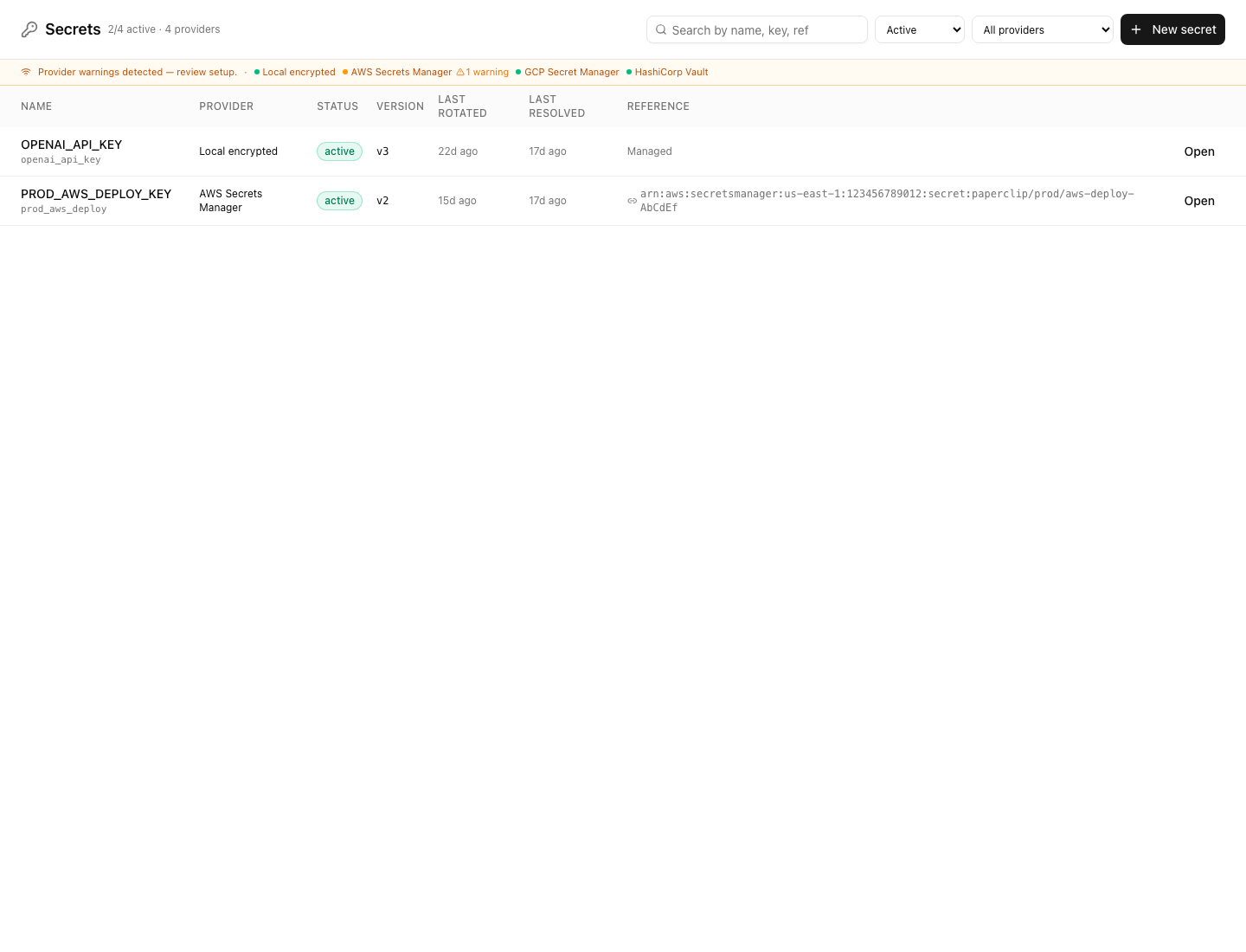
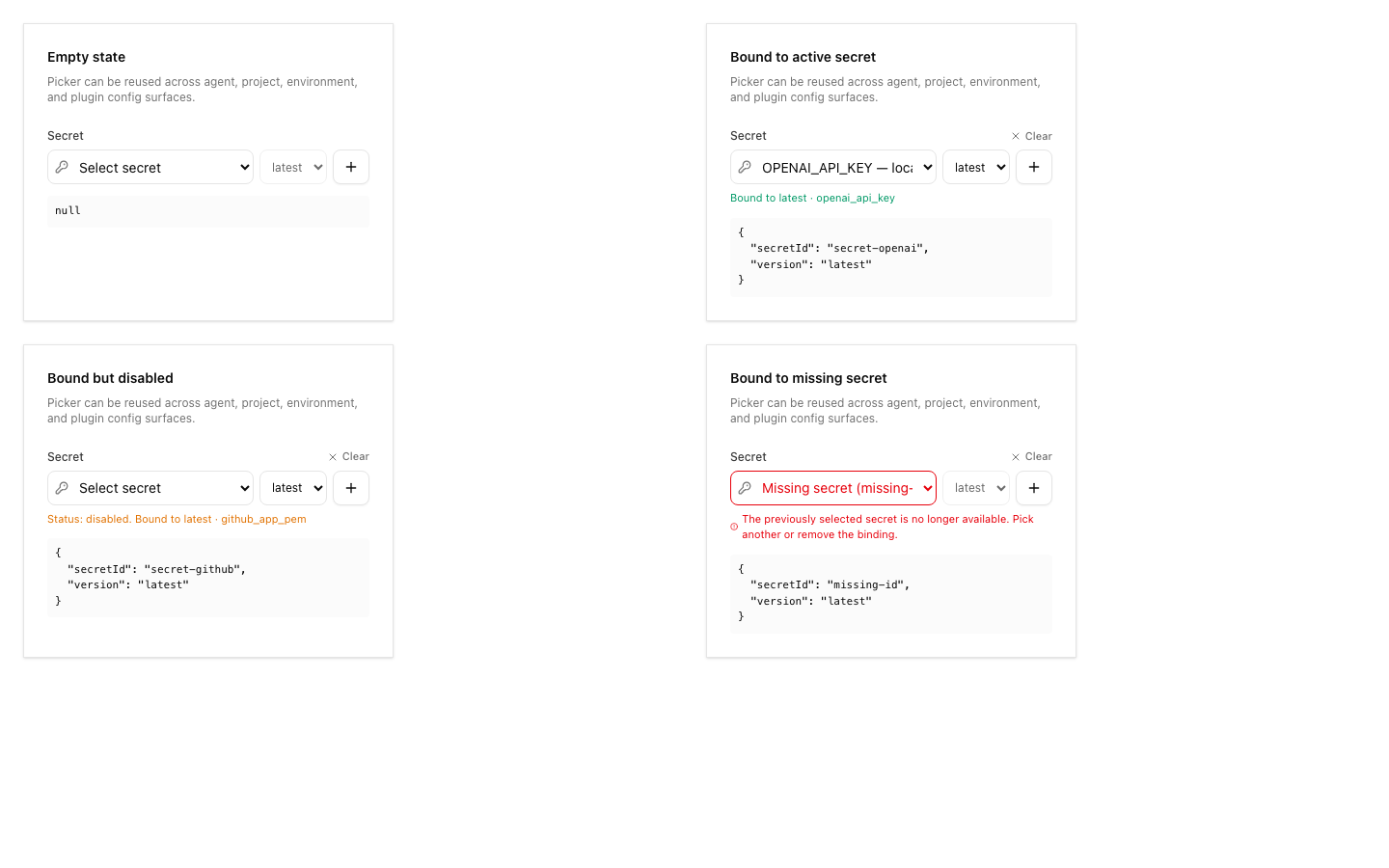
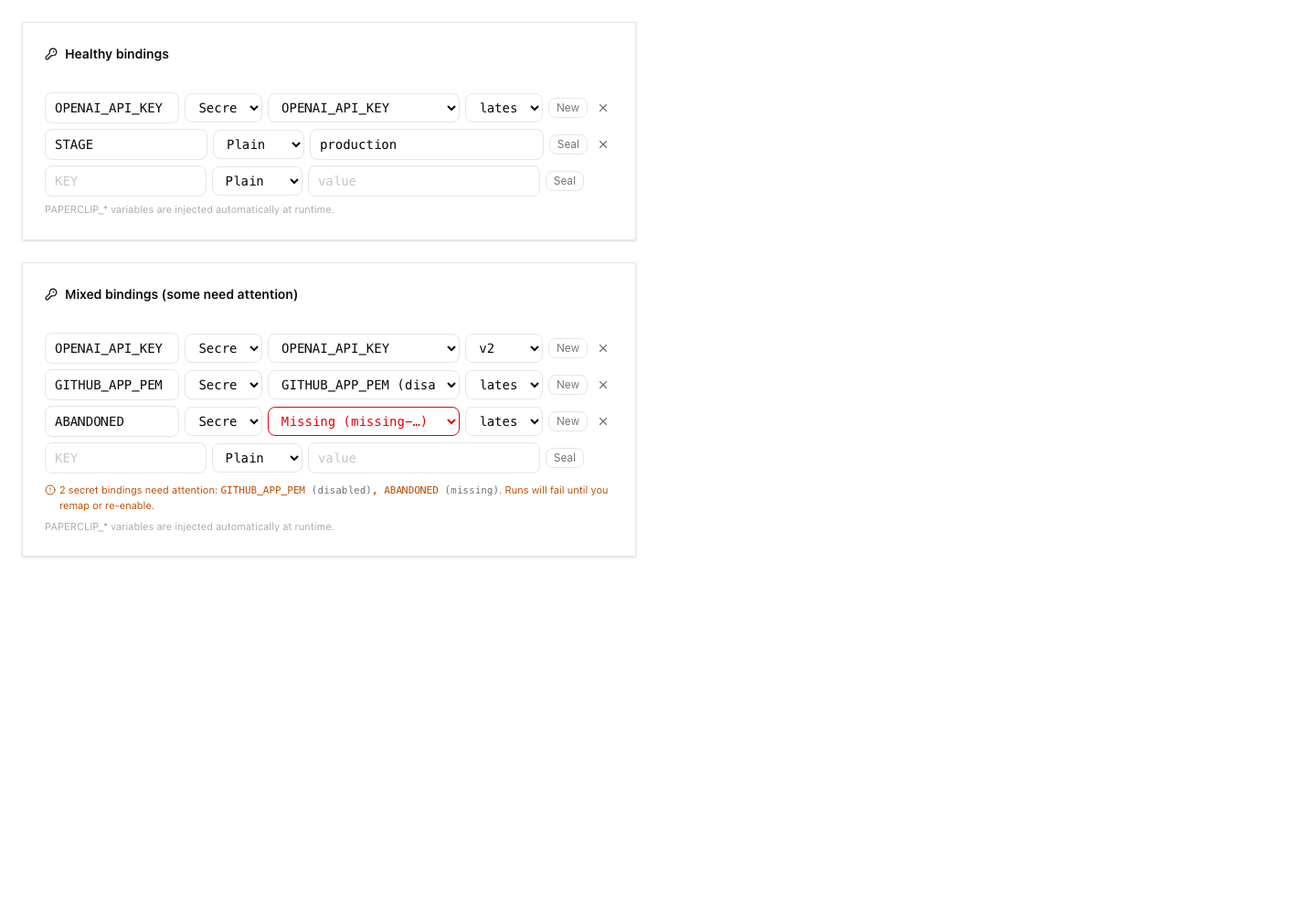
- Added Secrets UI surfaces for vault management and remote import, plus
CLI/API documentation for setup and operations.
- Stabilized routine webhook secret binding paths and SSH
environment-driver fixture bindings discovered during verification.
- Addressed Greptile and CI findings: no lockfile/package drift,
monotonic migration metadata, disabled-vault default races, soft-deleted
secret hiding/recreate behavior, remove behavior with disabled vaults,
soft-deleted external-reference re-import, non-active rotation guards,
managed-secret soft deletion through PATCH, and per-call AWS SDK
credential client churn.
- Rebased this branch onto `public-gh/master` at `0e1a5828` and
force-pushed with lease to keep this as the single PR for the branch.
## Verification
- `git fetch public-gh master`
- `git rebase public-gh/master`
- `git diff --name-only public-gh/master...HEAD | grep
'^pnpm-lock\.yaml$' || true` confirmed `pnpm-lock.yaml` is not in the PR
diff.
- Confirmed migration ordering: master ends at `0081_optimal_dormammu`;
this PR adds `0082_dry_vision` and
`0083_company_secret_provider_configs`.
- Inspected migrations for repeat safety: new tables/indexes use `IF NOT
EXISTS`; foreign keys are guarded by `DO $$ ... IF NOT EXISTS`; column
additions use `ADD COLUMN IF NOT EXISTS`.
- `pnpm -r typecheck` passed before the Greptile follow-up commits.
- `pnpm test:run` ran the full stable Vitest path before the Greptile
follow-up commits; it completed with 3 timing-related failures under
parallel load: `codex-local-execute.test.ts`,
`cursor-local-execute.test.ts`, and `environment-service.test.ts`.
- `pnpm --filter @paperclipai/server exec vitest run
src/__tests__/codex-local-execute.test.ts
src/__tests__/cursor-local-execute.test.ts
src/__tests__/environment-service.test.ts` passed on targeted rerun
(`24/24`).
- `pnpm build` passed before the Greptile follow-up commits. Vite
reported existing chunk-size/dynamic-import warnings.
- After Greptile follow-up commits: `pnpm --filter @paperclipai/server
exec vitest run src/__tests__/secrets-service.test.ts` passed (`26/26`).
- After Greptile follow-up commits: `pnpm --filter @paperclipai/server
exec vitest run src/__tests__/aws-secrets-manager-provider.test.ts
src/__tests__/secrets-service.test.ts` passed (`39/39`).
- After Greptile follow-up commits: `pnpm --filter @paperclipai/server
typecheck` passed.
- Captured Storybook screenshots from `ui/storybook-static` for visual
review.
- Latest PR checks on `5ca3a5cf`: `policy`, serialized server suites
1/4-4/4, `Canary Dry Run`, `e2e`, `security/snyk`, and `Greptile Review`
pass; aggregate `verify` is still registering the completed child
checks.
- Greptile review loop continued through the latest requested pass; all
Greptile review threads are resolved and the latest `Greptile Review`
check on `5ca3a5cf` passed with 0 comments added.
## Screenshots
Before: the provider-vault and remote-import surfaces did not exist on
`master`; these are after-state screenshots from the Storybook fixtures.
## Risks
- Migration risk: this adds new secret provider tables and extends
existing secret rows. The migrations were checked for monotonic ordering
and idempotent guards, but reviewers should still inspect upgrade
behavior carefully.
- Provider risk: AWS support uses direct SigV4 requests. Automated tests
cover signing, request timeouts, vault-config selection, namespace
guardrails, pending-version archival, sanitized provider errors, and
service-level cleanup paths. A real-vault AWS smoke test remains
deployment validation for an operator with AWS credentials rather than
an unverified merge blocker in this local branch.
- UI risk: the Secrets page and import dialog are large new surfaces;
screenshots are included above for reviewer inspection.
- Verification risk: the full local stable test command hit
parallel-load timing failures, although the exact failed files passed
when rerun directly.
- Operational risk: remote import intentionally avoids plaintext reads;
operators must understand that imported external references resolve at
runtime and may fail if AWS permissions change.
> For core feature work, check [`ROADMAP.md`](ROADMAP.md) first and
discuss it in `#dev` before opening the PR. Feature PRs that overlap
with planned core work may need to be redirected — check the roadmap
first. See `CONTRIBUTING.md`.
## Model Used
- OpenAI Codex, GPT-5 coding agent with local shell/tool use in the
Paperclip worktree. Exact context-window size was not exposed by the
runtime.
## Checklist
- [x] I have included a thinking path that traces from project context
to this change
- [x] I have specified the model used (with version and capability
details)
- [x] I have checked ROADMAP.md and confirmed this PR does not duplicate
planned core work
- [ ] I have run tests locally and they pass
- [x] I have added or updated tests where applicable
- [x] If this change affects the UI, I have included before/after
screenshots
- [x] I have updated relevant documentation to reflect my changes
- [x] I have considered and documented any risks above
- [x] I will address all Greptile and reviewer comments before
requesting merge
---------
Co-authored-by: Paperclip <noreply@paperclip.ing>
Co-authored-by: Claude Sonnet 4.6 <noreply@anthropic.com>
2026-05-09 18:22:17 -05:00
|
|
|
// runSshCommand owns profile sourcing and the outer shell wrapper —
|
Sanitize remote execution envs at the boundary (#5325)
## Thinking Path
> - Paperclip orchestrates AI agents for zero-human companies
> - Adapters spawn CLIs against local, SSH, and sandbox targets,
threading a runtime env through `runAdapterExecutionTargetProcess` and
the SSH/sandbox runners
> - Host identity vars (HOME, TMPDIR, XDG_*, NVM_DIR, PATH) routinely
leak into the env we send to remote targets — sometimes via test probes,
sometimes via runtime config — and break sandboxed/SSH'd CLIs whose own
profiles set those values correctly
> - The sanitization logic existed but lived alongside other helpers in
`server-utils.ts` and was applied piecemeal at adapter callsites, so it
was easy to bypass
> - This pull request lifts the sanitization into a standalone
`remote-execution-env.ts`, applies it at the SSH and sandbox runtime
boundary so every remote spawn goes through it, and removes the
duplicated callsite-level filtering
> - The benefit is identity-bound host env stops leaking across
SSH/sandbox transports regardless of which adapter calls in
## What Changed
- `packages/adapter-utils/src/remote-execution-env.ts`: new module —
single source of truth for which env keys are identity-bound and how to
strip them when the value matches the host's value
- `packages/adapter-utils/src/server-utils.ts`: remove the inline
sanitization (now in `remote-execution-env.ts`)
- `packages/adapter-utils/src/execution-target.ts`: apply sanitization
at the sandbox runtime boundary
- `packages/adapter-utils/src/ssh.ts`: apply sanitization at the SSH
spawn boundary
- `packages/adapters/opencode-local/src/server/test.ts`: drop
now-redundant callsite filtering
- `packages/adapters/pi-local/src/server/test.ts`: drop now-redundant
callsite filtering
- New tests `execution-target.test.ts` and
`execution-target-sandbox.test.ts` cover the sanitizer flow at both
transports, including positive cases (host-shaped path stripped) and
explicit-override preservation
## Verification
- `pnpm vitest run --no-coverage --project @paperclipai/adapter-utils
--project @paperclipai/adapter-opencode-local --project
@paperclipai/adapter-pi-local`
- `pnpm typecheck` clean
## Risks
Low–medium. The sanitization is now applied at one layer (boundary)
instead of N (callsites), so behavior is more consistent. Any adapter
that previously relied on a leaked host var landing on the remote shell
would now see it stripped — but those reliances were what this change
exists to fix.
## Model Used
Claude Opus 4.7 (1M context)
## Checklist
- [x] I have included a thinking path that traces from project context
to this change
- [x] I have specified the model used (with version and capability
details)
- [x] I have checked ROADMAP.md and confirmed this PR does not duplicate
planned core work
- [x] I have run tests locally and they pass
- [x] I have added or updated tests where applicable — new tests at both
transports
- [x] If this change affects the UI, I have included before/after
screenshots — N/A (no UI)
- [x] I have updated relevant documentation to reflect my changes
- [x] I have considered and documented any risks above
- [x] I will address all Greptile and reviewer comments before
requesting merge
2026-05-05 19:30:14 -07:00
|
|
|
// the caller passes the raw command string. Wrapping it here would
|
|
|
|
|
// double-nest the login shell and re-source profiles after the explicit
|
|
|
|
|
// env override, silently undoing identity-var preservation.
|
Add SSH environment support (#4358)
## Thinking Path
> - Paperclip orchestrates AI agents for zero-human companies
> - The environments subsystem already models execution environments,
but before this branch there was no end-to-end SSH-backed runtime path
for agents to actually run work against a remote box
> - That meant agents could be configured around environment concepts
without a reliable way to execute adapter sessions remotely, sync
workspace state, and preserve run context across supported adapters
> - We also need environment selection to participate in normal
Paperclip control-plane behavior: agent defaults, project/issue
selection, route validation, and environment probing
> - Because this capability is still experimental, the UI surface should
be easy to hide and easy to remove later without undoing the underlying
implementation
> - This pull request adds SSH environment execution support across the
runtime, adapters, routes, schema, and tests, then puts the visible
environment-management UI behind an experimental flag
> - The benefit is that we can validate real SSH-backed agent execution
now while keeping the user-facing controls safely gated until the
feature is ready to come out of experimentation
## What Changed
- Added SSH-backed execution target support in the shared adapter
runtime, including remote workspace preparation, skill/runtime asset
sync, remote session handling, and workspace restore behavior after
runs.
- Added SSH execution coverage for supported local adapters, plus remote
execution tests across Claude, Codex, Cursor, Gemini, OpenCode, and Pi.
- Added environment selection and environment-management backend support
needed for SSH execution, including route/service work, validation,
probing, and agent default environment persistence.
- Added CLI support for SSH environment lab verification and updated
related docs/tests.
- Added the `enableEnvironments` experimental flag and gated the
environment UI behind it on company settings, agent configuration, and
project configuration surfaces.
## Verification
- `pnpm exec vitest run
packages/adapters/claude-local/src/server/execute.remote.test.ts
packages/adapters/cursor-local/src/server/execute.remote.test.ts
packages/adapters/gemini-local/src/server/execute.remote.test.ts
packages/adapters/opencode-local/src/server/execute.remote.test.ts
packages/adapters/pi-local/src/server/execute.remote.test.ts`
- `pnpm exec vitest run server/src/__tests__/environment-routes.test.ts`
- `pnpm exec vitest run
server/src/__tests__/instance-settings-routes.test.ts`
- `pnpm exec vitest run ui/src/lib/new-agent-hire-payload.test.ts
ui/src/lib/new-agent-runtime-config.test.ts`
- `pnpm -r typecheck`
- `pnpm build`
- Manual verification on a branch-local dev server:
- enabled the experimental flag
- created an SSH environment
- created a Linux Claude agent using that environment
- confirmed a run executed on the Linux box and synced workspace changes
back
## Risks
- Medium: this touches runtime execution flow across multiple adapters,
so regressions would likely show up in remote session setup, workspace
sync, or environment selection precedence.
- The UI flag reduces exposure, but the underlying runtime and route
changes are still substantial and rely on migration correctness.
- The change set is broad across adapters, control-plane services,
migrations, and UI gating, so review should pay close attention to
environment-selection precedence and remote workspace lifecycle
behavior.
## Model Used
- OpenAI Codex via Paperclip's local Codex adapter, GPT-5-class coding
model with tool use and code execution in the local repo workspace. The
local adapter does not surface a more specific public model version
string in this branch workflow.
## Checklist
- [x] I have included a thinking path that traces from project context
to this change
- [x] I have specified the model used (with version and capability
details)
- [x] I have checked ROADMAP.md and confirmed this PR does not duplicate
planned core work
- [x] I have run tests locally and they pass
- [x] I have added or updated tests where applicable
- [ ] If this change affects the UI, I have included before/after
screenshots
- [x] I have updated relevant documentation to reflect my changes
- [x] I have considered and documented any risks above
- [x] I will address all Greptile and reviewer comments before
requesting merge
2026-04-23 19:15:22 -07:00
|
|
|
expect(runSshCommandSpy).toHaveBeenCalledWith(
|
|
|
|
|
expect.objectContaining({
|
|
|
|
|
host: "ssh.example.test",
|
|
|
|
|
username: "ssh-user",
|
|
|
|
|
}),
|
Sanitize remote execution envs at the boundary (#5325)
## Thinking Path
> - Paperclip orchestrates AI agents for zero-human companies
> - Adapters spawn CLIs against local, SSH, and sandbox targets,
threading a runtime env through `runAdapterExecutionTargetProcess` and
the SSH/sandbox runners
> - Host identity vars (HOME, TMPDIR, XDG_*, NVM_DIR, PATH) routinely
leak into the env we send to remote targets — sometimes via test probes,
sometimes via runtime config — and break sandboxed/SSH'd CLIs whose own
profiles set those values correctly
> - The sanitization logic existed but lived alongside other helpers in
`server-utils.ts` and was applied piecemeal at adapter callsites, so it
was easy to bypass
> - This pull request lifts the sanitization into a standalone
`remote-execution-env.ts`, applies it at the SSH and sandbox runtime
boundary so every remote spawn goes through it, and removes the
duplicated callsite-level filtering
> - The benefit is identity-bound host env stops leaking across
SSH/sandbox transports regardless of which adapter calls in
## What Changed
- `packages/adapter-utils/src/remote-execution-env.ts`: new module —
single source of truth for which env keys are identity-bound and how to
strip them when the value matches the host's value
- `packages/adapter-utils/src/server-utils.ts`: remove the inline
sanitization (now in `remote-execution-env.ts`)
- `packages/adapter-utils/src/execution-target.ts`: apply sanitization
at the sandbox runtime boundary
- `packages/adapter-utils/src/ssh.ts`: apply sanitization at the SSH
spawn boundary
- `packages/adapters/opencode-local/src/server/test.ts`: drop
now-redundant callsite filtering
- `packages/adapters/pi-local/src/server/test.ts`: drop now-redundant
callsite filtering
- New tests `execution-target.test.ts` and
`execution-target-sandbox.test.ts` cover the sanitizer flow at both
transports, including positive cases (host-shaped path stripped) and
explicit-override preservation
## Verification
- `pnpm vitest run --no-coverage --project @paperclipai/adapter-utils
--project @paperclipai/adapter-opencode-local --project
@paperclipai/adapter-pi-local`
- `pnpm typecheck` clean
## Risks
Low–medium. The sanitization is now applied at one layer (boundary)
instead of N (callsites), so behavior is more consistent. Any adapter
that previously relied on a leaked host var landing on the remote shell
would now see it stripped — but those reliances were what this change
exists to fix.
## Model Used
Claude Opus 4.7 (1M context)
## Checklist
- [x] I have included a thinking path that traces from project context
to this change
- [x] I have specified the model used (with version and capability
details)
- [x] I have checked ROADMAP.md and confirmed this PR does not duplicate
planned core work
- [x] I have run tests locally and they pass
- [x] I have added or updated tests where applicable — new tests at both
transports
- [x] If this change affects the UI, I have included before/after
screenshots — N/A (no UI)
- [x] I have updated relevant documentation to reflect my changes
- [x] I have considered and documented any risks above
- [x] I will address all Greptile and reviewer comments before
requesting merge
2026-05-05 19:30:14 -07:00
|
|
|
`printf '%s\\n' "$HOME" && echo "it's ok"`,
|
|
|
|
|
expect.any(Object),
|
|
|
|
|
);
|
|
|
|
|
});
|
|
|
|
|
|
|
|
|
|
it("sanitizes inherited host env before SSH shell execution", async () => {
|
|
|
|
|
vi.stubEnv("PATH", "/host/bin:/usr/bin");
|
|
|
|
|
vi.stubEnv("HOME", "/Users/local");
|
|
|
|
|
|
|
|
|
|
const runSshCommandSpy = vi.spyOn(ssh, "runSshCommand").mockResolvedValue({
|
|
|
|
|
stdout: "",
|
|
|
|
|
stderr: "",
|
|
|
|
|
});
|
|
|
|
|
|
|
|
|
|
await runAdapterExecutionTargetShellCommand(
|
|
|
|
|
"run-1b",
|
|
|
|
|
{
|
|
|
|
|
kind: "remote",
|
|
|
|
|
transport: "ssh",
|
|
|
|
|
remoteCwd: "/srv/paperclip/workspace",
|
|
|
|
|
spec: {
|
|
|
|
|
host: "ssh.example.test",
|
|
|
|
|
port: 22,
|
|
|
|
|
username: "ssh-user",
|
|
|
|
|
remoteCwd: "/srv/paperclip/workspace",
|
|
|
|
|
remoteWorkspacePath: "/srv/paperclip/workspace",
|
|
|
|
|
privateKey: null,
|
|
|
|
|
knownHosts: null,
|
|
|
|
|
strictHostKeyChecking: true,
|
|
|
|
|
},
|
|
|
|
|
},
|
|
|
|
|
"env",
|
|
|
|
|
{
|
|
|
|
|
cwd: "/tmp/local",
|
|
|
|
|
env: {
|
|
|
|
|
PATH: "/host/bin:/usr/bin",
|
|
|
|
|
HOME: "/Users/local",
|
|
|
|
|
SAFE_VALUE: "visible",
|
|
|
|
|
},
|
|
|
|
|
},
|
|
|
|
|
);
|
|
|
|
|
|
|
|
|
|
expect(runSshCommandSpy).toHaveBeenCalledWith(
|
Add SSH environment support (#4358)
## Thinking Path
> - Paperclip orchestrates AI agents for zero-human companies
> - The environments subsystem already models execution environments,
but before this branch there was no end-to-end SSH-backed runtime path
for agents to actually run work against a remote box
> - That meant agents could be configured around environment concepts
without a reliable way to execute adapter sessions remotely, sync
workspace state, and preserve run context across supported adapters
> - We also need environment selection to participate in normal
Paperclip control-plane behavior: agent defaults, project/issue
selection, route validation, and environment probing
> - Because this capability is still experimental, the UI surface should
be easy to hide and easy to remove later without undoing the underlying
implementation
> - This pull request adds SSH environment execution support across the
runtime, adapters, routes, schema, and tests, then puts the visible
environment-management UI behind an experimental flag
> - The benefit is that we can validate real SSH-backed agent execution
now while keeping the user-facing controls safely gated until the
feature is ready to come out of experimentation
## What Changed
- Added SSH-backed execution target support in the shared adapter
runtime, including remote workspace preparation, skill/runtime asset
sync, remote session handling, and workspace restore behavior after
runs.
- Added SSH execution coverage for supported local adapters, plus remote
execution tests across Claude, Codex, Cursor, Gemini, OpenCode, and Pi.
- Added environment selection and environment-management backend support
needed for SSH execution, including route/service work, validation,
probing, and agent default environment persistence.
- Added CLI support for SSH environment lab verification and updated
related docs/tests.
- Added the `enableEnvironments` experimental flag and gated the
environment UI behind it on company settings, agent configuration, and
project configuration surfaces.
## Verification
- `pnpm exec vitest run
packages/adapters/claude-local/src/server/execute.remote.test.ts
packages/adapters/cursor-local/src/server/execute.remote.test.ts
packages/adapters/gemini-local/src/server/execute.remote.test.ts
packages/adapters/opencode-local/src/server/execute.remote.test.ts
packages/adapters/pi-local/src/server/execute.remote.test.ts`
- `pnpm exec vitest run server/src/__tests__/environment-routes.test.ts`
- `pnpm exec vitest run
server/src/__tests__/instance-settings-routes.test.ts`
- `pnpm exec vitest run ui/src/lib/new-agent-hire-payload.test.ts
ui/src/lib/new-agent-runtime-config.test.ts`
- `pnpm -r typecheck`
- `pnpm build`
- Manual verification on a branch-local dev server:
- enabled the experimental flag
- created an SSH environment
- created a Linux Claude agent using that environment
- confirmed a run executed on the Linux box and synced workspace changes
back
## Risks
- Medium: this touches runtime execution flow across multiple adapters,
so regressions would likely show up in remote session setup, workspace
sync, or environment selection precedence.
- The UI flag reduces exposure, but the underlying runtime and route
changes are still substantial and rely on migration correctness.
- The change set is broad across adapters, control-plane services,
migrations, and UI gating, so review should pay close attention to
environment-selection precedence and remote workspace lifecycle
behavior.
## Model Used
- OpenAI Codex via Paperclip's local Codex adapter, GPT-5-class coding
model with tool use and code execution in the local repo workspace. The
local adapter does not surface a more specific public model version
string in this branch workflow.
## Checklist
- [x] I have included a thinking path that traces from project context
to this change
- [x] I have specified the model used (with version and capability
details)
- [x] I have checked ROADMAP.md and confirmed this PR does not duplicate
planned core work
- [x] I have run tests locally and they pass
- [x] I have added or updated tests where applicable
- [ ] If this change affects the UI, I have included before/after
screenshots
- [x] I have updated relevant documentation to reflect my changes
- [x] I have considered and documented any risks above
- [x] I will address all Greptile and reviewer comments before
requesting merge
2026-04-23 19:15:22 -07:00
|
|
|
expect.any(Object),
|
Sanitize remote execution envs at the boundary (#5325)
## Thinking Path
> - Paperclip orchestrates AI agents for zero-human companies
> - Adapters spawn CLIs against local, SSH, and sandbox targets,
threading a runtime env through `runAdapterExecutionTargetProcess` and
the SSH/sandbox runners
> - Host identity vars (HOME, TMPDIR, XDG_*, NVM_DIR, PATH) routinely
leak into the env we send to remote targets — sometimes via test probes,
sometimes via runtime config — and break sandboxed/SSH'd CLIs whose own
profiles set those values correctly
> - The sanitization logic existed but lived alongside other helpers in
`server-utils.ts` and was applied piecemeal at adapter callsites, so it
was easy to bypass
> - This pull request lifts the sanitization into a standalone
`remote-execution-env.ts`, applies it at the SSH and sandbox runtime
boundary so every remote spawn goes through it, and removes the
duplicated callsite-level filtering
> - The benefit is identity-bound host env stops leaking across
SSH/sandbox transports regardless of which adapter calls in
## What Changed
- `packages/adapter-utils/src/remote-execution-env.ts`: new module —
single source of truth for which env keys are identity-bound and how to
strip them when the value matches the host's value
- `packages/adapter-utils/src/server-utils.ts`: remove the inline
sanitization (now in `remote-execution-env.ts`)
- `packages/adapter-utils/src/execution-target.ts`: apply sanitization
at the sandbox runtime boundary
- `packages/adapter-utils/src/ssh.ts`: apply sanitization at the SSH
spawn boundary
- `packages/adapters/opencode-local/src/server/test.ts`: drop
now-redundant callsite filtering
- `packages/adapters/pi-local/src/server/test.ts`: drop now-redundant
callsite filtering
- New tests `execution-target.test.ts` and
`execution-target-sandbox.test.ts` cover the sanitizer flow at both
transports, including positive cases (host-shaped path stripped) and
explicit-override preservation
## Verification
- `pnpm vitest run --no-coverage --project @paperclipai/adapter-utils
--project @paperclipai/adapter-opencode-local --project
@paperclipai/adapter-pi-local`
- `pnpm typecheck` clean
## Risks
Low–medium. The sanitization is now applied at one layer (boundary)
instead of N (callsites), so behavior is more consistent. Any adapter
that previously relied on a leaked host var landing on the remote shell
would now see it stripped — but those reliances were what this change
exists to fix.
## Model Used
Claude Opus 4.7 (1M context)
## Checklist
- [x] I have included a thinking path that traces from project context
to this change
- [x] I have specified the model used (with version and capability
details)
- [x] I have checked ROADMAP.md and confirmed this PR does not duplicate
planned core work
- [x] I have run tests locally and they pass
- [x] I have added or updated tests where applicable — new tests at both
transports
- [x] If this change affects the UI, I have included before/after
screenshots — N/A (no UI)
- [x] I have updated relevant documentation to reflect my changes
- [x] I have considered and documented any risks above
- [x] I will address all Greptile and reviewer comments before
requesting merge
2026-05-05 19:30:14 -07:00
|
|
|
expect.any(String),
|
|
|
|
|
expect.objectContaining({
|
|
|
|
|
env: {
|
|
|
|
|
SAFE_VALUE: "visible",
|
|
|
|
|
},
|
|
|
|
|
}),
|
Add SSH environment support (#4358)
## Thinking Path
> - Paperclip orchestrates AI agents for zero-human companies
> - The environments subsystem already models execution environments,
but before this branch there was no end-to-end SSH-backed runtime path
for agents to actually run work against a remote box
> - That meant agents could be configured around environment concepts
without a reliable way to execute adapter sessions remotely, sync
workspace state, and preserve run context across supported adapters
> - We also need environment selection to participate in normal
Paperclip control-plane behavior: agent defaults, project/issue
selection, route validation, and environment probing
> - Because this capability is still experimental, the UI surface should
be easy to hide and easy to remove later without undoing the underlying
implementation
> - This pull request adds SSH environment execution support across the
runtime, adapters, routes, schema, and tests, then puts the visible
environment-management UI behind an experimental flag
> - The benefit is that we can validate real SSH-backed agent execution
now while keeping the user-facing controls safely gated until the
feature is ready to come out of experimentation
## What Changed
- Added SSH-backed execution target support in the shared adapter
runtime, including remote workspace preparation, skill/runtime asset
sync, remote session handling, and workspace restore behavior after
runs.
- Added SSH execution coverage for supported local adapters, plus remote
execution tests across Claude, Codex, Cursor, Gemini, OpenCode, and Pi.
- Added environment selection and environment-management backend support
needed for SSH execution, including route/service work, validation,
probing, and agent default environment persistence.
- Added CLI support for SSH environment lab verification and updated
related docs/tests.
- Added the `enableEnvironments` experimental flag and gated the
environment UI behind it on company settings, agent configuration, and
project configuration surfaces.
## Verification
- `pnpm exec vitest run
packages/adapters/claude-local/src/server/execute.remote.test.ts
packages/adapters/cursor-local/src/server/execute.remote.test.ts
packages/adapters/gemini-local/src/server/execute.remote.test.ts
packages/adapters/opencode-local/src/server/execute.remote.test.ts
packages/adapters/pi-local/src/server/execute.remote.test.ts`
- `pnpm exec vitest run server/src/__tests__/environment-routes.test.ts`
- `pnpm exec vitest run
server/src/__tests__/instance-settings-routes.test.ts`
- `pnpm exec vitest run ui/src/lib/new-agent-hire-payload.test.ts
ui/src/lib/new-agent-runtime-config.test.ts`
- `pnpm -r typecheck`
- `pnpm build`
- Manual verification on a branch-local dev server:
- enabled the experimental flag
- created an SSH environment
- created a Linux Claude agent using that environment
- confirmed a run executed on the Linux box and synced workspace changes
back
## Risks
- Medium: this touches runtime execution flow across multiple adapters,
so regressions would likely show up in remote session setup, workspace
sync, or environment selection precedence.
- The UI flag reduces exposure, but the underlying runtime and route
changes are still substantial and rely on migration correctness.
- The change set is broad across adapters, control-plane services,
migrations, and UI gating, so review should pay close attention to
environment-selection precedence and remote workspace lifecycle
behavior.
## Model Used
- OpenAI Codex via Paperclip's local Codex adapter, GPT-5-class coding
model with tool use and code execution in the local repo workspace. The
local adapter does not surface a more specific public model version
string in this branch workflow.
## Checklist
- [x] I have included a thinking path that traces from project context
to this change
- [x] I have specified the model used (with version and capability
details)
- [x] I have checked ROADMAP.md and confirmed this PR does not duplicate
planned core work
- [x] I have run tests locally and they pass
- [x] I have added or updated tests where applicable
- [ ] If this change affects the UI, I have included before/after
screenshots
- [x] I have updated relevant documentation to reflect my changes
- [x] I have considered and documented any risks above
- [x] I will address all Greptile and reviewer comments before
requesting merge
2026-04-23 19:15:22 -07:00
|
|
|
);
|
|
|
|
|
});
|
|
|
|
|
|
|
|
|
|
it("returns a timedOut result when the SSH shell command times out", async () => {
|
|
|
|
|
vi.spyOn(ssh, "runSshCommand").mockRejectedValue(Object.assign(new Error("timed out"), {
|
|
|
|
|
code: "ETIMEDOUT",
|
|
|
|
|
stdout: "partial stdout",
|
|
|
|
|
stderr: "partial stderr",
|
|
|
|
|
signal: "SIGTERM",
|
|
|
|
|
}));
|
|
|
|
|
const onLog = vi.fn(async () => {});
|
|
|
|
|
|
|
|
|
|
const result = await runAdapterExecutionTargetShellCommand(
|
|
|
|
|
"run-2",
|
|
|
|
|
{
|
|
|
|
|
kind: "remote",
|
|
|
|
|
transport: "ssh",
|
|
|
|
|
remoteCwd: "/srv/paperclip/workspace",
|
|
|
|
|
spec: {
|
|
|
|
|
host: "ssh.example.test",
|
|
|
|
|
port: 22,
|
|
|
|
|
username: "ssh-user",
|
|
|
|
|
remoteCwd: "/srv/paperclip/workspace",
|
|
|
|
|
remoteWorkspacePath: "/srv/paperclip/workspace",
|
|
|
|
|
privateKey: null,
|
|
|
|
|
knownHosts: null,
|
|
|
|
|
strictHostKeyChecking: true,
|
|
|
|
|
},
|
|
|
|
|
},
|
|
|
|
|
"sleep 10",
|
|
|
|
|
{
|
|
|
|
|
cwd: "/tmp/local",
|
|
|
|
|
env: {},
|
|
|
|
|
onLog,
|
|
|
|
|
},
|
|
|
|
|
);
|
|
|
|
|
|
|
|
|
|
expect(result).toMatchObject({
|
|
|
|
|
exitCode: null,
|
|
|
|
|
signal: "SIGTERM",
|
|
|
|
|
timedOut: true,
|
|
|
|
|
stdout: "partial stdout",
|
|
|
|
|
stderr: "partial stderr",
|
|
|
|
|
});
|
|
|
|
|
expect(onLog).toHaveBeenCalledWith("stdout", "partial stdout");
|
|
|
|
|
expect(onLog).toHaveBeenCalledWith("stderr", "partial stderr");
|
|
|
|
|
});
|
|
|
|
|
|
|
|
|
|
it("returns the SSH process exit code for non-zero remote command failures", async () => {
|
|
|
|
|
vi.spyOn(ssh, "runSshCommand").mockRejectedValue(Object.assign(new Error("non-zero exit"), {
|
|
|
|
|
code: 17,
|
|
|
|
|
stdout: "partial stdout",
|
|
|
|
|
stderr: "partial stderr",
|
|
|
|
|
signal: null,
|
|
|
|
|
}));
|
|
|
|
|
const onLog = vi.fn(async () => {});
|
|
|
|
|
|
|
|
|
|
const result = await runAdapterExecutionTargetShellCommand(
|
|
|
|
|
"run-3",
|
|
|
|
|
{
|
|
|
|
|
kind: "remote",
|
|
|
|
|
transport: "ssh",
|
|
|
|
|
remoteCwd: "/srv/paperclip/workspace",
|
|
|
|
|
spec: {
|
|
|
|
|
host: "ssh.example.test",
|
|
|
|
|
port: 22,
|
|
|
|
|
username: "ssh-user",
|
|
|
|
|
remoteCwd: "/srv/paperclip/workspace",
|
|
|
|
|
remoteWorkspacePath: "/srv/paperclip/workspace",
|
|
|
|
|
privateKey: null,
|
|
|
|
|
knownHosts: null,
|
|
|
|
|
strictHostKeyChecking: true,
|
|
|
|
|
},
|
|
|
|
|
},
|
|
|
|
|
"false",
|
|
|
|
|
{
|
|
|
|
|
cwd: "/tmp/local",
|
|
|
|
|
env: {},
|
|
|
|
|
onLog,
|
|
|
|
|
},
|
|
|
|
|
);
|
|
|
|
|
|
|
|
|
|
expect(result).toMatchObject({
|
|
|
|
|
exitCode: 17,
|
|
|
|
|
signal: null,
|
|
|
|
|
timedOut: false,
|
|
|
|
|
stdout: "partial stdout",
|
|
|
|
|
stderr: "partial stderr",
|
|
|
|
|
});
|
|
|
|
|
expect(onLog).toHaveBeenCalledWith("stdout", "partial stdout");
|
|
|
|
|
expect(onLog).toHaveBeenCalledWith("stderr", "partial stderr");
|
|
|
|
|
});
|
|
|
|
|
|
|
|
|
|
it("keeps managed homes disabled for both local and SSH targets", () => {
|
|
|
|
|
expect(adapterExecutionTargetUsesManagedHome(null)).toBe(false);
|
|
|
|
|
expect(adapterExecutionTargetUsesManagedHome({
|
|
|
|
|
kind: "remote",
|
|
|
|
|
transport: "ssh",
|
|
|
|
|
remoteCwd: "/srv/paperclip/workspace",
|
|
|
|
|
spec: {
|
|
|
|
|
host: "ssh.example.test",
|
|
|
|
|
port: 22,
|
|
|
|
|
username: "ssh-user",
|
|
|
|
|
remoteCwd: "/srv/paperclip/workspace",
|
|
|
|
|
remoteWorkspacePath: "/srv/paperclip/workspace",
|
|
|
|
|
privateKey: null,
|
|
|
|
|
knownHosts: null,
|
|
|
|
|
strictHostKeyChecking: true,
|
|
|
|
|
},
|
|
|
|
|
})).toBe(false);
|
|
|
|
|
});
|
|
|
|
|
});
|
Add dedicated environment settings page and test-in-environment (#4798)
## Thinking Path
> - Paperclip orchestrates AI agents for zero-human companies
> - Agents run inside environments (local, SSH, E2B sandbox)
> - Operators need to configure and manage these environments
> - But environment settings were buried inside the general company
settings page, making them hard to find
> - Additionally, when testing an agent from the configuration form, the
test always ran locally regardless of which environment was selected
> - This PR moves environments into a dedicated top-level company
settings section and wires the "Test Environment" button to run inside
the selected environment
> - The benefit is operators can find and manage environments more
easily, and the test button now validates the actual environment the
agent will use
## What Changed
- Added a dedicated `CompanyEnvironments` settings page with its own
route and sidebar entry
- Updated `CompanySettingsSidebar` and `CompanySettingsNav` to include
the new environments section
- Modified the agent test route (`POST /agents/:id/test`) to accept an
optional `environmentId` parameter
- Updated all adapter `test.ts` handlers to resolve and use the
specified execution target environment
- Added `resolveTestExecutionTarget` to `execution-target.ts` for remote
environment test resolution with cwd fallback
- Moved the "Test Environment" button and its feedback display into the
`NewAgent` page footer for better UX flow
## Verification
- `pnpm test` — all existing and new tests pass
- `pnpm typecheck` — clean
- Manual: navigate to Company Settings, confirm "Environments" appears
as a top-level section
- Manual: configure an agent with a non-local environment, click "Test
Environment", confirm the test runs inside that environment
## Risks
- Low risk. UI-only routing change for the settings page. The
test-in-environment change adds an optional parameter with a local
fallback, so existing behavior is preserved when no environment is
specified.
## Model Used
Codex GPT 5.4 high via Paperclip.
## Checklist
- [x] I have included a thinking path that traces from project context
to this change
- [x] I have specified the model used (with version and capability
details)
- [x] I have checked ROADMAP.md and confirmed this PR does not duplicate
planned core work
- [x] I have run tests locally and they pass
- [x] I have added or updated tests where applicable
- [x] If this change affects the UI, I have included before/after
screenshots
- [x] I have updated relevant documentation to reflect my changes
- [x] I have considered and documented any risks above
- [x] I will address all Greptile and reviewer comments before
requesting merge
2026-04-29 15:56:13 -07:00
|
|
|
|
Sanitize remote execution envs at the boundary (#5325)
## Thinking Path
> - Paperclip orchestrates AI agents for zero-human companies
> - Adapters spawn CLIs against local, SSH, and sandbox targets,
threading a runtime env through `runAdapterExecutionTargetProcess` and
the SSH/sandbox runners
> - Host identity vars (HOME, TMPDIR, XDG_*, NVM_DIR, PATH) routinely
leak into the env we send to remote targets — sometimes via test probes,
sometimes via runtime config — and break sandboxed/SSH'd CLIs whose own
profiles set those values correctly
> - The sanitization logic existed but lived alongside other helpers in
`server-utils.ts` and was applied piecemeal at adapter callsites, so it
was easy to bypass
> - This pull request lifts the sanitization into a standalone
`remote-execution-env.ts`, applies it at the SSH and sandbox runtime
boundary so every remote spawn goes through it, and removes the
duplicated callsite-level filtering
> - The benefit is identity-bound host env stops leaking across
SSH/sandbox transports regardless of which adapter calls in
## What Changed
- `packages/adapter-utils/src/remote-execution-env.ts`: new module —
single source of truth for which env keys are identity-bound and how to
strip them when the value matches the host's value
- `packages/adapter-utils/src/server-utils.ts`: remove the inline
sanitization (now in `remote-execution-env.ts`)
- `packages/adapter-utils/src/execution-target.ts`: apply sanitization
at the sandbox runtime boundary
- `packages/adapter-utils/src/ssh.ts`: apply sanitization at the SSH
spawn boundary
- `packages/adapters/opencode-local/src/server/test.ts`: drop
now-redundant callsite filtering
- `packages/adapters/pi-local/src/server/test.ts`: drop now-redundant
callsite filtering
- New tests `execution-target.test.ts` and
`execution-target-sandbox.test.ts` cover the sanitizer flow at both
transports, including positive cases (host-shaped path stripped) and
explicit-override preservation
## Verification
- `pnpm vitest run --no-coverage --project @paperclipai/adapter-utils
--project @paperclipai/adapter-opencode-local --project
@paperclipai/adapter-pi-local`
- `pnpm typecheck` clean
## Risks
Low–medium. The sanitization is now applied at one layer (boundary)
instead of N (callsites), so behavior is more consistent. Any adapter
that previously relied on a leaked host var landing on the remote shell
would now see it stripped — but those reliances were what this change
exists to fix.
## Model Used
Claude Opus 4.7 (1M context)
## Checklist
- [x] I have included a thinking path that traces from project context
to this change
- [x] I have specified the model used (with version and capability
details)
- [x] I have checked ROADMAP.md and confirmed this PR does not duplicate
planned core work
- [x] I have run tests locally and they pass
- [x] I have added or updated tests where applicable — new tests at both
transports
- [x] If this change affects the UI, I have included before/after
screenshots — N/A (no UI)
- [x] I have updated relevant documentation to reflect my changes
- [x] I have considered and documented any risks above
- [x] I will address all Greptile and reviewer comments before
requesting merge
2026-05-05 19:30:14 -07:00
|
|
|
describe("runAdapterExecutionTargetProcess", () => {
|
|
|
|
|
afterEach(() => {
|
|
|
|
|
vi.restoreAllMocks();
|
|
|
|
|
vi.unstubAllEnvs();
|
|
|
|
|
});
|
|
|
|
|
|
|
|
|
|
it("sanitizes inherited host env before SSH process execution", async () => {
|
|
|
|
|
vi.stubEnv("PATH", "/host/bin:/usr/bin");
|
|
|
|
|
vi.stubEnv("HOME", "/Users/local");
|
|
|
|
|
|
|
|
|
|
const runChildProcessSpy = vi.spyOn(serverUtils, "runChildProcess").mockResolvedValue({
|
|
|
|
|
exitCode: 0,
|
|
|
|
|
signal: null,
|
|
|
|
|
timedOut: false,
|
|
|
|
|
stdout: "",
|
|
|
|
|
stderr: "",
|
|
|
|
|
pid: null,
|
|
|
|
|
startedAt: new Date().toISOString(),
|
|
|
|
|
});
|
|
|
|
|
|
|
|
|
|
await runAdapterExecutionTargetProcess(
|
|
|
|
|
"run-ssh-process",
|
|
|
|
|
{
|
|
|
|
|
kind: "remote",
|
|
|
|
|
transport: "ssh",
|
|
|
|
|
remoteCwd: "/srv/paperclip/workspace",
|
|
|
|
|
spec: {
|
|
|
|
|
host: "ssh.example.test",
|
|
|
|
|
port: 22,
|
|
|
|
|
username: "ssh-user",
|
|
|
|
|
remoteCwd: "/srv/paperclip/workspace",
|
|
|
|
|
remoteWorkspacePath: "/srv/paperclip/workspace",
|
|
|
|
|
privateKey: null,
|
|
|
|
|
knownHosts: null,
|
|
|
|
|
strictHostKeyChecking: true,
|
|
|
|
|
},
|
|
|
|
|
},
|
|
|
|
|
"agent-cli",
|
|
|
|
|
["--json"],
|
|
|
|
|
{
|
|
|
|
|
cwd: "/tmp/local",
|
|
|
|
|
env: {
|
|
|
|
|
PATH: "/host/bin:/usr/bin",
|
|
|
|
|
HOME: "/Users/local",
|
|
|
|
|
SAFE_VALUE: "visible",
|
|
|
|
|
},
|
|
|
|
|
timeoutSec: 5,
|
|
|
|
|
graceSec: 1,
|
|
|
|
|
onLog: async () => {},
|
|
|
|
|
},
|
|
|
|
|
);
|
|
|
|
|
|
|
|
|
|
expect(runChildProcessSpy).toHaveBeenCalledWith(
|
|
|
|
|
"run-ssh-process",
|
|
|
|
|
"agent-cli",
|
|
|
|
|
["--json"],
|
|
|
|
|
expect.objectContaining({
|
|
|
|
|
env: {
|
|
|
|
|
SAFE_VALUE: "visible",
|
|
|
|
|
},
|
|
|
|
|
}),
|
|
|
|
|
);
|
|
|
|
|
});
|
|
|
|
|
});
|
|
|
|
|
|
Let adapters declare runtime command spec for remote provisioning (#5141)
## Thinking Path
> - Paperclip orchestrates AI agents for zero-human companies, running
adapter
> commands like `claude`, `codex`, `pi` either locally or on remote
runtimes
> (SSH hosts, sandboxes, etc.)
> - On a fresh remote runtime — particularly an ephemeral sandbox — the
> adapter's CLI may not be installed yet. Today operators handle this
via
> external configuration (e.g. a project-level `provisionCommand` shell
> script) that has to know about every adapter the operator might want
to use
> - This means every adapter has its own well-known npm package, but
operators
> end up writing duplicate provision shell scripts that paste together
> `npm install -g @anthropic-ai/claude-code`, `npm install -g
@openai/codex`,
> etc. — knowledge the adapter itself already has
> - This PR moves that knowledge into the adapter modules: each adapter
declares
> how its runtime command should be detected and (if applicable)
installed
> via `getRuntimeCommandSpec(config)`. The execution path runs the
adapter's
> own install command on remote sandbox targets before launching, so a
fresh
> sandbox bootstraps itself instead of requiring a hand-written
provision script
> - The benefit is fewer footguns for operators provisioning remote
runtimes,
> and a clean place for new adapters to plug in their install recipe
## What Changed
- New types in `packages/adapter-utils/src/types.ts`:
- `AdapterRuntimeCommandSpec` describing `command`, optional
`detectCommand`, and optional `installCommand`
- Optional `getRuntimeCommandSpec(config)` on `ServerAdapterModule`
- Optional `runtimeCommandSpec` on `AdapterExecutionContext` so adapters
receive the resolved spec at execute time
- New helper `ensureAdapterExecutionTargetRuntimeCommandInstalled(...)`
in
`packages/adapter-utils/src/execution-target.ts` that runs the install
command
on remote targets when `transport === "sandbox"`. SSH and local targets
are
no-ops. Throws on timeout or non-zero exit so failures surface early.
- Each of `claude-local`, `codex-local`, `cursor-local`, `gemini-local`,
`opencode-local`, `pi-local`'s `execute.ts` now reads
`ctx.runtimeCommandSpec?.installCommand` and calls the helper before
launching
the adapter command.
- `server/src/adapters/registry.ts` declares `getRuntimeCommandSpec` for
each
adapter:
- claude/codex/gemini/opencode/pi-local: `npm install -g <package>`
recipe via
a shared `buildNpmRuntimeCommandSpec` helper, with a defensive guard
that
only auto-installs when the configured `command` matches the well-known
fallback (custom binaries are left alone).
- cursor-local: declares `command` only; no auto-install (no public npm
package), preserving the existing manual setup.
- `server/src/services/heartbeat.ts` resolves the spec via
`adapter.getRuntimeCommandSpec?.(runtimeConfig)` and passes it through
to
`AdapterExecutionContext`.
- Tests added in `execution-target.test.ts` (~75 lines), e2b
`plugin.test.ts` (~32 lines), and `environment-run-orchestrator.test.ts`
(~76 lines).
## Verification
- `pnpm --filter @paperclipai/adapter-utils test`
- `pnpm --filter @paperclipai/server test --
environment-run-orchestrator`
- `pnpm --filter @paperclipai/sandbox-providers-e2b test`
- Manual QA: run an adapter (claude/codex/etc.) against a fresh
sandbox-backed
environment that does NOT have the adapter CLI pre-installed. Confirm
the
install runs once at the start of the agent run and the adapter then
launches
successfully. Re-run on the same sandbox; confirm the install command is
idempotent and the second run starts faster.
- Confirm SSH and local execution paths are unaffected (gated by
`transport === "sandbox"`).
## Risks
- Behavioural shift on sandbox runs: a new install step now runs at the
start
of every sandbox agent run for adapters with `installCommand` set. The
install commands are idempotent (`if ! command -v X >/dev/null 2>&1;
then
npm install -g <pkg>; fi`), so this is fast on warm sandboxes. On a cold
sandbox, the first run takes longer.
- Operators who used the legacy project-level `provisionCommand` to
install
adapter CLIs can drop that part of their script; the adapter handles it
now.
Existing scripts continue to work — installs are idempotent.
- The cursor-local adapter has no auto-install (no public npm package).
Behaviour for cursor-local on sandboxes is unchanged.
- New optional surface on `ServerAdapterModule`. Plugins that don't
implement
`getRuntimeCommandSpec` retain previous behaviour (no auto-install).
## Model Used
- OpenAI GPT-5.4 (reasoning effort: high) via Codex CLI
- Provider: OpenAI
- Used to author the code changes in this PR
## Checklist
- [x] I have included a thinking path that traces from project context
to this change
- [x] I have specified the model used (with version and capability
details)
- [x] I have checked ROADMAP.md and confirmed this PR does not duplicate
planned core work
- [x] I have run tests locally and they pass
- [x] I have added or updated tests where applicable
- [ ] If this change affects the UI, I have included before/after
screenshots — N/A
- [ ] I have updated relevant documentation to reflect my changes — N/A
- [x] I have considered and documented any risks above
- [x] I will address all Greptile and reviewer comments before
requesting merge
2026-05-03 18:35:36 -07:00
|
|
|
describe("ensureAdapterExecutionTargetRuntimeCommandInstalled", () => {
|
|
|
|
|
afterEach(() => {
|
|
|
|
|
vi.restoreAllMocks();
|
|
|
|
|
});
|
|
|
|
|
|
|
|
|
|
it("runs install commands for sandbox targets", async () => {
|
|
|
|
|
const runner = {
|
|
|
|
|
execute: vi.fn(async () => ({
|
|
|
|
|
exitCode: 0,
|
|
|
|
|
signal: null,
|
|
|
|
|
timedOut: false,
|
|
|
|
|
stdout: "",
|
|
|
|
|
stderr: "",
|
|
|
|
|
pid: null,
|
|
|
|
|
startedAt: new Date().toISOString(),
|
|
|
|
|
})),
|
|
|
|
|
};
|
|
|
|
|
|
|
|
|
|
await ensureAdapterExecutionTargetRuntimeCommandInstalled({
|
|
|
|
|
runId: "run-install",
|
|
|
|
|
target: {
|
|
|
|
|
kind: "remote",
|
|
|
|
|
transport: "sandbox",
|
|
|
|
|
providerKey: "e2b",
|
|
|
|
|
remoteCwd: "/remote/workspace",
|
|
|
|
|
runner,
|
|
|
|
|
},
|
|
|
|
|
installCommand: "npm install -g @google/gemini-cli",
|
|
|
|
|
cwd: "/local/workspace",
|
|
|
|
|
env: { PATH: "/usr/bin" },
|
|
|
|
|
timeoutSec: 30,
|
|
|
|
|
});
|
|
|
|
|
|
|
|
|
|
expect(runner.execute).toHaveBeenCalledWith(expect.objectContaining({
|
|
|
|
|
command: "sh",
|
Add secrets provider vaults and remote import (#5429)
## Thinking Path
> - Paperclip orchestrates AI-agent companies and needs secrets handling
to work across local development, hosted operators, and governed agent
execution.
> - The affected subsystem is the company-scoped secrets control plane:
database schema, server services/routes, CLI workflows, and the Secrets
settings UI.
> - The gap was that secrets were local-only and operators could not
manage provider vaults or import existing remote references without
exposing plaintext.
> - This branch adds provider vault configuration plus an AWS Secrets
Manager remote-import path while preserving company boundaries, binding
context, and audit trails.
> - I kept the PR to a single branch PR, removed unrelated
lockfile/package drift, rebased the full branch onto the current
`public-gh/master`, and addressed fresh Greptile findings.
> - The benefit is a reviewable implementation of provider-backed
secrets with focused tests covering provider selection, import
conflicts, deleted secret reuse, rotation guards, and AWS signing
behavior.
## What Changed
- Added provider vault support for company secrets, including provider
config storage, default vault handling, health checks, binding usage,
access events, and remote import preview/commit.
- Added an AWS Secrets Manager provider using SigV4 request signing,
bounded request timeouts, namespace guardrails, cached runtime
credential resolution, and external-reference linking without plaintext
reads.
- Added Secrets UI surfaces for vault management and remote import, plus
CLI/API documentation for setup and operations.
- Stabilized routine webhook secret binding paths and SSH
environment-driver fixture bindings discovered during verification.
- Addressed Greptile and CI findings: no lockfile/package drift,
monotonic migration metadata, disabled-vault default races, soft-deleted
secret hiding/recreate behavior, remove behavior with disabled vaults,
soft-deleted external-reference re-import, non-active rotation guards,
managed-secret soft deletion through PATCH, and per-call AWS SDK
credential client churn.
- Rebased this branch onto `public-gh/master` at `0e1a5828` and
force-pushed with lease to keep this as the single PR for the branch.
## Verification
- `git fetch public-gh master`
- `git rebase public-gh/master`
- `git diff --name-only public-gh/master...HEAD | grep
'^pnpm-lock\.yaml$' || true` confirmed `pnpm-lock.yaml` is not in the PR
diff.
- Confirmed migration ordering: master ends at `0081_optimal_dormammu`;
this PR adds `0082_dry_vision` and
`0083_company_secret_provider_configs`.
- Inspected migrations for repeat safety: new tables/indexes use `IF NOT
EXISTS`; foreign keys are guarded by `DO $$ ... IF NOT EXISTS`; column
additions use `ADD COLUMN IF NOT EXISTS`.
- `pnpm -r typecheck` passed before the Greptile follow-up commits.
- `pnpm test:run` ran the full stable Vitest path before the Greptile
follow-up commits; it completed with 3 timing-related failures under
parallel load: `codex-local-execute.test.ts`,
`cursor-local-execute.test.ts`, and `environment-service.test.ts`.
- `pnpm --filter @paperclipai/server exec vitest run
src/__tests__/codex-local-execute.test.ts
src/__tests__/cursor-local-execute.test.ts
src/__tests__/environment-service.test.ts` passed on targeted rerun
(`24/24`).
- `pnpm build` passed before the Greptile follow-up commits. Vite
reported existing chunk-size/dynamic-import warnings.
- After Greptile follow-up commits: `pnpm --filter @paperclipai/server
exec vitest run src/__tests__/secrets-service.test.ts` passed (`26/26`).
- After Greptile follow-up commits: `pnpm --filter @paperclipai/server
exec vitest run src/__tests__/aws-secrets-manager-provider.test.ts
src/__tests__/secrets-service.test.ts` passed (`39/39`).
- After Greptile follow-up commits: `pnpm --filter @paperclipai/server
typecheck` passed.
- Captured Storybook screenshots from `ui/storybook-static` for visual
review.
- Latest PR checks on `5ca3a5cf`: `policy`, serialized server suites
1/4-4/4, `Canary Dry Run`, `e2e`, `security/snyk`, and `Greptile Review`
pass; aggregate `verify` is still registering the completed child
checks.
- Greptile review loop continued through the latest requested pass; all
Greptile review threads are resolved and the latest `Greptile Review`
check on `5ca3a5cf` passed with 0 comments added.
## Screenshots
Before: the provider-vault and remote-import surfaces did not exist on
`master`; these are after-state screenshots from the Storybook fixtures.



## Risks
- Migration risk: this adds new secret provider tables and extends
existing secret rows. The migrations were checked for monotonic ordering
and idempotent guards, but reviewers should still inspect upgrade
behavior carefully.
- Provider risk: AWS support uses direct SigV4 requests. Automated tests
cover signing, request timeouts, vault-config selection, namespace
guardrails, pending-version archival, sanitized provider errors, and
service-level cleanup paths. A real-vault AWS smoke test remains
deployment validation for an operator with AWS credentials rather than
an unverified merge blocker in this local branch.
- UI risk: the Secrets page and import dialog are large new surfaces;
screenshots are included above for reviewer inspection.
- Verification risk: the full local stable test command hit
parallel-load timing failures, although the exact failed files passed
when rerun directly.
- Operational risk: remote import intentionally avoids plaintext reads;
operators must understand that imported external references resolve at
runtime and may fail if AWS permissions change.
> For core feature work, check [`ROADMAP.md`](ROADMAP.md) first and
discuss it in `#dev` before opening the PR. Feature PRs that overlap
with planned core work may need to be redirected — check the roadmap
first. See `CONTRIBUTING.md`.
## Model Used
- OpenAI Codex, GPT-5 coding agent with local shell/tool use in the
Paperclip worktree. Exact context-window size was not exposed by the
runtime.
## Checklist
- [x] I have included a thinking path that traces from project context
to this change
- [x] I have specified the model used (with version and capability
details)
- [x] I have checked ROADMAP.md and confirmed this PR does not duplicate
planned core work
- [ ] I have run tests locally and they pass
- [x] I have added or updated tests where applicable
- [x] If this change affects the UI, I have included before/after
screenshots
- [x] I have updated relevant documentation to reflect my changes
- [x] I have considered and documented any risks above
- [x] I will address all Greptile and reviewer comments before
requesting merge
---------
Co-authored-by: Paperclip <noreply@paperclip.ing>
Co-authored-by: Claude Sonnet 4.6 <noreply@anthropic.com>
2026-05-09 18:22:17 -05:00
|
|
|
args: ["-c", "npm install -g @google/gemini-cli"],
|
Let adapters declare runtime command spec for remote provisioning (#5141)
## Thinking Path
> - Paperclip orchestrates AI agents for zero-human companies, running
adapter
> commands like `claude`, `codex`, `pi` either locally or on remote
runtimes
> (SSH hosts, sandboxes, etc.)
> - On a fresh remote runtime — particularly an ephemeral sandbox — the
> adapter's CLI may not be installed yet. Today operators handle this
via
> external configuration (e.g. a project-level `provisionCommand` shell
> script) that has to know about every adapter the operator might want
to use
> - This means every adapter has its own well-known npm package, but
operators
> end up writing duplicate provision shell scripts that paste together
> `npm install -g @anthropic-ai/claude-code`, `npm install -g
@openai/codex`,
> etc. — knowledge the adapter itself already has
> - This PR moves that knowledge into the adapter modules: each adapter
declares
> how its runtime command should be detected and (if applicable)
installed
> via `getRuntimeCommandSpec(config)`. The execution path runs the
adapter's
> own install command on remote sandbox targets before launching, so a
fresh
> sandbox bootstraps itself instead of requiring a hand-written
provision script
> - The benefit is fewer footguns for operators provisioning remote
runtimes,
> and a clean place for new adapters to plug in their install recipe
## What Changed
- New types in `packages/adapter-utils/src/types.ts`:
- `AdapterRuntimeCommandSpec` describing `command`, optional
`detectCommand`, and optional `installCommand`
- Optional `getRuntimeCommandSpec(config)` on `ServerAdapterModule`
- Optional `runtimeCommandSpec` on `AdapterExecutionContext` so adapters
receive the resolved spec at execute time
- New helper `ensureAdapterExecutionTargetRuntimeCommandInstalled(...)`
in
`packages/adapter-utils/src/execution-target.ts` that runs the install
command
on remote targets when `transport === "sandbox"`. SSH and local targets
are
no-ops. Throws on timeout or non-zero exit so failures surface early.
- Each of `claude-local`, `codex-local`, `cursor-local`, `gemini-local`,
`opencode-local`, `pi-local`'s `execute.ts` now reads
`ctx.runtimeCommandSpec?.installCommand` and calls the helper before
launching
the adapter command.
- `server/src/adapters/registry.ts` declares `getRuntimeCommandSpec` for
each
adapter:
- claude/codex/gemini/opencode/pi-local: `npm install -g <package>`
recipe via
a shared `buildNpmRuntimeCommandSpec` helper, with a defensive guard
that
only auto-installs when the configured `command` matches the well-known
fallback (custom binaries are left alone).
- cursor-local: declares `command` only; no auto-install (no public npm
package), preserving the existing manual setup.
- `server/src/services/heartbeat.ts` resolves the spec via
`adapter.getRuntimeCommandSpec?.(runtimeConfig)` and passes it through
to
`AdapterExecutionContext`.
- Tests added in `execution-target.test.ts` (~75 lines), e2b
`plugin.test.ts` (~32 lines), and `environment-run-orchestrator.test.ts`
(~76 lines).
## Verification
- `pnpm --filter @paperclipai/adapter-utils test`
- `pnpm --filter @paperclipai/server test --
environment-run-orchestrator`
- `pnpm --filter @paperclipai/sandbox-providers-e2b test`
- Manual QA: run an adapter (claude/codex/etc.) against a fresh
sandbox-backed
environment that does NOT have the adapter CLI pre-installed. Confirm
the
install runs once at the start of the agent run and the adapter then
launches
successfully. Re-run on the same sandbox; confirm the install command is
idempotent and the second run starts faster.
- Confirm SSH and local execution paths are unaffected (gated by
`transport === "sandbox"`).
## Risks
- Behavioural shift on sandbox runs: a new install step now runs at the
start
of every sandbox agent run for adapters with `installCommand` set. The
install commands are idempotent (`if ! command -v X >/dev/null 2>&1;
then
npm install -g <pkg>; fi`), so this is fast on warm sandboxes. On a cold
sandbox, the first run takes longer.
- Operators who used the legacy project-level `provisionCommand` to
install
adapter CLIs can drop that part of their script; the adapter handles it
now.
Existing scripts continue to work — installs are idempotent.
- The cursor-local adapter has no auto-install (no public npm package).
Behaviour for cursor-local on sandboxes is unchanged.
- New optional surface on `ServerAdapterModule`. Plugins that don't
implement
`getRuntimeCommandSpec` retain previous behaviour (no auto-install).
## Model Used
- OpenAI GPT-5.4 (reasoning effort: high) via Codex CLI
- Provider: OpenAI
- Used to author the code changes in this PR
## Checklist
- [x] I have included a thinking path that traces from project context
to this change
- [x] I have specified the model used (with version and capability
details)
- [x] I have checked ROADMAP.md and confirmed this PR does not duplicate
planned core work
- [x] I have run tests locally and they pass
- [x] I have added or updated tests where applicable
- [ ] If this change affects the UI, I have included before/after
screenshots — N/A
- [ ] I have updated relevant documentation to reflect my changes — N/A
- [x] I have considered and documented any risks above
- [x] I will address all Greptile and reviewer comments before
requesting merge
2026-05-03 18:35:36 -07:00
|
|
|
cwd: "/remote/workspace",
|
|
|
|
|
env: { PATH: "/usr/bin" },
|
|
|
|
|
timeoutMs: 30_000,
|
|
|
|
|
}));
|
|
|
|
|
});
|
|
|
|
|
|
|
|
|
|
it("skips install commands for SSH targets", async () => {
|
|
|
|
|
const runSshCommandSpy = vi.spyOn(ssh, "runSshCommand").mockResolvedValue({
|
|
|
|
|
stdout: "",
|
|
|
|
|
stderr: "",
|
|
|
|
|
});
|
|
|
|
|
|
|
|
|
|
await ensureAdapterExecutionTargetRuntimeCommandInstalled({
|
|
|
|
|
runId: "run-skip",
|
|
|
|
|
target: {
|
|
|
|
|
kind: "remote",
|
|
|
|
|
transport: "ssh",
|
|
|
|
|
remoteCwd: "/srv/paperclip/workspace",
|
|
|
|
|
spec: {
|
|
|
|
|
host: "ssh.example.test",
|
|
|
|
|
port: 22,
|
|
|
|
|
username: "ssh-user",
|
|
|
|
|
remoteCwd: "/srv/paperclip/workspace",
|
|
|
|
|
remoteWorkspacePath: "/srv/paperclip/workspace",
|
|
|
|
|
privateKey: null,
|
|
|
|
|
knownHosts: null,
|
|
|
|
|
strictHostKeyChecking: true,
|
|
|
|
|
},
|
|
|
|
|
},
|
|
|
|
|
installCommand: "npm install -g @google/gemini-cli",
|
|
|
|
|
cwd: "/tmp/local",
|
|
|
|
|
env: {},
|
|
|
|
|
});
|
|
|
|
|
|
|
|
|
|
expect(runSshCommandSpy).not.toHaveBeenCalled();
|
|
|
|
|
});
|
|
|
|
|
});
|
|
|
|
|
|
Add dedicated environment settings page and test-in-environment (#4798)
## Thinking Path
> - Paperclip orchestrates AI agents for zero-human companies
> - Agents run inside environments (local, SSH, E2B sandbox)
> - Operators need to configure and manage these environments
> - But environment settings were buried inside the general company
settings page, making them hard to find
> - Additionally, when testing an agent from the configuration form, the
test always ran locally regardless of which environment was selected
> - This PR moves environments into a dedicated top-level company
settings section and wires the "Test Environment" button to run inside
the selected environment
> - The benefit is operators can find and manage environments more
easily, and the test button now validates the actual environment the
agent will use
## What Changed
- Added a dedicated `CompanyEnvironments` settings page with its own
route and sidebar entry
- Updated `CompanySettingsSidebar` and `CompanySettingsNav` to include
the new environments section
- Modified the agent test route (`POST /agents/:id/test`) to accept an
optional `environmentId` parameter
- Updated all adapter `test.ts` handlers to resolve and use the
specified execution target environment
- Added `resolveTestExecutionTarget` to `execution-target.ts` for remote
environment test resolution with cwd fallback
- Moved the "Test Environment" button and its feedback display into the
`NewAgent` page footer for better UX flow
## Verification
- `pnpm test` — all existing and new tests pass
- `pnpm typecheck` — clean
- Manual: navigate to Company Settings, confirm "Environments" appears
as a top-level section
- Manual: configure an agent with a non-local environment, click "Test
Environment", confirm the test runs inside that environment
## Risks
- Low risk. UI-only routing change for the settings page. The
test-in-environment change adds an optional parameter with a local
fallback, so existing behavior is preserved when no environment is
specified.
## Model Used
Codex GPT 5.4 high via Paperclip.
## Checklist
- [x] I have included a thinking path that traces from project context
to this change
- [x] I have specified the model used (with version and capability
details)
- [x] I have checked ROADMAP.md and confirmed this PR does not duplicate
planned core work
- [x] I have run tests locally and they pass
- [x] I have added or updated tests where applicable
- [x] If this change affects the UI, I have included before/after
screenshots
- [x] I have updated relevant documentation to reflect my changes
- [x] I have considered and documented any risks above
- [x] I will address all Greptile and reviewer comments before
requesting merge
2026-04-29 15:56:13 -07:00
|
|
|
describe("resolveAdapterExecutionTargetCwd", () => {
|
|
|
|
|
const sshTarget = {
|
|
|
|
|
kind: "remote" as const,
|
|
|
|
|
transport: "ssh" as const,
|
|
|
|
|
remoteCwd: "/srv/paperclip/workspace",
|
|
|
|
|
spec: {
|
|
|
|
|
host: "ssh.example.test",
|
|
|
|
|
port: 22,
|
|
|
|
|
username: "ssh-user",
|
|
|
|
|
remoteCwd: "/srv/paperclip/workspace",
|
|
|
|
|
remoteWorkspacePath: "/srv/paperclip/workspace",
|
|
|
|
|
privateKey: null,
|
|
|
|
|
knownHosts: null,
|
|
|
|
|
strictHostKeyChecking: true,
|
|
|
|
|
},
|
|
|
|
|
};
|
|
|
|
|
|
|
|
|
|
it("falls back to the remote cwd when no adapter cwd is configured", () => {
|
|
|
|
|
expect(resolveAdapterExecutionTargetCwd(sshTarget, "", "/Users/host/repo/server")).toBe(
|
|
|
|
|
"/srv/paperclip/workspace",
|
|
|
|
|
);
|
|
|
|
|
expect(resolveAdapterExecutionTargetCwd(sshTarget, " ", "/Users/host/repo/server")).toBe(
|
|
|
|
|
"/srv/paperclip/workspace",
|
|
|
|
|
);
|
|
|
|
|
expect(resolveAdapterExecutionTargetCwd(sshTarget, null, "/Users/host/repo/server")).toBe(
|
|
|
|
|
"/srv/paperclip/workspace",
|
|
|
|
|
);
|
|
|
|
|
});
|
|
|
|
|
|
|
|
|
|
it("preserves an explicit adapter cwd when one is configured", () => {
|
|
|
|
|
expect(
|
|
|
|
|
resolveAdapterExecutionTargetCwd(
|
|
|
|
|
sshTarget,
|
|
|
|
|
"/srv/paperclip/custom-agent-dir",
|
|
|
|
|
"/Users/host/repo/server",
|
|
|
|
|
),
|
|
|
|
|
).toBe("/srv/paperclip/custom-agent-dir");
|
|
|
|
|
});
|
|
|
|
|
|
|
|
|
|
it("keeps the local fallback cwd for local targets", () => {
|
|
|
|
|
expect(resolveAdapterExecutionTargetCwd(null, "", "/Users/host/repo/server")).toBe(
|
|
|
|
|
"/Users/host/repo/server",
|
|
|
|
|
);
|
|
|
|
|
});
|
|
|
|
|
});
|