
Harden remote workspace sync and restore flows (#5444)
## Thinking Path
> - Paperclip orchestrates AI agents for zero-human companies
> - When an agent runs against a remote target, Paperclip syncs the
workspace out to the remote at run start and restores changes back to
the local workspace at run end
> - The previous restore flow naïvely overwrote local files with
whatever the remote returned, so files that the remote run never touched
but had timestamp/mode drift could be needlessly rewritten — and a
single static `refs/paperclip/ssh-sync/imported` ref made concurrent SSH
workspace exports race on the same git ref
> - This pull request adds a `workspace-restore-merge` module that diffs
a pre-run snapshot against the post-run remote state and only writes
back files the remote actually changed; SSH workspace exports now use a
per-import unique ref so concurrent runs can't trample each other
> - Every adapter's execute path threads the snapshot through
`prepareAdapterExecutionTargetRuntime` so the merge has the baseline it
needs
> - The benefit is workspace restores no longer churn untouched files,
and concurrent SSH runs no longer collide on the import ref
## What Changed
- `packages/adapter-utils/src/workspace-restore-merge.{ts,test.ts}`: new
module — directory snapshot (kind/mode/sha256/symlink target) plus
snapshot-aware merge that writes only the files the remote changed
- `packages/adapter-utils/src/ssh.ts`: SSH workspace export uses a
per-import unique ref (`refs/paperclip/ssh-sync/imported/<uuid>`);
restore goes through the new merge helper; `ssh-fixture.test.ts` covers
the unique-ref + merge paths
- `packages/adapter-utils/src/sandbox-managed-runtime.ts` +
`remote-managed-runtime.ts`: thread the snapshot/merge through the
sandbox and SSH paths
- `packages/adapter-utils/src/server-utils.{ts,test.ts}` +
`execution-target.ts`: helpers for capturing the pre-run snapshot;
`prepareAdapterExecutionTargetRuntime` gains required `runId` and
optional `workspaceRemoteDir`, and returns the realized
`workspaceRemoteDir`
- Each adapter's `execute.ts` (acpx, claude, codex, cursor, gemini,
opencode, pi) takes the snapshot at run start and passes it through to
the runtime restore
- Remote execute test mocks updated to match the new
`prepareWorkspaceForSshExecution` return shape and the per-run
`${managedRemoteWorkspace}` cwd subdirectory
## Verification
- `pnpm vitest run --no-coverage --project @paperclipai/adapter-utils
--project @paperclipai/adapter-acpx-local --project
@paperclipai/adapter-claude-local --project
@paperclipai/adapter-codex-local --project
@paperclipai/adapter-cursor-local --project
@paperclipai/adapter-gemini-local --project
@paperclipai/adapter-opencode-local --project
@paperclipai/adapter-pi-local` — 196/196 passing
- `pnpm typecheck` clean across the workspace
## Risks
Medium. The restore path now writes a strict subset of what it
previously did — files the remote did not touch are no longer rewritten.
If any flow was relying on a touch-without-content-change being copied
back (timestamp or permission propagation only), that behavior is now
skipped. Snapshot capture adds an O(N-files-in-workspace) hash pass at
run start; the cost is bounded by the existing exclude list. The `runId`
parameter on `prepareAdapterExecutionTargetRuntime` is now required —
every in-tree caller is updated; out-of-tree adapter authors need to
pass it.
## Model Used
Claude Opus 4.7 (1M context)
## Checklist
- [x] I have included a thinking path that traces from project context
to this change
- [x] I have specified the model used (with version and capability
details)
- [x] I have checked ROADMAP.md and confirmed this PR does not duplicate
planned core work
- [x] I have run tests locally and they pass
- [x] I have added or updated tests where applicable — new module +
every adapter execute path covered
- [x] If this change affects the UI, I have included before/after
screenshots — N/A (no UI)
- [x] I have updated relevant documentation to reflect my changes
- [x] I have considered and documented any risks above
- [x] I will address all Greptile and reviewer comments before
requesting merge
2026-05-07 14:44:45 -07:00
|
|
|
import { randomUUID } from "node:crypto";
|
Add SSH environment support (#4358)
## Thinking Path
> - Paperclip orchestrates AI agents for zero-human companies
> - The environments subsystem already models execution environments,
but before this branch there was no end-to-end SSH-backed runtime path
for agents to actually run work against a remote box
> - That meant agents could be configured around environment concepts
without a reliable way to execute adapter sessions remotely, sync
workspace state, and preserve run context across supported adapters
> - We also need environment selection to participate in normal
Paperclip control-plane behavior: agent defaults, project/issue
selection, route validation, and environment probing
> - Because this capability is still experimental, the UI surface should
be easy to hide and easy to remove later without undoing the underlying
implementation
> - This pull request adds SSH environment execution support across the
runtime, adapters, routes, schema, and tests, then puts the visible
environment-management UI behind an experimental flag
> - The benefit is that we can validate real SSH-backed agent execution
now while keeping the user-facing controls safely gated until the
feature is ready to come out of experimentation
## What Changed
- Added SSH-backed execution target support in the shared adapter
runtime, including remote workspace preparation, skill/runtime asset
sync, remote session handling, and workspace restore behavior after
runs.
- Added SSH execution coverage for supported local adapters, plus remote
execution tests across Claude, Codex, Cursor, Gemini, OpenCode, and Pi.
- Added environment selection and environment-management backend support
needed for SSH execution, including route/service work, validation,
probing, and agent default environment persistence.
- Added CLI support for SSH environment lab verification and updated
related docs/tests.
- Added the `enableEnvironments` experimental flag and gated the
environment UI behind it on company settings, agent configuration, and
project configuration surfaces.
## Verification
- `pnpm exec vitest run
packages/adapters/claude-local/src/server/execute.remote.test.ts
packages/adapters/cursor-local/src/server/execute.remote.test.ts
packages/adapters/gemini-local/src/server/execute.remote.test.ts
packages/adapters/opencode-local/src/server/execute.remote.test.ts
packages/adapters/pi-local/src/server/execute.remote.test.ts`
- `pnpm exec vitest run server/src/__tests__/environment-routes.test.ts`
- `pnpm exec vitest run
server/src/__tests__/instance-settings-routes.test.ts`
- `pnpm exec vitest run ui/src/lib/new-agent-hire-payload.test.ts
ui/src/lib/new-agent-runtime-config.test.ts`
- `pnpm -r typecheck`
- `pnpm build`
- Manual verification on a branch-local dev server:
- enabled the experimental flag
- created an SSH environment
- created a Linux Claude agent using that environment
- confirmed a run executed on the Linux box and synced workspace changes
back
## Risks
- Medium: this touches runtime execution flow across multiple adapters,
so regressions would likely show up in remote session setup, workspace
sync, or environment selection precedence.
- The UI flag reduces exposure, but the underlying runtime and route
changes are still substantial and rely on migration correctness.
- The change set is broad across adapters, control-plane services,
migrations, and UI gating, so review should pay close attention to
environment-selection precedence and remote workspace lifecycle
behavior.
## Model Used
- OpenAI Codex via Paperclip's local Codex adapter, GPT-5-class coding
model with tool use and code execution in the local repo workspace. The
local adapter does not surface a more specific public model version
string in this branch workflow.
## Checklist
- [x] I have included a thinking path that traces from project context
to this change
- [x] I have specified the model used (with version and capability
details)
- [x] I have checked ROADMAP.md and confirmed this PR does not duplicate
planned core work
- [x] I have run tests locally and they pass
- [x] I have added or updated tests where applicable
- [ ] If this change affects the UI, I have included before/after
screenshots
- [x] I have updated relevant documentation to reflect my changes
- [x] I have considered and documented any risks above
- [x] I will address all Greptile and reviewer comments before
requesting merge
2026-04-23 19:15:22 -07:00
|
|
|
import { execFile, spawn } from "node:child_process";
|
|
|
|
|
import { constants as fsConstants, createReadStream, createWriteStream, promises as fs } from "node:fs";
|
|
|
|
|
import net from "node:net";
|
|
|
|
|
import os from "node:os";
|
|
|
|
|
import path from "node:path";
|
Migrate SSH environment callback to bridge (#5116)
> **Stacked PR (part 3 of 7).** Depends on:
- PR #5114
- PR #5115
> Diff against `master` includes commits from earlier PRs in the stack —
the new commit in this PR is the topmost one.
## Thinking Path
> - Paperclip orchestrates AI agents for zero-human companies
> - Agents executing on a remote SSH-backed environment need a way to
call back into
> the Paperclip control plane (run events, log streaming, signals)
> - When the SSH host can't reach the Paperclip host (NAT, firewalls, or
simply not
> on the same network), the run silently fails or hangs — a recurring
class of
> failure during SSH testing
> - In sandboxed environments we already solved this with a callback
bridge that
> tunnels back through the existing connection; SSH was the odd one out
> - This PR migrates SSH execution to use the same callback bridge, so
every
> adapter's remote run uses one consistent reverse-channel. Per-adapter
SSH glue
> is deleted in favour of a shared `CommandManagedRuntimeRunner` built
from the
> SSH spec
> - The benefit is fewer SSH-specific failure modes, a smaller code
surface, and
> one place to evolve the callback contract going forward
## What Changed
- Added `createSshCommandManagedRuntimeRunner` in
`packages/adapter-utils/src/ssh.ts` that adapts an SSH spec into a
generic
command-managed-runtime runner (with cwd, env, and timeout handling)
- Removed `paperclipApiUrl` from `SshRemoteExecutionSpec`; the bridge
URL now flows
through the shared runner
- Reworked `execution-target.ts` to use the SSH runner alongside sandbox
runners
via a unified `CommandManagedRuntimeRunner` interface
- Simplified `remote-managed-runtime.ts` and
`sandbox-managed-runtime.ts` to consume
the shared runner abstraction
- Deleted per-adapter SSH callback wiring from claude-local,
codex-local,
cursor-local, gemini-local, opencode-local, pi-local execute.ts files
- Removed `environment-runtime-driver-contract.test.ts` (the contract is
now
enforced by `environment-execution-target.test.ts`)
- Added/updated `execute.remote.test.ts` cases for each adapter to cover
the SSH
runner path
## Verification
- `pnpm --filter @paperclipai/adapter-utils test`
- `pnpm test -- execute.remote` (covers all six local adapters' SSH
paths)
- Manual QA: ran a claude-local agent against an SSH-backed environment,
confirmed
the agent successfully called back to `/api/agent-callback/*` endpoints
during
the run
## Risks
- Refactor touches all six local adapters. If any adapter had subtle
SSH-specific
behaviour that wasn't captured in tests, it could regress. Mitigation:
each
adapter's `execute.remote.test.ts` was extended.
- `paperclipApiUrl` removal from `SshRemoteExecutionSpec` is a breaking
type change
for any internal consumer. Verified no external plugins consume this
type.
- The new `CommandManagedRuntimeRunner` shape is a public surface in
`@paperclipai/adapter-utils`; downstream plugins implementing custom
runners may
need updates, but no such plugins exist in this repo.
## Model Used
- OpenAI GPT-5.4 (reasoning effort: high) via Codex CLI
- Provider: OpenAI
- Used to author the code changes in this PR
## Checklist
- [x] I have included a thinking path that traces from project context
to this change
- [x] I have specified the model used (with version and capability
details)
- [x] I have checked ROADMAP.md and confirmed this PR does not duplicate
planned core work
- [x] I have run tests locally and they pass
- [x] I have added or updated tests where applicable
- [ ] If this change affects the UI, I have included before/after
screenshots — N/A
- [ ] I have updated relevant documentation to reflect my changes — N/A
- [x] I have considered and documented any risks above
- [x] I will address all Greptile and reviewer comments before
requesting merge
2026-05-03 12:43:52 -07:00
|
|
|
import type { CommandManagedRuntimeRunner } from "./command-managed-runtime.js";
|
|
|
|
|
import type { RunProcessResult } from "./server-utils.js";
|
Harden remote workspace sync and restore flows (#5444)
## Thinking Path
> - Paperclip orchestrates AI agents for zero-human companies
> - When an agent runs against a remote target, Paperclip syncs the
workspace out to the remote at run start and restores changes back to
the local workspace at run end
> - The previous restore flow naïvely overwrote local files with
whatever the remote returned, so files that the remote run never touched
but had timestamp/mode drift could be needlessly rewritten — and a
single static `refs/paperclip/ssh-sync/imported` ref made concurrent SSH
workspace exports race on the same git ref
> - This pull request adds a `workspace-restore-merge` module that diffs
a pre-run snapshot against the post-run remote state and only writes
back files the remote actually changed; SSH workspace exports now use a
per-import unique ref so concurrent runs can't trample each other
> - Every adapter's execute path threads the snapshot through
`prepareAdapterExecutionTargetRuntime` so the merge has the baseline it
needs
> - The benefit is workspace restores no longer churn untouched files,
and concurrent SSH runs no longer collide on the import ref
## What Changed
- `packages/adapter-utils/src/workspace-restore-merge.{ts,test.ts}`: new
module — directory snapshot (kind/mode/sha256/symlink target) plus
snapshot-aware merge that writes only the files the remote changed
- `packages/adapter-utils/src/ssh.ts`: SSH workspace export uses a
per-import unique ref (`refs/paperclip/ssh-sync/imported/<uuid>`);
restore goes through the new merge helper; `ssh-fixture.test.ts` covers
the unique-ref + merge paths
- `packages/adapter-utils/src/sandbox-managed-runtime.ts` +
`remote-managed-runtime.ts`: thread the snapshot/merge through the
sandbox and SSH paths
- `packages/adapter-utils/src/server-utils.{ts,test.ts}` +
`execution-target.ts`: helpers for capturing the pre-run snapshot;
`prepareAdapterExecutionTargetRuntime` gains required `runId` and
optional `workspaceRemoteDir`, and returns the realized
`workspaceRemoteDir`
- Each adapter's `execute.ts` (acpx, claude, codex, cursor, gemini,
opencode, pi) takes the snapshot at run start and passes it through to
the runtime restore
- Remote execute test mocks updated to match the new
`prepareWorkspaceForSshExecution` return shape and the per-run
`${managedRemoteWorkspace}` cwd subdirectory
## Verification
- `pnpm vitest run --no-coverage --project @paperclipai/adapter-utils
--project @paperclipai/adapter-acpx-local --project
@paperclipai/adapter-claude-local --project
@paperclipai/adapter-codex-local --project
@paperclipai/adapter-cursor-local --project
@paperclipai/adapter-gemini-local --project
@paperclipai/adapter-opencode-local --project
@paperclipai/adapter-pi-local` — 196/196 passing
- `pnpm typecheck` clean across the workspace
## Risks
Medium. The restore path now writes a strict subset of what it
previously did — files the remote did not touch are no longer rewritten.
If any flow was relying on a touch-without-content-change being copied
back (timestamp or permission propagation only), that behavior is now
skipped. Snapshot capture adds an O(N-files-in-workspace) hash pass at
run start; the cost is bounded by the existing exclude list. The `runId`
parameter on `prepareAdapterExecutionTargetRuntime` is now required —
every in-tree caller is updated; out-of-tree adapter authors need to
pass it.
## Model Used
Claude Opus 4.7 (1M context)
## Checklist
- [x] I have included a thinking path that traces from project context
to this change
- [x] I have specified the model used (with version and capability
details)
- [x] I have checked ROADMAP.md and confirmed this PR does not duplicate
planned core work
- [x] I have run tests locally and they pass
- [x] I have added or updated tests where applicable — new module +
every adapter execute path covered
- [x] If this change affects the UI, I have included before/after
screenshots — N/A (no UI)
- [x] I have updated relevant documentation to reflect my changes
- [x] I have considered and documented any risks above
- [x] I will address all Greptile and reviewer comments before
requesting merge
2026-05-07 14:44:45 -07:00
|
|
|
import type { DirectorySnapshot } from "./workspace-restore-merge.js";
|
|
|
|
|
import { mergeDirectoryWithBaseline } from "./workspace-restore-merge.js";
|
Add SSH environment support (#4358)
## Thinking Path
> - Paperclip orchestrates AI agents for zero-human companies
> - The environments subsystem already models execution environments,
but before this branch there was no end-to-end SSH-backed runtime path
for agents to actually run work against a remote box
> - That meant agents could be configured around environment concepts
without a reliable way to execute adapter sessions remotely, sync
workspace state, and preserve run context across supported adapters
> - We also need environment selection to participate in normal
Paperclip control-plane behavior: agent defaults, project/issue
selection, route validation, and environment probing
> - Because this capability is still experimental, the UI surface should
be easy to hide and easy to remove later without undoing the underlying
implementation
> - This pull request adds SSH environment execution support across the
runtime, adapters, routes, schema, and tests, then puts the visible
environment-management UI behind an experimental flag
> - The benefit is that we can validate real SSH-backed agent execution
now while keeping the user-facing controls safely gated until the
feature is ready to come out of experimentation
## What Changed
- Added SSH-backed execution target support in the shared adapter
runtime, including remote workspace preparation, skill/runtime asset
sync, remote session handling, and workspace restore behavior after
runs.
- Added SSH execution coverage for supported local adapters, plus remote
execution tests across Claude, Codex, Cursor, Gemini, OpenCode, and Pi.
- Added environment selection and environment-management backend support
needed for SSH execution, including route/service work, validation,
probing, and agent default environment persistence.
- Added CLI support for SSH environment lab verification and updated
related docs/tests.
- Added the `enableEnvironments` experimental flag and gated the
environment UI behind it on company settings, agent configuration, and
project configuration surfaces.
## Verification
- `pnpm exec vitest run
packages/adapters/claude-local/src/server/execute.remote.test.ts
packages/adapters/cursor-local/src/server/execute.remote.test.ts
packages/adapters/gemini-local/src/server/execute.remote.test.ts
packages/adapters/opencode-local/src/server/execute.remote.test.ts
packages/adapters/pi-local/src/server/execute.remote.test.ts`
- `pnpm exec vitest run server/src/__tests__/environment-routes.test.ts`
- `pnpm exec vitest run
server/src/__tests__/instance-settings-routes.test.ts`
- `pnpm exec vitest run ui/src/lib/new-agent-hire-payload.test.ts
ui/src/lib/new-agent-runtime-config.test.ts`
- `pnpm -r typecheck`
- `pnpm build`
- Manual verification on a branch-local dev server:
- enabled the experimental flag
- created an SSH environment
- created a Linux Claude agent using that environment
- confirmed a run executed on the Linux box and synced workspace changes
back
## Risks
- Medium: this touches runtime execution flow across multiple adapters,
so regressions would likely show up in remote session setup, workspace
sync, or environment selection precedence.
- The UI flag reduces exposure, but the underlying runtime and route
changes are still substantial and rely on migration correctness.
- The change set is broad across adapters, control-plane services,
migrations, and UI gating, so review should pay close attention to
environment-selection precedence and remote workspace lifecycle
behavior.
## Model Used
- OpenAI Codex via Paperclip's local Codex adapter, GPT-5-class coding
model with tool use and code execution in the local repo workspace. The
local adapter does not surface a more specific public model version
string in this branch workflow.
## Checklist
- [x] I have included a thinking path that traces from project context
to this change
- [x] I have specified the model used (with version and capability
details)
- [x] I have checked ROADMAP.md and confirmed this PR does not duplicate
planned core work
- [x] I have run tests locally and they pass
- [x] I have added or updated tests where applicable
- [ ] If this change affects the UI, I have included before/after
screenshots
- [x] I have updated relevant documentation to reflect my changes
- [x] I have considered and documented any risks above
- [x] I will address all Greptile and reviewer comments before
requesting merge
2026-04-23 19:15:22 -07:00
|
|
|
|
|
|
|
|
export interface SshConnectionConfig {
|
|
|
|
|
host: string;
|
|
|
|
|
port: number;
|
|
|
|
|
username: string;
|
|
|
|
|
remoteWorkspacePath: string;
|
|
|
|
|
privateKey: string | null;
|
|
|
|
|
knownHosts: string | null;
|
|
|
|
|
strictHostKeyChecking: boolean;
|
|
|
|
|
}
|
|
|
|
|
|
|
|
|
|
export interface SshCommandResult {
|
|
|
|
|
stdout: string;
|
|
|
|
|
stderr: string;
|
|
|
|
|
}
|
|
|
|
|
|
|
|
|
|
export interface SshRemoteExecutionSpec extends SshConnectionConfig {
|
|
|
|
|
remoteCwd: string;
|
Migrate SSH environment callback to bridge (#5116)
> **Stacked PR (part 3 of 7).** Depends on:
- PR #5114
- PR #5115
> Diff against `master` includes commits from earlier PRs in the stack —
the new commit in this PR is the topmost one.
## Thinking Path
> - Paperclip orchestrates AI agents for zero-human companies
> - Agents executing on a remote SSH-backed environment need a way to
call back into
> the Paperclip control plane (run events, log streaming, signals)
> - When the SSH host can't reach the Paperclip host (NAT, firewalls, or
simply not
> on the same network), the run silently fails or hangs — a recurring
class of
> failure during SSH testing
> - In sandboxed environments we already solved this with a callback
bridge that
> tunnels back through the existing connection; SSH was the odd one out
> - This PR migrates SSH execution to use the same callback bridge, so
every
> adapter's remote run uses one consistent reverse-channel. Per-adapter
SSH glue
> is deleted in favour of a shared `CommandManagedRuntimeRunner` built
from the
> SSH spec
> - The benefit is fewer SSH-specific failure modes, a smaller code
surface, and
> one place to evolve the callback contract going forward
## What Changed
- Added `createSshCommandManagedRuntimeRunner` in
`packages/adapter-utils/src/ssh.ts` that adapts an SSH spec into a
generic
command-managed-runtime runner (with cwd, env, and timeout handling)
- Removed `paperclipApiUrl` from `SshRemoteExecutionSpec`; the bridge
URL now flows
through the shared runner
- Reworked `execution-target.ts` to use the SSH runner alongside sandbox
runners
via a unified `CommandManagedRuntimeRunner` interface
- Simplified `remote-managed-runtime.ts` and
`sandbox-managed-runtime.ts` to consume
the shared runner abstraction
- Deleted per-adapter SSH callback wiring from claude-local,
codex-local,
cursor-local, gemini-local, opencode-local, pi-local execute.ts files
- Removed `environment-runtime-driver-contract.test.ts` (the contract is
now
enforced by `environment-execution-target.test.ts`)
- Added/updated `execute.remote.test.ts` cases for each adapter to cover
the SSH
runner path
## Verification
- `pnpm --filter @paperclipai/adapter-utils test`
- `pnpm test -- execute.remote` (covers all six local adapters' SSH
paths)
- Manual QA: ran a claude-local agent against an SSH-backed environment,
confirmed
the agent successfully called back to `/api/agent-callback/*` endpoints
during
the run
## Risks
- Refactor touches all six local adapters. If any adapter had subtle
SSH-specific
behaviour that wasn't captured in tests, it could regress. Mitigation:
each
adapter's `execute.remote.test.ts` was extended.
- `paperclipApiUrl` removal from `SshRemoteExecutionSpec` is a breaking
type change
for any internal consumer. Verified no external plugins consume this
type.
- The new `CommandManagedRuntimeRunner` shape is a public surface in
`@paperclipai/adapter-utils`; downstream plugins implementing custom
runners may
need updates, but no such plugins exist in this repo.
## Model Used
- OpenAI GPT-5.4 (reasoning effort: high) via Codex CLI
- Provider: OpenAI
- Used to author the code changes in this PR
## Checklist
- [x] I have included a thinking path that traces from project context
to this change
- [x] I have specified the model used (with version and capability
details)
- [x] I have checked ROADMAP.md and confirmed this PR does not duplicate
planned core work
- [x] I have run tests locally and they pass
- [x] I have added or updated tests where applicable
- [ ] If this change affects the UI, I have included before/after
screenshots — N/A
- [ ] I have updated relevant documentation to reflect my changes — N/A
- [x] I have considered and documented any risks above
- [x] I will address all Greptile and reviewer comments before
requesting merge
2026-05-03 12:43:52 -07:00
|
|
|
}
|
|
|
|
|
|
|
|
|
|
export function createSshCommandManagedRuntimeRunner(input: {
|
|
|
|
|
spec: SshRemoteExecutionSpec;
|
|
|
|
|
defaultCwd?: string | null;
|
|
|
|
|
maxBufferBytes?: number | null;
|
|
|
|
|
}): CommandManagedRuntimeRunner {
|
|
|
|
|
const defaultCwd = input.defaultCwd?.trim() || input.spec.remoteCwd;
|
|
|
|
|
const maxBufferBytes =
|
|
|
|
|
typeof input.maxBufferBytes === "number" && Number.isFinite(input.maxBufferBytes) && input.maxBufferBytes > 0
|
|
|
|
|
? Math.trunc(input.maxBufferBytes)
|
|
|
|
|
: 1024 * 1024;
|
|
|
|
|
|
|
|
|
|
return {
|
|
|
|
|
execute: async (commandInput): Promise<RunProcessResult> => {
|
|
|
|
|
const startedAt = new Date().toISOString();
|
|
|
|
|
const command = commandInput.command.trim();
|
|
|
|
|
const args = commandInput.args ?? [];
|
|
|
|
|
const cwd = commandInput.cwd?.trim() || defaultCwd;
|
|
|
|
|
const envEntries = Object.entries(commandInput.env ?? {})
|
|
|
|
|
.filter((entry): entry is [string, string] => typeof entry[1] === "string");
|
|
|
|
|
const envPrefix = envEntries.length > 0
|
|
|
|
|
? `env ${envEntries.map(([key, value]) => `${key}=${shellQuote(value)}`).join(" ")} `
|
|
|
|
|
: "";
|
|
|
|
|
const exportPrefix = envEntries.length > 0
|
|
|
|
|
? envEntries.map(([key, value]) => `export ${key}=${shellQuote(value)};`).join(" ") + " "
|
|
|
|
|
: "";
|
|
|
|
|
const commandScript = command === "sh" || command === "bash"
|
Add secrets provider vaults and remote import (#5429)
## Thinking Path
> - Paperclip orchestrates AI-agent companies and needs secrets handling
to work across local development, hosted operators, and governed agent
execution.
> - The affected subsystem is the company-scoped secrets control plane:
database schema, server services/routes, CLI workflows, and the Secrets
settings UI.
> - The gap was that secrets were local-only and operators could not
manage provider vaults or import existing remote references without
exposing plaintext.
> - This branch adds provider vault configuration plus an AWS Secrets
Manager remote-import path while preserving company boundaries, binding
context, and audit trails.
> - I kept the PR to a single branch PR, removed unrelated
lockfile/package drift, rebased the full branch onto the current
`public-gh/master`, and addressed fresh Greptile findings.
> - The benefit is a reviewable implementation of provider-backed
secrets with focused tests covering provider selection, import
conflicts, deleted secret reuse, rotation guards, and AWS signing
behavior.
## What Changed
- Added provider vault support for company secrets, including provider
config storage, default vault handling, health checks, binding usage,
access events, and remote import preview/commit.
- Added an AWS Secrets Manager provider using SigV4 request signing,
bounded request timeouts, namespace guardrails, cached runtime
credential resolution, and external-reference linking without plaintext
reads.
- Added Secrets UI surfaces for vault management and remote import, plus
CLI/API documentation for setup and operations.
- Stabilized routine webhook secret binding paths and SSH
environment-driver fixture bindings discovered during verification.
- Addressed Greptile and CI findings: no lockfile/package drift,
monotonic migration metadata, disabled-vault default races, soft-deleted
secret hiding/recreate behavior, remove behavior with disabled vaults,
soft-deleted external-reference re-import, non-active rotation guards,
managed-secret soft deletion through PATCH, and per-call AWS SDK
credential client churn.
- Rebased this branch onto `public-gh/master` at `0e1a5828` and
force-pushed with lease to keep this as the single PR for the branch.
## Verification
- `git fetch public-gh master`
- `git rebase public-gh/master`
- `git diff --name-only public-gh/master...HEAD | grep
'^pnpm-lock\.yaml$' || true` confirmed `pnpm-lock.yaml` is not in the PR
diff.
- Confirmed migration ordering: master ends at `0081_optimal_dormammu`;
this PR adds `0082_dry_vision` and
`0083_company_secret_provider_configs`.
- Inspected migrations for repeat safety: new tables/indexes use `IF NOT
EXISTS`; foreign keys are guarded by `DO $$ ... IF NOT EXISTS`; column
additions use `ADD COLUMN IF NOT EXISTS`.
- `pnpm -r typecheck` passed before the Greptile follow-up commits.
- `pnpm test:run` ran the full stable Vitest path before the Greptile
follow-up commits; it completed with 3 timing-related failures under
parallel load: `codex-local-execute.test.ts`,
`cursor-local-execute.test.ts`, and `environment-service.test.ts`.
- `pnpm --filter @paperclipai/server exec vitest run
src/__tests__/codex-local-execute.test.ts
src/__tests__/cursor-local-execute.test.ts
src/__tests__/environment-service.test.ts` passed on targeted rerun
(`24/24`).
- `pnpm build` passed before the Greptile follow-up commits. Vite
reported existing chunk-size/dynamic-import warnings.
- After Greptile follow-up commits: `pnpm --filter @paperclipai/server
exec vitest run src/__tests__/secrets-service.test.ts` passed (`26/26`).
- After Greptile follow-up commits: `pnpm --filter @paperclipai/server
exec vitest run src/__tests__/aws-secrets-manager-provider.test.ts
src/__tests__/secrets-service.test.ts` passed (`39/39`).
- After Greptile follow-up commits: `pnpm --filter @paperclipai/server
typecheck` passed.
- Captured Storybook screenshots from `ui/storybook-static` for visual
review.
- Latest PR checks on `5ca3a5cf`: `policy`, serialized server suites
1/4-4/4, `Canary Dry Run`, `e2e`, `security/snyk`, and `Greptile Review`
pass; aggregate `verify` is still registering the completed child
checks.
- Greptile review loop continued through the latest requested pass; all
Greptile review threads are resolved and the latest `Greptile Review`
check on `5ca3a5cf` passed with 0 comments added.
## Screenshots
Before: the provider-vault and remote-import surfaces did not exist on
`master`; these are after-state screenshots from the Storybook fixtures.
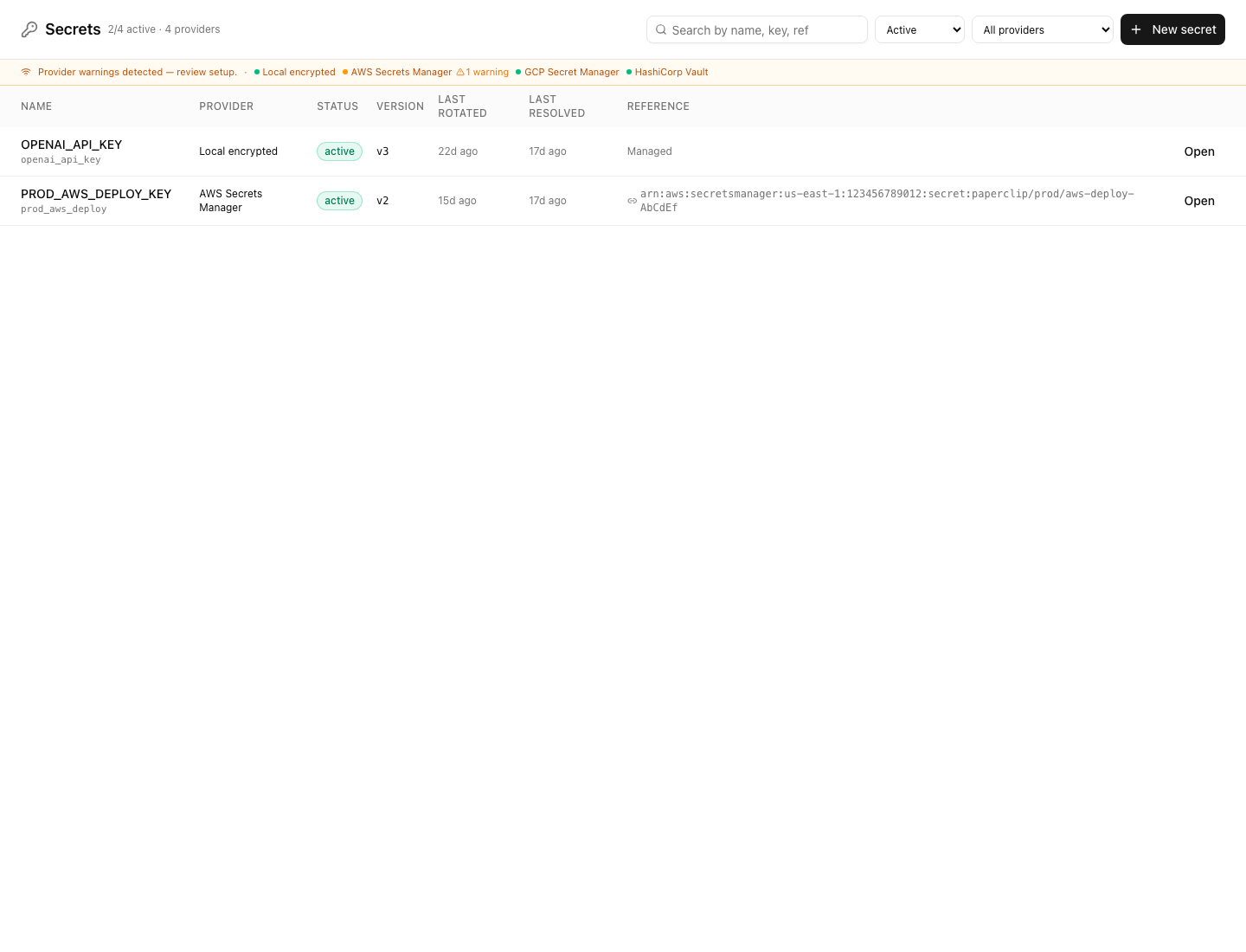
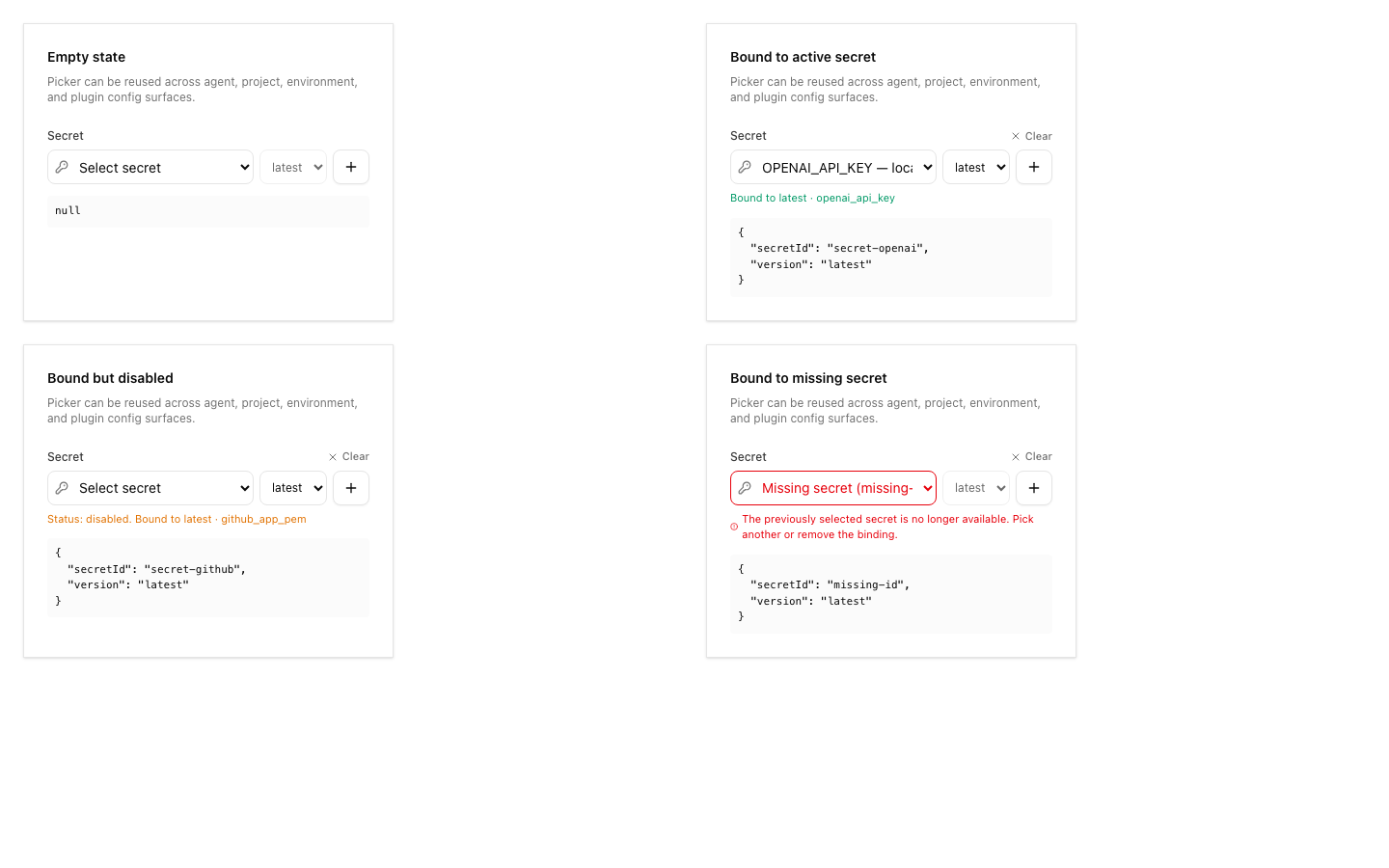
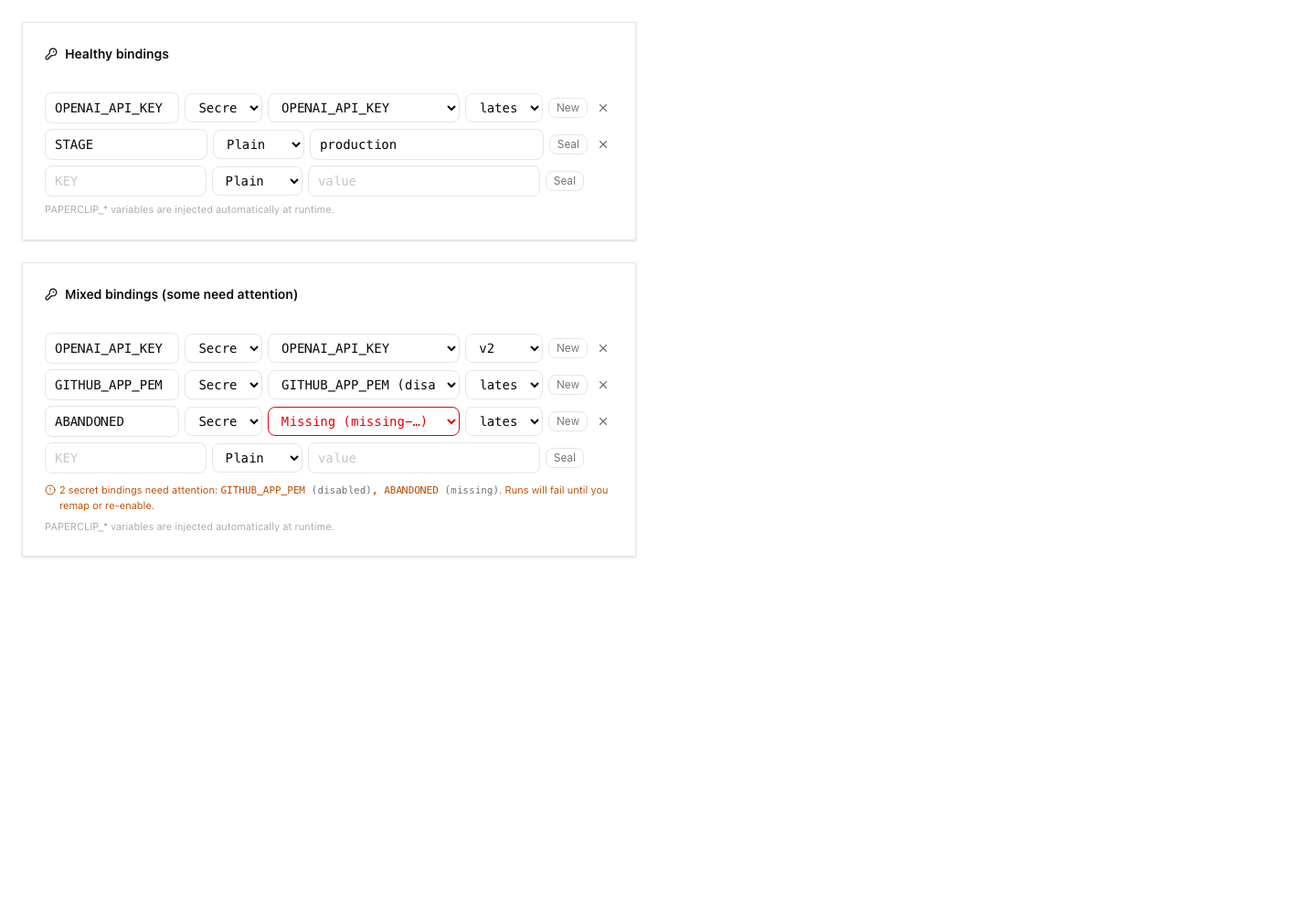
## Risks
- Migration risk: this adds new secret provider tables and extends
existing secret rows. The migrations were checked for monotonic ordering
and idempotent guards, but reviewers should still inspect upgrade
behavior carefully.
- Provider risk: AWS support uses direct SigV4 requests. Automated tests
cover signing, request timeouts, vault-config selection, namespace
guardrails, pending-version archival, sanitized provider errors, and
service-level cleanup paths. A real-vault AWS smoke test remains
deployment validation for an operator with AWS credentials rather than
an unverified merge blocker in this local branch.
- UI risk: the Secrets page and import dialog are large new surfaces;
screenshots are included above for reviewer inspection.
- Verification risk: the full local stable test command hit
parallel-load timing failures, although the exact failed files passed
when rerun directly.
- Operational risk: remote import intentionally avoids plaintext reads;
operators must understand that imported external references resolve at
runtime and may fail if AWS permissions change.
> For core feature work, check [`ROADMAP.md`](ROADMAP.md) first and
discuss it in `#dev` before opening the PR. Feature PRs that overlap
with planned core work may need to be redirected — check the roadmap
first. See `CONTRIBUTING.md`.
## Model Used
- OpenAI Codex, GPT-5 coding agent with local shell/tool use in the
Paperclip worktree. Exact context-window size was not exposed by the
runtime.
## Checklist
- [x] I have included a thinking path that traces from project context
to this change
- [x] I have specified the model used (with version and capability
details)
- [x] I have checked ROADMAP.md and confirmed this PR does not duplicate
planned core work
- [ ] I have run tests locally and they pass
- [x] I have added or updated tests where applicable
- [x] If this change affects the UI, I have included before/after
screenshots
- [x] I have updated relevant documentation to reflect my changes
- [x] I have considered and documented any risks above
- [x] I will address all Greptile and reviewer comments before
requesting merge
---------
Co-authored-by: Paperclip <noreply@paperclip.ing>
Co-authored-by: Claude Sonnet 4.6 <noreply@anthropic.com>
2026-05-09 18:22:17 -05:00
|
|
|
? (args[0] === "-c" || args[0] === "-lc") && typeof args[1] === "string"
|
Migrate SSH environment callback to bridge (#5116)
> **Stacked PR (part 3 of 7).** Depends on:
- PR #5114
- PR #5115
> Diff against `master` includes commits from earlier PRs in the stack —
the new commit in this PR is the topmost one.
## Thinking Path
> - Paperclip orchestrates AI agents for zero-human companies
> - Agents executing on a remote SSH-backed environment need a way to
call back into
> the Paperclip control plane (run events, log streaming, signals)
> - When the SSH host can't reach the Paperclip host (NAT, firewalls, or
simply not
> on the same network), the run silently fails or hangs — a recurring
class of
> failure during SSH testing
> - In sandboxed environments we already solved this with a callback
bridge that
> tunnels back through the existing connection; SSH was the odd one out
> - This PR migrates SSH execution to use the same callback bridge, so
every
> adapter's remote run uses one consistent reverse-channel. Per-adapter
SSH glue
> is deleted in favour of a shared `CommandManagedRuntimeRunner` built
from the
> SSH spec
> - The benefit is fewer SSH-specific failure modes, a smaller code
surface, and
> one place to evolve the callback contract going forward
## What Changed
- Added `createSshCommandManagedRuntimeRunner` in
`packages/adapter-utils/src/ssh.ts` that adapts an SSH spec into a
generic
command-managed-runtime runner (with cwd, env, and timeout handling)
- Removed `paperclipApiUrl` from `SshRemoteExecutionSpec`; the bridge
URL now flows
through the shared runner
- Reworked `execution-target.ts` to use the SSH runner alongside sandbox
runners
via a unified `CommandManagedRuntimeRunner` interface
- Simplified `remote-managed-runtime.ts` and
`sandbox-managed-runtime.ts` to consume
the shared runner abstraction
- Deleted per-adapter SSH callback wiring from claude-local,
codex-local,
cursor-local, gemini-local, opencode-local, pi-local execute.ts files
- Removed `environment-runtime-driver-contract.test.ts` (the contract is
now
enforced by `environment-execution-target.test.ts`)
- Added/updated `execute.remote.test.ts` cases for each adapter to cover
the SSH
runner path
## Verification
- `pnpm --filter @paperclipai/adapter-utils test`
- `pnpm test -- execute.remote` (covers all six local adapters' SSH
paths)
- Manual QA: ran a claude-local agent against an SSH-backed environment,
confirmed
the agent successfully called back to `/api/agent-callback/*` endpoints
during
the run
## Risks
- Refactor touches all six local adapters. If any adapter had subtle
SSH-specific
behaviour that wasn't captured in tests, it could regress. Mitigation:
each
adapter's `execute.remote.test.ts` was extended.
- `paperclipApiUrl` removal from `SshRemoteExecutionSpec` is a breaking
type change
for any internal consumer. Verified no external plugins consume this
type.
- The new `CommandManagedRuntimeRunner` shape is a public surface in
`@paperclipai/adapter-utils`; downstream plugins implementing custom
runners may
need updates, but no such plugins exist in this repo.
## Model Used
- OpenAI GPT-5.4 (reasoning effort: high) via Codex CLI
- Provider: OpenAI
- Used to author the code changes in this PR
## Checklist
- [x] I have included a thinking path that traces from project context
to this change
- [x] I have specified the model used (with version and capability
details)
- [x] I have checked ROADMAP.md and confirmed this PR does not duplicate
planned core work
- [x] I have run tests locally and they pass
- [x] I have added or updated tests where applicable
- [ ] If this change affects the UI, I have included before/after
screenshots — N/A
- [ ] I have updated relevant documentation to reflect my changes — N/A
- [x] I have considered and documented any risks above
- [x] I will address all Greptile and reviewer comments before
requesting merge
2026-05-03 12:43:52 -07:00
|
|
|
? `${exportPrefix}${args[1]}`
|
|
|
|
|
: `${envPrefix}exec ${[shellQuote(command), ...args.map((arg) => shellQuote(arg))].join(" ")}`
|
|
|
|
|
: `${envPrefix}exec ${[shellQuote(command), ...args.map((arg) => shellQuote(arg))].join(" ")}`;
|
Add secrets provider vaults and remote import (#5429)
## Thinking Path
> - Paperclip orchestrates AI-agent companies and needs secrets handling
to work across local development, hosted operators, and governed agent
execution.
> - The affected subsystem is the company-scoped secrets control plane:
database schema, server services/routes, CLI workflows, and the Secrets
settings UI.
> - The gap was that secrets were local-only and operators could not
manage provider vaults or import existing remote references without
exposing plaintext.
> - This branch adds provider vault configuration plus an AWS Secrets
Manager remote-import path while preserving company boundaries, binding
context, and audit trails.
> - I kept the PR to a single branch PR, removed unrelated
lockfile/package drift, rebased the full branch onto the current
`public-gh/master`, and addressed fresh Greptile findings.
> - The benefit is a reviewable implementation of provider-backed
secrets with focused tests covering provider selection, import
conflicts, deleted secret reuse, rotation guards, and AWS signing
behavior.
## What Changed
- Added provider vault support for company secrets, including provider
config storage, default vault handling, health checks, binding usage,
access events, and remote import preview/commit.
- Added an AWS Secrets Manager provider using SigV4 request signing,
bounded request timeouts, namespace guardrails, cached runtime
credential resolution, and external-reference linking without plaintext
reads.
- Added Secrets UI surfaces for vault management and remote import, plus
CLI/API documentation for setup and operations.
- Stabilized routine webhook secret binding paths and SSH
environment-driver fixture bindings discovered during verification.
- Addressed Greptile and CI findings: no lockfile/package drift,
monotonic migration metadata, disabled-vault default races, soft-deleted
secret hiding/recreate behavior, remove behavior with disabled vaults,
soft-deleted external-reference re-import, non-active rotation guards,
managed-secret soft deletion through PATCH, and per-call AWS SDK
credential client churn.
- Rebased this branch onto `public-gh/master` at `0e1a5828` and
force-pushed with lease to keep this as the single PR for the branch.
## Verification
- `git fetch public-gh master`
- `git rebase public-gh/master`
- `git diff --name-only public-gh/master...HEAD | grep
'^pnpm-lock\.yaml$' || true` confirmed `pnpm-lock.yaml` is not in the PR
diff.
- Confirmed migration ordering: master ends at `0081_optimal_dormammu`;
this PR adds `0082_dry_vision` and
`0083_company_secret_provider_configs`.
- Inspected migrations for repeat safety: new tables/indexes use `IF NOT
EXISTS`; foreign keys are guarded by `DO $$ ... IF NOT EXISTS`; column
additions use `ADD COLUMN IF NOT EXISTS`.
- `pnpm -r typecheck` passed before the Greptile follow-up commits.
- `pnpm test:run` ran the full stable Vitest path before the Greptile
follow-up commits; it completed with 3 timing-related failures under
parallel load: `codex-local-execute.test.ts`,
`cursor-local-execute.test.ts`, and `environment-service.test.ts`.
- `pnpm --filter @paperclipai/server exec vitest run
src/__tests__/codex-local-execute.test.ts
src/__tests__/cursor-local-execute.test.ts
src/__tests__/environment-service.test.ts` passed on targeted rerun
(`24/24`).
- `pnpm build` passed before the Greptile follow-up commits. Vite
reported existing chunk-size/dynamic-import warnings.
- After Greptile follow-up commits: `pnpm --filter @paperclipai/server
exec vitest run src/__tests__/secrets-service.test.ts` passed (`26/26`).
- After Greptile follow-up commits: `pnpm --filter @paperclipai/server
exec vitest run src/__tests__/aws-secrets-manager-provider.test.ts
src/__tests__/secrets-service.test.ts` passed (`39/39`).
- After Greptile follow-up commits: `pnpm --filter @paperclipai/server
typecheck` passed.
- Captured Storybook screenshots from `ui/storybook-static` for visual
review.
- Latest PR checks on `5ca3a5cf`: `policy`, serialized server suites
1/4-4/4, `Canary Dry Run`, `e2e`, `security/snyk`, and `Greptile Review`
pass; aggregate `verify` is still registering the completed child
checks.
- Greptile review loop continued through the latest requested pass; all
Greptile review threads are resolved and the latest `Greptile Review`
check on `5ca3a5cf` passed with 0 comments added.
## Screenshots
Before: the provider-vault and remote-import surfaces did not exist on
`master`; these are after-state screenshots from the Storybook fixtures.



## Risks
- Migration risk: this adds new secret provider tables and extends
existing secret rows. The migrations were checked for monotonic ordering
and idempotent guards, but reviewers should still inspect upgrade
behavior carefully.
- Provider risk: AWS support uses direct SigV4 requests. Automated tests
cover signing, request timeouts, vault-config selection, namespace
guardrails, pending-version archival, sanitized provider errors, and
service-level cleanup paths. A real-vault AWS smoke test remains
deployment validation for an operator with AWS credentials rather than
an unverified merge blocker in this local branch.
- UI risk: the Secrets page and import dialog are large new surfaces;
screenshots are included above for reviewer inspection.
- Verification risk: the full local stable test command hit
parallel-load timing failures, although the exact failed files passed
when rerun directly.
- Operational risk: remote import intentionally avoids plaintext reads;
operators must understand that imported external references resolve at
runtime and may fail if AWS permissions change.
> For core feature work, check [`ROADMAP.md`](ROADMAP.md) first and
discuss it in `#dev` before opening the PR. Feature PRs that overlap
with planned core work may need to be redirected — check the roadmap
first. See `CONTRIBUTING.md`.
## Model Used
- OpenAI Codex, GPT-5 coding agent with local shell/tool use in the
Paperclip worktree. Exact context-window size was not exposed by the
runtime.
## Checklist
- [x] I have included a thinking path that traces from project context
to this change
- [x] I have specified the model used (with version and capability
details)
- [x] I have checked ROADMAP.md and confirmed this PR does not duplicate
planned core work
- [ ] I have run tests locally and they pass
- [x] I have added or updated tests where applicable
- [x] If this change affects the UI, I have included before/after
screenshots
- [x] I have updated relevant documentation to reflect my changes
- [x] I have considered and documented any risks above
- [x] I will address all Greptile and reviewer comments before
requesting merge
---------
Co-authored-by: Paperclip <noreply@paperclip.ing>
Co-authored-by: Claude Sonnet 4.6 <noreply@anthropic.com>
2026-05-09 18:22:17 -05:00
|
|
|
const remoteCommand = `cd ${shellQuote(cwd)} && ${commandScript}`;
|
Migrate SSH environment callback to bridge (#5116)
> **Stacked PR (part 3 of 7).** Depends on:
- PR #5114
- PR #5115
> Diff against `master` includes commits from earlier PRs in the stack —
the new commit in this PR is the topmost one.
## Thinking Path
> - Paperclip orchestrates AI agents for zero-human companies
> - Agents executing on a remote SSH-backed environment need a way to
call back into
> the Paperclip control plane (run events, log streaming, signals)
> - When the SSH host can't reach the Paperclip host (NAT, firewalls, or
simply not
> on the same network), the run silently fails or hangs — a recurring
class of
> failure during SSH testing
> - In sandboxed environments we already solved this with a callback
bridge that
> tunnels back through the existing connection; SSH was the odd one out
> - This PR migrates SSH execution to use the same callback bridge, so
every
> adapter's remote run uses one consistent reverse-channel. Per-adapter
SSH glue
> is deleted in favour of a shared `CommandManagedRuntimeRunner` built
from the
> SSH spec
> - The benefit is fewer SSH-specific failure modes, a smaller code
surface, and
> one place to evolve the callback contract going forward
## What Changed
- Added `createSshCommandManagedRuntimeRunner` in
`packages/adapter-utils/src/ssh.ts` that adapts an SSH spec into a
generic
command-managed-runtime runner (with cwd, env, and timeout handling)
- Removed `paperclipApiUrl` from `SshRemoteExecutionSpec`; the bridge
URL now flows
through the shared runner
- Reworked `execution-target.ts` to use the SSH runner alongside sandbox
runners
via a unified `CommandManagedRuntimeRunner` interface
- Simplified `remote-managed-runtime.ts` and
`sandbox-managed-runtime.ts` to consume
the shared runner abstraction
- Deleted per-adapter SSH callback wiring from claude-local,
codex-local,
cursor-local, gemini-local, opencode-local, pi-local execute.ts files
- Removed `environment-runtime-driver-contract.test.ts` (the contract is
now
enforced by `environment-execution-target.test.ts`)
- Added/updated `execute.remote.test.ts` cases for each adapter to cover
the SSH
runner path
## Verification
- `pnpm --filter @paperclipai/adapter-utils test`
- `pnpm test -- execute.remote` (covers all six local adapters' SSH
paths)
- Manual QA: ran a claude-local agent against an SSH-backed environment,
confirmed
the agent successfully called back to `/api/agent-callback/*` endpoints
during
the run
## Risks
- Refactor touches all six local adapters. If any adapter had subtle
SSH-specific
behaviour that wasn't captured in tests, it could regress. Mitigation:
each
adapter's `execute.remote.test.ts` was extended.
- `paperclipApiUrl` removal from `SshRemoteExecutionSpec` is a breaking
type change
for any internal consumer. Verified no external plugins consume this
type.
- The new `CommandManagedRuntimeRunner` shape is a public surface in
`@paperclipai/adapter-utils`; downstream plugins implementing custom
runners may
need updates, but no such plugins exist in this repo.
## Model Used
- OpenAI GPT-5.4 (reasoning effort: high) via Codex CLI
- Provider: OpenAI
- Used to author the code changes in this PR
## Checklist
- [x] I have included a thinking path that traces from project context
to this change
- [x] I have specified the model used (with version and capability
details)
- [x] I have checked ROADMAP.md and confirmed this PR does not duplicate
planned core work
- [x] I have run tests locally and they pass
- [x] I have added or updated tests where applicable
- [ ] If this change affects the UI, I have included before/after
screenshots — N/A
- [ ] I have updated relevant documentation to reflect my changes — N/A
- [x] I have considered and documented any risks above
- [x] I will address all Greptile and reviewer comments before
requesting merge
2026-05-03 12:43:52 -07:00
|
|
|
|
|
|
|
|
try {
|
|
|
|
|
const result = await runSshCommand(input.spec, remoteCommand, {
|
Serialize sandbox callback bridge against concurrent heartbeats (#5326)
> **Stacked PR.** This PR's branch carries cumulative content from #5324
(bridge allowlist expand) and #5325 (env sanitization) — the
mutex/sha256 logic in this PR sits on top of both. Reviewers should
focus on the files this PR's commit touches:
`packages/adapter-utils/src/sandbox-callback-bridge.{ts,test.ts}`,
`packages/adapter-utils/src/ssh.ts`, and
`packages/adapter-utils/src/ssh-fixture.test.ts`. Will rebase onto
`master` and force-push once both prerequisite PRs are merged.
## Thinking Path
> - Paperclip orchestrates AI agents for zero-human companies
> - Each agent that runs in a sandbox or via SSH talks back to the
Paperclip server through a per-lease callback bridge whose entrypoint
script is uploaded to the remote
> - When two heartbeats target the same agent on the same machine
concurrently, both upload the bridge entrypoint and both write to the
same response files — producing torn-write races: `SyntaxError:
Identifier 'randomUUID' has already been declared` from a concatenated
upload, `mv: cannot stat …` from colliding `.json.tmp` writes, and
0-byte commits from a truncated stdin
> - This pull request serializes those operations with a POSIX
`mkdir`-mutex (PID liveness check + atomic rename) at the bridge
entrypoint upload, applies the same lock to the bridge response writer,
forwards stdin into remote ssh commands so the entrypoint payload
arrives intact, and verifies a sha256 of the upload before promoting it
> - The benefit is concurrent heartbeats no longer corrupt each other's
bridge state
## What Changed
- `packages/adapter-utils/src/sandbox-callback-bridge.ts`: serialize
entrypoint upload and response writes via POSIX `mkdir`-mutex with PID
liveness; sha256 the upload before promoting via `mv`; content-skip when
the existing entrypoint already matches
- `packages/adapter-utils/src/ssh.ts`: forward stdin into remote ssh
commands through the SSH managed runtime so `cat > "$remote_upload"`
actually receives the base64-encoded entrypoint
- `packages/adapter-utils/src/ssh-fixture.test.ts`: cover the
stdin-forwarded SSH path
- `packages/adapter-utils/src/sandbox-callback-bridge.test.ts`: cover
the mutex, content-skip, sha256-verify, and atomic-rename paths
## Verification
- `pnpm vitest run --no-coverage --project @paperclipai/adapter-utils`
- `pnpm typecheck` clean
- Manual: two parallel heartbeats targeting the same SSH agent no longer
race on the bridge entrypoint or response files
## Risks
Medium. Serializing previously-parallel operations adds latency on the
contended path (one heartbeat waits on another), bounded by the
entrypoint upload time. The mutex includes PID liveness so a crashed
heartbeat doesn't deadlock subsequent ones. Sha256-verify gives a clear
"torn upload" failure mode instead of silent 0-byte commits.
## Model Used
Claude Opus 4.7 (1M context)
## Checklist
- [x] I have included a thinking path that traces from project context
to this change
- [x] I have specified the model used (with version and capability
details)
- [x] I have checked ROADMAP.md and confirmed this PR does not duplicate
planned core work
- [x] I have run tests locally and they pass
- [x] I have added or updated tests where applicable — tests cover mutex
+ sha256-verify + stdin-forwarded ssh
- [x] If this change affects the UI, I have included before/after
screenshots — N/A (no UI)
- [x] I have updated relevant documentation to reflect my changes
- [x] I have considered and documented any risks above
- [x] I will address all Greptile and reviewer comments before
requesting merge
2026-05-05 20:01:04 -07:00
|
|
|
stdin: commandInput.stdin,
|
Migrate SSH environment callback to bridge (#5116)
> **Stacked PR (part 3 of 7).** Depends on:
- PR #5114
- PR #5115
> Diff against `master` includes commits from earlier PRs in the stack —
the new commit in this PR is the topmost one.
## Thinking Path
> - Paperclip orchestrates AI agents for zero-human companies
> - Agents executing on a remote SSH-backed environment need a way to
call back into
> the Paperclip control plane (run events, log streaming, signals)
> - When the SSH host can't reach the Paperclip host (NAT, firewalls, or
simply not
> on the same network), the run silently fails or hangs — a recurring
class of
> failure during SSH testing
> - In sandboxed environments we already solved this with a callback
bridge that
> tunnels back through the existing connection; SSH was the odd one out
> - This PR migrates SSH execution to use the same callback bridge, so
every
> adapter's remote run uses one consistent reverse-channel. Per-adapter
SSH glue
> is deleted in favour of a shared `CommandManagedRuntimeRunner` built
from the
> SSH spec
> - The benefit is fewer SSH-specific failure modes, a smaller code
surface, and
> one place to evolve the callback contract going forward
## What Changed
- Added `createSshCommandManagedRuntimeRunner` in
`packages/adapter-utils/src/ssh.ts` that adapts an SSH spec into a
generic
command-managed-runtime runner (with cwd, env, and timeout handling)
- Removed `paperclipApiUrl` from `SshRemoteExecutionSpec`; the bridge
URL now flows
through the shared runner
- Reworked `execution-target.ts` to use the SSH runner alongside sandbox
runners
via a unified `CommandManagedRuntimeRunner` interface
- Simplified `remote-managed-runtime.ts` and
`sandbox-managed-runtime.ts` to consume
the shared runner abstraction
- Deleted per-adapter SSH callback wiring from claude-local,
codex-local,
cursor-local, gemini-local, opencode-local, pi-local execute.ts files
- Removed `environment-runtime-driver-contract.test.ts` (the contract is
now
enforced by `environment-execution-target.test.ts`)
- Added/updated `execute.remote.test.ts` cases for each adapter to cover
the SSH
runner path
## Verification
- `pnpm --filter @paperclipai/adapter-utils test`
- `pnpm test -- execute.remote` (covers all six local adapters' SSH
paths)
- Manual QA: ran a claude-local agent against an SSH-backed environment,
confirmed
the agent successfully called back to `/api/agent-callback/*` endpoints
during
the run
## Risks
- Refactor touches all six local adapters. If any adapter had subtle
SSH-specific
behaviour that wasn't captured in tests, it could regress. Mitigation:
each
adapter's `execute.remote.test.ts` was extended.
- `paperclipApiUrl` removal from `SshRemoteExecutionSpec` is a breaking
type change
for any internal consumer. Verified no external plugins consume this
type.
- The new `CommandManagedRuntimeRunner` shape is a public surface in
`@paperclipai/adapter-utils`; downstream plugins implementing custom
runners may
need updates, but no such plugins exist in this repo.
## Model Used
- OpenAI GPT-5.4 (reasoning effort: high) via Codex CLI
- Provider: OpenAI
- Used to author the code changes in this PR
## Checklist
- [x] I have included a thinking path that traces from project context
to this change
- [x] I have specified the model used (with version and capability
details)
- [x] I have checked ROADMAP.md and confirmed this PR does not duplicate
planned core work
- [x] I have run tests locally and they pass
- [x] I have added or updated tests where applicable
- [ ] If this change affects the UI, I have included before/after
screenshots — N/A
- [ ] I have updated relevant documentation to reflect my changes — N/A
- [x] I have considered and documented any risks above
- [x] I will address all Greptile and reviewer comments before
requesting merge
2026-05-03 12:43:52 -07:00
|
|
|
timeoutMs: commandInput.timeoutMs,
|
|
|
|
|
maxBuffer: maxBufferBytes,
|
|
|
|
|
});
|
|
|
|
|
if (result.stdout) await commandInput.onLog?.("stdout", result.stdout);
|
|
|
|
|
if (result.stderr) await commandInput.onLog?.("stderr", result.stderr);
|
|
|
|
|
return {
|
|
|
|
|
exitCode: 0,
|
|
|
|
|
signal: null,
|
|
|
|
|
timedOut: false,
|
|
|
|
|
stdout: result.stdout,
|
|
|
|
|
stderr: result.stderr,
|
|
|
|
|
pid: null,
|
|
|
|
|
startedAt,
|
|
|
|
|
};
|
|
|
|
|
} catch (error) {
|
|
|
|
|
const failure = error as {
|
|
|
|
|
stdout?: unknown;
|
|
|
|
|
stderr?: unknown;
|
|
|
|
|
code?: unknown;
|
|
|
|
|
signal?: unknown;
|
|
|
|
|
killed?: unknown;
|
|
|
|
|
};
|
|
|
|
|
const stdout = typeof failure.stdout === "string" ? failure.stdout : "";
|
|
|
|
|
const stderr = typeof failure.stderr === "string"
|
|
|
|
|
? failure.stderr
|
|
|
|
|
: error instanceof Error
|
|
|
|
|
? error.message
|
|
|
|
|
: String(error);
|
|
|
|
|
if (stdout) await commandInput.onLog?.("stdout", stdout);
|
|
|
|
|
if (stderr) await commandInput.onLog?.("stderr", stderr);
|
|
|
|
|
return {
|
|
|
|
|
exitCode: typeof failure.code === "number" ? failure.code : null,
|
|
|
|
|
signal: typeof failure.signal === "string" ? failure.signal : null,
|
|
|
|
|
timedOut: failure.killed === true,
|
|
|
|
|
stdout,
|
|
|
|
|
stderr,
|
|
|
|
|
pid: null,
|
|
|
|
|
startedAt,
|
|
|
|
|
};
|
|
|
|
|
}
|
|
|
|
|
},
|
|
|
|
|
};
|
Add SSH environment support (#4358)
## Thinking Path
> - Paperclip orchestrates AI agents for zero-human companies
> - The environments subsystem already models execution environments,
but before this branch there was no end-to-end SSH-backed runtime path
for agents to actually run work against a remote box
> - That meant agents could be configured around environment concepts
without a reliable way to execute adapter sessions remotely, sync
workspace state, and preserve run context across supported adapters
> - We also need environment selection to participate in normal
Paperclip control-plane behavior: agent defaults, project/issue
selection, route validation, and environment probing
> - Because this capability is still experimental, the UI surface should
be easy to hide and easy to remove later without undoing the underlying
implementation
> - This pull request adds SSH environment execution support across the
runtime, adapters, routes, schema, and tests, then puts the visible
environment-management UI behind an experimental flag
> - The benefit is that we can validate real SSH-backed agent execution
now while keeping the user-facing controls safely gated until the
feature is ready to come out of experimentation
## What Changed
- Added SSH-backed execution target support in the shared adapter
runtime, including remote workspace preparation, skill/runtime asset
sync, remote session handling, and workspace restore behavior after
runs.
- Added SSH execution coverage for supported local adapters, plus remote
execution tests across Claude, Codex, Cursor, Gemini, OpenCode, and Pi.
- Added environment selection and environment-management backend support
needed for SSH execution, including route/service work, validation,
probing, and agent default environment persistence.
- Added CLI support for SSH environment lab verification and updated
related docs/tests.
- Added the `enableEnvironments` experimental flag and gated the
environment UI behind it on company settings, agent configuration, and
project configuration surfaces.
## Verification
- `pnpm exec vitest run
packages/adapters/claude-local/src/server/execute.remote.test.ts
packages/adapters/cursor-local/src/server/execute.remote.test.ts
packages/adapters/gemini-local/src/server/execute.remote.test.ts
packages/adapters/opencode-local/src/server/execute.remote.test.ts
packages/adapters/pi-local/src/server/execute.remote.test.ts`
- `pnpm exec vitest run server/src/__tests__/environment-routes.test.ts`
- `pnpm exec vitest run
server/src/__tests__/instance-settings-routes.test.ts`
- `pnpm exec vitest run ui/src/lib/new-agent-hire-payload.test.ts
ui/src/lib/new-agent-runtime-config.test.ts`
- `pnpm -r typecheck`
- `pnpm build`
- Manual verification on a branch-local dev server:
- enabled the experimental flag
- created an SSH environment
- created a Linux Claude agent using that environment
- confirmed a run executed on the Linux box and synced workspace changes
back
## Risks
- Medium: this touches runtime execution flow across multiple adapters,
so regressions would likely show up in remote session setup, workspace
sync, or environment selection precedence.
- The UI flag reduces exposure, but the underlying runtime and route
changes are still substantial and rely on migration correctness.
- The change set is broad across adapters, control-plane services,
migrations, and UI gating, so review should pay close attention to
environment-selection precedence and remote workspace lifecycle
behavior.
## Model Used
- OpenAI Codex via Paperclip's local Codex adapter, GPT-5-class coding
model with tool use and code execution in the local repo workspace. The
local adapter does not surface a more specific public model version
string in this branch workflow.
## Checklist
- [x] I have included a thinking path that traces from project context
to this change
- [x] I have specified the model used (with version and capability
details)
- [x] I have checked ROADMAP.md and confirmed this PR does not duplicate
planned core work
- [x] I have run tests locally and they pass
- [x] I have added or updated tests where applicable
- [ ] If this change affects the UI, I have included before/after
screenshots
- [x] I have updated relevant documentation to reflect my changes
- [x] I have considered and documented any risks above
- [x] I will address all Greptile and reviewer comments before
requesting merge
2026-04-23 19:15:22 -07:00
|
|
|
}
|
|
|
|
|
|
|
|
|
|
export interface SshEnvLabSupport {
|
|
|
|
|
supported: boolean;
|
|
|
|
|
reason: string | null;
|
|
|
|
|
}
|
|
|
|
|
|
|
|
|
|
export interface SshEnvLabFixtureState {
|
|
|
|
|
kind: "ssh_openbsd";
|
|
|
|
|
bindHost: string;
|
|
|
|
|
host: string;
|
|
|
|
|
port: number;
|
|
|
|
|
username: string;
|
|
|
|
|
rootDir: string;
|
|
|
|
|
workspaceDir: string;
|
|
|
|
|
statePath: string;
|
|
|
|
|
pid: number;
|
|
|
|
|
createdAt: string;
|
|
|
|
|
clientPrivateKeyPath: string;
|
|
|
|
|
clientPublicKeyPath: string;
|
|
|
|
|
hostPrivateKeyPath: string;
|
|
|
|
|
hostPublicKeyPath: string;
|
|
|
|
|
authorizedKeysPath: string;
|
|
|
|
|
knownHostsPath: string;
|
|
|
|
|
sshdConfigPath: string;
|
|
|
|
|
sshdLogPath: string;
|
|
|
|
|
}
|
|
|
|
|
|
|
|
|
|
interface LocalGitWorkspaceSnapshot {
|
|
|
|
|
headCommit: string;
|
|
|
|
|
branchName: string | null;
|
|
|
|
|
deletedPaths: string[];
|
|
|
|
|
}
|
|
|
|
|
|
|
|
|
|
export function shellQuote(value: string) {
|
|
|
|
|
return `'${value.replace(/'/g, `'\"'\"'`)}'`;
|
|
|
|
|
}
|
|
|
|
|
|
|
|
|
|
function isValidShellEnvKey(value: string) {
|
|
|
|
|
return /^[A-Za-z_][A-Za-z0-9_]*$/.test(value);
|
|
|
|
|
}
|
|
|
|
|
|
|
|
|
|
export function parseSshRemoteExecutionSpec(value: unknown): SshRemoteExecutionSpec | null {
|
|
|
|
|
if (!value || typeof value !== "object" || Array.isArray(value)) {
|
|
|
|
|
return null;
|
|
|
|
|
}
|
|
|
|
|
|
|
|
|
|
const parsed = value as Record<string, unknown>;
|
|
|
|
|
const host = typeof parsed.host === "string" ? parsed.host.trim() : "";
|
|
|
|
|
const username = typeof parsed.username === "string" ? parsed.username.trim() : "";
|
|
|
|
|
const remoteCwd = typeof parsed.remoteCwd === "string" ? parsed.remoteCwd.trim() : "";
|
|
|
|
|
const portValue = typeof parsed.port === "number" ? parsed.port : Number(parsed.port);
|
|
|
|
|
if (!host || !username || !remoteCwd || !Number.isInteger(portValue) || portValue < 1 || portValue > 65535) {
|
|
|
|
|
return null;
|
|
|
|
|
}
|
|
|
|
|
|
|
|
|
|
return {
|
|
|
|
|
host,
|
|
|
|
|
port: portValue,
|
|
|
|
|
username,
|
|
|
|
|
remoteCwd,
|
|
|
|
|
remoteWorkspacePath:
|
|
|
|
|
typeof parsed.remoteWorkspacePath === "string" && parsed.remoteWorkspacePath.trim().length > 0
|
|
|
|
|
? parsed.remoteWorkspacePath.trim()
|
|
|
|
|
: remoteCwd,
|
|
|
|
|
privateKey: typeof parsed.privateKey === "string" && parsed.privateKey.length > 0 ? parsed.privateKey : null,
|
|
|
|
|
knownHosts: typeof parsed.knownHosts === "string" && parsed.knownHosts.length > 0 ? parsed.knownHosts : null,
|
|
|
|
|
strictHostKeyChecking:
|
|
|
|
|
typeof parsed.strictHostKeyChecking === "boolean" ? parsed.strictHostKeyChecking : true,
|
|
|
|
|
};
|
|
|
|
|
}
|
|
|
|
|
|
|
|
|
|
async function execFileText(
|
|
|
|
|
file: string,
|
|
|
|
|
args: string[],
|
|
|
|
|
options: {
|
|
|
|
|
timeout?: number;
|
|
|
|
|
maxBuffer?: number;
|
|
|
|
|
} = {},
|
|
|
|
|
): Promise<SshCommandResult> {
|
|
|
|
|
return await new Promise<SshCommandResult>((resolve, reject) => {
|
|
|
|
|
execFile(
|
|
|
|
|
file,
|
|
|
|
|
args,
|
|
|
|
|
{
|
|
|
|
|
timeout: options.timeout ?? 15_000,
|
|
|
|
|
maxBuffer: options.maxBuffer ?? 1024 * 128,
|
|
|
|
|
},
|
|
|
|
|
(error, stdout, stderr) => {
|
|
|
|
|
if (error) {
|
|
|
|
|
reject(Object.assign(error, { stdout: stdout ?? "", stderr: stderr ?? "" }));
|
|
|
|
|
return;
|
|
|
|
|
}
|
|
|
|
|
resolve({
|
|
|
|
|
stdout: stdout ?? "",
|
|
|
|
|
stderr: stderr ?? "",
|
|
|
|
|
});
|
|
|
|
|
},
|
|
|
|
|
);
|
|
|
|
|
});
|
|
|
|
|
}
|
|
|
|
|
|
Serialize sandbox callback bridge against concurrent heartbeats (#5326)
> **Stacked PR.** This PR's branch carries cumulative content from #5324
(bridge allowlist expand) and #5325 (env sanitization) — the
mutex/sha256 logic in this PR sits on top of both. Reviewers should
focus on the files this PR's commit touches:
`packages/adapter-utils/src/sandbox-callback-bridge.{ts,test.ts}`,
`packages/adapter-utils/src/ssh.ts`, and
`packages/adapter-utils/src/ssh-fixture.test.ts`. Will rebase onto
`master` and force-push once both prerequisite PRs are merged.
## Thinking Path
> - Paperclip orchestrates AI agents for zero-human companies
> - Each agent that runs in a sandbox or via SSH talks back to the
Paperclip server through a per-lease callback bridge whose entrypoint
script is uploaded to the remote
> - When two heartbeats target the same agent on the same machine
concurrently, both upload the bridge entrypoint and both write to the
same response files — producing torn-write races: `SyntaxError:
Identifier 'randomUUID' has already been declared` from a concatenated
upload, `mv: cannot stat …` from colliding `.json.tmp` writes, and
0-byte commits from a truncated stdin
> - This pull request serializes those operations with a POSIX
`mkdir`-mutex (PID liveness check + atomic rename) at the bridge
entrypoint upload, applies the same lock to the bridge response writer,
forwards stdin into remote ssh commands so the entrypoint payload
arrives intact, and verifies a sha256 of the upload before promoting it
> - The benefit is concurrent heartbeats no longer corrupt each other's
bridge state
## What Changed
- `packages/adapter-utils/src/sandbox-callback-bridge.ts`: serialize
entrypoint upload and response writes via POSIX `mkdir`-mutex with PID
liveness; sha256 the upload before promoting via `mv`; content-skip when
the existing entrypoint already matches
- `packages/adapter-utils/src/ssh.ts`: forward stdin into remote ssh
commands through the SSH managed runtime so `cat > "$remote_upload"`
actually receives the base64-encoded entrypoint
- `packages/adapter-utils/src/ssh-fixture.test.ts`: cover the
stdin-forwarded SSH path
- `packages/adapter-utils/src/sandbox-callback-bridge.test.ts`: cover
the mutex, content-skip, sha256-verify, and atomic-rename paths
## Verification
- `pnpm vitest run --no-coverage --project @paperclipai/adapter-utils`
- `pnpm typecheck` clean
- Manual: two parallel heartbeats targeting the same SSH agent no longer
race on the bridge entrypoint or response files
## Risks
Medium. Serializing previously-parallel operations adds latency on the
contended path (one heartbeat waits on another), bounded by the
entrypoint upload time. The mutex includes PID liveness so a crashed
heartbeat doesn't deadlock subsequent ones. Sha256-verify gives a clear
"torn upload" failure mode instead of silent 0-byte commits.
## Model Used
Claude Opus 4.7 (1M context)
## Checklist
- [x] I have included a thinking path that traces from project context
to this change
- [x] I have specified the model used (with version and capability
details)
- [x] I have checked ROADMAP.md and confirmed this PR does not duplicate
planned core work
- [x] I have run tests locally and they pass
- [x] I have added or updated tests where applicable — tests cover mutex
+ sha256-verify + stdin-forwarded ssh
- [x] If this change affects the UI, I have included before/after
screenshots — N/A (no UI)
- [x] I have updated relevant documentation to reflect my changes
- [x] I have considered and documented any risks above
- [x] I will address all Greptile and reviewer comments before
requesting merge
2026-05-05 20:01:04 -07:00
|
|
|
async function spawnText(
|
|
|
|
|
file: string,
|
|
|
|
|
args: string[],
|
|
|
|
|
options: {
|
|
|
|
|
stdin?: string;
|
|
|
|
|
timeout?: number;
|
|
|
|
|
maxBuffer?: number;
|
|
|
|
|
} = {},
|
|
|
|
|
): Promise<SshCommandResult> {
|
|
|
|
|
return await new Promise<SshCommandResult>((resolve, reject) => {
|
|
|
|
|
const child = spawn(file, args, {
|
|
|
|
|
stdio: [options.stdin != null ? "pipe" : "ignore", "pipe", "pipe"],
|
|
|
|
|
});
|
|
|
|
|
|
|
|
|
|
const maxBuffer = options.maxBuffer ?? 1024 * 128;
|
|
|
|
|
let stdout = "";
|
|
|
|
|
let stderr = "";
|
|
|
|
|
let settled = false;
|
|
|
|
|
let timedOut = false;
|
|
|
|
|
|
|
|
|
|
const finishReject = (error: Error & { stdout?: string; stderr?: string; code?: number | null; killed?: boolean }) => {
|
|
|
|
|
if (settled) return;
|
|
|
|
|
settled = true;
|
|
|
|
|
error.stdout = stdout;
|
|
|
|
|
error.stderr = stderr;
|
|
|
|
|
error.killed = timedOut;
|
|
|
|
|
reject(error);
|
|
|
|
|
};
|
|
|
|
|
|
|
|
|
|
const append = (
|
|
|
|
|
streamName: "stdout" | "stderr",
|
|
|
|
|
chunk: unknown,
|
|
|
|
|
) => {
|
|
|
|
|
const text = String(chunk);
|
|
|
|
|
if (streamName === "stdout") {
|
|
|
|
|
stdout += text;
|
|
|
|
|
} else {
|
|
|
|
|
stderr += text;
|
|
|
|
|
}
|
|
|
|
|
if (Buffer.byteLength(stdout, "utf8") > maxBuffer || Buffer.byteLength(stderr, "utf8") > maxBuffer) {
|
|
|
|
|
child.kill("SIGTERM");
|
|
|
|
|
finishReject(Object.assign(new Error(`Process output exceeded maxBuffer of ${maxBuffer} bytes.`), {
|
|
|
|
|
code: null,
|
|
|
|
|
}));
|
|
|
|
|
}
|
|
|
|
|
};
|
|
|
|
|
|
|
|
|
|
let killEscalation: NodeJS.Timeout | null = null;
|
|
|
|
|
const timeout = options.timeout && options.timeout > 0
|
|
|
|
|
? setTimeout(() => {
|
|
|
|
|
timedOut = true;
|
|
|
|
|
child.kill("SIGTERM");
|
|
|
|
|
// Escalate to SIGKILL after a 5s grace window so a hung remote
|
|
|
|
|
// command that ignores SIGTERM cannot keep the child alive
|
|
|
|
|
// indefinitely.
|
|
|
|
|
killEscalation = setTimeout(() => {
|
|
|
|
|
try {
|
|
|
|
|
child.kill("SIGKILL");
|
|
|
|
|
} catch {
|
|
|
|
|
// child may have already exited between the SIGTERM and the
|
|
|
|
|
// escalation — that's fine.
|
|
|
|
|
}
|
|
|
|
|
}, 5_000);
|
|
|
|
|
killEscalation.unref?.();
|
|
|
|
|
}, options.timeout)
|
|
|
|
|
: null;
|
|
|
|
|
|
|
|
|
|
const clearTimers = () => {
|
|
|
|
|
if (timeout) clearTimeout(timeout);
|
|
|
|
|
if (killEscalation) clearTimeout(killEscalation);
|
|
|
|
|
};
|
|
|
|
|
|
|
|
|
|
child.stdout?.on("data", (chunk) => {
|
|
|
|
|
append("stdout", chunk);
|
|
|
|
|
});
|
|
|
|
|
child.stderr?.on("data", (chunk) => {
|
|
|
|
|
append("stderr", chunk);
|
|
|
|
|
});
|
|
|
|
|
|
|
|
|
|
child.on("error", (error) => {
|
|
|
|
|
clearTimers();
|
|
|
|
|
finishReject(Object.assign(error, { code: null }));
|
|
|
|
|
});
|
|
|
|
|
|
|
|
|
|
child.on("close", (code, signal) => {
|
|
|
|
|
clearTimers();
|
|
|
|
|
if (settled) return;
|
|
|
|
|
settled = true;
|
|
|
|
|
if (code === 0) {
|
|
|
|
|
resolve({ stdout, stderr });
|
|
|
|
|
return;
|
|
|
|
|
}
|
|
|
|
|
reject(Object.assign(new Error(stderr.trim() || stdout.trim() || `Process exited with code ${code ?? -1}`), {
|
|
|
|
|
stdout,
|
|
|
|
|
stderr,
|
|
|
|
|
code,
|
|
|
|
|
signal,
|
|
|
|
|
killed: timedOut,
|
|
|
|
|
}));
|
|
|
|
|
});
|
|
|
|
|
|
|
|
|
|
if (options.stdin != null && child.stdin) {
|
|
|
|
|
child.stdin.end(options.stdin);
|
|
|
|
|
}
|
|
|
|
|
});
|
|
|
|
|
}
|
|
|
|
|
|
Add SSH environment support (#4358)
## Thinking Path
> - Paperclip orchestrates AI agents for zero-human companies
> - The environments subsystem already models execution environments,
but before this branch there was no end-to-end SSH-backed runtime path
for agents to actually run work against a remote box
> - That meant agents could be configured around environment concepts
without a reliable way to execute adapter sessions remotely, sync
workspace state, and preserve run context across supported adapters
> - We also need environment selection to participate in normal
Paperclip control-plane behavior: agent defaults, project/issue
selection, route validation, and environment probing
> - Because this capability is still experimental, the UI surface should
be easy to hide and easy to remove later without undoing the underlying
implementation
> - This pull request adds SSH environment execution support across the
runtime, adapters, routes, schema, and tests, then puts the visible
environment-management UI behind an experimental flag
> - The benefit is that we can validate real SSH-backed agent execution
now while keeping the user-facing controls safely gated until the
feature is ready to come out of experimentation
## What Changed
- Added SSH-backed execution target support in the shared adapter
runtime, including remote workspace preparation, skill/runtime asset
sync, remote session handling, and workspace restore behavior after
runs.
- Added SSH execution coverage for supported local adapters, plus remote
execution tests across Claude, Codex, Cursor, Gemini, OpenCode, and Pi.
- Added environment selection and environment-management backend support
needed for SSH execution, including route/service work, validation,
probing, and agent default environment persistence.
- Added CLI support for SSH environment lab verification and updated
related docs/tests.
- Added the `enableEnvironments` experimental flag and gated the
environment UI behind it on company settings, agent configuration, and
project configuration surfaces.
## Verification
- `pnpm exec vitest run
packages/adapters/claude-local/src/server/execute.remote.test.ts
packages/adapters/cursor-local/src/server/execute.remote.test.ts
packages/adapters/gemini-local/src/server/execute.remote.test.ts
packages/adapters/opencode-local/src/server/execute.remote.test.ts
packages/adapters/pi-local/src/server/execute.remote.test.ts`
- `pnpm exec vitest run server/src/__tests__/environment-routes.test.ts`
- `pnpm exec vitest run
server/src/__tests__/instance-settings-routes.test.ts`
- `pnpm exec vitest run ui/src/lib/new-agent-hire-payload.test.ts
ui/src/lib/new-agent-runtime-config.test.ts`
- `pnpm -r typecheck`
- `pnpm build`
- Manual verification on a branch-local dev server:
- enabled the experimental flag
- created an SSH environment
- created a Linux Claude agent using that environment
- confirmed a run executed on the Linux box and synced workspace changes
back
## Risks
- Medium: this touches runtime execution flow across multiple adapters,
so regressions would likely show up in remote session setup, workspace
sync, or environment selection precedence.
- The UI flag reduces exposure, but the underlying runtime and route
changes are still substantial and rely on migration correctness.
- The change set is broad across adapters, control-plane services,
migrations, and UI gating, so review should pay close attention to
environment-selection precedence and remote workspace lifecycle
behavior.
## Model Used
- OpenAI Codex via Paperclip's local Codex adapter, GPT-5-class coding
model with tool use and code execution in the local repo workspace. The
local adapter does not surface a more specific public model version
string in this branch workflow.
## Checklist
- [x] I have included a thinking path that traces from project context
to this change
- [x] I have specified the model used (with version and capability
details)
- [x] I have checked ROADMAP.md and confirmed this PR does not duplicate
planned core work
- [x] I have run tests locally and they pass
- [x] I have added or updated tests where applicable
- [ ] If this change affects the UI, I have included before/after
screenshots
- [x] I have updated relevant documentation to reflect my changes
- [x] I have considered and documented any risks above
- [x] I will address all Greptile and reviewer comments before
requesting merge
2026-04-23 19:15:22 -07:00
|
|
|
async function runLocalGit(
|
|
|
|
|
localDir: string,
|
|
|
|
|
args: string[],
|
|
|
|
|
options: {
|
|
|
|
|
timeout?: number;
|
|
|
|
|
maxBuffer?: number;
|
|
|
|
|
} = {},
|
|
|
|
|
): Promise<SshCommandResult> {
|
|
|
|
|
return await execFileText("git", ["-C", localDir, ...args], options);
|
|
|
|
|
}
|
|
|
|
|
|
|
|
|
|
async function commandExists(command: string): Promise<boolean> {
|
|
|
|
|
return (await resolveCommandPath(command)) !== null;
|
|
|
|
|
}
|
|
|
|
|
|
|
|
|
|
async function resolveCommandPath(command: string): Promise<string | null> {
|
|
|
|
|
try {
|
Add secrets provider vaults and remote import (#5429)
## Thinking Path
> - Paperclip orchestrates AI-agent companies and needs secrets handling
to work across local development, hosted operators, and governed agent
execution.
> - The affected subsystem is the company-scoped secrets control plane:
database schema, server services/routes, CLI workflows, and the Secrets
settings UI.
> - The gap was that secrets were local-only and operators could not
manage provider vaults or import existing remote references without
exposing plaintext.
> - This branch adds provider vault configuration plus an AWS Secrets
Manager remote-import path while preserving company boundaries, binding
context, and audit trails.
> - I kept the PR to a single branch PR, removed unrelated
lockfile/package drift, rebased the full branch onto the current
`public-gh/master`, and addressed fresh Greptile findings.
> - The benefit is a reviewable implementation of provider-backed
secrets with focused tests covering provider selection, import
conflicts, deleted secret reuse, rotation guards, and AWS signing
behavior.
## What Changed
- Added provider vault support for company secrets, including provider
config storage, default vault handling, health checks, binding usage,
access events, and remote import preview/commit.
- Added an AWS Secrets Manager provider using SigV4 request signing,
bounded request timeouts, namespace guardrails, cached runtime
credential resolution, and external-reference linking without plaintext
reads.
- Added Secrets UI surfaces for vault management and remote import, plus
CLI/API documentation for setup and operations.
- Stabilized routine webhook secret binding paths and SSH
environment-driver fixture bindings discovered during verification.
- Addressed Greptile and CI findings: no lockfile/package drift,
monotonic migration metadata, disabled-vault default races, soft-deleted
secret hiding/recreate behavior, remove behavior with disabled vaults,
soft-deleted external-reference re-import, non-active rotation guards,
managed-secret soft deletion through PATCH, and per-call AWS SDK
credential client churn.
- Rebased this branch onto `public-gh/master` at `0e1a5828` and
force-pushed with lease to keep this as the single PR for the branch.
## Verification
- `git fetch public-gh master`
- `git rebase public-gh/master`
- `git diff --name-only public-gh/master...HEAD | grep
'^pnpm-lock\.yaml$' || true` confirmed `pnpm-lock.yaml` is not in the PR
diff.
- Confirmed migration ordering: master ends at `0081_optimal_dormammu`;
this PR adds `0082_dry_vision` and
`0083_company_secret_provider_configs`.
- Inspected migrations for repeat safety: new tables/indexes use `IF NOT
EXISTS`; foreign keys are guarded by `DO $$ ... IF NOT EXISTS`; column
additions use `ADD COLUMN IF NOT EXISTS`.
- `pnpm -r typecheck` passed before the Greptile follow-up commits.
- `pnpm test:run` ran the full stable Vitest path before the Greptile
follow-up commits; it completed with 3 timing-related failures under
parallel load: `codex-local-execute.test.ts`,
`cursor-local-execute.test.ts`, and `environment-service.test.ts`.
- `pnpm --filter @paperclipai/server exec vitest run
src/__tests__/codex-local-execute.test.ts
src/__tests__/cursor-local-execute.test.ts
src/__tests__/environment-service.test.ts` passed on targeted rerun
(`24/24`).
- `pnpm build` passed before the Greptile follow-up commits. Vite
reported existing chunk-size/dynamic-import warnings.
- After Greptile follow-up commits: `pnpm --filter @paperclipai/server
exec vitest run src/__tests__/secrets-service.test.ts` passed (`26/26`).
- After Greptile follow-up commits: `pnpm --filter @paperclipai/server
exec vitest run src/__tests__/aws-secrets-manager-provider.test.ts
src/__tests__/secrets-service.test.ts` passed (`39/39`).
- After Greptile follow-up commits: `pnpm --filter @paperclipai/server
typecheck` passed.
- Captured Storybook screenshots from `ui/storybook-static` for visual
review.
- Latest PR checks on `5ca3a5cf`: `policy`, serialized server suites
1/4-4/4, `Canary Dry Run`, `e2e`, `security/snyk`, and `Greptile Review`
pass; aggregate `verify` is still registering the completed child
checks.
- Greptile review loop continued through the latest requested pass; all
Greptile review threads are resolved and the latest `Greptile Review`
check on `5ca3a5cf` passed with 0 comments added.
## Screenshots
Before: the provider-vault and remote-import surfaces did not exist on
`master`; these are after-state screenshots from the Storybook fixtures.



## Risks
- Migration risk: this adds new secret provider tables and extends
existing secret rows. The migrations were checked for monotonic ordering
and idempotent guards, but reviewers should still inspect upgrade
behavior carefully.
- Provider risk: AWS support uses direct SigV4 requests. Automated tests
cover signing, request timeouts, vault-config selection, namespace
guardrails, pending-version archival, sanitized provider errors, and
service-level cleanup paths. A real-vault AWS smoke test remains
deployment validation for an operator with AWS credentials rather than
an unverified merge blocker in this local branch.
- UI risk: the Secrets page and import dialog are large new surfaces;
screenshots are included above for reviewer inspection.
- Verification risk: the full local stable test command hit
parallel-load timing failures, although the exact failed files passed
when rerun directly.
- Operational risk: remote import intentionally avoids plaintext reads;
operators must understand that imported external references resolve at
runtime and may fail if AWS permissions change.
> For core feature work, check [`ROADMAP.md`](ROADMAP.md) first and
discuss it in `#dev` before opening the PR. Feature PRs that overlap
with planned core work may need to be redirected — check the roadmap
first. See `CONTRIBUTING.md`.
## Model Used
- OpenAI Codex, GPT-5 coding agent with local shell/tool use in the
Paperclip worktree. Exact context-window size was not exposed by the
runtime.
## Checklist
- [x] I have included a thinking path that traces from project context
to this change
- [x] I have specified the model used (with version and capability
details)
- [x] I have checked ROADMAP.md and confirmed this PR does not duplicate
planned core work
- [ ] I have run tests locally and they pass
- [x] I have added or updated tests where applicable
- [x] If this change affects the UI, I have included before/after
screenshots
- [x] I have updated relevant documentation to reflect my changes
- [x] I have considered and documented any risks above
- [x] I will address all Greptile and reviewer comments before
requesting merge
---------
Co-authored-by: Paperclip <noreply@paperclip.ing>
Co-authored-by: Claude Sonnet 4.6 <noreply@anthropic.com>
2026-05-09 18:22:17 -05:00
|
|
|
const result = await execFileText("sh", ["-c", `command -v ${shellQuote(command)}`], {
|
Add SSH environment support (#4358)
## Thinking Path
> - Paperclip orchestrates AI agents for zero-human companies
> - The environments subsystem already models execution environments,
but before this branch there was no end-to-end SSH-backed runtime path
for agents to actually run work against a remote box
> - That meant agents could be configured around environment concepts
without a reliable way to execute adapter sessions remotely, sync
workspace state, and preserve run context across supported adapters
> - We also need environment selection to participate in normal
Paperclip control-plane behavior: agent defaults, project/issue
selection, route validation, and environment probing
> - Because this capability is still experimental, the UI surface should
be easy to hide and easy to remove later without undoing the underlying
implementation
> - This pull request adds SSH environment execution support across the
runtime, adapters, routes, schema, and tests, then puts the visible
environment-management UI behind an experimental flag
> - The benefit is that we can validate real SSH-backed agent execution
now while keeping the user-facing controls safely gated until the
feature is ready to come out of experimentation
## What Changed
- Added SSH-backed execution target support in the shared adapter
runtime, including remote workspace preparation, skill/runtime asset
sync, remote session handling, and workspace restore behavior after
runs.
- Added SSH execution coverage for supported local adapters, plus remote
execution tests across Claude, Codex, Cursor, Gemini, OpenCode, and Pi.
- Added environment selection and environment-management backend support
needed for SSH execution, including route/service work, validation,
probing, and agent default environment persistence.
- Added CLI support for SSH environment lab verification and updated
related docs/tests.
- Added the `enableEnvironments` experimental flag and gated the
environment UI behind it on company settings, agent configuration, and
project configuration surfaces.
## Verification
- `pnpm exec vitest run
packages/adapters/claude-local/src/server/execute.remote.test.ts
packages/adapters/cursor-local/src/server/execute.remote.test.ts
packages/adapters/gemini-local/src/server/execute.remote.test.ts
packages/adapters/opencode-local/src/server/execute.remote.test.ts
packages/adapters/pi-local/src/server/execute.remote.test.ts`
- `pnpm exec vitest run server/src/__tests__/environment-routes.test.ts`
- `pnpm exec vitest run
server/src/__tests__/instance-settings-routes.test.ts`
- `pnpm exec vitest run ui/src/lib/new-agent-hire-payload.test.ts
ui/src/lib/new-agent-runtime-config.test.ts`
- `pnpm -r typecheck`
- `pnpm build`
- Manual verification on a branch-local dev server:
- enabled the experimental flag
- created an SSH environment
- created a Linux Claude agent using that environment
- confirmed a run executed on the Linux box and synced workspace changes
back
## Risks
- Medium: this touches runtime execution flow across multiple adapters,
so regressions would likely show up in remote session setup, workspace
sync, or environment selection precedence.
- The UI flag reduces exposure, but the underlying runtime and route
changes are still substantial and rely on migration correctness.
- The change set is broad across adapters, control-plane services,
migrations, and UI gating, so review should pay close attention to
environment-selection precedence and remote workspace lifecycle
behavior.
## Model Used
- OpenAI Codex via Paperclip's local Codex adapter, GPT-5-class coding
model with tool use and code execution in the local repo workspace. The
local adapter does not surface a more specific public model version
string in this branch workflow.
## Checklist
- [x] I have included a thinking path that traces from project context
to this change
- [x] I have specified the model used (with version and capability
details)
- [x] I have checked ROADMAP.md and confirmed this PR does not duplicate
planned core work
- [x] I have run tests locally and they pass
- [x] I have added or updated tests where applicable
- [ ] If this change affects the UI, I have included before/after
screenshots
- [x] I have updated relevant documentation to reflect my changes
- [x] I have considered and documented any risks above
- [x] I will address all Greptile and reviewer comments before
requesting merge
2026-04-23 19:15:22 -07:00
|
|
|
timeout: 5_000,
|
|
|
|
|
maxBuffer: 8 * 1024,
|
|
|
|
|
});
|
|
|
|
|
const resolved = result.stdout.trim().split("\n")[0]?.trim() ?? "";
|
|
|
|
|
return resolved.length > 0 ? resolved : null;
|
|
|
|
|
} catch {
|
|
|
|
|
return null;
|
|
|
|
|
}
|
|
|
|
|
}
|
|
|
|
|
|
|
|
|
|
async function withTempFile(
|
|
|
|
|
prefix: string,
|
|
|
|
|
contents: string,
|
|
|
|
|
mode: number,
|
|
|
|
|
): Promise<{ path: string; cleanup: () => Promise<void> }> {
|
|
|
|
|
const dir = await fs.mkdtemp(path.join(os.tmpdir(), prefix));
|
|
|
|
|
const filePath = path.join(dir, "payload");
|
|
|
|
|
const normalizedContents = contents.endsWith("\n") ? contents : `${contents}\n`;
|
|
|
|
|
await fs.writeFile(filePath, normalizedContents, { mode, encoding: "utf8" });
|
|
|
|
|
return {
|
|
|
|
|
path: filePath,
|
|
|
|
|
cleanup: async () => {
|
|
|
|
|
await fs.rm(dir, { recursive: true, force: true }).catch(() => undefined);
|
|
|
|
|
},
|
|
|
|
|
};
|
|
|
|
|
}
|
|
|
|
|
|
|
|
|
|
async function createSshAuthArgs(
|
|
|
|
|
config: Pick<SshConnectionConfig, "privateKey" | "knownHosts" | "strictHostKeyChecking">,
|
|
|
|
|
): Promise<{ args: string[]; cleanup: () => Promise<void> }> {
|
|
|
|
|
const tempFiles: Array<() => Promise<void>> = [];
|
|
|
|
|
const sshArgs = [
|
|
|
|
|
"-o",
|
|
|
|
|
"BatchMode=yes",
|
|
|
|
|
"-o",
|
|
|
|
|
"ConnectTimeout=10",
|
|
|
|
|
"-o",
|
|
|
|
|
`StrictHostKeyChecking=${config.strictHostKeyChecking ? "yes" : "no"}`,
|
|
|
|
|
];
|
|
|
|
|
|
|
|
|
|
if (config.strictHostKeyChecking) {
|
|
|
|
|
if (config.knownHosts) {
|
|
|
|
|
const knownHosts = await withTempFile("paperclip-ssh-known-hosts-", config.knownHosts, 0o600);
|
|
|
|
|
tempFiles.push(knownHosts.cleanup);
|
|
|
|
|
sshArgs.push("-o", `UserKnownHostsFile=${knownHosts.path}`);
|
|
|
|
|
}
|
|
|
|
|
} else {
|
|
|
|
|
sshArgs.push("-o", "UserKnownHostsFile=/dev/null");
|
|
|
|
|
}
|
|
|
|
|
|
|
|
|
|
if (config.privateKey) {
|
|
|
|
|
const privateKey = await withTempFile("paperclip-ssh-key-", config.privateKey, 0o600);
|
|
|
|
|
tempFiles.push(privateKey.cleanup);
|
|
|
|
|
sshArgs.push("-i", privateKey.path);
|
|
|
|
|
}
|
|
|
|
|
|
|
|
|
|
return {
|
|
|
|
|
args: sshArgs,
|
|
|
|
|
cleanup: async () => {
|
|
|
|
|
await Promise.all(tempFiles.map((cleanup) => cleanup()));
|
|
|
|
|
},
|
|
|
|
|
};
|
|
|
|
|
}
|
|
|
|
|
|
|
|
|
|
function tarExcludeArgs(exclude: string[] | undefined): string[] {
|
|
|
|
|
const combined = ["._*", ...(exclude ?? [])];
|
|
|
|
|
return combined.flatMap((entry) => ["--exclude", entry]);
|
|
|
|
|
}
|
|
|
|
|
|
|
|
|
|
function tarSpawnEnv(): NodeJS.ProcessEnv {
|
|
|
|
|
return {
|
|
|
|
|
...process.env,
|
|
|
|
|
// Prevent macOS bsdtar from emitting AppleDouble metadata files like ._README.md.
|
|
|
|
|
COPYFILE_DISABLE: "1",
|
|
|
|
|
};
|
|
|
|
|
}
|
|
|
|
|
|
|
|
|
|
async function runSshScript(
|
|
|
|
|
config: SshConnectionConfig,
|
|
|
|
|
script: string,
|
|
|
|
|
options: {
|
|
|
|
|
timeoutMs?: number;
|
|
|
|
|
maxBuffer?: number;
|
|
|
|
|
} = {},
|
|
|
|
|
): Promise<SshCommandResult> {
|
|
|
|
|
return await runSshCommand(
|
|
|
|
|
config,
|
Add secrets provider vaults and remote import (#5429)
## Thinking Path
> - Paperclip orchestrates AI-agent companies and needs secrets handling
to work across local development, hosted operators, and governed agent
execution.
> - The affected subsystem is the company-scoped secrets control plane:
database schema, server services/routes, CLI workflows, and the Secrets
settings UI.
> - The gap was that secrets were local-only and operators could not
manage provider vaults or import existing remote references without
exposing plaintext.
> - This branch adds provider vault configuration plus an AWS Secrets
Manager remote-import path while preserving company boundaries, binding
context, and audit trails.
> - I kept the PR to a single branch PR, removed unrelated
lockfile/package drift, rebased the full branch onto the current
`public-gh/master`, and addressed fresh Greptile findings.
> - The benefit is a reviewable implementation of provider-backed
secrets with focused tests covering provider selection, import
conflicts, deleted secret reuse, rotation guards, and AWS signing
behavior.
## What Changed
- Added provider vault support for company secrets, including provider
config storage, default vault handling, health checks, binding usage,
access events, and remote import preview/commit.
- Added an AWS Secrets Manager provider using SigV4 request signing,
bounded request timeouts, namespace guardrails, cached runtime
credential resolution, and external-reference linking without plaintext
reads.
- Added Secrets UI surfaces for vault management and remote import, plus
CLI/API documentation for setup and operations.
- Stabilized routine webhook secret binding paths and SSH
environment-driver fixture bindings discovered during verification.
- Addressed Greptile and CI findings: no lockfile/package drift,
monotonic migration metadata, disabled-vault default races, soft-deleted
secret hiding/recreate behavior, remove behavior with disabled vaults,
soft-deleted external-reference re-import, non-active rotation guards,
managed-secret soft deletion through PATCH, and per-call AWS SDK
credential client churn.
- Rebased this branch onto `public-gh/master` at `0e1a5828` and
force-pushed with lease to keep this as the single PR for the branch.
## Verification
- `git fetch public-gh master`
- `git rebase public-gh/master`
- `git diff --name-only public-gh/master...HEAD | grep
'^pnpm-lock\.yaml$' || true` confirmed `pnpm-lock.yaml` is not in the PR
diff.
- Confirmed migration ordering: master ends at `0081_optimal_dormammu`;
this PR adds `0082_dry_vision` and
`0083_company_secret_provider_configs`.
- Inspected migrations for repeat safety: new tables/indexes use `IF NOT
EXISTS`; foreign keys are guarded by `DO $$ ... IF NOT EXISTS`; column
additions use `ADD COLUMN IF NOT EXISTS`.
- `pnpm -r typecheck` passed before the Greptile follow-up commits.
- `pnpm test:run` ran the full stable Vitest path before the Greptile
follow-up commits; it completed with 3 timing-related failures under
parallel load: `codex-local-execute.test.ts`,
`cursor-local-execute.test.ts`, and `environment-service.test.ts`.
- `pnpm --filter @paperclipai/server exec vitest run
src/__tests__/codex-local-execute.test.ts
src/__tests__/cursor-local-execute.test.ts
src/__tests__/environment-service.test.ts` passed on targeted rerun
(`24/24`).
- `pnpm build` passed before the Greptile follow-up commits. Vite
reported existing chunk-size/dynamic-import warnings.
- After Greptile follow-up commits: `pnpm --filter @paperclipai/server
exec vitest run src/__tests__/secrets-service.test.ts` passed (`26/26`).
- After Greptile follow-up commits: `pnpm --filter @paperclipai/server
exec vitest run src/__tests__/aws-secrets-manager-provider.test.ts
src/__tests__/secrets-service.test.ts` passed (`39/39`).
- After Greptile follow-up commits: `pnpm --filter @paperclipai/server
typecheck` passed.
- Captured Storybook screenshots from `ui/storybook-static` for visual
review.
- Latest PR checks on `5ca3a5cf`: `policy`, serialized server suites
1/4-4/4, `Canary Dry Run`, `e2e`, `security/snyk`, and `Greptile Review`
pass; aggregate `verify` is still registering the completed child
checks.
- Greptile review loop continued through the latest requested pass; all
Greptile review threads are resolved and the latest `Greptile Review`
check on `5ca3a5cf` passed with 0 comments added.
## Screenshots
Before: the provider-vault and remote-import surfaces did not exist on
`master`; these are after-state screenshots from the Storybook fixtures.



## Risks
- Migration risk: this adds new secret provider tables and extends
existing secret rows. The migrations were checked for monotonic ordering
and idempotent guards, but reviewers should still inspect upgrade
behavior carefully.
- Provider risk: AWS support uses direct SigV4 requests. Automated tests
cover signing, request timeouts, vault-config selection, namespace
guardrails, pending-version archival, sanitized provider errors, and
service-level cleanup paths. A real-vault AWS smoke test remains
deployment validation for an operator with AWS credentials rather than
an unverified merge blocker in this local branch.
- UI risk: the Secrets page and import dialog are large new surfaces;
screenshots are included above for reviewer inspection.
- Verification risk: the full local stable test command hit
parallel-load timing failures, although the exact failed files passed
when rerun directly.
- Operational risk: remote import intentionally avoids plaintext reads;
operators must understand that imported external references resolve at
runtime and may fail if AWS permissions change.
> For core feature work, check [`ROADMAP.md`](ROADMAP.md) first and
discuss it in `#dev` before opening the PR. Feature PRs that overlap
with planned core work may need to be redirected — check the roadmap
first. See `CONTRIBUTING.md`.
## Model Used
- OpenAI Codex, GPT-5 coding agent with local shell/tool use in the
Paperclip worktree. Exact context-window size was not exposed by the
runtime.
## Checklist
- [x] I have included a thinking path that traces from project context
to this change
- [x] I have specified the model used (with version and capability
details)
- [x] I have checked ROADMAP.md and confirmed this PR does not duplicate
planned core work
- [ ] I have run tests locally and they pass
- [x] I have added or updated tests where applicable
- [x] If this change affects the UI, I have included before/after
screenshots
- [x] I have updated relevant documentation to reflect my changes
- [x] I have considered and documented any risks above
- [x] I will address all Greptile and reviewer comments before
requesting merge
---------
Co-authored-by: Paperclip <noreply@paperclip.ing>
Co-authored-by: Claude Sonnet 4.6 <noreply@anthropic.com>
2026-05-09 18:22:17 -05:00
|
|
|
script,
|
Add SSH environment support (#4358)
## Thinking Path
> - Paperclip orchestrates AI agents for zero-human companies
> - The environments subsystem already models execution environments,
but before this branch there was no end-to-end SSH-backed runtime path
for agents to actually run work against a remote box
> - That meant agents could be configured around environment concepts
without a reliable way to execute adapter sessions remotely, sync
workspace state, and preserve run context across supported adapters
> - We also need environment selection to participate in normal
Paperclip control-plane behavior: agent defaults, project/issue
selection, route validation, and environment probing
> - Because this capability is still experimental, the UI surface should
be easy to hide and easy to remove later without undoing the underlying
implementation
> - This pull request adds SSH environment execution support across the
runtime, adapters, routes, schema, and tests, then puts the visible
environment-management UI behind an experimental flag
> - The benefit is that we can validate real SSH-backed agent execution
now while keeping the user-facing controls safely gated until the
feature is ready to come out of experimentation
## What Changed
- Added SSH-backed execution target support in the shared adapter
runtime, including remote workspace preparation, skill/runtime asset
sync, remote session handling, and workspace restore behavior after
runs.
- Added SSH execution coverage for supported local adapters, plus remote
execution tests across Claude, Codex, Cursor, Gemini, OpenCode, and Pi.
- Added environment selection and environment-management backend support
needed for SSH execution, including route/service work, validation,
probing, and agent default environment persistence.
- Added CLI support for SSH environment lab verification and updated
related docs/tests.
- Added the `enableEnvironments` experimental flag and gated the
environment UI behind it on company settings, agent configuration, and
project configuration surfaces.
## Verification
- `pnpm exec vitest run
packages/adapters/claude-local/src/server/execute.remote.test.ts
packages/adapters/cursor-local/src/server/execute.remote.test.ts
packages/adapters/gemini-local/src/server/execute.remote.test.ts
packages/adapters/opencode-local/src/server/execute.remote.test.ts
packages/adapters/pi-local/src/server/execute.remote.test.ts`
- `pnpm exec vitest run server/src/__tests__/environment-routes.test.ts`
- `pnpm exec vitest run
server/src/__tests__/instance-settings-routes.test.ts`
- `pnpm exec vitest run ui/src/lib/new-agent-hire-payload.test.ts
ui/src/lib/new-agent-runtime-config.test.ts`
- `pnpm -r typecheck`
- `pnpm build`
- Manual verification on a branch-local dev server:
- enabled the experimental flag
- created an SSH environment
- created a Linux Claude agent using that environment
- confirmed a run executed on the Linux box and synced workspace changes
back
## Risks
- Medium: this touches runtime execution flow across multiple adapters,
so regressions would likely show up in remote session setup, workspace
sync, or environment selection precedence.
- The UI flag reduces exposure, but the underlying runtime and route
changes are still substantial and rely on migration correctness.
- The change set is broad across adapters, control-plane services,
migrations, and UI gating, so review should pay close attention to
environment-selection precedence and remote workspace lifecycle
behavior.
## Model Used
- OpenAI Codex via Paperclip's local Codex adapter, GPT-5-class coding
model with tool use and code execution in the local repo workspace. The
local adapter does not surface a more specific public model version
string in this branch workflow.
## Checklist
- [x] I have included a thinking path that traces from project context
to this change
- [x] I have specified the model used (with version and capability
details)
- [x] I have checked ROADMAP.md and confirmed this PR does not duplicate
planned core work
- [x] I have run tests locally and they pass
- [x] I have added or updated tests where applicable
- [ ] If this change affects the UI, I have included before/after
screenshots
- [x] I have updated relevant documentation to reflect my changes
- [x] I have considered and documented any risks above
- [x] I will address all Greptile and reviewer comments before
requesting merge
2026-04-23 19:15:22 -07:00
|
|
|
options,
|
|
|
|
|
);
|
|
|
|
|
}
|
|
|
|
|
|
|
|
|
|
async function clearLocalDirectory(
|
|
|
|
|
localDir: string,
|
|
|
|
|
preserveEntries: string[] = [],
|
|
|
|
|
): Promise<void> {
|
|
|
|
|
await fs.mkdir(localDir, { recursive: true });
|
|
|
|
|
const preserve = new Set(preserveEntries);
|
|
|
|
|
const entries = await fs.readdir(localDir);
|
|
|
|
|
await Promise.all(
|
|
|
|
|
entries
|
|
|
|
|
.filter((entry) => !preserve.has(entry))
|
|
|
|
|
.map((entry) => fs.rm(path.join(localDir, entry), { recursive: true, force: true })),
|
|
|
|
|
);
|
|
|
|
|
}
|
|
|
|
|
|
|
|
|
|
async function copyDirectoryContents(sourceDir: string, targetDir: string): Promise<void> {
|
|
|
|
|
await fs.mkdir(targetDir, { recursive: true });
|
|
|
|
|
const entries = await fs.readdir(sourceDir);
|
|
|
|
|
await Promise.all(entries.map(async (entry) => {
|
|
|
|
|
await fs.cp(path.join(sourceDir, entry), path.join(targetDir, entry), {
|
|
|
|
|
recursive: true,
|
|
|
|
|
force: true,
|
|
|
|
|
preserveTimestamps: true,
|
|
|
|
|
});
|
|
|
|
|
}));
|
|
|
|
|
}
|
|
|
|
|
|
|
|
|
|
async function readLocalGitWorkspaceSnapshot(localDir: string): Promise<LocalGitWorkspaceSnapshot | null> {
|
|
|
|
|
try {
|
|
|
|
|
const insideWorkTree = await runLocalGit(localDir, ["rev-parse", "--is-inside-work-tree"], {
|
|
|
|
|
timeout: 10_000,
|
|
|
|
|
maxBuffer: 16 * 1024,
|
|
|
|
|
});
|
|
|
|
|
if (insideWorkTree.stdout.trim() !== "true") {
|
|
|
|
|
return null;
|
|
|
|
|
}
|
|
|
|
|
|
|
|
|
|
const [headCommitResult, branchResult, deletedResult] = await Promise.all([
|
|
|
|
|
runLocalGit(localDir, ["rev-parse", "HEAD"], {
|
|
|
|
|
timeout: 10_000,
|
|
|
|
|
maxBuffer: 16 * 1024,
|
|
|
|
|
}),
|
|
|
|
|
runLocalGit(localDir, ["rev-parse", "--abbrev-ref", "HEAD"], {
|
|
|
|
|
timeout: 10_000,
|
|
|
|
|
maxBuffer: 16 * 1024,
|
|
|
|
|
}),
|
|
|
|
|
runLocalGit(localDir, ["ls-files", "--deleted", "-z"], {
|
|
|
|
|
timeout: 10_000,
|
|
|
|
|
maxBuffer: 256 * 1024,
|
|
|
|
|
}),
|
|
|
|
|
]);
|
|
|
|
|
|
|
|
|
|
const branchName = branchResult.stdout.trim();
|
|
|
|
|
return {
|
|
|
|
|
headCommit: headCommitResult.stdout.trim(),
|
|
|
|
|
branchName: branchName && branchName !== "HEAD" ? branchName : null,
|
|
|
|
|
deletedPaths: deletedResult.stdout
|
|
|
|
|
.split("\0")
|
|
|
|
|
.map((entry) => entry.trim())
|
|
|
|
|
.filter(Boolean),
|
|
|
|
|
};
|
|
|
|
|
} catch {
|
|
|
|
|
return null;
|
|
|
|
|
}
|
|
|
|
|
}
|
|
|
|
|
|
|
|
|
|
async function streamLocalFileToSsh(input: {
|
|
|
|
|
spec: SshConnectionConfig;
|
|
|
|
|
localFile: string;
|
|
|
|
|
remoteScript: string;
|
|
|
|
|
}): Promise<void> {
|
|
|
|
|
const auth = await createSshAuthArgs(input.spec);
|
|
|
|
|
const sshArgs = [
|
|
|
|
|
...auth.args,
|
|
|
|
|
"-p",
|
|
|
|
|
String(input.spec.port),
|
|
|
|
|
`${input.spec.username}@${input.spec.host}`,
|
Add secrets provider vaults and remote import (#5429)
## Thinking Path
> - Paperclip orchestrates AI-agent companies and needs secrets handling
to work across local development, hosted operators, and governed agent
execution.
> - The affected subsystem is the company-scoped secrets control plane:
database schema, server services/routes, CLI workflows, and the Secrets
settings UI.
> - The gap was that secrets were local-only and operators could not
manage provider vaults or import existing remote references without
exposing plaintext.
> - This branch adds provider vault configuration plus an AWS Secrets
Manager remote-import path while preserving company boundaries, binding
context, and audit trails.
> - I kept the PR to a single branch PR, removed unrelated
lockfile/package drift, rebased the full branch onto the current
`public-gh/master`, and addressed fresh Greptile findings.
> - The benefit is a reviewable implementation of provider-backed
secrets with focused tests covering provider selection, import
conflicts, deleted secret reuse, rotation guards, and AWS signing
behavior.
## What Changed
- Added provider vault support for company secrets, including provider
config storage, default vault handling, health checks, binding usage,
access events, and remote import preview/commit.
- Added an AWS Secrets Manager provider using SigV4 request signing,
bounded request timeouts, namespace guardrails, cached runtime
credential resolution, and external-reference linking without plaintext
reads.
- Added Secrets UI surfaces for vault management and remote import, plus
CLI/API documentation for setup and operations.
- Stabilized routine webhook secret binding paths and SSH
environment-driver fixture bindings discovered during verification.
- Addressed Greptile and CI findings: no lockfile/package drift,
monotonic migration metadata, disabled-vault default races, soft-deleted
secret hiding/recreate behavior, remove behavior with disabled vaults,
soft-deleted external-reference re-import, non-active rotation guards,
managed-secret soft deletion through PATCH, and per-call AWS SDK
credential client churn.
- Rebased this branch onto `public-gh/master` at `0e1a5828` and
force-pushed with lease to keep this as the single PR for the branch.
## Verification
- `git fetch public-gh master`
- `git rebase public-gh/master`
- `git diff --name-only public-gh/master...HEAD | grep
'^pnpm-lock\.yaml$' || true` confirmed `pnpm-lock.yaml` is not in the PR
diff.
- Confirmed migration ordering: master ends at `0081_optimal_dormammu`;
this PR adds `0082_dry_vision` and
`0083_company_secret_provider_configs`.
- Inspected migrations for repeat safety: new tables/indexes use `IF NOT
EXISTS`; foreign keys are guarded by `DO $$ ... IF NOT EXISTS`; column
additions use `ADD COLUMN IF NOT EXISTS`.
- `pnpm -r typecheck` passed before the Greptile follow-up commits.
- `pnpm test:run` ran the full stable Vitest path before the Greptile
follow-up commits; it completed with 3 timing-related failures under
parallel load: `codex-local-execute.test.ts`,
`cursor-local-execute.test.ts`, and `environment-service.test.ts`.
- `pnpm --filter @paperclipai/server exec vitest run
src/__tests__/codex-local-execute.test.ts
src/__tests__/cursor-local-execute.test.ts
src/__tests__/environment-service.test.ts` passed on targeted rerun
(`24/24`).
- `pnpm build` passed before the Greptile follow-up commits. Vite
reported existing chunk-size/dynamic-import warnings.
- After Greptile follow-up commits: `pnpm --filter @paperclipai/server
exec vitest run src/__tests__/secrets-service.test.ts` passed (`26/26`).
- After Greptile follow-up commits: `pnpm --filter @paperclipai/server
exec vitest run src/__tests__/aws-secrets-manager-provider.test.ts
src/__tests__/secrets-service.test.ts` passed (`39/39`).
- After Greptile follow-up commits: `pnpm --filter @paperclipai/server
typecheck` passed.
- Captured Storybook screenshots from `ui/storybook-static` for visual
review.
- Latest PR checks on `5ca3a5cf`: `policy`, serialized server suites
1/4-4/4, `Canary Dry Run`, `e2e`, `security/snyk`, and `Greptile Review`
pass; aggregate `verify` is still registering the completed child
checks.
- Greptile review loop continued through the latest requested pass; all
Greptile review threads are resolved and the latest `Greptile Review`
check on `5ca3a5cf` passed with 0 comments added.
## Screenshots
Before: the provider-vault and remote-import surfaces did not exist on
`master`; these are after-state screenshots from the Storybook fixtures.



## Risks
- Migration risk: this adds new secret provider tables and extends
existing secret rows. The migrations were checked for monotonic ordering
and idempotent guards, but reviewers should still inspect upgrade
behavior carefully.
- Provider risk: AWS support uses direct SigV4 requests. Automated tests
cover signing, request timeouts, vault-config selection, namespace
guardrails, pending-version archival, sanitized provider errors, and
service-level cleanup paths. A real-vault AWS smoke test remains
deployment validation for an operator with AWS credentials rather than
an unverified merge blocker in this local branch.
- UI risk: the Secrets page and import dialog are large new surfaces;
screenshots are included above for reviewer inspection.
- Verification risk: the full local stable test command hit
parallel-load timing failures, although the exact failed files passed
when rerun directly.
- Operational risk: remote import intentionally avoids plaintext reads;
operators must understand that imported external references resolve at
runtime and may fail if AWS permissions change.
> For core feature work, check [`ROADMAP.md`](ROADMAP.md) first and
discuss it in `#dev` before opening the PR. Feature PRs that overlap
with planned core work may need to be redirected — check the roadmap
first. See `CONTRIBUTING.md`.
## Model Used
- OpenAI Codex, GPT-5 coding agent with local shell/tool use in the
Paperclip worktree. Exact context-window size was not exposed by the
runtime.
## Checklist
- [x] I have included a thinking path that traces from project context
to this change
- [x] I have specified the model used (with version and capability
details)
- [x] I have checked ROADMAP.md and confirmed this PR does not duplicate
planned core work
- [ ] I have run tests locally and they pass
- [x] I have added or updated tests where applicable
- [x] If this change affects the UI, I have included before/after
screenshots
- [x] I have updated relevant documentation to reflect my changes
- [x] I have considered and documented any risks above
- [x] I will address all Greptile and reviewer comments before
requesting merge
---------
Co-authored-by: Paperclip <noreply@paperclip.ing>
Co-authored-by: Claude Sonnet 4.6 <noreply@anthropic.com>
2026-05-09 18:22:17 -05:00
|
|
|
`sh -c ${shellQuote(input.remoteScript)}`,
|
Add SSH environment support (#4358)
## Thinking Path
> - Paperclip orchestrates AI agents for zero-human companies
> - The environments subsystem already models execution environments,
but before this branch there was no end-to-end SSH-backed runtime path
for agents to actually run work against a remote box
> - That meant agents could be configured around environment concepts
without a reliable way to execute adapter sessions remotely, sync
workspace state, and preserve run context across supported adapters
> - We also need environment selection to participate in normal
Paperclip control-plane behavior: agent defaults, project/issue
selection, route validation, and environment probing
> - Because this capability is still experimental, the UI surface should
be easy to hide and easy to remove later without undoing the underlying
implementation
> - This pull request adds SSH environment execution support across the
runtime, adapters, routes, schema, and tests, then puts the visible
environment-management UI behind an experimental flag
> - The benefit is that we can validate real SSH-backed agent execution
now while keeping the user-facing controls safely gated until the
feature is ready to come out of experimentation
## What Changed
- Added SSH-backed execution target support in the shared adapter
runtime, including remote workspace preparation, skill/runtime asset
sync, remote session handling, and workspace restore behavior after
runs.
- Added SSH execution coverage for supported local adapters, plus remote
execution tests across Claude, Codex, Cursor, Gemini, OpenCode, and Pi.
- Added environment selection and environment-management backend support
needed for SSH execution, including route/service work, validation,
probing, and agent default environment persistence.
- Added CLI support for SSH environment lab verification and updated
related docs/tests.
- Added the `enableEnvironments` experimental flag and gated the
environment UI behind it on company settings, agent configuration, and
project configuration surfaces.
## Verification
- `pnpm exec vitest run
packages/adapters/claude-local/src/server/execute.remote.test.ts
packages/adapters/cursor-local/src/server/execute.remote.test.ts
packages/adapters/gemini-local/src/server/execute.remote.test.ts
packages/adapters/opencode-local/src/server/execute.remote.test.ts
packages/adapters/pi-local/src/server/execute.remote.test.ts`
- `pnpm exec vitest run server/src/__tests__/environment-routes.test.ts`
- `pnpm exec vitest run
server/src/__tests__/instance-settings-routes.test.ts`
- `pnpm exec vitest run ui/src/lib/new-agent-hire-payload.test.ts
ui/src/lib/new-agent-runtime-config.test.ts`
- `pnpm -r typecheck`
- `pnpm build`
- Manual verification on a branch-local dev server:
- enabled the experimental flag
- created an SSH environment
- created a Linux Claude agent using that environment
- confirmed a run executed on the Linux box and synced workspace changes
back
## Risks
- Medium: this touches runtime execution flow across multiple adapters,
so regressions would likely show up in remote session setup, workspace
sync, or environment selection precedence.
- The UI flag reduces exposure, but the underlying runtime and route
changes are still substantial and rely on migration correctness.
- The change set is broad across adapters, control-plane services,
migrations, and UI gating, so review should pay close attention to
environment-selection precedence and remote workspace lifecycle
behavior.
## Model Used
- OpenAI Codex via Paperclip's local Codex adapter, GPT-5-class coding
model with tool use and code execution in the local repo workspace. The
local adapter does not surface a more specific public model version
string in this branch workflow.
## Checklist
- [x] I have included a thinking path that traces from project context
to this change
- [x] I have specified the model used (with version and capability
details)
- [x] I have checked ROADMAP.md and confirmed this PR does not duplicate
planned core work
- [x] I have run tests locally and they pass
- [x] I have added or updated tests where applicable
- [ ] If this change affects the UI, I have included before/after
screenshots
- [x] I have updated relevant documentation to reflect my changes
- [x] I have considered and documented any risks above
- [x] I will address all Greptile and reviewer comments before
requesting merge
2026-04-23 19:15:22 -07:00
|
|
|
];
|
|
|
|
|
|
|
|
|
|
await new Promise<void>((resolve, reject) => {
|
|
|
|
|
const source = createReadStream(input.localFile);
|
|
|
|
|
const ssh = spawn("ssh", sshArgs, {
|
|
|
|
|
stdio: ["pipe", "ignore", "pipe"],
|
|
|
|
|
});
|
|
|
|
|
|
|
|
|
|
let sshStderr = "";
|
|
|
|
|
let settled = false;
|
|
|
|
|
|
|
|
|
|
const fail = (error: Error) => {
|
|
|
|
|
if (settled) return;
|
|
|
|
|
settled = true;
|
|
|
|
|
source.destroy();
|
|
|
|
|
ssh.kill("SIGTERM");
|
|
|
|
|
reject(error);
|
|
|
|
|
};
|
|
|
|
|
|
|
|
|
|
ssh.stderr?.on("data", (chunk) => {
|
|
|
|
|
sshStderr += String(chunk);
|
|
|
|
|
});
|
|
|
|
|
source.on("error", fail);
|
|
|
|
|
ssh.on("error", fail);
|
|
|
|
|
source.pipe(ssh.stdin ?? null);
|
|
|
|
|
ssh.on("close", (code) => {
|
|
|
|
|
if (settled) return;
|
|
|
|
|
settled = true;
|
|
|
|
|
if ((code ?? 0) !== 0) {
|
|
|
|
|
reject(new Error(sshStderr.trim() || `ssh exited with code ${code ?? -1}`));
|
|
|
|
|
return;
|
|
|
|
|
}
|
|
|
|
|
resolve();
|
|
|
|
|
});
|
|
|
|
|
}).finally(auth.cleanup);
|
|
|
|
|
}
|
|
|
|
|
|
|
|
|
|
async function streamSshToLocalFile(input: {
|
|
|
|
|
spec: SshConnectionConfig;
|
|
|
|
|
remoteScript: string;
|
|
|
|
|
localFile: string;
|
|
|
|
|
}): Promise<void> {
|
|
|
|
|
const auth = await createSshAuthArgs(input.spec);
|
|
|
|
|
const sshArgs = [
|
|
|
|
|
...auth.args,
|
|
|
|
|
"-p",
|
|
|
|
|
String(input.spec.port),
|
|
|
|
|
`${input.spec.username}@${input.spec.host}`,
|
Add secrets provider vaults and remote import (#5429)
## Thinking Path
> - Paperclip orchestrates AI-agent companies and needs secrets handling
to work across local development, hosted operators, and governed agent
execution.
> - The affected subsystem is the company-scoped secrets control plane:
database schema, server services/routes, CLI workflows, and the Secrets
settings UI.
> - The gap was that secrets were local-only and operators could not
manage provider vaults or import existing remote references without
exposing plaintext.
> - This branch adds provider vault configuration plus an AWS Secrets
Manager remote-import path while preserving company boundaries, binding
context, and audit trails.
> - I kept the PR to a single branch PR, removed unrelated
lockfile/package drift, rebased the full branch onto the current
`public-gh/master`, and addressed fresh Greptile findings.
> - The benefit is a reviewable implementation of provider-backed
secrets with focused tests covering provider selection, import
conflicts, deleted secret reuse, rotation guards, and AWS signing
behavior.
## What Changed
- Added provider vault support for company secrets, including provider
config storage, default vault handling, health checks, binding usage,
access events, and remote import preview/commit.
- Added an AWS Secrets Manager provider using SigV4 request signing,
bounded request timeouts, namespace guardrails, cached runtime
credential resolution, and external-reference linking without plaintext
reads.
- Added Secrets UI surfaces for vault management and remote import, plus
CLI/API documentation for setup and operations.
- Stabilized routine webhook secret binding paths and SSH
environment-driver fixture bindings discovered during verification.
- Addressed Greptile and CI findings: no lockfile/package drift,
monotonic migration metadata, disabled-vault default races, soft-deleted
secret hiding/recreate behavior, remove behavior with disabled vaults,
soft-deleted external-reference re-import, non-active rotation guards,
managed-secret soft deletion through PATCH, and per-call AWS SDK
credential client churn.
- Rebased this branch onto `public-gh/master` at `0e1a5828` and
force-pushed with lease to keep this as the single PR for the branch.
## Verification
- `git fetch public-gh master`
- `git rebase public-gh/master`
- `git diff --name-only public-gh/master...HEAD | grep
'^pnpm-lock\.yaml$' || true` confirmed `pnpm-lock.yaml` is not in the PR
diff.
- Confirmed migration ordering: master ends at `0081_optimal_dormammu`;
this PR adds `0082_dry_vision` and
`0083_company_secret_provider_configs`.
- Inspected migrations for repeat safety: new tables/indexes use `IF NOT
EXISTS`; foreign keys are guarded by `DO $$ ... IF NOT EXISTS`; column
additions use `ADD COLUMN IF NOT EXISTS`.
- `pnpm -r typecheck` passed before the Greptile follow-up commits.
- `pnpm test:run` ran the full stable Vitest path before the Greptile
follow-up commits; it completed with 3 timing-related failures under
parallel load: `codex-local-execute.test.ts`,
`cursor-local-execute.test.ts`, and `environment-service.test.ts`.
- `pnpm --filter @paperclipai/server exec vitest run
src/__tests__/codex-local-execute.test.ts
src/__tests__/cursor-local-execute.test.ts
src/__tests__/environment-service.test.ts` passed on targeted rerun
(`24/24`).
- `pnpm build` passed before the Greptile follow-up commits. Vite
reported existing chunk-size/dynamic-import warnings.
- After Greptile follow-up commits: `pnpm --filter @paperclipai/server
exec vitest run src/__tests__/secrets-service.test.ts` passed (`26/26`).
- After Greptile follow-up commits: `pnpm --filter @paperclipai/server
exec vitest run src/__tests__/aws-secrets-manager-provider.test.ts
src/__tests__/secrets-service.test.ts` passed (`39/39`).
- After Greptile follow-up commits: `pnpm --filter @paperclipai/server
typecheck` passed.
- Captured Storybook screenshots from `ui/storybook-static` for visual
review.
- Latest PR checks on `5ca3a5cf`: `policy`, serialized server suites
1/4-4/4, `Canary Dry Run`, `e2e`, `security/snyk`, and `Greptile Review`
pass; aggregate `verify` is still registering the completed child
checks.
- Greptile review loop continued through the latest requested pass; all
Greptile review threads are resolved and the latest `Greptile Review`
check on `5ca3a5cf` passed with 0 comments added.
## Screenshots
Before: the provider-vault and remote-import surfaces did not exist on
`master`; these are after-state screenshots from the Storybook fixtures.



## Risks
- Migration risk: this adds new secret provider tables and extends
existing secret rows. The migrations were checked for monotonic ordering
and idempotent guards, but reviewers should still inspect upgrade
behavior carefully.
- Provider risk: AWS support uses direct SigV4 requests. Automated tests
cover signing, request timeouts, vault-config selection, namespace
guardrails, pending-version archival, sanitized provider errors, and
service-level cleanup paths. A real-vault AWS smoke test remains
deployment validation for an operator with AWS credentials rather than
an unverified merge blocker in this local branch.
- UI risk: the Secrets page and import dialog are large new surfaces;
screenshots are included above for reviewer inspection.
- Verification risk: the full local stable test command hit
parallel-load timing failures, although the exact failed files passed
when rerun directly.
- Operational risk: remote import intentionally avoids plaintext reads;
operators must understand that imported external references resolve at
runtime and may fail if AWS permissions change.
> For core feature work, check [`ROADMAP.md`](ROADMAP.md) first and
discuss it in `#dev` before opening the PR. Feature PRs that overlap
with planned core work may need to be redirected — check the roadmap
first. See `CONTRIBUTING.md`.
## Model Used
- OpenAI Codex, GPT-5 coding agent with local shell/tool use in the
Paperclip worktree. Exact context-window size was not exposed by the
runtime.
## Checklist
- [x] I have included a thinking path that traces from project context
to this change
- [x] I have specified the model used (with version and capability
details)
- [x] I have checked ROADMAP.md and confirmed this PR does not duplicate
planned core work
- [ ] I have run tests locally and they pass
- [x] I have added or updated tests where applicable
- [x] If this change affects the UI, I have included before/after
screenshots
- [x] I have updated relevant documentation to reflect my changes
- [x] I have considered and documented any risks above
- [x] I will address all Greptile and reviewer comments before
requesting merge
---------
Co-authored-by: Paperclip <noreply@paperclip.ing>
Co-authored-by: Claude Sonnet 4.6 <noreply@anthropic.com>
2026-05-09 18:22:17 -05:00
|
|
|
`sh -c ${shellQuote(input.remoteScript)}`,
|
Add SSH environment support (#4358)
## Thinking Path
> - Paperclip orchestrates AI agents for zero-human companies
> - The environments subsystem already models execution environments,
but before this branch there was no end-to-end SSH-backed runtime path
for agents to actually run work against a remote box
> - That meant agents could be configured around environment concepts
without a reliable way to execute adapter sessions remotely, sync
workspace state, and preserve run context across supported adapters
> - We also need environment selection to participate in normal
Paperclip control-plane behavior: agent defaults, project/issue
selection, route validation, and environment probing
> - Because this capability is still experimental, the UI surface should
be easy to hide and easy to remove later without undoing the underlying
implementation
> - This pull request adds SSH environment execution support across the
runtime, adapters, routes, schema, and tests, then puts the visible
environment-management UI behind an experimental flag
> - The benefit is that we can validate real SSH-backed agent execution
now while keeping the user-facing controls safely gated until the
feature is ready to come out of experimentation
## What Changed
- Added SSH-backed execution target support in the shared adapter
runtime, including remote workspace preparation, skill/runtime asset
sync, remote session handling, and workspace restore behavior after
runs.
- Added SSH execution coverage for supported local adapters, plus remote
execution tests across Claude, Codex, Cursor, Gemini, OpenCode, and Pi.
- Added environment selection and environment-management backend support
needed for SSH execution, including route/service work, validation,
probing, and agent default environment persistence.
- Added CLI support for SSH environment lab verification and updated
related docs/tests.
- Added the `enableEnvironments` experimental flag and gated the
environment UI behind it on company settings, agent configuration, and
project configuration surfaces.
## Verification
- `pnpm exec vitest run
packages/adapters/claude-local/src/server/execute.remote.test.ts
packages/adapters/cursor-local/src/server/execute.remote.test.ts
packages/adapters/gemini-local/src/server/execute.remote.test.ts
packages/adapters/opencode-local/src/server/execute.remote.test.ts
packages/adapters/pi-local/src/server/execute.remote.test.ts`
- `pnpm exec vitest run server/src/__tests__/environment-routes.test.ts`
- `pnpm exec vitest run
server/src/__tests__/instance-settings-routes.test.ts`
- `pnpm exec vitest run ui/src/lib/new-agent-hire-payload.test.ts
ui/src/lib/new-agent-runtime-config.test.ts`
- `pnpm -r typecheck`
- `pnpm build`
- Manual verification on a branch-local dev server:
- enabled the experimental flag
- created an SSH environment
- created a Linux Claude agent using that environment
- confirmed a run executed on the Linux box and synced workspace changes
back
## Risks
- Medium: this touches runtime execution flow across multiple adapters,
so regressions would likely show up in remote session setup, workspace
sync, or environment selection precedence.
- The UI flag reduces exposure, but the underlying runtime and route
changes are still substantial and rely on migration correctness.
- The change set is broad across adapters, control-plane services,
migrations, and UI gating, so review should pay close attention to
environment-selection precedence and remote workspace lifecycle
behavior.
## Model Used
- OpenAI Codex via Paperclip's local Codex adapter, GPT-5-class coding
model with tool use and code execution in the local repo workspace. The
local adapter does not surface a more specific public model version
string in this branch workflow.
## Checklist
- [x] I have included a thinking path that traces from project context
to this change
- [x] I have specified the model used (with version and capability
details)
- [x] I have checked ROADMAP.md and confirmed this PR does not duplicate
planned core work
- [x] I have run tests locally and they pass
- [x] I have added or updated tests where applicable
- [ ] If this change affects the UI, I have included before/after
screenshots
- [x] I have updated relevant documentation to reflect my changes
- [x] I have considered and documented any risks above
- [x] I will address all Greptile and reviewer comments before
requesting merge
2026-04-23 19:15:22 -07:00
|
|
|
];
|
|
|
|
|
|
|
|
|
|
await new Promise<void>((resolve, reject) => {
|
|
|
|
|
const ssh = spawn("ssh", sshArgs, {
|
|
|
|
|
stdio: ["ignore", "pipe", "pipe"],
|
|
|
|
|
});
|
|
|
|
|
const sink = createWriteStream(input.localFile, { mode: 0o600 });
|
|
|
|
|
|
|
|
|
|
let sshStderr = "";
|
|
|
|
|
let settled = false;
|
|
|
|
|
|
|
|
|
|
const fail = (error: Error) => {
|
|
|
|
|
if (settled) return;
|
|
|
|
|
settled = true;
|
|
|
|
|
ssh.kill("SIGTERM");
|
|
|
|
|
sink.destroy();
|
|
|
|
|
reject(error);
|
|
|
|
|
};
|
|
|
|
|
|
|
|
|
|
ssh.stdout?.pipe(sink);
|
|
|
|
|
ssh.stderr?.on("data", (chunk) => {
|
|
|
|
|
sshStderr += String(chunk);
|
|
|
|
|
});
|
|
|
|
|
ssh.on("error", fail);
|
|
|
|
|
sink.on("error", fail);
|
|
|
|
|
ssh.on("close", (code) => {
|
|
|
|
|
sink.end(() => {
|
|
|
|
|
if (settled) return;
|
|
|
|
|
settled = true;
|
|
|
|
|
if ((code ?? 0) !== 0) {
|
|
|
|
|
reject(new Error(sshStderr.trim() || `ssh exited with code ${code ?? -1}`));
|
|
|
|
|
return;
|
|
|
|
|
}
|
|
|
|
|
resolve();
|
|
|
|
|
});
|
|
|
|
|
});
|
|
|
|
|
}).finally(auth.cleanup);
|
|
|
|
|
}
|
|
|
|
|
|
|
|
|
|
async function importGitWorkspaceToSsh(input: {
|
|
|
|
|
spec: SshRemoteExecutionSpec;
|
|
|
|
|
localDir: string;
|
|
|
|
|
remoteDir: string;
|
|
|
|
|
snapshot: LocalGitWorkspaceSnapshot;
|
|
|
|
|
}): Promise<void> {
|
|
|
|
|
const bundleDir = await fs.mkdtemp(path.join(os.tmpdir(), "paperclip-ssh-bundle-"));
|
|
|
|
|
const bundlePath = path.join(bundleDir, "workspace.bundle");
|
Harden remote workspace sync and restore flows (#5444)
## Thinking Path
> - Paperclip orchestrates AI agents for zero-human companies
> - When an agent runs against a remote target, Paperclip syncs the
workspace out to the remote at run start and restores changes back to
the local workspace at run end
> - The previous restore flow naïvely overwrote local files with
whatever the remote returned, so files that the remote run never touched
but had timestamp/mode drift could be needlessly rewritten — and a
single static `refs/paperclip/ssh-sync/imported` ref made concurrent SSH
workspace exports race on the same git ref
> - This pull request adds a `workspace-restore-merge` module that diffs
a pre-run snapshot against the post-run remote state and only writes
back files the remote actually changed; SSH workspace exports now use a
per-import unique ref so concurrent runs can't trample each other
> - Every adapter's execute path threads the snapshot through
`prepareAdapterExecutionTargetRuntime` so the merge has the baseline it
needs
> - The benefit is workspace restores no longer churn untouched files,
and concurrent SSH runs no longer collide on the import ref
## What Changed
- `packages/adapter-utils/src/workspace-restore-merge.{ts,test.ts}`: new
module — directory snapshot (kind/mode/sha256/symlink target) plus
snapshot-aware merge that writes only the files the remote changed
- `packages/adapter-utils/src/ssh.ts`: SSH workspace export uses a
per-import unique ref (`refs/paperclip/ssh-sync/imported/<uuid>`);
restore goes through the new merge helper; `ssh-fixture.test.ts` covers
the unique-ref + merge paths
- `packages/adapter-utils/src/sandbox-managed-runtime.ts` +
`remote-managed-runtime.ts`: thread the snapshot/merge through the
sandbox and SSH paths
- `packages/adapter-utils/src/server-utils.{ts,test.ts}` +
`execution-target.ts`: helpers for capturing the pre-run snapshot;
`prepareAdapterExecutionTargetRuntime` gains required `runId` and
optional `workspaceRemoteDir`, and returns the realized
`workspaceRemoteDir`
- Each adapter's `execute.ts` (acpx, claude, codex, cursor, gemini,
opencode, pi) takes the snapshot at run start and passes it through to
the runtime restore
- Remote execute test mocks updated to match the new
`prepareWorkspaceForSshExecution` return shape and the per-run
`${managedRemoteWorkspace}` cwd subdirectory
## Verification
- `pnpm vitest run --no-coverage --project @paperclipai/adapter-utils
--project @paperclipai/adapter-acpx-local --project
@paperclipai/adapter-claude-local --project
@paperclipai/adapter-codex-local --project
@paperclipai/adapter-cursor-local --project
@paperclipai/adapter-gemini-local --project
@paperclipai/adapter-opencode-local --project
@paperclipai/adapter-pi-local` — 196/196 passing
- `pnpm typecheck` clean across the workspace
## Risks
Medium. The restore path now writes a strict subset of what it
previously did — files the remote did not touch are no longer rewritten.
If any flow was relying on a touch-without-content-change being copied
back (timestamp or permission propagation only), that behavior is now
skipped. Snapshot capture adds an O(N-files-in-workspace) hash pass at
run start; the cost is bounded by the existing exclude list. The `runId`
parameter on `prepareAdapterExecutionTargetRuntime` is now required —
every in-tree caller is updated; out-of-tree adapter authors need to
pass it.
## Model Used
Claude Opus 4.7 (1M context)
## Checklist
- [x] I have included a thinking path that traces from project context
to this change
- [x] I have specified the model used (with version and capability
details)
- [x] I have checked ROADMAP.md and confirmed this PR does not duplicate
planned core work
- [x] I have run tests locally and they pass
- [x] I have added or updated tests where applicable — new module +
every adapter execute path covered
- [x] If this change affects the UI, I have included before/after
screenshots — N/A (no UI)
- [x] I have updated relevant documentation to reflect my changes
- [x] I have considered and documented any risks above
- [x] I will address all Greptile and reviewer comments before
requesting merge
2026-05-07 14:44:45 -07:00
|
|
|
// Per-import unique ref so concurrent imports against the same local repo
|
|
|
|
|
// can't race on `update-ref` between this run's update and bundle create.
|
|
|
|
|
const tempRef = `refs/paperclip/ssh-sync/import/${randomUUID()}`;
|
Add SSH environment support (#4358)
## Thinking Path
> - Paperclip orchestrates AI agents for zero-human companies
> - The environments subsystem already models execution environments,
but before this branch there was no end-to-end SSH-backed runtime path
for agents to actually run work against a remote box
> - That meant agents could be configured around environment concepts
without a reliable way to execute adapter sessions remotely, sync
workspace state, and preserve run context across supported adapters
> - We also need environment selection to participate in normal
Paperclip control-plane behavior: agent defaults, project/issue
selection, route validation, and environment probing
> - Because this capability is still experimental, the UI surface should
be easy to hide and easy to remove later without undoing the underlying
implementation
> - This pull request adds SSH environment execution support across the
runtime, adapters, routes, schema, and tests, then puts the visible
environment-management UI behind an experimental flag
> - The benefit is that we can validate real SSH-backed agent execution
now while keeping the user-facing controls safely gated until the
feature is ready to come out of experimentation
## What Changed
- Added SSH-backed execution target support in the shared adapter
runtime, including remote workspace preparation, skill/runtime asset
sync, remote session handling, and workspace restore behavior after
runs.
- Added SSH execution coverage for supported local adapters, plus remote
execution tests across Claude, Codex, Cursor, Gemini, OpenCode, and Pi.
- Added environment selection and environment-management backend support
needed for SSH execution, including route/service work, validation,
probing, and agent default environment persistence.
- Added CLI support for SSH environment lab verification and updated
related docs/tests.
- Added the `enableEnvironments` experimental flag and gated the
environment UI behind it on company settings, agent configuration, and
project configuration surfaces.
## Verification
- `pnpm exec vitest run
packages/adapters/claude-local/src/server/execute.remote.test.ts
packages/adapters/cursor-local/src/server/execute.remote.test.ts
packages/adapters/gemini-local/src/server/execute.remote.test.ts
packages/adapters/opencode-local/src/server/execute.remote.test.ts
packages/adapters/pi-local/src/server/execute.remote.test.ts`
- `pnpm exec vitest run server/src/__tests__/environment-routes.test.ts`
- `pnpm exec vitest run
server/src/__tests__/instance-settings-routes.test.ts`
- `pnpm exec vitest run ui/src/lib/new-agent-hire-payload.test.ts
ui/src/lib/new-agent-runtime-config.test.ts`
- `pnpm -r typecheck`
- `pnpm build`
- Manual verification on a branch-local dev server:
- enabled the experimental flag
- created an SSH environment
- created a Linux Claude agent using that environment
- confirmed a run executed on the Linux box and synced workspace changes
back
## Risks
- Medium: this touches runtime execution flow across multiple adapters,
so regressions would likely show up in remote session setup, workspace
sync, or environment selection precedence.
- The UI flag reduces exposure, but the underlying runtime and route
changes are still substantial and rely on migration correctness.
- The change set is broad across adapters, control-plane services,
migrations, and UI gating, so review should pay close attention to
environment-selection precedence and remote workspace lifecycle
behavior.
## Model Used
- OpenAI Codex via Paperclip's local Codex adapter, GPT-5-class coding
model with tool use and code execution in the local repo workspace. The
local adapter does not surface a more specific public model version
string in this branch workflow.
## Checklist
- [x] I have included a thinking path that traces from project context
to this change
- [x] I have specified the model used (with version and capability
details)
- [x] I have checked ROADMAP.md and confirmed this PR does not duplicate
planned core work
- [x] I have run tests locally and they pass
- [x] I have added or updated tests where applicable
- [ ] If this change affects the UI, I have included before/after
screenshots
- [x] I have updated relevant documentation to reflect my changes
- [x] I have considered and documented any risks above
- [x] I will address all Greptile and reviewer comments before
requesting merge
2026-04-23 19:15:22 -07:00
|
|
|
|
|
|
|
|
try {
|
|
|
|
|
await runLocalGit(input.localDir, ["update-ref", tempRef, input.snapshot.headCommit], {
|
|
|
|
|
timeout: 10_000,
|
|
|
|
|
maxBuffer: 16 * 1024,
|
|
|
|
|
});
|
|
|
|
|
await runLocalGit(input.localDir, ["bundle", "create", bundlePath, tempRef], {
|
|
|
|
|
timeout: 60_000,
|
|
|
|
|
maxBuffer: 1024 * 1024,
|
|
|
|
|
});
|
|
|
|
|
|
|
|
|
|
const remoteSetupScript = [
|
|
|
|
|
"set -e",
|
|
|
|
|
`mkdir -p ${shellQuote(path.posix.join(input.remoteDir, ".paperclip-runtime"))}`,
|
|
|
|
|
`tmp_bundle=$(mktemp ${shellQuote(path.posix.join(input.remoteDir, ".paperclip-runtime", "import-XXXXXX.bundle"))})`,
|
|
|
|
|
'trap \'rm -f "$tmp_bundle"\' EXIT',
|
|
|
|
|
'cat > "$tmp_bundle"',
|
|
|
|
|
`if [ ! -d ${shellQuote(path.posix.join(input.remoteDir, ".git"))} ]; then git init ${shellQuote(input.remoteDir)} >/dev/null; fi`,
|
|
|
|
|
`git -C ${shellQuote(input.remoteDir)} fetch --force "$tmp_bundle" '${tempRef}:${tempRef}' >/dev/null`,
|
|
|
|
|
input.snapshot.branchName
|
Add cursor sandbox support and fix SSH workspace sync (#4803)
## Thinking Path
> - Paperclip orchestrates AI agents for zero-human companies
> - Agents can run inside sandboxed environments like E2B, or on remote
hosts via SSH
> - The cursor adapter needs to resolve `cursor-agent` inside sandbox
environments where it's installed in `~/.local/bin`
> - But when using the default `agent` command on a sandbox target, the
adapter didn't know to look in `~/.local/bin/cursor-agent`, causing
"command not found" failures
> - Additionally, repeated SSH runs failed because `git checkout` during
workspace sync conflicted with leftover `.paperclip-runtime` files from
previous runs
> - This PR adds sandbox-aware command resolution for cursor and fixes
the SSH workspace sync conflict
> - The benefit is cursor works in E2B sandboxes out of the box, and
repeated SSH runs don't fail on workspace sync
## What Changed
- `cursor-local`: Added `prepareCursorSandboxCommand` — on sandbox
targets, reads the remote `$HOME`, prepends `~/.local/bin` to PATH, and
prefers `~/.local/bin/cursor-agent` when the default command is
requested; tightened the sandbox command probe to validate the binary
exists before launching; preserves explicit custom command overrides
- `adapter-utils/ssh.ts`: Added `--force` to git checkout in SSH
workspace sync to handle `.paperclip-runtime` untracked file conflicts
from previous runs
## Verification
- `pnpm test` — all existing and new tests pass, including cursor
sandbox probe, sandbox execution, and custom command override tests
- `pnpm typecheck` — clean
- Manual: configure an E2B environment, run a cursor-local task, verify
it resolves cursor-agent from the sandbox install path
## Risks
- Low-medium. The `--force` flag on git checkout could discard
uncommitted changes in the remote workspace, but the workspace is
managed by Paperclip and should not contain user edits.
## Model Used
Codex GPT 5.4 high via Paperclip.
## Checklist
- [x] I have included a thinking path that traces from project context
to this change
- [x] I have specified the model used (with version and capability
details)
- [x] I have checked ROADMAP.md and confirmed this PR does not duplicate
planned core work
- [x] I have run tests locally and they pass
- [x] I have added or updated tests where applicable
- [ ] If this change affects the UI, I have included before/after
screenshots
- [x] I have updated relevant documentation to reflect my changes
- [x] I have considered and documented any risks above
- [x] I will address all Greptile and reviewer comments before
requesting merge
2026-04-29 16:12:06 -07:00
|
|
|
? `git -C ${shellQuote(input.remoteDir)} checkout --force -B ${shellQuote(input.snapshot.branchName)} ${shellQuote(input.snapshot.headCommit)} >/dev/null`
|
|
|
|
|
: `git -C ${shellQuote(input.remoteDir)} -c advice.detachedHead=false checkout --force --detach ${shellQuote(input.snapshot.headCommit)} >/dev/null`,
|
Add SSH environment support (#4358)
## Thinking Path
> - Paperclip orchestrates AI agents for zero-human companies
> - The environments subsystem already models execution environments,
but before this branch there was no end-to-end SSH-backed runtime path
for agents to actually run work against a remote box
> - That meant agents could be configured around environment concepts
without a reliable way to execute adapter sessions remotely, sync
workspace state, and preserve run context across supported adapters
> - We also need environment selection to participate in normal
Paperclip control-plane behavior: agent defaults, project/issue
selection, route validation, and environment probing
> - Because this capability is still experimental, the UI surface should
be easy to hide and easy to remove later without undoing the underlying
implementation
> - This pull request adds SSH environment execution support across the
runtime, adapters, routes, schema, and tests, then puts the visible
environment-management UI behind an experimental flag
> - The benefit is that we can validate real SSH-backed agent execution
now while keeping the user-facing controls safely gated until the
feature is ready to come out of experimentation
## What Changed
- Added SSH-backed execution target support in the shared adapter
runtime, including remote workspace preparation, skill/runtime asset
sync, remote session handling, and workspace restore behavior after
runs.
- Added SSH execution coverage for supported local adapters, plus remote
execution tests across Claude, Codex, Cursor, Gemini, OpenCode, and Pi.
- Added environment selection and environment-management backend support
needed for SSH execution, including route/service work, validation,
probing, and agent default environment persistence.
- Added CLI support for SSH environment lab verification and updated
related docs/tests.
- Added the `enableEnvironments` experimental flag and gated the
environment UI behind it on company settings, agent configuration, and
project configuration surfaces.
## Verification
- `pnpm exec vitest run
packages/adapters/claude-local/src/server/execute.remote.test.ts
packages/adapters/cursor-local/src/server/execute.remote.test.ts
packages/adapters/gemini-local/src/server/execute.remote.test.ts
packages/adapters/opencode-local/src/server/execute.remote.test.ts
packages/adapters/pi-local/src/server/execute.remote.test.ts`
- `pnpm exec vitest run server/src/__tests__/environment-routes.test.ts`
- `pnpm exec vitest run
server/src/__tests__/instance-settings-routes.test.ts`
- `pnpm exec vitest run ui/src/lib/new-agent-hire-payload.test.ts
ui/src/lib/new-agent-runtime-config.test.ts`
- `pnpm -r typecheck`
- `pnpm build`
- Manual verification on a branch-local dev server:
- enabled the experimental flag
- created an SSH environment
- created a Linux Claude agent using that environment
- confirmed a run executed on the Linux box and synced workspace changes
back
## Risks
- Medium: this touches runtime execution flow across multiple adapters,
so regressions would likely show up in remote session setup, workspace
sync, or environment selection precedence.
- The UI flag reduces exposure, but the underlying runtime and route
changes are still substantial and rely on migration correctness.
- The change set is broad across adapters, control-plane services,
migrations, and UI gating, so review should pay close attention to
environment-selection precedence and remote workspace lifecycle
behavior.
## Model Used
- OpenAI Codex via Paperclip's local Codex adapter, GPT-5-class coding
model with tool use and code execution in the local repo workspace. The
local adapter does not surface a more specific public model version
string in this branch workflow.
## Checklist
- [x] I have included a thinking path that traces from project context
to this change
- [x] I have specified the model used (with version and capability
details)
- [x] I have checked ROADMAP.md and confirmed this PR does not duplicate
planned core work
- [x] I have run tests locally and they pass
- [x] I have added or updated tests where applicable
- [ ] If this change affects the UI, I have included before/after
screenshots
- [x] I have updated relevant documentation to reflect my changes
- [x] I have considered and documented any risks above
- [x] I will address all Greptile and reviewer comments before
requesting merge
2026-04-23 19:15:22 -07:00
|
|
|
`git -C ${shellQuote(input.remoteDir)} reset --hard ${shellQuote(input.snapshot.headCommit)} >/dev/null`,
|
|
|
|
|
`git -C ${shellQuote(input.remoteDir)} clean -fdx -e .paperclip-runtime >/dev/null`,
|
Harden remote workspace sync and restore flows (#5444)
## Thinking Path
> - Paperclip orchestrates AI agents for zero-human companies
> - When an agent runs against a remote target, Paperclip syncs the
workspace out to the remote at run start and restores changes back to
the local workspace at run end
> - The previous restore flow naïvely overwrote local files with
whatever the remote returned, so files that the remote run never touched
but had timestamp/mode drift could be needlessly rewritten — and a
single static `refs/paperclip/ssh-sync/imported` ref made concurrent SSH
workspace exports race on the same git ref
> - This pull request adds a `workspace-restore-merge` module that diffs
a pre-run snapshot against the post-run remote state and only writes
back files the remote actually changed; SSH workspace exports now use a
per-import unique ref so concurrent runs can't trample each other
> - Every adapter's execute path threads the snapshot through
`prepareAdapterExecutionTargetRuntime` so the merge has the baseline it
needs
> - The benefit is workspace restores no longer churn untouched files,
and concurrent SSH runs no longer collide on the import ref
## What Changed
- `packages/adapter-utils/src/workspace-restore-merge.{ts,test.ts}`: new
module — directory snapshot (kind/mode/sha256/symlink target) plus
snapshot-aware merge that writes only the files the remote changed
- `packages/adapter-utils/src/ssh.ts`: SSH workspace export uses a
per-import unique ref (`refs/paperclip/ssh-sync/imported/<uuid>`);
restore goes through the new merge helper; `ssh-fixture.test.ts` covers
the unique-ref + merge paths
- `packages/adapter-utils/src/sandbox-managed-runtime.ts` +
`remote-managed-runtime.ts`: thread the snapshot/merge through the
sandbox and SSH paths
- `packages/adapter-utils/src/server-utils.{ts,test.ts}` +
`execution-target.ts`: helpers for capturing the pre-run snapshot;
`prepareAdapterExecutionTargetRuntime` gains required `runId` and
optional `workspaceRemoteDir`, and returns the realized
`workspaceRemoteDir`
- Each adapter's `execute.ts` (acpx, claude, codex, cursor, gemini,
opencode, pi) takes the snapshot at run start and passes it through to
the runtime restore
- Remote execute test mocks updated to match the new
`prepareWorkspaceForSshExecution` return shape and the per-run
`${managedRemoteWorkspace}` cwd subdirectory
## Verification
- `pnpm vitest run --no-coverage --project @paperclipai/adapter-utils
--project @paperclipai/adapter-acpx-local --project
@paperclipai/adapter-claude-local --project
@paperclipai/adapter-codex-local --project
@paperclipai/adapter-cursor-local --project
@paperclipai/adapter-gemini-local --project
@paperclipai/adapter-opencode-local --project
@paperclipai/adapter-pi-local` — 196/196 passing
- `pnpm typecheck` clean across the workspace
## Risks
Medium. The restore path now writes a strict subset of what it
previously did — files the remote did not touch are no longer rewritten.
If any flow was relying on a touch-without-content-change being copied
back (timestamp or permission propagation only), that behavior is now
skipped. Snapshot capture adds an O(N-files-in-workspace) hash pass at
run start; the cost is bounded by the existing exclude list. The `runId`
parameter on `prepareAdapterExecutionTargetRuntime` is now required —
every in-tree caller is updated; out-of-tree adapter authors need to
pass it.
## Model Used
Claude Opus 4.7 (1M context)
## Checklist
- [x] I have included a thinking path that traces from project context
to this change
- [x] I have specified the model used (with version and capability
details)
- [x] I have checked ROADMAP.md and confirmed this PR does not duplicate
planned core work
- [x] I have run tests locally and they pass
- [x] I have added or updated tests where applicable — new module +
every adapter execute path covered
- [x] If this change affects the UI, I have included before/after
screenshots — N/A (no UI)
- [x] I have updated relevant documentation to reflect my changes
- [x] I have considered and documented any risks above
- [x] I will address all Greptile and reviewer comments before
requesting merge
2026-05-07 14:44:45 -07:00
|
|
|
// Drop the per-import ref on the remote side too so it can't accumulate.
|
|
|
|
|
`git -C ${shellQuote(input.remoteDir)} update-ref -d ${shellQuote(tempRef)} >/dev/null 2>&1 || true`,
|
Add SSH environment support (#4358)
## Thinking Path
> - Paperclip orchestrates AI agents for zero-human companies
> - The environments subsystem already models execution environments,
but before this branch there was no end-to-end SSH-backed runtime path
for agents to actually run work against a remote box
> - That meant agents could be configured around environment concepts
without a reliable way to execute adapter sessions remotely, sync
workspace state, and preserve run context across supported adapters
> - We also need environment selection to participate in normal
Paperclip control-plane behavior: agent defaults, project/issue
selection, route validation, and environment probing
> - Because this capability is still experimental, the UI surface should
be easy to hide and easy to remove later without undoing the underlying
implementation
> - This pull request adds SSH environment execution support across the
runtime, adapters, routes, schema, and tests, then puts the visible
environment-management UI behind an experimental flag
> - The benefit is that we can validate real SSH-backed agent execution
now while keeping the user-facing controls safely gated until the
feature is ready to come out of experimentation
## What Changed
- Added SSH-backed execution target support in the shared adapter
runtime, including remote workspace preparation, skill/runtime asset
sync, remote session handling, and workspace restore behavior after
runs.
- Added SSH execution coverage for supported local adapters, plus remote
execution tests across Claude, Codex, Cursor, Gemini, OpenCode, and Pi.
- Added environment selection and environment-management backend support
needed for SSH execution, including route/service work, validation,
probing, and agent default environment persistence.
- Added CLI support for SSH environment lab verification and updated
related docs/tests.
- Added the `enableEnvironments` experimental flag and gated the
environment UI behind it on company settings, agent configuration, and
project configuration surfaces.
## Verification
- `pnpm exec vitest run
packages/adapters/claude-local/src/server/execute.remote.test.ts
packages/adapters/cursor-local/src/server/execute.remote.test.ts
packages/adapters/gemini-local/src/server/execute.remote.test.ts
packages/adapters/opencode-local/src/server/execute.remote.test.ts
packages/adapters/pi-local/src/server/execute.remote.test.ts`
- `pnpm exec vitest run server/src/__tests__/environment-routes.test.ts`
- `pnpm exec vitest run
server/src/__tests__/instance-settings-routes.test.ts`
- `pnpm exec vitest run ui/src/lib/new-agent-hire-payload.test.ts
ui/src/lib/new-agent-runtime-config.test.ts`
- `pnpm -r typecheck`
- `pnpm build`
- Manual verification on a branch-local dev server:
- enabled the experimental flag
- created an SSH environment
- created a Linux Claude agent using that environment
- confirmed a run executed on the Linux box and synced workspace changes
back
## Risks
- Medium: this touches runtime execution flow across multiple adapters,
so regressions would likely show up in remote session setup, workspace
sync, or environment selection precedence.
- The UI flag reduces exposure, but the underlying runtime and route
changes are still substantial and rely on migration correctness.
- The change set is broad across adapters, control-plane services,
migrations, and UI gating, so review should pay close attention to
environment-selection precedence and remote workspace lifecycle
behavior.
## Model Used
- OpenAI Codex via Paperclip's local Codex adapter, GPT-5-class coding
model with tool use and code execution in the local repo workspace. The
local adapter does not surface a more specific public model version
string in this branch workflow.
## Checklist
- [x] I have included a thinking path that traces from project context
to this change
- [x] I have specified the model used (with version and capability
details)
- [x] I have checked ROADMAP.md and confirmed this PR does not duplicate
planned core work
- [x] I have run tests locally and they pass
- [x] I have added or updated tests where applicable
- [ ] If this change affects the UI, I have included before/after
screenshots
- [x] I have updated relevant documentation to reflect my changes
- [x] I have considered and documented any risks above
- [x] I will address all Greptile and reviewer comments before
requesting merge
2026-04-23 19:15:22 -07:00
|
|
|
].join("\n");
|
|
|
|
|
|
|
|
|
|
await streamLocalFileToSsh({
|
|
|
|
|
spec: input.spec,
|
|
|
|
|
localFile: bundlePath,
|
|
|
|
|
remoteScript: remoteSetupScript,
|
|
|
|
|
});
|
|
|
|
|
} finally {
|
|
|
|
|
await runLocalGit(input.localDir, ["update-ref", "-d", tempRef], {
|
|
|
|
|
timeout: 10_000,
|
|
|
|
|
maxBuffer: 16 * 1024,
|
|
|
|
|
}).catch(() => undefined);
|
|
|
|
|
await fs.rm(bundleDir, { recursive: true, force: true }).catch(() => undefined);
|
|
|
|
|
}
|
|
|
|
|
}
|
|
|
|
|
|
|
|
|
|
async function exportGitWorkspaceFromSsh(input: {
|
|
|
|
|
spec: SshRemoteExecutionSpec;
|
|
|
|
|
remoteDir: string;
|
|
|
|
|
localDir: string;
|
Harden remote workspace sync and restore flows (#5444)
## Thinking Path
> - Paperclip orchestrates AI agents for zero-human companies
> - When an agent runs against a remote target, Paperclip syncs the
workspace out to the remote at run start and restores changes back to
the local workspace at run end
> - The previous restore flow naïvely overwrote local files with
whatever the remote returned, so files that the remote run never touched
but had timestamp/mode drift could be needlessly rewritten — and a
single static `refs/paperclip/ssh-sync/imported` ref made concurrent SSH
workspace exports race on the same git ref
> - This pull request adds a `workspace-restore-merge` module that diffs
a pre-run snapshot against the post-run remote state and only writes
back files the remote actually changed; SSH workspace exports now use a
per-import unique ref so concurrent runs can't trample each other
> - Every adapter's execute path threads the snapshot through
`prepareAdapterExecutionTargetRuntime` so the merge has the baseline it
needs
> - The benefit is workspace restores no longer churn untouched files,
and concurrent SSH runs no longer collide on the import ref
## What Changed
- `packages/adapter-utils/src/workspace-restore-merge.{ts,test.ts}`: new
module — directory snapshot (kind/mode/sha256/symlink target) plus
snapshot-aware merge that writes only the files the remote changed
- `packages/adapter-utils/src/ssh.ts`: SSH workspace export uses a
per-import unique ref (`refs/paperclip/ssh-sync/imported/<uuid>`);
restore goes through the new merge helper; `ssh-fixture.test.ts` covers
the unique-ref + merge paths
- `packages/adapter-utils/src/sandbox-managed-runtime.ts` +
`remote-managed-runtime.ts`: thread the snapshot/merge through the
sandbox and SSH paths
- `packages/adapter-utils/src/server-utils.{ts,test.ts}` +
`execution-target.ts`: helpers for capturing the pre-run snapshot;
`prepareAdapterExecutionTargetRuntime` gains required `runId` and
optional `workspaceRemoteDir`, and returns the realized
`workspaceRemoteDir`
- Each adapter's `execute.ts` (acpx, claude, codex, cursor, gemini,
opencode, pi) takes the snapshot at run start and passes it through to
the runtime restore
- Remote execute test mocks updated to match the new
`prepareWorkspaceForSshExecution` return shape and the per-run
`${managedRemoteWorkspace}` cwd subdirectory
## Verification
- `pnpm vitest run --no-coverage --project @paperclipai/adapter-utils
--project @paperclipai/adapter-acpx-local --project
@paperclipai/adapter-claude-local --project
@paperclipai/adapter-codex-local --project
@paperclipai/adapter-cursor-local --project
@paperclipai/adapter-gemini-local --project
@paperclipai/adapter-opencode-local --project
@paperclipai/adapter-pi-local` — 196/196 passing
- `pnpm typecheck` clean across the workspace
## Risks
Medium. The restore path now writes a strict subset of what it
previously did — files the remote did not touch are no longer rewritten.
If any flow was relying on a touch-without-content-change being copied
back (timestamp or permission propagation only), that behavior is now
skipped. Snapshot capture adds an O(N-files-in-workspace) hash pass at
run start; the cost is bounded by the existing exclude list. The `runId`
parameter on `prepareAdapterExecutionTargetRuntime` is now required —
every in-tree caller is updated; out-of-tree adapter authors need to
pass it.
## Model Used
Claude Opus 4.7 (1M context)
## Checklist
- [x] I have included a thinking path that traces from project context
to this change
- [x] I have specified the model used (with version and capability
details)
- [x] I have checked ROADMAP.md and confirmed this PR does not duplicate
planned core work
- [x] I have run tests locally and they pass
- [x] I have added or updated tests where applicable — new module +
every adapter execute path covered
- [x] If this change affects the UI, I have included before/after
screenshots — N/A (no UI)
- [x] I have updated relevant documentation to reflect my changes
- [x] I have considered and documented any risks above
- [x] I will address all Greptile and reviewer comments before
requesting merge
2026-05-07 14:44:45 -07:00
|
|
|
importedRef?: string;
|
|
|
|
|
resetLocalWorkspace?: boolean;
|
|
|
|
|
}): Promise<string> {
|
Add SSH environment support (#4358)
## Thinking Path
> - Paperclip orchestrates AI agents for zero-human companies
> - The environments subsystem already models execution environments,
but before this branch there was no end-to-end SSH-backed runtime path
for agents to actually run work against a remote box
> - That meant agents could be configured around environment concepts
without a reliable way to execute adapter sessions remotely, sync
workspace state, and preserve run context across supported adapters
> - We also need environment selection to participate in normal
Paperclip control-plane behavior: agent defaults, project/issue
selection, route validation, and environment probing
> - Because this capability is still experimental, the UI surface should
be easy to hide and easy to remove later without undoing the underlying
implementation
> - This pull request adds SSH environment execution support across the
runtime, adapters, routes, schema, and tests, then puts the visible
environment-management UI behind an experimental flag
> - The benefit is that we can validate real SSH-backed agent execution
now while keeping the user-facing controls safely gated until the
feature is ready to come out of experimentation
## What Changed
- Added SSH-backed execution target support in the shared adapter
runtime, including remote workspace preparation, skill/runtime asset
sync, remote session handling, and workspace restore behavior after
runs.
- Added SSH execution coverage for supported local adapters, plus remote
execution tests across Claude, Codex, Cursor, Gemini, OpenCode, and Pi.
- Added environment selection and environment-management backend support
needed for SSH execution, including route/service work, validation,
probing, and agent default environment persistence.
- Added CLI support for SSH environment lab verification and updated
related docs/tests.
- Added the `enableEnvironments` experimental flag and gated the
environment UI behind it on company settings, agent configuration, and
project configuration surfaces.
## Verification
- `pnpm exec vitest run
packages/adapters/claude-local/src/server/execute.remote.test.ts
packages/adapters/cursor-local/src/server/execute.remote.test.ts
packages/adapters/gemini-local/src/server/execute.remote.test.ts
packages/adapters/opencode-local/src/server/execute.remote.test.ts
packages/adapters/pi-local/src/server/execute.remote.test.ts`
- `pnpm exec vitest run server/src/__tests__/environment-routes.test.ts`
- `pnpm exec vitest run
server/src/__tests__/instance-settings-routes.test.ts`
- `pnpm exec vitest run ui/src/lib/new-agent-hire-payload.test.ts
ui/src/lib/new-agent-runtime-config.test.ts`
- `pnpm -r typecheck`
- `pnpm build`
- Manual verification on a branch-local dev server:
- enabled the experimental flag
- created an SSH environment
- created a Linux Claude agent using that environment
- confirmed a run executed on the Linux box and synced workspace changes
back
## Risks
- Medium: this touches runtime execution flow across multiple adapters,
so regressions would likely show up in remote session setup, workspace
sync, or environment selection precedence.
- The UI flag reduces exposure, but the underlying runtime and route
changes are still substantial and rely on migration correctness.
- The change set is broad across adapters, control-plane services,
migrations, and UI gating, so review should pay close attention to
environment-selection precedence and remote workspace lifecycle
behavior.
## Model Used
- OpenAI Codex via Paperclip's local Codex adapter, GPT-5-class coding
model with tool use and code execution in the local repo workspace. The
local adapter does not surface a more specific public model version
string in this branch workflow.
## Checklist
- [x] I have included a thinking path that traces from project context
to this change
- [x] I have specified the model used (with version and capability
details)
- [x] I have checked ROADMAP.md and confirmed this PR does not duplicate
planned core work
- [x] I have run tests locally and they pass
- [x] I have added or updated tests where applicable
- [ ] If this change affects the UI, I have included before/after
screenshots
- [x] I have updated relevant documentation to reflect my changes
- [x] I have considered and documented any risks above
- [x] I will address all Greptile and reviewer comments before
requesting merge
2026-04-23 19:15:22 -07:00
|
|
|
const bundleDir = await fs.mkdtemp(path.join(os.tmpdir(), "paperclip-ssh-bundle-"));
|
|
|
|
|
const bundlePath = path.join(bundleDir, "workspace.bundle");
|
Harden remote workspace sync and restore flows (#5444)
## Thinking Path
> - Paperclip orchestrates AI agents for zero-human companies
> - When an agent runs against a remote target, Paperclip syncs the
workspace out to the remote at run start and restores changes back to
the local workspace at run end
> - The previous restore flow naïvely overwrote local files with
whatever the remote returned, so files that the remote run never touched
but had timestamp/mode drift could be needlessly rewritten — and a
single static `refs/paperclip/ssh-sync/imported` ref made concurrent SSH
workspace exports race on the same git ref
> - This pull request adds a `workspace-restore-merge` module that diffs
a pre-run snapshot against the post-run remote state and only writes
back files the remote actually changed; SSH workspace exports now use a
per-import unique ref so concurrent runs can't trample each other
> - Every adapter's execute path threads the snapshot through
`prepareAdapterExecutionTargetRuntime` so the merge has the baseline it
needs
> - The benefit is workspace restores no longer churn untouched files,
and concurrent SSH runs no longer collide on the import ref
## What Changed
- `packages/adapter-utils/src/workspace-restore-merge.{ts,test.ts}`: new
module — directory snapshot (kind/mode/sha256/symlink target) plus
snapshot-aware merge that writes only the files the remote changed
- `packages/adapter-utils/src/ssh.ts`: SSH workspace export uses a
per-import unique ref (`refs/paperclip/ssh-sync/imported/<uuid>`);
restore goes through the new merge helper; `ssh-fixture.test.ts` covers
the unique-ref + merge paths
- `packages/adapter-utils/src/sandbox-managed-runtime.ts` +
`remote-managed-runtime.ts`: thread the snapshot/merge through the
sandbox and SSH paths
- `packages/adapter-utils/src/server-utils.{ts,test.ts}` +
`execution-target.ts`: helpers for capturing the pre-run snapshot;
`prepareAdapterExecutionTargetRuntime` gains required `runId` and
optional `workspaceRemoteDir`, and returns the realized
`workspaceRemoteDir`
- Each adapter's `execute.ts` (acpx, claude, codex, cursor, gemini,
opencode, pi) takes the snapshot at run start and passes it through to
the runtime restore
- Remote execute test mocks updated to match the new
`prepareWorkspaceForSshExecution` return shape and the per-run
`${managedRemoteWorkspace}` cwd subdirectory
## Verification
- `pnpm vitest run --no-coverage --project @paperclipai/adapter-utils
--project @paperclipai/adapter-acpx-local --project
@paperclipai/adapter-claude-local --project
@paperclipai/adapter-codex-local --project
@paperclipai/adapter-cursor-local --project
@paperclipai/adapter-gemini-local --project
@paperclipai/adapter-opencode-local --project
@paperclipai/adapter-pi-local` — 196/196 passing
- `pnpm typecheck` clean across the workspace
## Risks
Medium. The restore path now writes a strict subset of what it
previously did — files the remote did not touch are no longer rewritten.
If any flow was relying on a touch-without-content-change being copied
back (timestamp or permission propagation only), that behavior is now
skipped. Snapshot capture adds an O(N-files-in-workspace) hash pass at
run start; the cost is bounded by the existing exclude list. The `runId`
parameter on `prepareAdapterExecutionTargetRuntime` is now required —
every in-tree caller is updated; out-of-tree adapter authors need to
pass it.
## Model Used
Claude Opus 4.7 (1M context)
## Checklist
- [x] I have included a thinking path that traces from project context
to this change
- [x] I have specified the model used (with version and capability
details)
- [x] I have checked ROADMAP.md and confirmed this PR does not duplicate
planned core work
- [x] I have run tests locally and they pass
- [x] I have added or updated tests where applicable — new module +
every adapter execute path covered
- [x] If this change affects the UI, I have included before/after
screenshots — N/A (no UI)
- [x] I have updated relevant documentation to reflect my changes
- [x] I have considered and documented any risks above
- [x] I will address all Greptile and reviewer comments before
requesting merge
2026-05-07 14:44:45 -07:00
|
|
|
const importedRef = input.importedRef ?? `refs/paperclip/ssh-sync/imported/${randomUUID()}`;
|
Add SSH environment support (#4358)
## Thinking Path
> - Paperclip orchestrates AI agents for zero-human companies
> - The environments subsystem already models execution environments,
but before this branch there was no end-to-end SSH-backed runtime path
for agents to actually run work against a remote box
> - That meant agents could be configured around environment concepts
without a reliable way to execute adapter sessions remotely, sync
workspace state, and preserve run context across supported adapters
> - We also need environment selection to participate in normal
Paperclip control-plane behavior: agent defaults, project/issue
selection, route validation, and environment probing
> - Because this capability is still experimental, the UI surface should
be easy to hide and easy to remove later without undoing the underlying
implementation
> - This pull request adds SSH environment execution support across the
runtime, adapters, routes, schema, and tests, then puts the visible
environment-management UI behind an experimental flag
> - The benefit is that we can validate real SSH-backed agent execution
now while keeping the user-facing controls safely gated until the
feature is ready to come out of experimentation
## What Changed
- Added SSH-backed execution target support in the shared adapter
runtime, including remote workspace preparation, skill/runtime asset
sync, remote session handling, and workspace restore behavior after
runs.
- Added SSH execution coverage for supported local adapters, plus remote
execution tests across Claude, Codex, Cursor, Gemini, OpenCode, and Pi.
- Added environment selection and environment-management backend support
needed for SSH execution, including route/service work, validation,
probing, and agent default environment persistence.
- Added CLI support for SSH environment lab verification and updated
related docs/tests.
- Added the `enableEnvironments` experimental flag and gated the
environment UI behind it on company settings, agent configuration, and
project configuration surfaces.
## Verification
- `pnpm exec vitest run
packages/adapters/claude-local/src/server/execute.remote.test.ts
packages/adapters/cursor-local/src/server/execute.remote.test.ts
packages/adapters/gemini-local/src/server/execute.remote.test.ts
packages/adapters/opencode-local/src/server/execute.remote.test.ts
packages/adapters/pi-local/src/server/execute.remote.test.ts`
- `pnpm exec vitest run server/src/__tests__/environment-routes.test.ts`
- `pnpm exec vitest run
server/src/__tests__/instance-settings-routes.test.ts`
- `pnpm exec vitest run ui/src/lib/new-agent-hire-payload.test.ts
ui/src/lib/new-agent-runtime-config.test.ts`
- `pnpm -r typecheck`
- `pnpm build`
- Manual verification on a branch-local dev server:
- enabled the experimental flag
- created an SSH environment
- created a Linux Claude agent using that environment
- confirmed a run executed on the Linux box and synced workspace changes
back
## Risks
- Medium: this touches runtime execution flow across multiple adapters,
so regressions would likely show up in remote session setup, workspace
sync, or environment selection precedence.
- The UI flag reduces exposure, but the underlying runtime and route
changes are still substantial and rely on migration correctness.
- The change set is broad across adapters, control-plane services,
migrations, and UI gating, so review should pay close attention to
environment-selection precedence and remote workspace lifecycle
behavior.
## Model Used
- OpenAI Codex via Paperclip's local Codex adapter, GPT-5-class coding
model with tool use and code execution in the local repo workspace. The
local adapter does not surface a more specific public model version
string in this branch workflow.
## Checklist
- [x] I have included a thinking path that traces from project context
to this change
- [x] I have specified the model used (with version and capability
details)
- [x] I have checked ROADMAP.md and confirmed this PR does not duplicate
planned core work
- [x] I have run tests locally and they pass
- [x] I have added or updated tests where applicable
- [ ] If this change affects the UI, I have included before/after
screenshots
- [x] I have updated relevant documentation to reflect my changes
- [x] I have considered and documented any risks above
- [x] I will address all Greptile and reviewer comments before
requesting merge
2026-04-23 19:15:22 -07:00
|
|
|
|
|
|
|
|
try {
|
|
|
|
|
const exportScript = [
|
|
|
|
|
"set -e",
|
|
|
|
|
`git -C ${shellQuote(input.remoteDir)} update-ref refs/paperclip/ssh-sync/export HEAD`,
|
|
|
|
|
`mkdir -p ${shellQuote(path.posix.join(input.remoteDir, ".paperclip-runtime"))}`,
|
|
|
|
|
`tmp_bundle=$(mktemp ${shellQuote(path.posix.join(input.remoteDir, ".paperclip-runtime", "export-XXXXXX.bundle"))})`,
|
|
|
|
|
'cleanup() { rm -f "$tmp_bundle"; git -C ' + shellQuote(input.remoteDir) + ' update-ref -d refs/paperclip/ssh-sync/export >/dev/null 2>&1 || true; }',
|
|
|
|
|
'trap cleanup EXIT',
|
|
|
|
|
`git -C ${shellQuote(input.remoteDir)} bundle create "$tmp_bundle" refs/paperclip/ssh-sync/export >/dev/null`,
|
|
|
|
|
'cat "$tmp_bundle"',
|
|
|
|
|
].join("\n");
|
|
|
|
|
|
|
|
|
|
await streamSshToLocalFile({
|
|
|
|
|
spec: input.spec,
|
|
|
|
|
remoteScript: exportScript,
|
|
|
|
|
localFile: bundlePath,
|
|
|
|
|
});
|
|
|
|
|
|
|
|
|
|
await runLocalGit(input.localDir, ["fetch", "--force", bundlePath, `refs/paperclip/ssh-sync/export:${importedRef}`], {
|
|
|
|
|
timeout: 60_000,
|
|
|
|
|
maxBuffer: 1024 * 1024,
|
|
|
|
|
});
|
Harden remote workspace sync and restore flows (#5444)
## Thinking Path
> - Paperclip orchestrates AI agents for zero-human companies
> - When an agent runs against a remote target, Paperclip syncs the
workspace out to the remote at run start and restores changes back to
the local workspace at run end
> - The previous restore flow naïvely overwrote local files with
whatever the remote returned, so files that the remote run never touched
but had timestamp/mode drift could be needlessly rewritten — and a
single static `refs/paperclip/ssh-sync/imported` ref made concurrent SSH
workspace exports race on the same git ref
> - This pull request adds a `workspace-restore-merge` module that diffs
a pre-run snapshot against the post-run remote state and only writes
back files the remote actually changed; SSH workspace exports now use a
per-import unique ref so concurrent runs can't trample each other
> - Every adapter's execute path threads the snapshot through
`prepareAdapterExecutionTargetRuntime` so the merge has the baseline it
needs
> - The benefit is workspace restores no longer churn untouched files,
and concurrent SSH runs no longer collide on the import ref
## What Changed
- `packages/adapter-utils/src/workspace-restore-merge.{ts,test.ts}`: new
module — directory snapshot (kind/mode/sha256/symlink target) plus
snapshot-aware merge that writes only the files the remote changed
- `packages/adapter-utils/src/ssh.ts`: SSH workspace export uses a
per-import unique ref (`refs/paperclip/ssh-sync/imported/<uuid>`);
restore goes through the new merge helper; `ssh-fixture.test.ts` covers
the unique-ref + merge paths
- `packages/adapter-utils/src/sandbox-managed-runtime.ts` +
`remote-managed-runtime.ts`: thread the snapshot/merge through the
sandbox and SSH paths
- `packages/adapter-utils/src/server-utils.{ts,test.ts}` +
`execution-target.ts`: helpers for capturing the pre-run snapshot;
`prepareAdapterExecutionTargetRuntime` gains required `runId` and
optional `workspaceRemoteDir`, and returns the realized
`workspaceRemoteDir`
- Each adapter's `execute.ts` (acpx, claude, codex, cursor, gemini,
opencode, pi) takes the snapshot at run start and passes it through to
the runtime restore
- Remote execute test mocks updated to match the new
`prepareWorkspaceForSshExecution` return shape and the per-run
`${managedRemoteWorkspace}` cwd subdirectory
## Verification
- `pnpm vitest run --no-coverage --project @paperclipai/adapter-utils
--project @paperclipai/adapter-acpx-local --project
@paperclipai/adapter-claude-local --project
@paperclipai/adapter-codex-local --project
@paperclipai/adapter-cursor-local --project
@paperclipai/adapter-gemini-local --project
@paperclipai/adapter-opencode-local --project
@paperclipai/adapter-pi-local` — 196/196 passing
- `pnpm typecheck` clean across the workspace
## Risks
Medium. The restore path now writes a strict subset of what it
previously did — files the remote did not touch are no longer rewritten.
If any flow was relying on a touch-without-content-change being copied
back (timestamp or permission propagation only), that behavior is now
skipped. Snapshot capture adds an O(N-files-in-workspace) hash pass at
run start; the cost is bounded by the existing exclude list. The `runId`
parameter on `prepareAdapterExecutionTargetRuntime` is now required —
every in-tree caller is updated; out-of-tree adapter authors need to
pass it.
## Model Used
Claude Opus 4.7 (1M context)
## Checklist
- [x] I have included a thinking path that traces from project context
to this change
- [x] I have specified the model used (with version and capability
details)
- [x] I have checked ROADMAP.md and confirmed this PR does not duplicate
planned core work
- [x] I have run tests locally and they pass
- [x] I have added or updated tests where applicable — new module +
every adapter execute path covered
- [x] If this change affects the UI, I have included before/after
screenshots — N/A (no UI)
- [x] I have updated relevant documentation to reflect my changes
- [x] I have considered and documented any risks above
- [x] I will address all Greptile and reviewer comments before
requesting merge
2026-05-07 14:44:45 -07:00
|
|
|
if (input.resetLocalWorkspace !== false) {
|
|
|
|
|
await runLocalGit(input.localDir, ["reset", "--hard", importedRef], {
|
|
|
|
|
timeout: 60_000,
|
|
|
|
|
maxBuffer: 1024 * 1024,
|
|
|
|
|
});
|
|
|
|
|
}
|
|
|
|
|
const importedHead = await runLocalGit(input.localDir, ["rev-parse", importedRef], {
|
|
|
|
|
timeout: 10_000,
|
|
|
|
|
maxBuffer: 16 * 1024,
|
Add SSH environment support (#4358)
## Thinking Path
> - Paperclip orchestrates AI agents for zero-human companies
> - The environments subsystem already models execution environments,
but before this branch there was no end-to-end SSH-backed runtime path
for agents to actually run work against a remote box
> - That meant agents could be configured around environment concepts
without a reliable way to execute adapter sessions remotely, sync
workspace state, and preserve run context across supported adapters
> - We also need environment selection to participate in normal
Paperclip control-plane behavior: agent defaults, project/issue
selection, route validation, and environment probing
> - Because this capability is still experimental, the UI surface should
be easy to hide and easy to remove later without undoing the underlying
implementation
> - This pull request adds SSH environment execution support across the
runtime, adapters, routes, schema, and tests, then puts the visible
environment-management UI behind an experimental flag
> - The benefit is that we can validate real SSH-backed agent execution
now while keeping the user-facing controls safely gated until the
feature is ready to come out of experimentation
## What Changed
- Added SSH-backed execution target support in the shared adapter
runtime, including remote workspace preparation, skill/runtime asset
sync, remote session handling, and workspace restore behavior after
runs.
- Added SSH execution coverage for supported local adapters, plus remote
execution tests across Claude, Codex, Cursor, Gemini, OpenCode, and Pi.
- Added environment selection and environment-management backend support
needed for SSH execution, including route/service work, validation,
probing, and agent default environment persistence.
- Added CLI support for SSH environment lab verification and updated
related docs/tests.
- Added the `enableEnvironments` experimental flag and gated the
environment UI behind it on company settings, agent configuration, and
project configuration surfaces.
## Verification
- `pnpm exec vitest run
packages/adapters/claude-local/src/server/execute.remote.test.ts
packages/adapters/cursor-local/src/server/execute.remote.test.ts
packages/adapters/gemini-local/src/server/execute.remote.test.ts
packages/adapters/opencode-local/src/server/execute.remote.test.ts
packages/adapters/pi-local/src/server/execute.remote.test.ts`
- `pnpm exec vitest run server/src/__tests__/environment-routes.test.ts`
- `pnpm exec vitest run
server/src/__tests__/instance-settings-routes.test.ts`
- `pnpm exec vitest run ui/src/lib/new-agent-hire-payload.test.ts
ui/src/lib/new-agent-runtime-config.test.ts`
- `pnpm -r typecheck`
- `pnpm build`
- Manual verification on a branch-local dev server:
- enabled the experimental flag
- created an SSH environment
- created a Linux Claude agent using that environment
- confirmed a run executed on the Linux box and synced workspace changes
back
## Risks
- Medium: this touches runtime execution flow across multiple adapters,
so regressions would likely show up in remote session setup, workspace
sync, or environment selection precedence.
- The UI flag reduces exposure, but the underlying runtime and route
changes are still substantial and rely on migration correctness.
- The change set is broad across adapters, control-plane services,
migrations, and UI gating, so review should pay close attention to
environment-selection precedence and remote workspace lifecycle
behavior.
## Model Used
- OpenAI Codex via Paperclip's local Codex adapter, GPT-5-class coding
model with tool use and code execution in the local repo workspace. The
local adapter does not surface a more specific public model version
string in this branch workflow.
## Checklist
- [x] I have included a thinking path that traces from project context
to this change
- [x] I have specified the model used (with version and capability
details)
- [x] I have checked ROADMAP.md and confirmed this PR does not duplicate
planned core work
- [x] I have run tests locally and they pass
- [x] I have added or updated tests where applicable
- [ ] If this change affects the UI, I have included before/after
screenshots
- [x] I have updated relevant documentation to reflect my changes
- [x] I have considered and documented any risks above
- [x] I will address all Greptile and reviewer comments before
requesting merge
2026-04-23 19:15:22 -07:00
|
|
|
});
|
Harden remote workspace sync and restore flows (#5444)
## Thinking Path
> - Paperclip orchestrates AI agents for zero-human companies
> - When an agent runs against a remote target, Paperclip syncs the
workspace out to the remote at run start and restores changes back to
the local workspace at run end
> - The previous restore flow naïvely overwrote local files with
whatever the remote returned, so files that the remote run never touched
but had timestamp/mode drift could be needlessly rewritten — and a
single static `refs/paperclip/ssh-sync/imported` ref made concurrent SSH
workspace exports race on the same git ref
> - This pull request adds a `workspace-restore-merge` module that diffs
a pre-run snapshot against the post-run remote state and only writes
back files the remote actually changed; SSH workspace exports now use a
per-import unique ref so concurrent runs can't trample each other
> - Every adapter's execute path threads the snapshot through
`prepareAdapterExecutionTargetRuntime` so the merge has the baseline it
needs
> - The benefit is workspace restores no longer churn untouched files,
and concurrent SSH runs no longer collide on the import ref
## What Changed
- `packages/adapter-utils/src/workspace-restore-merge.{ts,test.ts}`: new
module — directory snapshot (kind/mode/sha256/symlink target) plus
snapshot-aware merge that writes only the files the remote changed
- `packages/adapter-utils/src/ssh.ts`: SSH workspace export uses a
per-import unique ref (`refs/paperclip/ssh-sync/imported/<uuid>`);
restore goes through the new merge helper; `ssh-fixture.test.ts` covers
the unique-ref + merge paths
- `packages/adapter-utils/src/sandbox-managed-runtime.ts` +
`remote-managed-runtime.ts`: thread the snapshot/merge through the
sandbox and SSH paths
- `packages/adapter-utils/src/server-utils.{ts,test.ts}` +
`execution-target.ts`: helpers for capturing the pre-run snapshot;
`prepareAdapterExecutionTargetRuntime` gains required `runId` and
optional `workspaceRemoteDir`, and returns the realized
`workspaceRemoteDir`
- Each adapter's `execute.ts` (acpx, claude, codex, cursor, gemini,
opencode, pi) takes the snapshot at run start and passes it through to
the runtime restore
- Remote execute test mocks updated to match the new
`prepareWorkspaceForSshExecution` return shape and the per-run
`${managedRemoteWorkspace}` cwd subdirectory
## Verification
- `pnpm vitest run --no-coverage --project @paperclipai/adapter-utils
--project @paperclipai/adapter-acpx-local --project
@paperclipai/adapter-claude-local --project
@paperclipai/adapter-codex-local --project
@paperclipai/adapter-cursor-local --project
@paperclipai/adapter-gemini-local --project
@paperclipai/adapter-opencode-local --project
@paperclipai/adapter-pi-local` — 196/196 passing
- `pnpm typecheck` clean across the workspace
## Risks
Medium. The restore path now writes a strict subset of what it
previously did — files the remote did not touch are no longer rewritten.
If any flow was relying on a touch-without-content-change being copied
back (timestamp or permission propagation only), that behavior is now
skipped. Snapshot capture adds an O(N-files-in-workspace) hash pass at
run start; the cost is bounded by the existing exclude list. The `runId`
parameter on `prepareAdapterExecutionTargetRuntime` is now required —
every in-tree caller is updated; out-of-tree adapter authors need to
pass it.
## Model Used
Claude Opus 4.7 (1M context)
## Checklist
- [x] I have included a thinking path that traces from project context
to this change
- [x] I have specified the model used (with version and capability
details)
- [x] I have checked ROADMAP.md and confirmed this PR does not duplicate
planned core work
- [x] I have run tests locally and they pass
- [x] I have added or updated tests where applicable — new module +
every adapter execute path covered
- [x] If this change affects the UI, I have included before/after
screenshots — N/A (no UI)
- [x] I have updated relevant documentation to reflect my changes
- [x] I have considered and documented any risks above
- [x] I will address all Greptile and reviewer comments before
requesting merge
2026-05-07 14:44:45 -07:00
|
|
|
return importedHead.stdout.trim();
|
Add SSH environment support (#4358)
## Thinking Path
> - Paperclip orchestrates AI agents for zero-human companies
> - The environments subsystem already models execution environments,
but before this branch there was no end-to-end SSH-backed runtime path
for agents to actually run work against a remote box
> - That meant agents could be configured around environment concepts
without a reliable way to execute adapter sessions remotely, sync
workspace state, and preserve run context across supported adapters
> - We also need environment selection to participate in normal
Paperclip control-plane behavior: agent defaults, project/issue
selection, route validation, and environment probing
> - Because this capability is still experimental, the UI surface should
be easy to hide and easy to remove later without undoing the underlying
implementation
> - This pull request adds SSH environment execution support across the
runtime, adapters, routes, schema, and tests, then puts the visible
environment-management UI behind an experimental flag
> - The benefit is that we can validate real SSH-backed agent execution
now while keeping the user-facing controls safely gated until the
feature is ready to come out of experimentation
## What Changed
- Added SSH-backed execution target support in the shared adapter
runtime, including remote workspace preparation, skill/runtime asset
sync, remote session handling, and workspace restore behavior after
runs.
- Added SSH execution coverage for supported local adapters, plus remote
execution tests across Claude, Codex, Cursor, Gemini, OpenCode, and Pi.
- Added environment selection and environment-management backend support
needed for SSH execution, including route/service work, validation,
probing, and agent default environment persistence.
- Added CLI support for SSH environment lab verification and updated
related docs/tests.
- Added the `enableEnvironments` experimental flag and gated the
environment UI behind it on company settings, agent configuration, and
project configuration surfaces.
## Verification
- `pnpm exec vitest run
packages/adapters/claude-local/src/server/execute.remote.test.ts
packages/adapters/cursor-local/src/server/execute.remote.test.ts
packages/adapters/gemini-local/src/server/execute.remote.test.ts
packages/adapters/opencode-local/src/server/execute.remote.test.ts
packages/adapters/pi-local/src/server/execute.remote.test.ts`
- `pnpm exec vitest run server/src/__tests__/environment-routes.test.ts`
- `pnpm exec vitest run
server/src/__tests__/instance-settings-routes.test.ts`
- `pnpm exec vitest run ui/src/lib/new-agent-hire-payload.test.ts
ui/src/lib/new-agent-runtime-config.test.ts`
- `pnpm -r typecheck`
- `pnpm build`
- Manual verification on a branch-local dev server:
- enabled the experimental flag
- created an SSH environment
- created a Linux Claude agent using that environment
- confirmed a run executed on the Linux box and synced workspace changes
back
## Risks
- Medium: this touches runtime execution flow across multiple adapters,
so regressions would likely show up in remote session setup, workspace
sync, or environment selection precedence.
- The UI flag reduces exposure, but the underlying runtime and route
changes are still substantial and rely on migration correctness.
- The change set is broad across adapters, control-plane services,
migrations, and UI gating, so review should pay close attention to
environment-selection precedence and remote workspace lifecycle
behavior.
## Model Used
- OpenAI Codex via Paperclip's local Codex adapter, GPT-5-class coding
model with tool use and code execution in the local repo workspace. The
local adapter does not surface a more specific public model version
string in this branch workflow.
## Checklist
- [x] I have included a thinking path that traces from project context
to this change
- [x] I have specified the model used (with version and capability
details)
- [x] I have checked ROADMAP.md and confirmed this PR does not duplicate
planned core work
- [x] I have run tests locally and they pass
- [x] I have added or updated tests where applicable
- [ ] If this change affects the UI, I have included before/after
screenshots
- [x] I have updated relevant documentation to reflect my changes
- [x] I have considered and documented any risks above
- [x] I will address all Greptile and reviewer comments before
requesting merge
2026-04-23 19:15:22 -07:00
|
|
|
} finally {
|
Harden remote workspace sync and restore flows (#5444)
## Thinking Path
> - Paperclip orchestrates AI agents for zero-human companies
> - When an agent runs against a remote target, Paperclip syncs the
workspace out to the remote at run start and restores changes back to
the local workspace at run end
> - The previous restore flow naïvely overwrote local files with
whatever the remote returned, so files that the remote run never touched
but had timestamp/mode drift could be needlessly rewritten — and a
single static `refs/paperclip/ssh-sync/imported` ref made concurrent SSH
workspace exports race on the same git ref
> - This pull request adds a `workspace-restore-merge` module that diffs
a pre-run snapshot against the post-run remote state and only writes
back files the remote actually changed; SSH workspace exports now use a
per-import unique ref so concurrent runs can't trample each other
> - Every adapter's execute path threads the snapshot through
`prepareAdapterExecutionTargetRuntime` so the merge has the baseline it
needs
> - The benefit is workspace restores no longer churn untouched files,
and concurrent SSH runs no longer collide on the import ref
## What Changed
- `packages/adapter-utils/src/workspace-restore-merge.{ts,test.ts}`: new
module — directory snapshot (kind/mode/sha256/symlink target) plus
snapshot-aware merge that writes only the files the remote changed
- `packages/adapter-utils/src/ssh.ts`: SSH workspace export uses a
per-import unique ref (`refs/paperclip/ssh-sync/imported/<uuid>`);
restore goes through the new merge helper; `ssh-fixture.test.ts` covers
the unique-ref + merge paths
- `packages/adapter-utils/src/sandbox-managed-runtime.ts` +
`remote-managed-runtime.ts`: thread the snapshot/merge through the
sandbox and SSH paths
- `packages/adapter-utils/src/server-utils.{ts,test.ts}` +
`execution-target.ts`: helpers for capturing the pre-run snapshot;
`prepareAdapterExecutionTargetRuntime` gains required `runId` and
optional `workspaceRemoteDir`, and returns the realized
`workspaceRemoteDir`
- Each adapter's `execute.ts` (acpx, claude, codex, cursor, gemini,
opencode, pi) takes the snapshot at run start and passes it through to
the runtime restore
- Remote execute test mocks updated to match the new
`prepareWorkspaceForSshExecution` return shape and the per-run
`${managedRemoteWorkspace}` cwd subdirectory
## Verification
- `pnpm vitest run --no-coverage --project @paperclipai/adapter-utils
--project @paperclipai/adapter-acpx-local --project
@paperclipai/adapter-claude-local --project
@paperclipai/adapter-codex-local --project
@paperclipai/adapter-cursor-local --project
@paperclipai/adapter-gemini-local --project
@paperclipai/adapter-opencode-local --project
@paperclipai/adapter-pi-local` — 196/196 passing
- `pnpm typecheck` clean across the workspace
## Risks
Medium. The restore path now writes a strict subset of what it
previously did — files the remote did not touch are no longer rewritten.
If any flow was relying on a touch-without-content-change being copied
back (timestamp or permission propagation only), that behavior is now
skipped. Snapshot capture adds an O(N-files-in-workspace) hash pass at
run start; the cost is bounded by the existing exclude list. The `runId`
parameter on `prepareAdapterExecutionTargetRuntime` is now required —
every in-tree caller is updated; out-of-tree adapter authors need to
pass it.
## Model Used
Claude Opus 4.7 (1M context)
## Checklist
- [x] I have included a thinking path that traces from project context
to this change
- [x] I have specified the model used (with version and capability
details)
- [x] I have checked ROADMAP.md and confirmed this PR does not duplicate
planned core work
- [x] I have run tests locally and they pass
- [x] I have added or updated tests where applicable — new module +
every adapter execute path covered
- [x] If this change affects the UI, I have included before/after
screenshots — N/A (no UI)
- [x] I have updated relevant documentation to reflect my changes
- [x] I have considered and documented any risks above
- [x] I will address all Greptile and reviewer comments before
requesting merge
2026-05-07 14:44:45 -07:00
|
|
|
if (input.resetLocalWorkspace !== false) {
|
|
|
|
|
await runLocalGit(input.localDir, ["update-ref", "-d", importedRef], {
|
|
|
|
|
timeout: 10_000,
|
|
|
|
|
maxBuffer: 16 * 1024,
|
|
|
|
|
}).catch(() => undefined);
|
|
|
|
|
}
|
|
|
|
|
await fs.rm(bundleDir, { recursive: true, force: true }).catch(() => undefined);
|
|
|
|
|
}
|
|
|
|
|
}
|
|
|
|
|
|
|
|
|
|
async function integrateImportedGitHead(input: {
|
|
|
|
|
localDir: string;
|
|
|
|
|
importedHead: string;
|
|
|
|
|
}): Promise<void> {
|
|
|
|
|
const snapshot = await readLocalGitWorkspaceSnapshot(input.localDir);
|
|
|
|
|
if (!snapshot) return;
|
|
|
|
|
|
|
|
|
|
const currentHead = snapshot.headCommit;
|
|
|
|
|
if (!currentHead || currentHead === input.importedHead) return;
|
|
|
|
|
|
|
|
|
|
const headRef = snapshot.branchName ? `refs/heads/${snapshot.branchName}` : "HEAD";
|
|
|
|
|
const mergeBase = await runLocalGit(input.localDir, ["merge-base", currentHead, input.importedHead], {
|
|
|
|
|
timeout: 10_000,
|
|
|
|
|
maxBuffer: 16 * 1024,
|
|
|
|
|
}).catch(() => null);
|
|
|
|
|
const mergeBaseHead = mergeBase?.stdout.trim() ?? "";
|
|
|
|
|
|
|
|
|
|
if (mergeBaseHead === input.importedHead) {
|
|
|
|
|
return;
|
|
|
|
|
}
|
|
|
|
|
|
|
|
|
|
if (mergeBaseHead === currentHead) {
|
|
|
|
|
await runLocalGit(input.localDir, ["update-ref", headRef, input.importedHead, currentHead], {
|
Add SSH environment support (#4358)
## Thinking Path
> - Paperclip orchestrates AI agents for zero-human companies
> - The environments subsystem already models execution environments,
but before this branch there was no end-to-end SSH-backed runtime path
for agents to actually run work against a remote box
> - That meant agents could be configured around environment concepts
without a reliable way to execute adapter sessions remotely, sync
workspace state, and preserve run context across supported adapters
> - We also need environment selection to participate in normal
Paperclip control-plane behavior: agent defaults, project/issue
selection, route validation, and environment probing
> - Because this capability is still experimental, the UI surface should
be easy to hide and easy to remove later without undoing the underlying
implementation
> - This pull request adds SSH environment execution support across the
runtime, adapters, routes, schema, and tests, then puts the visible
environment-management UI behind an experimental flag
> - The benefit is that we can validate real SSH-backed agent execution
now while keeping the user-facing controls safely gated until the
feature is ready to come out of experimentation
## What Changed
- Added SSH-backed execution target support in the shared adapter
runtime, including remote workspace preparation, skill/runtime asset
sync, remote session handling, and workspace restore behavior after
runs.
- Added SSH execution coverage for supported local adapters, plus remote
execution tests across Claude, Codex, Cursor, Gemini, OpenCode, and Pi.
- Added environment selection and environment-management backend support
needed for SSH execution, including route/service work, validation,
probing, and agent default environment persistence.
- Added CLI support for SSH environment lab verification and updated
related docs/tests.
- Added the `enableEnvironments` experimental flag and gated the
environment UI behind it on company settings, agent configuration, and
project configuration surfaces.
## Verification
- `pnpm exec vitest run
packages/adapters/claude-local/src/server/execute.remote.test.ts
packages/adapters/cursor-local/src/server/execute.remote.test.ts
packages/adapters/gemini-local/src/server/execute.remote.test.ts
packages/adapters/opencode-local/src/server/execute.remote.test.ts
packages/adapters/pi-local/src/server/execute.remote.test.ts`
- `pnpm exec vitest run server/src/__tests__/environment-routes.test.ts`
- `pnpm exec vitest run
server/src/__tests__/instance-settings-routes.test.ts`
- `pnpm exec vitest run ui/src/lib/new-agent-hire-payload.test.ts
ui/src/lib/new-agent-runtime-config.test.ts`
- `pnpm -r typecheck`
- `pnpm build`
- Manual verification on a branch-local dev server:
- enabled the experimental flag
- created an SSH environment
- created a Linux Claude agent using that environment
- confirmed a run executed on the Linux box and synced workspace changes
back
## Risks
- Medium: this touches runtime execution flow across multiple adapters,
so regressions would likely show up in remote session setup, workspace
sync, or environment selection precedence.
- The UI flag reduces exposure, but the underlying runtime and route
changes are still substantial and rely on migration correctness.
- The change set is broad across adapters, control-plane services,
migrations, and UI gating, so review should pay close attention to
environment-selection precedence and remote workspace lifecycle
behavior.
## Model Used
- OpenAI Codex via Paperclip's local Codex adapter, GPT-5-class coding
model with tool use and code execution in the local repo workspace. The
local adapter does not surface a more specific public model version
string in this branch workflow.
## Checklist
- [x] I have included a thinking path that traces from project context
to this change
- [x] I have specified the model used (with version and capability
details)
- [x] I have checked ROADMAP.md and confirmed this PR does not duplicate
planned core work
- [x] I have run tests locally and they pass
- [x] I have added or updated tests where applicable
- [ ] If this change affects the UI, I have included before/after
screenshots
- [x] I have updated relevant documentation to reflect my changes
- [x] I have considered and documented any risks above
- [x] I will address all Greptile and reviewer comments before
requesting merge
2026-04-23 19:15:22 -07:00
|
|
|
timeout: 10_000,
|
|
|
|
|
maxBuffer: 16 * 1024,
|
Harden remote workspace sync and restore flows (#5444)
## Thinking Path
> - Paperclip orchestrates AI agents for zero-human companies
> - When an agent runs against a remote target, Paperclip syncs the
workspace out to the remote at run start and restores changes back to
the local workspace at run end
> - The previous restore flow naïvely overwrote local files with
whatever the remote returned, so files that the remote run never touched
but had timestamp/mode drift could be needlessly rewritten — and a
single static `refs/paperclip/ssh-sync/imported` ref made concurrent SSH
workspace exports race on the same git ref
> - This pull request adds a `workspace-restore-merge` module that diffs
a pre-run snapshot against the post-run remote state and only writes
back files the remote actually changed; SSH workspace exports now use a
per-import unique ref so concurrent runs can't trample each other
> - Every adapter's execute path threads the snapshot through
`prepareAdapterExecutionTargetRuntime` so the merge has the baseline it
needs
> - The benefit is workspace restores no longer churn untouched files,
and concurrent SSH runs no longer collide on the import ref
## What Changed
- `packages/adapter-utils/src/workspace-restore-merge.{ts,test.ts}`: new
module — directory snapshot (kind/mode/sha256/symlink target) plus
snapshot-aware merge that writes only the files the remote changed
- `packages/adapter-utils/src/ssh.ts`: SSH workspace export uses a
per-import unique ref (`refs/paperclip/ssh-sync/imported/<uuid>`);
restore goes through the new merge helper; `ssh-fixture.test.ts` covers
the unique-ref + merge paths
- `packages/adapter-utils/src/sandbox-managed-runtime.ts` +
`remote-managed-runtime.ts`: thread the snapshot/merge through the
sandbox and SSH paths
- `packages/adapter-utils/src/server-utils.{ts,test.ts}` +
`execution-target.ts`: helpers for capturing the pre-run snapshot;
`prepareAdapterExecutionTargetRuntime` gains required `runId` and
optional `workspaceRemoteDir`, and returns the realized
`workspaceRemoteDir`
- Each adapter's `execute.ts` (acpx, claude, codex, cursor, gemini,
opencode, pi) takes the snapshot at run start and passes it through to
the runtime restore
- Remote execute test mocks updated to match the new
`prepareWorkspaceForSshExecution` return shape and the per-run
`${managedRemoteWorkspace}` cwd subdirectory
## Verification
- `pnpm vitest run --no-coverage --project @paperclipai/adapter-utils
--project @paperclipai/adapter-acpx-local --project
@paperclipai/adapter-claude-local --project
@paperclipai/adapter-codex-local --project
@paperclipai/adapter-cursor-local --project
@paperclipai/adapter-gemini-local --project
@paperclipai/adapter-opencode-local --project
@paperclipai/adapter-pi-local` — 196/196 passing
- `pnpm typecheck` clean across the workspace
## Risks
Medium. The restore path now writes a strict subset of what it
previously did — files the remote did not touch are no longer rewritten.
If any flow was relying on a touch-without-content-change being copied
back (timestamp or permission propagation only), that behavior is now
skipped. Snapshot capture adds an O(N-files-in-workspace) hash pass at
run start; the cost is bounded by the existing exclude list. The `runId`
parameter on `prepareAdapterExecutionTargetRuntime` is now required —
every in-tree caller is updated; out-of-tree adapter authors need to
pass it.
## Model Used
Claude Opus 4.7 (1M context)
## Checklist
- [x] I have included a thinking path that traces from project context
to this change
- [x] I have specified the model used (with version and capability
details)
- [x] I have checked ROADMAP.md and confirmed this PR does not duplicate
planned core work
- [x] I have run tests locally and they pass
- [x] I have added or updated tests where applicable — new module +
every adapter execute path covered
- [x] If this change affects the UI, I have included before/after
screenshots — N/A (no UI)
- [x] I have updated relevant documentation to reflect my changes
- [x] I have considered and documented any risks above
- [x] I will address all Greptile and reviewer comments before
requesting merge
2026-05-07 14:44:45 -07:00
|
|
|
});
|
|
|
|
|
return;
|
Add SSH environment support (#4358)
## Thinking Path
> - Paperclip orchestrates AI agents for zero-human companies
> - The environments subsystem already models execution environments,
but before this branch there was no end-to-end SSH-backed runtime path
for agents to actually run work against a remote box
> - That meant agents could be configured around environment concepts
without a reliable way to execute adapter sessions remotely, sync
workspace state, and preserve run context across supported adapters
> - We also need environment selection to participate in normal
Paperclip control-plane behavior: agent defaults, project/issue
selection, route validation, and environment probing
> - Because this capability is still experimental, the UI surface should
be easy to hide and easy to remove later without undoing the underlying
implementation
> - This pull request adds SSH environment execution support across the
runtime, adapters, routes, schema, and tests, then puts the visible
environment-management UI behind an experimental flag
> - The benefit is that we can validate real SSH-backed agent execution
now while keeping the user-facing controls safely gated until the
feature is ready to come out of experimentation
## What Changed
- Added SSH-backed execution target support in the shared adapter
runtime, including remote workspace preparation, skill/runtime asset
sync, remote session handling, and workspace restore behavior after
runs.
- Added SSH execution coverage for supported local adapters, plus remote
execution tests across Claude, Codex, Cursor, Gemini, OpenCode, and Pi.
- Added environment selection and environment-management backend support
needed for SSH execution, including route/service work, validation,
probing, and agent default environment persistence.
- Added CLI support for SSH environment lab verification and updated
related docs/tests.
- Added the `enableEnvironments` experimental flag and gated the
environment UI behind it on company settings, agent configuration, and
project configuration surfaces.
## Verification
- `pnpm exec vitest run
packages/adapters/claude-local/src/server/execute.remote.test.ts
packages/adapters/cursor-local/src/server/execute.remote.test.ts
packages/adapters/gemini-local/src/server/execute.remote.test.ts
packages/adapters/opencode-local/src/server/execute.remote.test.ts
packages/adapters/pi-local/src/server/execute.remote.test.ts`
- `pnpm exec vitest run server/src/__tests__/environment-routes.test.ts`
- `pnpm exec vitest run
server/src/__tests__/instance-settings-routes.test.ts`
- `pnpm exec vitest run ui/src/lib/new-agent-hire-payload.test.ts
ui/src/lib/new-agent-runtime-config.test.ts`
- `pnpm -r typecheck`
- `pnpm build`
- Manual verification on a branch-local dev server:
- enabled the experimental flag
- created an SSH environment
- created a Linux Claude agent using that environment
- confirmed a run executed on the Linux box and synced workspace changes
back
## Risks
- Medium: this touches runtime execution flow across multiple adapters,
so regressions would likely show up in remote session setup, workspace
sync, or environment selection precedence.
- The UI flag reduces exposure, but the underlying runtime and route
changes are still substantial and rely on migration correctness.
- The change set is broad across adapters, control-plane services,
migrations, and UI gating, so review should pay close attention to
environment-selection precedence and remote workspace lifecycle
behavior.
## Model Used
- OpenAI Codex via Paperclip's local Codex adapter, GPT-5-class coding
model with tool use and code execution in the local repo workspace. The
local adapter does not surface a more specific public model version
string in this branch workflow.
## Checklist
- [x] I have included a thinking path that traces from project context
to this change
- [x] I have specified the model used (with version and capability
details)
- [x] I have checked ROADMAP.md and confirmed this PR does not duplicate
planned core work
- [x] I have run tests locally and they pass
- [x] I have added or updated tests where applicable
- [ ] If this change affects the UI, I have included before/after
screenshots
- [x] I have updated relevant documentation to reflect my changes
- [x] I have considered and documented any risks above
- [x] I will address all Greptile and reviewer comments before
requesting merge
2026-04-23 19:15:22 -07:00
|
|
|
}
|
Harden remote workspace sync and restore flows (#5444)
## Thinking Path
> - Paperclip orchestrates AI agents for zero-human companies
> - When an agent runs against a remote target, Paperclip syncs the
workspace out to the remote at run start and restores changes back to
the local workspace at run end
> - The previous restore flow naïvely overwrote local files with
whatever the remote returned, so files that the remote run never touched
but had timestamp/mode drift could be needlessly rewritten — and a
single static `refs/paperclip/ssh-sync/imported` ref made concurrent SSH
workspace exports race on the same git ref
> - This pull request adds a `workspace-restore-merge` module that diffs
a pre-run snapshot against the post-run remote state and only writes
back files the remote actually changed; SSH workspace exports now use a
per-import unique ref so concurrent runs can't trample each other
> - Every adapter's execute path threads the snapshot through
`prepareAdapterExecutionTargetRuntime` so the merge has the baseline it
needs
> - The benefit is workspace restores no longer churn untouched files,
and concurrent SSH runs no longer collide on the import ref
## What Changed
- `packages/adapter-utils/src/workspace-restore-merge.{ts,test.ts}`: new
module — directory snapshot (kind/mode/sha256/symlink target) plus
snapshot-aware merge that writes only the files the remote changed
- `packages/adapter-utils/src/ssh.ts`: SSH workspace export uses a
per-import unique ref (`refs/paperclip/ssh-sync/imported/<uuid>`);
restore goes through the new merge helper; `ssh-fixture.test.ts` covers
the unique-ref + merge paths
- `packages/adapter-utils/src/sandbox-managed-runtime.ts` +
`remote-managed-runtime.ts`: thread the snapshot/merge through the
sandbox and SSH paths
- `packages/adapter-utils/src/server-utils.{ts,test.ts}` +
`execution-target.ts`: helpers for capturing the pre-run snapshot;
`prepareAdapterExecutionTargetRuntime` gains required `runId` and
optional `workspaceRemoteDir`, and returns the realized
`workspaceRemoteDir`
- Each adapter's `execute.ts` (acpx, claude, codex, cursor, gemini,
opencode, pi) takes the snapshot at run start and passes it through to
the runtime restore
- Remote execute test mocks updated to match the new
`prepareWorkspaceForSshExecution` return shape and the per-run
`${managedRemoteWorkspace}` cwd subdirectory
## Verification
- `pnpm vitest run --no-coverage --project @paperclipai/adapter-utils
--project @paperclipai/adapter-acpx-local --project
@paperclipai/adapter-claude-local --project
@paperclipai/adapter-codex-local --project
@paperclipai/adapter-cursor-local --project
@paperclipai/adapter-gemini-local --project
@paperclipai/adapter-opencode-local --project
@paperclipai/adapter-pi-local` — 196/196 passing
- `pnpm typecheck` clean across the workspace
## Risks
Medium. The restore path now writes a strict subset of what it
previously did — files the remote did not touch are no longer rewritten.
If any flow was relying on a touch-without-content-change being copied
back (timestamp or permission propagation only), that behavior is now
skipped. Snapshot capture adds an O(N-files-in-workspace) hash pass at
run start; the cost is bounded by the existing exclude list. The `runId`
parameter on `prepareAdapterExecutionTargetRuntime` is now required —
every in-tree caller is updated; out-of-tree adapter authors need to
pass it.
## Model Used
Claude Opus 4.7 (1M context)
## Checklist
- [x] I have included a thinking path that traces from project context
to this change
- [x] I have specified the model used (with version and capability
details)
- [x] I have checked ROADMAP.md and confirmed this PR does not duplicate
planned core work
- [x] I have run tests locally and they pass
- [x] I have added or updated tests where applicable — new module +
every adapter execute path covered
- [x] If this change affects the UI, I have included before/after
screenshots — N/A (no UI)
- [x] I have updated relevant documentation to reflect my changes
- [x] I have considered and documented any risks above
- [x] I will address all Greptile and reviewer comments before
requesting merge
2026-05-07 14:44:45 -07:00
|
|
|
|
|
|
|
|
let mergedTree;
|
|
|
|
|
try {
|
|
|
|
|
mergedTree = await runLocalGit(input.localDir, ["merge-tree", "--write-tree", currentHead, input.importedHead], {
|
|
|
|
|
timeout: 60_000,
|
|
|
|
|
maxBuffer: 256 * 1024,
|
|
|
|
|
});
|
|
|
|
|
} catch (error) {
|
|
|
|
|
const reason = error instanceof Error ? error.message : String(error);
|
|
|
|
|
throw new Error(
|
|
|
|
|
`Failed to merge concurrent SSH git histories for ${currentHead.slice(0, 12)} and ${input.importedHead.slice(0, 12)}: ${reason}`,
|
|
|
|
|
);
|
|
|
|
|
}
|
|
|
|
|
const mergedTreeId = mergedTree.stdout.trim().split("\n")[0]?.trim() ?? "";
|
|
|
|
|
if (!mergedTreeId) {
|
|
|
|
|
throw new Error("Failed to compute a merged git tree for SSH workspace restore.");
|
|
|
|
|
}
|
|
|
|
|
|
|
|
|
|
const mergeCommit = await runLocalGit(
|
|
|
|
|
input.localDir,
|
|
|
|
|
[
|
|
|
|
|
"commit-tree",
|
|
|
|
|
mergedTreeId,
|
|
|
|
|
"-p",
|
|
|
|
|
currentHead,
|
|
|
|
|
"-p",
|
|
|
|
|
input.importedHead,
|
|
|
|
|
"-m",
|
|
|
|
|
`Paperclip SSH sync merge ${input.importedHead.slice(0, 12)}`,
|
|
|
|
|
],
|
|
|
|
|
{
|
|
|
|
|
timeout: 60_000,
|
|
|
|
|
maxBuffer: 64 * 1024,
|
|
|
|
|
},
|
|
|
|
|
);
|
|
|
|
|
await runLocalGit(input.localDir, ["update-ref", headRef, mergeCommit.stdout.trim(), currentHead], {
|
|
|
|
|
timeout: 10_000,
|
|
|
|
|
maxBuffer: 16 * 1024,
|
|
|
|
|
});
|
Add SSH environment support (#4358)
## Thinking Path
> - Paperclip orchestrates AI agents for zero-human companies
> - The environments subsystem already models execution environments,
but before this branch there was no end-to-end SSH-backed runtime path
for agents to actually run work against a remote box
> - That meant agents could be configured around environment concepts
without a reliable way to execute adapter sessions remotely, sync
workspace state, and preserve run context across supported adapters
> - We also need environment selection to participate in normal
Paperclip control-plane behavior: agent defaults, project/issue
selection, route validation, and environment probing
> - Because this capability is still experimental, the UI surface should
be easy to hide and easy to remove later without undoing the underlying
implementation
> - This pull request adds SSH environment execution support across the
runtime, adapters, routes, schema, and tests, then puts the visible
environment-management UI behind an experimental flag
> - The benefit is that we can validate real SSH-backed agent execution
now while keeping the user-facing controls safely gated until the
feature is ready to come out of experimentation
## What Changed
- Added SSH-backed execution target support in the shared adapter
runtime, including remote workspace preparation, skill/runtime asset
sync, remote session handling, and workspace restore behavior after
runs.
- Added SSH execution coverage for supported local adapters, plus remote
execution tests across Claude, Codex, Cursor, Gemini, OpenCode, and Pi.
- Added environment selection and environment-management backend support
needed for SSH execution, including route/service work, validation,
probing, and agent default environment persistence.
- Added CLI support for SSH environment lab verification and updated
related docs/tests.
- Added the `enableEnvironments` experimental flag and gated the
environment UI behind it on company settings, agent configuration, and
project configuration surfaces.
## Verification
- `pnpm exec vitest run
packages/adapters/claude-local/src/server/execute.remote.test.ts
packages/adapters/cursor-local/src/server/execute.remote.test.ts
packages/adapters/gemini-local/src/server/execute.remote.test.ts
packages/adapters/opencode-local/src/server/execute.remote.test.ts
packages/adapters/pi-local/src/server/execute.remote.test.ts`
- `pnpm exec vitest run server/src/__tests__/environment-routes.test.ts`
- `pnpm exec vitest run
server/src/__tests__/instance-settings-routes.test.ts`
- `pnpm exec vitest run ui/src/lib/new-agent-hire-payload.test.ts
ui/src/lib/new-agent-runtime-config.test.ts`
- `pnpm -r typecheck`
- `pnpm build`
- Manual verification on a branch-local dev server:
- enabled the experimental flag
- created an SSH environment
- created a Linux Claude agent using that environment
- confirmed a run executed on the Linux box and synced workspace changes
back
## Risks
- Medium: this touches runtime execution flow across multiple adapters,
so regressions would likely show up in remote session setup, workspace
sync, or environment selection precedence.
- The UI flag reduces exposure, but the underlying runtime and route
changes are still substantial and rely on migration correctness.
- The change set is broad across adapters, control-plane services,
migrations, and UI gating, so review should pay close attention to
environment-selection precedence and remote workspace lifecycle
behavior.
## Model Used
- OpenAI Codex via Paperclip's local Codex adapter, GPT-5-class coding
model with tool use and code execution in the local repo workspace. The
local adapter does not surface a more specific public model version
string in this branch workflow.
## Checklist
- [x] I have included a thinking path that traces from project context
to this change
- [x] I have specified the model used (with version and capability
details)
- [x] I have checked ROADMAP.md and confirmed this PR does not duplicate
planned core work
- [x] I have run tests locally and they pass
- [x] I have added or updated tests where applicable
- [ ] If this change affects the UI, I have included before/after
screenshots
- [x] I have updated relevant documentation to reflect my changes
- [x] I have considered and documented any risks above
- [x] I will address all Greptile and reviewer comments before
requesting merge
2026-04-23 19:15:22 -07:00
|
|
|
}
|
|
|
|
|
|
|
|
|
|
async function clearRemoteDirectory(input: {
|
|
|
|
|
spec: SshConnectionConfig;
|
|
|
|
|
remoteDir: string;
|
|
|
|
|
preserveEntries?: string[];
|
|
|
|
|
}): Promise<void> {
|
|
|
|
|
const preservePatterns = (input.preserveEntries ?? [])
|
|
|
|
|
.map((entry) => `! -name ${shellQuote(entry)}`)
|
|
|
|
|
.join(" ");
|
|
|
|
|
const script = [
|
|
|
|
|
"set -e",
|
|
|
|
|
`mkdir -p ${shellQuote(input.remoteDir)}`,
|
|
|
|
|
`find ${shellQuote(input.remoteDir)} -mindepth 1 -maxdepth 1 ${preservePatterns} -exec rm -rf -- {} +`,
|
|
|
|
|
].join("\n");
|
|
|
|
|
await runSshScript(input.spec, script, {
|
|
|
|
|
timeoutMs: 30_000,
|
|
|
|
|
maxBuffer: 256 * 1024,
|
|
|
|
|
});
|
|
|
|
|
}
|
|
|
|
|
|
|
|
|
|
async function removeDeletedPathsOnSsh(input: {
|
|
|
|
|
spec: SshConnectionConfig;
|
|
|
|
|
remoteDir: string;
|
|
|
|
|
deletedPaths: string[];
|
|
|
|
|
}): Promise<void> {
|
|
|
|
|
if (input.deletedPaths.length === 0) return;
|
|
|
|
|
const quotedPaths = input.deletedPaths.map((entry) => shellQuote(entry)).join(" ");
|
|
|
|
|
const script = `cd ${shellQuote(input.remoteDir)} && rm -rf -- ${quotedPaths}`;
|
|
|
|
|
await runSshScript(input.spec, script, {
|
|
|
|
|
timeoutMs: 30_000,
|
|
|
|
|
maxBuffer: 256 * 1024,
|
|
|
|
|
});
|
|
|
|
|
}
|
|
|
|
|
|
|
|
|
|
async function allocateLoopbackPort(host: string): Promise<number> {
|
|
|
|
|
return await new Promise<number>((resolve, reject) => {
|
|
|
|
|
const server = net.createServer();
|
|
|
|
|
server.once("error", reject);
|
|
|
|
|
server.listen(0, host, () => {
|
|
|
|
|
const address = server.address();
|
|
|
|
|
if (!address || typeof address === "string") {
|
|
|
|
|
server.close(() => reject(new Error("Failed to allocate a loopback port.")));
|
|
|
|
|
return;
|
|
|
|
|
}
|
|
|
|
|
const { port } = address;
|
|
|
|
|
server.close((error) => {
|
|
|
|
|
if (error) {
|
|
|
|
|
reject(error);
|
|
|
|
|
return;
|
|
|
|
|
}
|
|
|
|
|
resolve(port);
|
|
|
|
|
});
|
|
|
|
|
});
|
|
|
|
|
});
|
|
|
|
|
}
|
|
|
|
|
|
|
|
|
|
async function waitForCondition(
|
|
|
|
|
fn: () => Promise<void>,
|
|
|
|
|
options: {
|
|
|
|
|
timeoutMs?: number;
|
|
|
|
|
intervalMs?: number;
|
|
|
|
|
} = {},
|
|
|
|
|
): Promise<void> {
|
|
|
|
|
const timeoutAt = Date.now() + (options.timeoutMs ?? 10_000);
|
|
|
|
|
const intervalMs = options.intervalMs ?? 200;
|
|
|
|
|
let lastError: unknown = null;
|
|
|
|
|
while (Date.now() < timeoutAt) {
|
|
|
|
|
try {
|
|
|
|
|
await fn();
|
|
|
|
|
return;
|
|
|
|
|
} catch (error) {
|
|
|
|
|
lastError = error;
|
|
|
|
|
await new Promise((resolve) => setTimeout(resolve, intervalMs));
|
|
|
|
|
}
|
|
|
|
|
}
|
|
|
|
|
throw lastError instanceof Error
|
|
|
|
|
? lastError
|
|
|
|
|
: new Error("Timed out waiting for SSH fixture readiness.");
|
|
|
|
|
}
|
|
|
|
|
|
|
|
|
|
async function isPidRunning(pid: number): Promise<boolean> {
|
|
|
|
|
try {
|
|
|
|
|
process.kill(pid, 0);
|
|
|
|
|
return true;
|
|
|
|
|
} catch {
|
|
|
|
|
return false;
|
|
|
|
|
}
|
|
|
|
|
}
|
|
|
|
|
|
|
|
|
|
async function readProcessCommand(pid: number): Promise<string | null> {
|
|
|
|
|
for (const format of ["command=", "args="]) {
|
|
|
|
|
try {
|
|
|
|
|
const result = await execFileText("ps", ["-o", format, "-p", String(pid)], {
|
|
|
|
|
timeout: 5_000,
|
|
|
|
|
maxBuffer: 16 * 1024,
|
|
|
|
|
});
|
|
|
|
|
const command = result.stdout.trim();
|
|
|
|
|
if (command.length > 0) {
|
|
|
|
|
return command;
|
|
|
|
|
}
|
|
|
|
|
} catch {
|
|
|
|
|
continue;
|
|
|
|
|
}
|
|
|
|
|
}
|
|
|
|
|
|
|
|
|
|
return null;
|
|
|
|
|
}
|
|
|
|
|
|
|
|
|
|
async function isSshEnvLabFixtureProcess(state: Pick<SshEnvLabFixtureState, "pid" | "sshdConfigPath">): Promise<boolean> {
|
|
|
|
|
if (!(await isPidRunning(state.pid))) {
|
|
|
|
|
return false;
|
|
|
|
|
}
|
|
|
|
|
|
|
|
|
|
const command = await readProcessCommand(state.pid);
|
|
|
|
|
if (!command) {
|
|
|
|
|
return false;
|
|
|
|
|
}
|
|
|
|
|
|
|
|
|
|
return command.includes(state.sshdConfigPath);
|
|
|
|
|
}
|
|
|
|
|
|
|
|
|
|
export async function getSshEnvLabSupport(): Promise<SshEnvLabSupport> {
|
Add secrets provider vaults and remote import (#5429)
## Thinking Path
> - Paperclip orchestrates AI-agent companies and needs secrets handling
to work across local development, hosted operators, and governed agent
execution.
> - The affected subsystem is the company-scoped secrets control plane:
database schema, server services/routes, CLI workflows, and the Secrets
settings UI.
> - The gap was that secrets were local-only and operators could not
manage provider vaults or import existing remote references without
exposing plaintext.
> - This branch adds provider vault configuration plus an AWS Secrets
Manager remote-import path while preserving company boundaries, binding
context, and audit trails.
> - I kept the PR to a single branch PR, removed unrelated
lockfile/package drift, rebased the full branch onto the current
`public-gh/master`, and addressed fresh Greptile findings.
> - The benefit is a reviewable implementation of provider-backed
secrets with focused tests covering provider selection, import
conflicts, deleted secret reuse, rotation guards, and AWS signing
behavior.
## What Changed
- Added provider vault support for company secrets, including provider
config storage, default vault handling, health checks, binding usage,
access events, and remote import preview/commit.
- Added an AWS Secrets Manager provider using SigV4 request signing,
bounded request timeouts, namespace guardrails, cached runtime
credential resolution, and external-reference linking without plaintext
reads.
- Added Secrets UI surfaces for vault management and remote import, plus
CLI/API documentation for setup and operations.
- Stabilized routine webhook secret binding paths and SSH
environment-driver fixture bindings discovered during verification.
- Addressed Greptile and CI findings: no lockfile/package drift,
monotonic migration metadata, disabled-vault default races, soft-deleted
secret hiding/recreate behavior, remove behavior with disabled vaults,
soft-deleted external-reference re-import, non-active rotation guards,
managed-secret soft deletion through PATCH, and per-call AWS SDK
credential client churn.
- Rebased this branch onto `public-gh/master` at `0e1a5828` and
force-pushed with lease to keep this as the single PR for the branch.
## Verification
- `git fetch public-gh master`
- `git rebase public-gh/master`
- `git diff --name-only public-gh/master...HEAD | grep
'^pnpm-lock\.yaml$' || true` confirmed `pnpm-lock.yaml` is not in the PR
diff.
- Confirmed migration ordering: master ends at `0081_optimal_dormammu`;
this PR adds `0082_dry_vision` and
`0083_company_secret_provider_configs`.
- Inspected migrations for repeat safety: new tables/indexes use `IF NOT
EXISTS`; foreign keys are guarded by `DO $$ ... IF NOT EXISTS`; column
additions use `ADD COLUMN IF NOT EXISTS`.
- `pnpm -r typecheck` passed before the Greptile follow-up commits.
- `pnpm test:run` ran the full stable Vitest path before the Greptile
follow-up commits; it completed with 3 timing-related failures under
parallel load: `codex-local-execute.test.ts`,
`cursor-local-execute.test.ts`, and `environment-service.test.ts`.
- `pnpm --filter @paperclipai/server exec vitest run
src/__tests__/codex-local-execute.test.ts
src/__tests__/cursor-local-execute.test.ts
src/__tests__/environment-service.test.ts` passed on targeted rerun
(`24/24`).
- `pnpm build` passed before the Greptile follow-up commits. Vite
reported existing chunk-size/dynamic-import warnings.
- After Greptile follow-up commits: `pnpm --filter @paperclipai/server
exec vitest run src/__tests__/secrets-service.test.ts` passed (`26/26`).
- After Greptile follow-up commits: `pnpm --filter @paperclipai/server
exec vitest run src/__tests__/aws-secrets-manager-provider.test.ts
src/__tests__/secrets-service.test.ts` passed (`39/39`).
- After Greptile follow-up commits: `pnpm --filter @paperclipai/server
typecheck` passed.
- Captured Storybook screenshots from `ui/storybook-static` for visual
review.
- Latest PR checks on `5ca3a5cf`: `policy`, serialized server suites
1/4-4/4, `Canary Dry Run`, `e2e`, `security/snyk`, and `Greptile Review`
pass; aggregate `verify` is still registering the completed child
checks.
- Greptile review loop continued through the latest requested pass; all
Greptile review threads are resolved and the latest `Greptile Review`
check on `5ca3a5cf` passed with 0 comments added.
## Screenshots
Before: the provider-vault and remote-import surfaces did not exist on
`master`; these are after-state screenshots from the Storybook fixtures.



## Risks
- Migration risk: this adds new secret provider tables and extends
existing secret rows. The migrations were checked for monotonic ordering
and idempotent guards, but reviewers should still inspect upgrade
behavior carefully.
- Provider risk: AWS support uses direct SigV4 requests. Automated tests
cover signing, request timeouts, vault-config selection, namespace
guardrails, pending-version archival, sanitized provider errors, and
service-level cleanup paths. A real-vault AWS smoke test remains
deployment validation for an operator with AWS credentials rather than
an unverified merge blocker in this local branch.
- UI risk: the Secrets page and import dialog are large new surfaces;
screenshots are included above for reviewer inspection.
- Verification risk: the full local stable test command hit
parallel-load timing failures, although the exact failed files passed
when rerun directly.
- Operational risk: remote import intentionally avoids plaintext reads;
operators must understand that imported external references resolve at
runtime and may fail if AWS permissions change.
> For core feature work, check [`ROADMAP.md`](ROADMAP.md) first and
discuss it in `#dev` before opening the PR. Feature PRs that overlap
with planned core work may need to be redirected — check the roadmap
first. See `CONTRIBUTING.md`.
## Model Used
- OpenAI Codex, GPT-5 coding agent with local shell/tool use in the
Paperclip worktree. Exact context-window size was not exposed by the
runtime.
## Checklist
- [x] I have included a thinking path that traces from project context
to this change
- [x] I have specified the model used (with version and capability
details)
- [x] I have checked ROADMAP.md and confirmed this PR does not duplicate
planned core work
- [ ] I have run tests locally and they pass
- [x] I have added or updated tests where applicable
- [x] If this change affects the UI, I have included before/after
screenshots
- [x] I have updated relevant documentation to reflect my changes
- [x] I have considered and documented any risks above
- [x] I will address all Greptile and reviewer comments before
requesting merge
---------
Co-authored-by: Paperclip <noreply@paperclip.ing>
Co-authored-by: Claude Sonnet 4.6 <noreply@anthropic.com>
2026-05-09 18:22:17 -05:00
|
|
|
if (process.platform === "darwin" && process.env.PAPERCLIP_ENABLE_DARWIN_SSH_ENV_LAB !== "1") {
|
|
|
|
|
return {
|
|
|
|
|
supported: false,
|
|
|
|
|
reason: "SSH env-lab fixture is disabled on macOS; set PAPERCLIP_ENABLE_DARWIN_SSH_ENV_LAB=1 to opt in.",
|
|
|
|
|
};
|
|
|
|
|
}
|
|
|
|
|
|
Add SSH environment support (#4358)
## Thinking Path
> - Paperclip orchestrates AI agents for zero-human companies
> - The environments subsystem already models execution environments,
but before this branch there was no end-to-end SSH-backed runtime path
for agents to actually run work against a remote box
> - That meant agents could be configured around environment concepts
without a reliable way to execute adapter sessions remotely, sync
workspace state, and preserve run context across supported adapters
> - We also need environment selection to participate in normal
Paperclip control-plane behavior: agent defaults, project/issue
selection, route validation, and environment probing
> - Because this capability is still experimental, the UI surface should
be easy to hide and easy to remove later without undoing the underlying
implementation
> - This pull request adds SSH environment execution support across the
runtime, adapters, routes, schema, and tests, then puts the visible
environment-management UI behind an experimental flag
> - The benefit is that we can validate real SSH-backed agent execution
now while keeping the user-facing controls safely gated until the
feature is ready to come out of experimentation
## What Changed
- Added SSH-backed execution target support in the shared adapter
runtime, including remote workspace preparation, skill/runtime asset
sync, remote session handling, and workspace restore behavior after
runs.
- Added SSH execution coverage for supported local adapters, plus remote
execution tests across Claude, Codex, Cursor, Gemini, OpenCode, and Pi.
- Added environment selection and environment-management backend support
needed for SSH execution, including route/service work, validation,
probing, and agent default environment persistence.
- Added CLI support for SSH environment lab verification and updated
related docs/tests.
- Added the `enableEnvironments` experimental flag and gated the
environment UI behind it on company settings, agent configuration, and
project configuration surfaces.
## Verification
- `pnpm exec vitest run
packages/adapters/claude-local/src/server/execute.remote.test.ts
packages/adapters/cursor-local/src/server/execute.remote.test.ts
packages/adapters/gemini-local/src/server/execute.remote.test.ts
packages/adapters/opencode-local/src/server/execute.remote.test.ts
packages/adapters/pi-local/src/server/execute.remote.test.ts`
- `pnpm exec vitest run server/src/__tests__/environment-routes.test.ts`
- `pnpm exec vitest run
server/src/__tests__/instance-settings-routes.test.ts`
- `pnpm exec vitest run ui/src/lib/new-agent-hire-payload.test.ts
ui/src/lib/new-agent-runtime-config.test.ts`
- `pnpm -r typecheck`
- `pnpm build`
- Manual verification on a branch-local dev server:
- enabled the experimental flag
- created an SSH environment
- created a Linux Claude agent using that environment
- confirmed a run executed on the Linux box and synced workspace changes
back
## Risks
- Medium: this touches runtime execution flow across multiple adapters,
so regressions would likely show up in remote session setup, workspace
sync, or environment selection precedence.
- The UI flag reduces exposure, but the underlying runtime and route
changes are still substantial and rely on migration correctness.
- The change set is broad across adapters, control-plane services,
migrations, and UI gating, so review should pay close attention to
environment-selection precedence and remote workspace lifecycle
behavior.
## Model Used
- OpenAI Codex via Paperclip's local Codex adapter, GPT-5-class coding
model with tool use and code execution in the local repo workspace. The
local adapter does not surface a more specific public model version
string in this branch workflow.
## Checklist
- [x] I have included a thinking path that traces from project context
to this change
- [x] I have specified the model used (with version and capability
details)
- [x] I have checked ROADMAP.md and confirmed this PR does not duplicate
planned core work
- [x] I have run tests locally and they pass
- [x] I have added or updated tests where applicable
- [ ] If this change affects the UI, I have included before/after
screenshots
- [x] I have updated relevant documentation to reflect my changes
- [x] I have considered and documented any risks above
- [x] I will address all Greptile and reviewer comments before
requesting merge
2026-04-23 19:15:22 -07:00
|
|
|
for (const command of ["ssh", "sshd", "ssh-keygen"]) {
|
|
|
|
|
if (!(await commandExists(command))) {
|
|
|
|
|
return {
|
|
|
|
|
supported: false,
|
|
|
|
|
reason: `Missing required command: ${command}`,
|
|
|
|
|
};
|
|
|
|
|
}
|
|
|
|
|
}
|
|
|
|
|
|
|
|
|
|
return {
|
|
|
|
|
supported: true,
|
|
|
|
|
reason: null,
|
|
|
|
|
};
|
|
|
|
|
}
|
|
|
|
|
|
|
|
|
|
export function buildKnownHostsEntry(input: {
|
|
|
|
|
host: string;
|
|
|
|
|
port: number;
|
|
|
|
|
publicKey: string;
|
|
|
|
|
}): string {
|
|
|
|
|
return `[${input.host}]:${input.port} ${input.publicKey.trim()}`;
|
|
|
|
|
}
|
|
|
|
|
|
|
|
|
|
export async function runSshCommand(
|
|
|
|
|
config: SshConnectionConfig,
|
|
|
|
|
remoteCommand: string,
|
|
|
|
|
options: {
|
Sanitize remote execution envs at the boundary (#5325)
## Thinking Path
> - Paperclip orchestrates AI agents for zero-human companies
> - Adapters spawn CLIs against local, SSH, and sandbox targets,
threading a runtime env through `runAdapterExecutionTargetProcess` and
the SSH/sandbox runners
> - Host identity vars (HOME, TMPDIR, XDG_*, NVM_DIR, PATH) routinely
leak into the env we send to remote targets — sometimes via test probes,
sometimes via runtime config — and break sandboxed/SSH'd CLIs whose own
profiles set those values correctly
> - The sanitization logic existed but lived alongside other helpers in
`server-utils.ts` and was applied piecemeal at adapter callsites, so it
was easy to bypass
> - This pull request lifts the sanitization into a standalone
`remote-execution-env.ts`, applies it at the SSH and sandbox runtime
boundary so every remote spawn goes through it, and removes the
duplicated callsite-level filtering
> - The benefit is identity-bound host env stops leaking across
SSH/sandbox transports regardless of which adapter calls in
## What Changed
- `packages/adapter-utils/src/remote-execution-env.ts`: new module —
single source of truth for which env keys are identity-bound and how to
strip them when the value matches the host's value
- `packages/adapter-utils/src/server-utils.ts`: remove the inline
sanitization (now in `remote-execution-env.ts`)
- `packages/adapter-utils/src/execution-target.ts`: apply sanitization
at the sandbox runtime boundary
- `packages/adapter-utils/src/ssh.ts`: apply sanitization at the SSH
spawn boundary
- `packages/adapters/opencode-local/src/server/test.ts`: drop
now-redundant callsite filtering
- `packages/adapters/pi-local/src/server/test.ts`: drop now-redundant
callsite filtering
- New tests `execution-target.test.ts` and
`execution-target-sandbox.test.ts` cover the sanitizer flow at both
transports, including positive cases (host-shaped path stripped) and
explicit-override preservation
## Verification
- `pnpm vitest run --no-coverage --project @paperclipai/adapter-utils
--project @paperclipai/adapter-opencode-local --project
@paperclipai/adapter-pi-local`
- `pnpm typecheck` clean
## Risks
Low–medium. The sanitization is now applied at one layer (boundary)
instead of N (callsites), so behavior is more consistent. Any adapter
that previously relied on a leaked host var landing on the remote shell
would now see it stripped — but those reliances were what this change
exists to fix.
## Model Used
Claude Opus 4.7 (1M context)
## Checklist
- [x] I have included a thinking path that traces from project context
to this change
- [x] I have specified the model used (with version and capability
details)
- [x] I have checked ROADMAP.md and confirmed this PR does not duplicate
planned core work
- [x] I have run tests locally and they pass
- [x] I have added or updated tests where applicable — new tests at both
transports
- [x] If this change affects the UI, I have included before/after
screenshots — N/A (no UI)
- [x] I have updated relevant documentation to reflect my changes
- [x] I have considered and documented any risks above
- [x] I will address all Greptile and reviewer comments before
requesting merge
2026-05-05 19:30:14 -07:00
|
|
|
env?: Record<string, string>;
|
Serialize sandbox callback bridge against concurrent heartbeats (#5326)
> **Stacked PR.** This PR's branch carries cumulative content from #5324
(bridge allowlist expand) and #5325 (env sanitization) — the
mutex/sha256 logic in this PR sits on top of both. Reviewers should
focus on the files this PR's commit touches:
`packages/adapter-utils/src/sandbox-callback-bridge.{ts,test.ts}`,
`packages/adapter-utils/src/ssh.ts`, and
`packages/adapter-utils/src/ssh-fixture.test.ts`. Will rebase onto
`master` and force-push once both prerequisite PRs are merged.
## Thinking Path
> - Paperclip orchestrates AI agents for zero-human companies
> - Each agent that runs in a sandbox or via SSH talks back to the
Paperclip server through a per-lease callback bridge whose entrypoint
script is uploaded to the remote
> - When two heartbeats target the same agent on the same machine
concurrently, both upload the bridge entrypoint and both write to the
same response files — producing torn-write races: `SyntaxError:
Identifier 'randomUUID' has already been declared` from a concatenated
upload, `mv: cannot stat …` from colliding `.json.tmp` writes, and
0-byte commits from a truncated stdin
> - This pull request serializes those operations with a POSIX
`mkdir`-mutex (PID liveness check + atomic rename) at the bridge
entrypoint upload, applies the same lock to the bridge response writer,
forwards stdin into remote ssh commands so the entrypoint payload
arrives intact, and verifies a sha256 of the upload before promoting it
> - The benefit is concurrent heartbeats no longer corrupt each other's
bridge state
## What Changed
- `packages/adapter-utils/src/sandbox-callback-bridge.ts`: serialize
entrypoint upload and response writes via POSIX `mkdir`-mutex with PID
liveness; sha256 the upload before promoting via `mv`; content-skip when
the existing entrypoint already matches
- `packages/adapter-utils/src/ssh.ts`: forward stdin into remote ssh
commands through the SSH managed runtime so `cat > "$remote_upload"`
actually receives the base64-encoded entrypoint
- `packages/adapter-utils/src/ssh-fixture.test.ts`: cover the
stdin-forwarded SSH path
- `packages/adapter-utils/src/sandbox-callback-bridge.test.ts`: cover
the mutex, content-skip, sha256-verify, and atomic-rename paths
## Verification
- `pnpm vitest run --no-coverage --project @paperclipai/adapter-utils`
- `pnpm typecheck` clean
- Manual: two parallel heartbeats targeting the same SSH agent no longer
race on the bridge entrypoint or response files
## Risks
Medium. Serializing previously-parallel operations adds latency on the
contended path (one heartbeat waits on another), bounded by the
entrypoint upload time. The mutex includes PID liveness so a crashed
heartbeat doesn't deadlock subsequent ones. Sha256-verify gives a clear
"torn upload" failure mode instead of silent 0-byte commits.
## Model Used
Claude Opus 4.7 (1M context)
## Checklist
- [x] I have included a thinking path that traces from project context
to this change
- [x] I have specified the model used (with version and capability
details)
- [x] I have checked ROADMAP.md and confirmed this PR does not duplicate
planned core work
- [x] I have run tests locally and they pass
- [x] I have added or updated tests where applicable — tests cover mutex
+ sha256-verify + stdin-forwarded ssh
- [x] If this change affects the UI, I have included before/after
screenshots — N/A (no UI)
- [x] I have updated relevant documentation to reflect my changes
- [x] I have considered and documented any risks above
- [x] I will address all Greptile and reviewer comments before
requesting merge
2026-05-05 20:01:04 -07:00
|
|
|
stdin?: string;
|
Add SSH environment support (#4358)
## Thinking Path
> - Paperclip orchestrates AI agents for zero-human companies
> - The environments subsystem already models execution environments,
but before this branch there was no end-to-end SSH-backed runtime path
for agents to actually run work against a remote box
> - That meant agents could be configured around environment concepts
without a reliable way to execute adapter sessions remotely, sync
workspace state, and preserve run context across supported adapters
> - We also need environment selection to participate in normal
Paperclip control-plane behavior: agent defaults, project/issue
selection, route validation, and environment probing
> - Because this capability is still experimental, the UI surface should
be easy to hide and easy to remove later without undoing the underlying
implementation
> - This pull request adds SSH environment execution support across the
runtime, adapters, routes, schema, and tests, then puts the visible
environment-management UI behind an experimental flag
> - The benefit is that we can validate real SSH-backed agent execution
now while keeping the user-facing controls safely gated until the
feature is ready to come out of experimentation
## What Changed
- Added SSH-backed execution target support in the shared adapter
runtime, including remote workspace preparation, skill/runtime asset
sync, remote session handling, and workspace restore behavior after
runs.
- Added SSH execution coverage for supported local adapters, plus remote
execution tests across Claude, Codex, Cursor, Gemini, OpenCode, and Pi.
- Added environment selection and environment-management backend support
needed for SSH execution, including route/service work, validation,
probing, and agent default environment persistence.
- Added CLI support for SSH environment lab verification and updated
related docs/tests.
- Added the `enableEnvironments` experimental flag and gated the
environment UI behind it on company settings, agent configuration, and
project configuration surfaces.
## Verification
- `pnpm exec vitest run
packages/adapters/claude-local/src/server/execute.remote.test.ts
packages/adapters/cursor-local/src/server/execute.remote.test.ts
packages/adapters/gemini-local/src/server/execute.remote.test.ts
packages/adapters/opencode-local/src/server/execute.remote.test.ts
packages/adapters/pi-local/src/server/execute.remote.test.ts`
- `pnpm exec vitest run server/src/__tests__/environment-routes.test.ts`
- `pnpm exec vitest run
server/src/__tests__/instance-settings-routes.test.ts`
- `pnpm exec vitest run ui/src/lib/new-agent-hire-payload.test.ts
ui/src/lib/new-agent-runtime-config.test.ts`
- `pnpm -r typecheck`
- `pnpm build`
- Manual verification on a branch-local dev server:
- enabled the experimental flag
- created an SSH environment
- created a Linux Claude agent using that environment
- confirmed a run executed on the Linux box and synced workspace changes
back
## Risks
- Medium: this touches runtime execution flow across multiple adapters,
so regressions would likely show up in remote session setup, workspace
sync, or environment selection precedence.
- The UI flag reduces exposure, but the underlying runtime and route
changes are still substantial and rely on migration correctness.
- The change set is broad across adapters, control-plane services,
migrations, and UI gating, so review should pay close attention to
environment-selection precedence and remote workspace lifecycle
behavior.
## Model Used
- OpenAI Codex via Paperclip's local Codex adapter, GPT-5-class coding
model with tool use and code execution in the local repo workspace. The
local adapter does not surface a more specific public model version
string in this branch workflow.
## Checklist
- [x] I have included a thinking path that traces from project context
to this change
- [x] I have specified the model used (with version and capability
details)
- [x] I have checked ROADMAP.md and confirmed this PR does not duplicate
planned core work
- [x] I have run tests locally and they pass
- [x] I have added or updated tests where applicable
- [ ] If this change affects the UI, I have included before/after
screenshots
- [x] I have updated relevant documentation to reflect my changes
- [x] I have considered and documented any risks above
- [x] I will address all Greptile and reviewer comments before
requesting merge
2026-04-23 19:15:22 -07:00
|
|
|
timeoutMs?: number;
|
|
|
|
|
maxBuffer?: number;
|
|
|
|
|
} = {},
|
|
|
|
|
): Promise<SshCommandResult> {
|
|
|
|
|
let cleanup: () => Promise<void> = () => Promise.resolve();
|
|
|
|
|
try {
|
|
|
|
|
const auth = await createSshAuthArgs(config);
|
|
|
|
|
cleanup = auth.cleanup;
|
|
|
|
|
const sshArgs = [...auth.args];
|
Sanitize remote execution envs at the boundary (#5325)
## Thinking Path
> - Paperclip orchestrates AI agents for zero-human companies
> - Adapters spawn CLIs against local, SSH, and sandbox targets,
threading a runtime env through `runAdapterExecutionTargetProcess` and
the SSH/sandbox runners
> - Host identity vars (HOME, TMPDIR, XDG_*, NVM_DIR, PATH) routinely
leak into the env we send to remote targets — sometimes via test probes,
sometimes via runtime config — and break sandboxed/SSH'd CLIs whose own
profiles set those values correctly
> - The sanitization logic existed but lived alongside other helpers in
`server-utils.ts` and was applied piecemeal at adapter callsites, so it
was easy to bypass
> - This pull request lifts the sanitization into a standalone
`remote-execution-env.ts`, applies it at the SSH and sandbox runtime
boundary so every remote spawn goes through it, and removes the
duplicated callsite-level filtering
> - The benefit is identity-bound host env stops leaking across
SSH/sandbox transports regardless of which adapter calls in
## What Changed
- `packages/adapter-utils/src/remote-execution-env.ts`: new module —
single source of truth for which env keys are identity-bound and how to
strip them when the value matches the host's value
- `packages/adapter-utils/src/server-utils.ts`: remove the inline
sanitization (now in `remote-execution-env.ts`)
- `packages/adapter-utils/src/execution-target.ts`: apply sanitization
at the sandbox runtime boundary
- `packages/adapter-utils/src/ssh.ts`: apply sanitization at the SSH
spawn boundary
- `packages/adapters/opencode-local/src/server/test.ts`: drop
now-redundant callsite filtering
- `packages/adapters/pi-local/src/server/test.ts`: drop now-redundant
callsite filtering
- New tests `execution-target.test.ts` and
`execution-target-sandbox.test.ts` cover the sanitizer flow at both
transports, including positive cases (host-shaped path stripped) and
explicit-override preservation
## Verification
- `pnpm vitest run --no-coverage --project @paperclipai/adapter-utils
--project @paperclipai/adapter-opencode-local --project
@paperclipai/adapter-pi-local`
- `pnpm typecheck` clean
## Risks
Low–medium. The sanitization is now applied at one layer (boundary)
instead of N (callsites), so behavior is more consistent. Any adapter
that previously relied on a leaked host var landing on the remote shell
would now see it stripped — but those reliances were what this change
exists to fix.
## Model Used
Claude Opus 4.7 (1M context)
## Checklist
- [x] I have included a thinking path that traces from project context
to this change
- [x] I have specified the model used (with version and capability
details)
- [x] I have checked ROADMAP.md and confirmed this PR does not duplicate
planned core work
- [x] I have run tests locally and they pass
- [x] I have added or updated tests where applicable — new tests at both
transports
- [x] If this change affects the UI, I have included before/after
screenshots — N/A (no UI)
- [x] I have updated relevant documentation to reflect my changes
- [x] I have considered and documented any risks above
- [x] I will address all Greptile and reviewer comments before
requesting merge
2026-05-05 19:30:14 -07:00
|
|
|
const envEntries = Object.entries(options.env ?? {})
|
|
|
|
|
.filter((entry): entry is [string, string] => typeof entry[1] === "string");
|
|
|
|
|
for (const [key] of envEntries) {
|
|
|
|
|
if (!isValidShellEnvKey(key)) {
|
|
|
|
|
throw new Error(`Invalid SSH environment variable key: ${key}`);
|
|
|
|
|
}
|
|
|
|
|
}
|
|
|
|
|
|
|
|
|
|
// Mirror buildSshSpawnTarget: source login profiles first, then run
|
|
|
|
|
// `env KEY=VAL cmd` so user-supplied identity overrides win over anything
|
|
|
|
|
// a profile re-exports. Without this, a remote profile that resets HOME
|
|
|
|
|
// / NVM_DIR / etc. would silently undo the explicit env passed in here.
|
|
|
|
|
const envArgs = envEntries.map(([key, value]) => `${key}=${shellQuote(value)}`);
|
|
|
|
|
const remoteScript = [
|
|
|
|
|
'if [ -f "$HOME/.profile" ]; then . "$HOME/.profile" >/dev/null 2>&1 || true; fi',
|
|
|
|
|
'if [ -f "$HOME/.bash_profile" ]; then . "$HOME/.bash_profile" >/dev/null 2>&1 || true; fi',
|
|
|
|
|
'if [ -f "$HOME/.zprofile" ]; then . "$HOME/.zprofile" >/dev/null 2>&1 || true; fi',
|
|
|
|
|
envArgs.length > 0
|
|
|
|
|
? `exec env ${envArgs.join(" ")} sh -c ${shellQuote(remoteCommand)}`
|
|
|
|
|
: `exec sh -c ${shellQuote(remoteCommand)}`,
|
|
|
|
|
].join(" && ");
|
Add SSH environment support (#4358)
## Thinking Path
> - Paperclip orchestrates AI agents for zero-human companies
> - The environments subsystem already models execution environments,
but before this branch there was no end-to-end SSH-backed runtime path
for agents to actually run work against a remote box
> - That meant agents could be configured around environment concepts
without a reliable way to execute adapter sessions remotely, sync
workspace state, and preserve run context across supported adapters
> - We also need environment selection to participate in normal
Paperclip control-plane behavior: agent defaults, project/issue
selection, route validation, and environment probing
> - Because this capability is still experimental, the UI surface should
be easy to hide and easy to remove later without undoing the underlying
implementation
> - This pull request adds SSH environment execution support across the
runtime, adapters, routes, schema, and tests, then puts the visible
environment-management UI behind an experimental flag
> - The benefit is that we can validate real SSH-backed agent execution
now while keeping the user-facing controls safely gated until the
feature is ready to come out of experimentation
## What Changed
- Added SSH-backed execution target support in the shared adapter
runtime, including remote workspace preparation, skill/runtime asset
sync, remote session handling, and workspace restore behavior after
runs.
- Added SSH execution coverage for supported local adapters, plus remote
execution tests across Claude, Codex, Cursor, Gemini, OpenCode, and Pi.
- Added environment selection and environment-management backend support
needed for SSH execution, including route/service work, validation,
probing, and agent default environment persistence.
- Added CLI support for SSH environment lab verification and updated
related docs/tests.
- Added the `enableEnvironments` experimental flag and gated the
environment UI behind it on company settings, agent configuration, and
project configuration surfaces.
## Verification
- `pnpm exec vitest run
packages/adapters/claude-local/src/server/execute.remote.test.ts
packages/adapters/cursor-local/src/server/execute.remote.test.ts
packages/adapters/gemini-local/src/server/execute.remote.test.ts
packages/adapters/opencode-local/src/server/execute.remote.test.ts
packages/adapters/pi-local/src/server/execute.remote.test.ts`
- `pnpm exec vitest run server/src/__tests__/environment-routes.test.ts`
- `pnpm exec vitest run
server/src/__tests__/instance-settings-routes.test.ts`
- `pnpm exec vitest run ui/src/lib/new-agent-hire-payload.test.ts
ui/src/lib/new-agent-runtime-config.test.ts`
- `pnpm -r typecheck`
- `pnpm build`
- Manual verification on a branch-local dev server:
- enabled the experimental flag
- created an SSH environment
- created a Linux Claude agent using that environment
- confirmed a run executed on the Linux box and synced workspace changes
back
## Risks
- Medium: this touches runtime execution flow across multiple adapters,
so regressions would likely show up in remote session setup, workspace
sync, or environment selection precedence.
- The UI flag reduces exposure, but the underlying runtime and route
changes are still substantial and rely on migration correctness.
- The change set is broad across adapters, control-plane services,
migrations, and UI gating, so review should pay close attention to
environment-selection precedence and remote workspace lifecycle
behavior.
## Model Used
- OpenAI Codex via Paperclip's local Codex adapter, GPT-5-class coding
model with tool use and code execution in the local repo workspace. The
local adapter does not surface a more specific public model version
string in this branch workflow.
## Checklist
- [x] I have included a thinking path that traces from project context
to this change
- [x] I have specified the model used (with version and capability
details)
- [x] I have checked ROADMAP.md and confirmed this PR does not duplicate
planned core work
- [x] I have run tests locally and they pass
- [x] I have added or updated tests where applicable
- [ ] If this change affects the UI, I have included before/after
screenshots
- [x] I have updated relevant documentation to reflect my changes
- [x] I have considered and documented any risks above
- [x] I will address all Greptile and reviewer comments before
requesting merge
2026-04-23 19:15:22 -07:00
|
|
|
|
|
|
|
|
sshArgs.push(
|
|
|
|
|
"-p",
|
|
|
|
|
String(config.port),
|
|
|
|
|
`${config.username}@${config.host}`,
|
Add secrets provider vaults and remote import (#5429)
## Thinking Path
> - Paperclip orchestrates AI-agent companies and needs secrets handling
to work across local development, hosted operators, and governed agent
execution.
> - The affected subsystem is the company-scoped secrets control plane:
database schema, server services/routes, CLI workflows, and the Secrets
settings UI.
> - The gap was that secrets were local-only and operators could not
manage provider vaults or import existing remote references without
exposing plaintext.
> - This branch adds provider vault configuration plus an AWS Secrets
Manager remote-import path while preserving company boundaries, binding
context, and audit trails.
> - I kept the PR to a single branch PR, removed unrelated
lockfile/package drift, rebased the full branch onto the current
`public-gh/master`, and addressed fresh Greptile findings.
> - The benefit is a reviewable implementation of provider-backed
secrets with focused tests covering provider selection, import
conflicts, deleted secret reuse, rotation guards, and AWS signing
behavior.
## What Changed
- Added provider vault support for company secrets, including provider
config storage, default vault handling, health checks, binding usage,
access events, and remote import preview/commit.
- Added an AWS Secrets Manager provider using SigV4 request signing,
bounded request timeouts, namespace guardrails, cached runtime
credential resolution, and external-reference linking without plaintext
reads.
- Added Secrets UI surfaces for vault management and remote import, plus
CLI/API documentation for setup and operations.
- Stabilized routine webhook secret binding paths and SSH
environment-driver fixture bindings discovered during verification.
- Addressed Greptile and CI findings: no lockfile/package drift,
monotonic migration metadata, disabled-vault default races, soft-deleted
secret hiding/recreate behavior, remove behavior with disabled vaults,
soft-deleted external-reference re-import, non-active rotation guards,
managed-secret soft deletion through PATCH, and per-call AWS SDK
credential client churn.
- Rebased this branch onto `public-gh/master` at `0e1a5828` and
force-pushed with lease to keep this as the single PR for the branch.
## Verification
- `git fetch public-gh master`
- `git rebase public-gh/master`
- `git diff --name-only public-gh/master...HEAD | grep
'^pnpm-lock\.yaml$' || true` confirmed `pnpm-lock.yaml` is not in the PR
diff.
- Confirmed migration ordering: master ends at `0081_optimal_dormammu`;
this PR adds `0082_dry_vision` and
`0083_company_secret_provider_configs`.
- Inspected migrations for repeat safety: new tables/indexes use `IF NOT
EXISTS`; foreign keys are guarded by `DO $$ ... IF NOT EXISTS`; column
additions use `ADD COLUMN IF NOT EXISTS`.
- `pnpm -r typecheck` passed before the Greptile follow-up commits.
- `pnpm test:run` ran the full stable Vitest path before the Greptile
follow-up commits; it completed with 3 timing-related failures under
parallel load: `codex-local-execute.test.ts`,
`cursor-local-execute.test.ts`, and `environment-service.test.ts`.
- `pnpm --filter @paperclipai/server exec vitest run
src/__tests__/codex-local-execute.test.ts
src/__tests__/cursor-local-execute.test.ts
src/__tests__/environment-service.test.ts` passed on targeted rerun
(`24/24`).
- `pnpm build` passed before the Greptile follow-up commits. Vite
reported existing chunk-size/dynamic-import warnings.
- After Greptile follow-up commits: `pnpm --filter @paperclipai/server
exec vitest run src/__tests__/secrets-service.test.ts` passed (`26/26`).
- After Greptile follow-up commits: `pnpm --filter @paperclipai/server
exec vitest run src/__tests__/aws-secrets-manager-provider.test.ts
src/__tests__/secrets-service.test.ts` passed (`39/39`).
- After Greptile follow-up commits: `pnpm --filter @paperclipai/server
typecheck` passed.
- Captured Storybook screenshots from `ui/storybook-static` for visual
review.
- Latest PR checks on `5ca3a5cf`: `policy`, serialized server suites
1/4-4/4, `Canary Dry Run`, `e2e`, `security/snyk`, and `Greptile Review`
pass; aggregate `verify` is still registering the completed child
checks.
- Greptile review loop continued through the latest requested pass; all
Greptile review threads are resolved and the latest `Greptile Review`
check on `5ca3a5cf` passed with 0 comments added.
## Screenshots
Before: the provider-vault and remote-import surfaces did not exist on
`master`; these are after-state screenshots from the Storybook fixtures.



## Risks
- Migration risk: this adds new secret provider tables and extends
existing secret rows. The migrations were checked for monotonic ordering
and idempotent guards, but reviewers should still inspect upgrade
behavior carefully.
- Provider risk: AWS support uses direct SigV4 requests. Automated tests
cover signing, request timeouts, vault-config selection, namespace
guardrails, pending-version archival, sanitized provider errors, and
service-level cleanup paths. A real-vault AWS smoke test remains
deployment validation for an operator with AWS credentials rather than
an unverified merge blocker in this local branch.
- UI risk: the Secrets page and import dialog are large new surfaces;
screenshots are included above for reviewer inspection.
- Verification risk: the full local stable test command hit
parallel-load timing failures, although the exact failed files passed
when rerun directly.
- Operational risk: remote import intentionally avoids plaintext reads;
operators must understand that imported external references resolve at
runtime and may fail if AWS permissions change.
> For core feature work, check [`ROADMAP.md`](ROADMAP.md) first and
discuss it in `#dev` before opening the PR. Feature PRs that overlap
with planned core work may need to be redirected — check the roadmap
first. See `CONTRIBUTING.md`.
## Model Used
- OpenAI Codex, GPT-5 coding agent with local shell/tool use in the
Paperclip worktree. Exact context-window size was not exposed by the
runtime.
## Checklist
- [x] I have included a thinking path that traces from project context
to this change
- [x] I have specified the model used (with version and capability
details)
- [x] I have checked ROADMAP.md and confirmed this PR does not duplicate
planned core work
- [ ] I have run tests locally and they pass
- [x] I have added or updated tests where applicable
- [x] If this change affects the UI, I have included before/after
screenshots
- [x] I have updated relevant documentation to reflect my changes
- [x] I have considered and documented any risks above
- [x] I will address all Greptile and reviewer comments before
requesting merge
---------
Co-authored-by: Paperclip <noreply@paperclip.ing>
Co-authored-by: Claude Sonnet 4.6 <noreply@anthropic.com>
2026-05-09 18:22:17 -05:00
|
|
|
`sh -c ${shellQuote(remoteScript)}`,
|
Add SSH environment support (#4358)
## Thinking Path
> - Paperclip orchestrates AI agents for zero-human companies
> - The environments subsystem already models execution environments,
but before this branch there was no end-to-end SSH-backed runtime path
for agents to actually run work against a remote box
> - That meant agents could be configured around environment concepts
without a reliable way to execute adapter sessions remotely, sync
workspace state, and preserve run context across supported adapters
> - We also need environment selection to participate in normal
Paperclip control-plane behavior: agent defaults, project/issue
selection, route validation, and environment probing
> - Because this capability is still experimental, the UI surface should
be easy to hide and easy to remove later without undoing the underlying
implementation
> - This pull request adds SSH environment execution support across the
runtime, adapters, routes, schema, and tests, then puts the visible
environment-management UI behind an experimental flag
> - The benefit is that we can validate real SSH-backed agent execution
now while keeping the user-facing controls safely gated until the
feature is ready to come out of experimentation
## What Changed
- Added SSH-backed execution target support in the shared adapter
runtime, including remote workspace preparation, skill/runtime asset
sync, remote session handling, and workspace restore behavior after
runs.
- Added SSH execution coverage for supported local adapters, plus remote
execution tests across Claude, Codex, Cursor, Gemini, OpenCode, and Pi.
- Added environment selection and environment-management backend support
needed for SSH execution, including route/service work, validation,
probing, and agent default environment persistence.
- Added CLI support for SSH environment lab verification and updated
related docs/tests.
- Added the `enableEnvironments` experimental flag and gated the
environment UI behind it on company settings, agent configuration, and
project configuration surfaces.
## Verification
- `pnpm exec vitest run
packages/adapters/claude-local/src/server/execute.remote.test.ts
packages/adapters/cursor-local/src/server/execute.remote.test.ts
packages/adapters/gemini-local/src/server/execute.remote.test.ts
packages/adapters/opencode-local/src/server/execute.remote.test.ts
packages/adapters/pi-local/src/server/execute.remote.test.ts`
- `pnpm exec vitest run server/src/__tests__/environment-routes.test.ts`
- `pnpm exec vitest run
server/src/__tests__/instance-settings-routes.test.ts`
- `pnpm exec vitest run ui/src/lib/new-agent-hire-payload.test.ts
ui/src/lib/new-agent-runtime-config.test.ts`
- `pnpm -r typecheck`
- `pnpm build`
- Manual verification on a branch-local dev server:
- enabled the experimental flag
- created an SSH environment
- created a Linux Claude agent using that environment
- confirmed a run executed on the Linux box and synced workspace changes
back
## Risks
- Medium: this touches runtime execution flow across multiple adapters,
so regressions would likely show up in remote session setup, workspace
sync, or environment selection precedence.
- The UI flag reduces exposure, but the underlying runtime and route
changes are still substantial and rely on migration correctness.
- The change set is broad across adapters, control-plane services,
migrations, and UI gating, so review should pay close attention to
environment-selection precedence and remote workspace lifecycle
behavior.
## Model Used
- OpenAI Codex via Paperclip's local Codex adapter, GPT-5-class coding
model with tool use and code execution in the local repo workspace. The
local adapter does not surface a more specific public model version
string in this branch workflow.
## Checklist
- [x] I have included a thinking path that traces from project context
to this change
- [x] I have specified the model used (with version and capability
details)
- [x] I have checked ROADMAP.md and confirmed this PR does not duplicate
planned core work
- [x] I have run tests locally and they pass
- [x] I have added or updated tests where applicable
- [ ] If this change affects the UI, I have included before/after
screenshots
- [x] I have updated relevant documentation to reflect my changes
- [x] I have considered and documented any risks above
- [x] I will address all Greptile and reviewer comments before
requesting merge
2026-04-23 19:15:22 -07:00
|
|
|
);
|
|
|
|
|
|
Serialize sandbox callback bridge against concurrent heartbeats (#5326)
> **Stacked PR.** This PR's branch carries cumulative content from #5324
(bridge allowlist expand) and #5325 (env sanitization) — the
mutex/sha256 logic in this PR sits on top of both. Reviewers should
focus on the files this PR's commit touches:
`packages/adapter-utils/src/sandbox-callback-bridge.{ts,test.ts}`,
`packages/adapter-utils/src/ssh.ts`, and
`packages/adapter-utils/src/ssh-fixture.test.ts`. Will rebase onto
`master` and force-push once both prerequisite PRs are merged.
## Thinking Path
> - Paperclip orchestrates AI agents for zero-human companies
> - Each agent that runs in a sandbox or via SSH talks back to the
Paperclip server through a per-lease callback bridge whose entrypoint
script is uploaded to the remote
> - When two heartbeats target the same agent on the same machine
concurrently, both upload the bridge entrypoint and both write to the
same response files — producing torn-write races: `SyntaxError:
Identifier 'randomUUID' has already been declared` from a concatenated
upload, `mv: cannot stat …` from colliding `.json.tmp` writes, and
0-byte commits from a truncated stdin
> - This pull request serializes those operations with a POSIX
`mkdir`-mutex (PID liveness check + atomic rename) at the bridge
entrypoint upload, applies the same lock to the bridge response writer,
forwards stdin into remote ssh commands so the entrypoint payload
arrives intact, and verifies a sha256 of the upload before promoting it
> - The benefit is concurrent heartbeats no longer corrupt each other's
bridge state
## What Changed
- `packages/adapter-utils/src/sandbox-callback-bridge.ts`: serialize
entrypoint upload and response writes via POSIX `mkdir`-mutex with PID
liveness; sha256 the upload before promoting via `mv`; content-skip when
the existing entrypoint already matches
- `packages/adapter-utils/src/ssh.ts`: forward stdin into remote ssh
commands through the SSH managed runtime so `cat > "$remote_upload"`
actually receives the base64-encoded entrypoint
- `packages/adapter-utils/src/ssh-fixture.test.ts`: cover the
stdin-forwarded SSH path
- `packages/adapter-utils/src/sandbox-callback-bridge.test.ts`: cover
the mutex, content-skip, sha256-verify, and atomic-rename paths
## Verification
- `pnpm vitest run --no-coverage --project @paperclipai/adapter-utils`
- `pnpm typecheck` clean
- Manual: two parallel heartbeats targeting the same SSH agent no longer
race on the bridge entrypoint or response files
## Risks
Medium. Serializing previously-parallel operations adds latency on the
contended path (one heartbeat waits on another), bounded by the
entrypoint upload time. The mutex includes PID liveness so a crashed
heartbeat doesn't deadlock subsequent ones. Sha256-verify gives a clear
"torn upload" failure mode instead of silent 0-byte commits.
## Model Used
Claude Opus 4.7 (1M context)
## Checklist
- [x] I have included a thinking path that traces from project context
to this change
- [x] I have specified the model used (with version and capability
details)
- [x] I have checked ROADMAP.md and confirmed this PR does not duplicate
planned core work
- [x] I have run tests locally and they pass
- [x] I have added or updated tests where applicable — tests cover mutex
+ sha256-verify + stdin-forwarded ssh
- [x] If this change affects the UI, I have included before/after
screenshots — N/A (no UI)
- [x] I have updated relevant documentation to reflect my changes
- [x] I have considered and documented any risks above
- [x] I will address all Greptile and reviewer comments before
requesting merge
2026-05-05 20:01:04 -07:00
|
|
|
return options.stdin != null
|
|
|
|
|
? await spawnText("ssh", sshArgs, {
|
|
|
|
|
stdin: options.stdin,
|
|
|
|
|
timeout: options.timeoutMs ?? 15_000,
|
|
|
|
|
maxBuffer: options.maxBuffer ?? 1024 * 128,
|
|
|
|
|
})
|
|
|
|
|
: await execFileText("ssh", sshArgs, {
|
|
|
|
|
timeout: options.timeoutMs ?? 15_000,
|
|
|
|
|
maxBuffer: options.maxBuffer ?? 1024 * 128,
|
|
|
|
|
});
|
Add SSH environment support (#4358)
## Thinking Path
> - Paperclip orchestrates AI agents for zero-human companies
> - The environments subsystem already models execution environments,
but before this branch there was no end-to-end SSH-backed runtime path
for agents to actually run work against a remote box
> - That meant agents could be configured around environment concepts
without a reliable way to execute adapter sessions remotely, sync
workspace state, and preserve run context across supported adapters
> - We also need environment selection to participate in normal
Paperclip control-plane behavior: agent defaults, project/issue
selection, route validation, and environment probing
> - Because this capability is still experimental, the UI surface should
be easy to hide and easy to remove later without undoing the underlying
implementation
> - This pull request adds SSH environment execution support across the
runtime, adapters, routes, schema, and tests, then puts the visible
environment-management UI behind an experimental flag
> - The benefit is that we can validate real SSH-backed agent execution
now while keeping the user-facing controls safely gated until the
feature is ready to come out of experimentation
## What Changed
- Added SSH-backed execution target support in the shared adapter
runtime, including remote workspace preparation, skill/runtime asset
sync, remote session handling, and workspace restore behavior after
runs.
- Added SSH execution coverage for supported local adapters, plus remote
execution tests across Claude, Codex, Cursor, Gemini, OpenCode, and Pi.
- Added environment selection and environment-management backend support
needed for SSH execution, including route/service work, validation,
probing, and agent default environment persistence.
- Added CLI support for SSH environment lab verification and updated
related docs/tests.
- Added the `enableEnvironments` experimental flag and gated the
environment UI behind it on company settings, agent configuration, and
project configuration surfaces.
## Verification
- `pnpm exec vitest run
packages/adapters/claude-local/src/server/execute.remote.test.ts
packages/adapters/cursor-local/src/server/execute.remote.test.ts
packages/adapters/gemini-local/src/server/execute.remote.test.ts
packages/adapters/opencode-local/src/server/execute.remote.test.ts
packages/adapters/pi-local/src/server/execute.remote.test.ts`
- `pnpm exec vitest run server/src/__tests__/environment-routes.test.ts`
- `pnpm exec vitest run
server/src/__tests__/instance-settings-routes.test.ts`
- `pnpm exec vitest run ui/src/lib/new-agent-hire-payload.test.ts
ui/src/lib/new-agent-runtime-config.test.ts`
- `pnpm -r typecheck`
- `pnpm build`
- Manual verification on a branch-local dev server:
- enabled the experimental flag
- created an SSH environment
- created a Linux Claude agent using that environment
- confirmed a run executed on the Linux box and synced workspace changes
back
## Risks
- Medium: this touches runtime execution flow across multiple adapters,
so regressions would likely show up in remote session setup, workspace
sync, or environment selection precedence.
- The UI flag reduces exposure, but the underlying runtime and route
changes are still substantial and rely on migration correctness.
- The change set is broad across adapters, control-plane services,
migrations, and UI gating, so review should pay close attention to
environment-selection precedence and remote workspace lifecycle
behavior.
## Model Used
- OpenAI Codex via Paperclip's local Codex adapter, GPT-5-class coding
model with tool use and code execution in the local repo workspace. The
local adapter does not surface a more specific public model version
string in this branch workflow.
## Checklist
- [x] I have included a thinking path that traces from project context
to this change
- [x] I have specified the model used (with version and capability
details)
- [x] I have checked ROADMAP.md and confirmed this PR does not duplicate
planned core work
- [x] I have run tests locally and they pass
- [x] I have added or updated tests where applicable
- [ ] If this change affects the UI, I have included before/after
screenshots
- [x] I have updated relevant documentation to reflect my changes
- [x] I have considered and documented any risks above
- [x] I will address all Greptile and reviewer comments before
requesting merge
2026-04-23 19:15:22 -07:00
|
|
|
} finally {
|
|
|
|
|
await cleanup();
|
|
|
|
|
}
|
|
|
|
|
}
|
|
|
|
|
|
|
|
|
|
export async function buildSshSpawnTarget(input: {
|
|
|
|
|
spec: SshRemoteExecutionSpec;
|
|
|
|
|
command: string;
|
|
|
|
|
args: string[];
|
|
|
|
|
env: Record<string, string>;
|
|
|
|
|
}): Promise<{
|
|
|
|
|
command: string;
|
|
|
|
|
args: string[];
|
|
|
|
|
cleanup: () => Promise<void>;
|
|
|
|
|
}> {
|
|
|
|
|
for (const key of Object.keys(input.env)) {
|
|
|
|
|
if (!isValidShellEnvKey(key)) {
|
|
|
|
|
throw new Error(`Invalid SSH environment variable key: ${key}`);
|
|
|
|
|
}
|
|
|
|
|
}
|
|
|
|
|
const auth = await createSshAuthArgs(input.spec);
|
|
|
|
|
const sshArgs = [...auth.args];
|
|
|
|
|
const envArgs = Object.entries(input.env)
|
|
|
|
|
.filter((entry): entry is [string, string] => typeof entry[1] === "string")
|
|
|
|
|
.map(([key, value]) => `${key}=${shellQuote(value)}`);
|
|
|
|
|
const remoteCommandParts = [shellQuote(input.command), ...input.args.map((arg) => shellQuote(arg))].join(" ");
|
|
|
|
|
const remoteScript = [
|
|
|
|
|
'if [ -f "$HOME/.profile" ]; then . "$HOME/.profile" >/dev/null 2>&1 || true; fi',
|
|
|
|
|
'if [ -f "$HOME/.bash_profile" ]; then . "$HOME/.bash_profile" >/dev/null 2>&1 || true; fi',
|
|
|
|
|
'if [ -f "$HOME/.zprofile" ]; then . "$HOME/.zprofile" >/dev/null 2>&1 || true; fi',
|
|
|
|
|
'export NVM_DIR="${NVM_DIR:-$HOME/.nvm}"',
|
|
|
|
|
'[ -s "$NVM_DIR/nvm.sh" ] && . "$NVM_DIR/nvm.sh" >/dev/null 2>&1 || true',
|
|
|
|
|
`cd ${shellQuote(input.spec.remoteCwd)}`,
|
|
|
|
|
envArgs.length > 0
|
|
|
|
|
? `exec env ${envArgs.join(" ")} ${remoteCommandParts}`
|
|
|
|
|
: `exec ${remoteCommandParts}`,
|
|
|
|
|
].join(" && ");
|
|
|
|
|
|
|
|
|
|
sshArgs.push(
|
|
|
|
|
"-p",
|
|
|
|
|
String(input.spec.port),
|
|
|
|
|
`${input.spec.username}@${input.spec.host}`,
|
Add secrets provider vaults and remote import (#5429)
## Thinking Path
> - Paperclip orchestrates AI-agent companies and needs secrets handling
to work across local development, hosted operators, and governed agent
execution.
> - The affected subsystem is the company-scoped secrets control plane:
database schema, server services/routes, CLI workflows, and the Secrets
settings UI.
> - The gap was that secrets were local-only and operators could not
manage provider vaults or import existing remote references without
exposing plaintext.
> - This branch adds provider vault configuration plus an AWS Secrets
Manager remote-import path while preserving company boundaries, binding
context, and audit trails.
> - I kept the PR to a single branch PR, removed unrelated
lockfile/package drift, rebased the full branch onto the current
`public-gh/master`, and addressed fresh Greptile findings.
> - The benefit is a reviewable implementation of provider-backed
secrets with focused tests covering provider selection, import
conflicts, deleted secret reuse, rotation guards, and AWS signing
behavior.
## What Changed
- Added provider vault support for company secrets, including provider
config storage, default vault handling, health checks, binding usage,
access events, and remote import preview/commit.
- Added an AWS Secrets Manager provider using SigV4 request signing,
bounded request timeouts, namespace guardrails, cached runtime
credential resolution, and external-reference linking without plaintext
reads.
- Added Secrets UI surfaces for vault management and remote import, plus
CLI/API documentation for setup and operations.
- Stabilized routine webhook secret binding paths and SSH
environment-driver fixture bindings discovered during verification.
- Addressed Greptile and CI findings: no lockfile/package drift,
monotonic migration metadata, disabled-vault default races, soft-deleted
secret hiding/recreate behavior, remove behavior with disabled vaults,
soft-deleted external-reference re-import, non-active rotation guards,
managed-secret soft deletion through PATCH, and per-call AWS SDK
credential client churn.
- Rebased this branch onto `public-gh/master` at `0e1a5828` and
force-pushed with lease to keep this as the single PR for the branch.
## Verification
- `git fetch public-gh master`
- `git rebase public-gh/master`
- `git diff --name-only public-gh/master...HEAD | grep
'^pnpm-lock\.yaml$' || true` confirmed `pnpm-lock.yaml` is not in the PR
diff.
- Confirmed migration ordering: master ends at `0081_optimal_dormammu`;
this PR adds `0082_dry_vision` and
`0083_company_secret_provider_configs`.
- Inspected migrations for repeat safety: new tables/indexes use `IF NOT
EXISTS`; foreign keys are guarded by `DO $$ ... IF NOT EXISTS`; column
additions use `ADD COLUMN IF NOT EXISTS`.
- `pnpm -r typecheck` passed before the Greptile follow-up commits.
- `pnpm test:run` ran the full stable Vitest path before the Greptile
follow-up commits; it completed with 3 timing-related failures under
parallel load: `codex-local-execute.test.ts`,
`cursor-local-execute.test.ts`, and `environment-service.test.ts`.
- `pnpm --filter @paperclipai/server exec vitest run
src/__tests__/codex-local-execute.test.ts
src/__tests__/cursor-local-execute.test.ts
src/__tests__/environment-service.test.ts` passed on targeted rerun
(`24/24`).
- `pnpm build` passed before the Greptile follow-up commits. Vite
reported existing chunk-size/dynamic-import warnings.
- After Greptile follow-up commits: `pnpm --filter @paperclipai/server
exec vitest run src/__tests__/secrets-service.test.ts` passed (`26/26`).
- After Greptile follow-up commits: `pnpm --filter @paperclipai/server
exec vitest run src/__tests__/aws-secrets-manager-provider.test.ts
src/__tests__/secrets-service.test.ts` passed (`39/39`).
- After Greptile follow-up commits: `pnpm --filter @paperclipai/server
typecheck` passed.
- Captured Storybook screenshots from `ui/storybook-static` for visual
review.
- Latest PR checks on `5ca3a5cf`: `policy`, serialized server suites
1/4-4/4, `Canary Dry Run`, `e2e`, `security/snyk`, and `Greptile Review`
pass; aggregate `verify` is still registering the completed child
checks.
- Greptile review loop continued through the latest requested pass; all
Greptile review threads are resolved and the latest `Greptile Review`
check on `5ca3a5cf` passed with 0 comments added.
## Screenshots
Before: the provider-vault and remote-import surfaces did not exist on
`master`; these are after-state screenshots from the Storybook fixtures.



## Risks
- Migration risk: this adds new secret provider tables and extends
existing secret rows. The migrations were checked for monotonic ordering
and idempotent guards, but reviewers should still inspect upgrade
behavior carefully.
- Provider risk: AWS support uses direct SigV4 requests. Automated tests
cover signing, request timeouts, vault-config selection, namespace
guardrails, pending-version archival, sanitized provider errors, and
service-level cleanup paths. A real-vault AWS smoke test remains
deployment validation for an operator with AWS credentials rather than
an unverified merge blocker in this local branch.
- UI risk: the Secrets page and import dialog are large new surfaces;
screenshots are included above for reviewer inspection.
- Verification risk: the full local stable test command hit
parallel-load timing failures, although the exact failed files passed
when rerun directly.
- Operational risk: remote import intentionally avoids plaintext reads;
operators must understand that imported external references resolve at
runtime and may fail if AWS permissions change.
> For core feature work, check [`ROADMAP.md`](ROADMAP.md) first and
discuss it in `#dev` before opening the PR. Feature PRs that overlap
with planned core work may need to be redirected — check the roadmap
first. See `CONTRIBUTING.md`.
## Model Used
- OpenAI Codex, GPT-5 coding agent with local shell/tool use in the
Paperclip worktree. Exact context-window size was not exposed by the
runtime.
## Checklist
- [x] I have included a thinking path that traces from project context
to this change
- [x] I have specified the model used (with version and capability
details)
- [x] I have checked ROADMAP.md and confirmed this PR does not duplicate
planned core work
- [ ] I have run tests locally and they pass
- [x] I have added or updated tests where applicable
- [x] If this change affects the UI, I have included before/after
screenshots
- [x] I have updated relevant documentation to reflect my changes
- [x] I have considered and documented any risks above
- [x] I will address all Greptile and reviewer comments before
requesting merge
---------
Co-authored-by: Paperclip <noreply@paperclip.ing>
Co-authored-by: Claude Sonnet 4.6 <noreply@anthropic.com>
2026-05-09 18:22:17 -05:00
|
|
|
`sh -c ${shellQuote(remoteScript)}`,
|
Add SSH environment support (#4358)
## Thinking Path
> - Paperclip orchestrates AI agents for zero-human companies
> - The environments subsystem already models execution environments,
but before this branch there was no end-to-end SSH-backed runtime path
for agents to actually run work against a remote box
> - That meant agents could be configured around environment concepts
without a reliable way to execute adapter sessions remotely, sync
workspace state, and preserve run context across supported adapters
> - We also need environment selection to participate in normal
Paperclip control-plane behavior: agent defaults, project/issue
selection, route validation, and environment probing
> - Because this capability is still experimental, the UI surface should
be easy to hide and easy to remove later without undoing the underlying
implementation
> - This pull request adds SSH environment execution support across the
runtime, adapters, routes, schema, and tests, then puts the visible
environment-management UI behind an experimental flag
> - The benefit is that we can validate real SSH-backed agent execution
now while keeping the user-facing controls safely gated until the
feature is ready to come out of experimentation
## What Changed
- Added SSH-backed execution target support in the shared adapter
runtime, including remote workspace preparation, skill/runtime asset
sync, remote session handling, and workspace restore behavior after
runs.
- Added SSH execution coverage for supported local adapters, plus remote
execution tests across Claude, Codex, Cursor, Gemini, OpenCode, and Pi.
- Added environment selection and environment-management backend support
needed for SSH execution, including route/service work, validation,
probing, and agent default environment persistence.
- Added CLI support for SSH environment lab verification and updated
related docs/tests.
- Added the `enableEnvironments` experimental flag and gated the
environment UI behind it on company settings, agent configuration, and
project configuration surfaces.
## Verification
- `pnpm exec vitest run
packages/adapters/claude-local/src/server/execute.remote.test.ts
packages/adapters/cursor-local/src/server/execute.remote.test.ts
packages/adapters/gemini-local/src/server/execute.remote.test.ts
packages/adapters/opencode-local/src/server/execute.remote.test.ts
packages/adapters/pi-local/src/server/execute.remote.test.ts`
- `pnpm exec vitest run server/src/__tests__/environment-routes.test.ts`
- `pnpm exec vitest run
server/src/__tests__/instance-settings-routes.test.ts`
- `pnpm exec vitest run ui/src/lib/new-agent-hire-payload.test.ts
ui/src/lib/new-agent-runtime-config.test.ts`
- `pnpm -r typecheck`
- `pnpm build`
- Manual verification on a branch-local dev server:
- enabled the experimental flag
- created an SSH environment
- created a Linux Claude agent using that environment
- confirmed a run executed on the Linux box and synced workspace changes
back
## Risks
- Medium: this touches runtime execution flow across multiple adapters,
so regressions would likely show up in remote session setup, workspace
sync, or environment selection precedence.
- The UI flag reduces exposure, but the underlying runtime and route
changes are still substantial and rely on migration correctness.
- The change set is broad across adapters, control-plane services,
migrations, and UI gating, so review should pay close attention to
environment-selection precedence and remote workspace lifecycle
behavior.
## Model Used
- OpenAI Codex via Paperclip's local Codex adapter, GPT-5-class coding
model with tool use and code execution in the local repo workspace. The
local adapter does not surface a more specific public model version
string in this branch workflow.
## Checklist
- [x] I have included a thinking path that traces from project context
to this change
- [x] I have specified the model used (with version and capability
details)
- [x] I have checked ROADMAP.md and confirmed this PR does not duplicate
planned core work
- [x] I have run tests locally and they pass
- [x] I have added or updated tests where applicable
- [ ] If this change affects the UI, I have included before/after
screenshots
- [x] I have updated relevant documentation to reflect my changes
- [x] I have considered and documented any risks above
- [x] I will address all Greptile and reviewer comments before
requesting merge
2026-04-23 19:15:22 -07:00
|
|
|
);
|
|
|
|
|
|
|
|
|
|
return {
|
|
|
|
|
command: "ssh",
|
|
|
|
|
args: sshArgs,
|
|
|
|
|
cleanup: auth.cleanup,
|
|
|
|
|
};
|
|
|
|
|
}
|
|
|
|
|
|
|
|
|
|
export async function syncDirectoryToSsh(input: {
|
|
|
|
|
spec: SshRemoteExecutionSpec;
|
|
|
|
|
localDir: string;
|
|
|
|
|
remoteDir: string;
|
|
|
|
|
exclude?: string[];
|
|
|
|
|
followSymlinks?: boolean;
|
|
|
|
|
}): Promise<void> {
|
|
|
|
|
const auth = await createSshAuthArgs(input.spec);
|
|
|
|
|
const sshArgs = [
|
|
|
|
|
...auth.args,
|
|
|
|
|
"-p",
|
|
|
|
|
String(input.spec.port),
|
|
|
|
|
`${input.spec.username}@${input.spec.host}`,
|
Add secrets provider vaults and remote import (#5429)
## Thinking Path
> - Paperclip orchestrates AI-agent companies and needs secrets handling
to work across local development, hosted operators, and governed agent
execution.
> - The affected subsystem is the company-scoped secrets control plane:
database schema, server services/routes, CLI workflows, and the Secrets
settings UI.
> - The gap was that secrets were local-only and operators could not
manage provider vaults or import existing remote references without
exposing plaintext.
> - This branch adds provider vault configuration plus an AWS Secrets
Manager remote-import path while preserving company boundaries, binding
context, and audit trails.
> - I kept the PR to a single branch PR, removed unrelated
lockfile/package drift, rebased the full branch onto the current
`public-gh/master`, and addressed fresh Greptile findings.
> - The benefit is a reviewable implementation of provider-backed
secrets with focused tests covering provider selection, import
conflicts, deleted secret reuse, rotation guards, and AWS signing
behavior.
## What Changed
- Added provider vault support for company secrets, including provider
config storage, default vault handling, health checks, binding usage,
access events, and remote import preview/commit.
- Added an AWS Secrets Manager provider using SigV4 request signing,
bounded request timeouts, namespace guardrails, cached runtime
credential resolution, and external-reference linking without plaintext
reads.
- Added Secrets UI surfaces for vault management and remote import, plus
CLI/API documentation for setup and operations.
- Stabilized routine webhook secret binding paths and SSH
environment-driver fixture bindings discovered during verification.
- Addressed Greptile and CI findings: no lockfile/package drift,
monotonic migration metadata, disabled-vault default races, soft-deleted
secret hiding/recreate behavior, remove behavior with disabled vaults,
soft-deleted external-reference re-import, non-active rotation guards,
managed-secret soft deletion through PATCH, and per-call AWS SDK
credential client churn.
- Rebased this branch onto `public-gh/master` at `0e1a5828` and
force-pushed with lease to keep this as the single PR for the branch.
## Verification
- `git fetch public-gh master`
- `git rebase public-gh/master`
- `git diff --name-only public-gh/master...HEAD | grep
'^pnpm-lock\.yaml$' || true` confirmed `pnpm-lock.yaml` is not in the PR
diff.
- Confirmed migration ordering: master ends at `0081_optimal_dormammu`;
this PR adds `0082_dry_vision` and
`0083_company_secret_provider_configs`.
- Inspected migrations for repeat safety: new tables/indexes use `IF NOT
EXISTS`; foreign keys are guarded by `DO $$ ... IF NOT EXISTS`; column
additions use `ADD COLUMN IF NOT EXISTS`.
- `pnpm -r typecheck` passed before the Greptile follow-up commits.
- `pnpm test:run` ran the full stable Vitest path before the Greptile
follow-up commits; it completed with 3 timing-related failures under
parallel load: `codex-local-execute.test.ts`,
`cursor-local-execute.test.ts`, and `environment-service.test.ts`.
- `pnpm --filter @paperclipai/server exec vitest run
src/__tests__/codex-local-execute.test.ts
src/__tests__/cursor-local-execute.test.ts
src/__tests__/environment-service.test.ts` passed on targeted rerun
(`24/24`).
- `pnpm build` passed before the Greptile follow-up commits. Vite
reported existing chunk-size/dynamic-import warnings.
- After Greptile follow-up commits: `pnpm --filter @paperclipai/server
exec vitest run src/__tests__/secrets-service.test.ts` passed (`26/26`).
- After Greptile follow-up commits: `pnpm --filter @paperclipai/server
exec vitest run src/__tests__/aws-secrets-manager-provider.test.ts
src/__tests__/secrets-service.test.ts` passed (`39/39`).
- After Greptile follow-up commits: `pnpm --filter @paperclipai/server
typecheck` passed.
- Captured Storybook screenshots from `ui/storybook-static` for visual
review.
- Latest PR checks on `5ca3a5cf`: `policy`, serialized server suites
1/4-4/4, `Canary Dry Run`, `e2e`, `security/snyk`, and `Greptile Review`
pass; aggregate `verify` is still registering the completed child
checks.
- Greptile review loop continued through the latest requested pass; all
Greptile review threads are resolved and the latest `Greptile Review`
check on `5ca3a5cf` passed with 0 comments added.
## Screenshots
Before: the provider-vault and remote-import surfaces did not exist on
`master`; these are after-state screenshots from the Storybook fixtures.



## Risks
- Migration risk: this adds new secret provider tables and extends
existing secret rows. The migrations were checked for monotonic ordering
and idempotent guards, but reviewers should still inspect upgrade
behavior carefully.
- Provider risk: AWS support uses direct SigV4 requests. Automated tests
cover signing, request timeouts, vault-config selection, namespace
guardrails, pending-version archival, sanitized provider errors, and
service-level cleanup paths. A real-vault AWS smoke test remains
deployment validation for an operator with AWS credentials rather than
an unverified merge blocker in this local branch.
- UI risk: the Secrets page and import dialog are large new surfaces;
screenshots are included above for reviewer inspection.
- Verification risk: the full local stable test command hit
parallel-load timing failures, although the exact failed files passed
when rerun directly.
- Operational risk: remote import intentionally avoids plaintext reads;
operators must understand that imported external references resolve at
runtime and may fail if AWS permissions change.
> For core feature work, check [`ROADMAP.md`](ROADMAP.md) first and
discuss it in `#dev` before opening the PR. Feature PRs that overlap
with planned core work may need to be redirected — check the roadmap
first. See `CONTRIBUTING.md`.
## Model Used
- OpenAI Codex, GPT-5 coding agent with local shell/tool use in the
Paperclip worktree. Exact context-window size was not exposed by the
runtime.
## Checklist
- [x] I have included a thinking path that traces from project context
to this change
- [x] I have specified the model used (with version and capability
details)
- [x] I have checked ROADMAP.md and confirmed this PR does not duplicate
planned core work
- [ ] I have run tests locally and they pass
- [x] I have added or updated tests where applicable
- [x] If this change affects the UI, I have included before/after
screenshots
- [x] I have updated relevant documentation to reflect my changes
- [x] I have considered and documented any risks above
- [x] I will address all Greptile and reviewer comments before
requesting merge
---------
Co-authored-by: Paperclip <noreply@paperclip.ing>
Co-authored-by: Claude Sonnet 4.6 <noreply@anthropic.com>
2026-05-09 18:22:17 -05:00
|
|
|
`sh -c ${shellQuote(`mkdir -p ${shellQuote(input.remoteDir)} && tar -xf - -C ${shellQuote(input.remoteDir)}`)}`,
|
Add SSH environment support (#4358)
## Thinking Path
> - Paperclip orchestrates AI agents for zero-human companies
> - The environments subsystem already models execution environments,
but before this branch there was no end-to-end SSH-backed runtime path
for agents to actually run work against a remote box
> - That meant agents could be configured around environment concepts
without a reliable way to execute adapter sessions remotely, sync
workspace state, and preserve run context across supported adapters
> - We also need environment selection to participate in normal
Paperclip control-plane behavior: agent defaults, project/issue
selection, route validation, and environment probing
> - Because this capability is still experimental, the UI surface should
be easy to hide and easy to remove later without undoing the underlying
implementation
> - This pull request adds SSH environment execution support across the
runtime, adapters, routes, schema, and tests, then puts the visible
environment-management UI behind an experimental flag
> - The benefit is that we can validate real SSH-backed agent execution
now while keeping the user-facing controls safely gated until the
feature is ready to come out of experimentation
## What Changed
- Added SSH-backed execution target support in the shared adapter
runtime, including remote workspace preparation, skill/runtime asset
sync, remote session handling, and workspace restore behavior after
runs.
- Added SSH execution coverage for supported local adapters, plus remote
execution tests across Claude, Codex, Cursor, Gemini, OpenCode, and Pi.
- Added environment selection and environment-management backend support
needed for SSH execution, including route/service work, validation,
probing, and agent default environment persistence.
- Added CLI support for SSH environment lab verification and updated
related docs/tests.
- Added the `enableEnvironments` experimental flag and gated the
environment UI behind it on company settings, agent configuration, and
project configuration surfaces.
## Verification
- `pnpm exec vitest run
packages/adapters/claude-local/src/server/execute.remote.test.ts
packages/adapters/cursor-local/src/server/execute.remote.test.ts
packages/adapters/gemini-local/src/server/execute.remote.test.ts
packages/adapters/opencode-local/src/server/execute.remote.test.ts
packages/adapters/pi-local/src/server/execute.remote.test.ts`
- `pnpm exec vitest run server/src/__tests__/environment-routes.test.ts`
- `pnpm exec vitest run
server/src/__tests__/instance-settings-routes.test.ts`
- `pnpm exec vitest run ui/src/lib/new-agent-hire-payload.test.ts
ui/src/lib/new-agent-runtime-config.test.ts`
- `pnpm -r typecheck`
- `pnpm build`
- Manual verification on a branch-local dev server:
- enabled the experimental flag
- created an SSH environment
- created a Linux Claude agent using that environment
- confirmed a run executed on the Linux box and synced workspace changes
back
## Risks
- Medium: this touches runtime execution flow across multiple adapters,
so regressions would likely show up in remote session setup, workspace
sync, or environment selection precedence.
- The UI flag reduces exposure, but the underlying runtime and route
changes are still substantial and rely on migration correctness.
- The change set is broad across adapters, control-plane services,
migrations, and UI gating, so review should pay close attention to
environment-selection precedence and remote workspace lifecycle
behavior.
## Model Used
- OpenAI Codex via Paperclip's local Codex adapter, GPT-5-class coding
model with tool use and code execution in the local repo workspace. The
local adapter does not surface a more specific public model version
string in this branch workflow.
## Checklist
- [x] I have included a thinking path that traces from project context
to this change
- [x] I have specified the model used (with version and capability
details)
- [x] I have checked ROADMAP.md and confirmed this PR does not duplicate
planned core work
- [x] I have run tests locally and they pass
- [x] I have added or updated tests where applicable
- [ ] If this change affects the UI, I have included before/after
screenshots
- [x] I have updated relevant documentation to reflect my changes
- [x] I have considered and documented any risks above
- [x] I will address all Greptile and reviewer comments before
requesting merge
2026-04-23 19:15:22 -07:00
|
|
|
];
|
|
|
|
|
|
|
|
|
|
await new Promise<void>((resolve, reject) => {
|
|
|
|
|
const tarArgs = [
|
|
|
|
|
...(input.followSymlinks ? ["-h"] : []),
|
|
|
|
|
"-C",
|
|
|
|
|
input.localDir,
|
|
|
|
|
...tarExcludeArgs(input.exclude),
|
|
|
|
|
"-cf",
|
|
|
|
|
"-",
|
|
|
|
|
".",
|
|
|
|
|
];
|
|
|
|
|
const tar = spawn("tar", tarArgs, {
|
|
|
|
|
stdio: ["ignore", "pipe", "pipe"],
|
|
|
|
|
env: tarSpawnEnv(),
|
|
|
|
|
});
|
|
|
|
|
const ssh = spawn("ssh", sshArgs, {
|
|
|
|
|
stdio: ["pipe", "ignore", "pipe"],
|
|
|
|
|
});
|
|
|
|
|
|
|
|
|
|
let tarStderr = "";
|
|
|
|
|
let sshStderr = "";
|
|
|
|
|
let settled = false;
|
|
|
|
|
let tarExited = false;
|
|
|
|
|
let sshExited = false;
|
|
|
|
|
let tarExitCode: number | null = null;
|
|
|
|
|
let sshExitCode: number | null = null;
|
|
|
|
|
|
|
|
|
|
const maybeFinish = () => {
|
|
|
|
|
if (settled || !tarExited || !sshExited) {
|
|
|
|
|
return;
|
|
|
|
|
}
|
|
|
|
|
settled = true;
|
|
|
|
|
if ((tarExitCode ?? 0) !== 0) {
|
|
|
|
|
reject(new Error(tarStderr.trim() || `tar exited with code ${tarExitCode ?? -1}`));
|
|
|
|
|
return;
|
|
|
|
|
}
|
|
|
|
|
if ((sshExitCode ?? 0) !== 0) {
|
|
|
|
|
reject(new Error(sshStderr.trim() || `ssh exited with code ${sshExitCode ?? -1}`));
|
|
|
|
|
return;
|
|
|
|
|
}
|
|
|
|
|
resolve();
|
|
|
|
|
};
|
|
|
|
|
|
|
|
|
|
const fail = (error: Error) => {
|
|
|
|
|
if (settled) {
|
|
|
|
|
return;
|
|
|
|
|
}
|
|
|
|
|
settled = true;
|
|
|
|
|
tar.kill("SIGTERM");
|
|
|
|
|
ssh.kill("SIGTERM");
|
|
|
|
|
reject(error);
|
|
|
|
|
};
|
|
|
|
|
|
|
|
|
|
tar.stdout?.pipe(ssh.stdin ?? null);
|
|
|
|
|
tar.stderr?.on("data", (chunk) => {
|
|
|
|
|
tarStderr += String(chunk);
|
|
|
|
|
});
|
|
|
|
|
ssh.stderr?.on("data", (chunk) => {
|
|
|
|
|
sshStderr += String(chunk);
|
|
|
|
|
});
|
|
|
|
|
|
|
|
|
|
tar.on("error", fail);
|
|
|
|
|
ssh.on("error", fail);
|
|
|
|
|
tar.on("close", (code) => {
|
|
|
|
|
tarExited = true;
|
|
|
|
|
tarExitCode = code;
|
|
|
|
|
maybeFinish();
|
|
|
|
|
});
|
|
|
|
|
ssh.on("close", (code) => {
|
|
|
|
|
sshExited = true;
|
|
|
|
|
sshExitCode = code;
|
|
|
|
|
maybeFinish();
|
|
|
|
|
});
|
|
|
|
|
}).finally(auth.cleanup);
|
|
|
|
|
}
|
|
|
|
|
|
|
|
|
|
export async function syncDirectoryFromSsh(input: {
|
|
|
|
|
spec: SshRemoteExecutionSpec;
|
|
|
|
|
remoteDir: string;
|
|
|
|
|
localDir: string;
|
|
|
|
|
exclude?: string[];
|
|
|
|
|
preserveLocalEntries?: string[];
|
|
|
|
|
}): Promise<void> {
|
|
|
|
|
const auth = await createSshAuthArgs(input.spec);
|
|
|
|
|
const stagingDir = await fs.mkdtemp(path.join(os.tmpdir(), "paperclip-ssh-sync-back-"));
|
|
|
|
|
const remoteTarScript = [
|
|
|
|
|
`cd ${shellQuote(input.remoteDir)}`,
|
|
|
|
|
`tar ${[...tarExcludeArgs(input.exclude).map(shellQuote), "-cf", "-", "."].join(" ")}`,
|
|
|
|
|
].join(" && ");
|
|
|
|
|
const sshArgs = [
|
|
|
|
|
...auth.args,
|
|
|
|
|
"-p",
|
|
|
|
|
String(input.spec.port),
|
|
|
|
|
`${input.spec.username}@${input.spec.host}`,
|
Add secrets provider vaults and remote import (#5429)
## Thinking Path
> - Paperclip orchestrates AI-agent companies and needs secrets handling
to work across local development, hosted operators, and governed agent
execution.
> - The affected subsystem is the company-scoped secrets control plane:
database schema, server services/routes, CLI workflows, and the Secrets
settings UI.
> - The gap was that secrets were local-only and operators could not
manage provider vaults or import existing remote references without
exposing plaintext.
> - This branch adds provider vault configuration plus an AWS Secrets
Manager remote-import path while preserving company boundaries, binding
context, and audit trails.
> - I kept the PR to a single branch PR, removed unrelated
lockfile/package drift, rebased the full branch onto the current
`public-gh/master`, and addressed fresh Greptile findings.
> - The benefit is a reviewable implementation of provider-backed
secrets with focused tests covering provider selection, import
conflicts, deleted secret reuse, rotation guards, and AWS signing
behavior.
## What Changed
- Added provider vault support for company secrets, including provider
config storage, default vault handling, health checks, binding usage,
access events, and remote import preview/commit.
- Added an AWS Secrets Manager provider using SigV4 request signing,
bounded request timeouts, namespace guardrails, cached runtime
credential resolution, and external-reference linking without plaintext
reads.
- Added Secrets UI surfaces for vault management and remote import, plus
CLI/API documentation for setup and operations.
- Stabilized routine webhook secret binding paths and SSH
environment-driver fixture bindings discovered during verification.
- Addressed Greptile and CI findings: no lockfile/package drift,
monotonic migration metadata, disabled-vault default races, soft-deleted
secret hiding/recreate behavior, remove behavior with disabled vaults,
soft-deleted external-reference re-import, non-active rotation guards,
managed-secret soft deletion through PATCH, and per-call AWS SDK
credential client churn.
- Rebased this branch onto `public-gh/master` at `0e1a5828` and
force-pushed with lease to keep this as the single PR for the branch.
## Verification
- `git fetch public-gh master`
- `git rebase public-gh/master`
- `git diff --name-only public-gh/master...HEAD | grep
'^pnpm-lock\.yaml$' || true` confirmed `pnpm-lock.yaml` is not in the PR
diff.
- Confirmed migration ordering: master ends at `0081_optimal_dormammu`;
this PR adds `0082_dry_vision` and
`0083_company_secret_provider_configs`.
- Inspected migrations for repeat safety: new tables/indexes use `IF NOT
EXISTS`; foreign keys are guarded by `DO $$ ... IF NOT EXISTS`; column
additions use `ADD COLUMN IF NOT EXISTS`.
- `pnpm -r typecheck` passed before the Greptile follow-up commits.
- `pnpm test:run` ran the full stable Vitest path before the Greptile
follow-up commits; it completed with 3 timing-related failures under
parallel load: `codex-local-execute.test.ts`,
`cursor-local-execute.test.ts`, and `environment-service.test.ts`.
- `pnpm --filter @paperclipai/server exec vitest run
src/__tests__/codex-local-execute.test.ts
src/__tests__/cursor-local-execute.test.ts
src/__tests__/environment-service.test.ts` passed on targeted rerun
(`24/24`).
- `pnpm build` passed before the Greptile follow-up commits. Vite
reported existing chunk-size/dynamic-import warnings.
- After Greptile follow-up commits: `pnpm --filter @paperclipai/server
exec vitest run src/__tests__/secrets-service.test.ts` passed (`26/26`).
- After Greptile follow-up commits: `pnpm --filter @paperclipai/server
exec vitest run src/__tests__/aws-secrets-manager-provider.test.ts
src/__tests__/secrets-service.test.ts` passed (`39/39`).
- After Greptile follow-up commits: `pnpm --filter @paperclipai/server
typecheck` passed.
- Captured Storybook screenshots from `ui/storybook-static` for visual
review.
- Latest PR checks on `5ca3a5cf`: `policy`, serialized server suites
1/4-4/4, `Canary Dry Run`, `e2e`, `security/snyk`, and `Greptile Review`
pass; aggregate `verify` is still registering the completed child
checks.
- Greptile review loop continued through the latest requested pass; all
Greptile review threads are resolved and the latest `Greptile Review`
check on `5ca3a5cf` passed with 0 comments added.
## Screenshots
Before: the provider-vault and remote-import surfaces did not exist on
`master`; these are after-state screenshots from the Storybook fixtures.



## Risks
- Migration risk: this adds new secret provider tables and extends
existing secret rows. The migrations were checked for monotonic ordering
and idempotent guards, but reviewers should still inspect upgrade
behavior carefully.
- Provider risk: AWS support uses direct SigV4 requests. Automated tests
cover signing, request timeouts, vault-config selection, namespace
guardrails, pending-version archival, sanitized provider errors, and
service-level cleanup paths. A real-vault AWS smoke test remains
deployment validation for an operator with AWS credentials rather than
an unverified merge blocker in this local branch.
- UI risk: the Secrets page and import dialog are large new surfaces;
screenshots are included above for reviewer inspection.
- Verification risk: the full local stable test command hit
parallel-load timing failures, although the exact failed files passed
when rerun directly.
- Operational risk: remote import intentionally avoids plaintext reads;
operators must understand that imported external references resolve at
runtime and may fail if AWS permissions change.
> For core feature work, check [`ROADMAP.md`](ROADMAP.md) first and
discuss it in `#dev` before opening the PR. Feature PRs that overlap
with planned core work may need to be redirected — check the roadmap
first. See `CONTRIBUTING.md`.
## Model Used
- OpenAI Codex, GPT-5 coding agent with local shell/tool use in the
Paperclip worktree. Exact context-window size was not exposed by the
runtime.
## Checklist
- [x] I have included a thinking path that traces from project context
to this change
- [x] I have specified the model used (with version and capability
details)
- [x] I have checked ROADMAP.md and confirmed this PR does not duplicate
planned core work
- [ ] I have run tests locally and they pass
- [x] I have added or updated tests where applicable
- [x] If this change affects the UI, I have included before/after
screenshots
- [x] I have updated relevant documentation to reflect my changes
- [x] I have considered and documented any risks above
- [x] I will address all Greptile and reviewer comments before
requesting merge
---------
Co-authored-by: Paperclip <noreply@paperclip.ing>
Co-authored-by: Claude Sonnet 4.6 <noreply@anthropic.com>
2026-05-09 18:22:17 -05:00
|
|
|
`sh -c ${shellQuote(remoteTarScript)}`,
|
Add SSH environment support (#4358)
## Thinking Path
> - Paperclip orchestrates AI agents for zero-human companies
> - The environments subsystem already models execution environments,
but before this branch there was no end-to-end SSH-backed runtime path
for agents to actually run work against a remote box
> - That meant agents could be configured around environment concepts
without a reliable way to execute adapter sessions remotely, sync
workspace state, and preserve run context across supported adapters
> - We also need environment selection to participate in normal
Paperclip control-plane behavior: agent defaults, project/issue
selection, route validation, and environment probing
> - Because this capability is still experimental, the UI surface should
be easy to hide and easy to remove later without undoing the underlying
implementation
> - This pull request adds SSH environment execution support across the
runtime, adapters, routes, schema, and tests, then puts the visible
environment-management UI behind an experimental flag
> - The benefit is that we can validate real SSH-backed agent execution
now while keeping the user-facing controls safely gated until the
feature is ready to come out of experimentation
## What Changed
- Added SSH-backed execution target support in the shared adapter
runtime, including remote workspace preparation, skill/runtime asset
sync, remote session handling, and workspace restore behavior after
runs.
- Added SSH execution coverage for supported local adapters, plus remote
execution tests across Claude, Codex, Cursor, Gemini, OpenCode, and Pi.
- Added environment selection and environment-management backend support
needed for SSH execution, including route/service work, validation,
probing, and agent default environment persistence.
- Added CLI support for SSH environment lab verification and updated
related docs/tests.
- Added the `enableEnvironments` experimental flag and gated the
environment UI behind it on company settings, agent configuration, and
project configuration surfaces.
## Verification
- `pnpm exec vitest run
packages/adapters/claude-local/src/server/execute.remote.test.ts
packages/adapters/cursor-local/src/server/execute.remote.test.ts
packages/adapters/gemini-local/src/server/execute.remote.test.ts
packages/adapters/opencode-local/src/server/execute.remote.test.ts
packages/adapters/pi-local/src/server/execute.remote.test.ts`
- `pnpm exec vitest run server/src/__tests__/environment-routes.test.ts`
- `pnpm exec vitest run
server/src/__tests__/instance-settings-routes.test.ts`
- `pnpm exec vitest run ui/src/lib/new-agent-hire-payload.test.ts
ui/src/lib/new-agent-runtime-config.test.ts`
- `pnpm -r typecheck`
- `pnpm build`
- Manual verification on a branch-local dev server:
- enabled the experimental flag
- created an SSH environment
- created a Linux Claude agent using that environment
- confirmed a run executed on the Linux box and synced workspace changes
back
## Risks
- Medium: this touches runtime execution flow across multiple adapters,
so regressions would likely show up in remote session setup, workspace
sync, or environment selection precedence.
- The UI flag reduces exposure, but the underlying runtime and route
changes are still substantial and rely on migration correctness.
- The change set is broad across adapters, control-plane services,
migrations, and UI gating, so review should pay close attention to
environment-selection precedence and remote workspace lifecycle
behavior.
## Model Used
- OpenAI Codex via Paperclip's local Codex adapter, GPT-5-class coding
model with tool use and code execution in the local repo workspace. The
local adapter does not surface a more specific public model version
string in this branch workflow.
## Checklist
- [x] I have included a thinking path that traces from project context
to this change
- [x] I have specified the model used (with version and capability
details)
- [x] I have checked ROADMAP.md and confirmed this PR does not duplicate
planned core work
- [x] I have run tests locally and they pass
- [x] I have added or updated tests where applicable
- [ ] If this change affects the UI, I have included before/after
screenshots
- [x] I have updated relevant documentation to reflect my changes
- [x] I have considered and documented any risks above
- [x] I will address all Greptile and reviewer comments before
requesting merge
2026-04-23 19:15:22 -07:00
|
|
|
];
|
|
|
|
|
|
|
|
|
|
try {
|
|
|
|
|
await new Promise<void>((resolve, reject) => {
|
|
|
|
|
const ssh = spawn("ssh", sshArgs, {
|
|
|
|
|
stdio: ["ignore", "pipe", "pipe"],
|
|
|
|
|
});
|
|
|
|
|
const tar = spawn("tar", ["-xf", "-", "-C", stagingDir], {
|
|
|
|
|
stdio: ["pipe", "ignore", "pipe"],
|
|
|
|
|
env: tarSpawnEnv(),
|
|
|
|
|
});
|
|
|
|
|
|
|
|
|
|
let sshStderr = "";
|
|
|
|
|
let tarStderr = "";
|
|
|
|
|
let settled = false;
|
|
|
|
|
let sshExited = false;
|
|
|
|
|
let tarExited = false;
|
|
|
|
|
let sshExitCode: number | null = null;
|
|
|
|
|
let tarExitCode: number | null = null;
|
|
|
|
|
|
|
|
|
|
const maybeFinish = () => {
|
|
|
|
|
if (settled || !sshExited || !tarExited) return;
|
|
|
|
|
settled = true;
|
|
|
|
|
if ((sshExitCode ?? 0) !== 0) {
|
|
|
|
|
reject(new Error(sshStderr.trim() || `ssh exited with code ${sshExitCode ?? -1}`));
|
|
|
|
|
return;
|
|
|
|
|
}
|
|
|
|
|
if ((tarExitCode ?? 0) !== 0) {
|
|
|
|
|
reject(new Error(tarStderr.trim() || `tar exited with code ${tarExitCode ?? -1}`));
|
|
|
|
|
return;
|
|
|
|
|
}
|
|
|
|
|
resolve();
|
|
|
|
|
};
|
|
|
|
|
|
|
|
|
|
const fail = (error: Error) => {
|
|
|
|
|
if (settled) return;
|
|
|
|
|
settled = true;
|
|
|
|
|
ssh.kill("SIGTERM");
|
|
|
|
|
tar.kill("SIGTERM");
|
|
|
|
|
reject(error);
|
|
|
|
|
};
|
|
|
|
|
|
|
|
|
|
ssh.stdout?.pipe(tar.stdin ?? null);
|
|
|
|
|
ssh.stderr?.on("data", (chunk) => {
|
|
|
|
|
sshStderr += String(chunk);
|
|
|
|
|
});
|
|
|
|
|
tar.stderr?.on("data", (chunk) => {
|
|
|
|
|
tarStderr += String(chunk);
|
|
|
|
|
});
|
|
|
|
|
|
|
|
|
|
ssh.on("error", fail);
|
|
|
|
|
tar.on("error", fail);
|
|
|
|
|
ssh.on("close", (code) => {
|
|
|
|
|
sshExited = true;
|
|
|
|
|
sshExitCode = code;
|
|
|
|
|
maybeFinish();
|
|
|
|
|
});
|
|
|
|
|
tar.on("close", (code) => {
|
|
|
|
|
tarExited = true;
|
|
|
|
|
tarExitCode = code;
|
|
|
|
|
maybeFinish();
|
|
|
|
|
});
|
|
|
|
|
});
|
|
|
|
|
|
|
|
|
|
await clearLocalDirectory(input.localDir, input.preserveLocalEntries);
|
|
|
|
|
await copyDirectoryContents(stagingDir, input.localDir);
|
|
|
|
|
} finally {
|
|
|
|
|
await fs.rm(stagingDir, { recursive: true, force: true }).catch(() => undefined);
|
|
|
|
|
await auth.cleanup();
|
|
|
|
|
}
|
|
|
|
|
}
|
|
|
|
|
|
|
|
|
|
export async function prepareWorkspaceForSshExecution(input: {
|
|
|
|
|
spec: SshRemoteExecutionSpec;
|
|
|
|
|
localDir: string;
|
|
|
|
|
remoteDir?: string;
|
Harden remote workspace sync and restore flows (#5444)
## Thinking Path
> - Paperclip orchestrates AI agents for zero-human companies
> - When an agent runs against a remote target, Paperclip syncs the
workspace out to the remote at run start and restores changes back to
the local workspace at run end
> - The previous restore flow naïvely overwrote local files with
whatever the remote returned, so files that the remote run never touched
but had timestamp/mode drift could be needlessly rewritten — and a
single static `refs/paperclip/ssh-sync/imported` ref made concurrent SSH
workspace exports race on the same git ref
> - This pull request adds a `workspace-restore-merge` module that diffs
a pre-run snapshot against the post-run remote state and only writes
back files the remote actually changed; SSH workspace exports now use a
per-import unique ref so concurrent runs can't trample each other
> - Every adapter's execute path threads the snapshot through
`prepareAdapterExecutionTargetRuntime` so the merge has the baseline it
needs
> - The benefit is workspace restores no longer churn untouched files,
and concurrent SSH runs no longer collide on the import ref
## What Changed
- `packages/adapter-utils/src/workspace-restore-merge.{ts,test.ts}`: new
module — directory snapshot (kind/mode/sha256/symlink target) plus
snapshot-aware merge that writes only the files the remote changed
- `packages/adapter-utils/src/ssh.ts`: SSH workspace export uses a
per-import unique ref (`refs/paperclip/ssh-sync/imported/<uuid>`);
restore goes through the new merge helper; `ssh-fixture.test.ts` covers
the unique-ref + merge paths
- `packages/adapter-utils/src/sandbox-managed-runtime.ts` +
`remote-managed-runtime.ts`: thread the snapshot/merge through the
sandbox and SSH paths
- `packages/adapter-utils/src/server-utils.{ts,test.ts}` +
`execution-target.ts`: helpers for capturing the pre-run snapshot;
`prepareAdapterExecutionTargetRuntime` gains required `runId` and
optional `workspaceRemoteDir`, and returns the realized
`workspaceRemoteDir`
- Each adapter's `execute.ts` (acpx, claude, codex, cursor, gemini,
opencode, pi) takes the snapshot at run start and passes it through to
the runtime restore
- Remote execute test mocks updated to match the new
`prepareWorkspaceForSshExecution` return shape and the per-run
`${managedRemoteWorkspace}` cwd subdirectory
## Verification
- `pnpm vitest run --no-coverage --project @paperclipai/adapter-utils
--project @paperclipai/adapter-acpx-local --project
@paperclipai/adapter-claude-local --project
@paperclipai/adapter-codex-local --project
@paperclipai/adapter-cursor-local --project
@paperclipai/adapter-gemini-local --project
@paperclipai/adapter-opencode-local --project
@paperclipai/adapter-pi-local` — 196/196 passing
- `pnpm typecheck` clean across the workspace
## Risks
Medium. The restore path now writes a strict subset of what it
previously did — files the remote did not touch are no longer rewritten.
If any flow was relying on a touch-without-content-change being copied
back (timestamp or permission propagation only), that behavior is now
skipped. Snapshot capture adds an O(N-files-in-workspace) hash pass at
run start; the cost is bounded by the existing exclude list. The `runId`
parameter on `prepareAdapterExecutionTargetRuntime` is now required —
every in-tree caller is updated; out-of-tree adapter authors need to
pass it.
## Model Used
Claude Opus 4.7 (1M context)
## Checklist
- [x] I have included a thinking path that traces from project context
to this change
- [x] I have specified the model used (with version and capability
details)
- [x] I have checked ROADMAP.md and confirmed this PR does not duplicate
planned core work
- [x] I have run tests locally and they pass
- [x] I have added or updated tests where applicable — new module +
every adapter execute path covered
- [x] If this change affects the UI, I have included before/after
screenshots — N/A (no UI)
- [x] I have updated relevant documentation to reflect my changes
- [x] I have considered and documented any risks above
- [x] I will address all Greptile and reviewer comments before
requesting merge
2026-05-07 14:44:45 -07:00
|
|
|
}): Promise<{ gitBacked: boolean }> {
|
Add SSH environment support (#4358)
## Thinking Path
> - Paperclip orchestrates AI agents for zero-human companies
> - The environments subsystem already models execution environments,
but before this branch there was no end-to-end SSH-backed runtime path
for agents to actually run work against a remote box
> - That meant agents could be configured around environment concepts
without a reliable way to execute adapter sessions remotely, sync
workspace state, and preserve run context across supported adapters
> - We also need environment selection to participate in normal
Paperclip control-plane behavior: agent defaults, project/issue
selection, route validation, and environment probing
> - Because this capability is still experimental, the UI surface should
be easy to hide and easy to remove later without undoing the underlying
implementation
> - This pull request adds SSH environment execution support across the
runtime, adapters, routes, schema, and tests, then puts the visible
environment-management UI behind an experimental flag
> - The benefit is that we can validate real SSH-backed agent execution
now while keeping the user-facing controls safely gated until the
feature is ready to come out of experimentation
## What Changed
- Added SSH-backed execution target support in the shared adapter
runtime, including remote workspace preparation, skill/runtime asset
sync, remote session handling, and workspace restore behavior after
runs.
- Added SSH execution coverage for supported local adapters, plus remote
execution tests across Claude, Codex, Cursor, Gemini, OpenCode, and Pi.
- Added environment selection and environment-management backend support
needed for SSH execution, including route/service work, validation,
probing, and agent default environment persistence.
- Added CLI support for SSH environment lab verification and updated
related docs/tests.
- Added the `enableEnvironments` experimental flag and gated the
environment UI behind it on company settings, agent configuration, and
project configuration surfaces.
## Verification
- `pnpm exec vitest run
packages/adapters/claude-local/src/server/execute.remote.test.ts
packages/adapters/cursor-local/src/server/execute.remote.test.ts
packages/adapters/gemini-local/src/server/execute.remote.test.ts
packages/adapters/opencode-local/src/server/execute.remote.test.ts
packages/adapters/pi-local/src/server/execute.remote.test.ts`
- `pnpm exec vitest run server/src/__tests__/environment-routes.test.ts`
- `pnpm exec vitest run
server/src/__tests__/instance-settings-routes.test.ts`
- `pnpm exec vitest run ui/src/lib/new-agent-hire-payload.test.ts
ui/src/lib/new-agent-runtime-config.test.ts`
- `pnpm -r typecheck`
- `pnpm build`
- Manual verification on a branch-local dev server:
- enabled the experimental flag
- created an SSH environment
- created a Linux Claude agent using that environment
- confirmed a run executed on the Linux box and synced workspace changes
back
## Risks
- Medium: this touches runtime execution flow across multiple adapters,
so regressions would likely show up in remote session setup, workspace
sync, or environment selection precedence.
- The UI flag reduces exposure, but the underlying runtime and route
changes are still substantial and rely on migration correctness.
- The change set is broad across adapters, control-plane services,
migrations, and UI gating, so review should pay close attention to
environment-selection precedence and remote workspace lifecycle
behavior.
## Model Used
- OpenAI Codex via Paperclip's local Codex adapter, GPT-5-class coding
model with tool use and code execution in the local repo workspace. The
local adapter does not surface a more specific public model version
string in this branch workflow.
## Checklist
- [x] I have included a thinking path that traces from project context
to this change
- [x] I have specified the model used (with version and capability
details)
- [x] I have checked ROADMAP.md and confirmed this PR does not duplicate
planned core work
- [x] I have run tests locally and they pass
- [x] I have added or updated tests where applicable
- [ ] If this change affects the UI, I have included before/after
screenshots
- [x] I have updated relevant documentation to reflect my changes
- [x] I have considered and documented any risks above
- [x] I will address all Greptile and reviewer comments before
requesting merge
2026-04-23 19:15:22 -07:00
|
|
|
const remoteDir = input.remoteDir ?? input.spec.remoteCwd;
|
|
|
|
|
const gitSnapshot = await readLocalGitWorkspaceSnapshot(input.localDir);
|
|
|
|
|
|
|
|
|
|
if (gitSnapshot) {
|
|
|
|
|
await importGitWorkspaceToSsh({
|
|
|
|
|
spec: input.spec,
|
|
|
|
|
localDir: input.localDir,
|
|
|
|
|
remoteDir,
|
|
|
|
|
snapshot: gitSnapshot,
|
|
|
|
|
});
|
|
|
|
|
await syncDirectoryToSsh({
|
|
|
|
|
spec: input.spec,
|
|
|
|
|
localDir: input.localDir,
|
|
|
|
|
remoteDir,
|
|
|
|
|
exclude: [".git", ".paperclip-runtime"],
|
|
|
|
|
});
|
|
|
|
|
await removeDeletedPathsOnSsh({
|
|
|
|
|
spec: input.spec,
|
|
|
|
|
remoteDir,
|
|
|
|
|
deletedPaths: gitSnapshot.deletedPaths,
|
|
|
|
|
});
|
Harden remote workspace sync and restore flows (#5444)
## Thinking Path
> - Paperclip orchestrates AI agents for zero-human companies
> - When an agent runs against a remote target, Paperclip syncs the
workspace out to the remote at run start and restores changes back to
the local workspace at run end
> - The previous restore flow naïvely overwrote local files with
whatever the remote returned, so files that the remote run never touched
but had timestamp/mode drift could be needlessly rewritten — and a
single static `refs/paperclip/ssh-sync/imported` ref made concurrent SSH
workspace exports race on the same git ref
> - This pull request adds a `workspace-restore-merge` module that diffs
a pre-run snapshot against the post-run remote state and only writes
back files the remote actually changed; SSH workspace exports now use a
per-import unique ref so concurrent runs can't trample each other
> - Every adapter's execute path threads the snapshot through
`prepareAdapterExecutionTargetRuntime` so the merge has the baseline it
needs
> - The benefit is workspace restores no longer churn untouched files,
and concurrent SSH runs no longer collide on the import ref
## What Changed
- `packages/adapter-utils/src/workspace-restore-merge.{ts,test.ts}`: new
module — directory snapshot (kind/mode/sha256/symlink target) plus
snapshot-aware merge that writes only the files the remote changed
- `packages/adapter-utils/src/ssh.ts`: SSH workspace export uses a
per-import unique ref (`refs/paperclip/ssh-sync/imported/<uuid>`);
restore goes through the new merge helper; `ssh-fixture.test.ts` covers
the unique-ref + merge paths
- `packages/adapter-utils/src/sandbox-managed-runtime.ts` +
`remote-managed-runtime.ts`: thread the snapshot/merge through the
sandbox and SSH paths
- `packages/adapter-utils/src/server-utils.{ts,test.ts}` +
`execution-target.ts`: helpers for capturing the pre-run snapshot;
`prepareAdapterExecutionTargetRuntime` gains required `runId` and
optional `workspaceRemoteDir`, and returns the realized
`workspaceRemoteDir`
- Each adapter's `execute.ts` (acpx, claude, codex, cursor, gemini,
opencode, pi) takes the snapshot at run start and passes it through to
the runtime restore
- Remote execute test mocks updated to match the new
`prepareWorkspaceForSshExecution` return shape and the per-run
`${managedRemoteWorkspace}` cwd subdirectory
## Verification
- `pnpm vitest run --no-coverage --project @paperclipai/adapter-utils
--project @paperclipai/adapter-acpx-local --project
@paperclipai/adapter-claude-local --project
@paperclipai/adapter-codex-local --project
@paperclipai/adapter-cursor-local --project
@paperclipai/adapter-gemini-local --project
@paperclipai/adapter-opencode-local --project
@paperclipai/adapter-pi-local` — 196/196 passing
- `pnpm typecheck` clean across the workspace
## Risks
Medium. The restore path now writes a strict subset of what it
previously did — files the remote did not touch are no longer rewritten.
If any flow was relying on a touch-without-content-change being copied
back (timestamp or permission propagation only), that behavior is now
skipped. Snapshot capture adds an O(N-files-in-workspace) hash pass at
run start; the cost is bounded by the existing exclude list. The `runId`
parameter on `prepareAdapterExecutionTargetRuntime` is now required —
every in-tree caller is updated; out-of-tree adapter authors need to
pass it.
## Model Used
Claude Opus 4.7 (1M context)
## Checklist
- [x] I have included a thinking path that traces from project context
to this change
- [x] I have specified the model used (with version and capability
details)
- [x] I have checked ROADMAP.md and confirmed this PR does not duplicate
planned core work
- [x] I have run tests locally and they pass
- [x] I have added or updated tests where applicable — new module +
every adapter execute path covered
- [x] If this change affects the UI, I have included before/after
screenshots — N/A (no UI)
- [x] I have updated relevant documentation to reflect my changes
- [x] I have considered and documented any risks above
- [x] I will address all Greptile and reviewer comments before
requesting merge
2026-05-07 14:44:45 -07:00
|
|
|
return { gitBacked: true };
|
Add SSH environment support (#4358)
## Thinking Path
> - Paperclip orchestrates AI agents for zero-human companies
> - The environments subsystem already models execution environments,
but before this branch there was no end-to-end SSH-backed runtime path
for agents to actually run work against a remote box
> - That meant agents could be configured around environment concepts
without a reliable way to execute adapter sessions remotely, sync
workspace state, and preserve run context across supported adapters
> - We also need environment selection to participate in normal
Paperclip control-plane behavior: agent defaults, project/issue
selection, route validation, and environment probing
> - Because this capability is still experimental, the UI surface should
be easy to hide and easy to remove later without undoing the underlying
implementation
> - This pull request adds SSH environment execution support across the
runtime, adapters, routes, schema, and tests, then puts the visible
environment-management UI behind an experimental flag
> - The benefit is that we can validate real SSH-backed agent execution
now while keeping the user-facing controls safely gated until the
feature is ready to come out of experimentation
## What Changed
- Added SSH-backed execution target support in the shared adapter
runtime, including remote workspace preparation, skill/runtime asset
sync, remote session handling, and workspace restore behavior after
runs.
- Added SSH execution coverage for supported local adapters, plus remote
execution tests across Claude, Codex, Cursor, Gemini, OpenCode, and Pi.
- Added environment selection and environment-management backend support
needed for SSH execution, including route/service work, validation,
probing, and agent default environment persistence.
- Added CLI support for SSH environment lab verification and updated
related docs/tests.
- Added the `enableEnvironments` experimental flag and gated the
environment UI behind it on company settings, agent configuration, and
project configuration surfaces.
## Verification
- `pnpm exec vitest run
packages/adapters/claude-local/src/server/execute.remote.test.ts
packages/adapters/cursor-local/src/server/execute.remote.test.ts
packages/adapters/gemini-local/src/server/execute.remote.test.ts
packages/adapters/opencode-local/src/server/execute.remote.test.ts
packages/adapters/pi-local/src/server/execute.remote.test.ts`
- `pnpm exec vitest run server/src/__tests__/environment-routes.test.ts`
- `pnpm exec vitest run
server/src/__tests__/instance-settings-routes.test.ts`
- `pnpm exec vitest run ui/src/lib/new-agent-hire-payload.test.ts
ui/src/lib/new-agent-runtime-config.test.ts`
- `pnpm -r typecheck`
- `pnpm build`
- Manual verification on a branch-local dev server:
- enabled the experimental flag
- created an SSH environment
- created a Linux Claude agent using that environment
- confirmed a run executed on the Linux box and synced workspace changes
back
## Risks
- Medium: this touches runtime execution flow across multiple adapters,
so regressions would likely show up in remote session setup, workspace
sync, or environment selection precedence.
- The UI flag reduces exposure, but the underlying runtime and route
changes are still substantial and rely on migration correctness.
- The change set is broad across adapters, control-plane services,
migrations, and UI gating, so review should pay close attention to
environment-selection precedence and remote workspace lifecycle
behavior.
## Model Used
- OpenAI Codex via Paperclip's local Codex adapter, GPT-5-class coding
model with tool use and code execution in the local repo workspace. The
local adapter does not surface a more specific public model version
string in this branch workflow.
## Checklist
- [x] I have included a thinking path that traces from project context
to this change
- [x] I have specified the model used (with version and capability
details)
- [x] I have checked ROADMAP.md and confirmed this PR does not duplicate
planned core work
- [x] I have run tests locally and they pass
- [x] I have added or updated tests where applicable
- [ ] If this change affects the UI, I have included before/after
screenshots
- [x] I have updated relevant documentation to reflect my changes
- [x] I have considered and documented any risks above
- [x] I will address all Greptile and reviewer comments before
requesting merge
2026-04-23 19:15:22 -07:00
|
|
|
}
|
|
|
|
|
|
|
|
|
|
await clearRemoteDirectory({
|
|
|
|
|
spec: input.spec,
|
|
|
|
|
remoteDir,
|
|
|
|
|
preserveEntries: [".paperclip-runtime"],
|
|
|
|
|
});
|
|
|
|
|
await syncDirectoryToSsh({
|
|
|
|
|
spec: input.spec,
|
|
|
|
|
localDir: input.localDir,
|
|
|
|
|
remoteDir,
|
|
|
|
|
exclude: [".paperclip-runtime"],
|
|
|
|
|
});
|
Harden remote workspace sync and restore flows (#5444)
## Thinking Path
> - Paperclip orchestrates AI agents for zero-human companies
> - When an agent runs against a remote target, Paperclip syncs the
workspace out to the remote at run start and restores changes back to
the local workspace at run end
> - The previous restore flow naïvely overwrote local files with
whatever the remote returned, so files that the remote run never touched
but had timestamp/mode drift could be needlessly rewritten — and a
single static `refs/paperclip/ssh-sync/imported` ref made concurrent SSH
workspace exports race on the same git ref
> - This pull request adds a `workspace-restore-merge` module that diffs
a pre-run snapshot against the post-run remote state and only writes
back files the remote actually changed; SSH workspace exports now use a
per-import unique ref so concurrent runs can't trample each other
> - Every adapter's execute path threads the snapshot through
`prepareAdapterExecutionTargetRuntime` so the merge has the baseline it
needs
> - The benefit is workspace restores no longer churn untouched files,
and concurrent SSH runs no longer collide on the import ref
## What Changed
- `packages/adapter-utils/src/workspace-restore-merge.{ts,test.ts}`: new
module — directory snapshot (kind/mode/sha256/symlink target) plus
snapshot-aware merge that writes only the files the remote changed
- `packages/adapter-utils/src/ssh.ts`: SSH workspace export uses a
per-import unique ref (`refs/paperclip/ssh-sync/imported/<uuid>`);
restore goes through the new merge helper; `ssh-fixture.test.ts` covers
the unique-ref + merge paths
- `packages/adapter-utils/src/sandbox-managed-runtime.ts` +
`remote-managed-runtime.ts`: thread the snapshot/merge through the
sandbox and SSH paths
- `packages/adapter-utils/src/server-utils.{ts,test.ts}` +
`execution-target.ts`: helpers for capturing the pre-run snapshot;
`prepareAdapterExecutionTargetRuntime` gains required `runId` and
optional `workspaceRemoteDir`, and returns the realized
`workspaceRemoteDir`
- Each adapter's `execute.ts` (acpx, claude, codex, cursor, gemini,
opencode, pi) takes the snapshot at run start and passes it through to
the runtime restore
- Remote execute test mocks updated to match the new
`prepareWorkspaceForSshExecution` return shape and the per-run
`${managedRemoteWorkspace}` cwd subdirectory
## Verification
- `pnpm vitest run --no-coverage --project @paperclipai/adapter-utils
--project @paperclipai/adapter-acpx-local --project
@paperclipai/adapter-claude-local --project
@paperclipai/adapter-codex-local --project
@paperclipai/adapter-cursor-local --project
@paperclipai/adapter-gemini-local --project
@paperclipai/adapter-opencode-local --project
@paperclipai/adapter-pi-local` — 196/196 passing
- `pnpm typecheck` clean across the workspace
## Risks
Medium. The restore path now writes a strict subset of what it
previously did — files the remote did not touch are no longer rewritten.
If any flow was relying on a touch-without-content-change being copied
back (timestamp or permission propagation only), that behavior is now
skipped. Snapshot capture adds an O(N-files-in-workspace) hash pass at
run start; the cost is bounded by the existing exclude list. The `runId`
parameter on `prepareAdapterExecutionTargetRuntime` is now required —
every in-tree caller is updated; out-of-tree adapter authors need to
pass it.
## Model Used
Claude Opus 4.7 (1M context)
## Checklist
- [x] I have included a thinking path that traces from project context
to this change
- [x] I have specified the model used (with version and capability
details)
- [x] I have checked ROADMAP.md and confirmed this PR does not duplicate
planned core work
- [x] I have run tests locally and they pass
- [x] I have added or updated tests where applicable — new module +
every adapter execute path covered
- [x] If this change affects the UI, I have included before/after
screenshots — N/A (no UI)
- [x] I have updated relevant documentation to reflect my changes
- [x] I have considered and documented any risks above
- [x] I will address all Greptile and reviewer comments before
requesting merge
2026-05-07 14:44:45 -07:00
|
|
|
return { gitBacked: false };
|
Add SSH environment support (#4358)
## Thinking Path
> - Paperclip orchestrates AI agents for zero-human companies
> - The environments subsystem already models execution environments,
but before this branch there was no end-to-end SSH-backed runtime path
for agents to actually run work against a remote box
> - That meant agents could be configured around environment concepts
without a reliable way to execute adapter sessions remotely, sync
workspace state, and preserve run context across supported adapters
> - We also need environment selection to participate in normal
Paperclip control-plane behavior: agent defaults, project/issue
selection, route validation, and environment probing
> - Because this capability is still experimental, the UI surface should
be easy to hide and easy to remove later without undoing the underlying
implementation
> - This pull request adds SSH environment execution support across the
runtime, adapters, routes, schema, and tests, then puts the visible
environment-management UI behind an experimental flag
> - The benefit is that we can validate real SSH-backed agent execution
now while keeping the user-facing controls safely gated until the
feature is ready to come out of experimentation
## What Changed
- Added SSH-backed execution target support in the shared adapter
runtime, including remote workspace preparation, skill/runtime asset
sync, remote session handling, and workspace restore behavior after
runs.
- Added SSH execution coverage for supported local adapters, plus remote
execution tests across Claude, Codex, Cursor, Gemini, OpenCode, and Pi.
- Added environment selection and environment-management backend support
needed for SSH execution, including route/service work, validation,
probing, and agent default environment persistence.
- Added CLI support for SSH environment lab verification and updated
related docs/tests.
- Added the `enableEnvironments` experimental flag and gated the
environment UI behind it on company settings, agent configuration, and
project configuration surfaces.
## Verification
- `pnpm exec vitest run
packages/adapters/claude-local/src/server/execute.remote.test.ts
packages/adapters/cursor-local/src/server/execute.remote.test.ts
packages/adapters/gemini-local/src/server/execute.remote.test.ts
packages/adapters/opencode-local/src/server/execute.remote.test.ts
packages/adapters/pi-local/src/server/execute.remote.test.ts`
- `pnpm exec vitest run server/src/__tests__/environment-routes.test.ts`
- `pnpm exec vitest run
server/src/__tests__/instance-settings-routes.test.ts`
- `pnpm exec vitest run ui/src/lib/new-agent-hire-payload.test.ts
ui/src/lib/new-agent-runtime-config.test.ts`
- `pnpm -r typecheck`
- `pnpm build`
- Manual verification on a branch-local dev server:
- enabled the experimental flag
- created an SSH environment
- created a Linux Claude agent using that environment
- confirmed a run executed on the Linux box and synced workspace changes
back
## Risks
- Medium: this touches runtime execution flow across multiple adapters,
so regressions would likely show up in remote session setup, workspace
sync, or environment selection precedence.
- The UI flag reduces exposure, but the underlying runtime and route
changes are still substantial and rely on migration correctness.
- The change set is broad across adapters, control-plane services,
migrations, and UI gating, so review should pay close attention to
environment-selection precedence and remote workspace lifecycle
behavior.
## Model Used
- OpenAI Codex via Paperclip's local Codex adapter, GPT-5-class coding
model with tool use and code execution in the local repo workspace. The
local adapter does not surface a more specific public model version
string in this branch workflow.
## Checklist
- [x] I have included a thinking path that traces from project context
to this change
- [x] I have specified the model used (with version and capability
details)
- [x] I have checked ROADMAP.md and confirmed this PR does not duplicate
planned core work
- [x] I have run tests locally and they pass
- [x] I have added or updated tests where applicable
- [ ] If this change affects the UI, I have included before/after
screenshots
- [x] I have updated relevant documentation to reflect my changes
- [x] I have considered and documented any risks above
- [x] I will address all Greptile and reviewer comments before
requesting merge
2026-04-23 19:15:22 -07:00
|
|
|
}
|
|
|
|
|
|
|
|
|
|
export async function restoreWorkspaceFromSshExecution(input: {
|
|
|
|
|
spec: SshRemoteExecutionSpec;
|
|
|
|
|
localDir: string;
|
|
|
|
|
remoteDir?: string;
|
Harden remote workspace sync and restore flows (#5444)
## Thinking Path
> - Paperclip orchestrates AI agents for zero-human companies
> - When an agent runs against a remote target, Paperclip syncs the
workspace out to the remote at run start and restores changes back to
the local workspace at run end
> - The previous restore flow naïvely overwrote local files with
whatever the remote returned, so files that the remote run never touched
but had timestamp/mode drift could be needlessly rewritten — and a
single static `refs/paperclip/ssh-sync/imported` ref made concurrent SSH
workspace exports race on the same git ref
> - This pull request adds a `workspace-restore-merge` module that diffs
a pre-run snapshot against the post-run remote state and only writes
back files the remote actually changed; SSH workspace exports now use a
per-import unique ref so concurrent runs can't trample each other
> - Every adapter's execute path threads the snapshot through
`prepareAdapterExecutionTargetRuntime` so the merge has the baseline it
needs
> - The benefit is workspace restores no longer churn untouched files,
and concurrent SSH runs no longer collide on the import ref
## What Changed
- `packages/adapter-utils/src/workspace-restore-merge.{ts,test.ts}`: new
module — directory snapshot (kind/mode/sha256/symlink target) plus
snapshot-aware merge that writes only the files the remote changed
- `packages/adapter-utils/src/ssh.ts`: SSH workspace export uses a
per-import unique ref (`refs/paperclip/ssh-sync/imported/<uuid>`);
restore goes through the new merge helper; `ssh-fixture.test.ts` covers
the unique-ref + merge paths
- `packages/adapter-utils/src/sandbox-managed-runtime.ts` +
`remote-managed-runtime.ts`: thread the snapshot/merge through the
sandbox and SSH paths
- `packages/adapter-utils/src/server-utils.{ts,test.ts}` +
`execution-target.ts`: helpers for capturing the pre-run snapshot;
`prepareAdapterExecutionTargetRuntime` gains required `runId` and
optional `workspaceRemoteDir`, and returns the realized
`workspaceRemoteDir`
- Each adapter's `execute.ts` (acpx, claude, codex, cursor, gemini,
opencode, pi) takes the snapshot at run start and passes it through to
the runtime restore
- Remote execute test mocks updated to match the new
`prepareWorkspaceForSshExecution` return shape and the per-run
`${managedRemoteWorkspace}` cwd subdirectory
## Verification
- `pnpm vitest run --no-coverage --project @paperclipai/adapter-utils
--project @paperclipai/adapter-acpx-local --project
@paperclipai/adapter-claude-local --project
@paperclipai/adapter-codex-local --project
@paperclipai/adapter-cursor-local --project
@paperclipai/adapter-gemini-local --project
@paperclipai/adapter-opencode-local --project
@paperclipai/adapter-pi-local` — 196/196 passing
- `pnpm typecheck` clean across the workspace
## Risks
Medium. The restore path now writes a strict subset of what it
previously did — files the remote did not touch are no longer rewritten.
If any flow was relying on a touch-without-content-change being copied
back (timestamp or permission propagation only), that behavior is now
skipped. Snapshot capture adds an O(N-files-in-workspace) hash pass at
run start; the cost is bounded by the existing exclude list. The `runId`
parameter on `prepareAdapterExecutionTargetRuntime` is now required —
every in-tree caller is updated; out-of-tree adapter authors need to
pass it.
## Model Used
Claude Opus 4.7 (1M context)
## Checklist
- [x] I have included a thinking path that traces from project context
to this change
- [x] I have specified the model used (with version and capability
details)
- [x] I have checked ROADMAP.md and confirmed this PR does not duplicate
planned core work
- [x] I have run tests locally and they pass
- [x] I have added or updated tests where applicable — new module +
every adapter execute path covered
- [x] If this change affects the UI, I have included before/after
screenshots — N/A (no UI)
- [x] I have updated relevant documentation to reflect my changes
- [x] I have considered and documented any risks above
- [x] I will address all Greptile and reviewer comments before
requesting merge
2026-05-07 14:44:45 -07:00
|
|
|
baselineSnapshot?: DirectorySnapshot;
|
|
|
|
|
restoreGitHistory?: boolean;
|
Add SSH environment support (#4358)
## Thinking Path
> - Paperclip orchestrates AI agents for zero-human companies
> - The environments subsystem already models execution environments,
but before this branch there was no end-to-end SSH-backed runtime path
for agents to actually run work against a remote box
> - That meant agents could be configured around environment concepts
without a reliable way to execute adapter sessions remotely, sync
workspace state, and preserve run context across supported adapters
> - We also need environment selection to participate in normal
Paperclip control-plane behavior: agent defaults, project/issue
selection, route validation, and environment probing
> - Because this capability is still experimental, the UI surface should
be easy to hide and easy to remove later without undoing the underlying
implementation
> - This pull request adds SSH environment execution support across the
runtime, adapters, routes, schema, and tests, then puts the visible
environment-management UI behind an experimental flag
> - The benefit is that we can validate real SSH-backed agent execution
now while keeping the user-facing controls safely gated until the
feature is ready to come out of experimentation
## What Changed
- Added SSH-backed execution target support in the shared adapter
runtime, including remote workspace preparation, skill/runtime asset
sync, remote session handling, and workspace restore behavior after
runs.
- Added SSH execution coverage for supported local adapters, plus remote
execution tests across Claude, Codex, Cursor, Gemini, OpenCode, and Pi.
- Added environment selection and environment-management backend support
needed for SSH execution, including route/service work, validation,
probing, and agent default environment persistence.
- Added CLI support for SSH environment lab verification and updated
related docs/tests.
- Added the `enableEnvironments` experimental flag and gated the
environment UI behind it on company settings, agent configuration, and
project configuration surfaces.
## Verification
- `pnpm exec vitest run
packages/adapters/claude-local/src/server/execute.remote.test.ts
packages/adapters/cursor-local/src/server/execute.remote.test.ts
packages/adapters/gemini-local/src/server/execute.remote.test.ts
packages/adapters/opencode-local/src/server/execute.remote.test.ts
packages/adapters/pi-local/src/server/execute.remote.test.ts`
- `pnpm exec vitest run server/src/__tests__/environment-routes.test.ts`
- `pnpm exec vitest run
server/src/__tests__/instance-settings-routes.test.ts`
- `pnpm exec vitest run ui/src/lib/new-agent-hire-payload.test.ts
ui/src/lib/new-agent-runtime-config.test.ts`
- `pnpm -r typecheck`
- `pnpm build`
- Manual verification on a branch-local dev server:
- enabled the experimental flag
- created an SSH environment
- created a Linux Claude agent using that environment
- confirmed a run executed on the Linux box and synced workspace changes
back
## Risks
- Medium: this touches runtime execution flow across multiple adapters,
so regressions would likely show up in remote session setup, workspace
sync, or environment selection precedence.
- The UI flag reduces exposure, but the underlying runtime and route
changes are still substantial and rely on migration correctness.
- The change set is broad across adapters, control-plane services,
migrations, and UI gating, so review should pay close attention to
environment-selection precedence and remote workspace lifecycle
behavior.
## Model Used
- OpenAI Codex via Paperclip's local Codex adapter, GPT-5-class coding
model with tool use and code execution in the local repo workspace. The
local adapter does not surface a more specific public model version
string in this branch workflow.
## Checklist
- [x] I have included a thinking path that traces from project context
to this change
- [x] I have specified the model used (with version and capability
details)
- [x] I have checked ROADMAP.md and confirmed this PR does not duplicate
planned core work
- [x] I have run tests locally and they pass
- [x] I have added or updated tests where applicable
- [ ] If this change affects the UI, I have included before/after
screenshots
- [x] I have updated relevant documentation to reflect my changes
- [x] I have considered and documented any risks above
- [x] I will address all Greptile and reviewer comments before
requesting merge
2026-04-23 19:15:22 -07:00
|
|
|
}): Promise<void> {
|
|
|
|
|
const remoteDir = input.remoteDir ?? input.spec.remoteCwd;
|
Harden remote workspace sync and restore flows (#5444)
## Thinking Path
> - Paperclip orchestrates AI agents for zero-human companies
> - When an agent runs against a remote target, Paperclip syncs the
workspace out to the remote at run start and restores changes back to
the local workspace at run end
> - The previous restore flow naïvely overwrote local files with
whatever the remote returned, so files that the remote run never touched
but had timestamp/mode drift could be needlessly rewritten — and a
single static `refs/paperclip/ssh-sync/imported` ref made concurrent SSH
workspace exports race on the same git ref
> - This pull request adds a `workspace-restore-merge` module that diffs
a pre-run snapshot against the post-run remote state and only writes
back files the remote actually changed; SSH workspace exports now use a
per-import unique ref so concurrent runs can't trample each other
> - Every adapter's execute path threads the snapshot through
`prepareAdapterExecutionTargetRuntime` so the merge has the baseline it
needs
> - The benefit is workspace restores no longer churn untouched files,
and concurrent SSH runs no longer collide on the import ref
## What Changed
- `packages/adapter-utils/src/workspace-restore-merge.{ts,test.ts}`: new
module — directory snapshot (kind/mode/sha256/symlink target) plus
snapshot-aware merge that writes only the files the remote changed
- `packages/adapter-utils/src/ssh.ts`: SSH workspace export uses a
per-import unique ref (`refs/paperclip/ssh-sync/imported/<uuid>`);
restore goes through the new merge helper; `ssh-fixture.test.ts` covers
the unique-ref + merge paths
- `packages/adapter-utils/src/sandbox-managed-runtime.ts` +
`remote-managed-runtime.ts`: thread the snapshot/merge through the
sandbox and SSH paths
- `packages/adapter-utils/src/server-utils.{ts,test.ts}` +
`execution-target.ts`: helpers for capturing the pre-run snapshot;
`prepareAdapterExecutionTargetRuntime` gains required `runId` and
optional `workspaceRemoteDir`, and returns the realized
`workspaceRemoteDir`
- Each adapter's `execute.ts` (acpx, claude, codex, cursor, gemini,
opencode, pi) takes the snapshot at run start and passes it through to
the runtime restore
- Remote execute test mocks updated to match the new
`prepareWorkspaceForSshExecution` return shape and the per-run
`${managedRemoteWorkspace}` cwd subdirectory
## Verification
- `pnpm vitest run --no-coverage --project @paperclipai/adapter-utils
--project @paperclipai/adapter-acpx-local --project
@paperclipai/adapter-claude-local --project
@paperclipai/adapter-codex-local --project
@paperclipai/adapter-cursor-local --project
@paperclipai/adapter-gemini-local --project
@paperclipai/adapter-opencode-local --project
@paperclipai/adapter-pi-local` — 196/196 passing
- `pnpm typecheck` clean across the workspace
## Risks
Medium. The restore path now writes a strict subset of what it
previously did — files the remote did not touch are no longer rewritten.
If any flow was relying on a touch-without-content-change being copied
back (timestamp or permission propagation only), that behavior is now
skipped. Snapshot capture adds an O(N-files-in-workspace) hash pass at
run start; the cost is bounded by the existing exclude list. The `runId`
parameter on `prepareAdapterExecutionTargetRuntime` is now required —
every in-tree caller is updated; out-of-tree adapter authors need to
pass it.
## Model Used
Claude Opus 4.7 (1M context)
## Checklist
- [x] I have included a thinking path that traces from project context
to this change
- [x] I have specified the model used (with version and capability
details)
- [x] I have checked ROADMAP.md and confirmed this PR does not duplicate
planned core work
- [x] I have run tests locally and they pass
- [x] I have added or updated tests where applicable — new module +
every adapter execute path covered
- [x] If this change affects the UI, I have included before/after
screenshots — N/A (no UI)
- [x] I have updated relevant documentation to reflect my changes
- [x] I have considered and documented any risks above
- [x] I will address all Greptile and reviewer comments before
requesting merge
2026-05-07 14:44:45 -07:00
|
|
|
if (input.baselineSnapshot) {
|
|
|
|
|
const stagingDir = await fs.mkdtemp(path.join(os.tmpdir(), "paperclip-ssh-sync-back-"));
|
|
|
|
|
const importedRef = input.restoreGitHistory
|
|
|
|
|
? `refs/paperclip/ssh-sync/imported/${randomUUID()}`
|
|
|
|
|
: null;
|
|
|
|
|
try {
|
|
|
|
|
const importedHead = input.restoreGitHistory
|
|
|
|
|
? await exportGitWorkspaceFromSsh({
|
|
|
|
|
spec: input.spec,
|
|
|
|
|
remoteDir,
|
|
|
|
|
localDir: input.localDir,
|
|
|
|
|
importedRef: importedRef ?? undefined,
|
|
|
|
|
resetLocalWorkspace: false,
|
|
|
|
|
})
|
|
|
|
|
: null;
|
|
|
|
|
await syncDirectoryFromSsh({
|
|
|
|
|
spec: input.spec,
|
|
|
|
|
remoteDir,
|
|
|
|
|
localDir: stagingDir,
|
|
|
|
|
exclude: input.baselineSnapshot.exclude,
|
|
|
|
|
});
|
|
|
|
|
await mergeDirectoryWithBaseline({
|
|
|
|
|
baseline: input.baselineSnapshot,
|
|
|
|
|
sourceDir: stagingDir,
|
|
|
|
|
targetDir: input.localDir,
|
|
|
|
|
// Git history advances via integrateImportedGitHead; the working tree
|
|
|
|
|
// still comes from the remote file snapshot so dirty remote edits win.
|
|
|
|
|
beforeApply: importedHead
|
|
|
|
|
? async () => {
|
|
|
|
|
await integrateImportedGitHead({
|
|
|
|
|
localDir: input.localDir,
|
|
|
|
|
importedHead,
|
|
|
|
|
});
|
|
|
|
|
}
|
|
|
|
|
: undefined,
|
|
|
|
|
});
|
|
|
|
|
} finally {
|
|
|
|
|
if (importedRef) {
|
|
|
|
|
await runLocalGit(input.localDir, ["update-ref", "-d", importedRef], {
|
|
|
|
|
timeout: 10_000,
|
|
|
|
|
maxBuffer: 16 * 1024,
|
|
|
|
|
}).catch(() => undefined);
|
|
|
|
|
}
|
|
|
|
|
await fs.rm(stagingDir, { recursive: true, force: true }).catch(() => undefined);
|
|
|
|
|
}
|
|
|
|
|
return;
|
|
|
|
|
}
|
Add SSH environment support (#4358)
## Thinking Path
> - Paperclip orchestrates AI agents for zero-human companies
> - The environments subsystem already models execution environments,
but before this branch there was no end-to-end SSH-backed runtime path
for agents to actually run work against a remote box
> - That meant agents could be configured around environment concepts
without a reliable way to execute adapter sessions remotely, sync
workspace state, and preserve run context across supported adapters
> - We also need environment selection to participate in normal
Paperclip control-plane behavior: agent defaults, project/issue
selection, route validation, and environment probing
> - Because this capability is still experimental, the UI surface should
be easy to hide and easy to remove later without undoing the underlying
implementation
> - This pull request adds SSH environment execution support across the
runtime, adapters, routes, schema, and tests, then puts the visible
environment-management UI behind an experimental flag
> - The benefit is that we can validate real SSH-backed agent execution
now while keeping the user-facing controls safely gated until the
feature is ready to come out of experimentation
## What Changed
- Added SSH-backed execution target support in the shared adapter
runtime, including remote workspace preparation, skill/runtime asset
sync, remote session handling, and workspace restore behavior after
runs.
- Added SSH execution coverage for supported local adapters, plus remote
execution tests across Claude, Codex, Cursor, Gemini, OpenCode, and Pi.
- Added environment selection and environment-management backend support
needed for SSH execution, including route/service work, validation,
probing, and agent default environment persistence.
- Added CLI support for SSH environment lab verification and updated
related docs/tests.
- Added the `enableEnvironments` experimental flag and gated the
environment UI behind it on company settings, agent configuration, and
project configuration surfaces.
## Verification
- `pnpm exec vitest run
packages/adapters/claude-local/src/server/execute.remote.test.ts
packages/adapters/cursor-local/src/server/execute.remote.test.ts
packages/adapters/gemini-local/src/server/execute.remote.test.ts
packages/adapters/opencode-local/src/server/execute.remote.test.ts
packages/adapters/pi-local/src/server/execute.remote.test.ts`
- `pnpm exec vitest run server/src/__tests__/environment-routes.test.ts`
- `pnpm exec vitest run
server/src/__tests__/instance-settings-routes.test.ts`
- `pnpm exec vitest run ui/src/lib/new-agent-hire-payload.test.ts
ui/src/lib/new-agent-runtime-config.test.ts`
- `pnpm -r typecheck`
- `pnpm build`
- Manual verification on a branch-local dev server:
- enabled the experimental flag
- created an SSH environment
- created a Linux Claude agent using that environment
- confirmed a run executed on the Linux box and synced workspace changes
back
## Risks
- Medium: this touches runtime execution flow across multiple adapters,
so regressions would likely show up in remote session setup, workspace
sync, or environment selection precedence.
- The UI flag reduces exposure, but the underlying runtime and route
changes are still substantial and rely on migration correctness.
- The change set is broad across adapters, control-plane services,
migrations, and UI gating, so review should pay close attention to
environment-selection precedence and remote workspace lifecycle
behavior.
## Model Used
- OpenAI Codex via Paperclip's local Codex adapter, GPT-5-class coding
model with tool use and code execution in the local repo workspace. The
local adapter does not surface a more specific public model version
string in this branch workflow.
## Checklist
- [x] I have included a thinking path that traces from project context
to this change
- [x] I have specified the model used (with version and capability
details)
- [x] I have checked ROADMAP.md and confirmed this PR does not duplicate
planned core work
- [x] I have run tests locally and they pass
- [x] I have added or updated tests where applicable
- [ ] If this change affects the UI, I have included before/after
screenshots
- [x] I have updated relevant documentation to reflect my changes
- [x] I have considered and documented any risks above
- [x] I will address all Greptile and reviewer comments before
requesting merge
2026-04-23 19:15:22 -07:00
|
|
|
const gitSnapshot = await readLocalGitWorkspaceSnapshot(input.localDir);
|
|
|
|
|
|
|
|
|
|
if (gitSnapshot) {
|
|
|
|
|
await exportGitWorkspaceFromSsh({
|
|
|
|
|
spec: input.spec,
|
|
|
|
|
remoteDir,
|
|
|
|
|
localDir: input.localDir,
|
|
|
|
|
});
|
|
|
|
|
await syncDirectoryFromSsh({
|
|
|
|
|
spec: input.spec,
|
|
|
|
|
remoteDir,
|
|
|
|
|
localDir: input.localDir,
|
|
|
|
|
exclude: [".git", ".paperclip-runtime"],
|
|
|
|
|
preserveLocalEntries: [".git"],
|
|
|
|
|
});
|
|
|
|
|
return;
|
|
|
|
|
}
|
|
|
|
|
|
|
|
|
|
await syncDirectoryFromSsh({
|
|
|
|
|
spec: input.spec,
|
|
|
|
|
remoteDir,
|
|
|
|
|
localDir: input.localDir,
|
|
|
|
|
exclude: [".paperclip-runtime"],
|
|
|
|
|
});
|
|
|
|
|
}
|
|
|
|
|
|
|
|
|
|
export async function ensureSshWorkspaceReady(
|
|
|
|
|
config: SshConnectionConfig,
|
|
|
|
|
): Promise<{ remoteCwd: string }> {
|
|
|
|
|
const result = await runSshCommand(
|
|
|
|
|
config,
|
Add secrets provider vaults and remote import (#5429)
## Thinking Path
> - Paperclip orchestrates AI-agent companies and needs secrets handling
to work across local development, hosted operators, and governed agent
execution.
> - The affected subsystem is the company-scoped secrets control plane:
database schema, server services/routes, CLI workflows, and the Secrets
settings UI.
> - The gap was that secrets were local-only and operators could not
manage provider vaults or import existing remote references without
exposing plaintext.
> - This branch adds provider vault configuration plus an AWS Secrets
Manager remote-import path while preserving company boundaries, binding
context, and audit trails.
> - I kept the PR to a single branch PR, removed unrelated
lockfile/package drift, rebased the full branch onto the current
`public-gh/master`, and addressed fresh Greptile findings.
> - The benefit is a reviewable implementation of provider-backed
secrets with focused tests covering provider selection, import
conflicts, deleted secret reuse, rotation guards, and AWS signing
behavior.
## What Changed
- Added provider vault support for company secrets, including provider
config storage, default vault handling, health checks, binding usage,
access events, and remote import preview/commit.
- Added an AWS Secrets Manager provider using SigV4 request signing,
bounded request timeouts, namespace guardrails, cached runtime
credential resolution, and external-reference linking without plaintext
reads.
- Added Secrets UI surfaces for vault management and remote import, plus
CLI/API documentation for setup and operations.
- Stabilized routine webhook secret binding paths and SSH
environment-driver fixture bindings discovered during verification.
- Addressed Greptile and CI findings: no lockfile/package drift,
monotonic migration metadata, disabled-vault default races, soft-deleted
secret hiding/recreate behavior, remove behavior with disabled vaults,
soft-deleted external-reference re-import, non-active rotation guards,
managed-secret soft deletion through PATCH, and per-call AWS SDK
credential client churn.
- Rebased this branch onto `public-gh/master` at `0e1a5828` and
force-pushed with lease to keep this as the single PR for the branch.
## Verification
- `git fetch public-gh master`
- `git rebase public-gh/master`
- `git diff --name-only public-gh/master...HEAD | grep
'^pnpm-lock\.yaml$' || true` confirmed `pnpm-lock.yaml` is not in the PR
diff.
- Confirmed migration ordering: master ends at `0081_optimal_dormammu`;
this PR adds `0082_dry_vision` and
`0083_company_secret_provider_configs`.
- Inspected migrations for repeat safety: new tables/indexes use `IF NOT
EXISTS`; foreign keys are guarded by `DO $$ ... IF NOT EXISTS`; column
additions use `ADD COLUMN IF NOT EXISTS`.
- `pnpm -r typecheck` passed before the Greptile follow-up commits.
- `pnpm test:run` ran the full stable Vitest path before the Greptile
follow-up commits; it completed with 3 timing-related failures under
parallel load: `codex-local-execute.test.ts`,
`cursor-local-execute.test.ts`, and `environment-service.test.ts`.
- `pnpm --filter @paperclipai/server exec vitest run
src/__tests__/codex-local-execute.test.ts
src/__tests__/cursor-local-execute.test.ts
src/__tests__/environment-service.test.ts` passed on targeted rerun
(`24/24`).
- `pnpm build` passed before the Greptile follow-up commits. Vite
reported existing chunk-size/dynamic-import warnings.
- After Greptile follow-up commits: `pnpm --filter @paperclipai/server
exec vitest run src/__tests__/secrets-service.test.ts` passed (`26/26`).
- After Greptile follow-up commits: `pnpm --filter @paperclipai/server
exec vitest run src/__tests__/aws-secrets-manager-provider.test.ts
src/__tests__/secrets-service.test.ts` passed (`39/39`).
- After Greptile follow-up commits: `pnpm --filter @paperclipai/server
typecheck` passed.
- Captured Storybook screenshots from `ui/storybook-static` for visual
review.
- Latest PR checks on `5ca3a5cf`: `policy`, serialized server suites
1/4-4/4, `Canary Dry Run`, `e2e`, `security/snyk`, and `Greptile Review`
pass; aggregate `verify` is still registering the completed child
checks.
- Greptile review loop continued through the latest requested pass; all
Greptile review threads are resolved and the latest `Greptile Review`
check on `5ca3a5cf` passed with 0 comments added.
## Screenshots
Before: the provider-vault and remote-import surfaces did not exist on
`master`; these are after-state screenshots from the Storybook fixtures.



## Risks
- Migration risk: this adds new secret provider tables and extends
existing secret rows. The migrations were checked for monotonic ordering
and idempotent guards, but reviewers should still inspect upgrade
behavior carefully.
- Provider risk: AWS support uses direct SigV4 requests. Automated tests
cover signing, request timeouts, vault-config selection, namespace
guardrails, pending-version archival, sanitized provider errors, and
service-level cleanup paths. A real-vault AWS smoke test remains
deployment validation for an operator with AWS credentials rather than
an unverified merge blocker in this local branch.
- UI risk: the Secrets page and import dialog are large new surfaces;
screenshots are included above for reviewer inspection.
- Verification risk: the full local stable test command hit
parallel-load timing failures, although the exact failed files passed
when rerun directly.
- Operational risk: remote import intentionally avoids plaintext reads;
operators must understand that imported external references resolve at
runtime and may fail if AWS permissions change.
> For core feature work, check [`ROADMAP.md`](ROADMAP.md) first and
discuss it in `#dev` before opening the PR. Feature PRs that overlap
with planned core work may need to be redirected — check the roadmap
first. See `CONTRIBUTING.md`.
## Model Used
- OpenAI Codex, GPT-5 coding agent with local shell/tool use in the
Paperclip worktree. Exact context-window size was not exposed by the
runtime.
## Checklist
- [x] I have included a thinking path that traces from project context
to this change
- [x] I have specified the model used (with version and capability
details)
- [x] I have checked ROADMAP.md and confirmed this PR does not duplicate
planned core work
- [ ] I have run tests locally and they pass
- [x] I have added or updated tests where applicable
- [x] If this change affects the UI, I have included before/after
screenshots
- [x] I have updated relevant documentation to reflect my changes
- [x] I have considered and documented any risks above
- [x] I will address all Greptile and reviewer comments before
requesting merge
---------
Co-authored-by: Paperclip <noreply@paperclip.ing>
Co-authored-by: Claude Sonnet 4.6 <noreply@anthropic.com>
2026-05-09 18:22:17 -05:00
|
|
|
`mkdir -p ${shellQuote(config.remoteWorkspacePath)} && cd ${shellQuote(config.remoteWorkspacePath)} && pwd`,
|
Add SSH environment support (#4358)
## Thinking Path
> - Paperclip orchestrates AI agents for zero-human companies
> - The environments subsystem already models execution environments,
but before this branch there was no end-to-end SSH-backed runtime path
for agents to actually run work against a remote box
> - That meant agents could be configured around environment concepts
without a reliable way to execute adapter sessions remotely, sync
workspace state, and preserve run context across supported adapters
> - We also need environment selection to participate in normal
Paperclip control-plane behavior: agent defaults, project/issue
selection, route validation, and environment probing
> - Because this capability is still experimental, the UI surface should
be easy to hide and easy to remove later without undoing the underlying
implementation
> - This pull request adds SSH environment execution support across the
runtime, adapters, routes, schema, and tests, then puts the visible
environment-management UI behind an experimental flag
> - The benefit is that we can validate real SSH-backed agent execution
now while keeping the user-facing controls safely gated until the
feature is ready to come out of experimentation
## What Changed
- Added SSH-backed execution target support in the shared adapter
runtime, including remote workspace preparation, skill/runtime asset
sync, remote session handling, and workspace restore behavior after
runs.
- Added SSH execution coverage for supported local adapters, plus remote
execution tests across Claude, Codex, Cursor, Gemini, OpenCode, and Pi.
- Added environment selection and environment-management backend support
needed for SSH execution, including route/service work, validation,
probing, and agent default environment persistence.
- Added CLI support for SSH environment lab verification and updated
related docs/tests.
- Added the `enableEnvironments` experimental flag and gated the
environment UI behind it on company settings, agent configuration, and
project configuration surfaces.
## Verification
- `pnpm exec vitest run
packages/adapters/claude-local/src/server/execute.remote.test.ts
packages/adapters/cursor-local/src/server/execute.remote.test.ts
packages/adapters/gemini-local/src/server/execute.remote.test.ts
packages/adapters/opencode-local/src/server/execute.remote.test.ts
packages/adapters/pi-local/src/server/execute.remote.test.ts`
- `pnpm exec vitest run server/src/__tests__/environment-routes.test.ts`
- `pnpm exec vitest run
server/src/__tests__/instance-settings-routes.test.ts`
- `pnpm exec vitest run ui/src/lib/new-agent-hire-payload.test.ts
ui/src/lib/new-agent-runtime-config.test.ts`
- `pnpm -r typecheck`
- `pnpm build`
- Manual verification on a branch-local dev server:
- enabled the experimental flag
- created an SSH environment
- created a Linux Claude agent using that environment
- confirmed a run executed on the Linux box and synced workspace changes
back
## Risks
- Medium: this touches runtime execution flow across multiple adapters,
so regressions would likely show up in remote session setup, workspace
sync, or environment selection precedence.
- The UI flag reduces exposure, but the underlying runtime and route
changes are still substantial and rely on migration correctness.
- The change set is broad across adapters, control-plane services,
migrations, and UI gating, so review should pay close attention to
environment-selection precedence and remote workspace lifecycle
behavior.
## Model Used
- OpenAI Codex via Paperclip's local Codex adapter, GPT-5-class coding
model with tool use and code execution in the local repo workspace. The
local adapter does not surface a more specific public model version
string in this branch workflow.
## Checklist
- [x] I have included a thinking path that traces from project context
to this change
- [x] I have specified the model used (with version and capability
details)
- [x] I have checked ROADMAP.md and confirmed this PR does not duplicate
planned core work
- [x] I have run tests locally and they pass
- [x] I have added or updated tests where applicable
- [ ] If this change affects the UI, I have included before/after
screenshots
- [x] I have updated relevant documentation to reflect my changes
- [x] I have considered and documented any risks above
- [x] I will address all Greptile and reviewer comments before
requesting merge
2026-04-23 19:15:22 -07:00
|
|
|
);
|
|
|
|
|
return {
|
|
|
|
|
remoteCwd: result.stdout.trim(),
|
|
|
|
|
};
|
|
|
|
|
}
|
|
|
|
|
|
|
|
|
|
export async function readSshEnvLabFixtureState(
|
|
|
|
|
statePath: string,
|
|
|
|
|
): Promise<SshEnvLabFixtureState | null> {
|
|
|
|
|
try {
|
|
|
|
|
const raw = JSON.parse(await fs.readFile(statePath, "utf8")) as SshEnvLabFixtureState;
|
|
|
|
|
if (!raw || raw.kind !== "ssh_openbsd") return null;
|
|
|
|
|
return raw;
|
|
|
|
|
} catch {
|
|
|
|
|
return null;
|
|
|
|
|
}
|
|
|
|
|
}
|
|
|
|
|
|
|
|
|
|
export async function stopSshEnvLabFixture(statePath: string): Promise<boolean> {
|
|
|
|
|
const state = await readSshEnvLabFixtureState(statePath);
|
|
|
|
|
if (!state) return false;
|
|
|
|
|
|
|
|
|
|
if (await isSshEnvLabFixtureProcess(state)) {
|
|
|
|
|
process.kill(state.pid, "SIGTERM");
|
|
|
|
|
await waitForCondition(async () => {
|
|
|
|
|
if (await isSshEnvLabFixtureProcess(state)) {
|
|
|
|
|
throw new Error("SSH fixture process is still running.");
|
|
|
|
|
}
|
|
|
|
|
}, { timeoutMs: 5_000, intervalMs: 100 });
|
|
|
|
|
}
|
|
|
|
|
|
|
|
|
|
await fs.rm(state.rootDir, { recursive: true, force: true }).catch(() => undefined);
|
|
|
|
|
return true;
|
|
|
|
|
}
|
|
|
|
|
|
|
|
|
|
export async function startSshEnvLabFixture(input: {
|
|
|
|
|
statePath: string;
|
|
|
|
|
bindHost?: string;
|
|
|
|
|
host?: string;
|
|
|
|
|
}): Promise<SshEnvLabFixtureState> {
|
|
|
|
|
const existing = await readSshEnvLabFixtureState(input.statePath);
|
|
|
|
|
if (existing && await isSshEnvLabFixtureProcess(existing)) {
|
|
|
|
|
return existing;
|
|
|
|
|
}
|
|
|
|
|
if (existing) {
|
|
|
|
|
await fs.rm(existing.rootDir, { recursive: true, force: true }).catch(() => undefined);
|
|
|
|
|
}
|
|
|
|
|
|
|
|
|
|
const support = await getSshEnvLabSupport();
|
|
|
|
|
if (!support.supported) {
|
|
|
|
|
throw new Error(`SSH env-lab fixture is unavailable: ${support.reason}`);
|
|
|
|
|
}
|
|
|
|
|
const sshdPath = await resolveCommandPath("sshd");
|
|
|
|
|
if (!sshdPath) {
|
|
|
|
|
throw new Error("SSH env-lab fixture is unavailable: missing required command: sshd");
|
|
|
|
|
}
|
|
|
|
|
|
|
|
|
|
const bindHost = input.bindHost ?? "127.0.0.1";
|
|
|
|
|
const host = input.host ?? bindHost;
|
|
|
|
|
const rootDir = path.dirname(input.statePath);
|
|
|
|
|
await fs.mkdir(rootDir, { recursive: true });
|
|
|
|
|
|
|
|
|
|
const username = os.userInfo().username;
|
|
|
|
|
const port = await allocateLoopbackPort(bindHost);
|
|
|
|
|
const workspaceDir = path.join(rootDir, "workspace");
|
|
|
|
|
const clientPrivateKeyPath = path.join(rootDir, "client_key");
|
|
|
|
|
const clientPublicKeyPath = `${clientPrivateKeyPath}.pub`;
|
|
|
|
|
const hostPrivateKeyPath = path.join(rootDir, "host_key");
|
|
|
|
|
const hostPublicKeyPath = `${hostPrivateKeyPath}.pub`;
|
|
|
|
|
const authorizedKeysPath = path.join(rootDir, "authorized_keys");
|
|
|
|
|
const knownHostsPath = path.join(rootDir, "known_hosts");
|
|
|
|
|
const sshdConfigPath = path.join(rootDir, "sshd_config");
|
|
|
|
|
const sshdLogPath = path.join(rootDir, "sshd.log");
|
|
|
|
|
const sshdPidPath = path.join(rootDir, "sshd.pid");
|
|
|
|
|
|
|
|
|
|
await fs.mkdir(workspaceDir, { recursive: true });
|
|
|
|
|
await execFileText("ssh-keygen", ["-q", "-t", "ed25519", "-N", "", "-f", clientPrivateKeyPath], {
|
|
|
|
|
timeout: 15_000,
|
|
|
|
|
});
|
|
|
|
|
await execFileText("ssh-keygen", ["-q", "-t", "ed25519", "-N", "", "-f", hostPrivateKeyPath], {
|
|
|
|
|
timeout: 15_000,
|
|
|
|
|
});
|
|
|
|
|
|
|
|
|
|
await fs.copyFile(clientPublicKeyPath, authorizedKeysPath);
|
|
|
|
|
const hostPublicKey = (await execFileText("ssh-keygen", ["-y", "-f", hostPrivateKeyPath], {
|
|
|
|
|
timeout: 15_000,
|
|
|
|
|
})).stdout.trim();
|
|
|
|
|
await fs.writeFile(
|
|
|
|
|
knownHostsPath,
|
|
|
|
|
`${buildKnownHostsEntry({ host, port, publicKey: hostPublicKey })}\n`,
|
|
|
|
|
{ mode: 0o600 },
|
|
|
|
|
);
|
|
|
|
|
await fs.writeFile(
|
|
|
|
|
sshdConfigPath,
|
|
|
|
|
[
|
|
|
|
|
`Port ${port}`,
|
|
|
|
|
`ListenAddress ${bindHost}`,
|
|
|
|
|
`HostKey ${hostPrivateKeyPath}`,
|
|
|
|
|
`PidFile ${sshdPidPath}`,
|
|
|
|
|
`AuthorizedKeysFile ${authorizedKeysPath}`,
|
|
|
|
|
"PasswordAuthentication no",
|
|
|
|
|
"ChallengeResponseAuthentication no",
|
|
|
|
|
"KbdInteractiveAuthentication no",
|
|
|
|
|
"PubkeyAuthentication yes",
|
|
|
|
|
"PermitRootLogin no",
|
|
|
|
|
"UsePAM no",
|
|
|
|
|
"StrictModes no",
|
|
|
|
|
`AllowUsers ${username}`,
|
|
|
|
|
"LogLevel VERBOSE",
|
|
|
|
|
"PrintMotd no",
|
|
|
|
|
"UseDNS no",
|
|
|
|
|
"Subsystem sftp internal-sftp",
|
|
|
|
|
"",
|
|
|
|
|
].join("\n"),
|
|
|
|
|
{ mode: 0o600 },
|
|
|
|
|
);
|
|
|
|
|
|
|
|
|
|
const child = spawn(sshdPath, ["-D", "-f", sshdConfigPath, "-E", sshdLogPath], {
|
|
|
|
|
detached: true,
|
|
|
|
|
stdio: "ignore",
|
|
|
|
|
});
|
|
|
|
|
child.unref();
|
|
|
|
|
|
|
|
|
|
const state: SshEnvLabFixtureState = {
|
|
|
|
|
kind: "ssh_openbsd",
|
|
|
|
|
bindHost,
|
|
|
|
|
host,
|
|
|
|
|
port,
|
|
|
|
|
username,
|
|
|
|
|
rootDir,
|
|
|
|
|
workspaceDir,
|
|
|
|
|
statePath: input.statePath,
|
|
|
|
|
pid: child.pid ?? 0,
|
|
|
|
|
createdAt: new Date().toISOString(),
|
|
|
|
|
clientPrivateKeyPath,
|
|
|
|
|
clientPublicKeyPath,
|
|
|
|
|
hostPrivateKeyPath,
|
|
|
|
|
hostPublicKeyPath,
|
|
|
|
|
authorizedKeysPath,
|
|
|
|
|
knownHostsPath,
|
|
|
|
|
sshdConfigPath,
|
|
|
|
|
sshdLogPath,
|
|
|
|
|
};
|
|
|
|
|
|
|
|
|
|
if (!state.pid) {
|
|
|
|
|
throw new Error("Failed to start SSH env-lab fixture.");
|
|
|
|
|
}
|
|
|
|
|
|
|
|
|
|
try {
|
|
|
|
|
await waitForCondition(async () => {
|
|
|
|
|
if (!(await isPidRunning(state.pid))) {
|
|
|
|
|
const logOutput = await fs.readFile(sshdLogPath, "utf8").catch(() => "");
|
|
|
|
|
throw new Error(logOutput || "SSH env-lab fixture exited before becoming ready.");
|
|
|
|
|
}
|
|
|
|
|
const config = await buildSshEnvLabFixtureConfig(state);
|
|
|
|
|
await ensureSshWorkspaceReady(config);
|
|
|
|
|
}, { timeoutMs: 10_000, intervalMs: 250 });
|
|
|
|
|
await fs.writeFile(input.statePath, JSON.stringify(state, null, 2), { mode: 0o600 });
|
|
|
|
|
return state;
|
|
|
|
|
} catch (error) {
|
|
|
|
|
if (await isPidRunning(state.pid)) {
|
|
|
|
|
process.kill(state.pid, "SIGTERM");
|
|
|
|
|
}
|
|
|
|
|
await fs.rm(rootDir, { recursive: true, force: true }).catch(() => undefined);
|
|
|
|
|
throw error;
|
|
|
|
|
}
|
|
|
|
|
}
|
|
|
|
|
|
|
|
|
|
export async function buildSshEnvLabFixtureConfig(
|
|
|
|
|
state: SshEnvLabFixtureState,
|
|
|
|
|
): Promise<SshConnectionConfig> {
|
|
|
|
|
const [privateKey, knownHosts] = await Promise.all([
|
|
|
|
|
fs.readFile(state.clientPrivateKeyPath, "utf8"),
|
|
|
|
|
fs.readFile(state.knownHostsPath, "utf8"),
|
|
|
|
|
]);
|
|
|
|
|
return {
|
|
|
|
|
host: state.host,
|
|
|
|
|
port: state.port,
|
|
|
|
|
username: state.username,
|
|
|
|
|
remoteWorkspacePath: state.workspaceDir,
|
|
|
|
|
privateKey,
|
|
|
|
|
knownHosts,
|
|
|
|
|
strictHostKeyChecking: true,
|
|
|
|
|
};
|
|
|
|
|
}
|
|
|
|
|
|
|
|
|
|
export async function readSshEnvLabFixtureStatus(statePath: string): Promise<{
|
|
|
|
|
running: boolean;
|
|
|
|
|
state: SshEnvLabFixtureState | null;
|
|
|
|
|
}> {
|
|
|
|
|
const state = await readSshEnvLabFixtureState(statePath);
|
|
|
|
|
if (!state) {
|
|
|
|
|
return { running: false, state: null };
|
|
|
|
|
}
|
|
|
|
|
return {
|
|
|
|
|
running: await isSshEnvLabFixtureProcess(state),
|
|
|
|
|
state,
|
|
|
|
|
};
|
|
|
|
|
}
|
|
|
|
|
|
|
|
|
|
export async function fileExists(filePath: string): Promise<boolean> {
|
|
|
|
|
try {
|
|
|
|
|
await fs.access(filePath, fsConstants.F_OK);
|
|
|
|
|
return true;
|
|
|
|
|
} catch {
|
|
|
|
|
return false;
|
|
|
|
|
}
|
|
|
|
|
}
|