[codex] Harden execution reliability and heartbeat tooling (#3679)
## Thinking Path
> - Paperclip orchestrates AI agents for zero-human companies
> - Reliable execution depends on heartbeat routing, issue lifecycle
semantics, telemetry, and a fast enough local verification loop to keep
regressions visible
> - The remaining commits on this branch were mostly server/runtime
correctness fixes plus test and documentation follow-ups in that area
> - Those changes are logically separate from the UI-focused
issue-detail and workspace/navigation branches even when they touch
overlapping issue APIs
> - This pull request groups the execution reliability, heartbeat,
telemetry, and tooling changes into one standalone branch
> - The benefit is a focused review of the control-plane correctness
work, including the follow-up fix that restored the implicit
comment-reopen helpers after branch splitting
## What Changed
- Hardened issue/heartbeat execution behavior, including self-review
stage skipping, deferred mention wakes during active execution, stranded
execution recovery, active-run scoping, assignee resolution, and
blocked-to-todo wake resumption
- Reduced noisy polling/logging overhead by trimming issue run payloads,
compacting persisted run logs, silencing high-volume request logs, and
capping heartbeat-run queries in dashboard/inbox surfaces
- Expanded telemetry and status semantics with adapter/model fields on
task completion plus clearer status guidance in docs/onboarding material
- Updated test infrastructure and verification defaults with faster
route-test module isolation, cheaper default `pnpm test`, e2e isolation
from local state, and repo verification follow-ups
- Included docs/release housekeeping from the branch and added a small
follow-up commit restoring the implicit comment-reopen helpers that were
dropped during branch reconstruction
## Verification
- `pnpm vitest run
server/src/__tests__/issue-comment-reopen-routes.test.ts
server/src/__tests__/issue-telemetry-routes.test.ts`
- `pnpm vitest run server/src/__tests__/http-log-policy.test.ts
server/src/__tests__/heartbeat-run-log.test.ts
server/src/__tests__/health.test.ts`
- `server/src/__tests__/activity-service.test.ts`,
`server/src/__tests__/heartbeat-comment-wake-batching.test.ts`, and
`server/src/__tests__/heartbeat-process-recovery.test.ts` were attempted
on this host but the embedded Postgres harness reported
init-script/data-dir problems and skipped or failed to start, so they
are noted as environment-limited
## Risks
- Medium: this branch changes core issue/heartbeat routing and
reopen/wakeup behavior, so regressions would affect agent execution flow
rather than isolated UI polish
- Because it also updates verification infrastructure, reviewers should
pay attention to whether the new tests are asserting the right failure
modes and not just reshaping harness behavior
## Model Used
- OpenAI Codex coding agent (GPT-5-class runtime in Codex CLI; exact
deployed model ID is not exposed in this environment), reasoning
enabled, tool use and local code execution enabled
## Checklist
- [x] I have included a thinking path that traces from project context
to this change
- [x] I have specified the model used (with version and capability
details)
- [ ] I have run tests locally and they pass
- [x] I have added or updated tests where applicable
- [ ] If this change affects the UI, I have included before/after
screenshots
- [x] I have updated relevant documentation to reflect my changes
- [x] I have considered and documented any risks above
- [x] I will address all Greptile and reviewer comments before
requesting merge
---------
Co-authored-by: Paperclip <noreply@paperclip.ing>
2026-04-14 13:34:52 -05:00
# Execution Semantics
Status: Current implementation guide
2026-04-26 21:17:38 -05:00
Date: 2026-04-26
[codex] Harden execution reliability and heartbeat tooling (#3679)
## Thinking Path
> - Paperclip orchestrates AI agents for zero-human companies
> - Reliable execution depends on heartbeat routing, issue lifecycle
semantics, telemetry, and a fast enough local verification loop to keep
regressions visible
> - The remaining commits on this branch were mostly server/runtime
correctness fixes plus test and documentation follow-ups in that area
> - Those changes are logically separate from the UI-focused
issue-detail and workspace/navigation branches even when they touch
overlapping issue APIs
> - This pull request groups the execution reliability, heartbeat,
telemetry, and tooling changes into one standalone branch
> - The benefit is a focused review of the control-plane correctness
work, including the follow-up fix that restored the implicit
comment-reopen helpers after branch splitting
## What Changed
- Hardened issue/heartbeat execution behavior, including self-review
stage skipping, deferred mention wakes during active execution, stranded
execution recovery, active-run scoping, assignee resolution, and
blocked-to-todo wake resumption
- Reduced noisy polling/logging overhead by trimming issue run payloads,
compacting persisted run logs, silencing high-volume request logs, and
capping heartbeat-run queries in dashboard/inbox surfaces
- Expanded telemetry and status semantics with adapter/model fields on
task completion plus clearer status guidance in docs/onboarding material
- Updated test infrastructure and verification defaults with faster
route-test module isolation, cheaper default `pnpm test`, e2e isolation
from local state, and repo verification follow-ups
- Included docs/release housekeeping from the branch and added a small
follow-up commit restoring the implicit comment-reopen helpers that were
dropped during branch reconstruction
## Verification
- `pnpm vitest run
server/src/__tests__/issue-comment-reopen-routes.test.ts
server/src/__tests__/issue-telemetry-routes.test.ts`
- `pnpm vitest run server/src/__tests__/http-log-policy.test.ts
server/src/__tests__/heartbeat-run-log.test.ts
server/src/__tests__/health.test.ts`
- `server/src/__tests__/activity-service.test.ts`,
`server/src/__tests__/heartbeat-comment-wake-batching.test.ts`, and
`server/src/__tests__/heartbeat-process-recovery.test.ts` were attempted
on this host but the embedded Postgres harness reported
init-script/data-dir problems and skipped or failed to start, so they
are noted as environment-limited
## Risks
- Medium: this branch changes core issue/heartbeat routing and
reopen/wakeup behavior, so regressions would affect agent execution flow
rather than isolated UI polish
- Because it also updates verification infrastructure, reviewers should
pay attention to whether the new tests are asserting the right failure
modes and not just reshaping harness behavior
## Model Used
- OpenAI Codex coding agent (GPT-5-class runtime in Codex CLI; exact
deployed model ID is not exposed in this environment), reasoning
enabled, tool use and local code execution enabled
## Checklist
- [x] I have included a thinking path that traces from project context
to this change
- [x] I have specified the model used (with version and capability
details)
- [ ] I have run tests locally and they pass
- [x] I have added or updated tests where applicable
- [ ] If this change affects the UI, I have included before/after
screenshots
- [x] I have updated relevant documentation to reflect my changes
- [x] I have considered and documented any risks above
- [x] I will address all Greptile and reviewer comments before
requesting merge
---------
Co-authored-by: Paperclip <noreply@paperclip.ing>
2026-04-14 13:34:52 -05:00
Audience: Product and engineering
This document explains how Paperclip interprets issue assignment, issue status, execution runs, wakeups, parent/sub-issue structure, and blocker relationships.
`doc/SPEC-implementation.md` remains the V1 contract. This document is the detailed execution model behind that contract.
## 1. Core Model
Paperclip separates four concepts that are easy to blur together:
1. structure: parent/sub-issue relationships
2. dependency: blocker relationships
3. ownership: who is responsible for the issue now
4. execution: whether the control plane currently has a live path to move the issue forward
The system works best when those are kept separate.
## 2. Assignee Semantics
An issue has at most one assignee.
- `assigneeAgentId` means the issue is owned by an agent
- `assigneeUserId` means the issue is owned by a human board user
- both cannot be set at the same time
This is a hard invariant. Paperclip is single-assignee by design.
## 3. Status Semantics
Paperclip issue statuses are not just UI labels. They imply different expectations about ownership and execution.
### `backlog`
The issue is not ready for active work.
- no execution expectation
- no pickup expectation
- safe resting state for future work
### `todo`
The issue is actionable but not actively claimed.
- it may be assigned or unassigned
- no checkout/execution lock is required yet
- for agent-assigned work, Paperclip may still need a wake path to ensure the assignee actually sees it
### `in_progress`
The issue is actively owned work.
- requires an assignee
- for agent-owned issues, this is a strict execution-backed state
- for user-owned issues, this is a human ownership state and is not backed by heartbeat execution
For agent-owned issues, `in_progress` should not be allowed to become a silent dead state.
### `blocked`
The issue cannot proceed until something external changes.
This is the right state for:
- waiting on another issue
- waiting on a human decision
[codex] Add issue monitor liveness controls (#4988)
## Thinking Path
> - Paperclip is a control plane for autonomous AI companies where work
must stay observable, governable, and recoverable.
> - The task/heartbeat subsystem owns agent execution continuity, issue
state transitions, and visible recovery behavior.
> - Waiting on an external service is not the same as being blocked when
the assignee still owns a future check.
> - The gap was that agents had no first-class one-shot monitor state
for external-service waits, so recovery could look stalled or require ad
hoc comments.
> - This pull request adds bounded issue monitors that can wake the
owner, clear exhausted waits, and produce explicit recovery behavior.
> - It also surfaces monitor status in the board UI and documents when
to use monitors versus `blocked`.
> - The benefit is clearer liveness semantics for asynchronous waits
without weakening single-assignee task ownership.
## What Changed
- Added issue monitor fields, shared types, validators, constants, and
an idempotent `0075` migration for scheduled monitor state.
- Added server-side monitor scheduling, dispatch, recovery bounds,
activity logging, and external-ref redaction.
- Added board/agent route coverage for monitor permissions and child
monitor scheduling.
- Added issue detail/property UI for monitor state, a monitor activity
card, and Storybook stories for review surfaces.
- Documented monitor semantics and recovery policy behavior in
`doc/execution-semantics.md`.
- Addressed Greptile review feedback by preserving monitor state in
skipped-stage builders and making board monitor saves send `scheduledBy:
"board"`.
## Verification
- `pnpm install --frozen-lockfile`
- `pnpm run preflight:workspace-links && pnpm exec vitest run
server/src/__tests__/issue-execution-policy-routes.test.ts
server/src/__tests__/issue-execution-policy.test.ts
server/src/__tests__/issue-monitor-scheduler.test.ts
server/src/__tests__/recovery-classifiers.test.ts
ui/src/components/IssueMonitorActivityCard.test.tsx
ui/src/components/IssueProperties.test.tsx
ui/src/lib/activity-format.test.ts`
- First run passed 5 files and failed to collect 2 server suites because
the worktree was missing the optional `acpx/runtime` dependency.
- After `pnpm install --frozen-lockfile`, reran the 2 failed suites
successfully.
- `pnpm exec vitest run
server/src/__tests__/issue-monitor-scheduler.test.ts
server/src/__tests__/recovery-classifiers.test.ts`
- `pnpm --filter @paperclipai/shared typecheck && pnpm --filter
@paperclipai/db typecheck && pnpm --filter @paperclipai/server typecheck
&& pnpm --filter @paperclipai/ui typecheck`
- `pnpm exec vitest run
server/src/__tests__/issue-execution-policy.test.ts
ui/src/components/IssueProperties.test.tsx`
- `pnpm --filter @paperclipai/server typecheck && pnpm --filter
@paperclipai/ui typecheck`
- `pnpm exec vitest run
ui/src/components/IssueMonitorActivityCard.test.tsx
ui/src/components/IssueProperties.test.tsx`
- `pnpm --filter @paperclipai/ui typecheck`
- Storybook screenshot captured from
`http://127.0.0.1:6006/iframe.html?viewMode=story&id=product-issue-monitor-surfaces--monitor-surfaces`
with Playwright.
## Screenshots
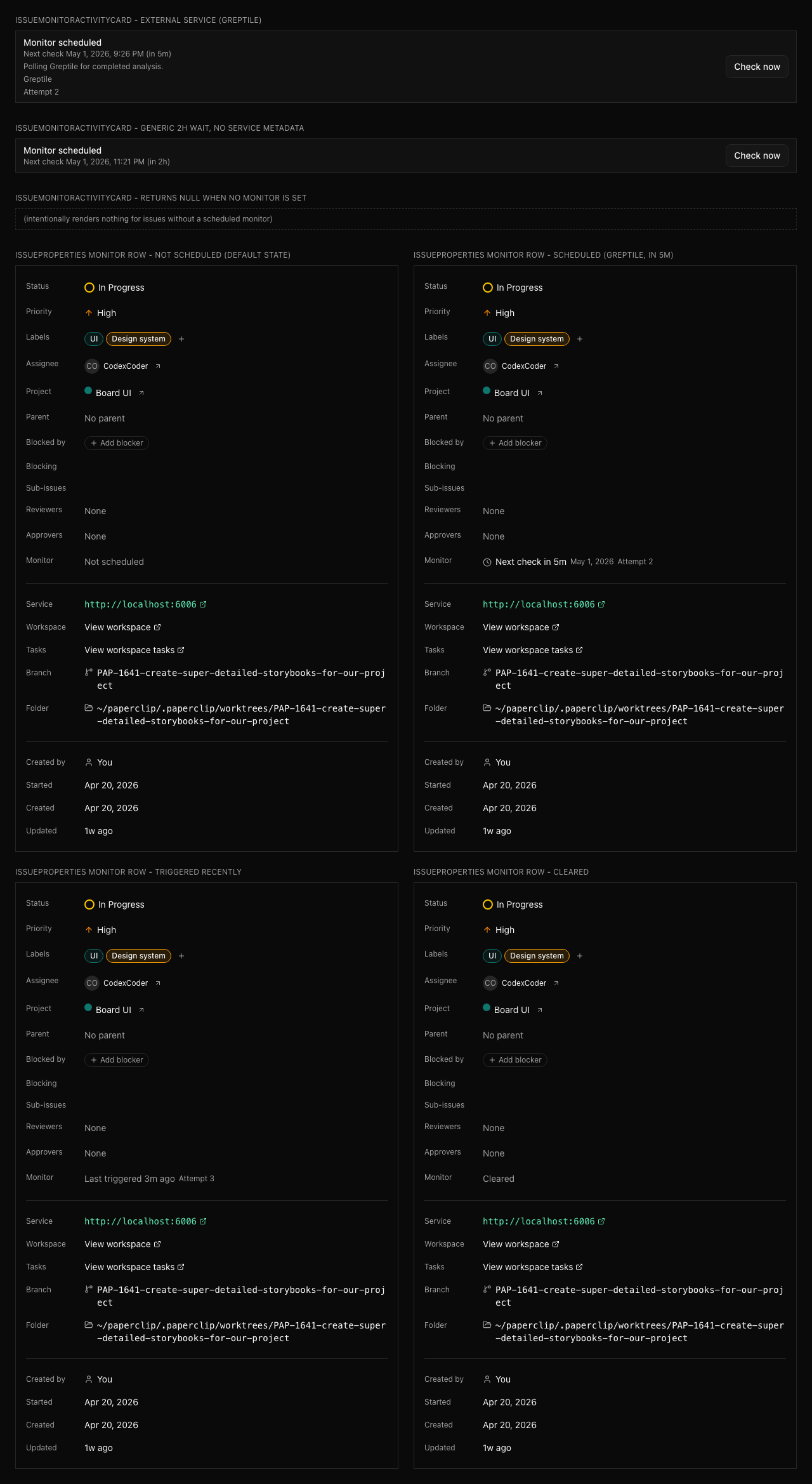
## Risks
- Medium: this changes heartbeat recovery behavior for scheduled
external-service waits, so regressions could affect wake timing or
recovery issue creation.
- Migration risk is reduced by using `IF NOT EXISTS` for the new issue
monitor columns and index.
- External monitor references are treated as secret-adjacent and are
intentionally omitted from visible activity/wake payloads.
> For core feature work, check [`ROADMAP.md`](ROADMAP.md) first and
discuss it in `#dev` before opening the PR. Feature PRs that overlap
with planned core work may need to be redirected — check the roadmap
first. See `CONTRIBUTING.md`.
## Model Used
- OpenAI Codex, GPT-5 coding agent with repository tool use and terminal
execution.
## Checklist
- [x] I have included a thinking path that traces from project context
to this change
- [x] I have specified the model used (with version and capability
details)
- [x] I have checked ROADMAP.md and confirmed this PR does not duplicate
planned core work
- [x] I have run tests locally and they pass
- [x] I have added or updated tests where applicable
- [x] If this change affects the UI, I have included before/after
screenshots or Storybook review surfaces
- [x] I have updated relevant documentation to reflect my changes
- [x] I have considered and documented any risks above
- [x] I will address all Greptile and reviewer comments before
requesting merge
---------
Co-authored-by: Paperclip <noreply@paperclip.ing>
2026-05-03 08:58:53 -05:00
- waiting on an external dependency or system when Paperclip does not own a scheduled re-check
[codex] Harden execution reliability and heartbeat tooling (#3679)
## Thinking Path
> - Paperclip orchestrates AI agents for zero-human companies
> - Reliable execution depends on heartbeat routing, issue lifecycle
semantics, telemetry, and a fast enough local verification loop to keep
regressions visible
> - The remaining commits on this branch were mostly server/runtime
correctness fixes plus test and documentation follow-ups in that area
> - Those changes are logically separate from the UI-focused
issue-detail and workspace/navigation branches even when they touch
overlapping issue APIs
> - This pull request groups the execution reliability, heartbeat,
telemetry, and tooling changes into one standalone branch
> - The benefit is a focused review of the control-plane correctness
work, including the follow-up fix that restored the implicit
comment-reopen helpers after branch splitting
## What Changed
- Hardened issue/heartbeat execution behavior, including self-review
stage skipping, deferred mention wakes during active execution, stranded
execution recovery, active-run scoping, assignee resolution, and
blocked-to-todo wake resumption
- Reduced noisy polling/logging overhead by trimming issue run payloads,
compacting persisted run logs, silencing high-volume request logs, and
capping heartbeat-run queries in dashboard/inbox surfaces
- Expanded telemetry and status semantics with adapter/model fields on
task completion plus clearer status guidance in docs/onboarding material
- Updated test infrastructure and verification defaults with faster
route-test module isolation, cheaper default `pnpm test`, e2e isolation
from local state, and repo verification follow-ups
- Included docs/release housekeeping from the branch and added a small
follow-up commit restoring the implicit comment-reopen helpers that were
dropped during branch reconstruction
## Verification
- `pnpm vitest run
server/src/__tests__/issue-comment-reopen-routes.test.ts
server/src/__tests__/issue-telemetry-routes.test.ts`
- `pnpm vitest run server/src/__tests__/http-log-policy.test.ts
server/src/__tests__/heartbeat-run-log.test.ts
server/src/__tests__/health.test.ts`
- `server/src/__tests__/activity-service.test.ts`,
`server/src/__tests__/heartbeat-comment-wake-batching.test.ts`, and
`server/src/__tests__/heartbeat-process-recovery.test.ts` were attempted
on this host but the embedded Postgres harness reported
init-script/data-dir problems and skipped or failed to start, so they
are noted as environment-limited
## Risks
- Medium: this branch changes core issue/heartbeat routing and
reopen/wakeup behavior, so regressions would affect agent execution flow
rather than isolated UI polish
- Because it also updates verification infrastructure, reviewers should
pay attention to whether the new tests are asserting the right failure
modes and not just reshaping harness behavior
## Model Used
- OpenAI Codex coding agent (GPT-5-class runtime in Codex CLI; exact
deployed model ID is not exposed in this environment), reasoning
enabled, tool use and local code execution enabled
## Checklist
- [x] I have included a thinking path that traces from project context
to this change
- [x] I have specified the model used (with version and capability
details)
- [ ] I have run tests locally and they pass
- [x] I have added or updated tests where applicable
- [ ] If this change affects the UI, I have included before/after
screenshots
- [x] I have updated relevant documentation to reflect my changes
- [x] I have considered and documented any risks above
- [x] I will address all Greptile and reviewer comments before
requesting merge
---------
Co-authored-by: Paperclip <noreply@paperclip.ing>
2026-04-14 13:34:52 -05:00
- work that automatic recovery could not safely continue
### `in_review`
Execution work is paused because the next move belongs to a reviewer or approver, not the current executor.
[codex] Add issue monitor liveness controls (#4988)
## Thinking Path
> - Paperclip is a control plane for autonomous AI companies where work
must stay observable, governable, and recoverable.
> - The task/heartbeat subsystem owns agent execution continuity, issue
state transitions, and visible recovery behavior.
> - Waiting on an external service is not the same as being blocked when
the assignee still owns a future check.
> - The gap was that agents had no first-class one-shot monitor state
for external-service waits, so recovery could look stalled or require ad
hoc comments.
> - This pull request adds bounded issue monitors that can wake the
owner, clear exhausted waits, and produce explicit recovery behavior.
> - It also surfaces monitor status in the board UI and documents when
to use monitors versus `blocked`.
> - The benefit is clearer liveness semantics for asynchronous waits
without weakening single-assignee task ownership.
## What Changed
- Added issue monitor fields, shared types, validators, constants, and
an idempotent `0075` migration for scheduled monitor state.
- Added server-side monitor scheduling, dispatch, recovery bounds,
activity logging, and external-ref redaction.
- Added board/agent route coverage for monitor permissions and child
monitor scheduling.
- Added issue detail/property UI for monitor state, a monitor activity
card, and Storybook stories for review surfaces.
- Documented monitor semantics and recovery policy behavior in
`doc/execution-semantics.md`.
- Addressed Greptile review feedback by preserving monitor state in
skipped-stage builders and making board monitor saves send `scheduledBy:
"board"`.
## Verification
- `pnpm install --frozen-lockfile`
- `pnpm run preflight:workspace-links && pnpm exec vitest run
server/src/__tests__/issue-execution-policy-routes.test.ts
server/src/__tests__/issue-execution-policy.test.ts
server/src/__tests__/issue-monitor-scheduler.test.ts
server/src/__tests__/recovery-classifiers.test.ts
ui/src/components/IssueMonitorActivityCard.test.tsx
ui/src/components/IssueProperties.test.tsx
ui/src/lib/activity-format.test.ts`
- First run passed 5 files and failed to collect 2 server suites because
the worktree was missing the optional `acpx/runtime` dependency.
- After `pnpm install --frozen-lockfile`, reran the 2 failed suites
successfully.
- `pnpm exec vitest run
server/src/__tests__/issue-monitor-scheduler.test.ts
server/src/__tests__/recovery-classifiers.test.ts`
- `pnpm --filter @paperclipai/shared typecheck && pnpm --filter
@paperclipai/db typecheck && pnpm --filter @paperclipai/server typecheck
&& pnpm --filter @paperclipai/ui typecheck`
- `pnpm exec vitest run
server/src/__tests__/issue-execution-policy.test.ts
ui/src/components/IssueProperties.test.tsx`
- `pnpm --filter @paperclipai/server typecheck && pnpm --filter
@paperclipai/ui typecheck`
- `pnpm exec vitest run
ui/src/components/IssueMonitorActivityCard.test.tsx
ui/src/components/IssueProperties.test.tsx`
- `pnpm --filter @paperclipai/ui typecheck`
- Storybook screenshot captured from
`http://127.0.0.1:6006/iframe.html?viewMode=story&id=product-issue-monitor-surfaces--monitor-surfaces`
with Playwright.
## Screenshots

## Risks
- Medium: this changes heartbeat recovery behavior for scheduled
external-service waits, so regressions could affect wake timing or
recovery issue creation.
- Migration risk is reduced by using `IF NOT EXISTS` for the new issue
monitor columns and index.
- External monitor references are treated as secret-adjacent and are
intentionally omitted from visible activity/wake payloads.
> For core feature work, check [`ROADMAP.md`](ROADMAP.md) first and
discuss it in `#dev` before opening the PR. Feature PRs that overlap
with planned core work may need to be redirected — check the roadmap
first. See `CONTRIBUTING.md`.
## Model Used
- OpenAI Codex, GPT-5 coding agent with repository tool use and terminal
execution.
## Checklist
- [x] I have included a thinking path that traces from project context
to this change
- [x] I have specified the model used (with version and capability
details)
- [x] I have checked ROADMAP.md and confirmed this PR does not duplicate
planned core work
- [x] I have run tests locally and they pass
- [x] I have added or updated tests where applicable
- [x] If this change affects the UI, I have included before/after
screenshots or Storybook review surfaces
- [x] I have updated relevant documentation to reflect my changes
- [x] I have considered and documented any risks above
- [x] I will address all Greptile and reviewer comments before
requesting merge
---------
Co-authored-by: Paperclip <noreply@paperclip.ing>
2026-05-03 08:58:53 -05:00
An external review service can also be a valid review path when the issue keeps an agent assignee and has an active one-shot monitor that will wake that assignee to check the service later.
[codex] Harden execution reliability and heartbeat tooling (#3679)
## Thinking Path
> - Paperclip orchestrates AI agents for zero-human companies
> - Reliable execution depends on heartbeat routing, issue lifecycle
semantics, telemetry, and a fast enough local verification loop to keep
regressions visible
> - The remaining commits on this branch were mostly server/runtime
correctness fixes plus test and documentation follow-ups in that area
> - Those changes are logically separate from the UI-focused
issue-detail and workspace/navigation branches even when they touch
overlapping issue APIs
> - This pull request groups the execution reliability, heartbeat,
telemetry, and tooling changes into one standalone branch
> - The benefit is a focused review of the control-plane correctness
work, including the follow-up fix that restored the implicit
comment-reopen helpers after branch splitting
## What Changed
- Hardened issue/heartbeat execution behavior, including self-review
stage skipping, deferred mention wakes during active execution, stranded
execution recovery, active-run scoping, assignee resolution, and
blocked-to-todo wake resumption
- Reduced noisy polling/logging overhead by trimming issue run payloads,
compacting persisted run logs, silencing high-volume request logs, and
capping heartbeat-run queries in dashboard/inbox surfaces
- Expanded telemetry and status semantics with adapter/model fields on
task completion plus clearer status guidance in docs/onboarding material
- Updated test infrastructure and verification defaults with faster
route-test module isolation, cheaper default `pnpm test`, e2e isolation
from local state, and repo verification follow-ups
- Included docs/release housekeeping from the branch and added a small
follow-up commit restoring the implicit comment-reopen helpers that were
dropped during branch reconstruction
## Verification
- `pnpm vitest run
server/src/__tests__/issue-comment-reopen-routes.test.ts
server/src/__tests__/issue-telemetry-routes.test.ts`
- `pnpm vitest run server/src/__tests__/http-log-policy.test.ts
server/src/__tests__/heartbeat-run-log.test.ts
server/src/__tests__/health.test.ts`
- `server/src/__tests__/activity-service.test.ts`,
`server/src/__tests__/heartbeat-comment-wake-batching.test.ts`, and
`server/src/__tests__/heartbeat-process-recovery.test.ts` were attempted
on this host but the embedded Postgres harness reported
init-script/data-dir problems and skipped or failed to start, so they
are noted as environment-limited
## Risks
- Medium: this branch changes core issue/heartbeat routing and
reopen/wakeup behavior, so regressions would affect agent execution flow
rather than isolated UI polish
- Because it also updates verification infrastructure, reviewers should
pay attention to whether the new tests are asserting the right failure
modes and not just reshaping harness behavior
## Model Used
- OpenAI Codex coding agent (GPT-5-class runtime in Codex CLI; exact
deployed model ID is not exposed in this environment), reasoning
enabled, tool use and local code execution enabled
## Checklist
- [x] I have included a thinking path that traces from project context
to this change
- [x] I have specified the model used (with version and capability
details)
- [ ] I have run tests locally and they pass
- [x] I have added or updated tests where applicable
- [ ] If this change affects the UI, I have included before/after
screenshots
- [x] I have updated relevant documentation to reflect my changes
- [x] I have considered and documented any risks above
- [x] I will address all Greptile and reviewer comments before
requesting merge
---------
Co-authored-by: Paperclip <noreply@paperclip.ing>
2026-04-14 13:34:52 -05:00
### `done`
The work is complete and terminal.
### `cancelled`
The work will not continue and is terminal.
## 4. Agent-Owned vs User-Owned Execution
The execution model differs depending on assignee type.
### Agent-owned issues
Agent-owned issues are part of the control plane's execution loop.
- Paperclip can wake the assignee
- Paperclip can track runs linked to the issue
- Paperclip can recover some lost execution state after crashes/restarts
### User-owned issues
User-owned issues are not executed by the heartbeat scheduler.
- Paperclip can track the ownership and status
- Paperclip cannot rely on heartbeat/run semantics to keep them moving
- stranded-work reconciliation does not apply to them
This is why `in_progress` can be strict for agents without forcing the same runtime rules onto human-held work.
## 5. Checkout and Active Execution
Checkout is the bridge from issue ownership to active agent execution.
- checkout is required to move an issue into agent-owned `in_progress`
- `checkoutRunId` represents issue-ownership lock for the current agent run
- `executionRunId` represents the currently active execution path for the issue
These are related but not identical:
- `checkoutRunId` answers who currently owns execution rights for the issue
- `executionRunId` answers which run is actually live right now
Paperclip already clears stale execution locks and can adopt some stale checkout locks when the original run is gone.
## 6. Parent/Sub-Issue vs Blockers
Paperclip uses two different relationships for different jobs.
### Parent/Sub-Issue (`parentId`)
This is structural.
Use it for:
- work breakdown
- rollup context
- explaining why a child issue exists
- waking the parent assignee when all direct children become terminal
Do not treat `parentId` as execution dependency by itself.
### Blockers (`blockedByIssueIds`)
This is dependency semantics.
Use it for:
- \"this issue cannot continue until that issue changes state\"
- explicit waiting relationships
- automatic wakeups when all blockers resolve
[codex] Harden heartbeat scheduling and runtime controls (#4223)
## Thinking Path
> - Paperclip orchestrates AI agents through issue checkout, heartbeat
runs, routines, and auditable control-plane state
> - The runtime path has to recover from lost local processes, transient
adapter failures, blocked dependencies, and routine coalescing without
stranding work
> - The existing branch carried several reliability fixes across
heartbeat scheduling, issue runtime controls, routine dispatch, and
operator-facing run state
> - These changes belong together because they share backend contracts,
migrations, and runtime status semantics
> - This pull request groups the control-plane/runtime slice so it can
merge independently from board UI polish and adapter sandbox work
> - The benefit is safer heartbeat recovery, clearer runtime controls,
and more predictable recurring execution behavior
## What Changed
- Adds bounded heartbeat retry scheduling, scheduled retry state, and
Codex transient failure recovery handling.
- Tightens heartbeat process recovery, blocker wake behavior, issue
comment wake handling, routine dispatch coalescing, and
activity/dashboard bounds.
- Adds runtime-control MCP tools and Paperclip skill docs for issue
workspace runtime management.
- Adds migrations `0061_lively_thor_girl.sql` and
`0062_routine_run_dispatch_fingerprint.sql`.
- Surfaces retry state in run ledger/agent UI and keeps related shared
types synchronized.
## Verification
- `pnpm exec vitest run
server/src/__tests__/heartbeat-retry-scheduling.test.ts
server/src/__tests__/heartbeat-process-recovery.test.ts
server/src/__tests__/routines-service.test.ts`
- `pnpm exec vitest run src/tools.test.ts` from `packages/mcp-server`
## Risks
- Medium risk: this touches heartbeat recovery and routine dispatch,
which are central execution paths.
- Migration order matters if split branches land out of order: merge
this PR before branches that assume the new runtime/routine fields.
- Runtime retry behavior should be watched in CI and in local operator
smoke tests because it changes how transient failures are resumed.
> For core feature work, check [`ROADMAP.md`](ROADMAP.md) first and
discuss it in `#dev` before opening the PR. Feature PRs that overlap
with planned core work may need to be redirected — check the roadmap
first. See `CONTRIBUTING.md`.
## Model Used
- OpenAI Codex, GPT-5-based coding agent runtime, shell/git tool use
enabled. Exact hosted model build and context window are not exposed in
this Paperclip heartbeat environment.
## Checklist
- [x] I have included a thinking path that traces from project context
to this change
- [x] I have specified the model used (with version and capability
details)
- [x] I have checked ROADMAP.md and confirmed this PR does not duplicate
planned core work
- [x] I have run tests locally and they pass
- [x] I have added or updated tests where applicable
- [ ] If this change affects the UI, I have included before/after
screenshots
- [x] I have updated relevant documentation to reflect my changes
- [x] I have considered and documented any risks above
- [x] I will address all Greptile and reviewer comments before
requesting merge
2026-04-21 12:24:11 -05:00
Blocked issues should stay idle while blockers remain unresolved. Paperclip should not create a queued heartbeat run for that issue until the final blocker is done and the `issue_blockers_resolved` wake can start real work.
[codex] Harden execution reliability and heartbeat tooling (#3679)
## Thinking Path
> - Paperclip orchestrates AI agents for zero-human companies
> - Reliable execution depends on heartbeat routing, issue lifecycle
semantics, telemetry, and a fast enough local verification loop to keep
regressions visible
> - The remaining commits on this branch were mostly server/runtime
correctness fixes plus test and documentation follow-ups in that area
> - Those changes are logically separate from the UI-focused
issue-detail and workspace/navigation branches even when they touch
overlapping issue APIs
> - This pull request groups the execution reliability, heartbeat,
telemetry, and tooling changes into one standalone branch
> - The benefit is a focused review of the control-plane correctness
work, including the follow-up fix that restored the implicit
comment-reopen helpers after branch splitting
## What Changed
- Hardened issue/heartbeat execution behavior, including self-review
stage skipping, deferred mention wakes during active execution, stranded
execution recovery, active-run scoping, assignee resolution, and
blocked-to-todo wake resumption
- Reduced noisy polling/logging overhead by trimming issue run payloads,
compacting persisted run logs, silencing high-volume request logs, and
capping heartbeat-run queries in dashboard/inbox surfaces
- Expanded telemetry and status semantics with adapter/model fields on
task completion plus clearer status guidance in docs/onboarding material
- Updated test infrastructure and verification defaults with faster
route-test module isolation, cheaper default `pnpm test`, e2e isolation
from local state, and repo verification follow-ups
- Included docs/release housekeeping from the branch and added a small
follow-up commit restoring the implicit comment-reopen helpers that were
dropped during branch reconstruction
## Verification
- `pnpm vitest run
server/src/__tests__/issue-comment-reopen-routes.test.ts
server/src/__tests__/issue-telemetry-routes.test.ts`
- `pnpm vitest run server/src/__tests__/http-log-policy.test.ts
server/src/__tests__/heartbeat-run-log.test.ts
server/src/__tests__/health.test.ts`
- `server/src/__tests__/activity-service.test.ts`,
`server/src/__tests__/heartbeat-comment-wake-batching.test.ts`, and
`server/src/__tests__/heartbeat-process-recovery.test.ts` were attempted
on this host but the embedded Postgres harness reported
init-script/data-dir problems and skipped or failed to start, so they
are noted as environment-limited
## Risks
- Medium: this branch changes core issue/heartbeat routing and
reopen/wakeup behavior, so regressions would affect agent execution flow
rather than isolated UI polish
- Because it also updates verification infrastructure, reviewers should
pay attention to whether the new tests are asserting the right failure
modes and not just reshaping harness behavior
## Model Used
- OpenAI Codex coding agent (GPT-5-class runtime in Codex CLI; exact
deployed model ID is not exposed in this environment), reasoning
enabled, tool use and local code execution enabled
## Checklist
- [x] I have included a thinking path that traces from project context
to this change
- [x] I have specified the model used (with version and capability
details)
- [ ] I have run tests locally and they pass
- [x] I have added or updated tests where applicable
- [ ] If this change affects the UI, I have included before/after
screenshots
- [x] I have updated relevant documentation to reflect my changes
- [x] I have considered and documented any risks above
- [x] I will address all Greptile and reviewer comments before
requesting merge
---------
Co-authored-by: Paperclip <noreply@paperclip.ing>
2026-04-14 13:34:52 -05:00
If a parent is truly waiting on a child, model that with blockers. Do not rely on the parent/child relationship alone.
2026-04-26 21:17:38 -05:00
## 7. Non-Terminal Issue Liveness Contract
[codex] Harden execution reliability and heartbeat tooling (#3679)
## Thinking Path
> - Paperclip orchestrates AI agents for zero-human companies
> - Reliable execution depends on heartbeat routing, issue lifecycle
semantics, telemetry, and a fast enough local verification loop to keep
regressions visible
> - The remaining commits on this branch were mostly server/runtime
correctness fixes plus test and documentation follow-ups in that area
> - Those changes are logically separate from the UI-focused
issue-detail and workspace/navigation branches even when they touch
overlapping issue APIs
> - This pull request groups the execution reliability, heartbeat,
telemetry, and tooling changes into one standalone branch
> - The benefit is a focused review of the control-plane correctness
work, including the follow-up fix that restored the implicit
comment-reopen helpers after branch splitting
## What Changed
- Hardened issue/heartbeat execution behavior, including self-review
stage skipping, deferred mention wakes during active execution, stranded
execution recovery, active-run scoping, assignee resolution, and
blocked-to-todo wake resumption
- Reduced noisy polling/logging overhead by trimming issue run payloads,
compacting persisted run logs, silencing high-volume request logs, and
capping heartbeat-run queries in dashboard/inbox surfaces
- Expanded telemetry and status semantics with adapter/model fields on
task completion plus clearer status guidance in docs/onboarding material
- Updated test infrastructure and verification defaults with faster
route-test module isolation, cheaper default `pnpm test`, e2e isolation
from local state, and repo verification follow-ups
- Included docs/release housekeeping from the branch and added a small
follow-up commit restoring the implicit comment-reopen helpers that were
dropped during branch reconstruction
## Verification
- `pnpm vitest run
server/src/__tests__/issue-comment-reopen-routes.test.ts
server/src/__tests__/issue-telemetry-routes.test.ts`
- `pnpm vitest run server/src/__tests__/http-log-policy.test.ts
server/src/__tests__/heartbeat-run-log.test.ts
server/src/__tests__/health.test.ts`
- `server/src/__tests__/activity-service.test.ts`,
`server/src/__tests__/heartbeat-comment-wake-batching.test.ts`, and
`server/src/__tests__/heartbeat-process-recovery.test.ts` were attempted
on this host but the embedded Postgres harness reported
init-script/data-dir problems and skipped or failed to start, so they
are noted as environment-limited
## Risks
- Medium: this branch changes core issue/heartbeat routing and
reopen/wakeup behavior, so regressions would affect agent execution flow
rather than isolated UI polish
- Because it also updates verification infrastructure, reviewers should
pay attention to whether the new tests are asserting the right failure
modes and not just reshaping harness behavior
## Model Used
- OpenAI Codex coding agent (GPT-5-class runtime in Codex CLI; exact
deployed model ID is not exposed in this environment), reasoning
enabled, tool use and local code execution enabled
## Checklist
- [x] I have included a thinking path that traces from project context
to this change
- [x] I have specified the model used (with version and capability
details)
- [ ] I have run tests locally and they pass
- [x] I have added or updated tests where applicable
- [ ] If this change affects the UI, I have included before/after
screenshots
- [x] I have updated relevant documentation to reflect my changes
- [x] I have considered and documented any risks above
- [x] I will address all Greptile and reviewer comments before
requesting merge
---------
Co-authored-by: Paperclip <noreply@paperclip.ing>
2026-04-14 13:34:52 -05:00
2026-04-26 21:17:38 -05:00
For agent-owned, non-terminal issues, Paperclip should never leave work in a state where nobody is responsible for the next move and nothing will wake or surface it.
[codex] Harden execution reliability and heartbeat tooling (#3679)
## Thinking Path
> - Paperclip orchestrates AI agents for zero-human companies
> - Reliable execution depends on heartbeat routing, issue lifecycle
semantics, telemetry, and a fast enough local verification loop to keep
regressions visible
> - The remaining commits on this branch were mostly server/runtime
correctness fixes plus test and documentation follow-ups in that area
> - Those changes are logically separate from the UI-focused
issue-detail and workspace/navigation branches even when they touch
overlapping issue APIs
> - This pull request groups the execution reliability, heartbeat,
telemetry, and tooling changes into one standalone branch
> - The benefit is a focused review of the control-plane correctness
work, including the follow-up fix that restored the implicit
comment-reopen helpers after branch splitting
## What Changed
- Hardened issue/heartbeat execution behavior, including self-review
stage skipping, deferred mention wakes during active execution, stranded
execution recovery, active-run scoping, assignee resolution, and
blocked-to-todo wake resumption
- Reduced noisy polling/logging overhead by trimming issue run payloads,
compacting persisted run logs, silencing high-volume request logs, and
capping heartbeat-run queries in dashboard/inbox surfaces
- Expanded telemetry and status semantics with adapter/model fields on
task completion plus clearer status guidance in docs/onboarding material
- Updated test infrastructure and verification defaults with faster
route-test module isolation, cheaper default `pnpm test`, e2e isolation
from local state, and repo verification follow-ups
- Included docs/release housekeeping from the branch and added a small
follow-up commit restoring the implicit comment-reopen helpers that were
dropped during branch reconstruction
## Verification
- `pnpm vitest run
server/src/__tests__/issue-comment-reopen-routes.test.ts
server/src/__tests__/issue-telemetry-routes.test.ts`
- `pnpm vitest run server/src/__tests__/http-log-policy.test.ts
server/src/__tests__/heartbeat-run-log.test.ts
server/src/__tests__/health.test.ts`
- `server/src/__tests__/activity-service.test.ts`,
`server/src/__tests__/heartbeat-comment-wake-batching.test.ts`, and
`server/src/__tests__/heartbeat-process-recovery.test.ts` were attempted
on this host but the embedded Postgres harness reported
init-script/data-dir problems and skipped or failed to start, so they
are noted as environment-limited
## Risks
- Medium: this branch changes core issue/heartbeat routing and
reopen/wakeup behavior, so regressions would affect agent execution flow
rather than isolated UI polish
- Because it also updates verification infrastructure, reviewers should
pay attention to whether the new tests are asserting the right failure
modes and not just reshaping harness behavior
## Model Used
- OpenAI Codex coding agent (GPT-5-class runtime in Codex CLI; exact
deployed model ID is not exposed in this environment), reasoning
enabled, tool use and local code execution enabled
## Checklist
- [x] I have included a thinking path that traces from project context
to this change
- [x] I have specified the model used (with version and capability
details)
- [ ] I have run tests locally and they pass
- [x] I have added or updated tests where applicable
- [ ] If this change affects the UI, I have included before/after
screenshots
- [x] I have updated relevant documentation to reflect my changes
- [x] I have considered and documented any risks above
- [x] I will address all Greptile and reviewer comments before
requesting merge
---------
Co-authored-by: Paperclip <noreply@paperclip.ing>
2026-04-14 13:34:52 -05:00
[codex] Add source-scoped recovery actions (#5599)
## Thinking Path
> - Paperclip is a control plane for autonomous AI companies, where work
must end with a clear disposition rather than ambiguous agent liveness.
> - Recovery currently detects stalled or missing-next-step issues, but
source issue recovery can become split across child recovery issues,
blockers, and comments.
> - That makes it harder for operators and agents to see who owns
recovery and what exact action is needed on the original issue.
> - Source-scoped recovery actions give the original issue a first-class
active recovery state with owner, evidence, wake policy, and resolution
outcome.
> - This pull request adds the recovery-action data model, backend
reconciliation and resolution APIs, and board UI indicators/actions.
> - The benefit is clearer stalled-work recovery without losing source
issue context or relying on comments as the liveness path.
## What Changed
- Added the `issue_recovery_actions` schema, shared
types/constants/validators, and an idempotent
`0084_issue_recovery_actions` migration ordered after current `master`
migrations.
- Updated stranded/missing-disposition recovery to create source-scoped
recovery actions, wake the recovery owner on the source issue, and avoid
locking the source issue for recovery-action wakes.
- Added API support for reading active recovery actions on issue
detail/list surfaces and resolving them with restored, blocked,
cancelled, or false-positive outcomes.
- Require blocked recovery resolutions to have an unresolved first-class
blocker, and removed the UI shortcut that could mark recovery blocked
without a blocker selection path.
- Surfaced recovery indicators/actions in the issue UI, blocker notices,
active run panels, issue rows, and Storybook coverage.
- Updated docs and focused tests for recovery semantics, ownership,
races, stale comments, and UI behavior.
## Verification
- `pnpm exec vitest run
server/src/__tests__/issue-recovery-actions.test.ts
server/src/__tests__/heartbeat-process-recovery.test.ts
ui/src/components/IssueRecoveryActionCard.test.tsx
ui/src/components/IssueBlockedNotice.test.tsx ui/src/api/issues.test.ts`
— 5 files, 72 tests passed.
- `pnpm --filter @paperclipai/shared typecheck` — passed.
- `pnpm --filter @paperclipai/db typecheck` — passed, including
migration numbering check.
- `pnpm --filter @paperclipai/server typecheck` — passed.
- `pnpm --filter @paperclipai/ui typecheck` — passed.
- Follow-up verification after blocker-resolution guard: `pnpm exec
vitest run server/src/__tests__/issue-recovery-actions.test.ts
ui/src/components/IssueRecoveryActionCard.test.tsx
ui/src/api/issues.test.ts` — 3 files, 27 tests passed.
- Follow-up `pnpm --filter @paperclipai/server typecheck` — passed.
- Follow-up `pnpm --filter @paperclipai/ui typecheck` — passed.
- UI states are available in
`ui/storybook/stories/source-issue-recovery.stories.tsx`; screenshot
capture helper is `scripts/screenshot-recovery-card.cjs`.
## Risks
- Medium: recovery behavior changes from child recovery issue ownership
toward source-scoped actions, so operators may see stalled-work state in
new places.
- Migration risk is mitigated by using the next migration slot after
`master` and making the table/constraints/index creation idempotent for
anyone who previously applied the old branch-local
`0082_dizzy_master_mold` migration.
- Existing child recovery issue paths are still guarded for
already-created recovery issues, but new source-scoped flows should be
watched in CI and Greptile review.
> For core feature work, check [`ROADMAP.md`](ROADMAP.md) first and
discuss it in `#dev` before opening the PR. Feature PRs that overlap
with planned core work may need to be redirected — check the roadmap
first. See `CONTRIBUTING.md`.
## Model Used
- OpenAI Codex, GPT-5 coding agent, tool use enabled for shell, Git,
GitHub, and local test execution. Context window not exposed by the
runtime.
## Checklist
- [x] I have included a thinking path that traces from project context
to this change
- [x] I have specified the model used (with version and capability
details)
- [x] I have checked ROADMAP.md and confirmed this PR does not duplicate
planned core work
- [x] I have run tests locally and they pass
- [x] I have added or updated tests where applicable
- [x] If this change affects the UI, I have included before/after
screenshots
- [x] I have updated relevant documentation to reflect my changes
- [x] I have considered and documented any risks above
- [x] I will address all Greptile and reviewer comments before
requesting merge
---------
Co-authored-by: Paperclip <noreply@paperclip.ing>
2026-05-12 09:37:15 -05:00
This is a visibility contract, not an auto-completion contract. If Paperclip cannot safely infer the next action, it should surface the ambiguity with a blocked state, a visible notice, or an explicit recovery action. It must not silently mark work done from prose comments or guess that a dependency is complete.
2026-04-26 21:17:38 -05:00
An issue is healthy when the product can answer "what moves this forward next?" without requiring a human to reconstruct intent from the whole thread. An issue is stalled when it is non-terminal but has no live execution path, no explicit waiting path, and no recovery path.
The valid action-path primitives are:
- an active run linked to the issue
- a queued wake or continuation that can be delivered to the responsible agent
- a typed execution-policy participant, such as `executionState.currentParticipant`
- a pending issue-thread interaction or linked approval that is waiting for a specific responder
[codex] Add issue monitor liveness controls (#4988)
## Thinking Path
> - Paperclip is a control plane for autonomous AI companies where work
must stay observable, governable, and recoverable.
> - The task/heartbeat subsystem owns agent execution continuity, issue
state transitions, and visible recovery behavior.
> - Waiting on an external service is not the same as being blocked when
the assignee still owns a future check.
> - The gap was that agents had no first-class one-shot monitor state
for external-service waits, so recovery could look stalled or require ad
hoc comments.
> - This pull request adds bounded issue monitors that can wake the
owner, clear exhausted waits, and produce explicit recovery behavior.
> - It also surfaces monitor status in the board UI and documents when
to use monitors versus `blocked`.
> - The benefit is clearer liveness semantics for asynchronous waits
without weakening single-assignee task ownership.
## What Changed
- Added issue monitor fields, shared types, validators, constants, and
an idempotent `0075` migration for scheduled monitor state.
- Added server-side monitor scheduling, dispatch, recovery bounds,
activity logging, and external-ref redaction.
- Added board/agent route coverage for monitor permissions and child
monitor scheduling.
- Added issue detail/property UI for monitor state, a monitor activity
card, and Storybook stories for review surfaces.
- Documented monitor semantics and recovery policy behavior in
`doc/execution-semantics.md`.
- Addressed Greptile review feedback by preserving monitor state in
skipped-stage builders and making board monitor saves send `scheduledBy:
"board"`.
## Verification
- `pnpm install --frozen-lockfile`
- `pnpm run preflight:workspace-links && pnpm exec vitest run
server/src/__tests__/issue-execution-policy-routes.test.ts
server/src/__tests__/issue-execution-policy.test.ts
server/src/__tests__/issue-monitor-scheduler.test.ts
server/src/__tests__/recovery-classifiers.test.ts
ui/src/components/IssueMonitorActivityCard.test.tsx
ui/src/components/IssueProperties.test.tsx
ui/src/lib/activity-format.test.ts`
- First run passed 5 files and failed to collect 2 server suites because
the worktree was missing the optional `acpx/runtime` dependency.
- After `pnpm install --frozen-lockfile`, reran the 2 failed suites
successfully.
- `pnpm exec vitest run
server/src/__tests__/issue-monitor-scheduler.test.ts
server/src/__tests__/recovery-classifiers.test.ts`
- `pnpm --filter @paperclipai/shared typecheck && pnpm --filter
@paperclipai/db typecheck && pnpm --filter @paperclipai/server typecheck
&& pnpm --filter @paperclipai/ui typecheck`
- `pnpm exec vitest run
server/src/__tests__/issue-execution-policy.test.ts
ui/src/components/IssueProperties.test.tsx`
- `pnpm --filter @paperclipai/server typecheck && pnpm --filter
@paperclipai/ui typecheck`
- `pnpm exec vitest run
ui/src/components/IssueMonitorActivityCard.test.tsx
ui/src/components/IssueProperties.test.tsx`
- `pnpm --filter @paperclipai/ui typecheck`
- Storybook screenshot captured from
`http://127.0.0.1:6006/iframe.html?viewMode=story&id=product-issue-monitor-surfaces--monitor-surfaces`
with Playwright.
## Screenshots

## Risks
- Medium: this changes heartbeat recovery behavior for scheduled
external-service waits, so regressions could affect wake timing or
recovery issue creation.
- Migration risk is reduced by using `IF NOT EXISTS` for the new issue
monitor columns and index.
- External monitor references are treated as secret-adjacent and are
intentionally omitted from visible activity/wake payloads.
> For core feature work, check [`ROADMAP.md`](ROADMAP.md) first and
discuss it in `#dev` before opening the PR. Feature PRs that overlap
with planned core work may need to be redirected — check the roadmap
first. See `CONTRIBUTING.md`.
## Model Used
- OpenAI Codex, GPT-5 coding agent with repository tool use and terminal
execution.
## Checklist
- [x] I have included a thinking path that traces from project context
to this change
- [x] I have specified the model used (with version and capability
details)
- [x] I have checked ROADMAP.md and confirmed this PR does not duplicate
planned core work
- [x] I have run tests locally and they pass
- [x] I have added or updated tests where applicable
- [x] If this change affects the UI, I have included before/after
screenshots or Storybook review surfaces
- [x] I have updated relevant documentation to reflect my changes
- [x] I have considered and documented any risks above
- [x] I will address all Greptile and reviewer comments before
requesting merge
---------
Co-authored-by: Paperclip <noreply@paperclip.ing>
2026-05-03 08:58:53 -05:00
- a one-shot issue monitor (`executionPolicy.monitor.nextCheckAt` ) that will wake the assignee for a future check
2026-04-26 21:17:38 -05:00
- a human owner via `assigneeUserId`
- a first-class blocker chain whose unresolved leaf issues are themselves healthy
[codex] Add source-scoped recovery actions (#5599)
## Thinking Path
> - Paperclip is a control plane for autonomous AI companies, where work
must end with a clear disposition rather than ambiguous agent liveness.
> - Recovery currently detects stalled or missing-next-step issues, but
source issue recovery can become split across child recovery issues,
blockers, and comments.
> - That makes it harder for operators and agents to see who owns
recovery and what exact action is needed on the original issue.
> - Source-scoped recovery actions give the original issue a first-class
active recovery state with owner, evidence, wake policy, and resolution
outcome.
> - This pull request adds the recovery-action data model, backend
reconciliation and resolution APIs, and board UI indicators/actions.
> - The benefit is clearer stalled-work recovery without losing source
issue context or relying on comments as the liveness path.
## What Changed
- Added the `issue_recovery_actions` schema, shared
types/constants/validators, and an idempotent
`0084_issue_recovery_actions` migration ordered after current `master`
migrations.
- Updated stranded/missing-disposition recovery to create source-scoped
recovery actions, wake the recovery owner on the source issue, and avoid
locking the source issue for recovery-action wakes.
- Added API support for reading active recovery actions on issue
detail/list surfaces and resolving them with restored, blocked,
cancelled, or false-positive outcomes.
- Require blocked recovery resolutions to have an unresolved first-class
blocker, and removed the UI shortcut that could mark recovery blocked
without a blocker selection path.
- Surfaced recovery indicators/actions in the issue UI, blocker notices,
active run panels, issue rows, and Storybook coverage.
- Updated docs and focused tests for recovery semantics, ownership,
races, stale comments, and UI behavior.
## Verification
- `pnpm exec vitest run
server/src/__tests__/issue-recovery-actions.test.ts
server/src/__tests__/heartbeat-process-recovery.test.ts
ui/src/components/IssueRecoveryActionCard.test.tsx
ui/src/components/IssueBlockedNotice.test.tsx ui/src/api/issues.test.ts`
— 5 files, 72 tests passed.
- `pnpm --filter @paperclipai/shared typecheck` — passed.
- `pnpm --filter @paperclipai/db typecheck` — passed, including
migration numbering check.
- `pnpm --filter @paperclipai/server typecheck` — passed.
- `pnpm --filter @paperclipai/ui typecheck` — passed.
- Follow-up verification after blocker-resolution guard: `pnpm exec
vitest run server/src/__tests__/issue-recovery-actions.test.ts
ui/src/components/IssueRecoveryActionCard.test.tsx
ui/src/api/issues.test.ts` — 3 files, 27 tests passed.
- Follow-up `pnpm --filter @paperclipai/server typecheck` — passed.
- Follow-up `pnpm --filter @paperclipai/ui typecheck` — passed.
- UI states are available in
`ui/storybook/stories/source-issue-recovery.stories.tsx`; screenshot
capture helper is `scripts/screenshot-recovery-card.cjs`.
## Risks
- Medium: recovery behavior changes from child recovery issue ownership
toward source-scoped actions, so operators may see stalled-work state in
new places.
- Migration risk is mitigated by using the next migration slot after
`master` and making the table/constraints/index creation idempotent for
anyone who previously applied the old branch-local
`0082_dizzy_master_mold` migration.
- Existing child recovery issue paths are still guarded for
already-created recovery issues, but new source-scoped flows should be
watched in CI and Greptile review.
> For core feature work, check [`ROADMAP.md`](ROADMAP.md) first and
discuss it in `#dev` before opening the PR. Feature PRs that overlap
with planned core work may need to be redirected — check the roadmap
first. See `CONTRIBUTING.md`.
## Model Used
- OpenAI Codex, GPT-5 coding agent, tool use enabled for shell, Git,
GitHub, and local test execution. Context window not exposed by the
runtime.
## Checklist
- [x] I have included a thinking path that traces from project context
to this change
- [x] I have specified the model used (with version and capability
details)
- [x] I have checked ROADMAP.md and confirmed this PR does not duplicate
planned core work
- [x] I have run tests locally and they pass
- [x] I have added or updated tests where applicable
- [x] If this change affects the UI, I have included before/after
screenshots
- [x] I have updated relevant documentation to reflect my changes
- [x] I have considered and documented any risks above
- [x] I will address all Greptile and reviewer comments before
requesting merge
---------
Co-authored-by: Paperclip <noreply@paperclip.ing>
2026-05-12 09:37:15 -05:00
- an open explicit recovery action that names the owner and action needed to restore liveness
### Explicit recovery actions
An explicit recovery action is a typed liveness repair path for a source issue. It is the recovery primitive; the action can be rendered directly on the source issue or backed by a separate recovery issue when the repair needs its own work item.
A valid recovery action must name:
- the source issue and company
- the recovery kind and idempotency fingerprint
- the recovery owner, plus previous or return owner when ownership may temporarily shift
- the cause, bounded evidence, and next action
- the wake, monitor, timeout, retry, or escalation policy that will move the action forward
- the resolution outcome when closed, such as restored, delegated, false positive, blocked, escalated, or cancelled
A source-scoped recovery action is the default form. Use it when the next safe move is to repair the source issue's liveness directly: restore a wake path, clarify disposition, re-establish a monitor, record a false positive, or delegate real follow-up work from the source issue.
Use an issue-backed recovery action only when the recovery is genuinely independent work or when source-scoped handling would be unsafe or unclear. Examples include:
- long or cross-agent repair work with its own assignee, subtasks, or blockers
- real delegated follow-up that should block the source issue as a first-class dependency
- active-run watchdog work that must observe a still-running source process without interfering with it
- recovery that needs separate review, approval, security handling, or escalation ownership
- cases where source issue ownership cannot be changed or restored safely
A comment or system notice can be evidence for a recovery action, but it is not a recovery action by itself. Comment-only recovery is not a healthy liveness path because it does not define a typed owner, wake or monitor policy, retry bound, timeout, escalation path, or resolution outcome.
[codex] Harden execution reliability and heartbeat tooling (#3679)
## Thinking Path
> - Paperclip orchestrates AI agents for zero-human companies
> - Reliable execution depends on heartbeat routing, issue lifecycle
semantics, telemetry, and a fast enough local verification loop to keep
regressions visible
> - The remaining commits on this branch were mostly server/runtime
correctness fixes plus test and documentation follow-ups in that area
> - Those changes are logically separate from the UI-focused
issue-detail and workspace/navigation branches even when they touch
overlapping issue APIs
> - This pull request groups the execution reliability, heartbeat,
telemetry, and tooling changes into one standalone branch
> - The benefit is a focused review of the control-plane correctness
work, including the follow-up fix that restored the implicit
comment-reopen helpers after branch splitting
## What Changed
- Hardened issue/heartbeat execution behavior, including self-review
stage skipping, deferred mention wakes during active execution, stranded
execution recovery, active-run scoping, assignee resolution, and
blocked-to-todo wake resumption
- Reduced noisy polling/logging overhead by trimming issue run payloads,
compacting persisted run logs, silencing high-volume request logs, and
capping heartbeat-run queries in dashboard/inbox surfaces
- Expanded telemetry and status semantics with adapter/model fields on
task completion plus clearer status guidance in docs/onboarding material
- Updated test infrastructure and verification defaults with faster
route-test module isolation, cheaper default `pnpm test`, e2e isolation
from local state, and repo verification follow-ups
- Included docs/release housekeeping from the branch and added a small
follow-up commit restoring the implicit comment-reopen helpers that were
dropped during branch reconstruction
## Verification
- `pnpm vitest run
server/src/__tests__/issue-comment-reopen-routes.test.ts
server/src/__tests__/issue-telemetry-routes.test.ts`
- `pnpm vitest run server/src/__tests__/http-log-policy.test.ts
server/src/__tests__/heartbeat-run-log.test.ts
server/src/__tests__/health.test.ts`
- `server/src/__tests__/activity-service.test.ts`,
`server/src/__tests__/heartbeat-comment-wake-batching.test.ts`, and
`server/src/__tests__/heartbeat-process-recovery.test.ts` were attempted
on this host but the embedded Postgres harness reported
init-script/data-dir problems and skipped or failed to start, so they
are noted as environment-limited
## Risks
- Medium: this branch changes core issue/heartbeat routing and
reopen/wakeup behavior, so regressions would affect agent execution flow
rather than isolated UI polish
- Because it also updates verification infrastructure, reviewers should
pay attention to whether the new tests are asserting the right failure
modes and not just reshaping harness behavior
## Model Used
- OpenAI Codex coding agent (GPT-5-class runtime in Codex CLI; exact
deployed model ID is not exposed in this environment), reasoning
enabled, tool use and local code execution enabled
## Checklist
- [x] I have included a thinking path that traces from project context
to this change
- [x] I have specified the model used (with version and capability
details)
- [ ] I have run tests locally and they pass
- [x] I have added or updated tests where applicable
- [ ] If this change affects the UI, I have included before/after
screenshots
- [x] I have updated relevant documentation to reflect my changes
- [x] I have considered and documented any risks above
- [x] I will address all Greptile and reviewer comments before
requesting merge
---------
Co-authored-by: Paperclip <noreply@paperclip.ing>
2026-04-14 13:34:52 -05:00
### Agent-assigned `todo`
This is dispatch state: ready to start, not yet actively claimed.
A healthy dispatch state means at least one of these is true:
2026-04-26 21:17:38 -05:00
- the issue already has a queued wake path
- the issue is intentionally resting in `todo` after a completed agent heartbeat, with no interrupted dispatch evidence
- the issue has been explicitly surfaced as stranded through a visible blocked/recovery path
An assigned `todo` issue is stalled when dispatch was interrupted, no wake remains queued or running, and no recovery path has been opened.
[codex] Harden execution reliability and heartbeat tooling (#3679)
## Thinking Path
> - Paperclip orchestrates AI agents for zero-human companies
> - Reliable execution depends on heartbeat routing, issue lifecycle
semantics, telemetry, and a fast enough local verification loop to keep
regressions visible
> - The remaining commits on this branch were mostly server/runtime
correctness fixes plus test and documentation follow-ups in that area
> - Those changes are logically separate from the UI-focused
issue-detail and workspace/navigation branches even when they touch
overlapping issue APIs
> - This pull request groups the execution reliability, heartbeat,
telemetry, and tooling changes into one standalone branch
> - The benefit is a focused review of the control-plane correctness
work, including the follow-up fix that restored the implicit
comment-reopen helpers after branch splitting
## What Changed
- Hardened issue/heartbeat execution behavior, including self-review
stage skipping, deferred mention wakes during active execution, stranded
execution recovery, active-run scoping, assignee resolution, and
blocked-to-todo wake resumption
- Reduced noisy polling/logging overhead by trimming issue run payloads,
compacting persisted run logs, silencing high-volume request logs, and
capping heartbeat-run queries in dashboard/inbox surfaces
- Expanded telemetry and status semantics with adapter/model fields on
task completion plus clearer status guidance in docs/onboarding material
- Updated test infrastructure and verification defaults with faster
route-test module isolation, cheaper default `pnpm test`, e2e isolation
from local state, and repo verification follow-ups
- Included docs/release housekeeping from the branch and added a small
follow-up commit restoring the implicit comment-reopen helpers that were
dropped during branch reconstruction
## Verification
- `pnpm vitest run
server/src/__tests__/issue-comment-reopen-routes.test.ts
server/src/__tests__/issue-telemetry-routes.test.ts`
- `pnpm vitest run server/src/__tests__/http-log-policy.test.ts
server/src/__tests__/heartbeat-run-log.test.ts
server/src/__tests__/health.test.ts`
- `server/src/__tests__/activity-service.test.ts`,
`server/src/__tests__/heartbeat-comment-wake-batching.test.ts`, and
`server/src/__tests__/heartbeat-process-recovery.test.ts` were attempted
on this host but the embedded Postgres harness reported
init-script/data-dir problems and skipped or failed to start, so they
are noted as environment-limited
## Risks
- Medium: this branch changes core issue/heartbeat routing and
reopen/wakeup behavior, so regressions would affect agent execution flow
rather than isolated UI polish
- Because it also updates verification infrastructure, reviewers should
pay attention to whether the new tests are asserting the right failure
modes and not just reshaping harness behavior
## Model Used
- OpenAI Codex coding agent (GPT-5-class runtime in Codex CLI; exact
deployed model ID is not exposed in this environment), reasoning
enabled, tool use and local code execution enabled
## Checklist
- [x] I have included a thinking path that traces from project context
to this change
- [x] I have specified the model used (with version and capability
details)
- [ ] I have run tests locally and they pass
- [x] I have added or updated tests where applicable
- [ ] If this change affects the UI, I have included before/after
screenshots
- [x] I have updated relevant documentation to reflect my changes
- [x] I have considered and documented any risks above
- [x] I will address all Greptile and reviewer comments before
requesting merge
---------
Co-authored-by: Paperclip <noreply@paperclip.ing>
2026-04-14 13:34:52 -05:00
Guard assigned backlog liveness (#5428)
## Thinking Path
> - Paperclip orchestrates AI agents for zero-human companies
> - The issue graph and liveness recovery system decide whether assigned
work is executable or parked
> - Assigned issues created without an explicit status could silently
land in backlog, making parents look blocked with no productive wake
path
> - The server, shared validators, recovery analysis, and UI all need to
agree on that execution semantic
> - This pull request makes assigned issue creation default to `todo`,
flags assigned backlog blockers, and surfaces the state in the board
> - The benefit is that parked assigned work becomes intentional and
visible instead of creating silent liveness stalls
## What Changed
- Adds contract tests for assigned issue creation defaults.
- Defaults assigned issue creation to `todo` when status is omitted
while preserving explicit `backlog` parking.
- Exposes `resolveCreateIssueStatusDefault` through shared validators.
- Teaches liveness/blocker attention paths to distinguish assigned
backlog blockers.
- Adds UI notices, row/header badges, and issue detail safeguards for
assigned backlog blockers.
- Adds Storybook fixtures and execution-semantics documentation for the
assigned-backlog behavior.
## Verification
- `pnpm run preflight:workspace-links && pnpm exec vitest run
packages/shared/src/validators/issue.test.ts
server/src/__tests__/issue-assigned-backlog-contract-routes.test.ts
server/src/__tests__/issue-blocker-attention.test.ts
server/src/__tests__/issue-liveness.test.ts
server/src/__tests__/heartbeat-issue-liveness-escalation.test.ts
ui/src/components/IssueAssignedBacklogNotice.test.tsx
ui/src/components/IssueRow.test.tsx` — 50 passed, 23 skipped.
- Skipped tests were embedded Postgres suites on this host with the repo
skip message: `Postgres init script exited with code null. Please check
the logs for extra info. The data directory might already exist.`
- Pairwise merge check against the issue-controls PR branch completed
without conflicts via `git merge --no-commit --no-ff` in a temporary
worktree.
- Screenshots for assigned-backlog UI states:
[light](docs/pr-screenshots/pr-5428/assigned-backlog-light.png),
[dark](docs/pr-screenshots/pr-5428/assigned-backlog-dark.png).
- Follow-up checks: `pnpm --filter /ui typecheck`; `pnpm --filter
/mcp-server build`; `pnpm --filter /mcp-server test`; `pnpm exec vitest
run packages/shared/src/validators/issue.test.ts`; focused UI component
tests.
- Remote PR checks on head `6300b3c`: policy, verify, serialized server
shards 1/4-4/4, Canary Dry Run, e2e, Greptile Review, and Snyk all
passed.
## Risks
- Medium: changes status defaulting for assigned issue creation when the
caller omits status. Explicit `backlog` remains supported, and
server/shared tests cover both paths.
- Medium: liveness classification changes can affect blocker attention
labels; focused service and UI tests cover the new assigned-backlog
state.
> For core feature work, check [`ROADMAP.md`](ROADMAP.md) first and
discuss it in `#dev` before opening the PR. Feature PRs that overlap
with planned core work may need to be redirected — check the roadmap
first. See `CONTRIBUTING.md`.
## Model Used
- OpenAI Codex coding agent, GPT-5 model family (`gpt-5`), tool-enabled
Paperclip heartbeat environment. Context window and internal reasoning
mode are not exposed by the runtime.
## Checklist
- [x] I have included a thinking path that traces from project context
to this change
- [x] I have specified the model used (with version and capability
details)
- [x] I have checked ROADMAP.md and confirmed this PR does not duplicate
planned core work
- [x] I have run tests locally and they pass
- [x] I have added or updated tests where applicable
- [x] If this change affects the UI, I have included before/after
screenshots
- [x] I have updated relevant documentation to reflect my changes
- [x] I have considered and documented any risks above
- [x] I will address all Greptile and reviewer comments before
requesting merge
---------
Co-authored-by: Paperclip <noreply@paperclip.ing>
2026-05-07 12:25:26 -05:00
### Agent-assigned `backlog`
This is parked state, not dispatch state.
Assigning an issue normally implies executable intent. When create APIs receive an assignee and no explicit status, Paperclip defaults the issue to `todo` so the assignee has a wake path instead of silently inheriting the unassigned `backlog` default.
An explicit assigned `backlog` issue remains valid when the creator is deliberately parking the work. It must not wake the assignee just because it has an assignee. Paperclip should make that choice visible in activity and UI so operators can distinguish intentional parking from a missed handoff.
[codex] Add source-scoped recovery actions (#5599)
## Thinking Path
> - Paperclip is a control plane for autonomous AI companies, where work
must end with a clear disposition rather than ambiguous agent liveness.
> - Recovery currently detects stalled or missing-next-step issues, but
source issue recovery can become split across child recovery issues,
blockers, and comments.
> - That makes it harder for operators and agents to see who owns
recovery and what exact action is needed on the original issue.
> - Source-scoped recovery actions give the original issue a first-class
active recovery state with owner, evidence, wake policy, and resolution
outcome.
> - This pull request adds the recovery-action data model, backend
reconciliation and resolution APIs, and board UI indicators/actions.
> - The benefit is clearer stalled-work recovery without losing source
issue context or relying on comments as the liveness path.
## What Changed
- Added the `issue_recovery_actions` schema, shared
types/constants/validators, and an idempotent
`0084_issue_recovery_actions` migration ordered after current `master`
migrations.
- Updated stranded/missing-disposition recovery to create source-scoped
recovery actions, wake the recovery owner on the source issue, and avoid
locking the source issue for recovery-action wakes.
- Added API support for reading active recovery actions on issue
detail/list surfaces and resolving them with restored, blocked,
cancelled, or false-positive outcomes.
- Require blocked recovery resolutions to have an unresolved first-class
blocker, and removed the UI shortcut that could mark recovery blocked
without a blocker selection path.
- Surfaced recovery indicators/actions in the issue UI, blocker notices,
active run panels, issue rows, and Storybook coverage.
- Updated docs and focused tests for recovery semantics, ownership,
races, stale comments, and UI behavior.
## Verification
- `pnpm exec vitest run
server/src/__tests__/issue-recovery-actions.test.ts
server/src/__tests__/heartbeat-process-recovery.test.ts
ui/src/components/IssueRecoveryActionCard.test.tsx
ui/src/components/IssueBlockedNotice.test.tsx ui/src/api/issues.test.ts`
— 5 files, 72 tests passed.
- `pnpm --filter @paperclipai/shared typecheck` — passed.
- `pnpm --filter @paperclipai/db typecheck` — passed, including
migration numbering check.
- `pnpm --filter @paperclipai/server typecheck` — passed.
- `pnpm --filter @paperclipai/ui typecheck` — passed.
- Follow-up verification after blocker-resolution guard: `pnpm exec
vitest run server/src/__tests__/issue-recovery-actions.test.ts
ui/src/components/IssueRecoveryActionCard.test.tsx
ui/src/api/issues.test.ts` — 3 files, 27 tests passed.
- Follow-up `pnpm --filter @paperclipai/server typecheck` — passed.
- Follow-up `pnpm --filter @paperclipai/ui typecheck` — passed.
- UI states are available in
`ui/storybook/stories/source-issue-recovery.stories.tsx`; screenshot
capture helper is `scripts/screenshot-recovery-card.cjs`.
## Risks
- Medium: recovery behavior changes from child recovery issue ownership
toward source-scoped actions, so operators may see stalled-work state in
new places.
- Migration risk is mitigated by using the next migration slot after
`master` and making the table/constraints/index creation idempotent for
anyone who previously applied the old branch-local
`0082_dizzy_master_mold` migration.
- Existing child recovery issue paths are still guarded for
already-created recovery issues, but new source-scoped flows should be
watched in CI and Greptile review.
> For core feature work, check [`ROADMAP.md`](ROADMAP.md) first and
discuss it in `#dev` before opening the PR. Feature PRs that overlap
with planned core work may need to be redirected — check the roadmap
first. See `CONTRIBUTING.md`.
## Model Used
- OpenAI Codex, GPT-5 coding agent, tool use enabled for shell, Git,
GitHub, and local test execution. Context window not exposed by the
runtime.
## Checklist
- [x] I have included a thinking path that traces from project context
to this change
- [x] I have specified the model used (with version and capability
details)
- [x] I have checked ROADMAP.md and confirmed this PR does not duplicate
planned core work
- [x] I have run tests locally and they pass
- [x] I have added or updated tests where applicable
- [x] If this change affects the UI, I have included before/after
screenshots
- [x] I have updated relevant documentation to reflect my changes
- [x] I have considered and documented any risks above
- [x] I will address all Greptile and reviewer comments before
requesting merge
---------
Co-authored-by: Paperclip <noreply@paperclip.ing>
2026-05-12 09:37:15 -05:00
An assigned `backlog` issue becomes a liveness problem when another issue is blocked on it and there is no explicit waiting path such as a human owner, active run, queued wake, pending interaction or approval, monitor, or open recovery action. In that case the blocked parent should surface "blocked by parked work" rather than treating the dependency chain as healthy.
Guard assigned backlog liveness (#5428)
## Thinking Path
> - Paperclip orchestrates AI agents for zero-human companies
> - The issue graph and liveness recovery system decide whether assigned
work is executable or parked
> - Assigned issues created without an explicit status could silently
land in backlog, making parents look blocked with no productive wake
path
> - The server, shared validators, recovery analysis, and UI all need to
agree on that execution semantic
> - This pull request makes assigned issue creation default to `todo`,
flags assigned backlog blockers, and surfaces the state in the board
> - The benefit is that parked assigned work becomes intentional and
visible instead of creating silent liveness stalls
## What Changed
- Adds contract tests for assigned issue creation defaults.
- Defaults assigned issue creation to `todo` when status is omitted
while preserving explicit `backlog` parking.
- Exposes `resolveCreateIssueStatusDefault` through shared validators.
- Teaches liveness/blocker attention paths to distinguish assigned
backlog blockers.
- Adds UI notices, row/header badges, and issue detail safeguards for
assigned backlog blockers.
- Adds Storybook fixtures and execution-semantics documentation for the
assigned-backlog behavior.
## Verification
- `pnpm run preflight:workspace-links && pnpm exec vitest run
packages/shared/src/validators/issue.test.ts
server/src/__tests__/issue-assigned-backlog-contract-routes.test.ts
server/src/__tests__/issue-blocker-attention.test.ts
server/src/__tests__/issue-liveness.test.ts
server/src/__tests__/heartbeat-issue-liveness-escalation.test.ts
ui/src/components/IssueAssignedBacklogNotice.test.tsx
ui/src/components/IssueRow.test.tsx` — 50 passed, 23 skipped.
- Skipped tests were embedded Postgres suites on this host with the repo
skip message: `Postgres init script exited with code null. Please check
the logs for extra info. The data directory might already exist.`
- Pairwise merge check against the issue-controls PR branch completed
without conflicts via `git merge --no-commit --no-ff` in a temporary
worktree.
- Screenshots for assigned-backlog UI states:
[light](docs/pr-screenshots/pr-5428/assigned-backlog-light.png),
[dark](docs/pr-screenshots/pr-5428/assigned-backlog-dark.png).
- Follow-up checks: `pnpm --filter /ui typecheck`; `pnpm --filter
/mcp-server build`; `pnpm --filter /mcp-server test`; `pnpm exec vitest
run packages/shared/src/validators/issue.test.ts`; focused UI component
tests.
- Remote PR checks on head `6300b3c`: policy, verify, serialized server
shards 1/4-4/4, Canary Dry Run, e2e, Greptile Review, and Snyk all
passed.
## Risks
- Medium: changes status defaulting for assigned issue creation when the
caller omits status. Explicit `backlog` remains supported, and
server/shared tests cover both paths.
- Medium: liveness classification changes can affect blocker attention
labels; focused service and UI tests cover the new assigned-backlog
state.
> For core feature work, check [`ROADMAP.md`](ROADMAP.md) first and
discuss it in `#dev` before opening the PR. Feature PRs that overlap
with planned core work may need to be redirected — check the roadmap
first. See `CONTRIBUTING.md`.
## Model Used
- OpenAI Codex coding agent, GPT-5 model family (`gpt-5`), tool-enabled
Paperclip heartbeat environment. Context window and internal reasoning
mode are not exposed by the runtime.
## Checklist
- [x] I have included a thinking path that traces from project context
to this change
- [x] I have specified the model used (with version and capability
details)
- [x] I have checked ROADMAP.md and confirmed this PR does not duplicate
planned core work
- [x] I have run tests locally and they pass
- [x] I have added or updated tests where applicable
- [x] If this change affects the UI, I have included before/after
screenshots
- [x] I have updated relevant documentation to reflect my changes
- [x] I have considered and documented any risks above
- [x] I will address all Greptile and reviewer comments before
requesting merge
---------
Co-authored-by: Paperclip <noreply@paperclip.ing>
2026-05-07 12:25:26 -05:00
[codex] Harden execution reliability and heartbeat tooling (#3679)
## Thinking Path
> - Paperclip orchestrates AI agents for zero-human companies
> - Reliable execution depends on heartbeat routing, issue lifecycle
semantics, telemetry, and a fast enough local verification loop to keep
regressions visible
> - The remaining commits on this branch were mostly server/runtime
correctness fixes plus test and documentation follow-ups in that area
> - Those changes are logically separate from the UI-focused
issue-detail and workspace/navigation branches even when they touch
overlapping issue APIs
> - This pull request groups the execution reliability, heartbeat,
telemetry, and tooling changes into one standalone branch
> - The benefit is a focused review of the control-plane correctness
work, including the follow-up fix that restored the implicit
comment-reopen helpers after branch splitting
## What Changed
- Hardened issue/heartbeat execution behavior, including self-review
stage skipping, deferred mention wakes during active execution, stranded
execution recovery, active-run scoping, assignee resolution, and
blocked-to-todo wake resumption
- Reduced noisy polling/logging overhead by trimming issue run payloads,
compacting persisted run logs, silencing high-volume request logs, and
capping heartbeat-run queries in dashboard/inbox surfaces
- Expanded telemetry and status semantics with adapter/model fields on
task completion plus clearer status guidance in docs/onboarding material
- Updated test infrastructure and verification defaults with faster
route-test module isolation, cheaper default `pnpm test`, e2e isolation
from local state, and repo verification follow-ups
- Included docs/release housekeeping from the branch and added a small
follow-up commit restoring the implicit comment-reopen helpers that were
dropped during branch reconstruction
## Verification
- `pnpm vitest run
server/src/__tests__/issue-comment-reopen-routes.test.ts
server/src/__tests__/issue-telemetry-routes.test.ts`
- `pnpm vitest run server/src/__tests__/http-log-policy.test.ts
server/src/__tests__/heartbeat-run-log.test.ts
server/src/__tests__/health.test.ts`
- `server/src/__tests__/activity-service.test.ts`,
`server/src/__tests__/heartbeat-comment-wake-batching.test.ts`, and
`server/src/__tests__/heartbeat-process-recovery.test.ts` were attempted
on this host but the embedded Postgres harness reported
init-script/data-dir problems and skipped or failed to start, so they
are noted as environment-limited
## Risks
- Medium: this branch changes core issue/heartbeat routing and
reopen/wakeup behavior, so regressions would affect agent execution flow
rather than isolated UI polish
- Because it also updates verification infrastructure, reviewers should
pay attention to whether the new tests are asserting the right failure
modes and not just reshaping harness behavior
## Model Used
- OpenAI Codex coding agent (GPT-5-class runtime in Codex CLI; exact
deployed model ID is not exposed in this environment), reasoning
enabled, tool use and local code execution enabled
## Checklist
- [x] I have included a thinking path that traces from project context
to this change
- [x] I have specified the model used (with version and capability
details)
- [ ] I have run tests locally and they pass
- [x] I have added or updated tests where applicable
- [ ] If this change affects the UI, I have included before/after
screenshots
- [x] I have updated relevant documentation to reflect my changes
- [x] I have considered and documented any risks above
- [x] I will address all Greptile and reviewer comments before
requesting merge
---------
Co-authored-by: Paperclip <noreply@paperclip.ing>
2026-04-14 13:34:52 -05:00
### Agent-assigned `in_progress`
This is active-work state.
A healthy active-work state means at least one of these is true:
- there is an active run for the issue
- there is already a queued continuation wake
[codex] Add issue monitor liveness controls (#4988)
## Thinking Path
> - Paperclip is a control plane for autonomous AI companies where work
must stay observable, governable, and recoverable.
> - The task/heartbeat subsystem owns agent execution continuity, issue
state transitions, and visible recovery behavior.
> - Waiting on an external service is not the same as being blocked when
the assignee still owns a future check.
> - The gap was that agents had no first-class one-shot monitor state
for external-service waits, so recovery could look stalled or require ad
hoc comments.
> - This pull request adds bounded issue monitors that can wake the
owner, clear exhausted waits, and produce explicit recovery behavior.
> - It also surfaces monitor status in the board UI and documents when
to use monitors versus `blocked`.
> - The benefit is clearer liveness semantics for asynchronous waits
without weakening single-assignee task ownership.
## What Changed
- Added issue monitor fields, shared types, validators, constants, and
an idempotent `0075` migration for scheduled monitor state.
- Added server-side monitor scheduling, dispatch, recovery bounds,
activity logging, and external-ref redaction.
- Added board/agent route coverage for monitor permissions and child
monitor scheduling.
- Added issue detail/property UI for monitor state, a monitor activity
card, and Storybook stories for review surfaces.
- Documented monitor semantics and recovery policy behavior in
`doc/execution-semantics.md`.
- Addressed Greptile review feedback by preserving monitor state in
skipped-stage builders and making board monitor saves send `scheduledBy:
"board"`.
## Verification
- `pnpm install --frozen-lockfile`
- `pnpm run preflight:workspace-links && pnpm exec vitest run
server/src/__tests__/issue-execution-policy-routes.test.ts
server/src/__tests__/issue-execution-policy.test.ts
server/src/__tests__/issue-monitor-scheduler.test.ts
server/src/__tests__/recovery-classifiers.test.ts
ui/src/components/IssueMonitorActivityCard.test.tsx
ui/src/components/IssueProperties.test.tsx
ui/src/lib/activity-format.test.ts`
- First run passed 5 files and failed to collect 2 server suites because
the worktree was missing the optional `acpx/runtime` dependency.
- After `pnpm install --frozen-lockfile`, reran the 2 failed suites
successfully.
- `pnpm exec vitest run
server/src/__tests__/issue-monitor-scheduler.test.ts
server/src/__tests__/recovery-classifiers.test.ts`
- `pnpm --filter @paperclipai/shared typecheck && pnpm --filter
@paperclipai/db typecheck && pnpm --filter @paperclipai/server typecheck
&& pnpm --filter @paperclipai/ui typecheck`
- `pnpm exec vitest run
server/src/__tests__/issue-execution-policy.test.ts
ui/src/components/IssueProperties.test.tsx`
- `pnpm --filter @paperclipai/server typecheck && pnpm --filter
@paperclipai/ui typecheck`
- `pnpm exec vitest run
ui/src/components/IssueMonitorActivityCard.test.tsx
ui/src/components/IssueProperties.test.tsx`
- `pnpm --filter @paperclipai/ui typecheck`
- Storybook screenshot captured from
`http://127.0.0.1:6006/iframe.html?viewMode=story&id=product-issue-monitor-surfaces--monitor-surfaces`
with Playwright.
## Screenshots

## Risks
- Medium: this changes heartbeat recovery behavior for scheduled
external-service waits, so regressions could affect wake timing or
recovery issue creation.
- Migration risk is reduced by using `IF NOT EXISTS` for the new issue
monitor columns and index.
- External monitor references are treated as secret-adjacent and are
intentionally omitted from visible activity/wake payloads.
> For core feature work, check [`ROADMAP.md`](ROADMAP.md) first and
discuss it in `#dev` before opening the PR. Feature PRs that overlap
with planned core work may need to be redirected — check the roadmap
first. See `CONTRIBUTING.md`.
## Model Used
- OpenAI Codex, GPT-5 coding agent with repository tool use and terminal
execution.
## Checklist
- [x] I have included a thinking path that traces from project context
to this change
- [x] I have specified the model used (with version and capability
details)
- [x] I have checked ROADMAP.md and confirmed this PR does not duplicate
planned core work
- [x] I have run tests locally and they pass
- [x] I have added or updated tests where applicable
- [x] If this change affects the UI, I have included before/after
screenshots or Storybook review surfaces
- [x] I have updated relevant documentation to reflect my changes
- [x] I have considered and documented any risks above
- [x] I will address all Greptile and reviewer comments before
requesting merge
---------
Co-authored-by: Paperclip <noreply@paperclip.ing>
2026-05-03 08:58:53 -05:00
- there is an active one-shot monitor that will wake the assignee for a future check
[codex] Add source-scoped recovery actions (#5599)
## Thinking Path
> - Paperclip is a control plane for autonomous AI companies, where work
must end with a clear disposition rather than ambiguous agent liveness.
> - Recovery currently detects stalled or missing-next-step issues, but
source issue recovery can become split across child recovery issues,
blockers, and comments.
> - That makes it harder for operators and agents to see who owns
recovery and what exact action is needed on the original issue.
> - Source-scoped recovery actions give the original issue a first-class
active recovery state with owner, evidence, wake policy, and resolution
outcome.
> - This pull request adds the recovery-action data model, backend
reconciliation and resolution APIs, and board UI indicators/actions.
> - The benefit is clearer stalled-work recovery without losing source
issue context or relying on comments as the liveness path.
## What Changed
- Added the `issue_recovery_actions` schema, shared
types/constants/validators, and an idempotent
`0084_issue_recovery_actions` migration ordered after current `master`
migrations.
- Updated stranded/missing-disposition recovery to create source-scoped
recovery actions, wake the recovery owner on the source issue, and avoid
locking the source issue for recovery-action wakes.
- Added API support for reading active recovery actions on issue
detail/list surfaces and resolving them with restored, blocked,
cancelled, or false-positive outcomes.
- Require blocked recovery resolutions to have an unresolved first-class
blocker, and removed the UI shortcut that could mark recovery blocked
without a blocker selection path.
- Surfaced recovery indicators/actions in the issue UI, blocker notices,
active run panels, issue rows, and Storybook coverage.
- Updated docs and focused tests for recovery semantics, ownership,
races, stale comments, and UI behavior.
## Verification
- `pnpm exec vitest run
server/src/__tests__/issue-recovery-actions.test.ts
server/src/__tests__/heartbeat-process-recovery.test.ts
ui/src/components/IssueRecoveryActionCard.test.tsx
ui/src/components/IssueBlockedNotice.test.tsx ui/src/api/issues.test.ts`
— 5 files, 72 tests passed.
- `pnpm --filter @paperclipai/shared typecheck` — passed.
- `pnpm --filter @paperclipai/db typecheck` — passed, including
migration numbering check.
- `pnpm --filter @paperclipai/server typecheck` — passed.
- `pnpm --filter @paperclipai/ui typecheck` — passed.
- Follow-up verification after blocker-resolution guard: `pnpm exec
vitest run server/src/__tests__/issue-recovery-actions.test.ts
ui/src/components/IssueRecoveryActionCard.test.tsx
ui/src/api/issues.test.ts` — 3 files, 27 tests passed.
- Follow-up `pnpm --filter @paperclipai/server typecheck` — passed.
- Follow-up `pnpm --filter @paperclipai/ui typecheck` — passed.
- UI states are available in
`ui/storybook/stories/source-issue-recovery.stories.tsx`; screenshot
capture helper is `scripts/screenshot-recovery-card.cjs`.
## Risks
- Medium: recovery behavior changes from child recovery issue ownership
toward source-scoped actions, so operators may see stalled-work state in
new places.
- Migration risk is mitigated by using the next migration slot after
`master` and making the table/constraints/index creation idempotent for
anyone who previously applied the old branch-local
`0082_dizzy_master_mold` migration.
- Existing child recovery issue paths are still guarded for
already-created recovery issues, but new source-scoped flows should be
watched in CI and Greptile review.
> For core feature work, check [`ROADMAP.md`](ROADMAP.md) first and
discuss it in `#dev` before opening the PR. Feature PRs that overlap
with planned core work may need to be redirected — check the roadmap
first. See `CONTRIBUTING.md`.
## Model Used
- OpenAI Codex, GPT-5 coding agent, tool use enabled for shell, Git,
GitHub, and local test execution. Context window not exposed by the
runtime.
## Checklist
- [x] I have included a thinking path that traces from project context
to this change
- [x] I have specified the model used (with version and capability
details)
- [x] I have checked ROADMAP.md and confirmed this PR does not duplicate
planned core work
- [x] I have run tests locally and they pass
- [x] I have added or updated tests where applicable
- [x] If this change affects the UI, I have included before/after
screenshots
- [x] I have updated relevant documentation to reflect my changes
- [x] I have considered and documented any risks above
- [x] I will address all Greptile and reviewer comments before
requesting merge
---------
Co-authored-by: Paperclip <noreply@paperclip.ing>
2026-05-12 09:37:15 -05:00
- there is an open explicit recovery action for the lost execution path
2026-04-26 21:17:38 -05:00
An agent-owned `in_progress` issue is stalled when it has no active run, no queued continuation, and no explicit recovery surface. A still-running but silent process is not automatically stalled; it is handled by the active-run watchdog contract.
### `in_review`
This is review/approval state: execution is paused because the next move belongs to a reviewer, approver, board user, or recovery owner.
A healthy `in_review` issue has at least one valid action path:
- a typed execution-policy participant who can approve or request changes
- a pending issue-thread interaction or linked approval waiting for a named responder
- a human owner via `assigneeUserId`
- an active run or queued wake that is expected to process the review state
[codex] Add issue monitor liveness controls (#4988)
## Thinking Path
> - Paperclip is a control plane for autonomous AI companies where work
must stay observable, governable, and recoverable.
> - The task/heartbeat subsystem owns agent execution continuity, issue
state transitions, and visible recovery behavior.
> - Waiting on an external service is not the same as being blocked when
the assignee still owns a future check.
> - The gap was that agents had no first-class one-shot monitor state
for external-service waits, so recovery could look stalled or require ad
hoc comments.
> - This pull request adds bounded issue monitors that can wake the
owner, clear exhausted waits, and produce explicit recovery behavior.
> - It also surfaces monitor status in the board UI and documents when
to use monitors versus `blocked`.
> - The benefit is clearer liveness semantics for asynchronous waits
without weakening single-assignee task ownership.
## What Changed
- Added issue monitor fields, shared types, validators, constants, and
an idempotent `0075` migration for scheduled monitor state.
- Added server-side monitor scheduling, dispatch, recovery bounds,
activity logging, and external-ref redaction.
- Added board/agent route coverage for monitor permissions and child
monitor scheduling.
- Added issue detail/property UI for monitor state, a monitor activity
card, and Storybook stories for review surfaces.
- Documented monitor semantics and recovery policy behavior in
`doc/execution-semantics.md`.
- Addressed Greptile review feedback by preserving monitor state in
skipped-stage builders and making board monitor saves send `scheduledBy:
"board"`.
## Verification
- `pnpm install --frozen-lockfile`
- `pnpm run preflight:workspace-links && pnpm exec vitest run
server/src/__tests__/issue-execution-policy-routes.test.ts
server/src/__tests__/issue-execution-policy.test.ts
server/src/__tests__/issue-monitor-scheduler.test.ts
server/src/__tests__/recovery-classifiers.test.ts
ui/src/components/IssueMonitorActivityCard.test.tsx
ui/src/components/IssueProperties.test.tsx
ui/src/lib/activity-format.test.ts`
- First run passed 5 files and failed to collect 2 server suites because
the worktree was missing the optional `acpx/runtime` dependency.
- After `pnpm install --frozen-lockfile`, reran the 2 failed suites
successfully.
- `pnpm exec vitest run
server/src/__tests__/issue-monitor-scheduler.test.ts
server/src/__tests__/recovery-classifiers.test.ts`
- `pnpm --filter @paperclipai/shared typecheck && pnpm --filter
@paperclipai/db typecheck && pnpm --filter @paperclipai/server typecheck
&& pnpm --filter @paperclipai/ui typecheck`
- `pnpm exec vitest run
server/src/__tests__/issue-execution-policy.test.ts
ui/src/components/IssueProperties.test.tsx`
- `pnpm --filter @paperclipai/server typecheck && pnpm --filter
@paperclipai/ui typecheck`
- `pnpm exec vitest run
ui/src/components/IssueMonitorActivityCard.test.tsx
ui/src/components/IssueProperties.test.tsx`
- `pnpm --filter @paperclipai/ui typecheck`
- Storybook screenshot captured from
`http://127.0.0.1:6006/iframe.html?viewMode=story&id=product-issue-monitor-surfaces--monitor-surfaces`
with Playwright.
## Screenshots

## Risks
- Medium: this changes heartbeat recovery behavior for scheduled
external-service waits, so regressions could affect wake timing or
recovery issue creation.
- Migration risk is reduced by using `IF NOT EXISTS` for the new issue
monitor columns and index.
- External monitor references are treated as secret-adjacent and are
intentionally omitted from visible activity/wake payloads.
> For core feature work, check [`ROADMAP.md`](ROADMAP.md) first and
discuss it in `#dev` before opening the PR. Feature PRs that overlap
with planned core work may need to be redirected — check the roadmap
first. See `CONTRIBUTING.md`.
## Model Used
- OpenAI Codex, GPT-5 coding agent with repository tool use and terminal
execution.
## Checklist
- [x] I have included a thinking path that traces from project context
to this change
- [x] I have specified the model used (with version and capability
details)
- [x] I have checked ROADMAP.md and confirmed this PR does not duplicate
planned core work
- [x] I have run tests locally and they pass
- [x] I have added or updated tests where applicable
- [x] If this change affects the UI, I have included before/after
screenshots or Storybook review surfaces
- [x] I have updated relevant documentation to reflect my changes
- [x] I have considered and documented any risks above
- [x] I will address all Greptile and reviewer comments before
requesting merge
---------
Co-authored-by: Paperclip <noreply@paperclip.ing>
2026-05-03 08:58:53 -05:00
- an active one-shot monitor for an external service or async review loop that the assignee owns
[codex] Add source-scoped recovery actions (#5599)
## Thinking Path
> - Paperclip is a control plane for autonomous AI companies, where work
must end with a clear disposition rather than ambiguous agent liveness.
> - Recovery currently detects stalled or missing-next-step issues, but
source issue recovery can become split across child recovery issues,
blockers, and comments.
> - That makes it harder for operators and agents to see who owns
recovery and what exact action is needed on the original issue.
> - Source-scoped recovery actions give the original issue a first-class
active recovery state with owner, evidence, wake policy, and resolution
outcome.
> - This pull request adds the recovery-action data model, backend
reconciliation and resolution APIs, and board UI indicators/actions.
> - The benefit is clearer stalled-work recovery without losing source
issue context or relying on comments as the liveness path.
## What Changed
- Added the `issue_recovery_actions` schema, shared
types/constants/validators, and an idempotent
`0084_issue_recovery_actions` migration ordered after current `master`
migrations.
- Updated stranded/missing-disposition recovery to create source-scoped
recovery actions, wake the recovery owner on the source issue, and avoid
locking the source issue for recovery-action wakes.
- Added API support for reading active recovery actions on issue
detail/list surfaces and resolving them with restored, blocked,
cancelled, or false-positive outcomes.
- Require blocked recovery resolutions to have an unresolved first-class
blocker, and removed the UI shortcut that could mark recovery blocked
without a blocker selection path.
- Surfaced recovery indicators/actions in the issue UI, blocker notices,
active run panels, issue rows, and Storybook coverage.
- Updated docs and focused tests for recovery semantics, ownership,
races, stale comments, and UI behavior.
## Verification
- `pnpm exec vitest run
server/src/__tests__/issue-recovery-actions.test.ts
server/src/__tests__/heartbeat-process-recovery.test.ts
ui/src/components/IssueRecoveryActionCard.test.tsx
ui/src/components/IssueBlockedNotice.test.tsx ui/src/api/issues.test.ts`
— 5 files, 72 tests passed.
- `pnpm --filter @paperclipai/shared typecheck` — passed.
- `pnpm --filter @paperclipai/db typecheck` — passed, including
migration numbering check.
- `pnpm --filter @paperclipai/server typecheck` — passed.
- `pnpm --filter @paperclipai/ui typecheck` — passed.
- Follow-up verification after blocker-resolution guard: `pnpm exec
vitest run server/src/__tests__/issue-recovery-actions.test.ts
ui/src/components/IssueRecoveryActionCard.test.tsx
ui/src/api/issues.test.ts` — 3 files, 27 tests passed.
- Follow-up `pnpm --filter @paperclipai/server typecheck` — passed.
- Follow-up `pnpm --filter @paperclipai/ui typecheck` — passed.
- UI states are available in
`ui/storybook/stories/source-issue-recovery.stories.tsx`; screenshot
capture helper is `scripts/screenshot-recovery-card.cjs`.
## Risks
- Medium: recovery behavior changes from child recovery issue ownership
toward source-scoped actions, so operators may see stalled-work state in
new places.
- Migration risk is mitigated by using the next migration slot after
`master` and making the table/constraints/index creation idempotent for
anyone who previously applied the old branch-local
`0082_dizzy_master_mold` migration.
- Existing child recovery issue paths are still guarded for
already-created recovery issues, but new source-scoped flows should be
watched in CI and Greptile review.
> For core feature work, check [`ROADMAP.md`](ROADMAP.md) first and
discuss it in `#dev` before opening the PR. Feature PRs that overlap
with planned core work may need to be redirected — check the roadmap
first. See `CONTRIBUTING.md`.
## Model Used
- OpenAI Codex, GPT-5 coding agent, tool use enabled for shell, Git,
GitHub, and local test execution. Context window not exposed by the
runtime.
## Checklist
- [x] I have included a thinking path that traces from project context
to this change
- [x] I have specified the model used (with version and capability
details)
- [x] I have checked ROADMAP.md and confirmed this PR does not duplicate
planned core work
- [x] I have run tests locally and they pass
- [x] I have added or updated tests where applicable
- [x] If this change affects the UI, I have included before/after
screenshots
- [x] I have updated relevant documentation to reflect my changes
- [x] I have considered and documented any risks above
- [x] I will address all Greptile and reviewer comments before
requesting merge
---------
Co-authored-by: Paperclip <noreply@paperclip.ing>
2026-05-12 09:37:15 -05:00
- an open explicit recovery action for an ambiguous review handoff
2026-04-26 21:17:38 -05:00
Agent-assigned `in_review` with no typed participant is only healthy when one of the other paths exists. Assignment to the same agent that produced the handoff is not, by itself, a review path.
[codex] Add source-scoped recovery actions (#5599)
## Thinking Path
> - Paperclip is a control plane for autonomous AI companies, where work
must end with a clear disposition rather than ambiguous agent liveness.
> - Recovery currently detects stalled or missing-next-step issues, but
source issue recovery can become split across child recovery issues,
blockers, and comments.
> - That makes it harder for operators and agents to see who owns
recovery and what exact action is needed on the original issue.
> - Source-scoped recovery actions give the original issue a first-class
active recovery state with owner, evidence, wake policy, and resolution
outcome.
> - This pull request adds the recovery-action data model, backend
reconciliation and resolution APIs, and board UI indicators/actions.
> - The benefit is clearer stalled-work recovery without losing source
issue context or relying on comments as the liveness path.
## What Changed
- Added the `issue_recovery_actions` schema, shared
types/constants/validators, and an idempotent
`0084_issue_recovery_actions` migration ordered after current `master`
migrations.
- Updated stranded/missing-disposition recovery to create source-scoped
recovery actions, wake the recovery owner on the source issue, and avoid
locking the source issue for recovery-action wakes.
- Added API support for reading active recovery actions on issue
detail/list surfaces and resolving them with restored, blocked,
cancelled, or false-positive outcomes.
- Require blocked recovery resolutions to have an unresolved first-class
blocker, and removed the UI shortcut that could mark recovery blocked
without a blocker selection path.
- Surfaced recovery indicators/actions in the issue UI, blocker notices,
active run panels, issue rows, and Storybook coverage.
- Updated docs and focused tests for recovery semantics, ownership,
races, stale comments, and UI behavior.
## Verification
- `pnpm exec vitest run
server/src/__tests__/issue-recovery-actions.test.ts
server/src/__tests__/heartbeat-process-recovery.test.ts
ui/src/components/IssueRecoveryActionCard.test.tsx
ui/src/components/IssueBlockedNotice.test.tsx ui/src/api/issues.test.ts`
— 5 files, 72 tests passed.
- `pnpm --filter @paperclipai/shared typecheck` — passed.
- `pnpm --filter @paperclipai/db typecheck` — passed, including
migration numbering check.
- `pnpm --filter @paperclipai/server typecheck` — passed.
- `pnpm --filter @paperclipai/ui typecheck` — passed.
- Follow-up verification after blocker-resolution guard: `pnpm exec
vitest run server/src/__tests__/issue-recovery-actions.test.ts
ui/src/components/IssueRecoveryActionCard.test.tsx
ui/src/api/issues.test.ts` — 3 files, 27 tests passed.
- Follow-up `pnpm --filter @paperclipai/server typecheck` — passed.
- Follow-up `pnpm --filter @paperclipai/ui typecheck` — passed.
- UI states are available in
`ui/storybook/stories/source-issue-recovery.stories.tsx`; screenshot
capture helper is `scripts/screenshot-recovery-card.cjs`.
## Risks
- Medium: recovery behavior changes from child recovery issue ownership
toward source-scoped actions, so operators may see stalled-work state in
new places.
- Migration risk is mitigated by using the next migration slot after
`master` and making the table/constraints/index creation idempotent for
anyone who previously applied the old branch-local
`0082_dizzy_master_mold` migration.
- Existing child recovery issue paths are still guarded for
already-created recovery issues, but new source-scoped flows should be
watched in CI and Greptile review.
> For core feature work, check [`ROADMAP.md`](ROADMAP.md) first and
discuss it in `#dev` before opening the PR. Feature PRs that overlap
with planned core work may need to be redirected — check the roadmap
first. See `CONTRIBUTING.md`.
## Model Used
- OpenAI Codex, GPT-5 coding agent, tool use enabled for shell, Git,
GitHub, and local test execution. Context window not exposed by the
runtime.
## Checklist
- [x] I have included a thinking path that traces from project context
to this change
- [x] I have specified the model used (with version and capability
details)
- [x] I have checked ROADMAP.md and confirmed this PR does not duplicate
planned core work
- [x] I have run tests locally and they pass
- [x] I have added or updated tests where applicable
- [x] If this change affects the UI, I have included before/after
screenshots
- [x] I have updated relevant documentation to reflect my changes
- [x] I have considered and documented any risks above
- [x] I will address all Greptile and reviewer comments before
requesting merge
---------
Co-authored-by: Paperclip <noreply@paperclip.ing>
2026-05-12 09:37:15 -05:00
An `in_review` issue is stalled when it has no typed participant, no pending interaction or approval, no user owner, no active monitor, no active run, no queued wake, and no explicit recovery action. Paperclip should surface that state as recovery work rather than silently completing the issue or leaving blocker chains parked indefinitely.
[codex] Add issue monitor liveness controls (#4988)
## Thinking Path
> - Paperclip is a control plane for autonomous AI companies where work
must stay observable, governable, and recoverable.
> - The task/heartbeat subsystem owns agent execution continuity, issue
state transitions, and visible recovery behavior.
> - Waiting on an external service is not the same as being blocked when
the assignee still owns a future check.
> - The gap was that agents had no first-class one-shot monitor state
for external-service waits, so recovery could look stalled or require ad
hoc comments.
> - This pull request adds bounded issue monitors that can wake the
owner, clear exhausted waits, and produce explicit recovery behavior.
> - It also surfaces monitor status in the board UI and documents when
to use monitors versus `blocked`.
> - The benefit is clearer liveness semantics for asynchronous waits
without weakening single-assignee task ownership.
## What Changed
- Added issue monitor fields, shared types, validators, constants, and
an idempotent `0075` migration for scheduled monitor state.
- Added server-side monitor scheduling, dispatch, recovery bounds,
activity logging, and external-ref redaction.
- Added board/agent route coverage for monitor permissions and child
monitor scheduling.
- Added issue detail/property UI for monitor state, a monitor activity
card, and Storybook stories for review surfaces.
- Documented monitor semantics and recovery policy behavior in
`doc/execution-semantics.md`.
- Addressed Greptile review feedback by preserving monitor state in
skipped-stage builders and making board monitor saves send `scheduledBy:
"board"`.
## Verification
- `pnpm install --frozen-lockfile`
- `pnpm run preflight:workspace-links && pnpm exec vitest run
server/src/__tests__/issue-execution-policy-routes.test.ts
server/src/__tests__/issue-execution-policy.test.ts
server/src/__tests__/issue-monitor-scheduler.test.ts
server/src/__tests__/recovery-classifiers.test.ts
ui/src/components/IssueMonitorActivityCard.test.tsx
ui/src/components/IssueProperties.test.tsx
ui/src/lib/activity-format.test.ts`
- First run passed 5 files and failed to collect 2 server suites because
the worktree was missing the optional `acpx/runtime` dependency.
- After `pnpm install --frozen-lockfile`, reran the 2 failed suites
successfully.
- `pnpm exec vitest run
server/src/__tests__/issue-monitor-scheduler.test.ts
server/src/__tests__/recovery-classifiers.test.ts`
- `pnpm --filter @paperclipai/shared typecheck && pnpm --filter
@paperclipai/db typecheck && pnpm --filter @paperclipai/server typecheck
&& pnpm --filter @paperclipai/ui typecheck`
- `pnpm exec vitest run
server/src/__tests__/issue-execution-policy.test.ts
ui/src/components/IssueProperties.test.tsx`
- `pnpm --filter @paperclipai/server typecheck && pnpm --filter
@paperclipai/ui typecheck`
- `pnpm exec vitest run
ui/src/components/IssueMonitorActivityCard.test.tsx
ui/src/components/IssueProperties.test.tsx`
- `pnpm --filter @paperclipai/ui typecheck`
- Storybook screenshot captured from
`http://127.0.0.1:6006/iframe.html?viewMode=story&id=product-issue-monitor-surfaces--monitor-surfaces`
with Playwright.
## Screenshots

## Risks
- Medium: this changes heartbeat recovery behavior for scheduled
external-service waits, so regressions could affect wake timing or
recovery issue creation.
- Migration risk is reduced by using `IF NOT EXISTS` for the new issue
monitor columns and index.
- External monitor references are treated as secret-adjacent and are
intentionally omitted from visible activity/wake payloads.
> For core feature work, check [`ROADMAP.md`](ROADMAP.md) first and
discuss it in `#dev` before opening the PR. Feature PRs that overlap
with planned core work may need to be redirected — check the roadmap
first. See `CONTRIBUTING.md`.
## Model Used
- OpenAI Codex, GPT-5 coding agent with repository tool use and terminal
execution.
## Checklist
- [x] I have included a thinking path that traces from project context
to this change
- [x] I have specified the model used (with version and capability
details)
- [x] I have checked ROADMAP.md and confirmed this PR does not duplicate
planned core work
- [x] I have run tests locally and they pass
- [x] I have added or updated tests where applicable
- [x] If this change affects the UI, I have included before/after
screenshots or Storybook review surfaces
- [x] I have updated relevant documentation to reflect my changes
- [x] I have considered and documented any risks above
- [x] I will address all Greptile and reviewer comments before
requesting merge
---------
Co-authored-by: Paperclip <noreply@paperclip.ing>
2026-05-03 08:58:53 -05:00
### Issue monitors
An issue monitor is a one-shot deferred action path for agent-owned issues in `in_progress` or `in_review` .
Use a monitor when the current assignee owns a future check against an async system or external service. Examples include Greptile review loops, GitHub checks, Vercel deployments, or provider jobs where the agent should come back later and decide what happens next.
Monitor policy lives under `executionPolicy.monitor` and includes:
- `nextCheckAt` : when Paperclip should wake the assignee
- `notes` : non-secret instructions for what the assignee should check
- `serviceName` : optional non-secret external-service context
- `externalRef` : optional external-service reference input; Paperclip treats it as secret-adjacent, redacts it before persistence/visibility, and omits it from activity and wake payloads
- `timeoutAt` , `maxAttempts` , and `recoveryPolicy` : optional recovery hints for bounded waits
Monitors are not recurring intervals. When a monitor fires, Paperclip clears the scheduled monitor and queues an `issue_monitor_due` wake for the assignee. If the external service is still pending, the assignee must explicitly re-arm the monitor with a new `nextCheckAt` . If the issue moves to `done` , `cancelled` , an invalid status, or a human/unassigned owner, the monitor is cleared.
Because `serviceName` and `notes` remain visible in issue activity and wake context, operators should keep them short and non-secret. Put enough context for the assignee to know what to inspect, but do not include signed URLs, bearer tokens, customer secrets, tenant-private identifiers, or provider links with embedded credentials.
[codex] Add source-scoped recovery actions (#5599)
## Thinking Path
> - Paperclip is a control plane for autonomous AI companies, where work
must end with a clear disposition rather than ambiguous agent liveness.
> - Recovery currently detects stalled or missing-next-step issues, but
source issue recovery can become split across child recovery issues,
blockers, and comments.
> - That makes it harder for operators and agents to see who owns
recovery and what exact action is needed on the original issue.
> - Source-scoped recovery actions give the original issue a first-class
active recovery state with owner, evidence, wake policy, and resolution
outcome.
> - This pull request adds the recovery-action data model, backend
reconciliation and resolution APIs, and board UI indicators/actions.
> - The benefit is clearer stalled-work recovery without losing source
issue context or relying on comments as the liveness path.
## What Changed
- Added the `issue_recovery_actions` schema, shared
types/constants/validators, and an idempotent
`0084_issue_recovery_actions` migration ordered after current `master`
migrations.
- Updated stranded/missing-disposition recovery to create source-scoped
recovery actions, wake the recovery owner on the source issue, and avoid
locking the source issue for recovery-action wakes.
- Added API support for reading active recovery actions on issue
detail/list surfaces and resolving them with restored, blocked,
cancelled, or false-positive outcomes.
- Require blocked recovery resolutions to have an unresolved first-class
blocker, and removed the UI shortcut that could mark recovery blocked
without a blocker selection path.
- Surfaced recovery indicators/actions in the issue UI, blocker notices,
active run panels, issue rows, and Storybook coverage.
- Updated docs and focused tests for recovery semantics, ownership,
races, stale comments, and UI behavior.
## Verification
- `pnpm exec vitest run
server/src/__tests__/issue-recovery-actions.test.ts
server/src/__tests__/heartbeat-process-recovery.test.ts
ui/src/components/IssueRecoveryActionCard.test.tsx
ui/src/components/IssueBlockedNotice.test.tsx ui/src/api/issues.test.ts`
— 5 files, 72 tests passed.
- `pnpm --filter @paperclipai/shared typecheck` — passed.
- `pnpm --filter @paperclipai/db typecheck` — passed, including
migration numbering check.
- `pnpm --filter @paperclipai/server typecheck` — passed.
- `pnpm --filter @paperclipai/ui typecheck` — passed.
- Follow-up verification after blocker-resolution guard: `pnpm exec
vitest run server/src/__tests__/issue-recovery-actions.test.ts
ui/src/components/IssueRecoveryActionCard.test.tsx
ui/src/api/issues.test.ts` — 3 files, 27 tests passed.
- Follow-up `pnpm --filter @paperclipai/server typecheck` — passed.
- Follow-up `pnpm --filter @paperclipai/ui typecheck` — passed.
- UI states are available in
`ui/storybook/stories/source-issue-recovery.stories.tsx`; screenshot
capture helper is `scripts/screenshot-recovery-card.cjs`.
## Risks
- Medium: recovery behavior changes from child recovery issue ownership
toward source-scoped actions, so operators may see stalled-work state in
new places.
- Migration risk is mitigated by using the next migration slot after
`master` and making the table/constraints/index creation idempotent for
anyone who previously applied the old branch-local
`0082_dizzy_master_mold` migration.
- Existing child recovery issue paths are still guarded for
already-created recovery issues, but new source-scoped flows should be
watched in CI and Greptile review.
> For core feature work, check [`ROADMAP.md`](ROADMAP.md) first and
discuss it in `#dev` before opening the PR. Feature PRs that overlap
with planned core work may need to be redirected — check the roadmap
first. See `CONTRIBUTING.md`.
## Model Used
- OpenAI Codex, GPT-5 coding agent, tool use enabled for shell, Git,
GitHub, and local test execution. Context window not exposed by the
runtime.
## Checklist
- [x] I have included a thinking path that traces from project context
to this change
- [x] I have specified the model used (with version and capability
details)
- [x] I have checked ROADMAP.md and confirmed this PR does not duplicate
planned core work
- [x] I have run tests locally and they pass
- [x] I have added or updated tests where applicable
- [x] If this change affects the UI, I have included before/after
screenshots
- [x] I have updated relevant documentation to reflect my changes
- [x] I have considered and documented any risks above
- [x] I will address all Greptile and reviewer comments before
requesting merge
---------
Co-authored-by: Paperclip <noreply@paperclip.ing>
2026-05-12 09:37:15 -05:00
Monitor bounds are enforced. Paperclip rejects attempts to re-arm a monitor whose `timeoutAt` or `maxAttempts` is already exhausted. When a scheduled monitor reaches an exhausted bound at trigger time, Paperclip clears it and follows `recoveryPolicy` : `wake_owner` queues a bounded recovery wake for the assignee, `create_recovery_issue` opens visible issue-backed recovery work, and `escalate_to_board` records a board-visible escalation comment/activity.
[codex] Add issue monitor liveness controls (#4988)
## Thinking Path
> - Paperclip is a control plane for autonomous AI companies where work
must stay observable, governable, and recoverable.
> - The task/heartbeat subsystem owns agent execution continuity, issue
state transitions, and visible recovery behavior.
> - Waiting on an external service is not the same as being blocked when
the assignee still owns a future check.
> - The gap was that agents had no first-class one-shot monitor state
for external-service waits, so recovery could look stalled or require ad
hoc comments.
> - This pull request adds bounded issue monitors that can wake the
owner, clear exhausted waits, and produce explicit recovery behavior.
> - It also surfaces monitor status in the board UI and documents when
to use monitors versus `blocked`.
> - The benefit is clearer liveness semantics for asynchronous waits
without weakening single-assignee task ownership.
## What Changed
- Added issue monitor fields, shared types, validators, constants, and
an idempotent `0075` migration for scheduled monitor state.
- Added server-side monitor scheduling, dispatch, recovery bounds,
activity logging, and external-ref redaction.
- Added board/agent route coverage for monitor permissions and child
monitor scheduling.
- Added issue detail/property UI for monitor state, a monitor activity
card, and Storybook stories for review surfaces.
- Documented monitor semantics and recovery policy behavior in
`doc/execution-semantics.md`.
- Addressed Greptile review feedback by preserving monitor state in
skipped-stage builders and making board monitor saves send `scheduledBy:
"board"`.
## Verification
- `pnpm install --frozen-lockfile`
- `pnpm run preflight:workspace-links && pnpm exec vitest run
server/src/__tests__/issue-execution-policy-routes.test.ts
server/src/__tests__/issue-execution-policy.test.ts
server/src/__tests__/issue-monitor-scheduler.test.ts
server/src/__tests__/recovery-classifiers.test.ts
ui/src/components/IssueMonitorActivityCard.test.tsx
ui/src/components/IssueProperties.test.tsx
ui/src/lib/activity-format.test.ts`
- First run passed 5 files and failed to collect 2 server suites because
the worktree was missing the optional `acpx/runtime` dependency.
- After `pnpm install --frozen-lockfile`, reran the 2 failed suites
successfully.
- `pnpm exec vitest run
server/src/__tests__/issue-monitor-scheduler.test.ts
server/src/__tests__/recovery-classifiers.test.ts`
- `pnpm --filter @paperclipai/shared typecheck && pnpm --filter
@paperclipai/db typecheck && pnpm --filter @paperclipai/server typecheck
&& pnpm --filter @paperclipai/ui typecheck`
- `pnpm exec vitest run
server/src/__tests__/issue-execution-policy.test.ts
ui/src/components/IssueProperties.test.tsx`
- `pnpm --filter @paperclipai/server typecheck && pnpm --filter
@paperclipai/ui typecheck`
- `pnpm exec vitest run
ui/src/components/IssueMonitorActivityCard.test.tsx
ui/src/components/IssueProperties.test.tsx`
- `pnpm --filter @paperclipai/ui typecheck`
- Storybook screenshot captured from
`http://127.0.0.1:6006/iframe.html?viewMode=story&id=product-issue-monitor-surfaces--monitor-surfaces`
with Playwright.
## Screenshots

## Risks
- Medium: this changes heartbeat recovery behavior for scheduled
external-service waits, so regressions could affect wake timing or
recovery issue creation.
- Migration risk is reduced by using `IF NOT EXISTS` for the new issue
monitor columns and index.
- External monitor references are treated as secret-adjacent and are
intentionally omitted from visible activity/wake payloads.
> For core feature work, check [`ROADMAP.md`](ROADMAP.md) first and
discuss it in `#dev` before opening the PR. Feature PRs that overlap
with planned core work may need to be redirected — check the roadmap
first. See `CONTRIBUTING.md`.
## Model Used
- OpenAI Codex, GPT-5 coding agent with repository tool use and terminal
execution.
## Checklist
- [x] I have included a thinking path that traces from project context
to this change
- [x] I have specified the model used (with version and capability
details)
- [x] I have checked ROADMAP.md and confirmed this PR does not duplicate
planned core work
- [x] I have run tests locally and they pass
- [x] I have added or updated tests where applicable
- [x] If this change affects the UI, I have included before/after
screenshots or Storybook review surfaces
- [x] I have updated relevant documentation to reflect my changes
- [x] I have considered and documented any risks above
- [x] I will address all Greptile and reviewer comments before
requesting merge
---------
Co-authored-by: Paperclip <noreply@paperclip.ing>
2026-05-03 08:58:53 -05:00
Use `blocked` instead of a monitor when no Paperclip assignee owns a responsible polling path. In that case, name the external owner/action or create first-class recovery/blocker work.
2026-04-26 21:17:38 -05:00
### `blocked`
This is explicit waiting state.
A healthy `blocked` issue has an explicit waiting path:
- first-class blockers exist, and each unresolved leaf has a valid action path under this contract
[codex] Add source-scoped recovery actions (#5599)
## Thinking Path
> - Paperclip is a control plane for autonomous AI companies, where work
must end with a clear disposition rather than ambiguous agent liveness.
> - Recovery currently detects stalled or missing-next-step issues, but
source issue recovery can become split across child recovery issues,
blockers, and comments.
> - That makes it harder for operators and agents to see who owns
recovery and what exact action is needed on the original issue.
> - Source-scoped recovery actions give the original issue a first-class
active recovery state with owner, evidence, wake policy, and resolution
outcome.
> - This pull request adds the recovery-action data model, backend
reconciliation and resolution APIs, and board UI indicators/actions.
> - The benefit is clearer stalled-work recovery without losing source
issue context or relying on comments as the liveness path.
## What Changed
- Added the `issue_recovery_actions` schema, shared
types/constants/validators, and an idempotent
`0084_issue_recovery_actions` migration ordered after current `master`
migrations.
- Updated stranded/missing-disposition recovery to create source-scoped
recovery actions, wake the recovery owner on the source issue, and avoid
locking the source issue for recovery-action wakes.
- Added API support for reading active recovery actions on issue
detail/list surfaces and resolving them with restored, blocked,
cancelled, or false-positive outcomes.
- Require blocked recovery resolutions to have an unresolved first-class
blocker, and removed the UI shortcut that could mark recovery blocked
without a blocker selection path.
- Surfaced recovery indicators/actions in the issue UI, blocker notices,
active run panels, issue rows, and Storybook coverage.
- Updated docs and focused tests for recovery semantics, ownership,
races, stale comments, and UI behavior.
## Verification
- `pnpm exec vitest run
server/src/__tests__/issue-recovery-actions.test.ts
server/src/__tests__/heartbeat-process-recovery.test.ts
ui/src/components/IssueRecoveryActionCard.test.tsx
ui/src/components/IssueBlockedNotice.test.tsx ui/src/api/issues.test.ts`
— 5 files, 72 tests passed.
- `pnpm --filter @paperclipai/shared typecheck` — passed.
- `pnpm --filter @paperclipai/db typecheck` — passed, including
migration numbering check.
- `pnpm --filter @paperclipai/server typecheck` — passed.
- `pnpm --filter @paperclipai/ui typecheck` — passed.
- Follow-up verification after blocker-resolution guard: `pnpm exec
vitest run server/src/__tests__/issue-recovery-actions.test.ts
ui/src/components/IssueRecoveryActionCard.test.tsx
ui/src/api/issues.test.ts` — 3 files, 27 tests passed.
- Follow-up `pnpm --filter @paperclipai/server typecheck` — passed.
- Follow-up `pnpm --filter @paperclipai/ui typecheck` — passed.
- UI states are available in
`ui/storybook/stories/source-issue-recovery.stories.tsx`; screenshot
capture helper is `scripts/screenshot-recovery-card.cjs`.
## Risks
- Medium: recovery behavior changes from child recovery issue ownership
toward source-scoped actions, so operators may see stalled-work state in
new places.
- Migration risk is mitigated by using the next migration slot after
`master` and making the table/constraints/index creation idempotent for
anyone who previously applied the old branch-local
`0082_dizzy_master_mold` migration.
- Existing child recovery issue paths are still guarded for
already-created recovery issues, but new source-scoped flows should be
watched in CI and Greptile review.
> For core feature work, check [`ROADMAP.md`](ROADMAP.md) first and
discuss it in `#dev` before opening the PR. Feature PRs that overlap
with planned core work may need to be redirected — check the roadmap
first. See `CONTRIBUTING.md`.
## Model Used
- OpenAI Codex, GPT-5 coding agent, tool use enabled for shell, Git,
GitHub, and local test execution. Context window not exposed by the
runtime.
## Checklist
- [x] I have included a thinking path that traces from project context
to this change
- [x] I have specified the model used (with version and capability
details)
- [x] I have checked ROADMAP.md and confirmed this PR does not duplicate
planned core work
- [x] I have run tests locally and they pass
- [x] I have added or updated tests where applicable
- [x] If this change affects the UI, I have included before/after
screenshots
- [x] I have updated relevant documentation to reflect my changes
- [x] I have considered and documented any risks above
- [x] I will address all Greptile and reviewer comments before
requesting merge
---------
Co-authored-by: Paperclip <noreply@paperclip.ing>
2026-05-12 09:37:15 -05:00
- the issue has an explicit recovery action that itself has a live or waiting path
2026-04-26 21:17:38 -05:00
- the issue is waiting on a pending interaction, linked approval, human owner, or clearly named external owner/action
A blocker chain is covered only when its unresolved leaf is live or explicitly waiting. An intermediate `blocked` issue does not make the chain healthy by itself.
[codex] Add source-scoped recovery actions (#5599)
## Thinking Path
> - Paperclip is a control plane for autonomous AI companies, where work
must end with a clear disposition rather than ambiguous agent liveness.
> - Recovery currently detects stalled or missing-next-step issues, but
source issue recovery can become split across child recovery issues,
blockers, and comments.
> - That makes it harder for operators and agents to see who owns
recovery and what exact action is needed on the original issue.
> - Source-scoped recovery actions give the original issue a first-class
active recovery state with owner, evidence, wake policy, and resolution
outcome.
> - This pull request adds the recovery-action data model, backend
reconciliation and resolution APIs, and board UI indicators/actions.
> - The benefit is clearer stalled-work recovery without losing source
issue context or relying on comments as the liveness path.
## What Changed
- Added the `issue_recovery_actions` schema, shared
types/constants/validators, and an idempotent
`0084_issue_recovery_actions` migration ordered after current `master`
migrations.
- Updated stranded/missing-disposition recovery to create source-scoped
recovery actions, wake the recovery owner on the source issue, and avoid
locking the source issue for recovery-action wakes.
- Added API support for reading active recovery actions on issue
detail/list surfaces and resolving them with restored, blocked,
cancelled, or false-positive outcomes.
- Require blocked recovery resolutions to have an unresolved first-class
blocker, and removed the UI shortcut that could mark recovery blocked
without a blocker selection path.
- Surfaced recovery indicators/actions in the issue UI, blocker notices,
active run panels, issue rows, and Storybook coverage.
- Updated docs and focused tests for recovery semantics, ownership,
races, stale comments, and UI behavior.
## Verification
- `pnpm exec vitest run
server/src/__tests__/issue-recovery-actions.test.ts
server/src/__tests__/heartbeat-process-recovery.test.ts
ui/src/components/IssueRecoveryActionCard.test.tsx
ui/src/components/IssueBlockedNotice.test.tsx ui/src/api/issues.test.ts`
— 5 files, 72 tests passed.
- `pnpm --filter @paperclipai/shared typecheck` — passed.
- `pnpm --filter @paperclipai/db typecheck` — passed, including
migration numbering check.
- `pnpm --filter @paperclipai/server typecheck` — passed.
- `pnpm --filter @paperclipai/ui typecheck` — passed.
- Follow-up verification after blocker-resolution guard: `pnpm exec
vitest run server/src/__tests__/issue-recovery-actions.test.ts
ui/src/components/IssueRecoveryActionCard.test.tsx
ui/src/api/issues.test.ts` — 3 files, 27 tests passed.
- Follow-up `pnpm --filter @paperclipai/server typecheck` — passed.
- Follow-up `pnpm --filter @paperclipai/ui typecheck` — passed.
- UI states are available in
`ui/storybook/stories/source-issue-recovery.stories.tsx`; screenshot
capture helper is `scripts/screenshot-recovery-card.cjs`.
## Risks
- Medium: recovery behavior changes from child recovery issue ownership
toward source-scoped actions, so operators may see stalled-work state in
new places.
- Migration risk is mitigated by using the next migration slot after
`master` and making the table/constraints/index creation idempotent for
anyone who previously applied the old branch-local
`0082_dizzy_master_mold` migration.
- Existing child recovery issue paths are still guarded for
already-created recovery issues, but new source-scoped flows should be
watched in CI and Greptile review.
> For core feature work, check [`ROADMAP.md`](ROADMAP.md) first and
discuss it in `#dev` before opening the PR. Feature PRs that overlap
with planned core work may need to be redirected — check the roadmap
first. See `CONTRIBUTING.md`.
## Model Used
- OpenAI Codex, GPT-5 coding agent, tool use enabled for shell, Git,
GitHub, and local test execution. Context window not exposed by the
runtime.
## Checklist
- [x] I have included a thinking path that traces from project context
to this change
- [x] I have specified the model used (with version and capability
details)
- [x] I have checked ROADMAP.md and confirmed this PR does not duplicate
planned core work
- [x] I have run tests locally and they pass
- [x] I have added or updated tests where applicable
- [x] If this change affects the UI, I have included before/after
screenshots
- [x] I have updated relevant documentation to reflect my changes
- [x] I have considered and documented any risks above
- [x] I will address all Greptile and reviewer comments before
requesting merge
---------
Co-authored-by: Paperclip <noreply@paperclip.ing>
2026-05-12 09:37:15 -05:00
A `blocked` issue is stalled when the unresolved blocker leaf has no active run, queued wake, typed participant, pending interaction or approval, user owner, external owner/action, or recovery action. In that case the parent should show the first stalled leaf instead of presenting the dependency as calmly covered.
[codex] Harden execution reliability and heartbeat tooling (#3679)
## Thinking Path
> - Paperclip orchestrates AI agents for zero-human companies
> - Reliable execution depends on heartbeat routing, issue lifecycle
semantics, telemetry, and a fast enough local verification loop to keep
regressions visible
> - The remaining commits on this branch were mostly server/runtime
correctness fixes plus test and documentation follow-ups in that area
> - Those changes are logically separate from the UI-focused
issue-detail and workspace/navigation branches even when they touch
overlapping issue APIs
> - This pull request groups the execution reliability, heartbeat,
telemetry, and tooling changes into one standalone branch
> - The benefit is a focused review of the control-plane correctness
work, including the follow-up fix that restored the implicit
comment-reopen helpers after branch splitting
## What Changed
- Hardened issue/heartbeat execution behavior, including self-review
stage skipping, deferred mention wakes during active execution, stranded
execution recovery, active-run scoping, assignee resolution, and
blocked-to-todo wake resumption
- Reduced noisy polling/logging overhead by trimming issue run payloads,
compacting persisted run logs, silencing high-volume request logs, and
capping heartbeat-run queries in dashboard/inbox surfaces
- Expanded telemetry and status semantics with adapter/model fields on
task completion plus clearer status guidance in docs/onboarding material
- Updated test infrastructure and verification defaults with faster
route-test module isolation, cheaper default `pnpm test`, e2e isolation
from local state, and repo verification follow-ups
- Included docs/release housekeeping from the branch and added a small
follow-up commit restoring the implicit comment-reopen helpers that were
dropped during branch reconstruction
## Verification
- `pnpm vitest run
server/src/__tests__/issue-comment-reopen-routes.test.ts
server/src/__tests__/issue-telemetry-routes.test.ts`
- `pnpm vitest run server/src/__tests__/http-log-policy.test.ts
server/src/__tests__/heartbeat-run-log.test.ts
server/src/__tests__/health.test.ts`
- `server/src/__tests__/activity-service.test.ts`,
`server/src/__tests__/heartbeat-comment-wake-batching.test.ts`, and
`server/src/__tests__/heartbeat-process-recovery.test.ts` were attempted
on this host but the embedded Postgres harness reported
init-script/data-dir problems and skipped or failed to start, so they
are noted as environment-limited
## Risks
- Medium: this branch changes core issue/heartbeat routing and
reopen/wakeup behavior, so regressions would affect agent execution flow
rather than isolated UI polish
- Because it also updates verification infrastructure, reviewers should
pay attention to whether the new tests are asserting the right failure
modes and not just reshaping harness behavior
## Model Used
- OpenAI Codex coding agent (GPT-5-class runtime in Codex CLI; exact
deployed model ID is not exposed in this environment), reasoning
enabled, tool use and local code execution enabled
## Checklist
- [x] I have included a thinking path that traces from project context
to this change
- [x] I have specified the model used (with version and capability
details)
- [ ] I have run tests locally and they pass
- [x] I have added or updated tests where applicable
- [ ] If this change affects the UI, I have included before/after
screenshots
- [x] I have updated relevant documentation to reflect my changes
- [x] I have considered and documented any risks above
- [x] I will address all Greptile and reviewer comments before
requesting merge
---------
Co-authored-by: Paperclip <noreply@paperclip.ing>
2026-04-14 13:34:52 -05:00
## 8. Crash and Restart Recovery
Paperclip now treats crash/restart recovery as a stranded-assigned-work problem, not just a stranded-run problem.
There are two distinct failure modes.
### 8.1 Stranded assigned `todo`
Example:
- issue is assigned to an agent
- status is `todo`
- the original wake/run died during or after dispatch
- after restart there is no queued wake and nothing picks the issue back up
Recovery rule:
- if the latest issue-linked run failed/timed out/cancelled and no live execution path remains, Paperclip queues one automatic assignment recovery wake
[codex] Add source-scoped recovery actions (#5599)
## Thinking Path
> - Paperclip is a control plane for autonomous AI companies, where work
must end with a clear disposition rather than ambiguous agent liveness.
> - Recovery currently detects stalled or missing-next-step issues, but
source issue recovery can become split across child recovery issues,
blockers, and comments.
> - That makes it harder for operators and agents to see who owns
recovery and what exact action is needed on the original issue.
> - Source-scoped recovery actions give the original issue a first-class
active recovery state with owner, evidence, wake policy, and resolution
outcome.
> - This pull request adds the recovery-action data model, backend
reconciliation and resolution APIs, and board UI indicators/actions.
> - The benefit is clearer stalled-work recovery without losing source
issue context or relying on comments as the liveness path.
## What Changed
- Added the `issue_recovery_actions` schema, shared
types/constants/validators, and an idempotent
`0084_issue_recovery_actions` migration ordered after current `master`
migrations.
- Updated stranded/missing-disposition recovery to create source-scoped
recovery actions, wake the recovery owner on the source issue, and avoid
locking the source issue for recovery-action wakes.
- Added API support for reading active recovery actions on issue
detail/list surfaces and resolving them with restored, blocked,
cancelled, or false-positive outcomes.
- Require blocked recovery resolutions to have an unresolved first-class
blocker, and removed the UI shortcut that could mark recovery blocked
without a blocker selection path.
- Surfaced recovery indicators/actions in the issue UI, blocker notices,
active run panels, issue rows, and Storybook coverage.
- Updated docs and focused tests for recovery semantics, ownership,
races, stale comments, and UI behavior.
## Verification
- `pnpm exec vitest run
server/src/__tests__/issue-recovery-actions.test.ts
server/src/__tests__/heartbeat-process-recovery.test.ts
ui/src/components/IssueRecoveryActionCard.test.tsx
ui/src/components/IssueBlockedNotice.test.tsx ui/src/api/issues.test.ts`
— 5 files, 72 tests passed.
- `pnpm --filter @paperclipai/shared typecheck` — passed.
- `pnpm --filter @paperclipai/db typecheck` — passed, including
migration numbering check.
- `pnpm --filter @paperclipai/server typecheck` — passed.
- `pnpm --filter @paperclipai/ui typecheck` — passed.
- Follow-up verification after blocker-resolution guard: `pnpm exec
vitest run server/src/__tests__/issue-recovery-actions.test.ts
ui/src/components/IssueRecoveryActionCard.test.tsx
ui/src/api/issues.test.ts` — 3 files, 27 tests passed.
- Follow-up `pnpm --filter @paperclipai/server typecheck` — passed.
- Follow-up `pnpm --filter @paperclipai/ui typecheck` — passed.
- UI states are available in
`ui/storybook/stories/source-issue-recovery.stories.tsx`; screenshot
capture helper is `scripts/screenshot-recovery-card.cjs`.
## Risks
- Medium: recovery behavior changes from child recovery issue ownership
toward source-scoped actions, so operators may see stalled-work state in
new places.
- Migration risk is mitigated by using the next migration slot after
`master` and making the table/constraints/index creation idempotent for
anyone who previously applied the old branch-local
`0082_dizzy_master_mold` migration.
- Existing child recovery issue paths are still guarded for
already-created recovery issues, but new source-scoped flows should be
watched in CI and Greptile review.
> For core feature work, check [`ROADMAP.md`](ROADMAP.md) first and
discuss it in `#dev` before opening the PR. Feature PRs that overlap
with planned core work may need to be redirected — check the roadmap
first. See `CONTRIBUTING.md`.
## Model Used
- OpenAI Codex, GPT-5 coding agent, tool use enabled for shell, Git,
GitHub, and local test execution. Context window not exposed by the
runtime.
## Checklist
- [x] I have included a thinking path that traces from project context
to this change
- [x] I have specified the model used (with version and capability
details)
- [x] I have checked ROADMAP.md and confirmed this PR does not duplicate
planned core work
- [x] I have run tests locally and they pass
- [x] I have added or updated tests where applicable
- [x] If this change affects the UI, I have included before/after
screenshots
- [x] I have updated relevant documentation to reflect my changes
- [x] I have considered and documented any risks above
- [x] I will address all Greptile and reviewer comments before
requesting merge
---------
Co-authored-by: Paperclip <noreply@paperclip.ing>
2026-05-12 09:37:15 -05:00
- if that recovery wake also finishes and the issue is still stranded, Paperclip moves the issue to `blocked` and opens or updates an explicit recovery action when a bounded owner/action is known; the visible comment is evidence, not the recovery path by itself
[codex] Harden execution reliability and heartbeat tooling (#3679)
## Thinking Path
> - Paperclip orchestrates AI agents for zero-human companies
> - Reliable execution depends on heartbeat routing, issue lifecycle
semantics, telemetry, and a fast enough local verification loop to keep
regressions visible
> - The remaining commits on this branch were mostly server/runtime
correctness fixes plus test and documentation follow-ups in that area
> - Those changes are logically separate from the UI-focused
issue-detail and workspace/navigation branches even when they touch
overlapping issue APIs
> - This pull request groups the execution reliability, heartbeat,
telemetry, and tooling changes into one standalone branch
> - The benefit is a focused review of the control-plane correctness
work, including the follow-up fix that restored the implicit
comment-reopen helpers after branch splitting
## What Changed
- Hardened issue/heartbeat execution behavior, including self-review
stage skipping, deferred mention wakes during active execution, stranded
execution recovery, active-run scoping, assignee resolution, and
blocked-to-todo wake resumption
- Reduced noisy polling/logging overhead by trimming issue run payloads,
compacting persisted run logs, silencing high-volume request logs, and
capping heartbeat-run queries in dashboard/inbox surfaces
- Expanded telemetry and status semantics with adapter/model fields on
task completion plus clearer status guidance in docs/onboarding material
- Updated test infrastructure and verification defaults with faster
route-test module isolation, cheaper default `pnpm test`, e2e isolation
from local state, and repo verification follow-ups
- Included docs/release housekeeping from the branch and added a small
follow-up commit restoring the implicit comment-reopen helpers that were
dropped during branch reconstruction
## Verification
- `pnpm vitest run
server/src/__tests__/issue-comment-reopen-routes.test.ts
server/src/__tests__/issue-telemetry-routes.test.ts`
- `pnpm vitest run server/src/__tests__/http-log-policy.test.ts
server/src/__tests__/heartbeat-run-log.test.ts
server/src/__tests__/health.test.ts`
- `server/src/__tests__/activity-service.test.ts`,
`server/src/__tests__/heartbeat-comment-wake-batching.test.ts`, and
`server/src/__tests__/heartbeat-process-recovery.test.ts` were attempted
on this host but the embedded Postgres harness reported
init-script/data-dir problems and skipped or failed to start, so they
are noted as environment-limited
## Risks
- Medium: this branch changes core issue/heartbeat routing and
reopen/wakeup behavior, so regressions would affect agent execution flow
rather than isolated UI polish
- Because it also updates verification infrastructure, reviewers should
pay attention to whether the new tests are asserting the right failure
modes and not just reshaping harness behavior
## Model Used
- OpenAI Codex coding agent (GPT-5-class runtime in Codex CLI; exact
deployed model ID is not exposed in this environment), reasoning
enabled, tool use and local code execution enabled
## Checklist
- [x] I have included a thinking path that traces from project context
to this change
- [x] I have specified the model used (with version and capability
details)
- [ ] I have run tests locally and they pass
- [x] I have added or updated tests where applicable
- [ ] If this change affects the UI, I have included before/after
screenshots
- [x] I have updated relevant documentation to reflect my changes
- [x] I have considered and documented any risks above
- [x] I will address all Greptile and reviewer comments before
requesting merge
---------
Co-authored-by: Paperclip <noreply@paperclip.ing>
2026-04-14 13:34:52 -05:00
This is a dispatch recovery, not a continuation recovery.
### 8.2 Stranded assigned `in_progress`
Example:
- issue is assigned to an agent
- status is `in_progress`
- the live run disappeared
- after restart there is no active run and no queued continuation
Recovery rule:
- Paperclip queues one automatic continuation wake
[codex] Add source-scoped recovery actions (#5599)
## Thinking Path
> - Paperclip is a control plane for autonomous AI companies, where work
must end with a clear disposition rather than ambiguous agent liveness.
> - Recovery currently detects stalled or missing-next-step issues, but
source issue recovery can become split across child recovery issues,
blockers, and comments.
> - That makes it harder for operators and agents to see who owns
recovery and what exact action is needed on the original issue.
> - Source-scoped recovery actions give the original issue a first-class
active recovery state with owner, evidence, wake policy, and resolution
outcome.
> - This pull request adds the recovery-action data model, backend
reconciliation and resolution APIs, and board UI indicators/actions.
> - The benefit is clearer stalled-work recovery without losing source
issue context or relying on comments as the liveness path.
## What Changed
- Added the `issue_recovery_actions` schema, shared
types/constants/validators, and an idempotent
`0084_issue_recovery_actions` migration ordered after current `master`
migrations.
- Updated stranded/missing-disposition recovery to create source-scoped
recovery actions, wake the recovery owner on the source issue, and avoid
locking the source issue for recovery-action wakes.
- Added API support for reading active recovery actions on issue
detail/list surfaces and resolving them with restored, blocked,
cancelled, or false-positive outcomes.
- Require blocked recovery resolutions to have an unresolved first-class
blocker, and removed the UI shortcut that could mark recovery blocked
without a blocker selection path.
- Surfaced recovery indicators/actions in the issue UI, blocker notices,
active run panels, issue rows, and Storybook coverage.
- Updated docs and focused tests for recovery semantics, ownership,
races, stale comments, and UI behavior.
## Verification
- `pnpm exec vitest run
server/src/__tests__/issue-recovery-actions.test.ts
server/src/__tests__/heartbeat-process-recovery.test.ts
ui/src/components/IssueRecoveryActionCard.test.tsx
ui/src/components/IssueBlockedNotice.test.tsx ui/src/api/issues.test.ts`
— 5 files, 72 tests passed.
- `pnpm --filter @paperclipai/shared typecheck` — passed.
- `pnpm --filter @paperclipai/db typecheck` — passed, including
migration numbering check.
- `pnpm --filter @paperclipai/server typecheck` — passed.
- `pnpm --filter @paperclipai/ui typecheck` — passed.
- Follow-up verification after blocker-resolution guard: `pnpm exec
vitest run server/src/__tests__/issue-recovery-actions.test.ts
ui/src/components/IssueRecoveryActionCard.test.tsx
ui/src/api/issues.test.ts` — 3 files, 27 tests passed.
- Follow-up `pnpm --filter @paperclipai/server typecheck` — passed.
- Follow-up `pnpm --filter @paperclipai/ui typecheck` — passed.
- UI states are available in
`ui/storybook/stories/source-issue-recovery.stories.tsx`; screenshot
capture helper is `scripts/screenshot-recovery-card.cjs`.
## Risks
- Medium: recovery behavior changes from child recovery issue ownership
toward source-scoped actions, so operators may see stalled-work state in
new places.
- Migration risk is mitigated by using the next migration slot after
`master` and making the table/constraints/index creation idempotent for
anyone who previously applied the old branch-local
`0082_dizzy_master_mold` migration.
- Existing child recovery issue paths are still guarded for
already-created recovery issues, but new source-scoped flows should be
watched in CI and Greptile review.
> For core feature work, check [`ROADMAP.md`](ROADMAP.md) first and
discuss it in `#dev` before opening the PR. Feature PRs that overlap
with planned core work may need to be redirected — check the roadmap
first. See `CONTRIBUTING.md`.
## Model Used
- OpenAI Codex, GPT-5 coding agent, tool use enabled for shell, Git,
GitHub, and local test execution. Context window not exposed by the
runtime.
## Checklist
- [x] I have included a thinking path that traces from project context
to this change
- [x] I have specified the model used (with version and capability
details)
- [x] I have checked ROADMAP.md and confirmed this PR does not duplicate
planned core work
- [x] I have run tests locally and they pass
- [x] I have added or updated tests where applicable
- [x] If this change affects the UI, I have included before/after
screenshots
- [x] I have updated relevant documentation to reflect my changes
- [x] I have considered and documented any risks above
- [x] I will address all Greptile and reviewer comments before
requesting merge
---------
Co-authored-by: Paperclip <noreply@paperclip.ing>
2026-05-12 09:37:15 -05:00
- if that continuation wake also finishes and the issue is still stranded, Paperclip moves the issue to `blocked` and opens or updates an explicit recovery action when a bounded owner/action is known; the visible comment is evidence, not the recovery path by itself
[codex] Harden execution reliability and heartbeat tooling (#3679)
## Thinking Path
> - Paperclip orchestrates AI agents for zero-human companies
> - Reliable execution depends on heartbeat routing, issue lifecycle
semantics, telemetry, and a fast enough local verification loop to keep
regressions visible
> - The remaining commits on this branch were mostly server/runtime
correctness fixes plus test and documentation follow-ups in that area
> - Those changes are logically separate from the UI-focused
issue-detail and workspace/navigation branches even when they touch
overlapping issue APIs
> - This pull request groups the execution reliability, heartbeat,
telemetry, and tooling changes into one standalone branch
> - The benefit is a focused review of the control-plane correctness
work, including the follow-up fix that restored the implicit
comment-reopen helpers after branch splitting
## What Changed
- Hardened issue/heartbeat execution behavior, including self-review
stage skipping, deferred mention wakes during active execution, stranded
execution recovery, active-run scoping, assignee resolution, and
blocked-to-todo wake resumption
- Reduced noisy polling/logging overhead by trimming issue run payloads,
compacting persisted run logs, silencing high-volume request logs, and
capping heartbeat-run queries in dashboard/inbox surfaces
- Expanded telemetry and status semantics with adapter/model fields on
task completion plus clearer status guidance in docs/onboarding material
- Updated test infrastructure and verification defaults with faster
route-test module isolation, cheaper default `pnpm test`, e2e isolation
from local state, and repo verification follow-ups
- Included docs/release housekeeping from the branch and added a small
follow-up commit restoring the implicit comment-reopen helpers that were
dropped during branch reconstruction
## Verification
- `pnpm vitest run
server/src/__tests__/issue-comment-reopen-routes.test.ts
server/src/__tests__/issue-telemetry-routes.test.ts`
- `pnpm vitest run server/src/__tests__/http-log-policy.test.ts
server/src/__tests__/heartbeat-run-log.test.ts
server/src/__tests__/health.test.ts`
- `server/src/__tests__/activity-service.test.ts`,
`server/src/__tests__/heartbeat-comment-wake-batching.test.ts`, and
`server/src/__tests__/heartbeat-process-recovery.test.ts` were attempted
on this host but the embedded Postgres harness reported
init-script/data-dir problems and skipped or failed to start, so they
are noted as environment-limited
## Risks
- Medium: this branch changes core issue/heartbeat routing and
reopen/wakeup behavior, so regressions would affect agent execution flow
rather than isolated UI polish
- Because it also updates verification infrastructure, reviewers should
pay attention to whether the new tests are asserting the right failure
modes and not just reshaping harness behavior
## Model Used
- OpenAI Codex coding agent (GPT-5-class runtime in Codex CLI; exact
deployed model ID is not exposed in this environment), reasoning
enabled, tool use and local code execution enabled
## Checklist
- [x] I have included a thinking path that traces from project context
to this change
- [x] I have specified the model used (with version and capability
details)
- [ ] I have run tests locally and they pass
- [x] I have added or updated tests where applicable
- [ ] If this change affects the UI, I have included before/after
screenshots
- [x] I have updated relevant documentation to reflect my changes
- [x] I have considered and documented any risks above
- [x] I will address all Greptile and reviewer comments before
requesting merge
---------
Co-authored-by: Paperclip <noreply@paperclip.ing>
2026-04-14 13:34:52 -05:00
This is an active-work continuity recovery.
## 9. Startup and Periodic Reconciliation
Startup recovery and periodic recovery are different from normal wakeup delivery.
2026-04-24 15:50:32 -05:00
On startup and on the periodic recovery loop, Paperclip now does four things in sequence:
[codex] Harden execution reliability and heartbeat tooling (#3679)
## Thinking Path
> - Paperclip orchestrates AI agents for zero-human companies
> - Reliable execution depends on heartbeat routing, issue lifecycle
semantics, telemetry, and a fast enough local verification loop to keep
regressions visible
> - The remaining commits on this branch were mostly server/runtime
correctness fixes plus test and documentation follow-ups in that area
> - Those changes are logically separate from the UI-focused
issue-detail and workspace/navigation branches even when they touch
overlapping issue APIs
> - This pull request groups the execution reliability, heartbeat,
telemetry, and tooling changes into one standalone branch
> - The benefit is a focused review of the control-plane correctness
work, including the follow-up fix that restored the implicit
comment-reopen helpers after branch splitting
## What Changed
- Hardened issue/heartbeat execution behavior, including self-review
stage skipping, deferred mention wakes during active execution, stranded
execution recovery, active-run scoping, assignee resolution, and
blocked-to-todo wake resumption
- Reduced noisy polling/logging overhead by trimming issue run payloads,
compacting persisted run logs, silencing high-volume request logs, and
capping heartbeat-run queries in dashboard/inbox surfaces
- Expanded telemetry and status semantics with adapter/model fields on
task completion plus clearer status guidance in docs/onboarding material
- Updated test infrastructure and verification defaults with faster
route-test module isolation, cheaper default `pnpm test`, e2e isolation
from local state, and repo verification follow-ups
- Included docs/release housekeeping from the branch and added a small
follow-up commit restoring the implicit comment-reopen helpers that were
dropped during branch reconstruction
## Verification
- `pnpm vitest run
server/src/__tests__/issue-comment-reopen-routes.test.ts
server/src/__tests__/issue-telemetry-routes.test.ts`
- `pnpm vitest run server/src/__tests__/http-log-policy.test.ts
server/src/__tests__/heartbeat-run-log.test.ts
server/src/__tests__/health.test.ts`
- `server/src/__tests__/activity-service.test.ts`,
`server/src/__tests__/heartbeat-comment-wake-batching.test.ts`, and
`server/src/__tests__/heartbeat-process-recovery.test.ts` were attempted
on this host but the embedded Postgres harness reported
init-script/data-dir problems and skipped or failed to start, so they
are noted as environment-limited
## Risks
- Medium: this branch changes core issue/heartbeat routing and
reopen/wakeup behavior, so regressions would affect agent execution flow
rather than isolated UI polish
- Because it also updates verification infrastructure, reviewers should
pay attention to whether the new tests are asserting the right failure
modes and not just reshaping harness behavior
## Model Used
- OpenAI Codex coding agent (GPT-5-class runtime in Codex CLI; exact
deployed model ID is not exposed in this environment), reasoning
enabled, tool use and local code execution enabled
## Checklist
- [x] I have included a thinking path that traces from project context
to this change
- [x] I have specified the model used (with version and capability
details)
- [ ] I have run tests locally and they pass
- [x] I have added or updated tests where applicable
- [ ] If this change affects the UI, I have included before/after
screenshots
- [x] I have updated relevant documentation to reflect my changes
- [x] I have considered and documented any risks above
- [x] I will address all Greptile and reviewer comments before
requesting merge
---------
Co-authored-by: Paperclip <noreply@paperclip.ing>
2026-04-14 13:34:52 -05:00
1. reap orphaned `running` runs
2. resume persisted `queued` runs
3. reconcile stranded assigned work
[codex] Add source-scoped recovery actions (#5599)
## Thinking Path
> - Paperclip is a control plane for autonomous AI companies, where work
must end with a clear disposition rather than ambiguous agent liveness.
> - Recovery currently detects stalled or missing-next-step issues, but
source issue recovery can become split across child recovery issues,
blockers, and comments.
> - That makes it harder for operators and agents to see who owns
recovery and what exact action is needed on the original issue.
> - Source-scoped recovery actions give the original issue a first-class
active recovery state with owner, evidence, wake policy, and resolution
outcome.
> - This pull request adds the recovery-action data model, backend
reconciliation and resolution APIs, and board UI indicators/actions.
> - The benefit is clearer stalled-work recovery without losing source
issue context or relying on comments as the liveness path.
## What Changed
- Added the `issue_recovery_actions` schema, shared
types/constants/validators, and an idempotent
`0084_issue_recovery_actions` migration ordered after current `master`
migrations.
- Updated stranded/missing-disposition recovery to create source-scoped
recovery actions, wake the recovery owner on the source issue, and avoid
locking the source issue for recovery-action wakes.
- Added API support for reading active recovery actions on issue
detail/list surfaces and resolving them with restored, blocked,
cancelled, or false-positive outcomes.
- Require blocked recovery resolutions to have an unresolved first-class
blocker, and removed the UI shortcut that could mark recovery blocked
without a blocker selection path.
- Surfaced recovery indicators/actions in the issue UI, blocker notices,
active run panels, issue rows, and Storybook coverage.
- Updated docs and focused tests for recovery semantics, ownership,
races, stale comments, and UI behavior.
## Verification
- `pnpm exec vitest run
server/src/__tests__/issue-recovery-actions.test.ts
server/src/__tests__/heartbeat-process-recovery.test.ts
ui/src/components/IssueRecoveryActionCard.test.tsx
ui/src/components/IssueBlockedNotice.test.tsx ui/src/api/issues.test.ts`
— 5 files, 72 tests passed.
- `pnpm --filter @paperclipai/shared typecheck` — passed.
- `pnpm --filter @paperclipai/db typecheck` — passed, including
migration numbering check.
- `pnpm --filter @paperclipai/server typecheck` — passed.
- `pnpm --filter @paperclipai/ui typecheck` — passed.
- Follow-up verification after blocker-resolution guard: `pnpm exec
vitest run server/src/__tests__/issue-recovery-actions.test.ts
ui/src/components/IssueRecoveryActionCard.test.tsx
ui/src/api/issues.test.ts` — 3 files, 27 tests passed.
- Follow-up `pnpm --filter @paperclipai/server typecheck` — passed.
- Follow-up `pnpm --filter @paperclipai/ui typecheck` — passed.
- UI states are available in
`ui/storybook/stories/source-issue-recovery.stories.tsx`; screenshot
capture helper is `scripts/screenshot-recovery-card.cjs`.
## Risks
- Medium: recovery behavior changes from child recovery issue ownership
toward source-scoped actions, so operators may see stalled-work state in
new places.
- Migration risk is mitigated by using the next migration slot after
`master` and making the table/constraints/index creation idempotent for
anyone who previously applied the old branch-local
`0082_dizzy_master_mold` migration.
- Existing child recovery issue paths are still guarded for
already-created recovery issues, but new source-scoped flows should be
watched in CI and Greptile review.
> For core feature work, check [`ROADMAP.md`](ROADMAP.md) first and
discuss it in `#dev` before opening the PR. Feature PRs that overlap
with planned core work may need to be redirected — check the roadmap
first. See `CONTRIBUTING.md`.
## Model Used
- OpenAI Codex, GPT-5 coding agent, tool use enabled for shell, Git,
GitHub, and local test execution. Context window not exposed by the
runtime.
## Checklist
- [x] I have included a thinking path that traces from project context
to this change
- [x] I have specified the model used (with version and capability
details)
- [x] I have checked ROADMAP.md and confirmed this PR does not duplicate
planned core work
- [x] I have run tests locally and they pass
- [x] I have added or updated tests where applicable
- [x] If this change affects the UI, I have included before/after
screenshots
- [x] I have updated relevant documentation to reflect my changes
- [x] I have considered and documented any risks above
- [x] I will address all Greptile and reviewer comments before
requesting merge
---------
Co-authored-by: Paperclip <noreply@paperclip.ing>
2026-05-12 09:37:15 -05:00
4. scan silent active runs and create or update explicit watchdog recovery actions
[codex] Harden execution reliability and heartbeat tooling (#3679)
## Thinking Path
> - Paperclip orchestrates AI agents for zero-human companies
> - Reliable execution depends on heartbeat routing, issue lifecycle
semantics, telemetry, and a fast enough local verification loop to keep
regressions visible
> - The remaining commits on this branch were mostly server/runtime
correctness fixes plus test and documentation follow-ups in that area
> - Those changes are logically separate from the UI-focused
issue-detail and workspace/navigation branches even when they touch
overlapping issue APIs
> - This pull request groups the execution reliability, heartbeat,
telemetry, and tooling changes into one standalone branch
> - The benefit is a focused review of the control-plane correctness
work, including the follow-up fix that restored the implicit
comment-reopen helpers after branch splitting
## What Changed
- Hardened issue/heartbeat execution behavior, including self-review
stage skipping, deferred mention wakes during active execution, stranded
execution recovery, active-run scoping, assignee resolution, and
blocked-to-todo wake resumption
- Reduced noisy polling/logging overhead by trimming issue run payloads,
compacting persisted run logs, silencing high-volume request logs, and
capping heartbeat-run queries in dashboard/inbox surfaces
- Expanded telemetry and status semantics with adapter/model fields on
task completion plus clearer status guidance in docs/onboarding material
- Updated test infrastructure and verification defaults with faster
route-test module isolation, cheaper default `pnpm test`, e2e isolation
from local state, and repo verification follow-ups
- Included docs/release housekeeping from the branch and added a small
follow-up commit restoring the implicit comment-reopen helpers that were
dropped during branch reconstruction
## Verification
- `pnpm vitest run
server/src/__tests__/issue-comment-reopen-routes.test.ts
server/src/__tests__/issue-telemetry-routes.test.ts`
- `pnpm vitest run server/src/__tests__/http-log-policy.test.ts
server/src/__tests__/heartbeat-run-log.test.ts
server/src/__tests__/health.test.ts`
- `server/src/__tests__/activity-service.test.ts`,
`server/src/__tests__/heartbeat-comment-wake-batching.test.ts`, and
`server/src/__tests__/heartbeat-process-recovery.test.ts` were attempted
on this host but the embedded Postgres harness reported
init-script/data-dir problems and skipped or failed to start, so they
are noted as environment-limited
## Risks
- Medium: this branch changes core issue/heartbeat routing and
reopen/wakeup behavior, so regressions would affect agent execution flow
rather than isolated UI polish
- Because it also updates verification infrastructure, reviewers should
pay attention to whether the new tests are asserting the right failure
modes and not just reshaping harness behavior
## Model Used
- OpenAI Codex coding agent (GPT-5-class runtime in Codex CLI; exact
deployed model ID is not exposed in this environment), reasoning
enabled, tool use and local code execution enabled
## Checklist
- [x] I have included a thinking path that traces from project context
to this change
- [x] I have specified the model used (with version and capability
details)
- [ ] I have run tests locally and they pass
- [x] I have added or updated tests where applicable
- [ ] If this change affects the UI, I have included before/after
screenshots
- [x] I have updated relevant documentation to reflect my changes
- [x] I have considered and documented any risks above
- [x] I will address all Greptile and reviewer comments before
requesting merge
---------
Co-authored-by: Paperclip <noreply@paperclip.ing>
2026-04-14 13:34:52 -05:00
2026-04-24 15:50:32 -05:00
The stranded-work pass closes the gap where issue state survives a crash but the wake/run path does not. The silent-run scan covers the separate case where a live process exists but has stopped producing observable output.
[codex] Harden execution reliability and heartbeat tooling (#3679)
## Thinking Path
> - Paperclip orchestrates AI agents for zero-human companies
> - Reliable execution depends on heartbeat routing, issue lifecycle
semantics, telemetry, and a fast enough local verification loop to keep
regressions visible
> - The remaining commits on this branch were mostly server/runtime
correctness fixes plus test and documentation follow-ups in that area
> - Those changes are logically separate from the UI-focused
issue-detail and workspace/navigation branches even when they touch
overlapping issue APIs
> - This pull request groups the execution reliability, heartbeat,
telemetry, and tooling changes into one standalone branch
> - The benefit is a focused review of the control-plane correctness
work, including the follow-up fix that restored the implicit
comment-reopen helpers after branch splitting
## What Changed
- Hardened issue/heartbeat execution behavior, including self-review
stage skipping, deferred mention wakes during active execution, stranded
execution recovery, active-run scoping, assignee resolution, and
blocked-to-todo wake resumption
- Reduced noisy polling/logging overhead by trimming issue run payloads,
compacting persisted run logs, silencing high-volume request logs, and
capping heartbeat-run queries in dashboard/inbox surfaces
- Expanded telemetry and status semantics with adapter/model fields on
task completion plus clearer status guidance in docs/onboarding material
- Updated test infrastructure and verification defaults with faster
route-test module isolation, cheaper default `pnpm test`, e2e isolation
from local state, and repo verification follow-ups
- Included docs/release housekeeping from the branch and added a small
follow-up commit restoring the implicit comment-reopen helpers that were
dropped during branch reconstruction
## Verification
- `pnpm vitest run
server/src/__tests__/issue-comment-reopen-routes.test.ts
server/src/__tests__/issue-telemetry-routes.test.ts`
- `pnpm vitest run server/src/__tests__/http-log-policy.test.ts
server/src/__tests__/heartbeat-run-log.test.ts
server/src/__tests__/health.test.ts`
- `server/src/__tests__/activity-service.test.ts`,
`server/src/__tests__/heartbeat-comment-wake-batching.test.ts`, and
`server/src/__tests__/heartbeat-process-recovery.test.ts` were attempted
on this host but the embedded Postgres harness reported
init-script/data-dir problems and skipped or failed to start, so they
are noted as environment-limited
## Risks
- Medium: this branch changes core issue/heartbeat routing and
reopen/wakeup behavior, so regressions would affect agent execution flow
rather than isolated UI polish
- Because it also updates verification infrastructure, reviewers should
pay attention to whether the new tests are asserting the right failure
modes and not just reshaping harness behavior
## Model Used
- OpenAI Codex coding agent (GPT-5-class runtime in Codex CLI; exact
deployed model ID is not exposed in this environment), reasoning
enabled, tool use and local code execution enabled
## Checklist
- [x] I have included a thinking path that traces from project context
to this change
- [x] I have specified the model used (with version and capability
details)
- [ ] I have run tests locally and they pass
- [x] I have added or updated tests where applicable
- [ ] If this change affects the UI, I have included before/after
screenshots
- [x] I have updated relevant documentation to reflect my changes
- [x] I have considered and documented any risks above
- [x] I will address all Greptile and reviewer comments before
requesting merge
---------
Co-authored-by: Paperclip <noreply@paperclip.ing>
2026-04-14 13:34:52 -05:00
2026-04-24 15:50:32 -05:00
## 10. Silent Active-Run Watchdog
An active run can still be unhealthy even when its process is `running` . Paperclip treats prolonged output silence as a watchdog signal, not as proof that the run is failed.
The recovery service owns this contract:
- classify active-run output silence as `ok` , `suspicious` , `critical` , `snoozed` , or `not_applicable`
- collect bounded evidence from run logs, recent run events, child issues, and blockers
- preserve redaction and truncation before evidence is written to issue descriptions
[codex] Add source-scoped recovery actions (#5599)
## Thinking Path
> - Paperclip is a control plane for autonomous AI companies, where work
must end with a clear disposition rather than ambiguous agent liveness.
> - Recovery currently detects stalled or missing-next-step issues, but
source issue recovery can become split across child recovery issues,
blockers, and comments.
> - That makes it harder for operators and agents to see who owns
recovery and what exact action is needed on the original issue.
> - Source-scoped recovery actions give the original issue a first-class
active recovery state with owner, evidence, wake policy, and resolution
outcome.
> - This pull request adds the recovery-action data model, backend
reconciliation and resolution APIs, and board UI indicators/actions.
> - The benefit is clearer stalled-work recovery without losing source
issue context or relying on comments as the liveness path.
## What Changed
- Added the `issue_recovery_actions` schema, shared
types/constants/validators, and an idempotent
`0084_issue_recovery_actions` migration ordered after current `master`
migrations.
- Updated stranded/missing-disposition recovery to create source-scoped
recovery actions, wake the recovery owner on the source issue, and avoid
locking the source issue for recovery-action wakes.
- Added API support for reading active recovery actions on issue
detail/list surfaces and resolving them with restored, blocked,
cancelled, or false-positive outcomes.
- Require blocked recovery resolutions to have an unresolved first-class
blocker, and removed the UI shortcut that could mark recovery blocked
without a blocker selection path.
- Surfaced recovery indicators/actions in the issue UI, blocker notices,
active run panels, issue rows, and Storybook coverage.
- Updated docs and focused tests for recovery semantics, ownership,
races, stale comments, and UI behavior.
## Verification
- `pnpm exec vitest run
server/src/__tests__/issue-recovery-actions.test.ts
server/src/__tests__/heartbeat-process-recovery.test.ts
ui/src/components/IssueRecoveryActionCard.test.tsx
ui/src/components/IssueBlockedNotice.test.tsx ui/src/api/issues.test.ts`
— 5 files, 72 tests passed.
- `pnpm --filter @paperclipai/shared typecheck` — passed.
- `pnpm --filter @paperclipai/db typecheck` — passed, including
migration numbering check.
- `pnpm --filter @paperclipai/server typecheck` — passed.
- `pnpm --filter @paperclipai/ui typecheck` — passed.
- Follow-up verification after blocker-resolution guard: `pnpm exec
vitest run server/src/__tests__/issue-recovery-actions.test.ts
ui/src/components/IssueRecoveryActionCard.test.tsx
ui/src/api/issues.test.ts` — 3 files, 27 tests passed.
- Follow-up `pnpm --filter @paperclipai/server typecheck` — passed.
- Follow-up `pnpm --filter @paperclipai/ui typecheck` — passed.
- UI states are available in
`ui/storybook/stories/source-issue-recovery.stories.tsx`; screenshot
capture helper is `scripts/screenshot-recovery-card.cjs`.
## Risks
- Medium: recovery behavior changes from child recovery issue ownership
toward source-scoped actions, so operators may see stalled-work state in
new places.
- Migration risk is mitigated by using the next migration slot after
`master` and making the table/constraints/index creation idempotent for
anyone who previously applied the old branch-local
`0082_dizzy_master_mold` migration.
- Existing child recovery issue paths are still guarded for
already-created recovery issues, but new source-scoped flows should be
watched in CI and Greptile review.
> For core feature work, check [`ROADMAP.md`](ROADMAP.md) first and
discuss it in `#dev` before opening the PR. Feature PRs that overlap
with planned core work may need to be redirected — check the roadmap
first. See `CONTRIBUTING.md`.
## Model Used
- OpenAI Codex, GPT-5 coding agent, tool use enabled for shell, Git,
GitHub, and local test execution. Context window not exposed by the
runtime.
## Checklist
- [x] I have included a thinking path that traces from project context
to this change
- [x] I have specified the model used (with version and capability
details)
- [x] I have checked ROADMAP.md and confirmed this PR does not duplicate
planned core work
- [x] I have run tests locally and they pass
- [x] I have added or updated tests where applicable
- [x] If this change affects the UI, I have included before/after
screenshots
- [x] I have updated relevant documentation to reflect my changes
- [x] I have considered and documented any risks above
- [x] I will address all Greptile and reviewer comments before
requesting merge
---------
Co-authored-by: Paperclip <noreply@paperclip.ing>
2026-05-12 09:37:15 -05:00
- create at most one open watchdog recovery action per run; issue-backed implementations use `stale_active_run_evaluation` issues
2026-04-24 15:50:32 -05:00
- honor active snooze decisions before creating more review work
- build the `outputSilence` summary shown by live-run and active-run API responses
[codex] Add source-scoped recovery actions (#5599)
## Thinking Path
> - Paperclip is a control plane for autonomous AI companies, where work
must end with a clear disposition rather than ambiguous agent liveness.
> - Recovery currently detects stalled or missing-next-step issues, but
source issue recovery can become split across child recovery issues,
blockers, and comments.
> - That makes it harder for operators and agents to see who owns
recovery and what exact action is needed on the original issue.
> - Source-scoped recovery actions give the original issue a first-class
active recovery state with owner, evidence, wake policy, and resolution
outcome.
> - This pull request adds the recovery-action data model, backend
reconciliation and resolution APIs, and board UI indicators/actions.
> - The benefit is clearer stalled-work recovery without losing source
issue context or relying on comments as the liveness path.
## What Changed
- Added the `issue_recovery_actions` schema, shared
types/constants/validators, and an idempotent
`0084_issue_recovery_actions` migration ordered after current `master`
migrations.
- Updated stranded/missing-disposition recovery to create source-scoped
recovery actions, wake the recovery owner on the source issue, and avoid
locking the source issue for recovery-action wakes.
- Added API support for reading active recovery actions on issue
detail/list surfaces and resolving them with restored, blocked,
cancelled, or false-positive outcomes.
- Require blocked recovery resolutions to have an unresolved first-class
blocker, and removed the UI shortcut that could mark recovery blocked
without a blocker selection path.
- Surfaced recovery indicators/actions in the issue UI, blocker notices,
active run panels, issue rows, and Storybook coverage.
- Updated docs and focused tests for recovery semantics, ownership,
races, stale comments, and UI behavior.
## Verification
- `pnpm exec vitest run
server/src/__tests__/issue-recovery-actions.test.ts
server/src/__tests__/heartbeat-process-recovery.test.ts
ui/src/components/IssueRecoveryActionCard.test.tsx
ui/src/components/IssueBlockedNotice.test.tsx ui/src/api/issues.test.ts`
— 5 files, 72 tests passed.
- `pnpm --filter @paperclipai/shared typecheck` — passed.
- `pnpm --filter @paperclipai/db typecheck` — passed, including
migration numbering check.
- `pnpm --filter @paperclipai/server typecheck` — passed.
- `pnpm --filter @paperclipai/ui typecheck` — passed.
- Follow-up verification after blocker-resolution guard: `pnpm exec
vitest run server/src/__tests__/issue-recovery-actions.test.ts
ui/src/components/IssueRecoveryActionCard.test.tsx
ui/src/api/issues.test.ts` — 3 files, 27 tests passed.
- Follow-up `pnpm --filter @paperclipai/server typecheck` — passed.
- Follow-up `pnpm --filter @paperclipai/ui typecheck` — passed.
- UI states are available in
`ui/storybook/stories/source-issue-recovery.stories.tsx`; screenshot
capture helper is `scripts/screenshot-recovery-card.cjs`.
## Risks
- Medium: recovery behavior changes from child recovery issue ownership
toward source-scoped actions, so operators may see stalled-work state in
new places.
- Migration risk is mitigated by using the next migration slot after
`master` and making the table/constraints/index creation idempotent for
anyone who previously applied the old branch-local
`0082_dizzy_master_mold` migration.
- Existing child recovery issue paths are still guarded for
already-created recovery issues, but new source-scoped flows should be
watched in CI and Greptile review.
> For core feature work, check [`ROADMAP.md`](ROADMAP.md) first and
discuss it in `#dev` before opening the PR. Feature PRs that overlap
with planned core work may need to be redirected — check the roadmap
first. See `CONTRIBUTING.md`.
## Model Used
- OpenAI Codex, GPT-5 coding agent, tool use enabled for shell, Git,
GitHub, and local test execution. Context window not exposed by the
runtime.
## Checklist
- [x] I have included a thinking path that traces from project context
to this change
- [x] I have specified the model used (with version and capability
details)
- [x] I have checked ROADMAP.md and confirmed this PR does not duplicate
planned core work
- [x] I have run tests locally and they pass
- [x] I have added or updated tests where applicable
- [x] If this change affects the UI, I have included before/after
screenshots
- [x] I have updated relevant documentation to reflect my changes
- [x] I have considered and documented any risks above
- [x] I will address all Greptile and reviewer comments before
requesting merge
---------
Co-authored-by: Paperclip <noreply@paperclip.ing>
2026-05-12 09:37:15 -05:00
Suspicious silence creates a medium-priority watchdog recovery action for the selected recovery owner. Critical silence raises that recovery action to high priority and, when issue-backed evaluation is needed for correctness, blocks the source issue on the explicit evaluation task without cancelling the active process.
2026-04-24 15:50:32 -05:00
Watchdog decisions are explicit operator/recovery-owner decisions:
- `snooze` records an operator-chosen future quiet-until time and suppresses scan-created review work during that window
- `continue` records that the current evidence is acceptable, does not cancel or mutate the active run, and sets a 30-minute default re-arm window before the watchdog evaluates the still-silent run again
- `dismissed_false_positive` records why the review was not actionable
Operators should prefer `snooze` for known time-bounded quiet periods. `continue` is only a short acknowledgement of the current evidence; if the run remains silent after the re-arm window, the periodic watchdog scan can create or update review work again.
[codex] Add source-scoped recovery actions (#5599)
## Thinking Path
> - Paperclip is a control plane for autonomous AI companies, where work
must end with a clear disposition rather than ambiguous agent liveness.
> - Recovery currently detects stalled or missing-next-step issues, but
source issue recovery can become split across child recovery issues,
blockers, and comments.
> - That makes it harder for operators and agents to see who owns
recovery and what exact action is needed on the original issue.
> - Source-scoped recovery actions give the original issue a first-class
active recovery state with owner, evidence, wake policy, and resolution
outcome.
> - This pull request adds the recovery-action data model, backend
reconciliation and resolution APIs, and board UI indicators/actions.
> - The benefit is clearer stalled-work recovery without losing source
issue context or relying on comments as the liveness path.
## What Changed
- Added the `issue_recovery_actions` schema, shared
types/constants/validators, and an idempotent
`0084_issue_recovery_actions` migration ordered after current `master`
migrations.
- Updated stranded/missing-disposition recovery to create source-scoped
recovery actions, wake the recovery owner on the source issue, and avoid
locking the source issue for recovery-action wakes.
- Added API support for reading active recovery actions on issue
detail/list surfaces and resolving them with restored, blocked,
cancelled, or false-positive outcomes.
- Require blocked recovery resolutions to have an unresolved first-class
blocker, and removed the UI shortcut that could mark recovery blocked
without a blocker selection path.
- Surfaced recovery indicators/actions in the issue UI, blocker notices,
active run panels, issue rows, and Storybook coverage.
- Updated docs and focused tests for recovery semantics, ownership,
races, stale comments, and UI behavior.
## Verification
- `pnpm exec vitest run
server/src/__tests__/issue-recovery-actions.test.ts
server/src/__tests__/heartbeat-process-recovery.test.ts
ui/src/components/IssueRecoveryActionCard.test.tsx
ui/src/components/IssueBlockedNotice.test.tsx ui/src/api/issues.test.ts`
— 5 files, 72 tests passed.
- `pnpm --filter @paperclipai/shared typecheck` — passed.
- `pnpm --filter @paperclipai/db typecheck` — passed, including
migration numbering check.
- `pnpm --filter @paperclipai/server typecheck` — passed.
- `pnpm --filter @paperclipai/ui typecheck` — passed.
- Follow-up verification after blocker-resolution guard: `pnpm exec
vitest run server/src/__tests__/issue-recovery-actions.test.ts
ui/src/components/IssueRecoveryActionCard.test.tsx
ui/src/api/issues.test.ts` — 3 files, 27 tests passed.
- Follow-up `pnpm --filter @paperclipai/server typecheck` — passed.
- Follow-up `pnpm --filter @paperclipai/ui typecheck` — passed.
- UI states are available in
`ui/storybook/stories/source-issue-recovery.stories.tsx`; screenshot
capture helper is `scripts/screenshot-recovery-card.cjs`.
## Risks
- Medium: recovery behavior changes from child recovery issue ownership
toward source-scoped actions, so operators may see stalled-work state in
new places.
- Migration risk is mitigated by using the next migration slot after
`master` and making the table/constraints/index creation idempotent for
anyone who previously applied the old branch-local
`0082_dizzy_master_mold` migration.
- Existing child recovery issue paths are still guarded for
already-created recovery issues, but new source-scoped flows should be
watched in CI and Greptile review.
> For core feature work, check [`ROADMAP.md`](ROADMAP.md) first and
discuss it in `#dev` before opening the PR. Feature PRs that overlap
with planned core work may need to be redirected — check the roadmap
first. See `CONTRIBUTING.md`.
## Model Used
- OpenAI Codex, GPT-5 coding agent, tool use enabled for shell, Git,
GitHub, and local test execution. Context window not exposed by the
runtime.
## Checklist
- [x] I have included a thinking path that traces from project context
to this change
- [x] I have specified the model used (with version and capability
details)
- [x] I have checked ROADMAP.md and confirmed this PR does not duplicate
planned core work
- [x] I have run tests locally and they pass
- [x] I have added or updated tests where applicable
- [x] If this change affects the UI, I have included before/after
screenshots
- [x] I have updated relevant documentation to reflect my changes
- [x] I have considered and documented any risks above
- [x] I will address all Greptile and reviewer comments before
requesting merge
---------
Co-authored-by: Paperclip <noreply@paperclip.ing>
2026-05-12 09:37:15 -05:00
The board can record watchdog decisions. The assigned owner of an issue-backed watchdog evaluation can also record them. Other agents cannot.
2026-04-24 15:50:32 -05:00
## 11. Auto-Recover vs Explicit Recovery vs Human Escalation
Paperclip uses three different recovery outcomes, depending on how much it can safely infer.
### Auto-Recover
Auto-recovery is allowed when ownership is clear and the control plane only lost execution continuity.
Examples:
- requeue one dispatch wake for an assigned `todo` issue whose latest run failed, timed out, or was cancelled
- requeue one continuation wake for an assigned `in_progress` issue whose live execution path disappeared
- assign an orphan blocker back to its creator when that blocker is already preventing other work
Auto-recovery preserves the existing owner. It does not choose a replacement agent.
[codex] Add source-scoped recovery actions (#5599)
## Thinking Path
> - Paperclip is a control plane for autonomous AI companies, where work
must end with a clear disposition rather than ambiguous agent liveness.
> - Recovery currently detects stalled or missing-next-step issues, but
source issue recovery can become split across child recovery issues,
blockers, and comments.
> - That makes it harder for operators and agents to see who owns
recovery and what exact action is needed on the original issue.
> - Source-scoped recovery actions give the original issue a first-class
active recovery state with owner, evidence, wake policy, and resolution
outcome.
> - This pull request adds the recovery-action data model, backend
reconciliation and resolution APIs, and board UI indicators/actions.
> - The benefit is clearer stalled-work recovery without losing source
issue context or relying on comments as the liveness path.
## What Changed
- Added the `issue_recovery_actions` schema, shared
types/constants/validators, and an idempotent
`0084_issue_recovery_actions` migration ordered after current `master`
migrations.
- Updated stranded/missing-disposition recovery to create source-scoped
recovery actions, wake the recovery owner on the source issue, and avoid
locking the source issue for recovery-action wakes.
- Added API support for reading active recovery actions on issue
detail/list surfaces and resolving them with restored, blocked,
cancelled, or false-positive outcomes.
- Require blocked recovery resolutions to have an unresolved first-class
blocker, and removed the UI shortcut that could mark recovery blocked
without a blocker selection path.
- Surfaced recovery indicators/actions in the issue UI, blocker notices,
active run panels, issue rows, and Storybook coverage.
- Updated docs and focused tests for recovery semantics, ownership,
races, stale comments, and UI behavior.
## Verification
- `pnpm exec vitest run
server/src/__tests__/issue-recovery-actions.test.ts
server/src/__tests__/heartbeat-process-recovery.test.ts
ui/src/components/IssueRecoveryActionCard.test.tsx
ui/src/components/IssueBlockedNotice.test.tsx ui/src/api/issues.test.ts`
— 5 files, 72 tests passed.
- `pnpm --filter @paperclipai/shared typecheck` — passed.
- `pnpm --filter @paperclipai/db typecheck` — passed, including
migration numbering check.
- `pnpm --filter @paperclipai/server typecheck` — passed.
- `pnpm --filter @paperclipai/ui typecheck` — passed.
- Follow-up verification after blocker-resolution guard: `pnpm exec
vitest run server/src/__tests__/issue-recovery-actions.test.ts
ui/src/components/IssueRecoveryActionCard.test.tsx
ui/src/api/issues.test.ts` — 3 files, 27 tests passed.
- Follow-up `pnpm --filter @paperclipai/server typecheck` — passed.
- Follow-up `pnpm --filter @paperclipai/ui typecheck` — passed.
- UI states are available in
`ui/storybook/stories/source-issue-recovery.stories.tsx`; screenshot
capture helper is `scripts/screenshot-recovery-card.cjs`.
## Risks
- Medium: recovery behavior changes from child recovery issue ownership
toward source-scoped actions, so operators may see stalled-work state in
new places.
- Migration risk is mitigated by using the next migration slot after
`master` and making the table/constraints/index creation idempotent for
anyone who previously applied the old branch-local
`0082_dizzy_master_mold` migration.
- Existing child recovery issue paths are still guarded for
already-created recovery issues, but new source-scoped flows should be
watched in CI and Greptile review.
> For core feature work, check [`ROADMAP.md`](ROADMAP.md) first and
discuss it in `#dev` before opening the PR. Feature PRs that overlap
with planned core work may need to be redirected — check the roadmap
first. See `CONTRIBUTING.md`.
## Model Used
- OpenAI Codex, GPT-5 coding agent, tool use enabled for shell, Git,
GitHub, and local test execution. Context window not exposed by the
runtime.
## Checklist
- [x] I have included a thinking path that traces from project context
to this change
- [x] I have specified the model used (with version and capability
details)
- [x] I have checked ROADMAP.md and confirmed this PR does not duplicate
planned core work
- [x] I have run tests locally and they pass
- [x] I have added or updated tests where applicable
- [x] If this change affects the UI, I have included before/after
screenshots
- [x] I have updated relevant documentation to reflect my changes
- [x] I have considered and documented any risks above
- [x] I will address all Greptile and reviewer comments before
requesting merge
---------
Co-authored-by: Paperclip <noreply@paperclip.ing>
2026-05-12 09:37:15 -05:00
### Explicit Recovery Action
2026-04-24 15:50:32 -05:00
[codex] Add source-scoped recovery actions (#5599)
## Thinking Path
> - Paperclip is a control plane for autonomous AI companies, where work
must end with a clear disposition rather than ambiguous agent liveness.
> - Recovery currently detects stalled or missing-next-step issues, but
source issue recovery can become split across child recovery issues,
blockers, and comments.
> - That makes it harder for operators and agents to see who owns
recovery and what exact action is needed on the original issue.
> - Source-scoped recovery actions give the original issue a first-class
active recovery state with owner, evidence, wake policy, and resolution
outcome.
> - This pull request adds the recovery-action data model, backend
reconciliation and resolution APIs, and board UI indicators/actions.
> - The benefit is clearer stalled-work recovery without losing source
issue context or relying on comments as the liveness path.
## What Changed
- Added the `issue_recovery_actions` schema, shared
types/constants/validators, and an idempotent
`0084_issue_recovery_actions` migration ordered after current `master`
migrations.
- Updated stranded/missing-disposition recovery to create source-scoped
recovery actions, wake the recovery owner on the source issue, and avoid
locking the source issue for recovery-action wakes.
- Added API support for reading active recovery actions on issue
detail/list surfaces and resolving them with restored, blocked,
cancelled, or false-positive outcomes.
- Require blocked recovery resolutions to have an unresolved first-class
blocker, and removed the UI shortcut that could mark recovery blocked
without a blocker selection path.
- Surfaced recovery indicators/actions in the issue UI, blocker notices,
active run panels, issue rows, and Storybook coverage.
- Updated docs and focused tests for recovery semantics, ownership,
races, stale comments, and UI behavior.
## Verification
- `pnpm exec vitest run
server/src/__tests__/issue-recovery-actions.test.ts
server/src/__tests__/heartbeat-process-recovery.test.ts
ui/src/components/IssueRecoveryActionCard.test.tsx
ui/src/components/IssueBlockedNotice.test.tsx ui/src/api/issues.test.ts`
— 5 files, 72 tests passed.
- `pnpm --filter @paperclipai/shared typecheck` — passed.
- `pnpm --filter @paperclipai/db typecheck` — passed, including
migration numbering check.
- `pnpm --filter @paperclipai/server typecheck` — passed.
- `pnpm --filter @paperclipai/ui typecheck` — passed.
- Follow-up verification after blocker-resolution guard: `pnpm exec
vitest run server/src/__tests__/issue-recovery-actions.test.ts
ui/src/components/IssueRecoveryActionCard.test.tsx
ui/src/api/issues.test.ts` — 3 files, 27 tests passed.
- Follow-up `pnpm --filter @paperclipai/server typecheck` — passed.
- Follow-up `pnpm --filter @paperclipai/ui typecheck` — passed.
- UI states are available in
`ui/storybook/stories/source-issue-recovery.stories.tsx`; screenshot
capture helper is `scripts/screenshot-recovery-card.cjs`.
## Risks
- Medium: recovery behavior changes from child recovery issue ownership
toward source-scoped actions, so operators may see stalled-work state in
new places.
- Migration risk is mitigated by using the next migration slot after
`master` and making the table/constraints/index creation idempotent for
anyone who previously applied the old branch-local
`0082_dizzy_master_mold` migration.
- Existing child recovery issue paths are still guarded for
already-created recovery issues, but new source-scoped flows should be
watched in CI and Greptile review.
> For core feature work, check [`ROADMAP.md`](ROADMAP.md) first and
discuss it in `#dev` before opening the PR. Feature PRs that overlap
with planned core work may need to be redirected — check the roadmap
first. See `CONTRIBUTING.md`.
## Model Used
- OpenAI Codex, GPT-5 coding agent, tool use enabled for shell, Git,
GitHub, and local test execution. Context window not exposed by the
runtime.
## Checklist
- [x] I have included a thinking path that traces from project context
to this change
- [x] I have specified the model used (with version and capability
details)
- [x] I have checked ROADMAP.md and confirmed this PR does not duplicate
planned core work
- [x] I have run tests locally and they pass
- [x] I have added or updated tests where applicable
- [x] If this change affects the UI, I have included before/after
screenshots
- [x] I have updated relevant documentation to reflect my changes
- [x] I have considered and documented any risks above
- [x] I will address all Greptile and reviewer comments before
requesting merge
---------
Co-authored-by: Paperclip <noreply@paperclip.ing>
2026-05-12 09:37:15 -05:00
Paperclip opens an explicit recovery action when the system can identify a problem but cannot safely complete the work itself.
2026-04-24 15:50:32 -05:00
Examples:
- automatic stranded-work retry was already exhausted
- a dependency graph has an invalid/uninvokable owner, unassigned blocker, or invalid review participant
- an active run is silent past the watchdog threshold
[codex] Add source-scoped recovery actions (#5599)
## Thinking Path
> - Paperclip is a control plane for autonomous AI companies, where work
must end with a clear disposition rather than ambiguous agent liveness.
> - Recovery currently detects stalled or missing-next-step issues, but
source issue recovery can become split across child recovery issues,
blockers, and comments.
> - That makes it harder for operators and agents to see who owns
recovery and what exact action is needed on the original issue.
> - Source-scoped recovery actions give the original issue a first-class
active recovery state with owner, evidence, wake policy, and resolution
outcome.
> - This pull request adds the recovery-action data model, backend
reconciliation and resolution APIs, and board UI indicators/actions.
> - The benefit is clearer stalled-work recovery without losing source
issue context or relying on comments as the liveness path.
## What Changed
- Added the `issue_recovery_actions` schema, shared
types/constants/validators, and an idempotent
`0084_issue_recovery_actions` migration ordered after current `master`
migrations.
- Updated stranded/missing-disposition recovery to create source-scoped
recovery actions, wake the recovery owner on the source issue, and avoid
locking the source issue for recovery-action wakes.
- Added API support for reading active recovery actions on issue
detail/list surfaces and resolving them with restored, blocked,
cancelled, or false-positive outcomes.
- Require blocked recovery resolutions to have an unresolved first-class
blocker, and removed the UI shortcut that could mark recovery blocked
without a blocker selection path.
- Surfaced recovery indicators/actions in the issue UI, blocker notices,
active run panels, issue rows, and Storybook coverage.
- Updated docs and focused tests for recovery semantics, ownership,
races, stale comments, and UI behavior.
## Verification
- `pnpm exec vitest run
server/src/__tests__/issue-recovery-actions.test.ts
server/src/__tests__/heartbeat-process-recovery.test.ts
ui/src/components/IssueRecoveryActionCard.test.tsx
ui/src/components/IssueBlockedNotice.test.tsx ui/src/api/issues.test.ts`
— 5 files, 72 tests passed.
- `pnpm --filter @paperclipai/shared typecheck` — passed.
- `pnpm --filter @paperclipai/db typecheck` — passed, including
migration numbering check.
- `pnpm --filter @paperclipai/server typecheck` — passed.
- `pnpm --filter @paperclipai/ui typecheck` — passed.
- Follow-up verification after blocker-resolution guard: `pnpm exec
vitest run server/src/__tests__/issue-recovery-actions.test.ts
ui/src/components/IssueRecoveryActionCard.test.tsx
ui/src/api/issues.test.ts` — 3 files, 27 tests passed.
- Follow-up `pnpm --filter @paperclipai/server typecheck` — passed.
- Follow-up `pnpm --filter @paperclipai/ui typecheck` — passed.
- UI states are available in
`ui/storybook/stories/source-issue-recovery.stories.tsx`; screenshot
capture helper is `scripts/screenshot-recovery-card.cjs`.
## Risks
- Medium: recovery behavior changes from child recovery issue ownership
toward source-scoped actions, so operators may see stalled-work state in
new places.
- Migration risk is mitigated by using the next migration slot after
`master` and making the table/constraints/index creation idempotent for
anyone who previously applied the old branch-local
`0082_dizzy_master_mold` migration.
- Existing child recovery issue paths are still guarded for
already-created recovery issues, but new source-scoped flows should be
watched in CI and Greptile review.
> For core feature work, check [`ROADMAP.md`](ROADMAP.md) first and
discuss it in `#dev` before opening the PR. Feature PRs that overlap
with planned core work may need to be redirected — check the roadmap
first. See `CONTRIBUTING.md`.
## Model Used
- OpenAI Codex, GPT-5 coding agent, tool use enabled for shell, Git,
GitHub, and local test execution. Context window not exposed by the
runtime.
## Checklist
- [x] I have included a thinking path that traces from project context
to this change
- [x] I have specified the model used (with version and capability
details)
- [x] I have checked ROADMAP.md and confirmed this PR does not duplicate
planned core work
- [x] I have run tests locally and they pass
- [x] I have added or updated tests where applicable
- [x] If this change affects the UI, I have included before/after
screenshots
- [x] I have updated relevant documentation to reflect my changes
- [x] I have considered and documented any risks above
- [x] I will address all Greptile and reviewer comments before
requesting merge
---------
Co-authored-by: Paperclip <noreply@paperclip.ing>
2026-05-12 09:37:15 -05:00
The recovery action stays source-scoped by default. The source issue should show the recovery owner, cause, evidence, next action, and wake or monitor policy in its own thread/detail surface.
Create an issue-backed recovery action only when a separate issue is the right execution object. In that fallback form, the source issue remains visible and is blocked on the recovery issue when blocking is necessary for correctness. The recovery owner must restore a live path, resolve the source issue manually, delegate real follow-up work, or record the reason the signal is a false positive.
2026-04-24 15:50:32 -05:00
[codex] Add source-scoped recovery actions (#5599)
## Thinking Path
> - Paperclip is a control plane for autonomous AI companies, where work
must end with a clear disposition rather than ambiguous agent liveness.
> - Recovery currently detects stalled or missing-next-step issues, but
source issue recovery can become split across child recovery issues,
blockers, and comments.
> - That makes it harder for operators and agents to see who owns
recovery and what exact action is needed on the original issue.
> - Source-scoped recovery actions give the original issue a first-class
active recovery state with owner, evidence, wake policy, and resolution
outcome.
> - This pull request adds the recovery-action data model, backend
reconciliation and resolution APIs, and board UI indicators/actions.
> - The benefit is clearer stalled-work recovery without losing source
issue context or relying on comments as the liveness path.
## What Changed
- Added the `issue_recovery_actions` schema, shared
types/constants/validators, and an idempotent
`0084_issue_recovery_actions` migration ordered after current `master`
migrations.
- Updated stranded/missing-disposition recovery to create source-scoped
recovery actions, wake the recovery owner on the source issue, and avoid
locking the source issue for recovery-action wakes.
- Added API support for reading active recovery actions on issue
detail/list surfaces and resolving them with restored, blocked,
cancelled, or false-positive outcomes.
- Require blocked recovery resolutions to have an unresolved first-class
blocker, and removed the UI shortcut that could mark recovery blocked
without a blocker selection path.
- Surfaced recovery indicators/actions in the issue UI, blocker notices,
active run panels, issue rows, and Storybook coverage.
- Updated docs and focused tests for recovery semantics, ownership,
races, stale comments, and UI behavior.
## Verification
- `pnpm exec vitest run
server/src/__tests__/issue-recovery-actions.test.ts
server/src/__tests__/heartbeat-process-recovery.test.ts
ui/src/components/IssueRecoveryActionCard.test.tsx
ui/src/components/IssueBlockedNotice.test.tsx ui/src/api/issues.test.ts`
— 5 files, 72 tests passed.
- `pnpm --filter @paperclipai/shared typecheck` — passed.
- `pnpm --filter @paperclipai/db typecheck` — passed, including
migration numbering check.
- `pnpm --filter @paperclipai/server typecheck` — passed.
- `pnpm --filter @paperclipai/ui typecheck` — passed.
- Follow-up verification after blocker-resolution guard: `pnpm exec
vitest run server/src/__tests__/issue-recovery-actions.test.ts
ui/src/components/IssueRecoveryActionCard.test.tsx
ui/src/api/issues.test.ts` — 3 files, 27 tests passed.
- Follow-up `pnpm --filter @paperclipai/server typecheck` — passed.
- Follow-up `pnpm --filter @paperclipai/ui typecheck` — passed.
- UI states are available in
`ui/storybook/stories/source-issue-recovery.stories.tsx`; screenshot
capture helper is `scripts/screenshot-recovery-card.cjs`.
## Risks
- Medium: recovery behavior changes from child recovery issue ownership
toward source-scoped actions, so operators may see stalled-work state in
new places.
- Migration risk is mitigated by using the next migration slot after
`master` and making the table/constraints/index creation idempotent for
anyone who previously applied the old branch-local
`0082_dizzy_master_mold` migration.
- Existing child recovery issue paths are still guarded for
already-created recovery issues, but new source-scoped flows should be
watched in CI and Greptile review.
> For core feature work, check [`ROADMAP.md`](ROADMAP.md) first and
discuss it in `#dev` before opening the PR. Feature PRs that overlap
with planned core work may need to be redirected — check the roadmap
first. See `CONTRIBUTING.md`.
## Model Used
- OpenAI Codex, GPT-5 coding agent, tool use enabled for shell, Git,
GitHub, and local test execution. Context window not exposed by the
runtime.
## Checklist
- [x] I have included a thinking path that traces from project context
to this change
- [x] I have specified the model used (with version and capability
details)
- [x] I have checked ROADMAP.md and confirmed this PR does not duplicate
planned core work
- [x] I have run tests locally and they pass
- [x] I have added or updated tests where applicable
- [x] If this change affects the UI, I have included before/after
screenshots
- [x] I have updated relevant documentation to reflect my changes
- [x] I have considered and documented any risks above
- [x] I will address all Greptile and reviewer comments before
requesting merge
---------
Co-authored-by: Paperclip <noreply@paperclip.ing>
2026-05-12 09:37:15 -05:00
Instance-level issue-graph liveness auto-recovery is disabled by default. When enabled, its lookback window means "dependency paths updated within the last N hours"; older findings remain advisory and are counted as outside the configured lookback instead of creating recovery actions automatically. This is an operator noise control, not the older staleness delay for determining whether a chain is old enough to surface.
[codex] Add configurable liveness auto-recovery controls (#4587)
## Thinking Path
> - Paperclip orchestrates AI agents for zero-human companies.
> - Heartbeat liveness recovery decides when stalled issue trees need
manager-visible follow-up.
> - Automatic recovery issue creation is useful, but operators need
instance-level controls for how aggressive it is.
> - Without controls, recovery behavior is harder to tune for local
development, production operations, and noisy edge cases.
> - This pull request adds configurable liveness auto-recovery settings
across shared contracts, API routes, services, and the instance
experimental settings UI.
> - The benefit is that operators can keep liveness findings advisory or
enable bounded recovery automation with explicit intervals and lookback
windows.
## What Changed
- Added shared types and validators for liveness auto-recovery settings.
- Extended instance settings routes and services to persist and validate
the new controls.
- Wired heartbeat/recovery services to honor enablement, minimum
interval, and lookback settings.
- Added UI controls for liveness recovery under instance experimental
settings.
- Covered the new server behavior with instance settings and liveness
escalation tests.
## Verification
- `pnpm exec vitest run --project @paperclipai/server
server/src/__tests__/heartbeat-issue-liveness-escalation.test.ts
server/src/__tests__/instance-settings-routes.test.ts --pool=forks
--poolOptions.forks.isolate=true`
- `pnpm --filter @paperclipai/shared typecheck`
- `pnpm --filter @paperclipai/server typecheck`
- `pnpm --filter @paperclipai/ui typecheck`
## Risks
- Moderate behavioral risk because recovery automation timing changes
when enabled; defaults keep existing advisory behavior unless the
setting is turned on.
- No database migration in this PR; settings are stored through the
existing instance settings path.
> For core feature work, check [`ROADMAP.md`](ROADMAP.md) first and
discuss it in `#dev` before opening the PR. Feature PRs that overlap
with planned core work may need to be redirected — check the roadmap
first. See `CONTRIBUTING.md`.
## Model Used
- OpenAI Codex, `gpt-5`, coding model with tool use and local command
execution; context window not exposed by the runtime.
## Checklist
- [x] I have included a thinking path that traces from project context
to this change
- [x] I have specified the model used (with version and capability
details)
- [x] I have checked ROADMAP.md and confirmed this PR does not duplicate
planned core work
- [x] I have run tests locally and they pass
- [x] I have added or updated tests where applicable
- [ ] If this change affects the UI, I have included before/after
screenshots
- [x] I have updated relevant documentation to reflect my changes
- [x] I have considered and documented any risks above
- [x] I will address all Greptile and reviewer comments before
requesting merge
---------
Co-authored-by: Paperclip <noreply@paperclip.ing>
2026-04-27 08:46:44 -05:00
2026-04-24 15:50:32 -05:00
### Human Escalation
Human escalation is required when the next safe action depends on board judgment, budget/approval policy, or information unavailable to the control plane.
Examples:
- all candidate recovery owners are paused, terminated, pending approval, or budget-blocked
- the issue is human-owned rather than agent-owned
- the run is intentionally quiet but needs an operator decision before cancellation or continuation
In these cases Paperclip should leave a visible issue/comment trail instead of silently retrying.
## 12. What This Does Not Mean
[codex] Harden execution reliability and heartbeat tooling (#3679)
## Thinking Path
> - Paperclip orchestrates AI agents for zero-human companies
> - Reliable execution depends on heartbeat routing, issue lifecycle
semantics, telemetry, and a fast enough local verification loop to keep
regressions visible
> - The remaining commits on this branch were mostly server/runtime
correctness fixes plus test and documentation follow-ups in that area
> - Those changes are logically separate from the UI-focused
issue-detail and workspace/navigation branches even when they touch
overlapping issue APIs
> - This pull request groups the execution reliability, heartbeat,
telemetry, and tooling changes into one standalone branch
> - The benefit is a focused review of the control-plane correctness
work, including the follow-up fix that restored the implicit
comment-reopen helpers after branch splitting
## What Changed
- Hardened issue/heartbeat execution behavior, including self-review
stage skipping, deferred mention wakes during active execution, stranded
execution recovery, active-run scoping, assignee resolution, and
blocked-to-todo wake resumption
- Reduced noisy polling/logging overhead by trimming issue run payloads,
compacting persisted run logs, silencing high-volume request logs, and
capping heartbeat-run queries in dashboard/inbox surfaces
- Expanded telemetry and status semantics with adapter/model fields on
task completion plus clearer status guidance in docs/onboarding material
- Updated test infrastructure and verification defaults with faster
route-test module isolation, cheaper default `pnpm test`, e2e isolation
from local state, and repo verification follow-ups
- Included docs/release housekeeping from the branch and added a small
follow-up commit restoring the implicit comment-reopen helpers that were
dropped during branch reconstruction
## Verification
- `pnpm vitest run
server/src/__tests__/issue-comment-reopen-routes.test.ts
server/src/__tests__/issue-telemetry-routes.test.ts`
- `pnpm vitest run server/src/__tests__/http-log-policy.test.ts
server/src/__tests__/heartbeat-run-log.test.ts
server/src/__tests__/health.test.ts`
- `server/src/__tests__/activity-service.test.ts`,
`server/src/__tests__/heartbeat-comment-wake-batching.test.ts`, and
`server/src/__tests__/heartbeat-process-recovery.test.ts` were attempted
on this host but the embedded Postgres harness reported
init-script/data-dir problems and skipped or failed to start, so they
are noted as environment-limited
## Risks
- Medium: this branch changes core issue/heartbeat routing and
reopen/wakeup behavior, so regressions would affect agent execution flow
rather than isolated UI polish
- Because it also updates verification infrastructure, reviewers should
pay attention to whether the new tests are asserting the right failure
modes and not just reshaping harness behavior
## Model Used
- OpenAI Codex coding agent (GPT-5-class runtime in Codex CLI; exact
deployed model ID is not exposed in this environment), reasoning
enabled, tool use and local code execution enabled
## Checklist
- [x] I have included a thinking path that traces from project context
to this change
- [x] I have specified the model used (with version and capability
details)
- [ ] I have run tests locally and they pass
- [x] I have added or updated tests where applicable
- [ ] If this change affects the UI, I have included before/after
screenshots
- [x] I have updated relevant documentation to reflect my changes
- [x] I have considered and documented any risks above
- [x] I will address all Greptile and reviewer comments before
requesting merge
---------
Co-authored-by: Paperclip <noreply@paperclip.ing>
2026-04-14 13:34:52 -05:00
These semantics do not change V1 into an auto-reassignment system.
Paperclip still does not:
- automatically reassign work to a different agent
- infer dependency semantics from `parentId` alone
- treat human-held work as heartbeat-managed execution
The recovery model is intentionally conservative:
- preserve ownership
- retry once when the control plane lost execution continuity
[codex] Add source-scoped recovery actions (#5599)
## Thinking Path
> - Paperclip is a control plane for autonomous AI companies, where work
must end with a clear disposition rather than ambiguous agent liveness.
> - Recovery currently detects stalled or missing-next-step issues, but
source issue recovery can become split across child recovery issues,
blockers, and comments.
> - That makes it harder for operators and agents to see who owns
recovery and what exact action is needed on the original issue.
> - Source-scoped recovery actions give the original issue a first-class
active recovery state with owner, evidence, wake policy, and resolution
outcome.
> - This pull request adds the recovery-action data model, backend
reconciliation and resolution APIs, and board UI indicators/actions.
> - The benefit is clearer stalled-work recovery without losing source
issue context or relying on comments as the liveness path.
## What Changed
- Added the `issue_recovery_actions` schema, shared
types/constants/validators, and an idempotent
`0084_issue_recovery_actions` migration ordered after current `master`
migrations.
- Updated stranded/missing-disposition recovery to create source-scoped
recovery actions, wake the recovery owner on the source issue, and avoid
locking the source issue for recovery-action wakes.
- Added API support for reading active recovery actions on issue
detail/list surfaces and resolving them with restored, blocked,
cancelled, or false-positive outcomes.
- Require blocked recovery resolutions to have an unresolved first-class
blocker, and removed the UI shortcut that could mark recovery blocked
without a blocker selection path.
- Surfaced recovery indicators/actions in the issue UI, blocker notices,
active run panels, issue rows, and Storybook coverage.
- Updated docs and focused tests for recovery semantics, ownership,
races, stale comments, and UI behavior.
## Verification
- `pnpm exec vitest run
server/src/__tests__/issue-recovery-actions.test.ts
server/src/__tests__/heartbeat-process-recovery.test.ts
ui/src/components/IssueRecoveryActionCard.test.tsx
ui/src/components/IssueBlockedNotice.test.tsx ui/src/api/issues.test.ts`
— 5 files, 72 tests passed.
- `pnpm --filter @paperclipai/shared typecheck` — passed.
- `pnpm --filter @paperclipai/db typecheck` — passed, including
migration numbering check.
- `pnpm --filter @paperclipai/server typecheck` — passed.
- `pnpm --filter @paperclipai/ui typecheck` — passed.
- Follow-up verification after blocker-resolution guard: `pnpm exec
vitest run server/src/__tests__/issue-recovery-actions.test.ts
ui/src/components/IssueRecoveryActionCard.test.tsx
ui/src/api/issues.test.ts` — 3 files, 27 tests passed.
- Follow-up `pnpm --filter @paperclipai/server typecheck` — passed.
- Follow-up `pnpm --filter @paperclipai/ui typecheck` — passed.
- UI states are available in
`ui/storybook/stories/source-issue-recovery.stories.tsx`; screenshot
capture helper is `scripts/screenshot-recovery-card.cjs`.
## Risks
- Medium: recovery behavior changes from child recovery issue ownership
toward source-scoped actions, so operators may see stalled-work state in
new places.
- Migration risk is mitigated by using the next migration slot after
`master` and making the table/constraints/index creation idempotent for
anyone who previously applied the old branch-local
`0082_dizzy_master_mold` migration.
- Existing child recovery issue paths are still guarded for
already-created recovery issues, but new source-scoped flows should be
watched in CI and Greptile review.
> For core feature work, check [`ROADMAP.md`](ROADMAP.md) first and
discuss it in `#dev` before opening the PR. Feature PRs that overlap
with planned core work may need to be redirected — check the roadmap
first. See `CONTRIBUTING.md`.
## Model Used
- OpenAI Codex, GPT-5 coding agent, tool use enabled for shell, Git,
GitHub, and local test execution. Context window not exposed by the
runtime.
## Checklist
- [x] I have included a thinking path that traces from project context
to this change
- [x] I have specified the model used (with version and capability
details)
- [x] I have checked ROADMAP.md and confirmed this PR does not duplicate
planned core work
- [x] I have run tests locally and they pass
- [x] I have added or updated tests where applicable
- [x] If this change affects the UI, I have included before/after
screenshots
- [x] I have updated relevant documentation to reflect my changes
- [x] I have considered and documented any risks above
- [x] I will address all Greptile and reviewer comments before
requesting merge
---------
Co-authored-by: Paperclip <noreply@paperclip.ing>
2026-05-12 09:37:15 -05:00
- open an explicit recovery action when the system can identify a bounded recovery owner/action
[codex] Harden execution reliability and heartbeat tooling (#3679)
## Thinking Path
> - Paperclip orchestrates AI agents for zero-human companies
> - Reliable execution depends on heartbeat routing, issue lifecycle
semantics, telemetry, and a fast enough local verification loop to keep
regressions visible
> - The remaining commits on this branch were mostly server/runtime
correctness fixes plus test and documentation follow-ups in that area
> - Those changes are logically separate from the UI-focused
issue-detail and workspace/navigation branches even when they touch
overlapping issue APIs
> - This pull request groups the execution reliability, heartbeat,
telemetry, and tooling changes into one standalone branch
> - The benefit is a focused review of the control-plane correctness
work, including the follow-up fix that restored the implicit
comment-reopen helpers after branch splitting
## What Changed
- Hardened issue/heartbeat execution behavior, including self-review
stage skipping, deferred mention wakes during active execution, stranded
execution recovery, active-run scoping, assignee resolution, and
blocked-to-todo wake resumption
- Reduced noisy polling/logging overhead by trimming issue run payloads,
compacting persisted run logs, silencing high-volume request logs, and
capping heartbeat-run queries in dashboard/inbox surfaces
- Expanded telemetry and status semantics with adapter/model fields on
task completion plus clearer status guidance in docs/onboarding material
- Updated test infrastructure and verification defaults with faster
route-test module isolation, cheaper default `pnpm test`, e2e isolation
from local state, and repo verification follow-ups
- Included docs/release housekeeping from the branch and added a small
follow-up commit restoring the implicit comment-reopen helpers that were
dropped during branch reconstruction
## Verification
- `pnpm vitest run
server/src/__tests__/issue-comment-reopen-routes.test.ts
server/src/__tests__/issue-telemetry-routes.test.ts`
- `pnpm vitest run server/src/__tests__/http-log-policy.test.ts
server/src/__tests__/heartbeat-run-log.test.ts
server/src/__tests__/health.test.ts`
- `server/src/__tests__/activity-service.test.ts`,
`server/src/__tests__/heartbeat-comment-wake-batching.test.ts`, and
`server/src/__tests__/heartbeat-process-recovery.test.ts` were attempted
on this host but the embedded Postgres harness reported
init-script/data-dir problems and skipped or failed to start, so they
are noted as environment-limited
## Risks
- Medium: this branch changes core issue/heartbeat routing and
reopen/wakeup behavior, so regressions would affect agent execution flow
rather than isolated UI polish
- Because it also updates verification infrastructure, reviewers should
pay attention to whether the new tests are asserting the right failure
modes and not just reshaping harness behavior
## Model Used
- OpenAI Codex coding agent (GPT-5-class runtime in Codex CLI; exact
deployed model ID is not exposed in this environment), reasoning
enabled, tool use and local code execution enabled
## Checklist
- [x] I have included a thinking path that traces from project context
to this change
- [x] I have specified the model used (with version and capability
details)
- [ ] I have run tests locally and they pass
- [x] I have added or updated tests where applicable
- [ ] If this change affects the UI, I have included before/after
screenshots
- [x] I have updated relevant documentation to reflect my changes
- [x] I have considered and documented any risks above
- [x] I will address all Greptile and reviewer comments before
requesting merge
---------
Co-authored-by: Paperclip <noreply@paperclip.ing>
2026-04-14 13:34:52 -05:00
- escalate visibly when the system cannot safely keep going
2026-04-24 15:50:32 -05:00
## 13. Practical Interpretation
[codex] Harden execution reliability and heartbeat tooling (#3679)
## Thinking Path
> - Paperclip orchestrates AI agents for zero-human companies
> - Reliable execution depends on heartbeat routing, issue lifecycle
semantics, telemetry, and a fast enough local verification loop to keep
regressions visible
> - The remaining commits on this branch were mostly server/runtime
correctness fixes plus test and documentation follow-ups in that area
> - Those changes are logically separate from the UI-focused
issue-detail and workspace/navigation branches even when they touch
overlapping issue APIs
> - This pull request groups the execution reliability, heartbeat,
telemetry, and tooling changes into one standalone branch
> - The benefit is a focused review of the control-plane correctness
work, including the follow-up fix that restored the implicit
comment-reopen helpers after branch splitting
## What Changed
- Hardened issue/heartbeat execution behavior, including self-review
stage skipping, deferred mention wakes during active execution, stranded
execution recovery, active-run scoping, assignee resolution, and
blocked-to-todo wake resumption
- Reduced noisy polling/logging overhead by trimming issue run payloads,
compacting persisted run logs, silencing high-volume request logs, and
capping heartbeat-run queries in dashboard/inbox surfaces
- Expanded telemetry and status semantics with adapter/model fields on
task completion plus clearer status guidance in docs/onboarding material
- Updated test infrastructure and verification defaults with faster
route-test module isolation, cheaper default `pnpm test`, e2e isolation
from local state, and repo verification follow-ups
- Included docs/release housekeeping from the branch and added a small
follow-up commit restoring the implicit comment-reopen helpers that were
dropped during branch reconstruction
## Verification
- `pnpm vitest run
server/src/__tests__/issue-comment-reopen-routes.test.ts
server/src/__tests__/issue-telemetry-routes.test.ts`
- `pnpm vitest run server/src/__tests__/http-log-policy.test.ts
server/src/__tests__/heartbeat-run-log.test.ts
server/src/__tests__/health.test.ts`
- `server/src/__tests__/activity-service.test.ts`,
`server/src/__tests__/heartbeat-comment-wake-batching.test.ts`, and
`server/src/__tests__/heartbeat-process-recovery.test.ts` were attempted
on this host but the embedded Postgres harness reported
init-script/data-dir problems and skipped or failed to start, so they
are noted as environment-limited
## Risks
- Medium: this branch changes core issue/heartbeat routing and
reopen/wakeup behavior, so regressions would affect agent execution flow
rather than isolated UI polish
- Because it also updates verification infrastructure, reviewers should
pay attention to whether the new tests are asserting the right failure
modes and not just reshaping harness behavior
## Model Used
- OpenAI Codex coding agent (GPT-5-class runtime in Codex CLI; exact
deployed model ID is not exposed in this environment), reasoning
enabled, tool use and local code execution enabled
## Checklist
- [x] I have included a thinking path that traces from project context
to this change
- [x] I have specified the model used (with version and capability
details)
- [ ] I have run tests locally and they pass
- [x] I have added or updated tests where applicable
- [ ] If this change affects the UI, I have included before/after
screenshots
- [x] I have updated relevant documentation to reflect my changes
- [x] I have considered and documented any risks above
- [x] I will address all Greptile and reviewer comments before
requesting merge
---------
Co-authored-by: Paperclip <noreply@paperclip.ing>
2026-04-14 13:34:52 -05:00
For a board operator, the intended meaning is:
- agent-owned `in_progress` should mean \"this is live work or clearly surfaced as a problem\"
- agent-owned `todo` should not stay assigned forever after a crash with no remaining wake path
- parent/sub-issue explains structure
- blockers explain waiting
That is the execution contract Paperclip should present to operators.
