
Add sandbox environment support (#4415)
## Thinking Path
> - Paperclip orchestrates AI agents for zero-human companies.
> - The environment/runtime layer decides where agent work executes and
how the control plane reaches those runtimes.
> - Today Paperclip can run locally and over SSH, but sandboxed
execution needs a first-class environment model instead of one-off
adapter behavior.
> - We also want sandbox providers to be pluggable so the core does not
hardcode every provider implementation.
> - This branch adds the Sandbox environment path, the provider
contract, and a deterministic fake provider plugin.
> - That required synchronized changes across shared contracts, plugin
SDK surfaces, server runtime orchestration, and the UI
environment/workspace flows.
> - The result is that sandbox execution becomes a core control-plane
capability while keeping provider implementations extensible and
testable.
## What Changed
- Added sandbox runtime support to the environment execution path,
including runtime URL discovery, sandbox execution targeting,
orchestration, and heartbeat integration.
- Added plugin-provider support for sandbox environments so providers
can be supplied via plugins instead of hardcoded server logic.
- Added the fake sandbox provider plugin with deterministic behavior
suitable for local and automated testing.
- Updated shared types, validators, plugin protocol definitions, and SDK
helpers to carry sandbox provider and workspace-runtime contracts across
package boundaries.
- Updated server routes and services so companies can create sandbox
environments, select them for work, and execute work through the sandbox
runtime path.
- Updated the UI environment and workspace surfaces to expose sandbox
environment configuration and selection.
- Added test coverage for sandbox runtime behavior, provider seams,
environment route guards, orchestration, and the fake provider plugin.
## Verification
- Ran locally before the final fixture-only scrub:
- `pnpm -r typecheck`
- `pnpm test:run`
- `pnpm build`
- Ran locally after the final scrub amend:
- `pnpm vitest run server/src/__tests__/runtime-api.test.ts`
- Reviewer spot checks:
- create a sandbox environment backed by the fake provider plugin
- run work through that environment
- confirm sandbox provider execution does not inherit host secrets
implicitly
## Risks
- This touches shared contracts, plugin SDK plumbing, server runtime
orchestration, and UI environment/workspace flows, so regressions would
likely show up as cross-layer mismatches rather than isolated type
errors.
- Runtime URL discovery and sandbox callback selection are sensitive to
host/bind configuration; if that logic is wrong, sandbox-backed
callbacks may fail even when execution succeeds.
- The fake provider plugin is intentionally deterministic and
test-oriented; future providers may expose capability gaps that this
branch does not yet cover.
## Model Used
- OpenAI Codex coding agent on a GPT-5-class backend in the
Paperclip/Codex harness. Exact backend model ID is not exposed
in-session. Tool-assisted workflow with shell execution, file editing,
git history inspection, and local test execution.
## Checklist
- [x] I have included a thinking path that traces from project context
to this change
- [x] I have specified the model used (with version and capability
details)
- [x] I have checked ROADMAP.md and confirmed this PR does not duplicate
planned core work
- [x] I have run tests locally and they pass
- [x] I have added or updated tests where applicable
- [ ] If this change affects the UI, I have included before/after
screenshots
- [x] I have updated relevant documentation to reflect my changes
- [x] I have considered and documented any risks above
- [x] I will address all Greptile and reviewer comments before
requesting merge
2026-04-24 12:15:53 -07:00
|
|
|
import { execFile as execFileCallback } from "node:child_process";
|
|
|
|
|
import { constants as fsConstants, promises as fs } from "node:fs";
|
|
|
|
|
import os from "node:os";
|
|
|
|
|
import path from "node:path";
|
|
|
|
|
import { promisify } from "node:util";
|
Harden remote workspace sync and restore flows (#5444)
## Thinking Path
> - Paperclip orchestrates AI agents for zero-human companies
> - When an agent runs against a remote target, Paperclip syncs the
workspace out to the remote at run start and restores changes back to
the local workspace at run end
> - The previous restore flow naïvely overwrote local files with
whatever the remote returned, so files that the remote run never touched
but had timestamp/mode drift could be needlessly rewritten — and a
single static `refs/paperclip/ssh-sync/imported` ref made concurrent SSH
workspace exports race on the same git ref
> - This pull request adds a `workspace-restore-merge` module that diffs
a pre-run snapshot against the post-run remote state and only writes
back files the remote actually changed; SSH workspace exports now use a
per-import unique ref so concurrent runs can't trample each other
> - Every adapter's execute path threads the snapshot through
`prepareAdapterExecutionTargetRuntime` so the merge has the baseline it
needs
> - The benefit is workspace restores no longer churn untouched files,
and concurrent SSH runs no longer collide on the import ref
## What Changed
- `packages/adapter-utils/src/workspace-restore-merge.{ts,test.ts}`: new
module — directory snapshot (kind/mode/sha256/symlink target) plus
snapshot-aware merge that writes only the files the remote changed
- `packages/adapter-utils/src/ssh.ts`: SSH workspace export uses a
per-import unique ref (`refs/paperclip/ssh-sync/imported/<uuid>`);
restore goes through the new merge helper; `ssh-fixture.test.ts` covers
the unique-ref + merge paths
- `packages/adapter-utils/src/sandbox-managed-runtime.ts` +
`remote-managed-runtime.ts`: thread the snapshot/merge through the
sandbox and SSH paths
- `packages/adapter-utils/src/server-utils.{ts,test.ts}` +
`execution-target.ts`: helpers for capturing the pre-run snapshot;
`prepareAdapterExecutionTargetRuntime` gains required `runId` and
optional `workspaceRemoteDir`, and returns the realized
`workspaceRemoteDir`
- Each adapter's `execute.ts` (acpx, claude, codex, cursor, gemini,
opencode, pi) takes the snapshot at run start and passes it through to
the runtime restore
- Remote execute test mocks updated to match the new
`prepareWorkspaceForSshExecution` return shape and the per-run
`${managedRemoteWorkspace}` cwd subdirectory
## Verification
- `pnpm vitest run --no-coverage --project @paperclipai/adapter-utils
--project @paperclipai/adapter-acpx-local --project
@paperclipai/adapter-claude-local --project
@paperclipai/adapter-codex-local --project
@paperclipai/adapter-cursor-local --project
@paperclipai/adapter-gemini-local --project
@paperclipai/adapter-opencode-local --project
@paperclipai/adapter-pi-local` — 196/196 passing
- `pnpm typecheck` clean across the workspace
## Risks
Medium. The restore path now writes a strict subset of what it
previously did — files the remote did not touch are no longer rewritten.
If any flow was relying on a touch-without-content-change being copied
back (timestamp or permission propagation only), that behavior is now
skipped. Snapshot capture adds an O(N-files-in-workspace) hash pass at
run start; the cost is bounded by the existing exclude list. The `runId`
parameter on `prepareAdapterExecutionTargetRuntime` is now required —
every in-tree caller is updated; out-of-tree adapter authors need to
pass it.
## Model Used
Claude Opus 4.7 (1M context)
## Checklist
- [x] I have included a thinking path that traces from project context
to this change
- [x] I have specified the model used (with version and capability
details)
- [x] I have checked ROADMAP.md and confirmed this PR does not duplicate
planned core work
- [x] I have run tests locally and they pass
- [x] I have added or updated tests where applicable — new module +
every adapter execute path covered
- [x] If this change affects the UI, I have included before/after
screenshots — N/A (no UI)
- [x] I have updated relevant documentation to reflect my changes
- [x] I have considered and documented any risks above
- [x] I will address all Greptile and reviewer comments before
requesting merge
2026-05-07 14:44:45 -07:00
|
|
|
import { captureDirectorySnapshot, mergeDirectoryWithBaseline } from "./workspace-restore-merge.js";
|
Add sandbox environment support (#4415)
## Thinking Path
> - Paperclip orchestrates AI agents for zero-human companies.
> - The environment/runtime layer decides where agent work executes and
how the control plane reaches those runtimes.
> - Today Paperclip can run locally and over SSH, but sandboxed
execution needs a first-class environment model instead of one-off
adapter behavior.
> - We also want sandbox providers to be pluggable so the core does not
hardcode every provider implementation.
> - This branch adds the Sandbox environment path, the provider
contract, and a deterministic fake provider plugin.
> - That required synchronized changes across shared contracts, plugin
SDK surfaces, server runtime orchestration, and the UI
environment/workspace flows.
> - The result is that sandbox execution becomes a core control-plane
capability while keeping provider implementations extensible and
testable.
## What Changed
- Added sandbox runtime support to the environment execution path,
including runtime URL discovery, sandbox execution targeting,
orchestration, and heartbeat integration.
- Added plugin-provider support for sandbox environments so providers
can be supplied via plugins instead of hardcoded server logic.
- Added the fake sandbox provider plugin with deterministic behavior
suitable for local and automated testing.
- Updated shared types, validators, plugin protocol definitions, and SDK
helpers to carry sandbox provider and workspace-runtime contracts across
package boundaries.
- Updated server routes and services so companies can create sandbox
environments, select them for work, and execute work through the sandbox
runtime path.
- Updated the UI environment and workspace surfaces to expose sandbox
environment configuration and selection.
- Added test coverage for sandbox runtime behavior, provider seams,
environment route guards, orchestration, and the fake provider plugin.
## Verification
- Ran locally before the final fixture-only scrub:
- `pnpm -r typecheck`
- `pnpm test:run`
- `pnpm build`
- Ran locally after the final scrub amend:
- `pnpm vitest run server/src/__tests__/runtime-api.test.ts`
- Reviewer spot checks:
- create a sandbox environment backed by the fake provider plugin
- run work through that environment
- confirm sandbox provider execution does not inherit host secrets
implicitly
## Risks
- This touches shared contracts, plugin SDK plumbing, server runtime
orchestration, and UI environment/workspace flows, so regressions would
likely show up as cross-layer mismatches rather than isolated type
errors.
- Runtime URL discovery and sandbox callback selection are sensitive to
host/bind configuration; if that logic is wrong, sandbox-backed
callbacks may fail even when execution succeeds.
- The fake provider plugin is intentionally deterministic and
test-oriented; future providers may expose capability gaps that this
branch does not yet cover.
## Model Used
- OpenAI Codex coding agent on a GPT-5-class backend in the
Paperclip/Codex harness. Exact backend model ID is not exposed
in-session. Tool-assisted workflow with shell execution, file editing,
git history inspection, and local test execution.
## Checklist
- [x] I have included a thinking path that traces from project context
to this change
- [x] I have specified the model used (with version and capability
details)
- [x] I have checked ROADMAP.md and confirmed this PR does not duplicate
planned core work
- [x] I have run tests locally and they pass
- [x] I have added or updated tests where applicable
- [ ] If this change affects the UI, I have included before/after
screenshots
- [x] I have updated relevant documentation to reflect my changes
- [x] I have considered and documented any risks above
- [x] I will address all Greptile and reviewer comments before
requesting merge
2026-04-24 12:15:53 -07:00
|
|
|
|
|
|
|
|
const execFile = promisify(execFileCallback);
|
|
|
|
|
|
|
|
|
|
export interface SandboxRemoteExecutionSpec {
|
|
|
|
|
transport: "sandbox";
|
|
|
|
|
provider: string;
|
|
|
|
|
sandboxId: string;
|
|
|
|
|
remoteCwd: string;
|
|
|
|
|
timeoutMs: number;
|
|
|
|
|
apiKey: string | null;
|
|
|
|
|
}
|
|
|
|
|
|
|
|
|
|
export interface SandboxManagedRuntimeAsset {
|
|
|
|
|
key: string;
|
|
|
|
|
localDir: string;
|
|
|
|
|
followSymlinks?: boolean;
|
|
|
|
|
exclude?: string[];
|
|
|
|
|
}
|
|
|
|
|
|
|
|
|
|
export interface SandboxManagedRuntimeClient {
|
|
|
|
|
makeDir(remotePath: string): Promise<void>;
|
|
|
|
|
writeFile(remotePath: string, bytes: ArrayBuffer): Promise<void>;
|
|
|
|
|
readFile(remotePath: string): Promise<Buffer | Uint8Array | ArrayBuffer>;
|
Add sandbox callback bridge for remote environment API access (#4801)
## Thinking Path
> - Paperclip orchestrates AI agents for zero-human companies
> - Agents can run inside sandboxed environments like E2B, which are
isolated from the host network
> - Sandboxed agents need to call back to the Paperclip API to report
progress, post comments, and update issue status
> - But sandbox environments cannot reach the Paperclip server directly
because they run in isolated network namespaces
> - This PR adds a callback bridge that proxies API requests from the
sandbox to the Paperclip server, running as a local HTTP server on the
host that forwards authenticated requests
> - The bridge is started automatically when an adapter launches a
sandbox execution, and torn down when the run completes
> - The benefit is sandboxed agents can interact with the Paperclip API
without requiring network-level access to the host, enabling E2B and
similar providers to work end-to-end
## What Changed
- Added `sandbox-callback-bridge.ts` in `packages/adapter-utils/` — a
lightweight HTTP bridge server that accepts requests from sandbox
environments and proxies them to the Paperclip API with authentication
- Added request validation and security policy: the bridge only forwards
requests to the configured API URL, validates content types, enforces
size limits, and rejects non-API paths
- Wired the bridge into all remote adapter execute paths (claude, codex,
cursor, gemini, pi) — the bridge starts before the agent process and the
bridge URL is passed via environment variables
- Updated `environment-execution-target.ts` to prefer the explicit API
URL from environment lease metadata for sandbox callback routing
- Fixed Claude sandbox runtime setup to work with the bridge
configuration
- Added comprehensive test coverage for bridge request handling, policy
enforcement, and sandbox execution integration
- Fixed browser bundling — the bridge module is excluded from the
frontend bundle via the adapter-utils index export
## Verification
- `pnpm test` — all existing and new tests pass, including bridge unit
tests and sandbox execution integration tests
- `pnpm typecheck` — clean
- Manual: configure an E2B environment, run an agent task, verify the
agent can post comments and update issue status through the bridge
## Risks
- Medium. This is a new network-facing component (HTTP server on
localhost). The security policy restricts forwarding to the configured
API URL only and validates all requests, but any proxy introduces attack
surface. The bridge binds to localhost only and is scoped to the
lifetime of a single agent run.
## Model Used
Codex GPT 5.4 high via Paperclip.
## Checklist
- [x] I have included a thinking path that traces from project context
to this change
- [x] I have specified the model used (with version and capability
details)
- [x] I have checked ROADMAP.md and confirmed this PR does not duplicate
planned core work
- [x] I have run tests locally and they pass
- [x] I have added or updated tests where applicable
- [ ] If this change affects the UI, I have included before/after
screenshots
- [x] I have updated relevant documentation to reflect my changes
- [x] I have considered and documented any risks above
- [x] I will address all Greptile and reviewer comments before
requesting merge
2026-04-29 16:37:34 -07:00
|
|
|
listFiles(remotePath: string): Promise<string[]>;
|
Add sandbox environment support (#4415)
## Thinking Path
> - Paperclip orchestrates AI agents for zero-human companies.
> - The environment/runtime layer decides where agent work executes and
how the control plane reaches those runtimes.
> - Today Paperclip can run locally and over SSH, but sandboxed
execution needs a first-class environment model instead of one-off
adapter behavior.
> - We also want sandbox providers to be pluggable so the core does not
hardcode every provider implementation.
> - This branch adds the Sandbox environment path, the provider
contract, and a deterministic fake provider plugin.
> - That required synchronized changes across shared contracts, plugin
SDK surfaces, server runtime orchestration, and the UI
environment/workspace flows.
> - The result is that sandbox execution becomes a core control-plane
capability while keeping provider implementations extensible and
testable.
## What Changed
- Added sandbox runtime support to the environment execution path,
including runtime URL discovery, sandbox execution targeting,
orchestration, and heartbeat integration.
- Added plugin-provider support for sandbox environments so providers
can be supplied via plugins instead of hardcoded server logic.
- Added the fake sandbox provider plugin with deterministic behavior
suitable for local and automated testing.
- Updated shared types, validators, plugin protocol definitions, and SDK
helpers to carry sandbox provider and workspace-runtime contracts across
package boundaries.
- Updated server routes and services so companies can create sandbox
environments, select them for work, and execute work through the sandbox
runtime path.
- Updated the UI environment and workspace surfaces to expose sandbox
environment configuration and selection.
- Added test coverage for sandbox runtime behavior, provider seams,
environment route guards, orchestration, and the fake provider plugin.
## Verification
- Ran locally before the final fixture-only scrub:
- `pnpm -r typecheck`
- `pnpm test:run`
- `pnpm build`
- Ran locally after the final scrub amend:
- `pnpm vitest run server/src/__tests__/runtime-api.test.ts`
- Reviewer spot checks:
- create a sandbox environment backed by the fake provider plugin
- run work through that environment
- confirm sandbox provider execution does not inherit host secrets
implicitly
## Risks
- This touches shared contracts, plugin SDK plumbing, server runtime
orchestration, and UI environment/workspace flows, so regressions would
likely show up as cross-layer mismatches rather than isolated type
errors.
- Runtime URL discovery and sandbox callback selection are sensitive to
host/bind configuration; if that logic is wrong, sandbox-backed
callbacks may fail even when execution succeeds.
- The fake provider plugin is intentionally deterministic and
test-oriented; future providers may expose capability gaps that this
branch does not yet cover.
## Model Used
- OpenAI Codex coding agent on a GPT-5-class backend in the
Paperclip/Codex harness. Exact backend model ID is not exposed
in-session. Tool-assisted workflow with shell execution, file editing,
git history inspection, and local test execution.
## Checklist
- [x] I have included a thinking path that traces from project context
to this change
- [x] I have specified the model used (with version and capability
details)
- [x] I have checked ROADMAP.md and confirmed this PR does not duplicate
planned core work
- [x] I have run tests locally and they pass
- [x] I have added or updated tests where applicable
- [ ] If this change affects the UI, I have included before/after
screenshots
- [x] I have updated relevant documentation to reflect my changes
- [x] I have considered and documented any risks above
- [x] I will address all Greptile and reviewer comments before
requesting merge
2026-04-24 12:15:53 -07:00
|
|
|
remove(remotePath: string): Promise<void>;
|
|
|
|
|
run(command: string, options: { timeoutMs: number }): Promise<void>;
|
|
|
|
|
}
|
|
|
|
|
|
|
|
|
|
export interface PreparedSandboxManagedRuntime {
|
|
|
|
|
spec: SandboxRemoteExecutionSpec;
|
|
|
|
|
workspaceLocalDir: string;
|
|
|
|
|
workspaceRemoteDir: string;
|
|
|
|
|
runtimeRootDir: string;
|
|
|
|
|
assetDirs: Record<string, string>;
|
|
|
|
|
restoreWorkspace(): Promise<void>;
|
|
|
|
|
}
|
|
|
|
|
|
|
|
|
|
function asObject(value: unknown): Record<string, unknown> {
|
|
|
|
|
return value && typeof value === "object" && !Array.isArray(value)
|
|
|
|
|
? (value as Record<string, unknown>)
|
|
|
|
|
: {};
|
|
|
|
|
}
|
|
|
|
|
|
|
|
|
|
function asString(value: unknown): string {
|
|
|
|
|
return typeof value === "string" ? value : "";
|
|
|
|
|
}
|
|
|
|
|
|
|
|
|
|
function asNumber(value: unknown): number {
|
|
|
|
|
return typeof value === "number" ? value : Number(value);
|
|
|
|
|
}
|
|
|
|
|
|
|
|
|
|
function shellQuote(value: string) {
|
|
|
|
|
return `'${value.replace(/'/g, `'\"'\"'`)}'`;
|
|
|
|
|
}
|
|
|
|
|
|
|
|
|
|
export function parseSandboxRemoteExecutionSpec(value: unknown): SandboxRemoteExecutionSpec | null {
|
|
|
|
|
const parsed = asObject(value);
|
|
|
|
|
const transport = asString(parsed.transport).trim();
|
|
|
|
|
const provider = asString(parsed.provider).trim();
|
|
|
|
|
const sandboxId = asString(parsed.sandboxId).trim();
|
|
|
|
|
const remoteCwd = asString(parsed.remoteCwd).trim();
|
|
|
|
|
const timeoutMs = asNumber(parsed.timeoutMs);
|
|
|
|
|
|
|
|
|
|
if (
|
|
|
|
|
transport !== "sandbox" ||
|
|
|
|
|
provider.length === 0 ||
|
|
|
|
|
sandboxId.length === 0 ||
|
|
|
|
|
remoteCwd.length === 0 ||
|
|
|
|
|
!Number.isFinite(timeoutMs) ||
|
|
|
|
|
timeoutMs <= 0
|
|
|
|
|
) {
|
|
|
|
|
return null;
|
|
|
|
|
}
|
|
|
|
|
|
|
|
|
|
return {
|
|
|
|
|
transport: "sandbox",
|
|
|
|
|
provider,
|
|
|
|
|
sandboxId,
|
|
|
|
|
remoteCwd,
|
|
|
|
|
timeoutMs,
|
|
|
|
|
apiKey: asString(parsed.apiKey).trim() || null,
|
|
|
|
|
};
|
|
|
|
|
}
|
|
|
|
|
|
|
|
|
|
export function buildSandboxExecutionSessionIdentity(spec: SandboxRemoteExecutionSpec | null) {
|
|
|
|
|
if (!spec) return null;
|
|
|
|
|
return {
|
|
|
|
|
transport: "sandbox",
|
|
|
|
|
provider: spec.provider,
|
|
|
|
|
sandboxId: spec.sandboxId,
|
|
|
|
|
remoteCwd: spec.remoteCwd,
|
|
|
|
|
} as const;
|
|
|
|
|
}
|
|
|
|
|
|
|
|
|
|
export function sandboxExecutionSessionMatches(saved: unknown, current: SandboxRemoteExecutionSpec | null): boolean {
|
|
|
|
|
const currentIdentity = buildSandboxExecutionSessionIdentity(current);
|
|
|
|
|
if (!currentIdentity) return false;
|
|
|
|
|
const parsedSaved = asObject(saved);
|
|
|
|
|
return (
|
|
|
|
|
asString(parsedSaved.transport) === currentIdentity.transport &&
|
|
|
|
|
asString(parsedSaved.provider) === currentIdentity.provider &&
|
|
|
|
|
asString(parsedSaved.sandboxId) === currentIdentity.sandboxId &&
|
Migrate SSH environment callback to bridge (#5116)
> **Stacked PR (part 3 of 7).** Depends on:
- PR #5114
- PR #5115
> Diff against `master` includes commits from earlier PRs in the stack —
the new commit in this PR is the topmost one.
## Thinking Path
> - Paperclip orchestrates AI agents for zero-human companies
> - Agents executing on a remote SSH-backed environment need a way to
call back into
> the Paperclip control plane (run events, log streaming, signals)
> - When the SSH host can't reach the Paperclip host (NAT, firewalls, or
simply not
> on the same network), the run silently fails or hangs — a recurring
class of
> failure during SSH testing
> - In sandboxed environments we already solved this with a callback
bridge that
> tunnels back through the existing connection; SSH was the odd one out
> - This PR migrates SSH execution to use the same callback bridge, so
every
> adapter's remote run uses one consistent reverse-channel. Per-adapter
SSH glue
> is deleted in favour of a shared `CommandManagedRuntimeRunner` built
from the
> SSH spec
> - The benefit is fewer SSH-specific failure modes, a smaller code
surface, and
> one place to evolve the callback contract going forward
## What Changed
- Added `createSshCommandManagedRuntimeRunner` in
`packages/adapter-utils/src/ssh.ts` that adapts an SSH spec into a
generic
command-managed-runtime runner (with cwd, env, and timeout handling)
- Removed `paperclipApiUrl` from `SshRemoteExecutionSpec`; the bridge
URL now flows
through the shared runner
- Reworked `execution-target.ts` to use the SSH runner alongside sandbox
runners
via a unified `CommandManagedRuntimeRunner` interface
- Simplified `remote-managed-runtime.ts` and
`sandbox-managed-runtime.ts` to consume
the shared runner abstraction
- Deleted per-adapter SSH callback wiring from claude-local,
codex-local,
cursor-local, gemini-local, opencode-local, pi-local execute.ts files
- Removed `environment-runtime-driver-contract.test.ts` (the contract is
now
enforced by `environment-execution-target.test.ts`)
- Added/updated `execute.remote.test.ts` cases for each adapter to cover
the SSH
runner path
## Verification
- `pnpm --filter @paperclipai/adapter-utils test`
- `pnpm test -- execute.remote` (covers all six local adapters' SSH
paths)
- Manual QA: ran a claude-local agent against an SSH-backed environment,
confirmed
the agent successfully called back to `/api/agent-callback/*` endpoints
during
the run
## Risks
- Refactor touches all six local adapters. If any adapter had subtle
SSH-specific
behaviour that wasn't captured in tests, it could regress. Mitigation:
each
adapter's `execute.remote.test.ts` was extended.
- `paperclipApiUrl` removal from `SshRemoteExecutionSpec` is a breaking
type change
for any internal consumer. Verified no external plugins consume this
type.
- The new `CommandManagedRuntimeRunner` shape is a public surface in
`@paperclipai/adapter-utils`; downstream plugins implementing custom
runners may
need updates, but no such plugins exist in this repo.
## Model Used
- OpenAI GPT-5.4 (reasoning effort: high) via Codex CLI
- Provider: OpenAI
- Used to author the code changes in this PR
## Checklist
- [x] I have included a thinking path that traces from project context
to this change
- [x] I have specified the model used (with version and capability
details)
- [x] I have checked ROADMAP.md and confirmed this PR does not duplicate
planned core work
- [x] I have run tests locally and they pass
- [x] I have added or updated tests where applicable
- [ ] If this change affects the UI, I have included before/after
screenshots — N/A
- [ ] I have updated relevant documentation to reflect my changes — N/A
- [x] I have considered and documented any risks above
- [x] I will address all Greptile and reviewer comments before
requesting merge
2026-05-03 12:43:52 -07:00
|
|
|
asString(parsedSaved.remoteCwd) === currentIdentity.remoteCwd
|
Add sandbox environment support (#4415)
## Thinking Path
> - Paperclip orchestrates AI agents for zero-human companies.
> - The environment/runtime layer decides where agent work executes and
how the control plane reaches those runtimes.
> - Today Paperclip can run locally and over SSH, but sandboxed
execution needs a first-class environment model instead of one-off
adapter behavior.
> - We also want sandbox providers to be pluggable so the core does not
hardcode every provider implementation.
> - This branch adds the Sandbox environment path, the provider
contract, and a deterministic fake provider plugin.
> - That required synchronized changes across shared contracts, plugin
SDK surfaces, server runtime orchestration, and the UI
environment/workspace flows.
> - The result is that sandbox execution becomes a core control-plane
capability while keeping provider implementations extensible and
testable.
## What Changed
- Added sandbox runtime support to the environment execution path,
including runtime URL discovery, sandbox execution targeting,
orchestration, and heartbeat integration.
- Added plugin-provider support for sandbox environments so providers
can be supplied via plugins instead of hardcoded server logic.
- Added the fake sandbox provider plugin with deterministic behavior
suitable for local and automated testing.
- Updated shared types, validators, plugin protocol definitions, and SDK
helpers to carry sandbox provider and workspace-runtime contracts across
package boundaries.
- Updated server routes and services so companies can create sandbox
environments, select them for work, and execute work through the sandbox
runtime path.
- Updated the UI environment and workspace surfaces to expose sandbox
environment configuration and selection.
- Added test coverage for sandbox runtime behavior, provider seams,
environment route guards, orchestration, and the fake provider plugin.
## Verification
- Ran locally before the final fixture-only scrub:
- `pnpm -r typecheck`
- `pnpm test:run`
- `pnpm build`
- Ran locally after the final scrub amend:
- `pnpm vitest run server/src/__tests__/runtime-api.test.ts`
- Reviewer spot checks:
- create a sandbox environment backed by the fake provider plugin
- run work through that environment
- confirm sandbox provider execution does not inherit host secrets
implicitly
## Risks
- This touches shared contracts, plugin SDK plumbing, server runtime
orchestration, and UI environment/workspace flows, so regressions would
likely show up as cross-layer mismatches rather than isolated type
errors.
- Runtime URL discovery and sandbox callback selection are sensitive to
host/bind configuration; if that logic is wrong, sandbox-backed
callbacks may fail even when execution succeeds.
- The fake provider plugin is intentionally deterministic and
test-oriented; future providers may expose capability gaps that this
branch does not yet cover.
## Model Used
- OpenAI Codex coding agent on a GPT-5-class backend in the
Paperclip/Codex harness. Exact backend model ID is not exposed
in-session. Tool-assisted workflow with shell execution, file editing,
git history inspection, and local test execution.
## Checklist
- [x] I have included a thinking path that traces from project context
to this change
- [x] I have specified the model used (with version and capability
details)
- [x] I have checked ROADMAP.md and confirmed this PR does not duplicate
planned core work
- [x] I have run tests locally and they pass
- [x] I have added or updated tests where applicable
- [ ] If this change affects the UI, I have included before/after
screenshots
- [x] I have updated relevant documentation to reflect my changes
- [x] I have considered and documented any risks above
- [x] I will address all Greptile and reviewer comments before
requesting merge
2026-04-24 12:15:53 -07:00
|
|
|
);
|
|
|
|
|
}
|
|
|
|
|
|
|
|
|
|
async function withTempDir<T>(prefix: string, fn: (dir: string) => Promise<T>): Promise<T> {
|
|
|
|
|
const dir = await fs.mkdtemp(path.join(os.tmpdir(), prefix));
|
|
|
|
|
try {
|
|
|
|
|
return await fn(dir);
|
|
|
|
|
} finally {
|
|
|
|
|
await fs.rm(dir, { recursive: true, force: true }).catch(() => undefined);
|
|
|
|
|
}
|
|
|
|
|
}
|
|
|
|
|
|
|
|
|
|
async function execTar(args: string[]): Promise<void> {
|
|
|
|
|
await execFile("tar", args, {
|
|
|
|
|
env: {
|
|
|
|
|
...process.env,
|
|
|
|
|
COPYFILE_DISABLE: "1",
|
|
|
|
|
},
|
|
|
|
|
maxBuffer: 32 * 1024 * 1024,
|
|
|
|
|
});
|
|
|
|
|
}
|
|
|
|
|
|
|
|
|
|
async function createTarballFromDirectory(input: {
|
|
|
|
|
localDir: string;
|
|
|
|
|
archivePath: string;
|
|
|
|
|
exclude?: string[];
|
|
|
|
|
followSymlinks?: boolean;
|
|
|
|
|
}): Promise<void> {
|
|
|
|
|
const excludeArgs = ["._*", ...(input.exclude ?? [])].flatMap((entry) => ["--exclude", entry]);
|
|
|
|
|
await execTar([
|
|
|
|
|
"-c",
|
fix(sandbox): prevent E2B workspace upload + lease idle failures (PAPA-382) (#6560)
## Thinking Path
> - Paperclip orchestrates AI agents for zero-human companies
> - Heartbeats run inside managed sandboxes (E2B, Cloudflare Sandbox),
and each run begins by uploading the agent's workspace as a tar archive
> - PAPA-381's E2B runs were failing at 5 and 11 minutes — two distinct
failure modes were entangled: workspace tar extraction errors on Linux,
and sandbox idle/lease timeouts during normal heartbeat gaps
> - Workspace tar extraction failed because macOS bsdtar embeds
`LIBARCHIVE.xattr.*` PAX headers that GNU tar on Linux rejects with
"This does not look like a tar archive"; the existing
`COPYFILE_DISABLE=1` only suppresses AppleDouble `._*` sidecars, not
inline PAX xattr entries
> - E2B sandboxes also expired between heartbeats because `timeoutMs`
defaulted to a short window and was never refreshed per execute, and
Cloudflare sandboxes idled out because `sleepAfter` defaulted to 10
minutes
> - This pull request adds `--no-xattrs` to the workspace tar
invocation, refreshes the E2B sandbox lifetime on each execute and bumps
the default `timeoutMs` to 1h, and raises the Cloudflare `sleepAfter`
default to 1h
> - The benefit is that long-running heartbeat-driven runs (Claude,
Codex, etc.) survive across both their initial workspace upload and the
natural idle gaps between executes on both E2B and Cloudflare
## What Changed
- `packages/adapter-utils/src/sandbox-managed-runtime.ts`: added
`--no-xattrs` to `createTarballFromDirectory` so macOS bsdtar produces a
clean POSIX tar that GNU tar on Linux can extract, with an inline
comment explaining why `COPYFILE_DISABLE=1` alone is insufficient.
- `packages/plugins/sandbox-providers/e2b/src/plugin.ts`: refresh the
sandbox lifetime on every execute (so long runs don't expire mid-job)
and raised the default `timeoutMs` to 1h.
- `packages/plugins/sandbox-providers/e2b/src/manifest.ts` and
`plugin.test.ts`: updated manifest defaults and added regression
coverage for the new behavior.
- `packages/plugins/sandbox-providers/cloudflare/src/config.ts`,
`manifest.ts`, `plugin.test.ts`: raised default `sleepAfter` from 10m to
1h, mirroring the E2B 1h default, and added a regression test asserting
the acquire-lease request body sends `sleepAfter: "1h"` when not
overridden.
## Verification
- `pnpm --filter @paperclipai/plugin-e2b test`
- `pnpm --filter @paperclipai/plugin-cloudflare-sandbox test`
- Locally cherry-picked the `--no-xattrs` fix onto master and confirmed
end-to-end via a real PAPA-381-style heartbeat-driven E2B run that the
workspace upload now extracts cleanly on Linux. The user (board
operator) tested this on master and reported "Ok, that worked."
- Manual reviewer steps: trigger an E2B heartbeat from a macOS host
(this is where the bsdtar xattr headers come from), confirm the
workspace tar extracts on the Linux sandbox side; run a long (>15 min)
Cloudflare sandbox flow and confirm no lost-lease/idle errors between
executes.
## Risks
- Low risk overall.
- `--no-xattrs` is widely supported by both macOS bsdtar and GNU tar
(Linux). Worst case it silently no-ops on a future host that doesn't
support it; in that case the existing failure mode reappears, it doesn't
introduce a new one.
- Raising default `timeoutMs` (E2B) and `sleepAfter` (Cloudflare) from
short values to 1h means sandboxes stay alive longer between executes by
default. This is the intended behavior — operators that want a tighter
idle window can still override via plugin config.
- E2B per-execute sandbox lifetime refresh adds a small API call per
execute; it is bounded by the same client that already handles execute
traffic, so no new dependencies or retry semantics.
## Model Used
- Claude (Anthropic), `claude-opus-4-7`, extended thinking enabled, tool
use enabled (file/grep/git tools and Paperclip control-plane API). Used
to diagnose the dual failure mode (workspace tar PAX xattr headers +
sandbox lifetime), write the fixes and tests, and drive the verification
loop with the board operator.
## Checklist
- [x] I have included a thinking path that traces from project context
to this change
- [x] I have specified the model used (with version and capability
details)
- [x] I have checked ROADMAP.md and confirmed this PR does not duplicate
planned core work
- [x] I have run tests locally and they pass
- [x] I have added or updated tests where applicable
- [ ] If this change affects the UI, I have included before/after
screenshots (N/A — no UI changes)
- [x] I have updated relevant documentation to reflect my changes
- [x] I have considered and documented any risks above
- [x] I will address all Greptile and reviewer comments before
requesting merge
---------
Co-authored-by: Paperclip <noreply@paperclip.ing>
2026-05-22 13:34:11 -07:00
|
|
|
// Prevent macOS bsdtar from embedding LIBARCHIVE.xattr.* PAX extended
|
|
|
|
|
// headers for extended attributes (e.g. com.apple.provenance). GNU tar on
|
|
|
|
|
// Linux does not recognise these proprietary headers and fails extraction
|
|
|
|
|
// with "This does not look like a tar archive". COPYFILE_DISABLE=1 (set in
|
|
|
|
|
// execTar) already suppresses AppleDouble ._* sidecar files; --no-xattrs
|
|
|
|
|
// additionally suppresses the inline PAX xattr entries.
|
|
|
|
|
"--no-xattrs",
|
Add sandbox environment support (#4415)
## Thinking Path
> - Paperclip orchestrates AI agents for zero-human companies.
> - The environment/runtime layer decides where agent work executes and
how the control plane reaches those runtimes.
> - Today Paperclip can run locally and over SSH, but sandboxed
execution needs a first-class environment model instead of one-off
adapter behavior.
> - We also want sandbox providers to be pluggable so the core does not
hardcode every provider implementation.
> - This branch adds the Sandbox environment path, the provider
contract, and a deterministic fake provider plugin.
> - That required synchronized changes across shared contracts, plugin
SDK surfaces, server runtime orchestration, and the UI
environment/workspace flows.
> - The result is that sandbox execution becomes a core control-plane
capability while keeping provider implementations extensible and
testable.
## What Changed
- Added sandbox runtime support to the environment execution path,
including runtime URL discovery, sandbox execution targeting,
orchestration, and heartbeat integration.
- Added plugin-provider support for sandbox environments so providers
can be supplied via plugins instead of hardcoded server logic.
- Added the fake sandbox provider plugin with deterministic behavior
suitable for local and automated testing.
- Updated shared types, validators, plugin protocol definitions, and SDK
helpers to carry sandbox provider and workspace-runtime contracts across
package boundaries.
- Updated server routes and services so companies can create sandbox
environments, select them for work, and execute work through the sandbox
runtime path.
- Updated the UI environment and workspace surfaces to expose sandbox
environment configuration and selection.
- Added test coverage for sandbox runtime behavior, provider seams,
environment route guards, orchestration, and the fake provider plugin.
## Verification
- Ran locally before the final fixture-only scrub:
- `pnpm -r typecheck`
- `pnpm test:run`
- `pnpm build`
- Ran locally after the final scrub amend:
- `pnpm vitest run server/src/__tests__/runtime-api.test.ts`
- Reviewer spot checks:
- create a sandbox environment backed by the fake provider plugin
- run work through that environment
- confirm sandbox provider execution does not inherit host secrets
implicitly
## Risks
- This touches shared contracts, plugin SDK plumbing, server runtime
orchestration, and UI environment/workspace flows, so regressions would
likely show up as cross-layer mismatches rather than isolated type
errors.
- Runtime URL discovery and sandbox callback selection are sensitive to
host/bind configuration; if that logic is wrong, sandbox-backed
callbacks may fail even when execution succeeds.
- The fake provider plugin is intentionally deterministic and
test-oriented; future providers may expose capability gaps that this
branch does not yet cover.
## Model Used
- OpenAI Codex coding agent on a GPT-5-class backend in the
Paperclip/Codex harness. Exact backend model ID is not exposed
in-session. Tool-assisted workflow with shell execution, file editing,
git history inspection, and local test execution.
## Checklist
- [x] I have included a thinking path that traces from project context
to this change
- [x] I have specified the model used (with version and capability
details)
- [x] I have checked ROADMAP.md and confirmed this PR does not duplicate
planned core work
- [x] I have run tests locally and they pass
- [x] I have added or updated tests where applicable
- [ ] If this change affects the UI, I have included before/after
screenshots
- [x] I have updated relevant documentation to reflect my changes
- [x] I have considered and documented any risks above
- [x] I will address all Greptile and reviewer comments before
requesting merge
2026-04-24 12:15:53 -07:00
|
|
|
...(input.followSymlinks ? ["-h"] : []),
|
|
|
|
|
"-f",
|
|
|
|
|
input.archivePath,
|
|
|
|
|
"-C",
|
|
|
|
|
input.localDir,
|
|
|
|
|
...excludeArgs,
|
|
|
|
|
".",
|
|
|
|
|
]);
|
|
|
|
|
}
|
|
|
|
|
|
|
|
|
|
async function extractTarballToDirectory(input: {
|
|
|
|
|
archivePath: string;
|
|
|
|
|
localDir: string;
|
|
|
|
|
}): Promise<void> {
|
|
|
|
|
await fs.mkdir(input.localDir, { recursive: true });
|
|
|
|
|
await execTar(["-xf", input.archivePath, "-C", input.localDir]);
|
|
|
|
|
}
|
|
|
|
|
|
|
|
|
|
async function walkDirectory(root: string, relative = ""): Promise<string[]> {
|
|
|
|
|
const current = path.join(root, relative);
|
|
|
|
|
const entries = await fs.readdir(current, { withFileTypes: true }).catch(() => []);
|
|
|
|
|
const out: string[] = [];
|
|
|
|
|
for (const entry of entries) {
|
|
|
|
|
const nextRelative = relative ? path.posix.join(relative, entry.name) : entry.name;
|
|
|
|
|
out.push(nextRelative);
|
|
|
|
|
if (entry.isDirectory()) {
|
|
|
|
|
out.push(...(await walkDirectory(root, nextRelative)));
|
|
|
|
|
}
|
|
|
|
|
}
|
|
|
|
|
return out.sort((left, right) => right.length - left.length);
|
|
|
|
|
}
|
|
|
|
|
|
|
|
|
|
function isRelativePathOrDescendant(relative: string, candidate: string): boolean {
|
|
|
|
|
return relative === candidate || relative.startsWith(`${candidate}/`);
|
|
|
|
|
}
|
|
|
|
|
|
|
|
|
|
export async function mirrorDirectory(
|
|
|
|
|
sourceDir: string,
|
|
|
|
|
targetDir: string,
|
|
|
|
|
options: { preserveAbsent?: string[] } = {},
|
|
|
|
|
): Promise<void> {
|
|
|
|
|
await fs.mkdir(targetDir, { recursive: true });
|
|
|
|
|
const preserveAbsent = new Set(options.preserveAbsent ?? []);
|
|
|
|
|
const shouldPreserveAbsent = (relative: string) =>
|
|
|
|
|
[...preserveAbsent].some((candidate) => isRelativePathOrDescendant(relative, candidate));
|
|
|
|
|
|
|
|
|
|
const sourceEntries = new Set(await walkDirectory(sourceDir));
|
|
|
|
|
const targetEntries = await walkDirectory(targetDir);
|
|
|
|
|
for (const relative of targetEntries) {
|
|
|
|
|
if (shouldPreserveAbsent(relative)) continue;
|
|
|
|
|
if (!sourceEntries.has(relative)) {
|
|
|
|
|
await fs.rm(path.join(targetDir, relative), { recursive: true, force: true }).catch(() => undefined);
|
|
|
|
|
}
|
|
|
|
|
}
|
|
|
|
|
|
|
|
|
|
const copyEntry = async (relative: string) => {
|
|
|
|
|
const sourcePath = path.join(sourceDir, relative);
|
|
|
|
|
const targetPath = path.join(targetDir, relative);
|
|
|
|
|
const stats = await fs.lstat(sourcePath);
|
|
|
|
|
|
|
|
|
|
if (stats.isDirectory()) {
|
|
|
|
|
await fs.mkdir(targetPath, { recursive: true });
|
|
|
|
|
return;
|
|
|
|
|
}
|
|
|
|
|
|
|
|
|
|
await fs.mkdir(path.dirname(targetPath), { recursive: true });
|
|
|
|
|
await fs.rm(targetPath, { recursive: true, force: true }).catch(() => undefined);
|
|
|
|
|
if (stats.isSymbolicLink()) {
|
|
|
|
|
const linkTarget = await fs.readlink(sourcePath);
|
|
|
|
|
await fs.symlink(linkTarget, targetPath);
|
|
|
|
|
return;
|
|
|
|
|
}
|
|
|
|
|
|
|
|
|
|
await fs.copyFile(sourcePath, targetPath, fsConstants.COPYFILE_FICLONE).catch(async () => {
|
|
|
|
|
await fs.copyFile(sourcePath, targetPath);
|
|
|
|
|
});
|
|
|
|
|
await fs.chmod(targetPath, stats.mode);
|
|
|
|
|
};
|
|
|
|
|
|
|
|
|
|
const entries = (await walkDirectory(sourceDir)).sort((left, right) => left.localeCompare(right));
|
|
|
|
|
for (const relative of entries) {
|
|
|
|
|
await copyEntry(relative);
|
|
|
|
|
}
|
|
|
|
|
}
|
|
|
|
|
|
|
|
|
|
function toArrayBuffer(bytes: Buffer): ArrayBuffer {
|
|
|
|
|
return Uint8Array.from(bytes).buffer;
|
|
|
|
|
}
|
|
|
|
|
|
|
|
|
|
function toBuffer(bytes: Buffer | Uint8Array | ArrayBuffer): Buffer {
|
|
|
|
|
if (Buffer.isBuffer(bytes)) return bytes;
|
|
|
|
|
if (bytes instanceof ArrayBuffer) return Buffer.from(bytes);
|
|
|
|
|
return Buffer.from(bytes.buffer, bytes.byteOffset, bytes.byteLength);
|
|
|
|
|
}
|
|
|
|
|
|
|
|
|
|
function tarExcludeFlags(exclude: string[] | undefined): string {
|
|
|
|
|
return ["._*", ...(exclude ?? [])].map((entry) => `--exclude ${shellQuote(entry)}`).join(" ");
|
|
|
|
|
}
|
|
|
|
|
|
|
|
|
|
export async function prepareSandboxManagedRuntime(input: {
|
|
|
|
|
spec: SandboxRemoteExecutionSpec;
|
|
|
|
|
adapterKey: string;
|
|
|
|
|
client: SandboxManagedRuntimeClient;
|
|
|
|
|
workspaceLocalDir: string;
|
|
|
|
|
workspaceRemoteDir?: string;
|
|
|
|
|
workspaceExclude?: string[];
|
|
|
|
|
preserveAbsentOnRestore?: string[];
|
|
|
|
|
assets?: SandboxManagedRuntimeAsset[];
|
|
|
|
|
}): Promise<PreparedSandboxManagedRuntime> {
|
|
|
|
|
const workspaceRemoteDir = input.workspaceRemoteDir ?? input.spec.remoteCwd;
|
|
|
|
|
const runtimeRootDir = path.posix.join(workspaceRemoteDir, ".paperclip-runtime", input.adapterKey);
|
Harden remote workspace sync and restore flows (#5444)
## Thinking Path
> - Paperclip orchestrates AI agents for zero-human companies
> - When an agent runs against a remote target, Paperclip syncs the
workspace out to the remote at run start and restores changes back to
the local workspace at run end
> - The previous restore flow naïvely overwrote local files with
whatever the remote returned, so files that the remote run never touched
but had timestamp/mode drift could be needlessly rewritten — and a
single static `refs/paperclip/ssh-sync/imported` ref made concurrent SSH
workspace exports race on the same git ref
> - This pull request adds a `workspace-restore-merge` module that diffs
a pre-run snapshot against the post-run remote state and only writes
back files the remote actually changed; SSH workspace exports now use a
per-import unique ref so concurrent runs can't trample each other
> - Every adapter's execute path threads the snapshot through
`prepareAdapterExecutionTargetRuntime` so the merge has the baseline it
needs
> - The benefit is workspace restores no longer churn untouched files,
and concurrent SSH runs no longer collide on the import ref
## What Changed
- `packages/adapter-utils/src/workspace-restore-merge.{ts,test.ts}`: new
module — directory snapshot (kind/mode/sha256/symlink target) plus
snapshot-aware merge that writes only the files the remote changed
- `packages/adapter-utils/src/ssh.ts`: SSH workspace export uses a
per-import unique ref (`refs/paperclip/ssh-sync/imported/<uuid>`);
restore goes through the new merge helper; `ssh-fixture.test.ts` covers
the unique-ref + merge paths
- `packages/adapter-utils/src/sandbox-managed-runtime.ts` +
`remote-managed-runtime.ts`: thread the snapshot/merge through the
sandbox and SSH paths
- `packages/adapter-utils/src/server-utils.{ts,test.ts}` +
`execution-target.ts`: helpers for capturing the pre-run snapshot;
`prepareAdapterExecutionTargetRuntime` gains required `runId` and
optional `workspaceRemoteDir`, and returns the realized
`workspaceRemoteDir`
- Each adapter's `execute.ts` (acpx, claude, codex, cursor, gemini,
opencode, pi) takes the snapshot at run start and passes it through to
the runtime restore
- Remote execute test mocks updated to match the new
`prepareWorkspaceForSshExecution` return shape and the per-run
`${managedRemoteWorkspace}` cwd subdirectory
## Verification
- `pnpm vitest run --no-coverage --project @paperclipai/adapter-utils
--project @paperclipai/adapter-acpx-local --project
@paperclipai/adapter-claude-local --project
@paperclipai/adapter-codex-local --project
@paperclipai/adapter-cursor-local --project
@paperclipai/adapter-gemini-local --project
@paperclipai/adapter-opencode-local --project
@paperclipai/adapter-pi-local` — 196/196 passing
- `pnpm typecheck` clean across the workspace
## Risks
Medium. The restore path now writes a strict subset of what it
previously did — files the remote did not touch are no longer rewritten.
If any flow was relying on a touch-without-content-change being copied
back (timestamp or permission propagation only), that behavior is now
skipped. Snapshot capture adds an O(N-files-in-workspace) hash pass at
run start; the cost is bounded by the existing exclude list. The `runId`
parameter on `prepareAdapterExecutionTargetRuntime` is now required —
every in-tree caller is updated; out-of-tree adapter authors need to
pass it.
## Model Used
Claude Opus 4.7 (1M context)
## Checklist
- [x] I have included a thinking path that traces from project context
to this change
- [x] I have specified the model used (with version and capability
details)
- [x] I have checked ROADMAP.md and confirmed this PR does not duplicate
planned core work
- [x] I have run tests locally and they pass
- [x] I have added or updated tests where applicable — new module +
every adapter execute path covered
- [x] If this change affects the UI, I have included before/after
screenshots — N/A (no UI)
- [x] I have updated relevant documentation to reflect my changes
- [x] I have considered and documented any risks above
- [x] I will address all Greptile and reviewer comments before
requesting merge
2026-05-07 14:44:45 -07:00
|
|
|
const baselineSnapshot = await captureDirectorySnapshot(input.workspaceLocalDir, {
|
|
|
|
|
exclude: [...new Set([".paperclip-runtime", ...(input.preserveAbsentOnRestore ?? []), ...(input.workspaceExclude ?? [])])],
|
|
|
|
|
});
|
Add sandbox environment support (#4415)
## Thinking Path
> - Paperclip orchestrates AI agents for zero-human companies.
> - The environment/runtime layer decides where agent work executes and
how the control plane reaches those runtimes.
> - Today Paperclip can run locally and over SSH, but sandboxed
execution needs a first-class environment model instead of one-off
adapter behavior.
> - We also want sandbox providers to be pluggable so the core does not
hardcode every provider implementation.
> - This branch adds the Sandbox environment path, the provider
contract, and a deterministic fake provider plugin.
> - That required synchronized changes across shared contracts, plugin
SDK surfaces, server runtime orchestration, and the UI
environment/workspace flows.
> - The result is that sandbox execution becomes a core control-plane
capability while keeping provider implementations extensible and
testable.
## What Changed
- Added sandbox runtime support to the environment execution path,
including runtime URL discovery, sandbox execution targeting,
orchestration, and heartbeat integration.
- Added plugin-provider support for sandbox environments so providers
can be supplied via plugins instead of hardcoded server logic.
- Added the fake sandbox provider plugin with deterministic behavior
suitable for local and automated testing.
- Updated shared types, validators, plugin protocol definitions, and SDK
helpers to carry sandbox provider and workspace-runtime contracts across
package boundaries.
- Updated server routes and services so companies can create sandbox
environments, select them for work, and execute work through the sandbox
runtime path.
- Updated the UI environment and workspace surfaces to expose sandbox
environment configuration and selection.
- Added test coverage for sandbox runtime behavior, provider seams,
environment route guards, orchestration, and the fake provider plugin.
## Verification
- Ran locally before the final fixture-only scrub:
- `pnpm -r typecheck`
- `pnpm test:run`
- `pnpm build`
- Ran locally after the final scrub amend:
- `pnpm vitest run server/src/__tests__/runtime-api.test.ts`
- Reviewer spot checks:
- create a sandbox environment backed by the fake provider plugin
- run work through that environment
- confirm sandbox provider execution does not inherit host secrets
implicitly
## Risks
- This touches shared contracts, plugin SDK plumbing, server runtime
orchestration, and UI environment/workspace flows, so regressions would
likely show up as cross-layer mismatches rather than isolated type
errors.
- Runtime URL discovery and sandbox callback selection are sensitive to
host/bind configuration; if that logic is wrong, sandbox-backed
callbacks may fail even when execution succeeds.
- The fake provider plugin is intentionally deterministic and
test-oriented; future providers may expose capability gaps that this
branch does not yet cover.
## Model Used
- OpenAI Codex coding agent on a GPT-5-class backend in the
Paperclip/Codex harness. Exact backend model ID is not exposed
in-session. Tool-assisted workflow with shell execution, file editing,
git history inspection, and local test execution.
## Checklist
- [x] I have included a thinking path that traces from project context
to this change
- [x] I have specified the model used (with version and capability
details)
- [x] I have checked ROADMAP.md and confirmed this PR does not duplicate
planned core work
- [x] I have run tests locally and they pass
- [x] I have added or updated tests where applicable
- [ ] If this change affects the UI, I have included before/after
screenshots
- [x] I have updated relevant documentation to reflect my changes
- [x] I have considered and documented any risks above
- [x] I will address all Greptile and reviewer comments before
requesting merge
2026-04-24 12:15:53 -07:00
|
|
|
|
|
|
|
|
await withTempDir("paperclip-sandbox-sync-", async (tempDir) => {
|
|
|
|
|
const workspaceTarPath = path.join(tempDir, "workspace.tar");
|
|
|
|
|
await createTarballFromDirectory({
|
|
|
|
|
localDir: input.workspaceLocalDir,
|
|
|
|
|
archivePath: workspaceTarPath,
|
|
|
|
|
exclude: input.workspaceExclude,
|
|
|
|
|
});
|
|
|
|
|
const workspaceTarBytes = await fs.readFile(workspaceTarPath);
|
|
|
|
|
const remoteWorkspaceTar = path.posix.join(runtimeRootDir, "workspace-upload.tar");
|
|
|
|
|
await input.client.makeDir(runtimeRootDir);
|
|
|
|
|
await input.client.writeFile(remoteWorkspaceTar, toArrayBuffer(workspaceTarBytes));
|
|
|
|
|
const preservedNames = new Set([".paperclip-runtime", ...(input.preserveAbsentOnRestore ?? [])]);
|
|
|
|
|
const findPreserveArgs = [...preservedNames].map((entry) => `! -name ${shellQuote(entry)}`).join(" ");
|
|
|
|
|
await input.client.run(
|
Add secrets provider vaults and remote import (#5429)
## Thinking Path
> - Paperclip orchestrates AI-agent companies and needs secrets handling
to work across local development, hosted operators, and governed agent
execution.
> - The affected subsystem is the company-scoped secrets control plane:
database schema, server services/routes, CLI workflows, and the Secrets
settings UI.
> - The gap was that secrets were local-only and operators could not
manage provider vaults or import existing remote references without
exposing plaintext.
> - This branch adds provider vault configuration plus an AWS Secrets
Manager remote-import path while preserving company boundaries, binding
context, and audit trails.
> - I kept the PR to a single branch PR, removed unrelated
lockfile/package drift, rebased the full branch onto the current
`public-gh/master`, and addressed fresh Greptile findings.
> - The benefit is a reviewable implementation of provider-backed
secrets with focused tests covering provider selection, import
conflicts, deleted secret reuse, rotation guards, and AWS signing
behavior.
## What Changed
- Added provider vault support for company secrets, including provider
config storage, default vault handling, health checks, binding usage,
access events, and remote import preview/commit.
- Added an AWS Secrets Manager provider using SigV4 request signing,
bounded request timeouts, namespace guardrails, cached runtime
credential resolution, and external-reference linking without plaintext
reads.
- Added Secrets UI surfaces for vault management and remote import, plus
CLI/API documentation for setup and operations.
- Stabilized routine webhook secret binding paths and SSH
environment-driver fixture bindings discovered during verification.
- Addressed Greptile and CI findings: no lockfile/package drift,
monotonic migration metadata, disabled-vault default races, soft-deleted
secret hiding/recreate behavior, remove behavior with disabled vaults,
soft-deleted external-reference re-import, non-active rotation guards,
managed-secret soft deletion through PATCH, and per-call AWS SDK
credential client churn.
- Rebased this branch onto `public-gh/master` at `0e1a5828` and
force-pushed with lease to keep this as the single PR for the branch.
## Verification
- `git fetch public-gh master`
- `git rebase public-gh/master`
- `git diff --name-only public-gh/master...HEAD | grep
'^pnpm-lock\.yaml$' || true` confirmed `pnpm-lock.yaml` is not in the PR
diff.
- Confirmed migration ordering: master ends at `0081_optimal_dormammu`;
this PR adds `0082_dry_vision` and
`0083_company_secret_provider_configs`.
- Inspected migrations for repeat safety: new tables/indexes use `IF NOT
EXISTS`; foreign keys are guarded by `DO $$ ... IF NOT EXISTS`; column
additions use `ADD COLUMN IF NOT EXISTS`.
- `pnpm -r typecheck` passed before the Greptile follow-up commits.
- `pnpm test:run` ran the full stable Vitest path before the Greptile
follow-up commits; it completed with 3 timing-related failures under
parallel load: `codex-local-execute.test.ts`,
`cursor-local-execute.test.ts`, and `environment-service.test.ts`.
- `pnpm --filter @paperclipai/server exec vitest run
src/__tests__/codex-local-execute.test.ts
src/__tests__/cursor-local-execute.test.ts
src/__tests__/environment-service.test.ts` passed on targeted rerun
(`24/24`).
- `pnpm build` passed before the Greptile follow-up commits. Vite
reported existing chunk-size/dynamic-import warnings.
- After Greptile follow-up commits: `pnpm --filter @paperclipai/server
exec vitest run src/__tests__/secrets-service.test.ts` passed (`26/26`).
- After Greptile follow-up commits: `pnpm --filter @paperclipai/server
exec vitest run src/__tests__/aws-secrets-manager-provider.test.ts
src/__tests__/secrets-service.test.ts` passed (`39/39`).
- After Greptile follow-up commits: `pnpm --filter @paperclipai/server
typecheck` passed.
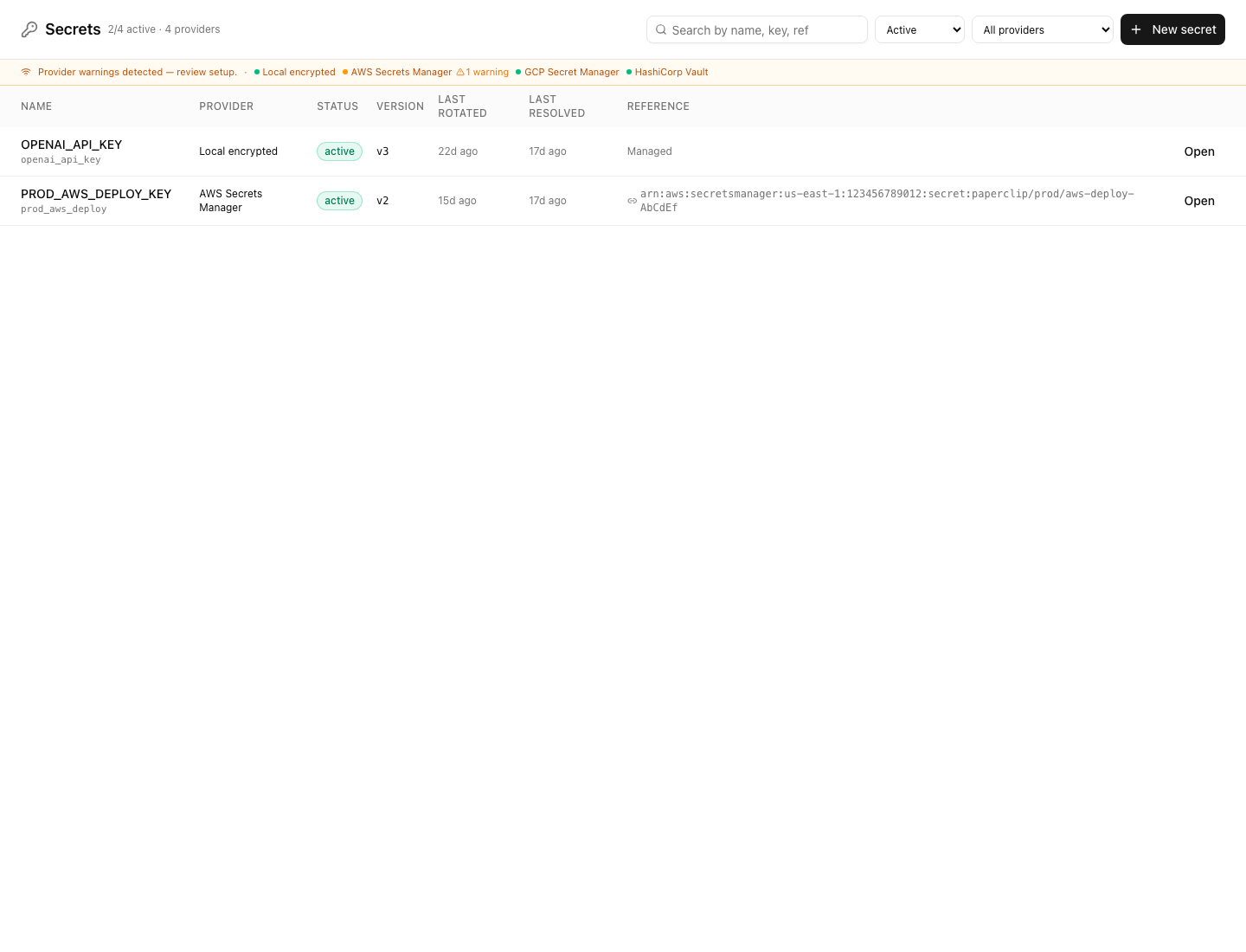
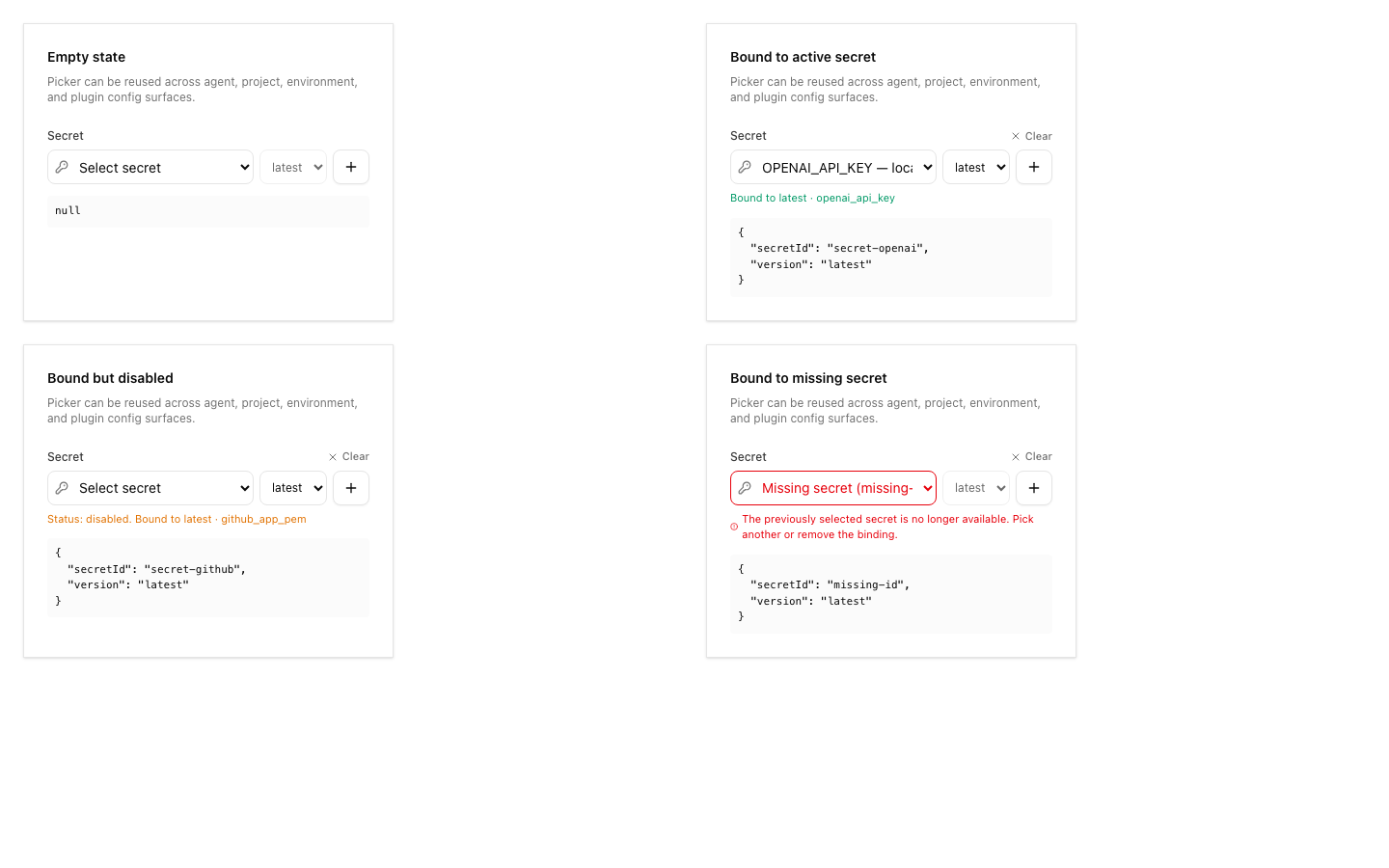
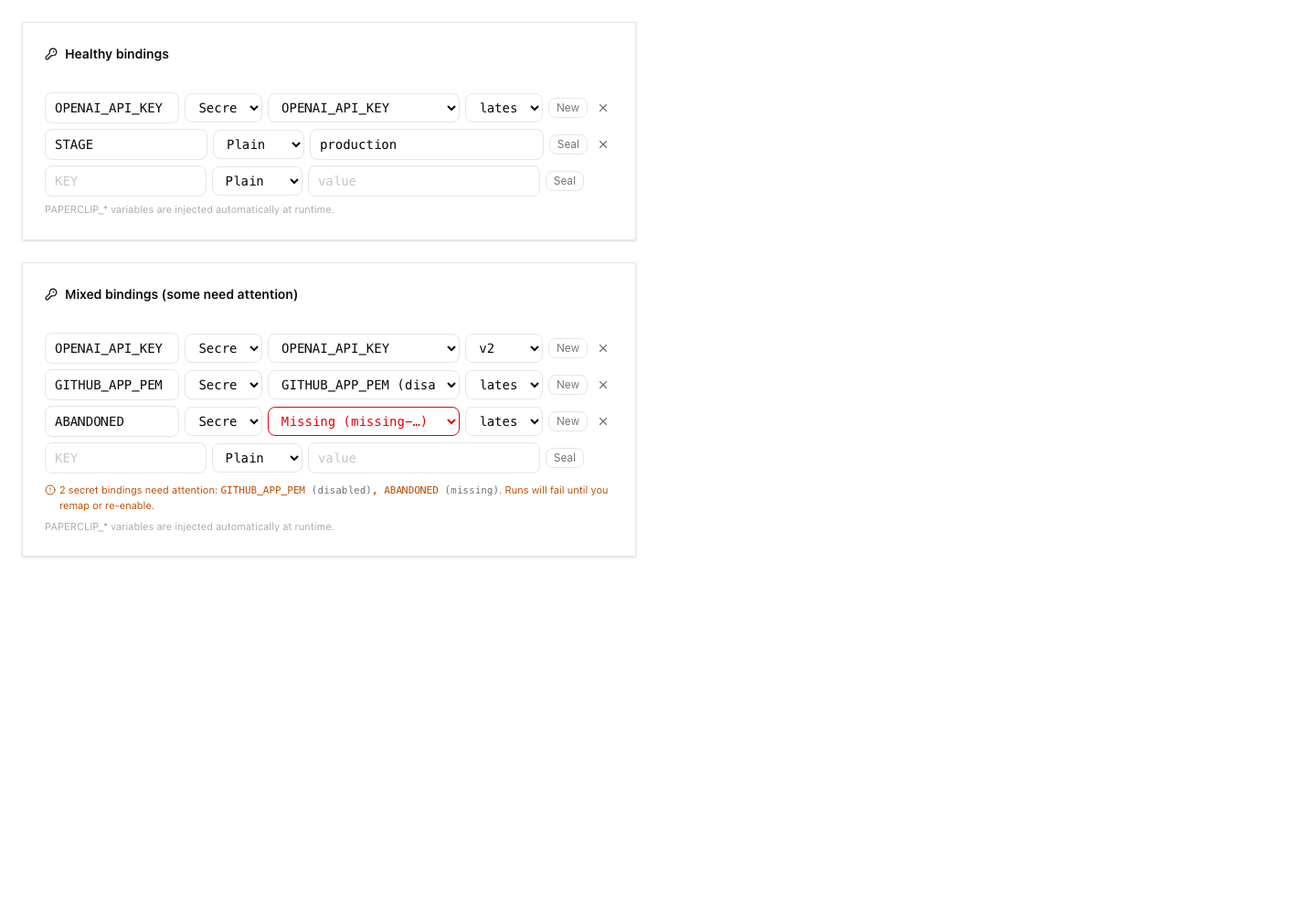
- Captured Storybook screenshots from `ui/storybook-static` for visual
review.
- Latest PR checks on `5ca3a5cf`: `policy`, serialized server suites
1/4-4/4, `Canary Dry Run`, `e2e`, `security/snyk`, and `Greptile Review`
pass; aggregate `verify` is still registering the completed child
checks.
- Greptile review loop continued through the latest requested pass; all
Greptile review threads are resolved and the latest `Greptile Review`
check on `5ca3a5cf` passed with 0 comments added.
## Screenshots
Before: the provider-vault and remote-import surfaces did not exist on
`master`; these are after-state screenshots from the Storybook fixtures.
## Risks
- Migration risk: this adds new secret provider tables and extends
existing secret rows. The migrations were checked for monotonic ordering
and idempotent guards, but reviewers should still inspect upgrade
behavior carefully.
- Provider risk: AWS support uses direct SigV4 requests. Automated tests
cover signing, request timeouts, vault-config selection, namespace
guardrails, pending-version archival, sanitized provider errors, and
service-level cleanup paths. A real-vault AWS smoke test remains
deployment validation for an operator with AWS credentials rather than
an unverified merge blocker in this local branch.
- UI risk: the Secrets page and import dialog are large new surfaces;
screenshots are included above for reviewer inspection.
- Verification risk: the full local stable test command hit
parallel-load timing failures, although the exact failed files passed
when rerun directly.
- Operational risk: remote import intentionally avoids plaintext reads;
operators must understand that imported external references resolve at
runtime and may fail if AWS permissions change.
> For core feature work, check [`ROADMAP.md`](ROADMAP.md) first and
discuss it in `#dev` before opening the PR. Feature PRs that overlap
with planned core work may need to be redirected — check the roadmap
first. See `CONTRIBUTING.md`.
## Model Used
- OpenAI Codex, GPT-5 coding agent with local shell/tool use in the
Paperclip worktree. Exact context-window size was not exposed by the
runtime.
## Checklist
- [x] I have included a thinking path that traces from project context
to this change
- [x] I have specified the model used (with version and capability
details)
- [x] I have checked ROADMAP.md and confirmed this PR does not duplicate
planned core work
- [ ] I have run tests locally and they pass
- [x] I have added or updated tests where applicable
- [x] If this change affects the UI, I have included before/after
screenshots
- [x] I have updated relevant documentation to reflect my changes
- [x] I have considered and documented any risks above
- [x] I will address all Greptile and reviewer comments before
requesting merge
---------
Co-authored-by: Paperclip <noreply@paperclip.ing>
Co-authored-by: Claude Sonnet 4.6 <noreply@anthropic.com>
2026-05-09 18:22:17 -05:00
|
|
|
`sh -c ${shellQuote(
|
Add sandbox environment support (#4415)
## Thinking Path
> - Paperclip orchestrates AI agents for zero-human companies.
> - The environment/runtime layer decides where agent work executes and
how the control plane reaches those runtimes.
> - Today Paperclip can run locally and over SSH, but sandboxed
execution needs a first-class environment model instead of one-off
adapter behavior.
> - We also want sandbox providers to be pluggable so the core does not
hardcode every provider implementation.
> - This branch adds the Sandbox environment path, the provider
contract, and a deterministic fake provider plugin.
> - That required synchronized changes across shared contracts, plugin
SDK surfaces, server runtime orchestration, and the UI
environment/workspace flows.
> - The result is that sandbox execution becomes a core control-plane
capability while keeping provider implementations extensible and
testable.
## What Changed
- Added sandbox runtime support to the environment execution path,
including runtime URL discovery, sandbox execution targeting,
orchestration, and heartbeat integration.
- Added plugin-provider support for sandbox environments so providers
can be supplied via plugins instead of hardcoded server logic.
- Added the fake sandbox provider plugin with deterministic behavior
suitable for local and automated testing.
- Updated shared types, validators, plugin protocol definitions, and SDK
helpers to carry sandbox provider and workspace-runtime contracts across
package boundaries.
- Updated server routes and services so companies can create sandbox
environments, select them for work, and execute work through the sandbox
runtime path.
- Updated the UI environment and workspace surfaces to expose sandbox
environment configuration and selection.
- Added test coverage for sandbox runtime behavior, provider seams,
environment route guards, orchestration, and the fake provider plugin.
## Verification
- Ran locally before the final fixture-only scrub:
- `pnpm -r typecheck`
- `pnpm test:run`
- `pnpm build`
- Ran locally after the final scrub amend:
- `pnpm vitest run server/src/__tests__/runtime-api.test.ts`
- Reviewer spot checks:
- create a sandbox environment backed by the fake provider plugin
- run work through that environment
- confirm sandbox provider execution does not inherit host secrets
implicitly
## Risks
- This touches shared contracts, plugin SDK plumbing, server runtime
orchestration, and UI environment/workspace flows, so regressions would
likely show up as cross-layer mismatches rather than isolated type
errors.
- Runtime URL discovery and sandbox callback selection are sensitive to
host/bind configuration; if that logic is wrong, sandbox-backed
callbacks may fail even when execution succeeds.
- The fake provider plugin is intentionally deterministic and
test-oriented; future providers may expose capability gaps that this
branch does not yet cover.
## Model Used
- OpenAI Codex coding agent on a GPT-5-class backend in the
Paperclip/Codex harness. Exact backend model ID is not exposed
in-session. Tool-assisted workflow with shell execution, file editing,
git history inspection, and local test execution.
## Checklist
- [x] I have included a thinking path that traces from project context
to this change
- [x] I have specified the model used (with version and capability
details)
- [x] I have checked ROADMAP.md and confirmed this PR does not duplicate
planned core work
- [x] I have run tests locally and they pass
- [x] I have added or updated tests where applicable
- [ ] If this change affects the UI, I have included before/after
screenshots
- [x] I have updated relevant documentation to reflect my changes
- [x] I have considered and documented any risks above
- [x] I will address all Greptile and reviewer comments before
requesting merge
2026-04-24 12:15:53 -07:00
|
|
|
`mkdir -p ${shellQuote(workspaceRemoteDir)} && ` +
|
|
|
|
|
`find ${shellQuote(workspaceRemoteDir)} -mindepth 1 -maxdepth 1 ${findPreserveArgs} -exec rm -rf -- {} + && ` +
|
|
|
|
|
`tar -xf ${shellQuote(remoteWorkspaceTar)} -C ${shellQuote(workspaceRemoteDir)} && ` +
|
|
|
|
|
`rm -f ${shellQuote(remoteWorkspaceTar)}`,
|
|
|
|
|
)}`,
|
|
|
|
|
{ timeoutMs: input.spec.timeoutMs },
|
|
|
|
|
);
|
|
|
|
|
|
|
|
|
|
for (const asset of input.assets ?? []) {
|
|
|
|
|
const assetTarPath = path.join(tempDir, `${asset.key}.tar`);
|
|
|
|
|
await createTarballFromDirectory({
|
|
|
|
|
localDir: asset.localDir,
|
|
|
|
|
archivePath: assetTarPath,
|
|
|
|
|
followSymlinks: asset.followSymlinks,
|
|
|
|
|
exclude: asset.exclude,
|
|
|
|
|
});
|
|
|
|
|
const assetTarBytes = await fs.readFile(assetTarPath);
|
|
|
|
|
const remoteAssetDir = path.posix.join(runtimeRootDir, asset.key);
|
|
|
|
|
const remoteAssetTar = path.posix.join(runtimeRootDir, `${asset.key}-upload.tar`);
|
|
|
|
|
await input.client.writeFile(remoteAssetTar, toArrayBuffer(assetTarBytes));
|
|
|
|
|
await input.client.run(
|
Add secrets provider vaults and remote import (#5429)
## Thinking Path
> - Paperclip orchestrates AI-agent companies and needs secrets handling
to work across local development, hosted operators, and governed agent
execution.
> - The affected subsystem is the company-scoped secrets control plane:
database schema, server services/routes, CLI workflows, and the Secrets
settings UI.
> - The gap was that secrets were local-only and operators could not
manage provider vaults or import existing remote references without
exposing plaintext.
> - This branch adds provider vault configuration plus an AWS Secrets
Manager remote-import path while preserving company boundaries, binding
context, and audit trails.
> - I kept the PR to a single branch PR, removed unrelated
lockfile/package drift, rebased the full branch onto the current
`public-gh/master`, and addressed fresh Greptile findings.
> - The benefit is a reviewable implementation of provider-backed
secrets with focused tests covering provider selection, import
conflicts, deleted secret reuse, rotation guards, and AWS signing
behavior.
## What Changed
- Added provider vault support for company secrets, including provider
config storage, default vault handling, health checks, binding usage,
access events, and remote import preview/commit.
- Added an AWS Secrets Manager provider using SigV4 request signing,
bounded request timeouts, namespace guardrails, cached runtime
credential resolution, and external-reference linking without plaintext
reads.
- Added Secrets UI surfaces for vault management and remote import, plus
CLI/API documentation for setup and operations.
- Stabilized routine webhook secret binding paths and SSH
environment-driver fixture bindings discovered during verification.
- Addressed Greptile and CI findings: no lockfile/package drift,
monotonic migration metadata, disabled-vault default races, soft-deleted
secret hiding/recreate behavior, remove behavior with disabled vaults,
soft-deleted external-reference re-import, non-active rotation guards,
managed-secret soft deletion through PATCH, and per-call AWS SDK
credential client churn.
- Rebased this branch onto `public-gh/master` at `0e1a5828` and
force-pushed with lease to keep this as the single PR for the branch.
## Verification
- `git fetch public-gh master`
- `git rebase public-gh/master`
- `git diff --name-only public-gh/master...HEAD | grep
'^pnpm-lock\.yaml$' || true` confirmed `pnpm-lock.yaml` is not in the PR
diff.
- Confirmed migration ordering: master ends at `0081_optimal_dormammu`;
this PR adds `0082_dry_vision` and
`0083_company_secret_provider_configs`.
- Inspected migrations for repeat safety: new tables/indexes use `IF NOT
EXISTS`; foreign keys are guarded by `DO $$ ... IF NOT EXISTS`; column
additions use `ADD COLUMN IF NOT EXISTS`.
- `pnpm -r typecheck` passed before the Greptile follow-up commits.
- `pnpm test:run` ran the full stable Vitest path before the Greptile
follow-up commits; it completed with 3 timing-related failures under
parallel load: `codex-local-execute.test.ts`,
`cursor-local-execute.test.ts`, and `environment-service.test.ts`.
- `pnpm --filter @paperclipai/server exec vitest run
src/__tests__/codex-local-execute.test.ts
src/__tests__/cursor-local-execute.test.ts
src/__tests__/environment-service.test.ts` passed on targeted rerun
(`24/24`).
- `pnpm build` passed before the Greptile follow-up commits. Vite
reported existing chunk-size/dynamic-import warnings.
- After Greptile follow-up commits: `pnpm --filter @paperclipai/server
exec vitest run src/__tests__/secrets-service.test.ts` passed (`26/26`).
- After Greptile follow-up commits: `pnpm --filter @paperclipai/server
exec vitest run src/__tests__/aws-secrets-manager-provider.test.ts
src/__tests__/secrets-service.test.ts` passed (`39/39`).
- After Greptile follow-up commits: `pnpm --filter @paperclipai/server
typecheck` passed.
- Captured Storybook screenshots from `ui/storybook-static` for visual
review.
- Latest PR checks on `5ca3a5cf`: `policy`, serialized server suites
1/4-4/4, `Canary Dry Run`, `e2e`, `security/snyk`, and `Greptile Review`
pass; aggregate `verify` is still registering the completed child
checks.
- Greptile review loop continued through the latest requested pass; all
Greptile review threads are resolved and the latest `Greptile Review`
check on `5ca3a5cf` passed with 0 comments added.
## Screenshots
Before: the provider-vault and remote-import surfaces did not exist on
`master`; these are after-state screenshots from the Storybook fixtures.



## Risks
- Migration risk: this adds new secret provider tables and extends
existing secret rows. The migrations were checked for monotonic ordering
and idempotent guards, but reviewers should still inspect upgrade
behavior carefully.
- Provider risk: AWS support uses direct SigV4 requests. Automated tests
cover signing, request timeouts, vault-config selection, namespace
guardrails, pending-version archival, sanitized provider errors, and
service-level cleanup paths. A real-vault AWS smoke test remains
deployment validation for an operator with AWS credentials rather than
an unverified merge blocker in this local branch.
- UI risk: the Secrets page and import dialog are large new surfaces;
screenshots are included above for reviewer inspection.
- Verification risk: the full local stable test command hit
parallel-load timing failures, although the exact failed files passed
when rerun directly.
- Operational risk: remote import intentionally avoids plaintext reads;
operators must understand that imported external references resolve at
runtime and may fail if AWS permissions change.
> For core feature work, check [`ROADMAP.md`](ROADMAP.md) first and
discuss it in `#dev` before opening the PR. Feature PRs that overlap
with planned core work may need to be redirected — check the roadmap
first. See `CONTRIBUTING.md`.
## Model Used
- OpenAI Codex, GPT-5 coding agent with local shell/tool use in the
Paperclip worktree. Exact context-window size was not exposed by the
runtime.
## Checklist
- [x] I have included a thinking path that traces from project context
to this change
- [x] I have specified the model used (with version and capability
details)
- [x] I have checked ROADMAP.md and confirmed this PR does not duplicate
planned core work
- [ ] I have run tests locally and they pass
- [x] I have added or updated tests where applicable
- [x] If this change affects the UI, I have included before/after
screenshots
- [x] I have updated relevant documentation to reflect my changes
- [x] I have considered and documented any risks above
- [x] I will address all Greptile and reviewer comments before
requesting merge
---------
Co-authored-by: Paperclip <noreply@paperclip.ing>
Co-authored-by: Claude Sonnet 4.6 <noreply@anthropic.com>
2026-05-09 18:22:17 -05:00
|
|
|
`sh -c ${shellQuote(
|
Add sandbox environment support (#4415)
## Thinking Path
> - Paperclip orchestrates AI agents for zero-human companies.
> - The environment/runtime layer decides where agent work executes and
how the control plane reaches those runtimes.
> - Today Paperclip can run locally and over SSH, but sandboxed
execution needs a first-class environment model instead of one-off
adapter behavior.
> - We also want sandbox providers to be pluggable so the core does not
hardcode every provider implementation.
> - This branch adds the Sandbox environment path, the provider
contract, and a deterministic fake provider plugin.
> - That required synchronized changes across shared contracts, plugin
SDK surfaces, server runtime orchestration, and the UI
environment/workspace flows.
> - The result is that sandbox execution becomes a core control-plane
capability while keeping provider implementations extensible and
testable.
## What Changed
- Added sandbox runtime support to the environment execution path,
including runtime URL discovery, sandbox execution targeting,
orchestration, and heartbeat integration.
- Added plugin-provider support for sandbox environments so providers
can be supplied via plugins instead of hardcoded server logic.
- Added the fake sandbox provider plugin with deterministic behavior
suitable for local and automated testing.
- Updated shared types, validators, plugin protocol definitions, and SDK
helpers to carry sandbox provider and workspace-runtime contracts across
package boundaries.
- Updated server routes and services so companies can create sandbox
environments, select them for work, and execute work through the sandbox
runtime path.
- Updated the UI environment and workspace surfaces to expose sandbox
environment configuration and selection.
- Added test coverage for sandbox runtime behavior, provider seams,
environment route guards, orchestration, and the fake provider plugin.
## Verification
- Ran locally before the final fixture-only scrub:
- `pnpm -r typecheck`
- `pnpm test:run`
- `pnpm build`
- Ran locally after the final scrub amend:
- `pnpm vitest run server/src/__tests__/runtime-api.test.ts`
- Reviewer spot checks:
- create a sandbox environment backed by the fake provider plugin
- run work through that environment
- confirm sandbox provider execution does not inherit host secrets
implicitly
## Risks
- This touches shared contracts, plugin SDK plumbing, server runtime
orchestration, and UI environment/workspace flows, so regressions would
likely show up as cross-layer mismatches rather than isolated type
errors.
- Runtime URL discovery and sandbox callback selection are sensitive to
host/bind configuration; if that logic is wrong, sandbox-backed
callbacks may fail even when execution succeeds.
- The fake provider plugin is intentionally deterministic and
test-oriented; future providers may expose capability gaps that this
branch does not yet cover.
## Model Used
- OpenAI Codex coding agent on a GPT-5-class backend in the
Paperclip/Codex harness. Exact backend model ID is not exposed
in-session. Tool-assisted workflow with shell execution, file editing,
git history inspection, and local test execution.
## Checklist
- [x] I have included a thinking path that traces from project context
to this change
- [x] I have specified the model used (with version and capability
details)
- [x] I have checked ROADMAP.md and confirmed this PR does not duplicate
planned core work
- [x] I have run tests locally and they pass
- [x] I have added or updated tests where applicable
- [ ] If this change affects the UI, I have included before/after
screenshots
- [x] I have updated relevant documentation to reflect my changes
- [x] I have considered and documented any risks above
- [x] I will address all Greptile and reviewer comments before
requesting merge
2026-04-24 12:15:53 -07:00
|
|
|
`rm -rf ${shellQuote(remoteAssetDir)} && ` +
|
|
|
|
|
`mkdir -p ${shellQuote(remoteAssetDir)} && ` +
|
|
|
|
|
`tar -xf ${shellQuote(remoteAssetTar)} -C ${shellQuote(remoteAssetDir)} && ` +
|
|
|
|
|
`rm -f ${shellQuote(remoteAssetTar)}`,
|
|
|
|
|
)}`,
|
|
|
|
|
{ timeoutMs: input.spec.timeoutMs },
|
|
|
|
|
);
|
|
|
|
|
}
|
|
|
|
|
});
|
|
|
|
|
|
|
|
|
|
const assetDirs = Object.fromEntries(
|
|
|
|
|
(input.assets ?? []).map((asset) => [asset.key, path.posix.join(runtimeRootDir, asset.key)]),
|
|
|
|
|
);
|
|
|
|
|
|
|
|
|
|
return {
|
|
|
|
|
spec: input.spec,
|
|
|
|
|
workspaceLocalDir: input.workspaceLocalDir,
|
|
|
|
|
workspaceRemoteDir,
|
|
|
|
|
runtimeRootDir,
|
|
|
|
|
assetDirs,
|
|
|
|
|
restoreWorkspace: async () => {
|
|
|
|
|
await withTempDir("paperclip-sandbox-restore-", async (tempDir) => {
|
|
|
|
|
const remoteWorkspaceTar = path.posix.join(runtimeRootDir, "workspace-download.tar");
|
|
|
|
|
await input.client.run(
|
Add secrets provider vaults and remote import (#5429)
## Thinking Path
> - Paperclip orchestrates AI-agent companies and needs secrets handling
to work across local development, hosted operators, and governed agent
execution.
> - The affected subsystem is the company-scoped secrets control plane:
database schema, server services/routes, CLI workflows, and the Secrets
settings UI.
> - The gap was that secrets were local-only and operators could not
manage provider vaults or import existing remote references without
exposing plaintext.
> - This branch adds provider vault configuration plus an AWS Secrets
Manager remote-import path while preserving company boundaries, binding
context, and audit trails.
> - I kept the PR to a single branch PR, removed unrelated
lockfile/package drift, rebased the full branch onto the current
`public-gh/master`, and addressed fresh Greptile findings.
> - The benefit is a reviewable implementation of provider-backed
secrets with focused tests covering provider selection, import
conflicts, deleted secret reuse, rotation guards, and AWS signing
behavior.
## What Changed
- Added provider vault support for company secrets, including provider
config storage, default vault handling, health checks, binding usage,
access events, and remote import preview/commit.
- Added an AWS Secrets Manager provider using SigV4 request signing,
bounded request timeouts, namespace guardrails, cached runtime
credential resolution, and external-reference linking without plaintext
reads.
- Added Secrets UI surfaces for vault management and remote import, plus
CLI/API documentation for setup and operations.
- Stabilized routine webhook secret binding paths and SSH
environment-driver fixture bindings discovered during verification.
- Addressed Greptile and CI findings: no lockfile/package drift,
monotonic migration metadata, disabled-vault default races, soft-deleted
secret hiding/recreate behavior, remove behavior with disabled vaults,
soft-deleted external-reference re-import, non-active rotation guards,
managed-secret soft deletion through PATCH, and per-call AWS SDK
credential client churn.
- Rebased this branch onto `public-gh/master` at `0e1a5828` and
force-pushed with lease to keep this as the single PR for the branch.
## Verification
- `git fetch public-gh master`
- `git rebase public-gh/master`
- `git diff --name-only public-gh/master...HEAD | grep
'^pnpm-lock\.yaml$' || true` confirmed `pnpm-lock.yaml` is not in the PR
diff.
- Confirmed migration ordering: master ends at `0081_optimal_dormammu`;
this PR adds `0082_dry_vision` and
`0083_company_secret_provider_configs`.
- Inspected migrations for repeat safety: new tables/indexes use `IF NOT
EXISTS`; foreign keys are guarded by `DO $$ ... IF NOT EXISTS`; column
additions use `ADD COLUMN IF NOT EXISTS`.
- `pnpm -r typecheck` passed before the Greptile follow-up commits.
- `pnpm test:run` ran the full stable Vitest path before the Greptile
follow-up commits; it completed with 3 timing-related failures under
parallel load: `codex-local-execute.test.ts`,
`cursor-local-execute.test.ts`, and `environment-service.test.ts`.
- `pnpm --filter @paperclipai/server exec vitest run
src/__tests__/codex-local-execute.test.ts
src/__tests__/cursor-local-execute.test.ts
src/__tests__/environment-service.test.ts` passed on targeted rerun
(`24/24`).
- `pnpm build` passed before the Greptile follow-up commits. Vite
reported existing chunk-size/dynamic-import warnings.
- After Greptile follow-up commits: `pnpm --filter @paperclipai/server
exec vitest run src/__tests__/secrets-service.test.ts` passed (`26/26`).
- After Greptile follow-up commits: `pnpm --filter @paperclipai/server
exec vitest run src/__tests__/aws-secrets-manager-provider.test.ts
src/__tests__/secrets-service.test.ts` passed (`39/39`).
- After Greptile follow-up commits: `pnpm --filter @paperclipai/server
typecheck` passed.
- Captured Storybook screenshots from `ui/storybook-static` for visual
review.
- Latest PR checks on `5ca3a5cf`: `policy`, serialized server suites
1/4-4/4, `Canary Dry Run`, `e2e`, `security/snyk`, and `Greptile Review`
pass; aggregate `verify` is still registering the completed child
checks.
- Greptile review loop continued through the latest requested pass; all
Greptile review threads are resolved and the latest `Greptile Review`
check on `5ca3a5cf` passed with 0 comments added.
## Screenshots
Before: the provider-vault and remote-import surfaces did not exist on
`master`; these are after-state screenshots from the Storybook fixtures.



## Risks
- Migration risk: this adds new secret provider tables and extends
existing secret rows. The migrations were checked for monotonic ordering
and idempotent guards, but reviewers should still inspect upgrade
behavior carefully.
- Provider risk: AWS support uses direct SigV4 requests. Automated tests
cover signing, request timeouts, vault-config selection, namespace
guardrails, pending-version archival, sanitized provider errors, and
service-level cleanup paths. A real-vault AWS smoke test remains
deployment validation for an operator with AWS credentials rather than
an unverified merge blocker in this local branch.
- UI risk: the Secrets page and import dialog are large new surfaces;
screenshots are included above for reviewer inspection.
- Verification risk: the full local stable test command hit
parallel-load timing failures, although the exact failed files passed
when rerun directly.
- Operational risk: remote import intentionally avoids plaintext reads;
operators must understand that imported external references resolve at
runtime and may fail if AWS permissions change.
> For core feature work, check [`ROADMAP.md`](ROADMAP.md) first and
discuss it in `#dev` before opening the PR. Feature PRs that overlap
with planned core work may need to be redirected — check the roadmap
first. See `CONTRIBUTING.md`.
## Model Used
- OpenAI Codex, GPT-5 coding agent with local shell/tool use in the
Paperclip worktree. Exact context-window size was not exposed by the
runtime.
## Checklist
- [x] I have included a thinking path that traces from project context
to this change
- [x] I have specified the model used (with version and capability
details)
- [x] I have checked ROADMAP.md and confirmed this PR does not duplicate
planned core work
- [ ] I have run tests locally and they pass
- [x] I have added or updated tests where applicable
- [x] If this change affects the UI, I have included before/after
screenshots
- [x] I have updated relevant documentation to reflect my changes
- [x] I have considered and documented any risks above
- [x] I will address all Greptile and reviewer comments before
requesting merge
---------
Co-authored-by: Paperclip <noreply@paperclip.ing>
Co-authored-by: Claude Sonnet 4.6 <noreply@anthropic.com>
2026-05-09 18:22:17 -05:00
|
|
|
`sh -c ${shellQuote(
|
Add sandbox environment support (#4415)
## Thinking Path
> - Paperclip orchestrates AI agents for zero-human companies.
> - The environment/runtime layer decides where agent work executes and
how the control plane reaches those runtimes.
> - Today Paperclip can run locally and over SSH, but sandboxed
execution needs a first-class environment model instead of one-off
adapter behavior.
> - We also want sandbox providers to be pluggable so the core does not
hardcode every provider implementation.
> - This branch adds the Sandbox environment path, the provider
contract, and a deterministic fake provider plugin.
> - That required synchronized changes across shared contracts, plugin
SDK surfaces, server runtime orchestration, and the UI
environment/workspace flows.
> - The result is that sandbox execution becomes a core control-plane
capability while keeping provider implementations extensible and
testable.
## What Changed
- Added sandbox runtime support to the environment execution path,
including runtime URL discovery, sandbox execution targeting,
orchestration, and heartbeat integration.
- Added plugin-provider support for sandbox environments so providers
can be supplied via plugins instead of hardcoded server logic.
- Added the fake sandbox provider plugin with deterministic behavior
suitable for local and automated testing.
- Updated shared types, validators, plugin protocol definitions, and SDK
helpers to carry sandbox provider and workspace-runtime contracts across
package boundaries.
- Updated server routes and services so companies can create sandbox
environments, select them for work, and execute work through the sandbox
runtime path.
- Updated the UI environment and workspace surfaces to expose sandbox
environment configuration and selection.
- Added test coverage for sandbox runtime behavior, provider seams,
environment route guards, orchestration, and the fake provider plugin.
## Verification
- Ran locally before the final fixture-only scrub:
- `pnpm -r typecheck`
- `pnpm test:run`
- `pnpm build`
- Ran locally after the final scrub amend:
- `pnpm vitest run server/src/__tests__/runtime-api.test.ts`
- Reviewer spot checks:
- create a sandbox environment backed by the fake provider plugin
- run work through that environment
- confirm sandbox provider execution does not inherit host secrets
implicitly
## Risks
- This touches shared contracts, plugin SDK plumbing, server runtime
orchestration, and UI environment/workspace flows, so regressions would
likely show up as cross-layer mismatches rather than isolated type
errors.
- Runtime URL discovery and sandbox callback selection are sensitive to
host/bind configuration; if that logic is wrong, sandbox-backed
callbacks may fail even when execution succeeds.
- The fake provider plugin is intentionally deterministic and
test-oriented; future providers may expose capability gaps that this
branch does not yet cover.
## Model Used
- OpenAI Codex coding agent on a GPT-5-class backend in the
Paperclip/Codex harness. Exact backend model ID is not exposed
in-session. Tool-assisted workflow with shell execution, file editing,
git history inspection, and local test execution.
## Checklist
- [x] I have included a thinking path that traces from project context
to this change
- [x] I have specified the model used (with version and capability
details)
- [x] I have checked ROADMAP.md and confirmed this PR does not duplicate
planned core work
- [x] I have run tests locally and they pass
- [x] I have added or updated tests where applicable
- [ ] If this change affects the UI, I have included before/after
screenshots
- [x] I have updated relevant documentation to reflect my changes
- [x] I have considered and documented any risks above
- [x] I will address all Greptile and reviewer comments before
requesting merge
2026-04-24 12:15:53 -07:00
|
|
|
`mkdir -p ${shellQuote(runtimeRootDir)} && ` +
|
|
|
|
|
`tar -cf ${shellQuote(remoteWorkspaceTar)} -C ${shellQuote(workspaceRemoteDir)} ` +
|
|
|
|
|
`${tarExcludeFlags(input.workspaceExclude)} .`,
|
|
|
|
|
)}`,
|
|
|
|
|
{ timeoutMs: input.spec.timeoutMs },
|
|
|
|
|
);
|
|
|
|
|
const archiveBytes = await input.client.readFile(remoteWorkspaceTar);
|
|
|
|
|
await input.client.remove(remoteWorkspaceTar).catch(() => undefined);
|
|
|
|
|
const localArchivePath = path.join(tempDir, "workspace.tar");
|
|
|
|
|
const extractedDir = path.join(tempDir, "workspace");
|
|
|
|
|
await fs.writeFile(localArchivePath, toBuffer(archiveBytes));
|
|
|
|
|
await extractTarballToDirectory({
|
|
|
|
|
archivePath: localArchivePath,
|
|
|
|
|
localDir: extractedDir,
|
|
|
|
|
});
|
Harden remote workspace sync and restore flows (#5444)
## Thinking Path
> - Paperclip orchestrates AI agents for zero-human companies
> - When an agent runs against a remote target, Paperclip syncs the
workspace out to the remote at run start and restores changes back to
the local workspace at run end
> - The previous restore flow naïvely overwrote local files with
whatever the remote returned, so files that the remote run never touched
but had timestamp/mode drift could be needlessly rewritten — and a
single static `refs/paperclip/ssh-sync/imported` ref made concurrent SSH
workspace exports race on the same git ref
> - This pull request adds a `workspace-restore-merge` module that diffs
a pre-run snapshot against the post-run remote state and only writes
back files the remote actually changed; SSH workspace exports now use a
per-import unique ref so concurrent runs can't trample each other
> - Every adapter's execute path threads the snapshot through
`prepareAdapterExecutionTargetRuntime` so the merge has the baseline it
needs
> - The benefit is workspace restores no longer churn untouched files,
and concurrent SSH runs no longer collide on the import ref
## What Changed
- `packages/adapter-utils/src/workspace-restore-merge.{ts,test.ts}`: new
module — directory snapshot (kind/mode/sha256/symlink target) plus
snapshot-aware merge that writes only the files the remote changed
- `packages/adapter-utils/src/ssh.ts`: SSH workspace export uses a
per-import unique ref (`refs/paperclip/ssh-sync/imported/<uuid>`);
restore goes through the new merge helper; `ssh-fixture.test.ts` covers
the unique-ref + merge paths
- `packages/adapter-utils/src/sandbox-managed-runtime.ts` +
`remote-managed-runtime.ts`: thread the snapshot/merge through the
sandbox and SSH paths
- `packages/adapter-utils/src/server-utils.{ts,test.ts}` +
`execution-target.ts`: helpers for capturing the pre-run snapshot;
`prepareAdapterExecutionTargetRuntime` gains required `runId` and
optional `workspaceRemoteDir`, and returns the realized
`workspaceRemoteDir`
- Each adapter's `execute.ts` (acpx, claude, codex, cursor, gemini,
opencode, pi) takes the snapshot at run start and passes it through to
the runtime restore
- Remote execute test mocks updated to match the new
`prepareWorkspaceForSshExecution` return shape and the per-run
`${managedRemoteWorkspace}` cwd subdirectory
## Verification
- `pnpm vitest run --no-coverage --project @paperclipai/adapter-utils
--project @paperclipai/adapter-acpx-local --project
@paperclipai/adapter-claude-local --project
@paperclipai/adapter-codex-local --project
@paperclipai/adapter-cursor-local --project
@paperclipai/adapter-gemini-local --project
@paperclipai/adapter-opencode-local --project
@paperclipai/adapter-pi-local` — 196/196 passing
- `pnpm typecheck` clean across the workspace
## Risks
Medium. The restore path now writes a strict subset of what it
previously did — files the remote did not touch are no longer rewritten.
If any flow was relying on a touch-without-content-change being copied
back (timestamp or permission propagation only), that behavior is now
skipped. Snapshot capture adds an O(N-files-in-workspace) hash pass at
run start; the cost is bounded by the existing exclude list. The `runId`
parameter on `prepareAdapterExecutionTargetRuntime` is now required —
every in-tree caller is updated; out-of-tree adapter authors need to
pass it.
## Model Used
Claude Opus 4.7 (1M context)
## Checklist
- [x] I have included a thinking path that traces from project context
to this change
- [x] I have specified the model used (with version and capability
details)
- [x] I have checked ROADMAP.md and confirmed this PR does not duplicate
planned core work
- [x] I have run tests locally and they pass
- [x] I have added or updated tests where applicable — new module +
every adapter execute path covered
- [x] If this change affects the UI, I have included before/after
screenshots — N/A (no UI)
- [x] I have updated relevant documentation to reflect my changes
- [x] I have considered and documented any risks above
- [x] I will address all Greptile and reviewer comments before
requesting merge
2026-05-07 14:44:45 -07:00
|
|
|
await mergeDirectoryWithBaseline({
|
|
|
|
|
baseline: baselineSnapshot,
|
|
|
|
|
sourceDir: extractedDir,
|
|
|
|
|
targetDir: input.workspaceLocalDir,
|
Add sandbox environment support (#4415)
## Thinking Path
> - Paperclip orchestrates AI agents for zero-human companies.
> - The environment/runtime layer decides where agent work executes and
how the control plane reaches those runtimes.
> - Today Paperclip can run locally and over SSH, but sandboxed
execution needs a first-class environment model instead of one-off
adapter behavior.
> - We also want sandbox providers to be pluggable so the core does not
hardcode every provider implementation.
> - This branch adds the Sandbox environment path, the provider
contract, and a deterministic fake provider plugin.
> - That required synchronized changes across shared contracts, plugin
SDK surfaces, server runtime orchestration, and the UI
environment/workspace flows.
> - The result is that sandbox execution becomes a core control-plane
capability while keeping provider implementations extensible and
testable.
## What Changed
- Added sandbox runtime support to the environment execution path,
including runtime URL discovery, sandbox execution targeting,
orchestration, and heartbeat integration.
- Added plugin-provider support for sandbox environments so providers
can be supplied via plugins instead of hardcoded server logic.
- Added the fake sandbox provider plugin with deterministic behavior
suitable for local and automated testing.
- Updated shared types, validators, plugin protocol definitions, and SDK
helpers to carry sandbox provider and workspace-runtime contracts across
package boundaries.
- Updated server routes and services so companies can create sandbox
environments, select them for work, and execute work through the sandbox
runtime path.
- Updated the UI environment and workspace surfaces to expose sandbox
environment configuration and selection.
- Added test coverage for sandbox runtime behavior, provider seams,
environment route guards, orchestration, and the fake provider plugin.
## Verification
- Ran locally before the final fixture-only scrub:
- `pnpm -r typecheck`
- `pnpm test:run`
- `pnpm build`
- Ran locally after the final scrub amend:
- `pnpm vitest run server/src/__tests__/runtime-api.test.ts`
- Reviewer spot checks:
- create a sandbox environment backed by the fake provider plugin
- run work through that environment
- confirm sandbox provider execution does not inherit host secrets
implicitly
## Risks
- This touches shared contracts, plugin SDK plumbing, server runtime
orchestration, and UI environment/workspace flows, so regressions would
likely show up as cross-layer mismatches rather than isolated type
errors.
- Runtime URL discovery and sandbox callback selection are sensitive to
host/bind configuration; if that logic is wrong, sandbox-backed
callbacks may fail even when execution succeeds.
- The fake provider plugin is intentionally deterministic and
test-oriented; future providers may expose capability gaps that this
branch does not yet cover.
## Model Used
- OpenAI Codex coding agent on a GPT-5-class backend in the
Paperclip/Codex harness. Exact backend model ID is not exposed
in-session. Tool-assisted workflow with shell execution, file editing,
git history inspection, and local test execution.
## Checklist
- [x] I have included a thinking path that traces from project context
to this change
- [x] I have specified the model used (with version and capability
details)
- [x] I have checked ROADMAP.md and confirmed this PR does not duplicate
planned core work
- [x] I have run tests locally and they pass
- [x] I have added or updated tests where applicable
- [ ] If this change affects the UI, I have included before/after
screenshots
- [x] I have updated relevant documentation to reflect my changes
- [x] I have considered and documented any risks above
- [x] I will address all Greptile and reviewer comments before
requesting merge
2026-04-24 12:15:53 -07:00
|
|
|
});
|
|
|
|
|
});
|
|
|
|
|
},
|
|
|
|
|
};
|
|
|
|
|
}
|