2026-02-20 07:10:58 -06:00
# CLI Reference
Paperclip CLI now supports both:
Add SSH environment support (#4358)
## Thinking Path
> - Paperclip orchestrates AI agents for zero-human companies
> - The environments subsystem already models execution environments,
but before this branch there was no end-to-end SSH-backed runtime path
for agents to actually run work against a remote box
> - That meant agents could be configured around environment concepts
without a reliable way to execute adapter sessions remotely, sync
workspace state, and preserve run context across supported adapters
> - We also need environment selection to participate in normal
Paperclip control-plane behavior: agent defaults, project/issue
selection, route validation, and environment probing
> - Because this capability is still experimental, the UI surface should
be easy to hide and easy to remove later without undoing the underlying
implementation
> - This pull request adds SSH environment execution support across the
runtime, adapters, routes, schema, and tests, then puts the visible
environment-management UI behind an experimental flag
> - The benefit is that we can validate real SSH-backed agent execution
now while keeping the user-facing controls safely gated until the
feature is ready to come out of experimentation
## What Changed
- Added SSH-backed execution target support in the shared adapter
runtime, including remote workspace preparation, skill/runtime asset
sync, remote session handling, and workspace restore behavior after
runs.
- Added SSH execution coverage for supported local adapters, plus remote
execution tests across Claude, Codex, Cursor, Gemini, OpenCode, and Pi.
- Added environment selection and environment-management backend support
needed for SSH execution, including route/service work, validation,
probing, and agent default environment persistence.
- Added CLI support for SSH environment lab verification and updated
related docs/tests.
- Added the `enableEnvironments` experimental flag and gated the
environment UI behind it on company settings, agent configuration, and
project configuration surfaces.
## Verification
- `pnpm exec vitest run
packages/adapters/claude-local/src/server/execute.remote.test.ts
packages/adapters/cursor-local/src/server/execute.remote.test.ts
packages/adapters/gemini-local/src/server/execute.remote.test.ts
packages/adapters/opencode-local/src/server/execute.remote.test.ts
packages/adapters/pi-local/src/server/execute.remote.test.ts`
- `pnpm exec vitest run server/src/__tests__/environment-routes.test.ts`
- `pnpm exec vitest run
server/src/__tests__/instance-settings-routes.test.ts`
- `pnpm exec vitest run ui/src/lib/new-agent-hire-payload.test.ts
ui/src/lib/new-agent-runtime-config.test.ts`
- `pnpm -r typecheck`
- `pnpm build`
- Manual verification on a branch-local dev server:
- enabled the experimental flag
- created an SSH environment
- created a Linux Claude agent using that environment
- confirmed a run executed on the Linux box and synced workspace changes
back
## Risks
- Medium: this touches runtime execution flow across multiple adapters,
so regressions would likely show up in remote session setup, workspace
sync, or environment selection precedence.
- The UI flag reduces exposure, but the underlying runtime and route
changes are still substantial and rely on migration correctness.
- The change set is broad across adapters, control-plane services,
migrations, and UI gating, so review should pay close attention to
environment-selection precedence and remote workspace lifecycle
behavior.
## Model Used
- OpenAI Codex via Paperclip's local Codex adapter, GPT-5-class coding
model with tool use and code execution in the local repo workspace. The
local adapter does not surface a more specific public model version
string in this branch workflow.
## Checklist
- [x] I have included a thinking path that traces from project context
to this change
- [x] I have specified the model used (with version and capability
details)
- [x] I have checked ROADMAP.md and confirmed this PR does not duplicate
planned core work
- [x] I have run tests locally and they pass
- [x] I have added or updated tests where applicable
- [ ] If this change affects the UI, I have included before/after
screenshots
- [x] I have updated relevant documentation to reflect my changes
- [x] I have considered and documented any risks above
- [x] I will address all Greptile and reviewer comments before
requesting merge
2026-04-23 19:15:22 -07:00
- instance setup/diagnostics (`onboard` , `doctor` , `configure` , `env` , `allowed-hostname` , `env-lab` )
2026-02-20 07:10:58 -06:00
- control-plane client operations (issues, approvals, agents, activity, dashboard)
## Base Usage
Use repo script in development:
```sh
2026-03-03 08:45:26 -06:00
pnpm paperclipai --help
2026-02-20 07:10:58 -06:00
```
First-time local bootstrap + run:
```sh
2026-03-03 08:45:26 -06:00
pnpm paperclipai run
2026-02-20 07:10:58 -06:00
```
Choose local instance:
```sh
2026-03-03 08:45:26 -06:00
pnpm paperclipai run --instance dev
2026-02-20 07:10:58 -06:00
```
2026-02-23 14:41:35 -06:00
## Deployment Modes
Mode taxonomy and design intent are documented in `doc/DEPLOYMENT-MODES.md` .
Current CLI behavior:
2026-03-03 08:45:26 -06:00
- `paperclipai onboard` and `paperclipai configure --section server` set deployment mode in config
2026-04-10 07:32:16 -05:00
- server onboarding/configure ask for reachability intent and write `server.bind`
- `paperclipai run --bind <loopback|lan|tailnet>` passes a quickstart bind preset into first-run onboarding when config is missing
2026-02-23 14:41:35 -06:00
- runtime can override mode with `PAPERCLIP_DEPLOYMENT_MODE`
2026-04-10 07:32:16 -05:00
- `paperclipai run` and `paperclipai doctor` still do not expose a direct low-level `--mode` flag
2026-02-23 14:41:35 -06:00
2026-04-10 07:32:16 -05:00
Canonical behavior is documented in `doc/DEPLOYMENT-MODES.md` .
2026-02-23 14:41:35 -06:00
2026-02-23 19:43:52 -06:00
Allow an authenticated/private hostname (for example custom Tailscale DNS):
```sh
2026-03-03 08:45:26 -06:00
pnpm paperclipai allowed-hostname dotta-macbook-pro
2026-02-23 19:43:52 -06:00
```
Add SSH environment support (#4358)
## Thinking Path
> - Paperclip orchestrates AI agents for zero-human companies
> - The environments subsystem already models execution environments,
but before this branch there was no end-to-end SSH-backed runtime path
for agents to actually run work against a remote box
> - That meant agents could be configured around environment concepts
without a reliable way to execute adapter sessions remotely, sync
workspace state, and preserve run context across supported adapters
> - We also need environment selection to participate in normal
Paperclip control-plane behavior: agent defaults, project/issue
selection, route validation, and environment probing
> - Because this capability is still experimental, the UI surface should
be easy to hide and easy to remove later without undoing the underlying
implementation
> - This pull request adds SSH environment execution support across the
runtime, adapters, routes, schema, and tests, then puts the visible
environment-management UI behind an experimental flag
> - The benefit is that we can validate real SSH-backed agent execution
now while keeping the user-facing controls safely gated until the
feature is ready to come out of experimentation
## What Changed
- Added SSH-backed execution target support in the shared adapter
runtime, including remote workspace preparation, skill/runtime asset
sync, remote session handling, and workspace restore behavior after
runs.
- Added SSH execution coverage for supported local adapters, plus remote
execution tests across Claude, Codex, Cursor, Gemini, OpenCode, and Pi.
- Added environment selection and environment-management backend support
needed for SSH execution, including route/service work, validation,
probing, and agent default environment persistence.
- Added CLI support for SSH environment lab verification and updated
related docs/tests.
- Added the `enableEnvironments` experimental flag and gated the
environment UI behind it on company settings, agent configuration, and
project configuration surfaces.
## Verification
- `pnpm exec vitest run
packages/adapters/claude-local/src/server/execute.remote.test.ts
packages/adapters/cursor-local/src/server/execute.remote.test.ts
packages/adapters/gemini-local/src/server/execute.remote.test.ts
packages/adapters/opencode-local/src/server/execute.remote.test.ts
packages/adapters/pi-local/src/server/execute.remote.test.ts`
- `pnpm exec vitest run server/src/__tests__/environment-routes.test.ts`
- `pnpm exec vitest run
server/src/__tests__/instance-settings-routes.test.ts`
- `pnpm exec vitest run ui/src/lib/new-agent-hire-payload.test.ts
ui/src/lib/new-agent-runtime-config.test.ts`
- `pnpm -r typecheck`
- `pnpm build`
- Manual verification on a branch-local dev server:
- enabled the experimental flag
- created an SSH environment
- created a Linux Claude agent using that environment
- confirmed a run executed on the Linux box and synced workspace changes
back
## Risks
- Medium: this touches runtime execution flow across multiple adapters,
so regressions would likely show up in remote session setup, workspace
sync, or environment selection precedence.
- The UI flag reduces exposure, but the underlying runtime and route
changes are still substantial and rely on migration correctness.
- The change set is broad across adapters, control-plane services,
migrations, and UI gating, so review should pay close attention to
environment-selection precedence and remote workspace lifecycle
behavior.
## Model Used
- OpenAI Codex via Paperclip's local Codex adapter, GPT-5-class coding
model with tool use and code execution in the local repo workspace. The
local adapter does not surface a more specific public model version
string in this branch workflow.
## Checklist
- [x] I have included a thinking path that traces from project context
to this change
- [x] I have specified the model used (with version and capability
details)
- [x] I have checked ROADMAP.md and confirmed this PR does not duplicate
planned core work
- [x] I have run tests locally and they pass
- [x] I have added or updated tests where applicable
- [ ] If this change affects the UI, I have included before/after
screenshots
- [x] I have updated relevant documentation to reflect my changes
- [x] I have considered and documented any risks above
- [x] I will address all Greptile and reviewer comments before
requesting merge
2026-04-23 19:15:22 -07:00
Bring up the default local SSH fixture for environment testing:
```sh
pnpm paperclipai env-lab up
pnpm paperclipai env-lab doctor
pnpm paperclipai env-lab status --json
pnpm paperclipai env-lab down
```
2026-02-20 07:10:58 -06:00
All client commands support:
2026-03-02 14:20:37 -06:00
- `--data-dir <path>`
2026-02-20 07:10:58 -06:00
- `--api-base <url>`
- `--api-key <token>`
- `--context <path>`
- `--profile <name>`
- `--json`
Company-scoped commands also support `--company-id <id>` .
2026-03-02 14:20:37 -06:00
Use `--data-dir` on any CLI command to isolate all default local state (config/context/db/logs/storage/secrets) away from `~/.paperclip` :
```sh
2026-03-03 08:45:26 -06:00
pnpm paperclipai run --data-dir ./tmp/paperclip-dev
pnpm paperclipai issue list --data-dir ./tmp/paperclip-dev
2026-03-02 14:20:37 -06:00
```
2026-02-20 07:10:58 -06:00
## Context Profiles
Store local defaults in `~/.paperclip/context.json` :
```sh
2026-03-03 08:45:26 -06:00
pnpm paperclipai context set --api-base http://localhost:3100 --company-id < company-id >
pnpm paperclipai context show
pnpm paperclipai context list
pnpm paperclipai context use default
2026-02-20 07:10:58 -06:00
```
To avoid storing secrets in context, set `apiKeyEnvVarName` and keep the key in env:
```sh
2026-03-03 08:45:26 -06:00
pnpm paperclipai context set --api-key-env-var-name PAPERCLIP_API_KEY
2026-02-20 07:10:58 -06:00
export PAPERCLIP_API_KEY=...
```
## Company Commands
```sh
2026-03-03 08:45:26 -06:00
pnpm paperclipai company list
pnpm paperclipai company get < company-id >
pnpm paperclipai company delete < company-id-or-prefix > --yes --confirm < same-id-or-prefix >
2026-02-20 07:10:58 -06:00
```
2026-03-02 16:44:10 -06:00
Examples:
```sh
2026-03-03 08:45:26 -06:00
pnpm paperclipai company delete PAP --yes --confirm PAP
pnpm paperclipai company delete 5cbe79ee-acb3-4597-896e-7662742593cd --yes --confirm 5cbe79ee-acb3-4597-896e-7662742593cd
2026-03-02 16:44:10 -06:00
```
Notes:
- Deletion is server-gated by `PAPERCLIP_ENABLE_COMPANY_DELETION` .
- With agent authentication, company deletion is company-scoped. Use the current company ID/prefix (for example via `--company-id` or `PAPERCLIP_COMPANY_ID` ), not another company.
2026-02-20 07:10:58 -06:00
## Issue Commands
```sh
2026-03-03 08:45:26 -06:00
pnpm paperclipai issue list --company-id < company-id > [--status todo,in_progress] [--assignee-agent-id < agent-id > ] [--match text]
pnpm paperclipai issue get < issue-id-or-identifier >
pnpm paperclipai issue create --company-id < company-id > --title "..." [--description "..."] [--status todo] [--priority high]
pnpm paperclipai issue update < issue-id > [--status in_progress] [--comment "..."]
pnpm paperclipai issue comment < issue-id > --body "..." [--reopen]
pnpm paperclipai issue checkout < issue-id > --agent-id < agent-id > [--expected-statuses todo,backlog,blocked]
pnpm paperclipai issue release < issue-id >
2026-02-20 07:10:58 -06:00
```
## Agent Commands
```sh
2026-03-03 08:45:26 -06:00
pnpm paperclipai agent list --company-id < company-id >
pnpm paperclipai agent get < agent-id >
2026-03-07 08:59:45 -06:00
pnpm paperclipai agent local-cli < agent-id-or-shortname > --company-id < company-id >
```
`agent local-cli` is the quickest way to run local Claude/Codex manually as a Paperclip agent:
- creates a new long-lived agent API key
- installs missing Paperclip skills into `~/.codex/skills` and `~/.claude/skills`
- prints `export ...` lines for `PAPERCLIP_API_URL` , `PAPERCLIP_COMPANY_ID` , `PAPERCLIP_AGENT_ID` , and `PAPERCLIP_API_KEY`
Example for shortname-based local setup:
```sh
pnpm paperclipai agent local-cli codexcoder --company-id < company-id >
pnpm paperclipai agent local-cli claudecoder --company-id < company-id >
2026-02-20 07:10:58 -06:00
```
Add secrets provider vaults and remote import (#5429)
## Thinking Path
> - Paperclip orchestrates AI-agent companies and needs secrets handling
to work across local development, hosted operators, and governed agent
execution.
> - The affected subsystem is the company-scoped secrets control plane:
database schema, server services/routes, CLI workflows, and the Secrets
settings UI.
> - The gap was that secrets were local-only and operators could not
manage provider vaults or import existing remote references without
exposing plaintext.
> - This branch adds provider vault configuration plus an AWS Secrets
Manager remote-import path while preserving company boundaries, binding
context, and audit trails.
> - I kept the PR to a single branch PR, removed unrelated
lockfile/package drift, rebased the full branch onto the current
`public-gh/master`, and addressed fresh Greptile findings.
> - The benefit is a reviewable implementation of provider-backed
secrets with focused tests covering provider selection, import
conflicts, deleted secret reuse, rotation guards, and AWS signing
behavior.
## What Changed
- Added provider vault support for company secrets, including provider
config storage, default vault handling, health checks, binding usage,
access events, and remote import preview/commit.
- Added an AWS Secrets Manager provider using SigV4 request signing,
bounded request timeouts, namespace guardrails, cached runtime
credential resolution, and external-reference linking without plaintext
reads.
- Added Secrets UI surfaces for vault management and remote import, plus
CLI/API documentation for setup and operations.
- Stabilized routine webhook secret binding paths and SSH
environment-driver fixture bindings discovered during verification.
- Addressed Greptile and CI findings: no lockfile/package drift,
monotonic migration metadata, disabled-vault default races, soft-deleted
secret hiding/recreate behavior, remove behavior with disabled vaults,
soft-deleted external-reference re-import, non-active rotation guards,
managed-secret soft deletion through PATCH, and per-call AWS SDK
credential client churn.
- Rebased this branch onto `public-gh/master` at `0e1a5828` and
force-pushed with lease to keep this as the single PR for the branch.
## Verification
- `git fetch public-gh master`
- `git rebase public-gh/master`
- `git diff --name-only public-gh/master...HEAD | grep
'^pnpm-lock\.yaml$' || true` confirmed `pnpm-lock.yaml` is not in the PR
diff.
- Confirmed migration ordering: master ends at `0081_optimal_dormammu`;
this PR adds `0082_dry_vision` and
`0083_company_secret_provider_configs`.
- Inspected migrations for repeat safety: new tables/indexes use `IF NOT
EXISTS`; foreign keys are guarded by `DO $$ ... IF NOT EXISTS`; column
additions use `ADD COLUMN IF NOT EXISTS`.
- `pnpm -r typecheck` passed before the Greptile follow-up commits.
- `pnpm test:run` ran the full stable Vitest path before the Greptile
follow-up commits; it completed with 3 timing-related failures under
parallel load: `codex-local-execute.test.ts`,
`cursor-local-execute.test.ts`, and `environment-service.test.ts`.
- `pnpm --filter @paperclipai/server exec vitest run
src/__tests__/codex-local-execute.test.ts
src/__tests__/cursor-local-execute.test.ts
src/__tests__/environment-service.test.ts` passed on targeted rerun
(`24/24`).
- `pnpm build` passed before the Greptile follow-up commits. Vite
reported existing chunk-size/dynamic-import warnings.
- After Greptile follow-up commits: `pnpm --filter @paperclipai/server
exec vitest run src/__tests__/secrets-service.test.ts` passed (`26/26`).
- After Greptile follow-up commits: `pnpm --filter @paperclipai/server
exec vitest run src/__tests__/aws-secrets-manager-provider.test.ts
src/__tests__/secrets-service.test.ts` passed (`39/39`).
- After Greptile follow-up commits: `pnpm --filter @paperclipai/server
typecheck` passed.
- Captured Storybook screenshots from `ui/storybook-static` for visual
review.
- Latest PR checks on `5ca3a5cf`: `policy`, serialized server suites
1/4-4/4, `Canary Dry Run`, `e2e`, `security/snyk`, and `Greptile Review`
pass; aggregate `verify` is still registering the completed child
checks.
- Greptile review loop continued through the latest requested pass; all
Greptile review threads are resolved and the latest `Greptile Review`
check on `5ca3a5cf` passed with 0 comments added.
## Screenshots
Before: the provider-vault and remote-import surfaces did not exist on
`master`; these are after-state screenshots from the Storybook fixtures.
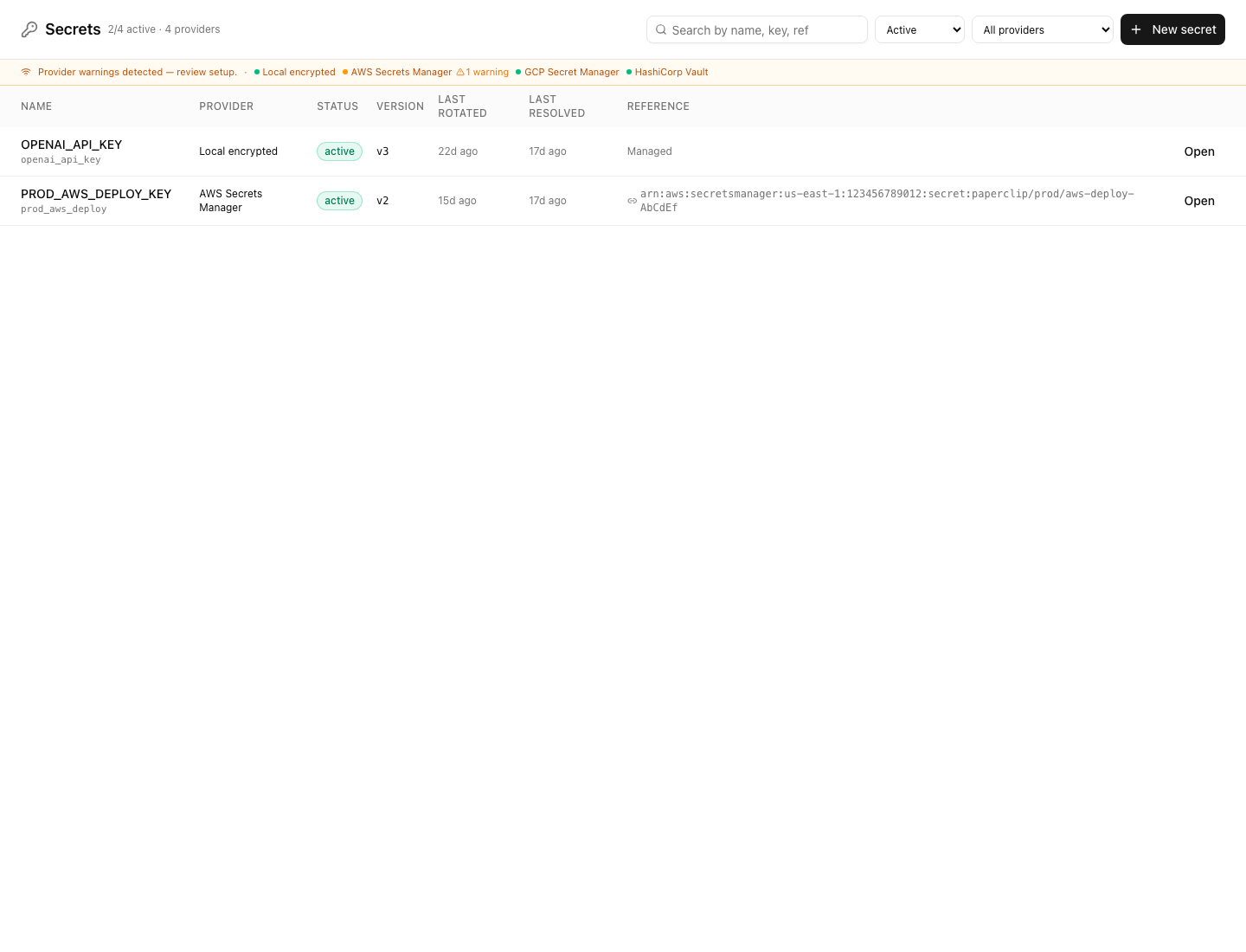
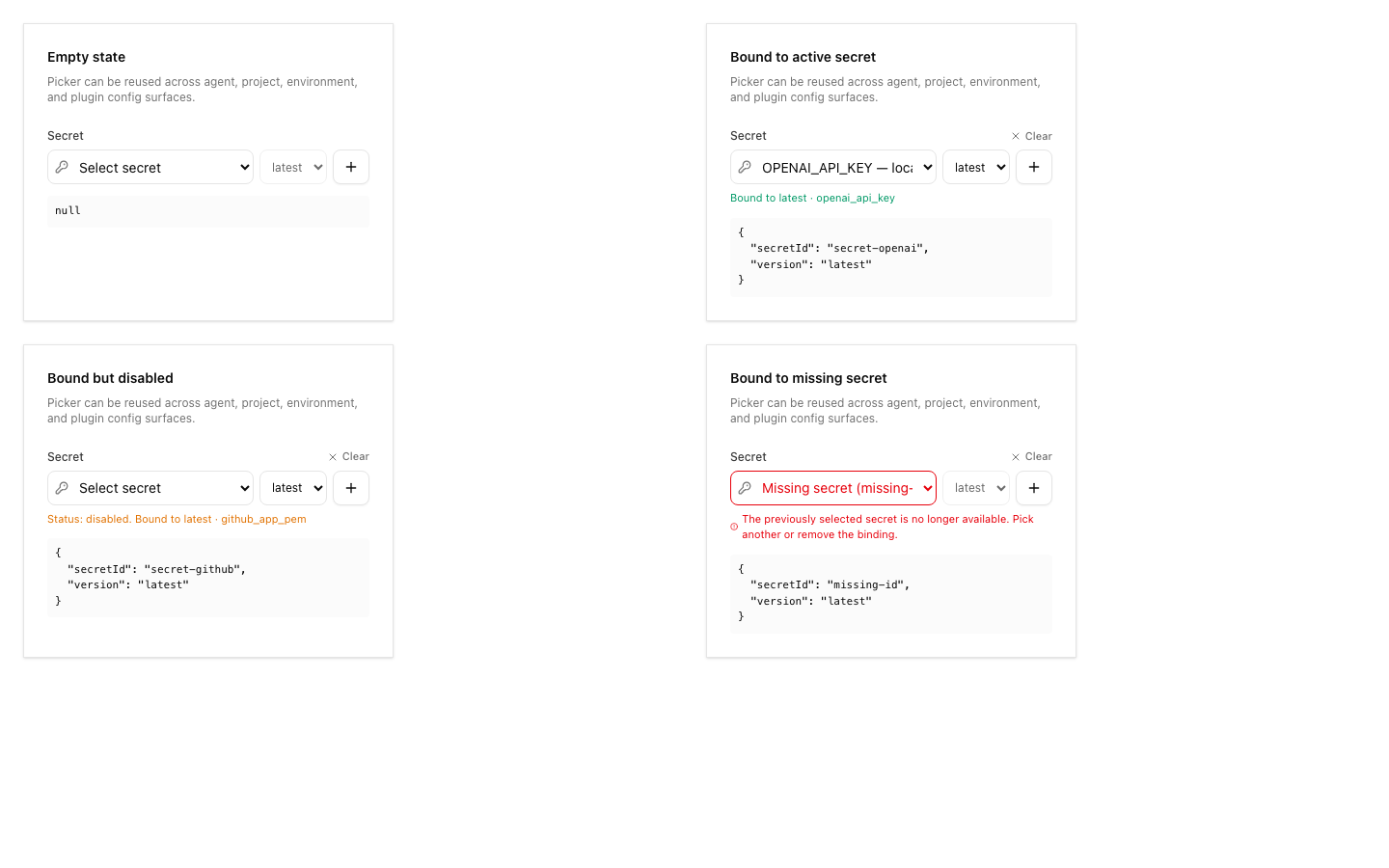
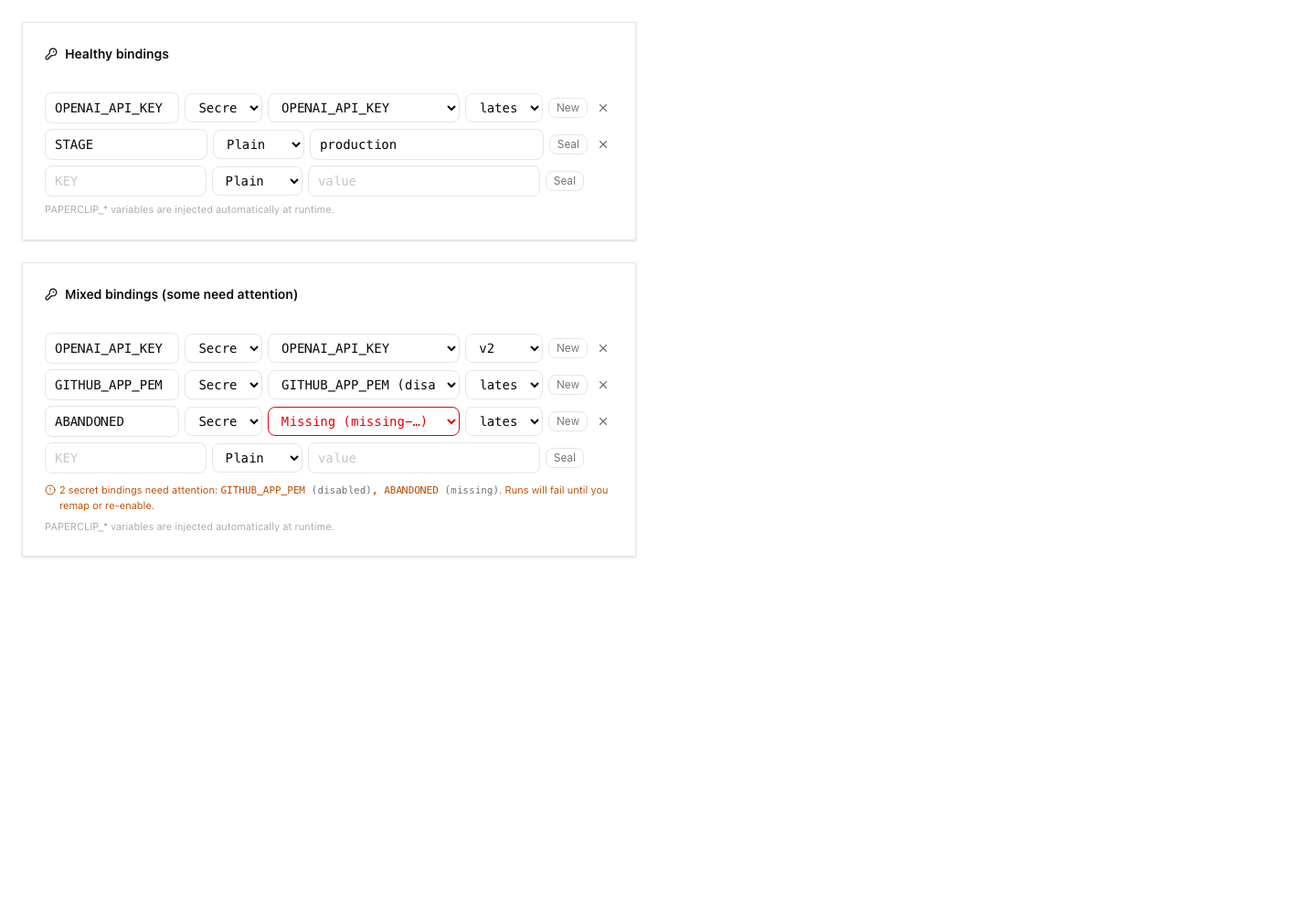
## Risks
- Migration risk: this adds new secret provider tables and extends
existing secret rows. The migrations were checked for monotonic ordering
and idempotent guards, but reviewers should still inspect upgrade
behavior carefully.
- Provider risk: AWS support uses direct SigV4 requests. Automated tests
cover signing, request timeouts, vault-config selection, namespace
guardrails, pending-version archival, sanitized provider errors, and
service-level cleanup paths. A real-vault AWS smoke test remains
deployment validation for an operator with AWS credentials rather than
an unverified merge blocker in this local branch.
- UI risk: the Secrets page and import dialog are large new surfaces;
screenshots are included above for reviewer inspection.
- Verification risk: the full local stable test command hit
parallel-load timing failures, although the exact failed files passed
when rerun directly.
- Operational risk: remote import intentionally avoids plaintext reads;
operators must understand that imported external references resolve at
runtime and may fail if AWS permissions change.
> For core feature work, check [`ROADMAP.md`](ROADMAP.md) first and
discuss it in `#dev` before opening the PR. Feature PRs that overlap
with planned core work may need to be redirected — check the roadmap
first. See `CONTRIBUTING.md`.
## Model Used
- OpenAI Codex, GPT-5 coding agent with local shell/tool use in the
Paperclip worktree. Exact context-window size was not exposed by the
runtime.
## Checklist
- [x] I have included a thinking path that traces from project context
to this change
- [x] I have specified the model used (with version and capability
details)
- [x] I have checked ROADMAP.md and confirmed this PR does not duplicate
planned core work
- [ ] I have run tests locally and they pass
- [x] I have added or updated tests where applicable
- [x] If this change affects the UI, I have included before/after
screenshots
- [x] I have updated relevant documentation to reflect my changes
- [x] I have considered and documented any risks above
- [x] I will address all Greptile and reviewer comments before
requesting merge
---------
Co-authored-by: Paperclip <noreply@paperclip.ing>
Co-authored-by: Claude Sonnet 4.6 <noreply@anthropic.com>
2026-05-09 18:22:17 -05:00
## Secrets Commands
```sh
pnpm paperclipai secrets list --company-id < company-id >
pnpm paperclipai secrets declarations --company-id < company-id > [--include agents,projects] [--kind secret]
pnpm paperclipai secrets create --company-id < company-id > --name anthropic-api-key --value-env ANTHROPIC_API_KEY
pnpm paperclipai secrets link --company-id < company-id > --name prod-stripe-key --provider aws_secrets_manager --external-ref < provider-ref >
pnpm paperclipai secrets doctor --company-id < company-id >
pnpm paperclipai secrets migrate-inline-env --company-id < company-id > [--apply]
```
Secret listing and declarations never print secret values. `create` accepts
`--value-env` so shell history does not capture the value. `link` records
provider-owned references without copying the secret value into Paperclip.
For AWS-backed secrets, `secrets doctor` reports missing non-secret provider
env and the expected AWS SDK runtime credential source; do not store AWS
bootstrap credentials in Paperclip secrets.
Per-company provider vaults (multiple vault instances per provider, default
vault selection, coming-soon GCP/Vault) are configured from the board UI under
`Company Settings → Secrets → Provider vaults` or through
`/api/companies/{companyId}/secret-provider-configs` . There is no CLI surface
for vault management today. See the
[secrets deploy guide ](../docs/deploy/secrets.md#provider-vaults ) and
[API reference ](../docs/api/secrets.md#provider-vaults ) for the contract.
2026-02-20 07:10:58 -06:00
## Approval Commands
```sh
2026-03-03 08:45:26 -06:00
pnpm paperclipai approval list --company-id < company-id > [--status pending]
pnpm paperclipai approval get < approval-id >
pnpm paperclipai approval create --company-id < company-id > --type hire_agent --payload '{"name":"..."}' [--issue-ids < id1 , id2 > ]
pnpm paperclipai approval approve < approval-id > [--decision-note "..."]
pnpm paperclipai approval reject < approval-id > [--decision-note "..."]
pnpm paperclipai approval request-revision < approval-id > [--decision-note "..."]
pnpm paperclipai approval resubmit < approval-id > [--payload '{"...":"..."}']
pnpm paperclipai approval comment < approval-id > --body "..."
2026-02-20 07:10:58 -06:00
```
## Activity Commands
```sh
2026-03-03 08:45:26 -06:00
pnpm paperclipai activity list --company-id < company-id > [--agent-id < agent-id > ] [--entity-type issue] [--entity-id < id > ]
2026-02-20 07:10:58 -06:00
```
## Dashboard Commands
```sh
2026-03-03 08:45:26 -06:00
pnpm paperclipai dashboard get --company-id < company-id >
2026-02-20 07:10:58 -06:00
```
## Heartbeat Command
`heartbeat run` now also supports context/api-key options and uses the shared client stack:
```sh
2026-03-03 08:45:26 -06:00
pnpm paperclipai heartbeat run --agent-id < agent-id > [--api-base http://localhost:3100] [--api-key < token > ]
2026-02-20 07:10:58 -06:00
```
## Local Storage Defaults
Default local instance root is `~/.paperclip/instances/default` :
- config: `~/.paperclip/instances/default/config.json`
- embedded db: `~/.paperclip/instances/default/db`
- logs: `~/.paperclip/instances/default/logs`
2026-02-20 10:33:36 -06:00
- storage: `~/.paperclip/instances/default/data/storage`
2026-02-20 07:10:58 -06:00
- secrets key: `~/.paperclip/instances/default/secrets/master.key`
Override base home or instance with env vars:
```sh
2026-03-03 08:45:26 -06:00
PAPERCLIP_HOME=/custom/home PAPERCLIP_INSTANCE_ID=dev pnpm paperclipai run
2026-02-20 07:10:58 -06:00
```
2026-02-20 10:33:36 -06:00
## Storage Configuration
Configure storage provider and settings:
```sh
2026-03-03 08:45:26 -06:00
pnpm paperclipai configure --section storage
2026-02-20 10:33:36 -06:00
```
Supported providers:
- `local_disk` (default; local single-user installs)
- `s3` (S3-compatible object storage)
