## Thinking Path
> - Paperclip orchestrates AI agents for zero-human companies.
> - Agent creation can happen through local runtimes, managed runtimes,
and external agents that onboard through invites.
> - The old OpenClaw-oriented invite UX lived under company
settings/invites and made a gateway-specific path look like a company
access setting.
> - That hid the broader bring-your-own-agent flow and forced operators
to leave the add-agent modal when adding an external agent.
> - This pull request moves external agent invite generation into the
add-agent modal and makes the copy agent-oriented instead of
OpenClaw-only.
> - The benefit is a clearer agent-first onboarding path while company
invites stay focused on human access.
## What Changed
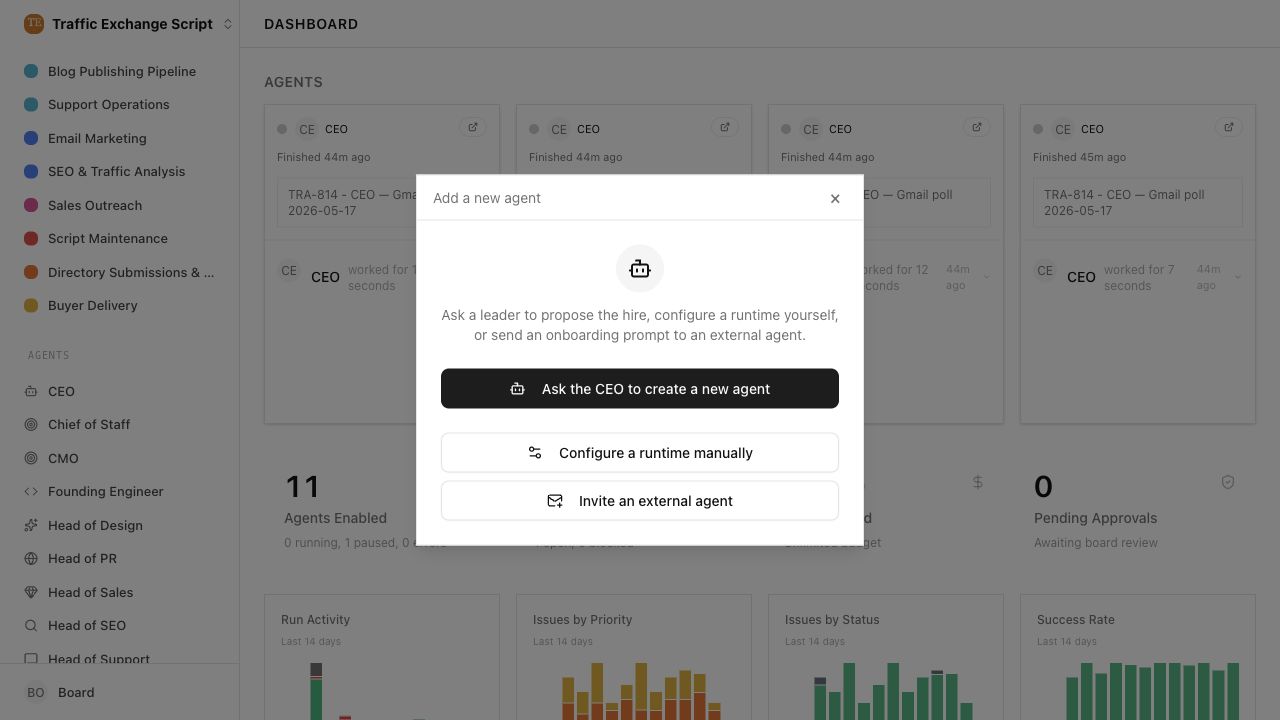
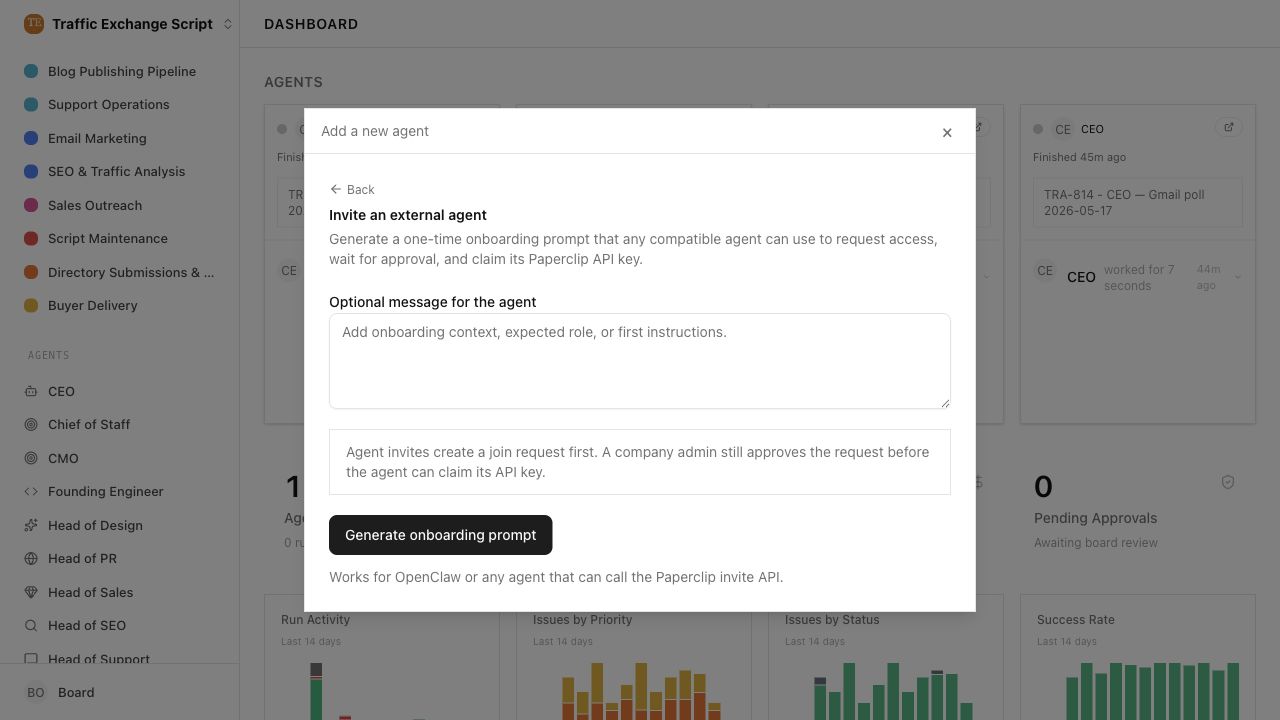
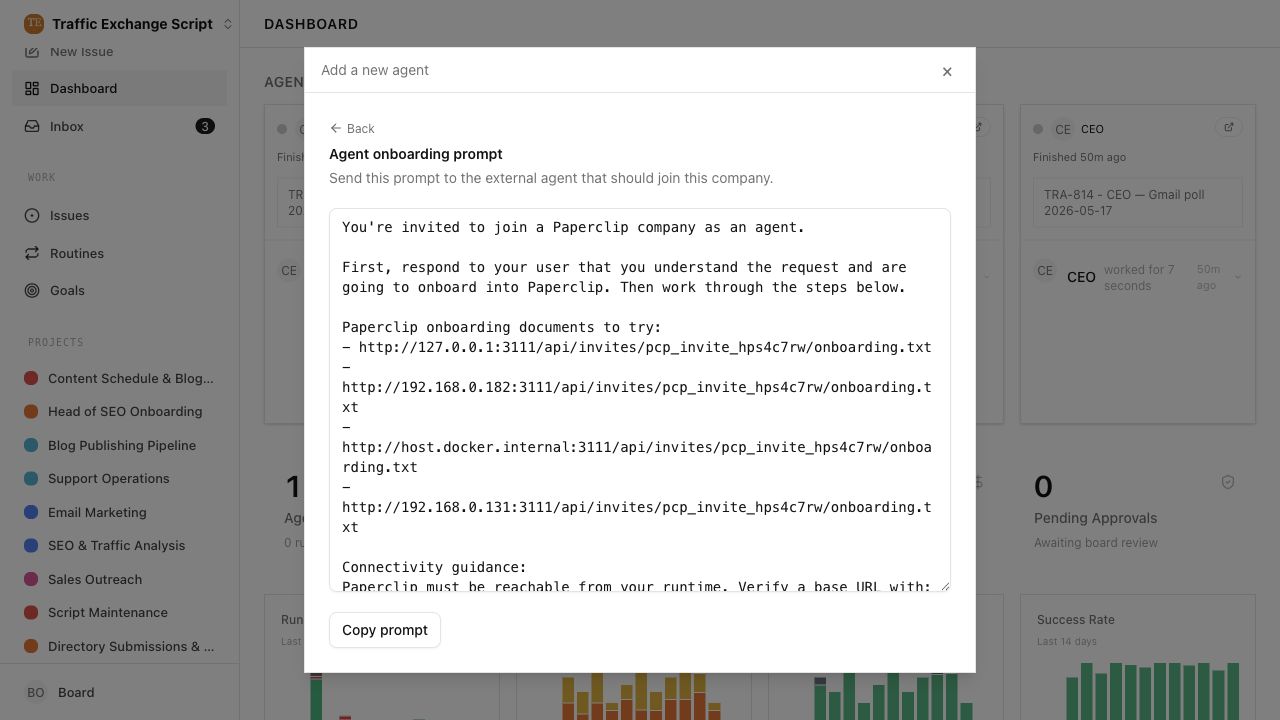
- Added an external-agent invite branch to the add-agent modal,
including a dedicated prompt result view with Back navigation.
- Added a shared agent onboarding prompt builder and focused modal
coverage for prompt replacement/back navigation.
- Removed the agent invite prompt UI from Company Settings and Company
Invites, leaving Company Invites focused on human access links and
invite history.
- Updated the hidden OpenClaw Gateway runtime hint to direct operators
to the add-agent invite flow instead of presenting it as a blocked
runtime card.
- Updated invite/onboarding docs, storybook coverage, and server-side
onboarding copy toward generic agent language while preserving existing
gateway compatibility.
## Verification
- `pnpm -r typecheck`
- `pnpm build`
- `FAKE_BIN="$(mktemp -d)/bin"; mkdir -p "$FAKE_BIN"; printf
'#!/bin/sh\nexit 1\n' > "$FAKE_BIN/tailscale"; chmod +x
"$FAKE_BIN/tailscale"; PATH="$FAKE_BIN:$PATH" pnpm test:run`
- `pnpm test:run` without the fake `tailscale` shim was also attempted;
it failed only in two pre-existing CLI tailnet fallback tests because
this host has a real Tailscale address (`100.125.202.3`) where those
tests expect no Tailscale.
- Focused confirmation for that host-env issue: `FAKE_BIN=...
PATH="$FAKE_BIN:$PATH" pnpm exec vitest run --project paperclipai
cli/src/__tests__/network-bind.test.ts
cli/src/__tests__/onboard.test.ts`
- Manual UI verification: served UI locally in light mode, opened
add-agent modal, generated external agent prompt, verified the generated
prompt replaces the form and Back returns to the form.
### Screenshots
## Risks
- Existing OpenClaw gateway compatibility remains, but operators now
discover external agent onboarding from the add-agent modal instead of
company settings.
- Agent invites still appear in the invite history table, so that page
may show agent-scoped invite rows even though it no longer creates agent
onboarding prompts.
- Low migration risk: no schema changes.
> For core feature work, check [`ROADMAP.md`](ROADMAP.md) first and
discuss it in `#dev` before opening the PR. Feature PRs that overlap
with planned core work may need to be redirected — check the roadmap
first. See `CONTRIBUTING.md`.
## Model Used
- OpenAI Codex, GPT-5 coding agent in Codex desktop; tool-enabled
repository, shell, browser, and GitHub workflow. Context window size was
not exposed by the runtime.
## Checklist
- [x] I have included a thinking path that traces from project context
to this change
- [x] I have specified the model used (with version and capability
details)
- [x] I have checked ROADMAP.md and confirmed this PR does not duplicate
planned core work
- [x] I have run tests locally and they pass
- [x] I have added or updated tests where applicable
- [x] If this change affects the UI, I have included before/after
screenshots
- [x] I have updated relevant documentation to reflect my changes
- [x] I have considered and documented any risks above
- [x] I will address all Greptile and reviewer comments before
requesting merge
## Thinking Path

> - Paperclip orchestrates AI agents for zero-human companies
> - The `grok-local` adapter streams reasoning text to the issue
"Working..." panel as the grok CLI runs
> - The `grok` CLI's `--output-format streaming-json` mode silently
drops the `\n` separator between reasoning turns around tool calls
> - Consecutive `thought` chunks (e.g. `` "`" `` followed by `"The"`)
arrive with no intervening whitespace event, so the UI's `delta: true`
concatenator merged them into run-on text like `"…planningGreat, now I
have the issue descriptionThe only co"`
> - This PR adds a small turn-boundary helper that detects sentence
boundaries in the upstream `thought` stream and inserts a single `\n`
only when the previous chunk ended with sentence punctuation (or a
balanced closing backtick) AND the next chunk begins a new uppercase
sentence
> - The benefit is readable streaming reasoning in the UI without
changing how completed messages are stored

## What Changed

- Added `packages/adapters/grok-local/src/shared/turn-boundary.ts` with
per-stream state (last chunk + backtick parity) and a
`restoreTurnBoundary()` helper that inserts `\n` only between balanced,
sentence-terminated `thought` chunks
- Wired the helper into `parseGrokJsonl` (server) and added a new
`createGrokStdoutParser` factory used by `grokLocalUIAdapter` for the
live "Working..." panel
- Added focused tests in `shared/turn-boundary.test.ts`, plus regression
assertions in `server/parse.test.ts` and `ui/parse-stdout.test.ts`

## Verification

- `pnpm --filter @paperclip/grok-local test` — 23/23 adapter tests pass
- `pnpm --filter @paperclip/grok-local typecheck` and UI typecheck —
clean
- Replayed an actual broken `grok 0.1.210` stream from the report;
previously-merged boundaries (`` `ls`The ``, `returned:Confirmed`) now
render with a separating newline; chunks inside un-closed backtick spans
are left alone

## Risks

- Low risk. Boundary insertion only fires when prev ends with
`.`/`!`/`?`/balanced `` ` `` and next begins with an uppercase ≥2-char
word, with no whitespace on either side. Worst case: a rare missed split
or a misplaced newline inside reasoning — both purely cosmetic and
confined to the live streaming panel.

## Model Used

- Claude Opus 4.7 (claude-opus-4-7), Anthropic, extended thinking + tool
use via Claude Code

## Checklist

- [x] I have included a thinking path that traces from project context
to this change
- [x] I have specified the model used (with version and capability
details)
- [x] I have checked ROADMAP.md and confirmed this PR does not duplicate
planned core work
- [x] I have run tests locally and they pass
- [x] I have added or updated tests where applicable
- [ ] If this change affects the UI, I have included before/after
screenshots
- [x] I have updated relevant documentation to reflect my changes
- [x] I have considered and documented any risks above
- [x] I will address all Greptile and reviewer comments before
requesting merge

---------

Co-authored-by: Paperclip <noreply@paperclip.ing>
## Thinking Path

> - Paperclip orchestrates AI agents for zero-human companies, so
adapter quality directly affects what runtimes the control plane can
supervise.
> - Local CLI adapters are one of the core execution surfaces because
they turn real coding tools into Paperclip-managed employees with
heartbeats, transcripts, and reviewability.
> - Grok Build was installed on the Paperclip host, but Paperclip had no
built-in `grok_local` adapter, so the runtime could not be configured
through the normal server/UI/CLI adapter path.
> - That gap needed to be closed with the same built-in registry,
environment diagnostics, transcript parsing, and skill/instructions
behavior that the other local adapters already rely on.
> - After the initial adapter landed, a real follow-up run showed that
Grok streaming text was being rendered one fragment per line, which made
transcripts harder to read even though the runtime itself was working.
> - This pull request adds the built-in `grok_local` adapter end-to-end
and then fixes the transcript parser so streamed Grok output is
coalesced into readable assistant/thinking blocks.
> - The benefit is that Grok Build becomes a first-class Paperclip
runtime with a usable operator experience instead of a partially wired
runtime with noisy transcript output.

## What Changed

- Added a new built-in `@paperclipai/adapter-grok-local` package with
server, UI, and CLI entrypoints.
- Implemented Grok execution, session handling, environment diagnostics,
config building, skill syncing, and parser coverage inside the new
adapter package.
- Registered `grok_local` across the built-in adapter inventories and
capability/display metadata in server, UI, CLI, and shared constants.
- Added adapter route coverage for the new built-in type.
- Fixed Grok transcript readability by emitting streamed `text` and
`thought` fragments as deltas so the shared transcript builder coalesces
them into readable message blocks.
- Added regression tests for the Grok parser and transcript coalescing
behavior.

## Verification

- `pnpm vitest run
packages/adapters/grok-local/src/ui/parse-stdout.test.ts
ui/src/adapters/transcript.test.ts`
- `pnpm --filter @paperclipai/adapter-grok-local build`
- Manual runtime verification on the Paperclip host during
implementation and follow-up review:
  - confirmed the Grok CLI was installed and authenticated
- confirmed the worktree dev server could be restarted cleanly and
health-checked after the parser follow-up
- No screenshots attached. This change is primarily adapter plumbing
plus transcript formatting behavior; reviewers can verify via the
Grok-backed run surfaces directly.

## Risks

- This adds a new built-in adapter, so any missed registration surface
could create inconsistencies between server, UI, and CLI behavior.
- The adapter depends on Grok Build's current event/output shape; if
upstream Grok streaming JSON changes, transcript parsing or session
extraction may need follow-up updates.
- The transcript readability fix intentionally changes how Grok
fragments are grouped, so any downstream code that implicitly expected
one entry per fragment would behave differently.

> For core feature work, check [`ROADMAP.md`](ROADMAP.md) first and
discuss it in `#dev` before opening the PR. Feature PRs that overlap
with planned core work may need to be redirected — check the roadmap
first. See `CONTRIBUTING.md`.

## Model Used

- OpenAI Codex via Paperclip `codex_local` agent runtime.
- GPT-5-class coding model with tool use, shell execution, file editing,
and repo inspection enabled.
- Exact backend model ID/context window were not surfaced to the agent
in this Paperclip session.

## Checklist

- [x] I have included a thinking path that traces from project context
to this change
- [x] I have specified the model used (with version and capability
details)
- [x] I have checked ROADMAP.md and confirmed this PR does not duplicate
planned core work
- [x] I have run tests locally and they pass
- [x] I have added or updated tests where applicable
- [ ] If this change affects the UI, I have included before/after
screenshots
- [ ] I have updated relevant documentation to reflect my changes
- [x] I have considered and documented any risks above
- [x] I will address all Greptile and reviewer comments before
requesting merge
## Thinking Path

> - Paperclip orchestrates AI agents for zero-human companies
> - There are many adapter types, one per agent-runtime product (Claude,
Codex, OpenCode, Cursor local CLI, etc.)
> - Cursor shipped a public TypeScript SDK on 2026-04-29 that exposes
Cursor's full hosted-agent platform (cloud VMs, harness, MCP, skills,
hooks)
> - Paperclip had no first-class adapter for this — agents that wanted
to use Cursor's managed cloud runtime had to fall back to the local CLI
adapter, which loses the cloud session, streaming, and durable run model
> - This PR adds a new `cursor_cloud` adapter built directly on
`@cursor/sdk`, with Paperclip's heartbeat mapped to Cursor's
durable-agent + per-run model
> - The benefit is that any Paperclip agent can now drive a Cursor cloud
agent across heartbeats with native session reuse, streaming, and
cancellation, while Paperclip remains the source of truth for issue/task
state

## What Changed

- New built-in adapter package `packages/adapters/cursor-cloud` (15
files, ~1.7k LOC) backed by `@cursor/sdk` ^1.0.12
- `src/server/execute.ts` — SDK-first lifecycle: `Agent.create` /
`Agent.resume` / `Agent.getRun` / `agent.send` / `run.stream` /
`run.wait`, with session reuse keyed on the (runtime env type, env name,
repo set) tuple
- `src/server/session.ts` — codec for `cursorAgentId` + `latestRunId` +
repo metadata, persisted in `runtime.sessionParams`
- `src/server/test.ts` — environment probe via `Cursor.me()` and
optional model validation via `Cursor.models.list()`
- `src/ui/parse-stdout.ts` + `src/cli/format-event.ts` — normalize
Cursor SDK message types (`status`, `thinking`, `assistant`, `user`,
`tool_call`, `tool_result`, `result`) into Paperclip transcript events
for the UI and CLI
- Registrations: `packages/shared/src/constants.ts`,
`packages/adapter-utils/src/session-compaction.ts`,
`server/src/adapters/{registry,builtin-adapter-types}.ts`,
`ui/src/adapters/{registry,adapter-display-registry}.ts` +
`ui/src/adapters/cursor-cloud/index.ts`, `cli/src/adapters/registry.ts`,
plus workspace deps in `cli`/`server`/`ui` `package.json`
- `ui/src/components/AgentConfigForm.tsx` — hide local-Cursor
`mode`/thinking-effort field for `cursor_cloud` (different config
surface)
- 11 vitest tests covering execute paths (fresh create, matching-resume,
active-run reattach, non-finished result), session codec round-trip,
transcript parsing, and config building

## Verification

Reviewer steps:

```bash
pnpm install
pnpm --filter @paperclipai/adapter-cursor-cloud typecheck   # → clean
pnpm vitest run packages/adapters/cursor-cloud              # → 11/11 passing
```

End-to-end check against a real Cursor cloud agent (requires
`CURSOR_API_KEY` and Cursor GitHub-app install on the target repo):

1. Create a `cursor_cloud` agent in Paperclip with `repoUrl` set to the
test repo, `repoStartingRef: main`, and `env.CURSOR_API_KEY` set
2. Trigger a heartbeat → adapter calls `Agent.create({ cloud: { env: {
type: "cloud" }, repos: [...] } })`, streams events, terminates on
`finished`
3. Trigger a second heartbeat → adapter calls `Agent.resume` or
`agent.send` follow-up depending on prior-run state, reusing
`cursorAgentId`
4. The Paperclip UI/CLI transcript reflects Cursor `status` / `thinking`
/ `assistant` events as they stream
5. Cancellation from Paperclip maps to `run.cancel()` or Cloud API v1
`cancelRun` for cross-heartbeat cancellation

A direct-SDK smoke run against a real repo (devinfoley/my_test_project @
main) confirmed: `Cursor.me()` ok → `Agent.create` → `agent.send` →
`run.stream()` (30 events) → terminal status `finished` in ~11s.

## Risks

- **New adapter, additive only.** No existing adapter or registry is
replaced; current `cursor` local-CLI adapter is untouched. Default
behavior of any existing agent is unchanged.
- **External dependency on `@cursor/sdk`.** Cursor's SDK is v1.0.x and
may evolve. Mocked unit tests cover the public surface used here; if the
SDK breaks compatibility we update the adapter independently.
- **Cost/budget.** `cursor_cloud` runs on Cursor's billed cloud VMs;
operators must understand they are spending money outside Paperclip's
budget controls when they enable this adapter. Same shape as other
API-billed adapters.
- **No webhook support in V1.** The SDK already provides
stream/wait/cancel/reattach, so V1 does not require a public callback
URL. If a future use case needs out-of-band wakes, we add a Cloud API v1
webhook bridge as a separate change. This is called out in the issue
plan document.
- **Lockfile.** Per repo policy, `pnpm-lock.yaml` is intentionally not
in this PR — CI's lockfile workflow will update it on merge given the
manifest changes.

## Model Used

- Provider: Anthropic Claude (via Claude Code / Paperclip `claude_local`
adapter)
- Model: `claude-opus-4-7` (Claude Opus 4.7), knowledge cutoff January
2026
- Mode: standard tool-use with extended reasoning
- Context: ~200k token window
- Capabilities used: code generation, multi-file edits, shell/test
execution, GitHub PR workflow

## Checklist

- [x] I have included a thinking path that traces from project context
to this change
- [x] I have specified the model used (with version and capability
details)
- [x] I have checked ROADMAP.md and confirmed this PR does not duplicate
planned core work
- [x] I have run tests locally and they pass (11/11 in
`packages/adapters/cursor-cloud`)
- [x] I have added or updated tests where applicable (4 new test files,
11 cases)
- [ ] If this change affects the UI, I have included before/after
screenshots (the only UI change is hiding the local-Cursor mode field on
the `cursor_cloud` adapter — happy to attach a screenshot if the
reviewer wants one)
- [x] I have updated relevant documentation to reflect my changes (issue
plan document supersedes the pre-SDK design; tracked in PAPA-203)
- [x] I have considered and documented any risks above
- [x] I will address all Greptile and reviewer comments before
requesting merge

---------

Co-authored-by: Paperclip <noreply@paperclip.ing>
## Thinking Path

> - Paperclip orchestrates AI agents across several adapter
implementations.
> - ACPX is a local adapter path that can proxy Claude and Codex-style
execution.
> - Its configuration needed stronger schema defaults, provider-aware
model handling, and better UI support.
> - Plugin authors also need clear docs for managed resources.
> - This pull request improves ACPX adapter configuration and documents
plugin-managed resources.
> - The benefit is a more predictable adapter setup path without
changing unrelated control-plane behavior.

## What Changed

- Improved ACPX config schema, execution config handling, UI build
config, and route coverage.
- Added ACPX model filtering support and tests.
- Updated the agent config form and storybook coverage for ACPX
model/provider behavior.
- Expanded plugin authoring documentation for managed resources.

## Verification

- `pnpm install --frozen-lockfile`
- `pnpm exec vitest run server/src/__tests__/acpx-local-execute.test.ts
server/src/__tests__/adapter-routes.test.ts
ui/src/lib/acpx-model-filter.test.ts`

## Risks

- Low-to-medium risk: adapter configuration behavior changes can affect
ACPX users, but the change is isolated to ACPX/plugin-doc surfaces and
covered by targeted adapter tests.

## Model Used

- OpenAI GPT-5 Codex via Paperclip `codex_local` adapter, with
shell/git/GitHub CLI tool use.

## Checklist

- [x] I have included a thinking path that traces from project context
to this change
- [x] I have specified the model used (with version and capability
details)
- [x] I have checked ROADMAP.md and confirmed this PR does not duplicate
planned core work
- [x] I have run tests locally and they pass
- [x] I have added or updated tests where applicable
- [x] If this change affects the UI, I have included before/after
screenshots
- [x] I have updated relevant documentation to reflect my changes
- [x] I have considered and documented any risks above
- [x] I will address all Greptile and reviewer comments before
requesting merge

---------

Co-authored-by: Paperclip <noreply@paperclip.ing>
## Thinking Path
> - Paperclip orchestrates AI-agent companies through a control plane
that can start, supervise, and recover agent runs.
> - Local adapters are the bridge between Paperclip issues and concrete
agent runtimes such as Claude, Codex, and other ACP-compatible tools.
> - The roadmap calls out broader “bring your own agent” and claw-style
agent support, and ACPX gives Paperclip one path to normalize multiple
ACP agents behind a single adapter.
> - The branch needed to become one reviewable PR against current
`paperclipai/paperclip:master`, without carrying stale base conflicts or
generated lockfile churn.
> - This pull request adds an experimental built-in `acpx_local`
adapter, integrates it through the server/CLI/UI adapter surfaces, and
adds regression coverage for runtime execution, skill sync, stream
parsing, diagnostics, and log redaction.
> - The benefit is that Paperclip can run Claude/Codex/custom ACP agents
through ACPX while keeping operator configuration, skills, logging, and
transcript rendering inside the existing adapter model.
## What Changed
- Added `@paperclipai/adapter-acpx-local` with server execution, config
schema, ACPX session handling, CLI formatting, UI config helpers, and
stdout parsing.
- Registered `acpx_local` across CLI, server, shared constants, UI
adapter metadata, adapter capabilities, and agent creation/editing
surfaces.
- Added ACPX runtime execution support with persistent sessions,
local-agent JWT environment handling, skill snapshots, runtime skill
materialization, and isolation/security regressions.
- Added ACPX adapter diagnostics and marked the adapter experimental in
the UI.
- Added command/env secret redaction for resolved command metadata in
adapter-utils, server event storage, and the Agent Detail invocation UI.
- Added Storybook coverage for ACPX config, transcript rendering, and
skill states, plus PR screenshots under `docs/pr-screenshots/pap-2944/`.
- Rebased the branch onto current `public-gh/master`; `pnpm-lock.yaml`
is intentionally not included and there are no migration/schema changes.
## Verification
- `pnpm exec vitest run
packages/adapters/acpx-local/src/server/execute.test.ts
packages/adapters/acpx-local/src/server/test.test.ts
packages/adapters/acpx-local/src/cli/format-event.test.ts
packages/adapters/acpx-local/src/ui/parse-stdout.test.ts
packages/adapter-utils/src/server-utils.test.ts
server/src/__tests__/redaction.test.ts
server/src/__tests__/acpx-local-execute.test.ts
server/src/__tests__/acpx-local-skill-sync.test.ts
server/src/__tests__/acpx-local-adapter-environment.test.ts
server/src/__tests__/adapter-routes.test.ts
server/src/__tests__/agent-skills-routes.test.ts
ui/src/adapters/metadata.test.ts` — 12 files, 87 tests passed.
- `pnpm --filter @paperclipai/adapter-acpx-local typecheck` — passed.
- `pnpm --filter @paperclipai/server typecheck` — passed.
- `pnpm --filter @paperclipai/ui typecheck` — passed.
- Confirmed PR diff does not include `pnpm-lock.yaml`, database schema
files, or migrations.
Screenshots:


## Risks
- Medium risk: this introduces a new built-in adapter package and
touches runtime execution, adapter registration, agent config, skills,
and transcript rendering.
- ACPX and ACP agent behavior can vary by installed tool versions; the
adapter is marked experimental to set operator expectations.
- `pnpm-lock.yaml` is excluded per repository PR policy, so dependency
lock refresh must be handled by the repo’s automation or maintainers.
- No database migration risk: no schema or migration files changed.
> For core feature work, check [`ROADMAP.md`](ROADMAP.md) first and
discuss it in `#dev` before opening the PR. Feature PRs that overlap
with planned core work may need to be redirected — check the roadmap
first. See `CONTRIBUTING.md`.
## Model Used
- OpenAI Codex coding agent based on GPT-5, with repository tool use,
shell execution, git operations, and local verification. Exact hosted
context window was not exposed in this environment.
## Checklist
- [x] I have included a thinking path that traces from project context
to this change
- [x] I have specified the model used (with version and capability
details)
- [x] I have checked ROADMAP.md and confirmed this PR does not duplicate
planned core work
- [x] I have run tests locally and they pass
- [x] I have added or updated tests where applicable
- [x] If this change affects the UI, I have included before/after
screenshots
- [x] I have updated relevant documentation to reflect my changes
- [x] I have considered and documented any risks above
- [x] I will address all Greptile and reviewer comments before
requesting merge
---------
Co-authored-by: Paperclip <noreply@paperclip.ing>
## Thinking Path

> - Paperclip is a control plane for autonomous AI companies, where
adapters are the boundary between the board, agents, and execution
runtimes.
> - Local adapters currently expose a primary runtime configuration, but
operators often need a cheaper model lane for routine or low-risk work.
> - That cheap lane has to stay adapter-owned: runtime profile settings
should not mutate the primary adapter config or bypass existing
auth/secret mediation.
> - Issue creation also needs an ergonomic way to request primary,
cheap, or custom model behavior for a selected assignee.
> - This pull request adds a first-class `cheap` model profile contract
across adapter capabilities, heartbeat config resolution, agent
configuration, and issue creation.
> - The benefit is cheaper task execution can be configured and
requested explicitly while preserving adapter boundaries, secret
handling, and audit visibility.

## What Changed

- Added adapter model-profile capability metadata and a `cheap` profile
contract for supported local adapters.
- Applied `runtimeConfig.modelProfiles.cheap.adapterConfig` during
heartbeat config resolution, including requested/applied/fallback run
metadata.
- Added agent configuration UI for cheap model profile settings without
writing those settings into primary `adapterConfig`.
- Added New Issue assignee model lane controls for Primary / Cheap /
Custom and request payload handling.
- Added run ledger profile badges and Storybook stories for the new
cheap-lane UI states.
- Added tests for validators, heartbeat model profile application,
permission/secret mediation, UI payload helpers, and run ledger
rendering.
- Added committed UI verification screenshots under
`docs/pr-screenshots/pap-2837/`.
- Addressed Greptile review feedback around cheap-profile defaults,
shared profile types, and fallback test data.

## Verification

Local:

- `pnpm exec vitest run packages/shared/src/validators/issue.test.ts
server/src/__tests__/adapter-registry.test.ts
server/src/__tests__/agent-permissions-routes.test.ts
server/src/__tests__/heartbeat-model-profile.test.ts
ui/src/components/IssueRunLedger.test.tsx
ui/src/lib/agent-config-patch.test.ts
ui/src/lib/issue-assignee-overrides.test.ts
ui/src/lib/new-agent-runtime-config.test.ts` — passed, 8 files / 103
tests.
- `pnpm exec vitest run ui/src/lib/new-agent-runtime-config.test.ts
ui/src/components/IssueRunLedger.test.tsx` — passed after
Greptile/rebase follow-up, 2 files / 17 tests.
- `pnpm --filter @paperclipai/ui typecheck` — passed after
Greptile/rebase follow-up.
- `pnpm -r typecheck` — passed.
- `pnpm build` — passed.
- `pnpm test:run` — did not complete successfully in this local
worktree: it stopped in pre-existing `@paperclipai/adapter-utils`
sandbox/SSH fixture suites outside this PR diff. Failures were 5s local
timeouts plus `git init -b` unsupported by this machine's Git 2.21.0.
The branch-specific targeted suites above passed.
- Branch was fetched/rebased onto `public-gh/master`; `git rev-list
--left-right --count public-gh/master...HEAD` reports `0 9`.

Remote PR checks on latest head
`e30bf399146451c86cee98ed528d51d33fa5af5a`:

- `policy` — passed.
- `verify` — passed.
- `e2e` — passed.
- `Greptile Review` — passed, confidence score 5/5; Greptile review
threads resolved.
- `security/snyk (cryppadotta)` — passed.

Screenshots:

- [New issue cheap lane
desktop](https://github.com/paperclipai/paperclip/blob/PAP-2837-plan-cheap-model-for-adapters-that-can-support-it/docs/pr-screenshots/pap-2837/newissue-cheap-desktop.png)
- [New issue custom lane
desktop](https://github.com/paperclipai/paperclip/blob/PAP-2837-plan-cheap-model-for-adapters-that-can-support-it/docs/pr-screenshots/pap-2837/newissue-custom-desktop.png)
- [New issue unsupported adapter
desktop](https://github.com/paperclipai/paperclip/blob/PAP-2837-plan-cheap-model-for-adapters-that-can-support-it/docs/pr-screenshots/pap-2837/newissue-unsupported-desktop.png)
- [Run ledger model profile badges
desktop](https://github.com/paperclipai/paperclip/blob/PAP-2837-plan-cheap-model-for-adapters-that-can-support-it/docs/pr-screenshots/pap-2837/runledger-profile-badges-desktop.png)
- Mobile variants are also in `docs/pr-screenshots/pap-2837/`.

## Risks

- Medium: heartbeat config mediation now merges runtime model profiles
into adapter configs, so adapter secret normalization and host-command
restrictions must keep covering nested config paths.
- Medium: the UI adds another issue creation choice; unsupported
adapters must keep hiding the cheap lane and preserve primary behavior.
- Low migration risk: no database migration is included.

> For core feature work, check [`ROADMAP.md`](ROADMAP.md) first and
discuss it in `#dev` before opening the PR. Feature PRs that overlap
with planned core work may need to be redirected — check the roadmap
first. See `CONTRIBUTING.md`.

## Model Used

OpenAI Codex coding agent using GPT-5-class reasoning with repo tool use
and command execution. Exact served model/context window was not exposed
by the runtime.

## Checklist

- [x] I have included a thinking path that traces from project context
to this change
- [x] I have specified the model used (with version and capability
details)
- [x] I have checked ROADMAP.md and confirmed this PR does not duplicate
planned core work
- [ ] I have run tests locally and they pass
- [x] I have added or updated tests where applicable
- [x] If this change affects the UI, I have included before/after
screenshots
- [x] I have updated relevant documentation to reflect my changes
- [x] I have considered and documented any risks above
- [x] I will address all Greptile and reviewer comments before
requesting merge

---------

Co-authored-by: Paperclip <noreply@paperclip.ing>
Co-authored-by: Claude Opus 4.7 <noreply@anthropic.com>
## Thinking Path

> - Paperclip orchestrates AI agents for zero-human companies
> - A fast-moving control plane needs stable local tests and repeatable
local maintenance tools so contributors can safely split and review work
> - Several route suites needed stronger isolation, Codex manual model
selection needed a faster-mode option, and local browser cleanup missed
Playwright's headless shell binary
> - Storybook static output also needed to be preserved as a generated
review artifact from the working branch
> - This pull request groups the test/local-dev maintenance pieces so
they can be reviewed separately from product runtime changes
> - The benefit is more predictable contributor verification and cleaner
local maintenance without mixing these changes into feature PRs

## What Changed

- Added stable Vitest runner support and serialized route/authz test
isolation.
- Fixed workspace runtime authz route mocks and stabilized
Claude/company-import related assertions.
- Allowed Codex fast mode for manually selected models.
- Broadened the agent browser cleanup script to detect
`chrome-headless-shell` as well as Chrome for Testing.
- Preserved generated Storybook static output from the source branch.

## Verification

- `pnpm exec vitest run
src/__tests__/workspace-runtime-routes-authz.test.ts
src/__tests__/claude-local-execute.test.ts --config vitest.config.ts`
from `server/` passed: 2 files, 19 tests.
- `pnpm exec vitest run src/server/codex-args.test.ts --config
vitest.config.ts` from `packages/adapters/codex-local/` passed: 1 file,
3 tests.
- `bash -n scripts/kill-agent-browsers.sh &&
scripts/kill-agent-browsers.sh --dry` passed; dry-run detected
`chrome-headless-shell` processes without killing them.
- `test -f ui/storybook-static/index.html && test -f
ui/storybook-static/assets/forms-editors.stories-Dry7qwx2.js` passed.
- `git diff --check public-gh/master..pap-2228-test-local-maintenance --
. ':(exclude)ui/storybook-static'` passed.
- `pnpm exec vitest run
cli/src/__tests__/company-import-export-e2e.test.ts --config
cli/vitest.config.ts` did not complete in the isolated split worktree
because `paperclipai run` exited during build prep with `TS2688: Cannot
find type definition file for 'react'`; this appears to be caused by the
worktree dependency symlink setup, not the code under test.
- Confirmed this PR does not include `pnpm-lock.yaml`.

## Risks

- Medium risk: the stable Vitest runner changes how route/authz tests
are scheduled.
- Generated `ui/storybook-static` files are large and contain minified
third-party output; `git diff --check` reports whitespace inside those
generated assets, so reviewers may choose to drop or regenerate that
artifact before merge.
- No database migrations.

> For core feature work, check [`ROADMAP.md`](ROADMAP.md) first and
discuss it in `#dev` before opening the PR. Feature PRs that overlap
with planned core work may need to be redirected — check the roadmap
first. See `CONTRIBUTING.md`.

## Model Used

- OpenAI Codex coding agent based on GPT-5, with shell, git, Paperclip
API, and GitHub CLI tool use in the local Paperclip workspace.

## Checklist

- [x] I have included a thinking path that traces from project context
to this change
- [x] I have specified the model used (with version and capability
details)
- [x] I have checked ROADMAP.md and confirmed this PR does not duplicate
planned core work
- [x] I have run tests locally and they pass
- [x] I have added or updated tests where applicable
- [x] If this change affects the UI, I have included before/after
screenshots
- [x] I have updated relevant documentation to reflect my changes
- [x] I have considered and documented any risks above
- [x] I will address all Greptile and reviewer comments before
requesting merge

Note: screenshot checklist item is not applicable to source UI behavior;
the included Storybook static output is generated artifact preservation
from the source branch.

---------

Co-authored-by: Paperclip <noreply@paperclip.ing>
## Thinking Path

> - Paperclip is a control plane for AI-agent companies.
> - External adapters can provide UI parser code that the board loads
dynamically for run transcript rendering.
> - Running adapter-provided parser code directly in the board page
gives that parser access to same-origin browser state.
> - This PR narrows that surface by evaluating dynamically loaded
external adapter UI parser code in a dedicated browser Web Worker with a
constrained postMessage protocol.
> - The worker here is a frontend isolation boundary for adapter UI
parser JavaScript; it is not Paperclip's server plugin-worker system and
it is not a server-side job runner.

## What Changed

- Runs dynamically loaded external adapter UI parsers inside a dedicated
Web Worker instead of importing/evaluating them directly in the board
page.
- Adds a narrow postMessage protocol for parser initialization and line
parsing.
- Caches completed async parse results and notifies the adapter registry
so transcript recomputation can synchronously drain the final parsed
line.
- Disables common worker network, persistence, child worker, Blob/object
URL, and WebRTC escape APIs inside the parser worker bootstrap.
- Handles worker error messages after initialization and drains pending
callbacks on worker termination or mid-session worker error.
- Adds focused regression coverage for the parser worker lockdown and
unused protocol removal.

## Verification

- `pnpm exec vitest run --config ui/vitest.config.ts
ui/src/adapters/sandboxed-parser-worker.test.ts`
- `pnpm exec tsc --noEmit --target es2021 --moduleResolution bundler
--module esnext --jsx react-jsx --lib dom,es2021 --skipLibCheck
ui/src/adapters/dynamic-loader.ts
ui/src/adapters/sandboxed-parser-worker.ts
ui/src/adapters/sandboxed-parser-worker.test.ts`
- `pnpm --filter @paperclipai/ui typecheck` was attempted; it reached
existing unrelated failures in HeartbeatRun test/storybook fixtures and
missing Storybook type resolution, with no adapter-module errors
surfaced.
- PR #4225 checks on current head `34c9da00`: `policy`, `e2e`, `verify`,
`security/snyk`, and `Greptile Review` are all `SUCCESS`.
- Greptile Review on current head `34c9da00` reached 5/5.

## Risks

- Medium risk: parser execution is now asynchronous through a worker
while the existing parser interface is synchronous, so transcript
updates should be watched with external adapters.
- Some adapter parser bundles may rely on direct ESM `export` syntax or
browser APIs that are no longer available inside the worker lockdown.
- The worker lockdown is a hardening layer around external parser code,
not a complete browser security sandbox for arbitrary untrusted
applications.

> For core feature work, check [`ROADMAP.md`](ROADMAP.md) first and
discuss it in `#dev` before opening the PR. Feature PRs that overlap
with planned core work may need to be redirected — check the roadmap
first. See `CONTRIBUTING.md`.

## Model Used

- OpenAI Codex, GPT-5-based coding agent runtime, shell/git tool use
enabled. Exact hosted model build and context window are not exposed in
this Paperclip heartbeat environment.

## Checklist

- [x] I have included a thinking path that traces from project context
to this change
- [x] I have specified the model used (with version and capability
details)
- [x] I have checked ROADMAP.md and confirmed this PR does not duplicate
planned core work
- [x] I have run tests locally and they pass
- [x] I have added or updated tests where applicable
- [x] If this change affects the UI, I have included before/after
screenshots
- [x] I have updated relevant documentation to reflect my changes
- [x] I have considered and documented any risks above
- [x] I will address all Greptile and reviewer comments before
requesting merge
## Summary

This fixes the Hermes local adapter so that a configured command
override is respected during both environment tests and execution.

## Problem

The Hermes adapter expects `adapterConfig.hermesCommand`, but the
generic local command path in the UI was storing
`adapterConfig.command`.

As a result, changing the command in the UI did not reliably affect
runtime behavior. In real use, the adapter could still fall back to the
default `hermes` binary.

This showed up clearly in setups where Hermes is launched through a
wrapper command rather than installed directly on the host.

## What changed

- switched the Hermes local UI adapter to the Hermes-specific config
builder
- updated the configuration form to read and write `hermesCommand` for
`hermes_local`
- preserved the override correctly in the test-environment path
- added server-side normalization from legacy `command` to
`hermesCommand`

## Compatibility

The server-side normalization keeps older saved agent configs working,
including configs that still store the value under `command`.

## Validation

Validated against a Docker-based Hermes workflow using a local wrapper
exposed through a symlinked command:

- `Command = hermes-docker`
- environment test respects the override
- runs no longer fall back to `hermes`

Typecheck also passed for both UI and server.

Co-authored-by: NoronhaH <NoronhaH@users.noreply.github.com>
## Thinking Path

> - Paperclip orchestrates AI agents for zero-human companies.
> - Local adapter capability flags decide which configuration surfaces
the UI and server expose for each adapter.
> - `hermes_local` currently advertises managed instructions bundle
support, so Paperclip exposes the AGENTS.md bundle flow for Hermes
agents.
> - The bundled `hermes-paperclip-adapter` only consumes
`promptTemplate` at runtime and does not read `instructionsFilePath`, so
that advertised bundle path silently does nothing.
> - Issue #3833 reports exactly that mismatch: users configure AGENTS.md
instructions, but Hermes only receives the built-in heartbeat prompt.
> - This pull request stops advertising managed instructions bundles for
`hermes_local` until the adapter actually consumes bundle files at
runtime.

## What Changed

- Changed the built-in `hermes_local` server adapter registration to
report `supportsInstructionsBundle: false`.
- Updated the UI's synchronous built-in capability fallback so Hermes no
longer shows the managed instructions bundle affordance on first render.
- Added regression coverage in
`server/src/__tests__/adapter-routes.test.ts` to assert that
`hermes_local` still reports skills + local JWT support, but not
instructions bundle support.

## Verification

- `git diff --check`
- `node --experimental-strip-types --input-type=module -e "import {
findActiveServerAdapter } from './server/src/adapters/index.ts'; const
adapter = findActiveServerAdapter('hermes_local');
console.log(JSON.stringify({ type: adapter?.type,
supportsInstructionsBundle: adapter?.supportsInstructionsBundle,
supportsLocalAgentJwt: adapter?.supportsLocalAgentJwt, supportsSkills:
Boolean(adapter?.listSkills || adapter?.syncSkills) }));"`
- Observed
`{"type":"hermes_local","supportsInstructionsBundle":false,"supportsLocalAgentJwt":true,"supportsSkills":true}`
- Added adapter-routes regression assertions for the Hermes capability
contract; CI should validate the full route path in a clean workspace.

## Risks

- Low risk: this only changes the advertised capability surface for
`hermes_local`.
- Behavior change: Hermes agents will no longer show the broken managed
instructions bundle UI until the underlying adapter actually supports
`instructionsFilePath`.
- Existing Hermes skill sync and local JWT behavior are unchanged.

## Model Used

- OpenAI Codex, GPT-5.4 class coding agent, medium reasoning,
terminal/git/gh tool use.

## Checklist

- [x] I have included a thinking path that traces from project context
to this change
- [x] I have specified the model used (with version and capability
details)
- [x] I have checked ROADMAP.md and confirmed this PR does not duplicate
planned core work
- [ ] I have run tests locally and they pass
- [x] I have added or updated tests where applicable
- [ ] If this change affects the UI, I have included before/after
screenshots
- [ ] I have updated relevant documentation to reflect my changes
- [x] I have considered and documented any risks above
- [x] I will address all Greptile and reviewer comments before
requesting merge
## Thinking Path

> - Paperclip orchestrates AI agents via adapters (`claude_local`,
`codex_local`, etc.)
> - Each adapter type has different capabilities — instructions bundles,
skill materialization, local JWT — but these were gated by 5 hardcoded
type lists scattered across server routes and UI components
> - External adapter plugins (e.g. a future `opencode_k8s`) cannot add
themselves to those hardcoded lists without patching Paperclip source
> - The existing `supportsLocalAgentJwt` field on `ServerAdapterModule`
proves the right pattern already exists; it just wasn't applied to the
other capability gates
> - This pull request replaces the 4 remaining hardcoded lists with
declarative capability flags on `ServerAdapterModule`, exposed through
the adapter listing API
> - The benefit is that external adapter plugins can now declare their
own capabilities without any changes to Paperclip source code

## What Changed

- **`packages/adapter-utils/src/types.ts`** — added optional capability
fields to `ServerAdapterModule`: `supportsInstructionsBundle`,
`instructionsPathKey`, `requiresMaterializedRuntimeSkills`
- **`server/src/routes/agents.ts`** — replaced
`DEFAULT_MANAGED_INSTRUCTIONS_ADAPTER_TYPES` and
`ADAPTERS_REQUIRING_MATERIALIZED_RUNTIME_SKILLS` hardcoded sets with
capability-aware helper functions that fall back to the legacy sets for
adapters that don't set flags
- **`server/src/routes/adapters.ts`** — `GET /api/adapters` now includes
a `capabilities` object per adapter (all four flags + derived
`supportsSkills`)
- **`server/src/adapters/registry.ts`** — all built-in adapters
(`claude_local`, `codex_local`, `process`, `cursor`) now declare flags
explicitly
- **`ui/src/adapters/use-adapter-capabilities.ts`** — new hook that
fetches adapter capabilities from the API
- **`ui/src/pages/AgentDetail.tsx`** — replaced hardcoded `isLocal`
allowlist with `capabilities.supportsInstructionsBundle` from the API
- **`ui/src/components/AgentConfigForm.tsx`** /
**`OnboardingWizard.tsx`** — replaced `NONLOCAL_TYPES` denylist with
capability-based checks
- **`server/src/__tests__/adapter-registry.test.ts`** /
**`adapter-routes.test.ts`** — tests covering flag exposure,
undefined-when-unset, and per-adapter values
- **`docs/adapters/creating-an-adapter.md`** — new "Capability Flags"
section documenting all flags and an example for external plugin authors

## Verification

- Run `pnpm test --filter=@paperclip/server -- adapter-registry
adapter-routes` — all new tests pass
- Run `pnpm test --filter=@paperclip/adapter-utils` — existing tests
still pass
- Spin up dev server, open an agent with `claude_local` type —
instructions bundle tab still visible
- Create/open an agent with a non-local type — instructions bundle tab
still hidden
- Call `GET /api/adapters` and verify each adapter includes a
`capabilities` object with the correct flags

## Risks

- **Low risk overall** — all new flags are optional with
backwards-compatible fallbacks to the existing hardcoded sets; no
adapter behaviour changes unless a flag is explicitly set
- Adapters that do not declare flags continue to use the legacy lists,
so there is no regression risk for built-in adapters
- The UI capability hook adds one API call to AgentDetail mount; this is
a pre-existing endpoint, so no new latency path is introduced

## Model Used

- Provider: Anthropic
- Model: Claude Sonnet 4.6 (`claude-sonnet-4-6`)
- Context: 200k token context window
- Mode: Agentic tool use (code editing, bash, grep, file reads)

## Checklist

- [x] I have included a thinking path that traces from project context
to this change
- [x] I have specified the model used (with version and capability
details)
- [x] I have run tests locally and they pass
- [x] I have added or updated tests where applicable
- [ ] If this change affects the UI, I have included before/after
screenshots
- [x] I have updated relevant documentation to reflect my changes
- [x] I have considered and documented any risks above
- [x] I will address all Greptile and reviewer comments before
requesting merge

---------

Co-authored-by: Pawla Abdul (Bot) <pawla@groombook.dev>
Co-authored-by: Paperclip <noreply@paperclip.ing>
Replace the client-side-only override store with a real server-side
toggle. When a developer pauses the external override, the server swaps
ALL adapter behavior back to the builtin — execute handler, model listing,
config schema, detection — not just the UI parser.

Server changes:
- registry.ts: builtinFallbacks map + pausedOverrides set + setOverridePaused()
- routes/adapters.ts: PATCH /api/adapters/:type/override endpoint + overridePaused in list

UI changes:
- adapters.ts: setOverridePaused API method + overridePaused on AdapterInfo
- AdapterManager: overrideMutation calls server, instant feedback via invalidate()
- use-disabled-adapters.ts: reads adapter.overridePaused from server response

Removed:
- disabled-overrides-store.ts: no longer needed (server is the source of truth)

Note: already-running agent sessions keep the adapter they started with.
Only new sessions use the swapped adapter.
Builtin adapter types (hermes_local, openclaw_gateway, etc.) could not
be overridden by external adapters on the UI side. The registry always
returned the built-in parser, ignoring the external ui-parser.js shipped
by packages like hermes-paperclip-adapter.

Changes:
- registry.ts: full override lifecycle with generation guard for stale loads
- disabled-overrides-store.ts: client-side override pause state with
  useSyncExternalStore reactivity (persisted to localStorage)
- use-disabled-adapters.ts: subscribe to override store changes
- AdapterManager.tsx: separate controls for override pause (client-side)
  vs menu visibility (server-side), virtual builtin rows with badges
- adapters.ts: allow reload/reinstall of builtin types when overridden
- Fix external adapters (hermes, droid) not auto-selected when
  navigating with ?adapterType= param — was using a stale
  module-level Set built before async adapter registration
- Move SchemaConfigFields to render after thinking effort (same
  visual area as Claude's chrome toggle) instead of bottom of
  config section
- Extract SelectField into its own component to fix React hooks
  order violation when schema fields change between renders
- Add onAdapterChange() subscription in registry.ts so
  registerUIAdapter() notifies components when dynamic parsers
  load, fixing stale parser for old runs
- Add parserTick to both RunTranscriptView and
  useLiveRunTranscripts to force recomputation on parser change
Re-align phase1 with upstream: hermes_local ships via hermes-paperclip-adapter on the server and UI (hermes-local module). Fixes ERR_PNPM_OUTDATED_LOCKFILE from server/package.json missing a dep still present in the lockfile.

Add shared BUILTIN_ADAPTER_TYPES and skip external plugin registration when it would override a built-in type. Docs list Hermes as built-in; Droid remains the primary external example.

Made-with: Cursor
- Plugin loader: install/reload/remove/reinstall external adapters
  from npm packages or local directories
- Plugin store persisted at ~/.paperclip/adapter-plugins.json
- Self-healing UI parser resolution with version caching
- UI: Adapter Manager page, dynamic loader, display registry
  with humanized names for unknown adapter types
- Dev watch: exclude adapter-plugins dir from tsx watcher
  to prevent mid-request server restarts during reinstall
- All consumer fallbacks use getAdapterLabel() for consistent display
- AdapterTypeDropdown uses controlled open state for proper close behavior
- Remove hermes-local from built-in UI (externalized to plugin)
- Add docs for external adapters and UI parser contract
The openclaw_gateway adapter hardcodes the Paperclip API key path to
~/.openclaw/workspace/paperclip-claimed-api-key.json in buildWakeText().
In multi-agent OpenClaw deployments, each agent has its own workspace
with its own key file. The hardcoded path forces all agents to share
one key, breaking agent identity isolation.
Add a claimedApiKeyPath field to the adapter config (with UI input)
that allows operators to set a per-agent path. Falls back to the
current default when unset — zero behavior change for existing
deployments.
Fixes#930
- Added hideInstructionsFile prop to AdapterConfigFieldsProps
- All adapter config-fields now conditionally hide the instructions file
  field when hideInstructionsFile is set (used during import since the
  AGENTS.md is automatically set as promptTemplate)
- Import adapter config panel now renders ClaudeLocalAdvancedFields
  (Chrome, skip permissions, max turns) when claude_local is selected

Co-Authored-By: Paperclip <noreply@paperclip.ing>
* public-gh/master:
  Default Gemini adapter to yolo mode and add API access prompt note
  fix: remove Cmd+1..9 company-switch shortcut
  fix(ui): prevent IME composition Enter from moving focus in new issue title
  fix(cli): add restart hint after allowed-hostname change
  docs: remove obsolete TODO for CONTRIBUTING.md
  fix: default dangerouslySkipPermissions to true for unattended agents
  fix: route heartbeat cost recording through costService
  Show issue creator in properties sidebar
Gemini CLI only registers run_shell_command in --approval-mode yolo.
Non-yolo modes don't expose it at all, making Paperclip API calls
impossible. Always pass --approval-mode yolo and remove the now-unused
policy engine code, approval mode config, and UI toggles.

Add a "Paperclip API access note" to the prompt with curl examples
via run_shell_command, since the universal SKILL.md is tool-agnostic.

Also extract structured question events from Gemini assistant messages
to support interactive approval flows.

Co-Authored-By: Claude Opus 4.6 <noreply@anthropic.com>
New adapter type for invoking OpenClaw agents via the gateway protocol.
Registers in server, CLI, and UI adapter registries. Adds onboarding
wizard support with gateway URL field and e2e smoke test script.

Co-Authored-By: Claude Opus 4.6 <noreply@anthropic.com>






