## Thinking Path

> - Paperclip orchestrates AI agents for zero-human companies.
> - Scheduled routines are the control-plane path for recurring agent
work.
> - Routines already had dispatch/history, but their runtime environment
did not carry routine-owned secret bindings through execution.
> - Operators need routine-specific secrets that can override
project/agent env without exposing secret values in history, logs, or
access events.
> - This pull request adds the routine env runtime contract, wires it
into execution, and makes the routine UI/history surfaces show safe
secret metadata.
> - The benefit is that routine executions can use scoped secret refs
predictably while preserving company boundaries and auditability.

## What Changed

- Added routine env persistence/runtime support, including
`routines.env`, `routine_runs.routine_revision_id`, revision snapshots,
and idempotent migration `0086_routine_env_runtime_contract`.
- Resolved routine env during heartbeat adapter config assembly with
precedence `agent < project < routine` and secret access events recorded
against the routine consumer.
- Added secret binding synchronization for routine create/update/restore
flows and guarded cross-company, missing, disabled, and deleted secret
cases.
- Added a Secrets tab to routine detail, env/secret history diff
rendering, and Storybook coverage for the new UI states.
- Added server/UI regression tests, including an embedded-Postgres QA
path for routine secret execution and restore behavior.
- Updated implementation/database docs for routine env and
secret-binding behavior.

## Verification

- `pnpm install --frozen-lockfile` after rebasing onto
`public-gh/master` to refresh workspace links for the newly-added
upstream Grok adapter package.
- `pnpm exec vitest run
server/src/__tests__/heartbeat-project-env.test.ts
server/src/__tests__/routines-service.test.ts
server/src/__tests__/secrets-service.test.ts
server/src/__tests__/qa-routine-secrets-e2e.test.ts
ui/src/components/RoutineHistoryTab.test.tsx` passed: 5 files, 92 tests.
- `pnpm -r typecheck` passed across the workspace.
- `pnpm build` passed. Vite emitted the existing
large-chunk/dynamic-import warnings.
- UI screenshots were captured locally during QA in
`artifacts/pap-9521/` and `artifacts/pap-9522/`; generated screenshots
are not committed to avoid adding binary artifacts to the repo.

## Risks

- Migration risk is limited by `IF NOT EXISTS` guards for the new
columns, FK, and index, and the migration is ordered as `0086`
immediately after upstream `0085`.
- Runtime behavior changes env precedence for routine executions by
adding routine env as the highest-precedence layer; tests cover
agent/project/routine precedence.
- Secret handling is security-sensitive; tests cover value-free
manifests/events/errors, disabled/missing/deleted secrets, and
cross-company rejection.
- UI history now renders routine env/secret diffs; tests and Storybook
stories cover the main rendering paths.

> For core feature work, check [`ROADMAP.md`](ROADMAP.md) first and
discuss it in `#dev` before opening the PR. Feature PRs that overlap
with planned core work may need to be redirected — check the roadmap
first. See `CONTRIBUTING.md`.

## Model Used

- OpenAI Codex coding agent based on GPT-5, with shell/tool use and
medium reasoning effort.

## Checklist

- [x] I have included a thinking path that traces from project context
to this change
- [x] I have specified the model used (with version and capability
details)
- [x] I have checked ROADMAP.md and confirmed this PR does not duplicate
planned core work
- [x] I have run tests locally and they pass
- [x] I have added or updated tests where applicable
- [x] If this change affects the UI, I have included before/after
screenshots
- [x] I have updated relevant documentation to reflect my changes
- [x] I have considered and documented any risks above
- [x] I will address all Greptile and reviewer comments before
requesting merge

---------

Co-authored-by: Paperclip <noreply@paperclip.ing>
## Thinking Path
> - Paperclip orchestrates AI-agent companies and needs secrets handling
to work across local development, hosted operators, and governed agent
execution.
> - The affected subsystem is the company-scoped secrets control plane:
database schema, server services/routes, CLI workflows, and the Secrets
settings UI.
> - The gap was that secrets were local-only and operators could not
manage provider vaults or import existing remote references without
exposing plaintext.
> - This branch adds provider vault configuration plus an AWS Secrets
Manager remote-import path while preserving company boundaries, binding
context, and audit trails.
> - I kept the PR to a single branch PR, removed unrelated
lockfile/package drift, rebased the full branch onto the current
`public-gh/master`, and addressed fresh Greptile findings.
> - The benefit is a reviewable implementation of provider-backed
secrets with focused tests covering provider selection, import
conflicts, deleted secret reuse, rotation guards, and AWS signing
behavior.
## What Changed
- Added provider vault support for company secrets, including provider
config storage, default vault handling, health checks, binding usage,
access events, and remote import preview/commit.
- Added an AWS Secrets Manager provider using SigV4 request signing,
bounded request timeouts, namespace guardrails, cached runtime
credential resolution, and external-reference linking without plaintext
reads.
- Added Secrets UI surfaces for vault management and remote import, plus
CLI/API documentation for setup and operations.
- Stabilized routine webhook secret binding paths and SSH
environment-driver fixture bindings discovered during verification.
- Addressed Greptile and CI findings: no lockfile/package drift,
monotonic migration metadata, disabled-vault default races, soft-deleted
secret hiding/recreate behavior, remove behavior with disabled vaults,
soft-deleted external-reference re-import, non-active rotation guards,
managed-secret soft deletion through PATCH, and per-call AWS SDK
credential client churn.
- Rebased this branch onto `public-gh/master` at `0e1a5828` and
force-pushed with lease to keep this as the single PR for the branch.
## Verification
- `git fetch public-gh master`
- `git rebase public-gh/master`
- `git diff --name-only public-gh/master...HEAD | grep
'^pnpm-lock\.yaml$' || true` confirmed `pnpm-lock.yaml` is not in the PR
diff.
- Confirmed migration ordering: master ends at `0081_optimal_dormammu`;
this PR adds `0082_dry_vision` and
`0083_company_secret_provider_configs`.
- Inspected migrations for repeat safety: new tables/indexes use `IF NOT
EXISTS`; foreign keys are guarded by `DO $$ ... IF NOT EXISTS`; column
additions use `ADD COLUMN IF NOT EXISTS`.
- `pnpm -r typecheck` passed before the Greptile follow-up commits.
- `pnpm test:run` ran the full stable Vitest path before the Greptile
follow-up commits; it completed with 3 timing-related failures under
parallel load: `codex-local-execute.test.ts`,
`cursor-local-execute.test.ts`, and `environment-service.test.ts`.
- `pnpm --filter @paperclipai/server exec vitest run
src/__tests__/codex-local-execute.test.ts
src/__tests__/cursor-local-execute.test.ts
src/__tests__/environment-service.test.ts` passed on targeted rerun
(`24/24`).
- `pnpm build` passed before the Greptile follow-up commits. Vite
reported existing chunk-size/dynamic-import warnings.
- After Greptile follow-up commits: `pnpm --filter @paperclipai/server
exec vitest run src/__tests__/secrets-service.test.ts` passed (`26/26`).
- After Greptile follow-up commits: `pnpm --filter @paperclipai/server
exec vitest run src/__tests__/aws-secrets-manager-provider.test.ts
src/__tests__/secrets-service.test.ts` passed (`39/39`).
- After Greptile follow-up commits: `pnpm --filter @paperclipai/server
typecheck` passed.
- Captured Storybook screenshots from `ui/storybook-static` for visual
review.
- Latest PR checks on `5ca3a5cf`: `policy`, serialized server suites
1/4-4/4, `Canary Dry Run`, `e2e`, `security/snyk`, and `Greptile Review`
pass; aggregate `verify` is still registering the completed child
checks.
- Greptile review loop continued through the latest requested pass; all
Greptile review threads are resolved and the latest `Greptile Review`
check on `5ca3a5cf` passed with 0 comments added.
## Screenshots
Before: the provider-vault and remote-import surfaces did not exist on
`master`; these are after-state screenshots from the Storybook fixtures.
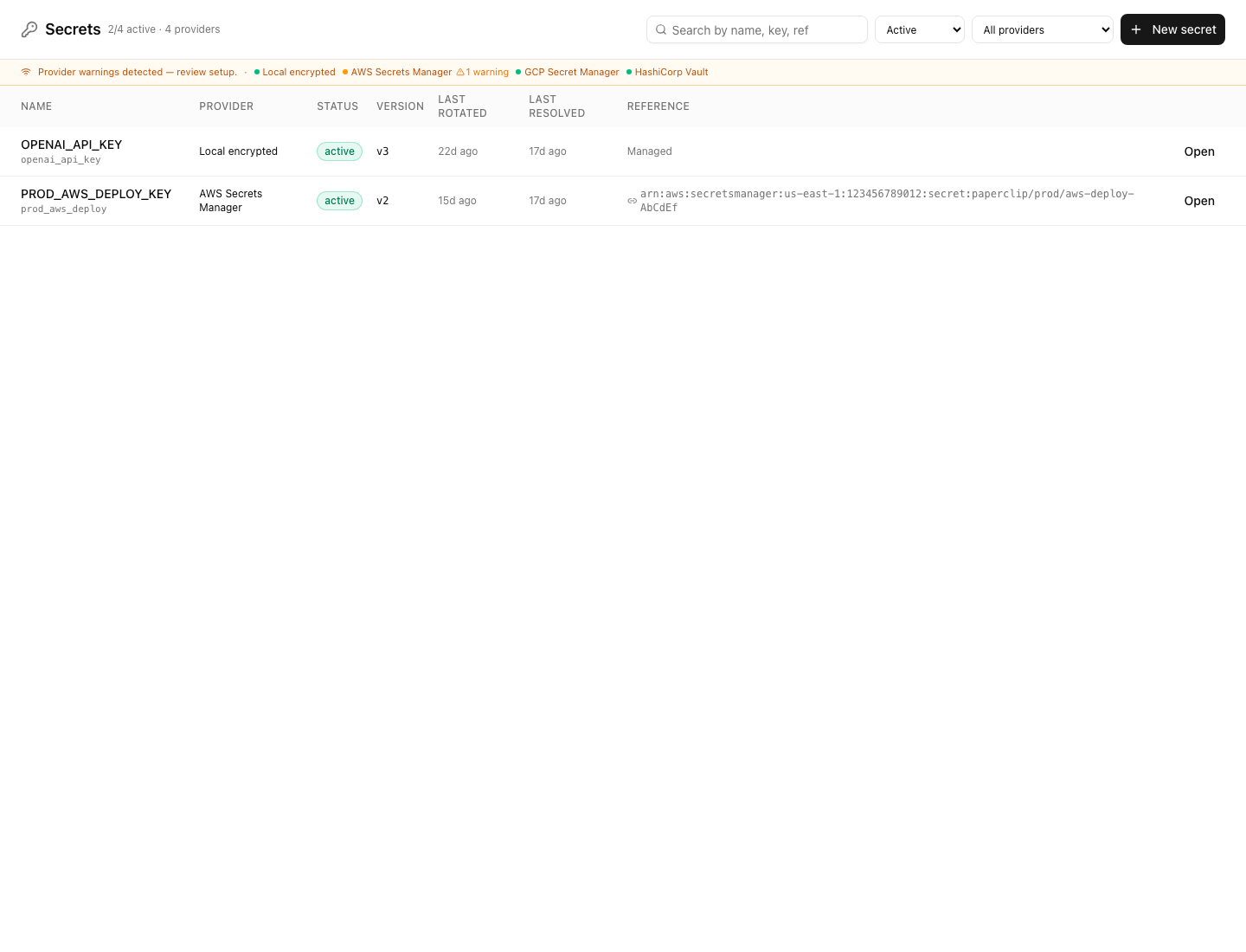
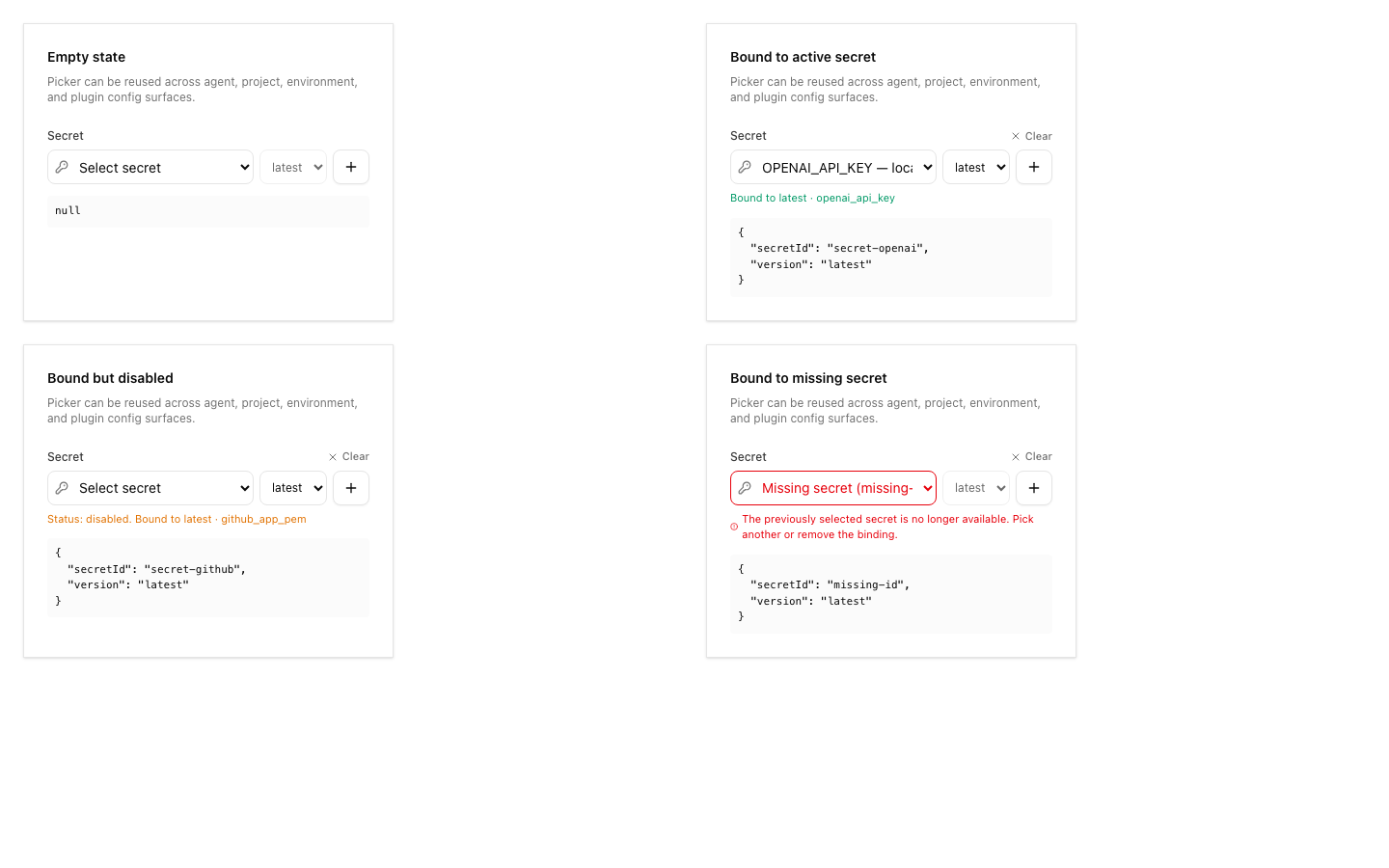
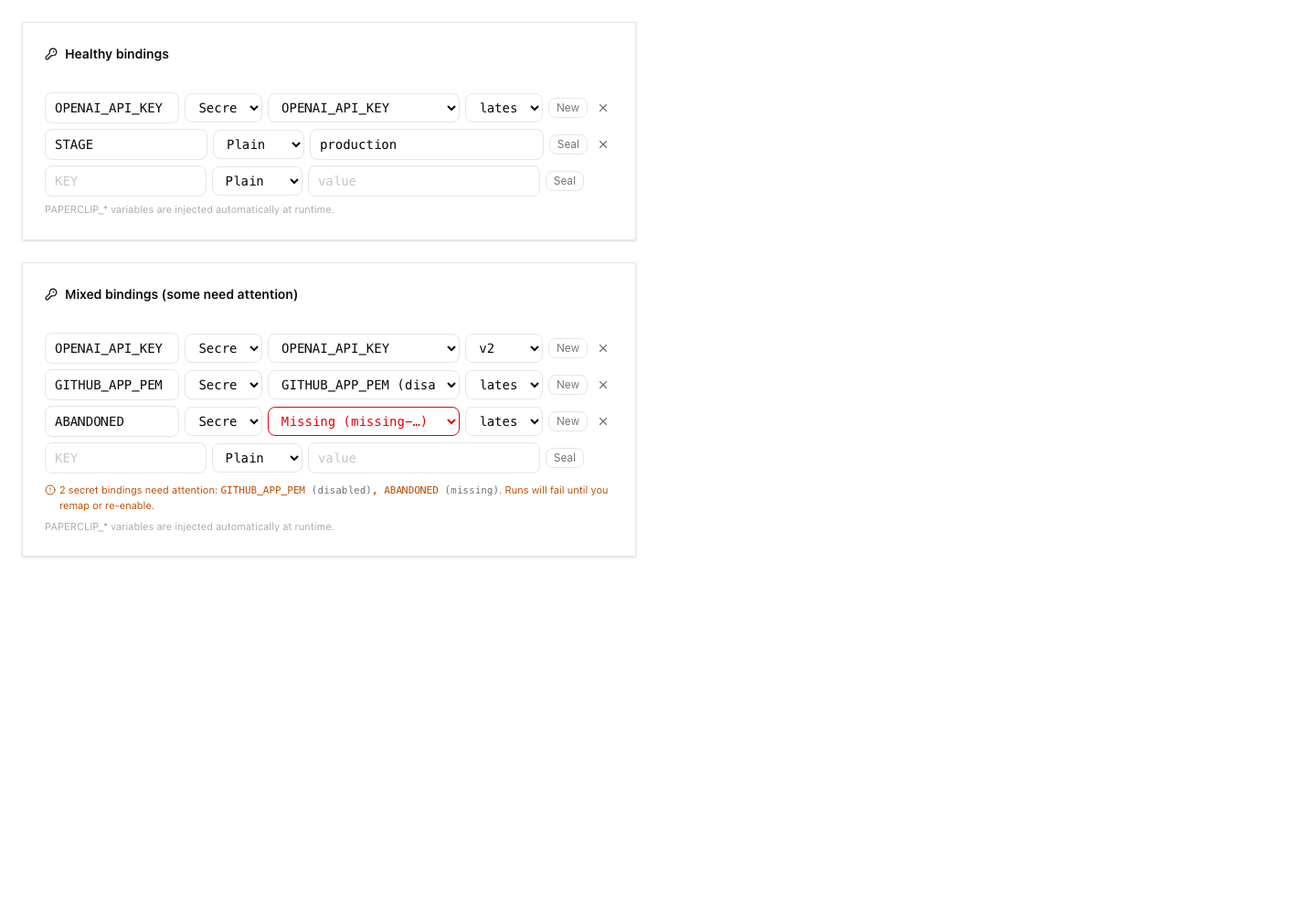
## Risks
- Migration risk: this adds new secret provider tables and extends
existing secret rows. The migrations were checked for monotonic ordering
and idempotent guards, but reviewers should still inspect upgrade
behavior carefully.
- Provider risk: AWS support uses direct SigV4 requests. Automated tests
cover signing, request timeouts, vault-config selection, namespace
guardrails, pending-version archival, sanitized provider errors, and
service-level cleanup paths. A real-vault AWS smoke test remains
deployment validation for an operator with AWS credentials rather than
an unverified merge blocker in this local branch.
- UI risk: the Secrets page and import dialog are large new surfaces;
screenshots are included above for reviewer inspection.
- Verification risk: the full local stable test command hit
parallel-load timing failures, although the exact failed files passed
when rerun directly.
- Operational risk: remote import intentionally avoids plaintext reads;
operators must understand that imported external references resolve at
runtime and may fail if AWS permissions change.
> For core feature work, check [`ROADMAP.md`](ROADMAP.md) first and
discuss it in `#dev` before opening the PR. Feature PRs that overlap
with planned core work may need to be redirected — check the roadmap
first. See `CONTRIBUTING.md`.
## Model Used
- OpenAI Codex, GPT-5 coding agent with local shell/tool use in the
Paperclip worktree. Exact context-window size was not exposed by the
runtime.
## Checklist
- [x] I have included a thinking path that traces from project context
to this change
- [x] I have specified the model used (with version and capability
details)
- [x] I have checked ROADMAP.md and confirmed this PR does not duplicate
planned core work
- [ ] I have run tests locally and they pass
- [x] I have added or updated tests where applicable
- [x] If this change affects the UI, I have included before/after
screenshots
- [x] I have updated relevant documentation to reflect my changes
- [x] I have considered and documented any risks above
- [x] I will address all Greptile and reviewer comments before
requesting merge
---------
Co-authored-by: Paperclip <noreply@paperclip.ing>
Co-authored-by: Claude Sonnet 4.6 <noreply@anthropic.com>
## Thinking Path

> - Paperclip is the control plane for autonomous AI companies.
> - Routines are the scheduled/recurring work surface that keeps a
company operating without manual kicks.
> - Operators need routine edits to be auditable and recoverable,
especially when routines control assignments, prompts, triggers, and
webhook secrets.
> - Documents already have revision-style safety, but routines did not
have equivalent history or restore semantics.
> - This pull request adds append-only routine revisions across the
database, shared contracts, server routes, and board UI.
> - The benefit is safer routine iteration: users can inspect history,
compare changes, restore older definitions, and avoid overwriting newer
edits.

## What Changed

- Added `routine_revisions` storage, latest revision pointers on
routines, shared types, validators, and API docs for routine revision
history.
- Added server service/route support for listing routine revisions,
conflict-aware routine saves, and append-only restore operations.
- Added a History tab on routine detail with revision preview,
structured change summaries, description line diffs, dirty-edit
blocking, restore confirmation, and restored webhook secret surfacing.
- Extracted the line diff helper from `DocumentDiffModal` into
`ui/src/lib/line-diff.ts` for reuse.
- Rebased the branch onto current `public-gh/master` and renumbered the
routine revision migration to `0077_unusual_karnak` after upstream
`0076_useful_elektra`.
- Made the `0077` routine revision migration idempotent so installs that
already applied the branch-local `0076_unusual_karnak` can safely
advance.
- Updated the plugin SDK test harness routine fixture with the new
revision fields required by the shared `Routine` contract.

## Verification

- `pnpm --filter @paperclipai/db run check:migrations` passed.
- `pnpm exec vitest run --project @paperclipai/shared
packages/shared/src/validators/routine.test.ts` passed.
- `pnpm exec vitest run --project @paperclipai/ui
ui/src/lib/line-diff.test.ts
ui/src/components/RoutineHistoryTab.test.tsx
ui/src/lib/workspace-routines.test.ts ui/src/pages/Routines.test.tsx`
passed.
- `pnpm exec vitest run --project @paperclipai/server
server/src/__tests__/routines-service.test.ts --pool=forks
--poolOptions.forks.isolate=true` passed.
- `pnpm exec vitest run --project @paperclipai/server
server/src/__tests__/routines-routes.test.ts --pool=forks
--poolOptions.forks.isolate=true` passed.
- `pnpm --filter @paperclipai/plugin-sdk typecheck` passed after
updating the SDK test harness fixture.
- `pnpm --filter @paperclipai/plugin-sdk build` passed; this refreshed
local generated SDK output needed by plugin example typechecks.
- `pnpm -r typecheck` passed.

## Risks

- Medium migration risk: this adds routine revision storage and
backfills existing routines. The migration is ordered after upstream
`0076` and uses `IF NOT EXISTS` / duplicate-object guards to tolerate
earlier branch-local migration application.
- Restore behavior intentionally appends a new revision instead of
mutating history; callers expecting an in-place rollback need to follow
the new latest revision pointer.
- Restoring webhook triggers recreates webhook secret material, so users
must copy newly surfaced secrets after restore.
- Conflict-aware saves now reject stale routine edits when the client
sends an older `baseRevisionId`.

> For core feature work, check [`ROADMAP.md`](ROADMAP.md) first and
discuss it in `#dev` before opening the PR. Feature PRs that overlap
with planned core work may need to be redirected — check the roadmap
first. See `CONTRIBUTING.md`.

## Model Used

- OpenAI Codex, GPT-5-based coding agent, with shell/tool use in a local
git worktree. Exact context-window size is not exposed in this runtime.

## Checklist

- [x] I have included a thinking path that traces from project context
to this change
- [x] I have specified the model used (with version and capability
details)
- [x] I have checked ROADMAP.md and confirmed this PR does not duplicate
planned core work
- [x] I have run tests locally and they pass
- [x] I have added or updated tests where applicable
- [x] If this change affects the UI, I have included before/after
screenshots
- [x] I have updated relevant documentation to reflect my changes
- [x] I have considered and documented any risks above
- [x] I will address all Greptile and reviewer comments before
requesting merge

Screenshots: not attached in this draft PR; the new UI flow is covered
by component tests listed above.

---------

Co-authored-by: Paperclip <noreply@paperclip.ing>
## Thinking Path

> - Paperclip orchestrates AI agents for zero-human companies
> - The plugin system is the extension boundary for optional product
capabilities
> - Rich plugins need more than a worker entrypoint: they need scoped
database storage, local project folders, managed agents/routines, host
navigation, and reusable UI components
> - The LLM Wiki work exposed those missing host surfaces while keeping
plugin code outside the core control plane
> - This pull request expands the core plugin host, SDK, server APIs,
and UI bridge so plugins can declare and use those surfaces
> - The benefit is that future plugins can integrate with Paperclip
through documented, validated contracts instead of bespoke server or UI
imports

## What Changed

- Added plugin-managed database namespaces and migration tracking,
including Drizzle schema/migration files and SQL validation for
namespace isolation.
- Added server support for plugin local folders, managed agents, managed
routines, scoped plugin APIs, and plugin operation visibility.
- Expanded shared plugin manifest/types/validators and SDK
host/testing/UI exports for richer plugin surfaces.
- Added reusable UI pieces for file trees, managed routines, resizable
sidebars, route sidebars, and plugin bridge initialization.
- Updated plugin docs and example plugins to use the expanded host and
SDK surface.

## Verification

- `pnpm install --frozen-lockfile`
- `pnpm run preflight:workspace-links && pnpm exec vitest run
packages/shared/src/validators/plugin.test.ts
server/src/__tests__/plugin-database.test.ts
server/src/__tests__/plugin-local-folders.test.ts
server/src/__tests__/plugin-managed-agents.test.ts
server/src/__tests__/plugin-managed-routines.test.ts
server/src/__tests__/plugin-orchestration-apis.test.ts
ui/src/api/plugins.test.ts ui/src/components/FileTree.test.tsx
ui/src/components/ResizableSidebarPane.test.tsx
ui/src/pages/PluginPage.test.tsx ui/src/plugins/bridge.test.ts` passed:
11 files, 67 tests.
- Confirmed this PR changes 89 files and does not include
`pnpm-lock.yaml` or `.github/workflows/*`.

## Risks

- Medium: this expands plugin host contracts across db/shared/server/ui
and includes a new core migration (`0076_useful_elektra.sql`).
- The plugin database namespace validator is intentionally restrictive;
plugin authors may need follow-up affordances for SQL patterns that
remain blocked.
- Merge this before the LLM Wiki plugin PR so the plugin can resolve the
new SDK and host APIs.

> For core feature work, check [`ROADMAP.md`](ROADMAP.md) first and
discuss it in `#dev` before opening the PR. Feature PRs that overlap
with planned core work may need to be redirected — check the roadmap
first. See `CONTRIBUTING.md`.

## Model Used

- OpenAI Codex, GPT-5 coding agent, tool-enabled shell/git/GitHub
workflow. Context window size was not exposed by the runtime.

## Checklist

- [x] I have included a thinking path that traces from project context
to this change
- [x] I have specified the model used (with version and capability
details)
- [x] I have checked ROADMAP.md and confirmed this PR does not duplicate
planned core work
- [x] I have run tests locally and they pass
- [x] I have added or updated tests where applicable
- [x] If this change affects the UI, I have included before/after
screenshots
- [x] I have updated relevant documentation to reflect my changes
- [x] I have considered and documented any risks above
- [x] I will address all Greptile and reviewer comments before
requesting merge

---------

Co-authored-by: Paperclip <noreply@paperclip.ing>
## Thinking Path

> - Paperclip orchestrates AI agents through reusable execution
workspaces and routines
> - Operators need a fast way to run workspace-aware routines against a
specific execution workspace
> - The existing workspace detail surface showed configuration, runtime
logs, and linked issues, but not routines that depend on workspace
variables
> - Routine runs also needed to prefill the selected execution workspace
so branch variables resolve correctly
> - This pull request adds a workspace routines tab and prefilled
routine-run dialog support
> - The benefit is a tighter workflow for rerunning reviews, smoke
checks, and other workspace-specific routines

## What Changed

- Added an execution workspace `Routines` tab and company-prefixed
routes.
- Listed routines that declare or reference workspace-specific
variables.
- Added `Run now` support that preselects the current execution
workspace in `RoutineRunVariablesDialog`.
- Centralized reusable execution workspace ordering/deduplication for
issue creation and workspace cards.
- Added focused UI helper and dialog regression tests.

## Verification

- `pnpm exec vitest run ui/src/lib/reusable-execution-workspaces.test.ts
ui/src/lib/workspace-routines.test.ts
ui/src/components/RoutineRunVariablesDialog.test.tsx
ui/src/lib/company-routes.test.ts`
- Screenshots were not captured in this PR split; the visible flow is
covered by focused component/helper tests and should get browser QA in
the follow-up issue.

## Risks

- Medium risk: this adds a new workspace detail tab and routine-run
path. It is isolated to workspace-scoped routines and uses existing
routine run APIs.

> For core feature work, check [`ROADMAP.md`](ROADMAP.md) first and
discuss it in `#dev` before opening the PR. Feature PRs that overlap
with planned core work may need to be redirected — check the roadmap
first. See `CONTRIBUTING.md`.

## Model Used

- OpenAI Codex, GPT-5 coding agent, tool use and local command
execution. Exact context window was not exposed in the runtime.

## Checklist

- [x] I have included a thinking path that traces from project context
to this change
- [x] I have specified the model used (with version and capability
details)
- [x] I have checked ROADMAP.md and confirmed this PR does not duplicate
planned core work
- [x] I have run tests locally and they pass
- [x] I have added or updated tests where applicable
- [ ] If this change affects the UI, I have included before/after
screenshots
- [x] I have updated relevant documentation to reflect my changes
- [x] I have considered and documented any risks above
- [x] I will address all Greptile and reviewer comments before
requesting merge

---------

Co-authored-by: Paperclip <noreply@paperclip.ing>
## Thinking Path

> - Paperclip coordinates recurring agent work through scheduled and
manual routines.
> - Manual routine runs are board-initiated work and should stay visible
to the human who kicked them off.
> - Routine execution issues are agent-assigned, so they can be filtered
away from a board user's inbox unless the user is recorded as touching
the work.
> - Coalesced or skipped active routine runs have the same visibility
problem because they reuse an existing live issue.
> - This pull request carries the manual runner actor into routine
dispatch and touches the linked issue for that user's inbox.
> - The benefit is that manually triggered routine work stays
discoverable by the operator who started it.

## What Changed

- Passed the board or agent actor from the routine run route into the
routine service.
- Recorded manual board runners as `createdByUserId` on fresh routine
execution issues.
- Touched coalesced or skipped active routine issues for the manual
runner by updating read state and clearing that user's inbox archive.
- Added route and service regressions for manual routine run actor
propagation and inbox visibility.

## Verification

- `pnpm exec vitest run server/src/__tests__/routines-routes.test.ts
server/src/__tests__/routines-service.test.ts`

## Risks

- Low risk: the change is scoped to manual routine runs and only updates
issue attribution/read-state metadata for the initiating actor.
- No migrations.

> For core feature work, check [`ROADMAP.md`](ROADMAP.md) first and
discuss it in `#dev` before opening the PR. Feature PRs that overlap
with planned core work may need to be redirected — check the roadmap
first. See `CONTRIBUTING.md`.

## Model Used

- OpenAI Codex coding agent based on GPT-5, tool-enabled local
repository and shell access, Paperclip heartbeat context.

## Checklist

- [x] I have included a thinking path that traces from project context
to this change
- [x] I have specified the model used (with version and capability
details)
- [x] I have checked ROADMAP.md and confirmed this PR does not duplicate
planned core work
- [x] I have run tests locally and they pass
- [x] I have added or updated tests where applicable
- [x] If this change affects the UI, I have included before/after
screenshots
- [x] I have updated relevant documentation to reflect my changes
- [x] I have considered and documented any risks above
- [x] I will address all Greptile and reviewer comments before
requesting merge

---------

Co-authored-by: Paperclip <noreply@paperclip.ing>
## Thinking Path

> - Paperclip orchestrates AI agents for zero-human companies.
> - The environment/runtime layer decides where agent work executes and
how the control plane reaches those runtimes.
> - Today Paperclip can run locally and over SSH, but sandboxed
execution needs a first-class environment model instead of one-off
adapter behavior.
> - We also want sandbox providers to be pluggable so the core does not
hardcode every provider implementation.
> - This branch adds the Sandbox environment path, the provider
contract, and a deterministic fake provider plugin.
> - That required synchronized changes across shared contracts, plugin
SDK surfaces, server runtime orchestration, and the UI
environment/workspace flows.
> - The result is that sandbox execution becomes a core control-plane
capability while keeping provider implementations extensible and
testable.

## What Changed

- Added sandbox runtime support to the environment execution path,
including runtime URL discovery, sandbox execution targeting,
orchestration, and heartbeat integration.
- Added plugin-provider support for sandbox environments so providers
can be supplied via plugins instead of hardcoded server logic.
- Added the fake sandbox provider plugin with deterministic behavior
suitable for local and automated testing.
- Updated shared types, validators, plugin protocol definitions, and SDK
helpers to carry sandbox provider and workspace-runtime contracts across
package boundaries.
- Updated server routes and services so companies can create sandbox
environments, select them for work, and execute work through the sandbox
runtime path.
- Updated the UI environment and workspace surfaces to expose sandbox
environment configuration and selection.
- Added test coverage for sandbox runtime behavior, provider seams,
environment route guards, orchestration, and the fake provider plugin.

## Verification

- Ran locally before the final fixture-only scrub:
  - `pnpm -r typecheck`
  - `pnpm test:run`
  - `pnpm build`
- Ran locally after the final scrub amend:
  - `pnpm vitest run server/src/__tests__/runtime-api.test.ts`
- Reviewer spot checks:
  - create a sandbox environment backed by the fake provider plugin
  - run work through that environment
- confirm sandbox provider execution does not inherit host secrets
implicitly

## Risks

- This touches shared contracts, plugin SDK plumbing, server runtime
orchestration, and UI environment/workspace flows, so regressions would
likely show up as cross-layer mismatches rather than isolated type
errors.
- Runtime URL discovery and sandbox callback selection are sensitive to
host/bind configuration; if that logic is wrong, sandbox-backed
callbacks may fail even when execution succeeds.
- The fake provider plugin is intentionally deterministic and
test-oriented; future providers may expose capability gaps that this
branch does not yet cover.

## Model Used

- OpenAI Codex coding agent on a GPT-5-class backend in the
Paperclip/Codex harness. Exact backend model ID is not exposed
in-session. Tool-assisted workflow with shell execution, file editing,
git history inspection, and local test execution.

## Checklist

- [x] I have included a thinking path that traces from project context
to this change
- [x] I have specified the model used (with version and capability
details)
- [x] I have checked ROADMAP.md and confirmed this PR does not duplicate
planned core work
- [x] I have run tests locally and they pass
- [x] I have added or updated tests where applicable
- [ ] If this change affects the UI, I have included before/after
screenshots
- [x] I have updated relevant documentation to reflect my changes
- [x] I have considered and documented any risks above
- [x] I will address all Greptile and reviewer comments before
requesting merge
## Thinking Path

> - Paperclip orchestrates AI agents through issue checkout, heartbeat
runs, routines, and auditable control-plane state
> - The runtime path has to recover from lost local processes, transient
adapter failures, blocked dependencies, and routine coalescing without
stranding work
> - The existing branch carried several reliability fixes across
heartbeat scheduling, issue runtime controls, routine dispatch, and
operator-facing run state
> - These changes belong together because they share backend contracts,
migrations, and runtime status semantics
> - This pull request groups the control-plane/runtime slice so it can
merge independently from board UI polish and adapter sandbox work
> - The benefit is safer heartbeat recovery, clearer runtime controls,
and more predictable recurring execution behavior

## What Changed

- Adds bounded heartbeat retry scheduling, scheduled retry state, and
Codex transient failure recovery handling.
- Tightens heartbeat process recovery, blocker wake behavior, issue
comment wake handling, routine dispatch coalescing, and
activity/dashboard bounds.
- Adds runtime-control MCP tools and Paperclip skill docs for issue
workspace runtime management.
- Adds migrations `0061_lively_thor_girl.sql` and
`0062_routine_run_dispatch_fingerprint.sql`.
- Surfaces retry state in run ledger/agent UI and keeps related shared
types synchronized.

## Verification

- `pnpm exec vitest run
server/src/__tests__/heartbeat-retry-scheduling.test.ts
server/src/__tests__/heartbeat-process-recovery.test.ts
server/src/__tests__/routines-service.test.ts`
- `pnpm exec vitest run src/tools.test.ts` from `packages/mcp-server`

## Risks

- Medium risk: this touches heartbeat recovery and routine dispatch,
which are central execution paths.
- Migration order matters if split branches land out of order: merge
this PR before branches that assume the new runtime/routine fields.
- Runtime retry behavior should be watched in CI and in local operator
smoke tests because it changes how transient failures are resumed.

> For core feature work, check [`ROADMAP.md`](ROADMAP.md) first and
discuss it in `#dev` before opening the PR. Feature PRs that overlap
with planned core work may need to be redirected — check the roadmap
first. See `CONTRIBUTING.md`.

## Model Used

- OpenAI Codex, GPT-5-based coding agent runtime, shell/git tool use
enabled. Exact hosted model build and context window are not exposed in
this Paperclip heartbeat environment.

## Checklist

- [x] I have included a thinking path that traces from project context
to this change
- [x] I have specified the model used (with version and capability
details)
- [x] I have checked ROADMAP.md and confirmed this PR does not duplicate
planned core work
- [x] I have run tests locally and they pass
- [x] I have added or updated tests where applicable
- [ ] If this change affects the UI, I have included before/after
screenshots
- [x] I have updated relevant documentation to reflect my changes
- [x] I have considered and documented any risks above
- [x] I will address all Greptile and reviewer comments before
requesting merge
## Thinking Path

> - Paperclip orchestrates AI agents inside execution and project
workspaces
> - Workspace runtime services can be controlled manually by operators
and reused by agent runs
> - Manual start/stop state was not preserved consistently across
workspace policies and routine launches
> - Routine launches also needed branch/workspace variables to default
from the selected workspace context
> - This pull request makes runtime policy state explicit, preserves
manual control, and auto-fills routine branch variables from workspace
data
> - The benefit is less surprising workspace service behavior and fewer
manual inputs when running workspace-scoped routines

## What Changed

- Added runtime-state handling for manual workspace control across
execution and project workspace validators, routes, and services.
- Updated heartbeat/runtime startup behavior so manually stopped
services are respected.
- Auto-filled routine workspace branch variables from available
workspace context.
- Added focused server and UI tests for workspace runtime and routine
variable behavior.
- Removed muted gray background styling from workspace pages and cards
for a cleaner workspace UI.

## Verification

- `pnpm install --frozen-lockfile --ignore-scripts`
- `pnpm exec vitest run server/src/__tests__/routines-service.test.ts
server/src/__tests__/workspace-runtime.test.ts
ui/src/components/RoutineRunVariablesDialog.test.tsx`
- Result: 55 tests passed, 21 skipped. The embedded Postgres routines
tests skipped on this host with the existing PGlite/Postgres init
warning; workspace-runtime and UI tests passed.

## Risks

- Medium risk: this touches runtime service start/stop policy and
heartbeat launch behavior.
- The focused tests cover manual runtime state, routine variables, and
workspace runtime reuse paths.

> For core feature work, check [`ROADMAP.md`](ROADMAP.md) first and
discuss it in `#dev` before opening the PR. Feature PRs that overlap
with planned core work may need to be redirected — check the roadmap
first. See `CONTRIBUTING.md`.

## Model Used

- OpenAI Codex coding agent based on GPT-5, tool-enabled local shell and
GitHub workflow, exact runtime context window not exposed in this
session.

## Checklist

- [x] I have included a thinking path that traces from project context
to this change
- [x] I have specified the model used (with version and capability
details)
- [x] I have checked ROADMAP.md and confirmed this PR does not duplicate
planned core work
- [x] I have run tests locally and they pass
- [x] I have added or updated tests where applicable
- [x] If this change affects the UI, I have included before/after
screenshots, or documented why targeted component/service verification
is sufficient here
- [x] I have updated relevant documentation to reflect my changes
- [x] I have considered and documented any risks above
- [x] I will address all Greptile and reviewer comments before
requesting merge

---------

Co-authored-by: Paperclip <noreply@paperclip.ing>
## Thinking Path

> - Paperclip orchestrates AI agents for zero-human companies
> - Routines are recurring tasks that trigger agents on a schedule or
via webhook
> - Routine triggers store their schedule as a `cronExpression` +
`timezone` in the database
> - The `GET /companies/:companyId/routines` list endpoint is the
primary way API consumers (and the UI) discover all routines and their
triggers
> - But the list endpoint was silently dropping `cronExpression` and
`timezone` from each trigger object — the DB query fetched them, but the
explicit object-construction mapping only forwarded seven other fields
> - This PR fixes the mapping to include `cronExpression` and
`timezone`, and extends the `RoutineListItem.triggers` type to match
> - The benefit is that API consumers can now see the actual schedule
from the list endpoint, and future UI components reading from the list
cache will get accurate schedule data

## What Changed

- **`server/src/services/routines.ts`** — Added `cronExpression` and
`timezone` to the explicit trigger object mapping inside
`routinesService.list()`. The DB query (`listTriggersForRoutineIds`)
already fetched all columns via `SELECT *`; the values were being
discarded during object construction.
- **`packages/shared/src/types/routine.ts`** — Extended
`RoutineListItem.triggers` `Pick<RoutineTrigger, ...>` to include
`cronExpression` and `timezone` so the TypeScript type contract matches
the actual runtime shape.
- **`server/src/__tests__/routines-e2e.test.ts`** — Added assertions to
the existing schedule-trigger E2E test that verify both `cronExpression`
and `timezone` are present in the `GET /companies/:companyId/routines`
list response.

## Verification

```bash
# Run the route + service unit tests
npx vitest run server/src/__tests__/routines-routes.test.ts server/src/__tests__/routines-service.test.ts
# → 21 tests pass

# Confirm cronExpression appears in list response
curl /api/companies/{id}/routines | jq '.[].triggers[].cronExpression'
# → now returns the actual cron string instead of undefined
```

Manual reproduction per the issue:
1. Create a routine with a schedule trigger (`cronExpression: "47 14 * *
*"`, `timezone: "America/Mexico_City"`)
2. `GET /api/companies/{id}/routines` — trigger object now includes
`cronExpression` and `timezone`

## Risks

Low risk. The change only adds two fields to an existing response shape
— no fields removed, no behavior changed. The `cronExpression` is `null`
for non-schedule trigger kinds (webhook, etc.), consistent with
`RoutineTrigger.cronExpression: string | null`. No migration required.

## Model Used

- **Provider:** Anthropic
- **Model:** Claude Sonnet 4.6 (`claude-sonnet-4-6`)
- **Context window:** 200k tokens
- **Mode:** Extended thinking + tool use (agentic)
- Secondary adversarial review: OpenAI Codex (via codex-companion
plugin)

## Checklist

- [x] I have included a thinking path that traces from project context
to this change
- [x] I have specified the model used (with version and capability
details)
- [x] I have run tests locally and they pass
- [x] I have added or updated tests where applicable
- [ ] If this change affects the UI, I have included before/after
screenshots (API-only fix; no UI rendering change)
- [ ] I have updated relevant documentation to reflect my changes (no
doc changes needed)
- [x] I have considered and documented any risks above
- [x] I will address all Greptile and reviewer comments before
requesting merge
Compare Buffer byte lengths instead of string character lengths before
timingSafeEqual to avoid potential mismatch with multi-byte input.
Add comment explaining the hubSignatureHeader ?? signatureHeader fallback.

Co-Authored-By: Claude Opus 4.6 (1M context) <noreply@anthropic.com>
Adds two new webhook trigger signing modes for external provider
compatibility:
- github_hmac: accepts X-Hub-Signature-256 header with
HMAC-SHA256(secret, rawBody), no timestamp prefix. Compatible with
GitHub, Sentry, and services following the same standard.
- none: no authentication; the 24-char hex publicId in the URL acts
as the shared secret. For services that cannot add auth headers.
The replay window UI field is hidden when these modes are selected
since neither uses timestamp-based replay protection.
Closes#1892
Co-Authored-By: Claude Opus 4.6 (1M context) <noreply@anthropic.com>
Share issue-assignment wakeup logic between direct issue creation and routine-created execution issues, and add regression coverage for the routine path.

Co-Authored-By: Paperclip <noreply@paperclip.ing>
The server rejected manual runs for any non-active routine. Now only
archived routines are blocked — paused routines can still be triggered
manually via "Run now".

Co-Authored-By: Paperclip <noreply@paperclip.ing>
- Add trash icon button to delete triggers (full stack: service, route, API client, UI)
- Fix pause/unpause bug where saving routine could revert status by excluding
  status from the save payload (status is managed via dedicated pause/resume buttons)
- Add toast feedback for run, pause, and resume actions
- Auto-switch to Runs tab after triggering a manual run
- Add live update invalidation for routine/trigger/run activity events

Co-Authored-By: Paperclip <noreply@paperclip.ing>
Align the routines list and detail editors with the issue-composer interaction model, and fix the scheduler's typed date comparison.

Co-Authored-By: Paperclip <noreply@paperclip.ing>



