mirror of
https://github.com/alkimake/paperclip.git
synced 2026-06-14 01:50:39 +09:00
13 commits
| Author | SHA1 | Message | Date | |
|---|---|---|---|---|
 Dotta
Dotta
|
778e775c35
|
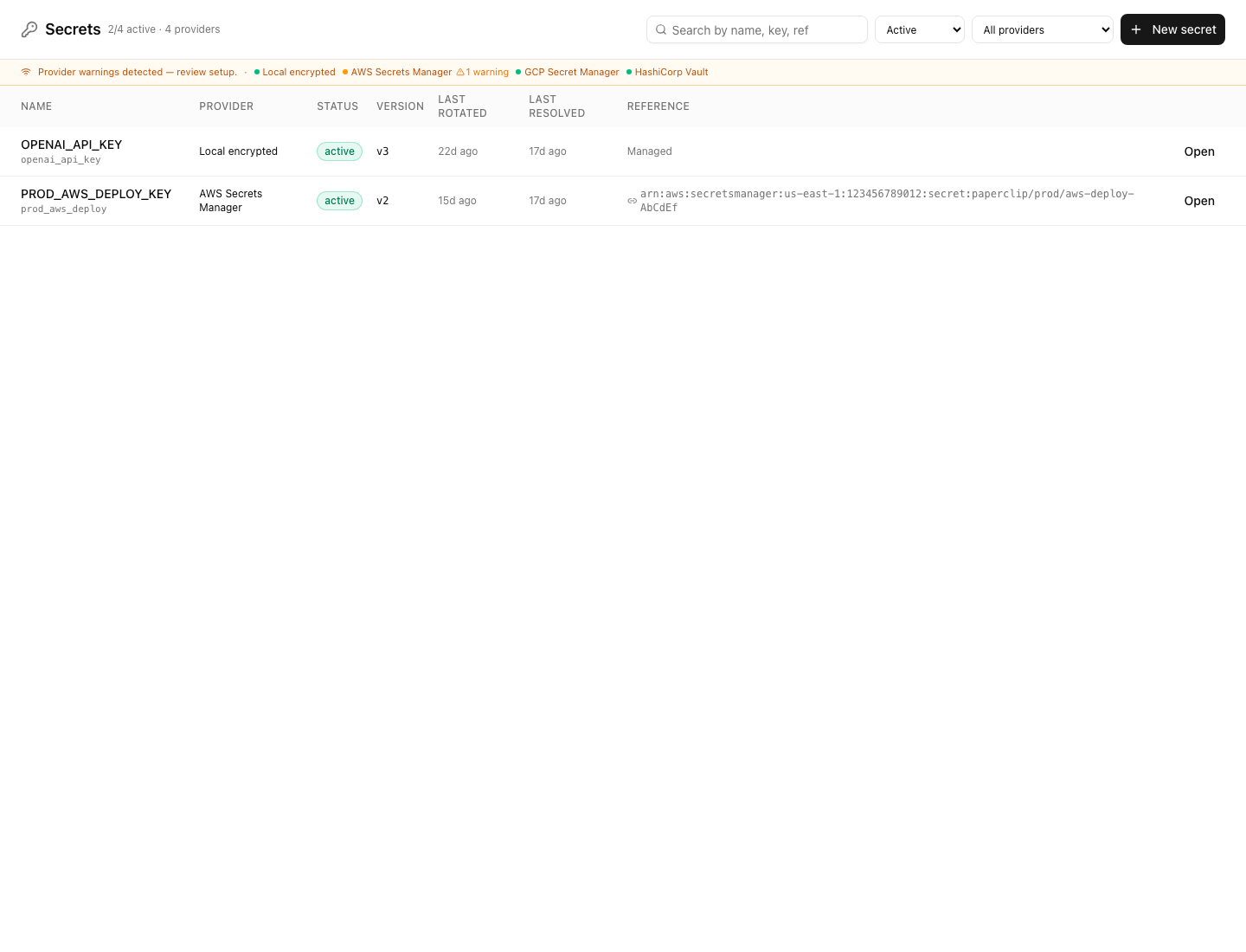
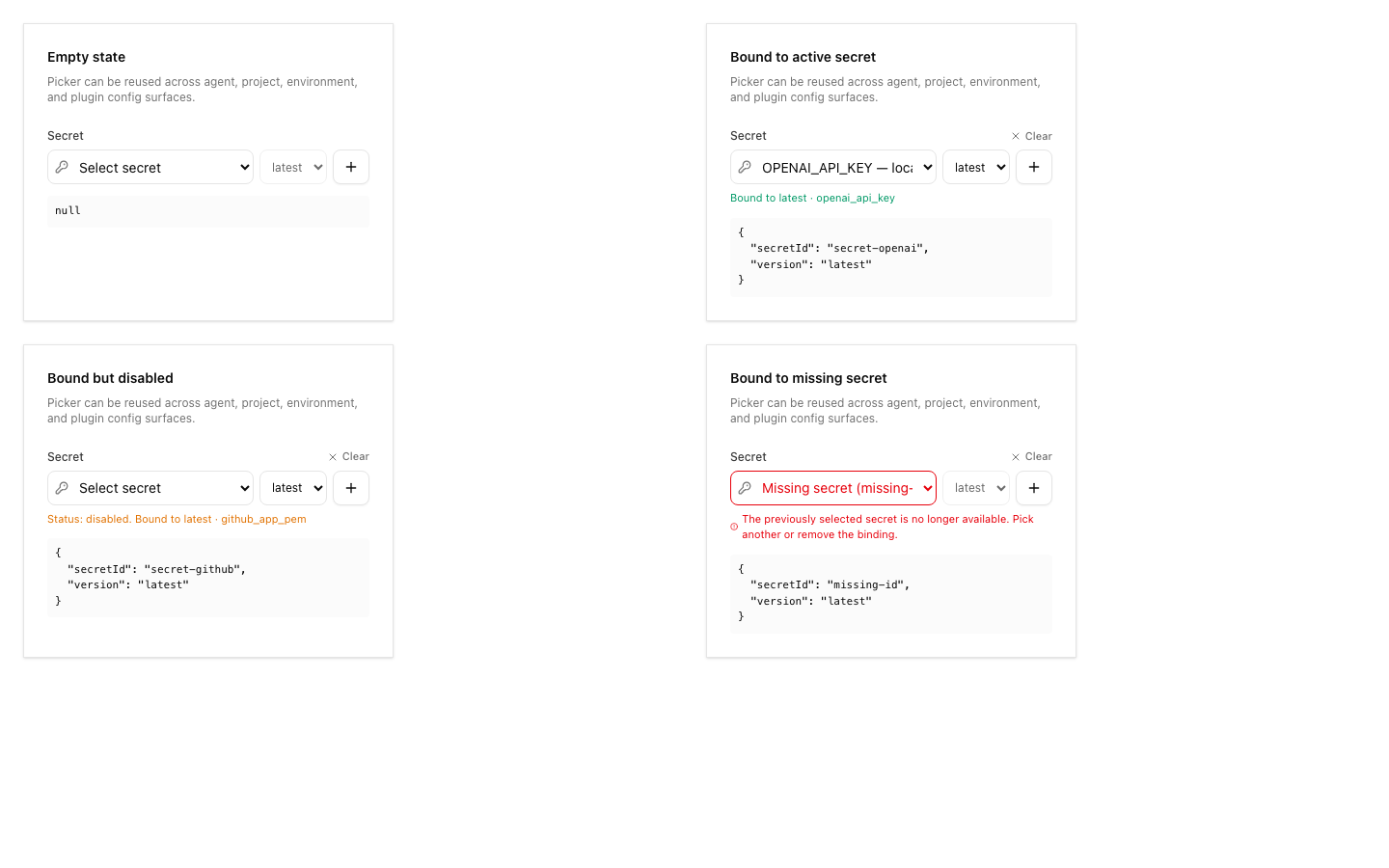
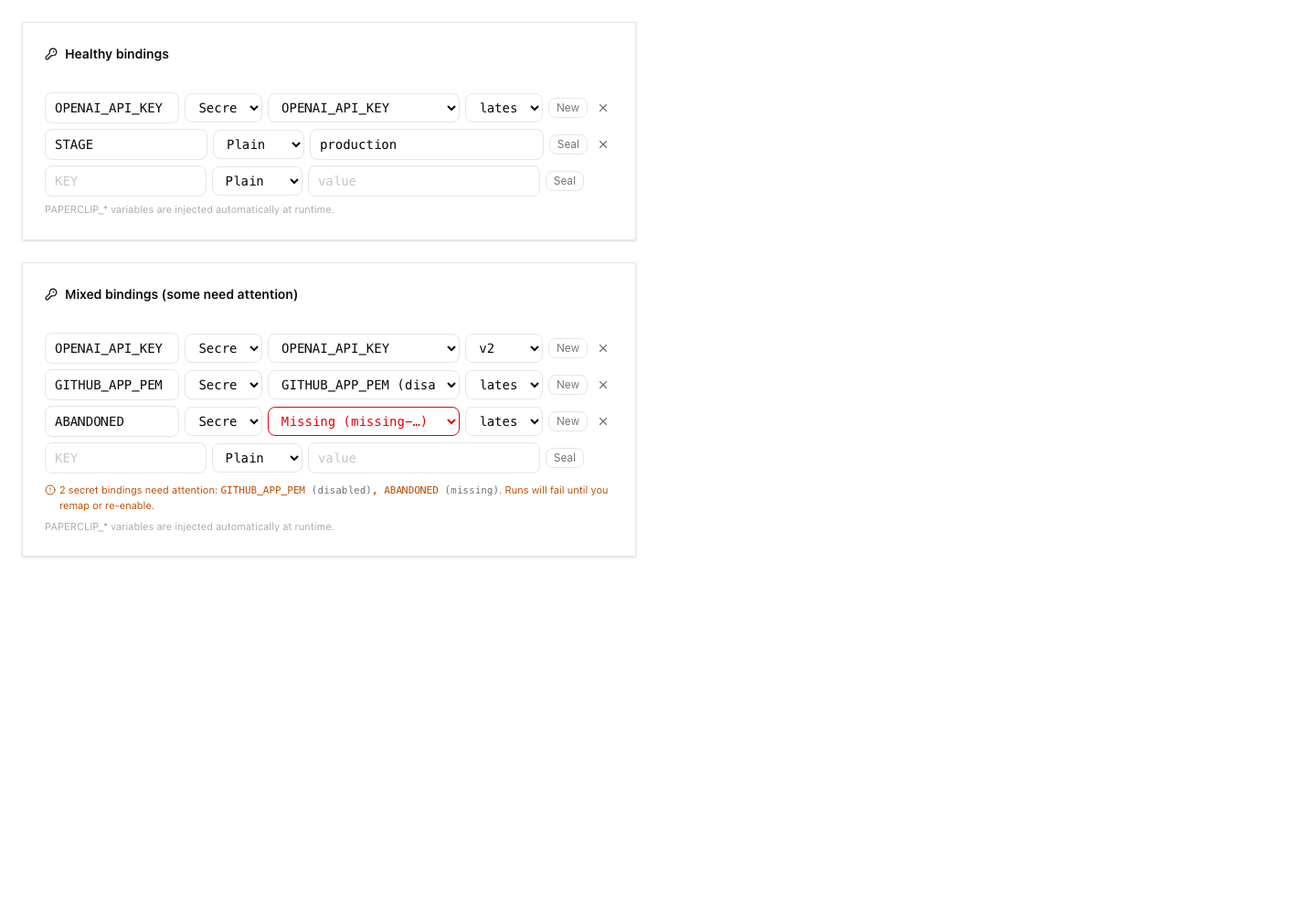
Add secrets provider vaults and remote import (#5429)
## Thinking Path
> - Paperclip orchestrates AI-agent companies and needs secrets handling
to work across local development, hosted operators, and governed agent
execution.
> - The affected subsystem is the company-scoped secrets control plane:
database schema, server services/routes, CLI workflows, and the Secrets
settings UI.
> - The gap was that secrets were local-only and operators could not
manage provider vaults or import existing remote references without
exposing plaintext.
> - This branch adds provider vault configuration plus an AWS Secrets
Manager remote-import path while preserving company boundaries, binding
context, and audit trails.
> - I kept the PR to a single branch PR, removed unrelated
lockfile/package drift, rebased the full branch onto the current
`public-gh/master`, and addressed fresh Greptile findings.
> - The benefit is a reviewable implementation of provider-backed
secrets with focused tests covering provider selection, import
conflicts, deleted secret reuse, rotation guards, and AWS signing
behavior.
## What Changed
- Added provider vault support for company secrets, including provider
config storage, default vault handling, health checks, binding usage,
access events, and remote import preview/commit.
- Added an AWS Secrets Manager provider using SigV4 request signing,
bounded request timeouts, namespace guardrails, cached runtime
credential resolution, and external-reference linking without plaintext
reads.
- Added Secrets UI surfaces for vault management and remote import, plus
CLI/API documentation for setup and operations.
- Stabilized routine webhook secret binding paths and SSH
environment-driver fixture bindings discovered during verification.
- Addressed Greptile and CI findings: no lockfile/package drift,
monotonic migration metadata, disabled-vault default races, soft-deleted
secret hiding/recreate behavior, remove behavior with disabled vaults,
soft-deleted external-reference re-import, non-active rotation guards,
managed-secret soft deletion through PATCH, and per-call AWS SDK
credential client churn.
- Rebased this branch onto `public-gh/master` at `
|
||
|
Devin Foley
|
12cb7b40fd
|
Harden remote workspace sync and restore flows (#5444)
## Thinking Path

> - Paperclip orchestrates AI agents for zero-human companies
> - When an agent runs against a remote target, Paperclip syncs the
workspace out to the remote at run start and restores changes back to
the local workspace at run end
> - The previous restore flow naïvely overwrote local files with
whatever the remote returned, so files that the remote run never touched
but had timestamp/mode drift could be needlessly rewritten — and a
single static `refs/paperclip/ssh-sync/imported` ref made concurrent SSH
workspace exports race on the same git ref
> - This pull request adds a `workspace-restore-merge` module that diffs
a pre-run snapshot against the post-run remote state and only writes
back files the remote actually changed; SSH workspace exports now use a
per-import unique ref so concurrent runs can't trample each other
> - Every adapter's execute path threads the snapshot through
`prepareAdapterExecutionTargetRuntime` so the merge has the baseline it
needs
> - The benefit is workspace restores no longer churn untouched files,
and concurrent SSH runs no longer collide on the import ref

## What Changed

- `packages/adapter-utils/src/workspace-restore-merge.{ts,test.ts}`: new
module — directory snapshot (kind/mode/sha256/symlink target) plus
snapshot-aware merge that writes only the files the remote changed
- `packages/adapter-utils/src/ssh.ts`: SSH workspace export uses a
per-import unique ref (`refs/paperclip/ssh-sync/imported/<uuid>`);
restore goes through the new merge helper; `ssh-fixture.test.ts` covers
the unique-ref + merge paths
- `packages/adapter-utils/src/sandbox-managed-runtime.ts` +
`remote-managed-runtime.ts`: thread the snapshot/merge through the
sandbox and SSH paths
- `packages/adapter-utils/src/server-utils.{ts,test.ts}` +
`execution-target.ts`: helpers for capturing the pre-run snapshot;
`prepareAdapterExecutionTargetRuntime` gains required `runId` and
optional `workspaceRemoteDir`, and returns the realized
`workspaceRemoteDir`
- Each adapter's `execute.ts` (acpx, claude, codex, cursor, gemini,
opencode, pi) takes the snapshot at run start and passes it through to
the runtime restore
- Remote execute test mocks updated to match the new
`prepareWorkspaceForSshExecution` return shape and the per-run
`${managedRemoteWorkspace}` cwd subdirectory

## Verification

- `pnpm vitest run --no-coverage --project @paperclipai/adapter-utils
--project @paperclipai/adapter-acpx-local --project
@paperclipai/adapter-claude-local --project
@paperclipai/adapter-codex-local --project
@paperclipai/adapter-cursor-local --project
@paperclipai/adapter-gemini-local --project
@paperclipai/adapter-opencode-local --project
@paperclipai/adapter-pi-local` — 196/196 passing
- `pnpm typecheck` clean across the workspace

## Risks

Medium. The restore path now writes a strict subset of what it
previously did — files the remote did not touch are no longer rewritten.
If any flow was relying on a touch-without-content-change being copied
back (timestamp or permission propagation only), that behavior is now
skipped. Snapshot capture adds an O(N-files-in-workspace) hash pass at
run start; the cost is bounded by the existing exclude list. The `runId`
parameter on `prepareAdapterExecutionTargetRuntime` is now required —
every in-tree caller is updated; out-of-tree adapter authors need to
pass it.

## Model Used

Claude Opus 4.7 (1M context)

## Checklist

- [x] I have included a thinking path that traces from project context
to this change
- [x] I have specified the model used (with version and capability
details)
- [x] I have checked ROADMAP.md and confirmed this PR does not duplicate
planned core work
- [x] I have run tests locally and they pass
- [x] I have added or updated tests where applicable — new module +
every adapter execute path covered
- [x] If this change affects the UI, I have included before/after
screenshots — N/A (no UI)
- [x] I have updated relevant documentation to reflect my changes
- [x] I have considered and documented any risks above
- [x] I will address all Greptile and reviewer comments before
requesting merge
|
||
|
Devin Foley
|
f6bad8f6bf
|
Sanitize remote execution envs at the boundary (#5325)
## Thinking Path > - Paperclip orchestrates AI agents for zero-human companies > - Adapters spawn CLIs against local, SSH, and sandbox targets, threading a runtime env through `runAdapterExecutionTargetProcess` and the SSH/sandbox runners > - Host identity vars (HOME, TMPDIR, XDG_*, NVM_DIR, PATH) routinely leak into the env we send to remote targets — sometimes via test probes, sometimes via runtime config — and break sandboxed/SSH'd CLIs whose own profiles set those values correctly > - The sanitization logic existed but lived alongside other helpers in `server-utils.ts` and was applied piecemeal at adapter callsites, so it was easy to bypass > - This pull request lifts the sanitization into a standalone `remote-execution-env.ts`, applies it at the SSH and sandbox runtime boundary so every remote spawn goes through it, and removes the duplicated callsite-level filtering > - The benefit is identity-bound host env stops leaking across SSH/sandbox transports regardless of which adapter calls in ## What Changed - `packages/adapter-utils/src/remote-execution-env.ts`: new module — single source of truth for which env keys are identity-bound and how to strip them when the value matches the host's value - `packages/adapter-utils/src/server-utils.ts`: remove the inline sanitization (now in `remote-execution-env.ts`) - `packages/adapter-utils/src/execution-target.ts`: apply sanitization at the sandbox runtime boundary - `packages/adapter-utils/src/ssh.ts`: apply sanitization at the SSH spawn boundary - `packages/adapters/opencode-local/src/server/test.ts`: drop now-redundant callsite filtering - `packages/adapters/pi-local/src/server/test.ts`: drop now-redundant callsite filtering - New tests `execution-target.test.ts` and `execution-target-sandbox.test.ts` cover the sanitizer flow at both transports, including positive cases (host-shaped path stripped) and explicit-override preservation ## Verification - `pnpm vitest run --no-coverage --project @paperclipai/adapter-utils --project @paperclipai/adapter-opencode-local --project @paperclipai/adapter-pi-local` - `pnpm typecheck` clean ## Risks Low–medium. The sanitization is now applied at one layer (boundary) instead of N (callsites), so behavior is more consistent. Any adapter that previously relied on a leaked host var landing on the remote shell would now see it stripped — but those reliances were what this change exists to fix. ## Model Used Claude Opus 4.7 (1M context) ## Checklist - [x] I have included a thinking path that traces from project context to this change - [x] I have specified the model used (with version and capability details) - [x] I have checked ROADMAP.md and confirmed this PR does not duplicate planned core work - [x] I have run tests locally and they pass - [x] I have added or updated tests where applicable — new tests at both transports - [x] If this change affects the UI, I have included before/after screenshots — N/A (no UI) - [x] I have updated relevant documentation to reflect my changes - [x] I have considered and documented any risks above - [x] I will address all Greptile and reviewer comments before requesting merge |
||
|
Devin Foley
|
9578dc3da7
|
Wire per-adapter sandbox install commands through test and execute paths (#5280)
> **Stacked PR.** Sits on top of the e2b sandbox chain — #5278 (stdin staging) and #5279 (honest-resolvability + login-profiles). The cumulative diff against `master` includes both of those PRs' content; the files touched by *this* PR's commit are the new `maybeRunSandboxInstallCommand` helper in `packages/adapter-utils/src/execution-target.ts` and the per-adapter `index.ts`/`server/test.ts`/`server/execute.ts` wiring under `packages/adapters/{claude,codex,cursor,gemini,opencode,pi}-local/`. The honest resolvability check from #5279 is what gives this PR's install command a meaningful "did it actually land on PATH" follow-up. ## Thinking Path > - Paperclip orchestrates AI agents for zero-human companies > - Sandbox execution targets are ephemeral — each fresh lease starts from a template image that may or may not have the agent CLIs preinstalled > - When a CLI isn't preinstalled, the resolvability probe fails at `command -v` and the hello probe never runs > - There's no shared mechanism for "before you probe or provision, install the CLI on this sandbox" > - This pull request adds a `SANDBOX_INSTALL_COMMAND` constant per adapter and a `maybeRunSandboxInstallCommand` helper that runs it via the existing sandbox login shell, captures structured output, and never throws (so the resolvability + hello probe still run after); each adapter's `test()` and `execute()` share the constant so the two callsites can't drift > - The benefit is a fresh sandbox lease without a preinstalled CLI now installs it once via `sh -lc` before the resolvability probe and before managed-runtime provisioning, with a uniform `<adapter>_install_command_run` check on the test report ## What Changed - `packages/adapter-utils/src/execution-target.ts`: add `AdapterSandboxInstallCommandCheck` and `maybeRunSandboxInstallCommand` (runs the install via existing sandbox shell, captures exit/stdout/stderr, returns a structured info/warn check, never throws) - Add `SANDBOX_INSTALL_COMMAND` to each adapter's `index.ts` so `test()` and `execute()` share a single source of truth - Wire each of the 6 affected adapter `testEnvironment()`s to call `maybeRunSandboxInstallCommand` before `ensureAdapterExecutionTargetCommandResolvable` - Pass `installCommand: SANDBOX_INSTALL_COMMAND` through `prepareAdapterExecutionTargetRuntime` in each adapter's `execute()` - Per-adapter install commands use npm globals where possible so binaries land on a PATH segment the template already exports: - claude → `npm install -g @anthropic-ai/claude-code` - codex → `npm install -g @openai/codex` - cursor → `curl https://cursor.com/install -fsS | bash` - gemini → `npm install -g @google/gemini-cli` - opencode → `npm install -g opencode-ai` - pi → `npm install -g @mariozechner/pi-coding-agent` SSH and local targets ignore `installCommand` (SSH runtime takes no such param; local short-circuits before runtime prep), so this is a no-op for non-sandbox environments. ## Verification - `pnpm typecheck` clean - `pnpm vitest run --no-coverage --project @paperclipai/adapter-utils` and per-adapter projects pass - Manual sandbox matrix (claude, codex, cursor, gemini, opencode, pi) — each goes `install_command_run → resolvable → hello_probe_passed` (Codex and Pi land on `hello_probe_auth_required`, which is the configured-credentials problem, not an install issue) - SSH no-regression: SSH Claude still passes; the helper short-circuits on non-sandbox targets ## Risks Medium — adds a network/CPU cost (npm install / curl) on every fresh sandbox lease. Cost is bounded (one-time per lease, typically tens of seconds for npm globals), and the helper never throws so a failing install still lets the report run resolvability and hello probes. If a sandbox image already has the CLI, the install is an idempotent reinstall. ## Model Used Claude Opus 4.7 (1M context) ## Checklist - [x] I have included a thinking path that traces from project context to this change - [x] I have specified the model used (with version and capability details) - [x] I have checked ROADMAP.md and confirmed this PR does not duplicate planned core work - [x] I have run tests locally and they pass - [x] I have added or updated tests where applicable - [x] If this change affects the UI, I have included before/after screenshots — N/A (no UI) - [x] I have updated relevant documentation to reflect my changes - [x] I have considered and documented any risks above - [x] I will address all Greptile and reviewer comments before requesting merge |
||
|
Devin Foley
|
af9386f879
|
Run a real command-v probe and source login profiles before exec in e2b sandboxes (#5279)
> **Stacked PR.** Sits on top of #5278 (`e2b/stage-stdin-to-temp-file`) which ships the stdin-staging fix this builds on. The cumulative diff against `master` includes that PR's content; the files touched by *this* PR's commit are `packages/adapter-utils/src/execution-target.ts`, `packages/plugins/sandbox-providers/e2b/src/plugin.ts`, and `packages/plugins/sandbox-providers/e2b/src/plugin.test.ts`. ## Thinking Path > - Paperclip orchestrates AI agents for zero-human companies > - The adapter Test flow does an "is the command resolvable?" probe before running the hello probe so the report distinguishes "binary not installed" from "binary errored" > - For sandbox targets, that resolvability check was a no-op early-return — every sandboxed adapter test reported "Command is executable" regardless of whether the binary existed > - That made the resolvability check disagree with the hello probe in a way that looked like a PATH bug, when it was actually a missing CLI > - Separately, the e2b spawn used `sandbox.commands.run` with a non-login non-interactive shell whose PATH did not include npm-globals, nvm shims, or anything else the template installs via `.profile`/`.bashrc` > - This pull request makes the resolvability check honest by running a real `command -v` invocation through the sandbox runner, and aligns the e2b spawn with SSH by sourcing login profiles before `exec env KEY=val <cmd>` > - The benefit is the e2b sandbox spawn agrees with the hello probe and finds CLIs at template-installed paths ## What Changed - `packages/adapter-utils/src/execution-target.ts`: add `ensureSandboxCommandResolvable` that runs `command -v <cli>` through the sandbox runner; replace the early-return in `ensureAdapterExecutionTargetCommandResolvable` for sandbox targets - `packages/plugins/sandbox-providers/e2b/src/plugin.ts`: replace `buildCommandLine` with `buildLoginShellScript` (sources `/etc/profile`, `~/.profile`, `~/.bash_profile`, `~/.bashrc`, `~/.zprofile`, and nvm.sh before `exec env KEY=val <cmd>`); env vars are interpolated inline so user-configured adapter env always wins over profile-exported values; drop the now-unused `envs:` SDK option - `plugin.test.ts` updated for the login-shell wrapping ## Verification - `pnpm vitest run --no-coverage --project @paperclipai/sandbox-e2b` — 17/17 plugin tests pass - `pnpm vitest run --no-coverage --project @paperclipai/adapter-utils` clean - `pnpm typecheck` clean - Manual: previously every sandboxed adapter said "Command is executable" then the hello probe failed with "exec: not found". After this change, missing CLIs surface honestly at the resolvability step. SSH no-regression: SSH Claude probe still passes. ## Risks Medium — sandbox adapter Test reports will start failing at the resolvability step for environments where the CLI was never actually installed. This was always the real state; the previous "Command is executable" message was incorrect. Operators should expect previously-green-but-broken sandbox environments to report accurately. ## Model Used Claude Opus 4.7 (1M context) ## Checklist - [x] I have included a thinking path that traces from project context to this change - [x] I have specified the model used (with version and capability details) - [x] I have checked ROADMAP.md and confirmed this PR does not duplicate planned core work - [x] I have run tests locally and they pass - [x] I have added or updated tests where applicable — `plugin.test.ts` updated for the login-shell wrapping - [x] If this change affects the UI, I have included before/after screenshots — N/A (no UI) - [x] I have updated relevant documentation to reflect my changes - [x] I have considered and documented any risks above - [x] I will address all Greptile and reviewer comments before requesting merge |
||
|
Devin Foley
|
90631b09b3
|
Let adapters declare runtime command spec for remote provisioning (#5141)
## Thinking Path

> - Paperclip orchestrates AI agents for zero-human companies, running
adapter
> commands like `claude`, `codex`, `pi` either locally or on remote
runtimes
>   (SSH hosts, sandboxes, etc.)
> - On a fresh remote runtime — particularly an ephemeral sandbox — the
> adapter's CLI may not be installed yet. Today operators handle this
via
> external configuration (e.g. a project-level `provisionCommand` shell
> script) that has to know about every adapter the operator might want
to use
> - This means every adapter has its own well-known npm package, but
operators
>   end up writing duplicate provision shell scripts that paste together
> `npm install -g @anthropic-ai/claude-code`, `npm install -g
@openai/codex`,
>   etc. — knowledge the adapter itself already has
> - This PR moves that knowledge into the adapter modules: each adapter
declares
> how its runtime command should be detected and (if applicable)
installed
> via `getRuntimeCommandSpec(config)`. The execution path runs the
adapter's
> own install command on remote sandbox targets before launching, so a
fresh
> sandbox bootstraps itself instead of requiring a hand-written
provision script
> - The benefit is fewer footguns for operators provisioning remote
runtimes,
>   and a clean place for new adapters to plug in their install recipe

## What Changed

- New types in `packages/adapter-utils/src/types.ts`:
    - `AdapterRuntimeCommandSpec` describing `command`, optional
      `detectCommand`, and optional `installCommand`
    - Optional `getRuntimeCommandSpec(config)` on `ServerAdapterModule`
- Optional `runtimeCommandSpec` on `AdapterExecutionContext` so adapters
      receive the resolved spec at execute time
- New helper `ensureAdapterExecutionTargetRuntimeCommandInstalled(...)`
in
`packages/adapter-utils/src/execution-target.ts` that runs the install
command
on remote targets when `transport === "sandbox"`. SSH and local targets
are
  no-ops. Throws on timeout or non-zero exit so failures surface early.
- Each of `claude-local`, `codex-local`, `cursor-local`, `gemini-local`,
  `opencode-local`, `pi-local`'s `execute.ts` now reads
`ctx.runtimeCommandSpec?.installCommand` and calls the helper before
launching
  the adapter command.
- `server/src/adapters/registry.ts` declares `getRuntimeCommandSpec` for
each
  adapter:
- claude/codex/gemini/opencode/pi-local: `npm install -g <package>`
recipe via
a shared `buildNpmRuntimeCommandSpec` helper, with a defensive guard
that
only auto-installs when the configured `command` matches the well-known
      fallback (custom binaries are left alone).
- cursor-local: declares `command` only; no auto-install (no public npm
      package), preserving the existing manual setup.
- `server/src/services/heartbeat.ts` resolves the spec via
`adapter.getRuntimeCommandSpec?.(runtimeConfig)` and passes it through
to
  `AdapterExecutionContext`.
- Tests added in `execution-target.test.ts` (~75 lines), e2b
`plugin.test.ts` (~32 lines), and `environment-run-orchestrator.test.ts`
  (~76 lines).

## Verification

- `pnpm --filter @paperclipai/adapter-utils test`
- `pnpm --filter @paperclipai/server test --
environment-run-orchestrator`
- `pnpm --filter @paperclipai/sandbox-providers-e2b test`
- Manual QA: run an adapter (claude/codex/etc.) against a fresh
sandbox-backed
environment that does NOT have the adapter CLI pre-installed. Confirm
the
install runs once at the start of the agent run and the adapter then
launches
successfully. Re-run on the same sandbox; confirm the install command is
  idempotent and the second run starts faster.
- Confirm SSH and local execution paths are unaffected (gated by
  `transport === "sandbox"`).

## Risks

- Behavioural shift on sandbox runs: a new install step now runs at the
start
  of every sandbox agent run for adapters with `installCommand` set. The
install commands are idempotent (`if ! command -v X >/dev/null 2>&1;
then
npm install -g <pkg>; fi`), so this is fast on warm sandboxes. On a cold
  sandbox, the first run takes longer.
- Operators who used the legacy project-level `provisionCommand` to
install
adapter CLIs can drop that part of their script; the adapter handles it
now.
  Existing scripts continue to work — installs are idempotent.
- The cursor-local adapter has no auto-install (no public npm package).
  Behaviour for cursor-local on sandboxes is unchanged.
- New optional surface on `ServerAdapterModule`. Plugins that don't
implement
  `getRuntimeCommandSpec` retain previous behaviour (no auto-install).

## Model Used

- OpenAI GPT-5.4 (reasoning effort: high) via Codex CLI
- Provider: OpenAI
- Used to author the code changes in this PR

## Checklist

- [x] I have included a thinking path that traces from project context
to this change
- [x] I have specified the model used (with version and capability
details)
- [x] I have checked ROADMAP.md and confirmed this PR does not duplicate
planned core work
- [x] I have run tests locally and they pass
- [x] I have added or updated tests where applicable
- [ ] If this change affects the UI, I have included before/after
screenshots — N/A
- [ ] I have updated relevant documentation to reflect my changes — N/A
- [x] I have considered and documented any risks above
- [x] I will address all Greptile and reviewer comments before
requesting merge
|
||
|
Devin Foley
|
2dce81fbf6
|
Add optional bridge proxy request logging via PAPERCLIP_BRIDGE_DEBUG (#5140)
## Thinking Path

> - Paperclip orchestrates AI agents for zero-human companies
> - Agents on remote sandboxes call back into the Paperclip control
plane via a
> callback bridge — the host process running the bridge proxies HTTP
requests
>   from the sandbox to the Paperclip API
> - When something goes wrong end-to-end (sandbox can't reach Paperclip,
requests
> timing out, malformed responses), it's hard to tell whether the bridge
> processed the request, what URL/method it used, and what the upstream
>   responded with
> - There was no built-in way to log bridge proxy traffic without
modifying
>   adapter code or attaching a debugger
> - This PR adds opt-in stdout logging of every bridge proxy request and
response
> (method, path, query, status), gated behind `PAPERCLIP_BRIDGE_DEBUG`
so it
>   stays off by default
> - The benefit is that operators can flip a single env var to get full
visibility
> into bridge traffic when debugging remote runs, without changing code

## What Changed

- `packages/adapter-utils/src/execution-target.ts`:
`startAdapterExecutionTargetPaperclipBridge`'s `handleRequest` now logs
each
  proxied request and response when `PAPERCLIP_BRIDGE_DEBUG` is truthy:
    - `[paperclip] Bridge proxy <METHOD> <path>?<query>` before fetch
- `[paperclip] Bridge proxy response <status> for <METHOD>
<path>?<query>` after
- Logging is no-op when the env var is unset/`"0"`/`"false"`.

## Verification

- Set `PAPERCLIP_BRIDGE_DEBUG=1` in the host process env, run an agent
against
a sandbox-backed environment, confirm the bridge log lines appear in
stdout.
- Unset the env var and confirm no extra log lines appear during normal
runs.

## Risks

- Off-by-default, no observable change for shipping users.
- When enabled, the logging is verbose — every API call from the sandbox
  produces 2 stdout lines. Operators should only enable it during active
  debugging.

## Model Used

- OpenAI GPT-5.4 (reasoning effort: high) via Codex CLI
- Provider: OpenAI
- Used to author the code changes in this PR

## Checklist

- [x] I have included a thinking path that traces from project context
to this change
- [x] I have specified the model used (with version and capability
details)
- [x] I have checked ROADMAP.md and confirmed this PR does not duplicate
planned core work
- [x] I have run tests locally and they pass
- [ ] I have added or updated tests where applicable — covered by
exercising the
      flag in dev; the underlying handleRequest behavior is unchanged
- [ ] If this change affects the UI, I have included before/after
screenshots — N/A
- [ ] I have updated relevant documentation to reflect my changes — N/A
- [x] I have considered and documented any risks above
- [x] I will address all Greptile and reviewer comments before
requesting merge
|
||
|
Devin Foley
|
076067865f
|
Migrate SSH environment callback to bridge (#5116)
> **Stacked PR (part 3 of 7).** Depends on: - PR #5114 - PR #5115 > Diff against `master` includes commits from earlier PRs in the stack — the new commit in this PR is the topmost one. ## Thinking Path > - Paperclip orchestrates AI agents for zero-human companies > - Agents executing on a remote SSH-backed environment need a way to call back into > the Paperclip control plane (run events, log streaming, signals) > - When the SSH host can't reach the Paperclip host (NAT, firewalls, or simply not > on the same network), the run silently fails or hangs — a recurring class of > failure during SSH testing > - In sandboxed environments we already solved this with a callback bridge that > tunnels back through the existing connection; SSH was the odd one out > - This PR migrates SSH execution to use the same callback bridge, so every > adapter's remote run uses one consistent reverse-channel. Per-adapter SSH glue > is deleted in favour of a shared `CommandManagedRuntimeRunner` built from the > SSH spec > - The benefit is fewer SSH-specific failure modes, a smaller code surface, and > one place to evolve the callback contract going forward ## What Changed - Added `createSshCommandManagedRuntimeRunner` in `packages/adapter-utils/src/ssh.ts` that adapts an SSH spec into a generic command-managed-runtime runner (with cwd, env, and timeout handling) - Removed `paperclipApiUrl` from `SshRemoteExecutionSpec`; the bridge URL now flows through the shared runner - Reworked `execution-target.ts` to use the SSH runner alongside sandbox runners via a unified `CommandManagedRuntimeRunner` interface - Simplified `remote-managed-runtime.ts` and `sandbox-managed-runtime.ts` to consume the shared runner abstraction - Deleted per-adapter SSH callback wiring from claude-local, codex-local, cursor-local, gemini-local, opencode-local, pi-local execute.ts files - Removed `environment-runtime-driver-contract.test.ts` (the contract is now enforced by `environment-execution-target.test.ts`) - Added/updated `execute.remote.test.ts` cases for each adapter to cover the SSH runner path ## Verification - `pnpm --filter @paperclipai/adapter-utils test` - `pnpm test -- execute.remote` (covers all six local adapters' SSH paths) - Manual QA: ran a claude-local agent against an SSH-backed environment, confirmed the agent successfully called back to `/api/agent-callback/*` endpoints during the run ## Risks - Refactor touches all six local adapters. If any adapter had subtle SSH-specific behaviour that wasn't captured in tests, it could regress. Mitigation: each adapter's `execute.remote.test.ts` was extended. - `paperclipApiUrl` removal from `SshRemoteExecutionSpec` is a breaking type change for any internal consumer. Verified no external plugins consume this type. - The new `CommandManagedRuntimeRunner` shape is a public surface in `@paperclipai/adapter-utils`; downstream plugins implementing custom runners may need updates, but no such plugins exist in this repo. ## Model Used - OpenAI GPT-5.4 (reasoning effort: high) via Codex CLI - Provider: OpenAI - Used to author the code changes in this PR ## Checklist - [x] I have included a thinking path that traces from project context to this change - [x] I have specified the model used (with version and capability details) - [x] I have checked ROADMAP.md and confirmed this PR does not duplicate planned core work - [x] I have run tests locally and they pass - [x] I have added or updated tests where applicable - [ ] If this change affects the UI, I have included before/after screenshots — N/A - [ ] I have updated relevant documentation to reflect my changes — N/A - [x] I have considered and documented any risks above - [x] I will address all Greptile and reviewer comments before requesting merge |
||
|
Devin Foley
|
a7b45938b7
|
Let sandbox providers declare shell defaults (#5114)
## Thinking Path

> - Paperclip orchestrates AI agents for zero-human companies
> - Agents execute in sandboxed remote environments served by pluggable
sandbox
>   providers (E2B today, more later)
> - Today every sandbox command runs under `sh -lc` regardless of what
the
>   provider's container actually ships
> - That misses bash-only shell init on E2B (which ships bash) and
prevents
> future providers from declaring a different default — there's no way
for a
>   provider to say "I have bash, use it"
> - This PR adds a `shellCommand` field to sandbox execution targets so
providers
> can declare their preferred shell ("bash" for E2B), threads it through
the
> sandbox-managed-runtime client, callback bridge, and execution-target
shell
>   helper, and validates the value at the lease-metadata boundary
> - The benefit is that sandbox commands run under the right shell on
the right
> provider, and adding new sandbox providers only needs to declare a
shell
>   preference

## What Changed

- Added `packages/adapter-utils/src/sandbox-shell.ts` exporting
`preferredShellForSandbox(shellCommand)` (returns `"bash"` if input is
`"bash"`,
  else `"sh"`)
- Added `shellCommand?: "bash" | "sh" | null` to
`AdapterSandboxExecutionTarget`
  and `CommandManagedRuntimeSpec`; threaded it through
`runAdapterExecutionTargetShellCommand`,
`prepareAdapterExecutionTargetRuntime`,
  and `startAdapterExecutionTargetPaperclipBridge`
- `createCommandManagedRuntimeClient`, `prepareCommandManagedRuntime`,
and
`createCommandManagedSandboxCallbackBridgeQueueClient` now take an
optional
  `shellCommand` and use `preferredShellForSandbox` to pick the shell
- `startSandboxCallbackBridgeServer` accepts a `shellCommand` for its
server
  startup, readiness probe, and stop hook
- E2B sandbox plugin declares `shellCommand: "bash"` in `leaseMetadata`
- `resolveEnvironmentExecutionTarget` reads `shellCommand` from lease
metadata
  (validating against `"bash" | "sh" | null`)
- `environment-runtime.ts` adds `"shellCommand"` to
`INTERNAL_PLUGIN_SANDBOX_CONFIG_KEYS`
so the field round-trips through internal plugin config without leaking
to
  external plugin metadata
- Updated tests in `command-managed-runtime.test.ts`,
  `execution-target-sandbox.test.ts`, `sandbox-callback-bridge.test.ts`,
  `environment-execution-target.test.ts`

## Verification

- `pnpm --filter @paperclipai/adapter-utils test`
- `pnpm --filter @paperclipai/server test --
environment-execution-target`
- `pnpm --filter @paperclipai/sandbox-providers-e2b test`
- Manual QA: boot a Paperclip instance, create an E2B-backed
environment, run a
claude_local agent against it, and confirm the run completes (verifies
bash
  shell semantics flow through the callback bridge end-to-end)

## Risks

- E2B sandbox commands now run under `bash -lc` instead of `sh -lc`.
Bash is a
strict superset for the commands we issue (no busybox-only flags in our
shell
scripts), so risk is low. The shellCommand field is opt-in via lease
metadata —
  providers that don't declare it stay on `sh`.
- New optional field on `CommandManagedRuntimeSpec` and
`AdapterSandboxExecutionTarget`.
  Consumers ignoring the field retain previous behaviour (sh).
- Lease metadata now carries an additional field. Existing leases
without
`shellCommand` resolve to `null` and fall back to sh — backwards
compatible.

## Model Used

- OpenAI GPT-5.4 (reasoning effort: high) via Codex CLI
- Provider: OpenAI
- Used to author the code changes in this PR

## Checklist

- [x] I have included a thinking path that traces from project context
to this change
- [x] I have specified the model used (with version and capability
details)
- [x] I have checked ROADMAP.md and confirmed this PR does not duplicate
planned core work
- [x] I have run tests locally and they pass
- [x] I have added or updated tests where applicable
- [ ] If this change affects the UI, I have included before/after
screenshots — N/A (no UI changes)
- [ ] I have updated relevant documentation to reflect my changes — N/A
- [x] I have considered and documented any risks above
- [x] I will address all Greptile and reviewer comments before
requesting merge
|
||
|
Devin Foley
|
a4ac6ff133
|
Add sandbox callback bridge for remote environment API access (#4801)
## Thinking Path > - Paperclip orchestrates AI agents for zero-human companies > - Agents can run inside sandboxed environments like E2B, which are isolated from the host network > - Sandboxed agents need to call back to the Paperclip API to report progress, post comments, and update issue status > - But sandbox environments cannot reach the Paperclip server directly because they run in isolated network namespaces > - This PR adds a callback bridge that proxies API requests from the sandbox to the Paperclip server, running as a local HTTP server on the host that forwards authenticated requests > - The bridge is started automatically when an adapter launches a sandbox execution, and torn down when the run completes > - The benefit is sandboxed agents can interact with the Paperclip API without requiring network-level access to the host, enabling E2B and similar providers to work end-to-end ## What Changed - Added `sandbox-callback-bridge.ts` in `packages/adapter-utils/` — a lightweight HTTP bridge server that accepts requests from sandbox environments and proxies them to the Paperclip API with authentication - Added request validation and security policy: the bridge only forwards requests to the configured API URL, validates content types, enforces size limits, and rejects non-API paths - Wired the bridge into all remote adapter execute paths (claude, codex, cursor, gemini, pi) — the bridge starts before the agent process and the bridge URL is passed via environment variables - Updated `environment-execution-target.ts` to prefer the explicit API URL from environment lease metadata for sandbox callback routing - Fixed Claude sandbox runtime setup to work with the bridge configuration - Added comprehensive test coverage for bridge request handling, policy enforcement, and sandbox execution integration - Fixed browser bundling — the bridge module is excluded from the frontend bundle via the adapter-utils index export ## Verification - `pnpm test` — all existing and new tests pass, including bridge unit tests and sandbox execution integration tests - `pnpm typecheck` — clean - Manual: configure an E2B environment, run an agent task, verify the agent can post comments and update issue status through the bridge ## Risks - Medium. This is a new network-facing component (HTTP server on localhost). The security policy restricts forwarding to the configured API URL only and validates all requests, but any proxy introduces attack surface. The bridge binds to localhost only and is scoped to the lifetime of a single agent run. ## Model Used Codex GPT 5.4 high via Paperclip. ## Checklist - [x] I have included a thinking path that traces from project context to this change - [x] I have specified the model used (with version and capability details) - [x] I have checked ROADMAP.md and confirmed this PR does not duplicate planned core work - [x] I have run tests locally and they pass - [x] I have added or updated tests where applicable - [ ] If this change affects the UI, I have included before/after screenshots - [x] I have updated relevant documentation to reflect my changes - [x] I have considered and documented any risks above - [x] I will address all Greptile and reviewer comments before requesting merge |
||
|
Devin Foley
|
9b99d30330
|
Add dedicated environment settings page and test-in-environment (#4798)
## Thinking Path > - Paperclip orchestrates AI agents for zero-human companies > - Agents run inside environments (local, SSH, E2B sandbox) > - Operators need to configure and manage these environments > - But environment settings were buried inside the general company settings page, making them hard to find > - Additionally, when testing an agent from the configuration form, the test always ran locally regardless of which environment was selected > - This PR moves environments into a dedicated top-level company settings section and wires the "Test Environment" button to run inside the selected environment > - The benefit is operators can find and manage environments more easily, and the test button now validates the actual environment the agent will use ## What Changed - Added a dedicated `CompanyEnvironments` settings page with its own route and sidebar entry - Updated `CompanySettingsSidebar` and `CompanySettingsNav` to include the new environments section - Modified the agent test route (`POST /agents/:id/test`) to accept an optional `environmentId` parameter - Updated all adapter `test.ts` handlers to resolve and use the specified execution target environment - Added `resolveTestExecutionTarget` to `execution-target.ts` for remote environment test resolution with cwd fallback - Moved the "Test Environment" button and its feedback display into the `NewAgent` page footer for better UX flow ## Verification - `pnpm test` — all existing and new tests pass - `pnpm typecheck` — clean - Manual: navigate to Company Settings, confirm "Environments" appears as a top-level section - Manual: configure an agent with a non-local environment, click "Test Environment", confirm the test runs inside that environment ## Risks - Low risk. UI-only routing change for the settings page. The test-in-environment change adds an optional parameter with a local fallback, so existing behavior is preserved when no environment is specified. ## Model Used Codex GPT 5.4 high via Paperclip. ## Checklist - [x] I have included a thinking path that traces from project context to this change - [x] I have specified the model used (with version and capability details) - [x] I have checked ROADMAP.md and confirmed this PR does not duplicate planned core work - [x] I have run tests locally and they pass - [x] I have added or updated tests where applicable - [x] If this change affects the UI, I have included before/after screenshots - [x] I have updated relevant documentation to reflect my changes - [x] I have considered and documented any risks above - [x] I will address all Greptile and reviewer comments before requesting merge |
||
|
Devin Foley
|
70679a3321
|
Add sandbox environment support (#4415)
## Thinking Path > - Paperclip orchestrates AI agents for zero-human companies. > - The environment/runtime layer decides where agent work executes and how the control plane reaches those runtimes. > - Today Paperclip can run locally and over SSH, but sandboxed execution needs a first-class environment model instead of one-off adapter behavior. > - We also want sandbox providers to be pluggable so the core does not hardcode every provider implementation. > - This branch adds the Sandbox environment path, the provider contract, and a deterministic fake provider plugin. > - That required synchronized changes across shared contracts, plugin SDK surfaces, server runtime orchestration, and the UI environment/workspace flows. > - The result is that sandbox execution becomes a core control-plane capability while keeping provider implementations extensible and testable. ## What Changed - Added sandbox runtime support to the environment execution path, including runtime URL discovery, sandbox execution targeting, orchestration, and heartbeat integration. - Added plugin-provider support for sandbox environments so providers can be supplied via plugins instead of hardcoded server logic. - Added the fake sandbox provider plugin with deterministic behavior suitable for local and automated testing. - Updated shared types, validators, plugin protocol definitions, and SDK helpers to carry sandbox provider and workspace-runtime contracts across package boundaries. - Updated server routes and services so companies can create sandbox environments, select them for work, and execute work through the sandbox runtime path. - Updated the UI environment and workspace surfaces to expose sandbox environment configuration and selection. - Added test coverage for sandbox runtime behavior, provider seams, environment route guards, orchestration, and the fake provider plugin. ## Verification - Ran locally before the final fixture-only scrub: - `pnpm -r typecheck` - `pnpm test:run` - `pnpm build` - Ran locally after the final scrub amend: - `pnpm vitest run server/src/__tests__/runtime-api.test.ts` - Reviewer spot checks: - create a sandbox environment backed by the fake provider plugin - run work through that environment - confirm sandbox provider execution does not inherit host secrets implicitly ## Risks - This touches shared contracts, plugin SDK plumbing, server runtime orchestration, and UI environment/workspace flows, so regressions would likely show up as cross-layer mismatches rather than isolated type errors. - Runtime URL discovery and sandbox callback selection are sensitive to host/bind configuration; if that logic is wrong, sandbox-backed callbacks may fail even when execution succeeds. - The fake provider plugin is intentionally deterministic and test-oriented; future providers may expose capability gaps that this branch does not yet cover. ## Model Used - OpenAI Codex coding agent on a GPT-5-class backend in the Paperclip/Codex harness. Exact backend model ID is not exposed in-session. Tool-assisted workflow with shell execution, file editing, git history inspection, and local test execution. ## Checklist - [x] I have included a thinking path that traces from project context to this change - [x] I have specified the model used (with version and capability details) - [x] I have checked ROADMAP.md and confirmed this PR does not duplicate planned core work - [x] I have run tests locally and they pass - [x] I have added or updated tests where applicable - [ ] If this change affects the UI, I have included before/after screenshots - [x] I have updated relevant documentation to reflect my changes - [x] I have considered and documented any risks above - [x] I will address all Greptile and reviewer comments before requesting merge |
||
|
Devin Foley
|
e4995bbb1c
|
Add SSH environment support (#4358)
## Thinking Path > - Paperclip orchestrates AI agents for zero-human companies > - The environments subsystem already models execution environments, but before this branch there was no end-to-end SSH-backed runtime path for agents to actually run work against a remote box > - That meant agents could be configured around environment concepts without a reliable way to execute adapter sessions remotely, sync workspace state, and preserve run context across supported adapters > - We also need environment selection to participate in normal Paperclip control-plane behavior: agent defaults, project/issue selection, route validation, and environment probing > - Because this capability is still experimental, the UI surface should be easy to hide and easy to remove later without undoing the underlying implementation > - This pull request adds SSH environment execution support across the runtime, adapters, routes, schema, and tests, then puts the visible environment-management UI behind an experimental flag > - The benefit is that we can validate real SSH-backed agent execution now while keeping the user-facing controls safely gated until the feature is ready to come out of experimentation ## What Changed - Added SSH-backed execution target support in the shared adapter runtime, including remote workspace preparation, skill/runtime asset sync, remote session handling, and workspace restore behavior after runs. - Added SSH execution coverage for supported local adapters, plus remote execution tests across Claude, Codex, Cursor, Gemini, OpenCode, and Pi. - Added environment selection and environment-management backend support needed for SSH execution, including route/service work, validation, probing, and agent default environment persistence. - Added CLI support for SSH environment lab verification and updated related docs/tests. - Added the `enableEnvironments` experimental flag and gated the environment UI behind it on company settings, agent configuration, and project configuration surfaces. ## Verification - `pnpm exec vitest run packages/adapters/claude-local/src/server/execute.remote.test.ts packages/adapters/cursor-local/src/server/execute.remote.test.ts packages/adapters/gemini-local/src/server/execute.remote.test.ts packages/adapters/opencode-local/src/server/execute.remote.test.ts packages/adapters/pi-local/src/server/execute.remote.test.ts` - `pnpm exec vitest run server/src/__tests__/environment-routes.test.ts` - `pnpm exec vitest run server/src/__tests__/instance-settings-routes.test.ts` - `pnpm exec vitest run ui/src/lib/new-agent-hire-payload.test.ts ui/src/lib/new-agent-runtime-config.test.ts` - `pnpm -r typecheck` - `pnpm build` - Manual verification on a branch-local dev server: - enabled the experimental flag - created an SSH environment - created a Linux Claude agent using that environment - confirmed a run executed on the Linux box and synced workspace changes back ## Risks - Medium: this touches runtime execution flow across multiple adapters, so regressions would likely show up in remote session setup, workspace sync, or environment selection precedence. - The UI flag reduces exposure, but the underlying runtime and route changes are still substantial and rely on migration correctness. - The change set is broad across adapters, control-plane services, migrations, and UI gating, so review should pay close attention to environment-selection precedence and remote workspace lifecycle behavior. ## Model Used - OpenAI Codex via Paperclip's local Codex adapter, GPT-5-class coding model with tool use and code execution in the local repo workspace. The local adapter does not surface a more specific public model version string in this branch workflow. ## Checklist - [x] I have included a thinking path that traces from project context to this change - [x] I have specified the model used (with version and capability details) - [x] I have checked ROADMAP.md and confirmed this PR does not duplicate planned core work - [x] I have run tests locally and they pass - [x] I have added or updated tests where applicable - [ ] If this change affects the UI, I have included before/after screenshots - [x] I have updated relevant documentation to reflect my changes - [x] I have considered and documented any risks above - [x] I will address all Greptile and reviewer comments before requesting merge |